

Paper Menu >>
Journal Menu >>
 Open Journal of Nursing, 2011, 1, 26-32 doi:10.4236/ojn.2011.12004 Published Online September 2011 (http://www.SciRP.org/journal/ojn/ OJN ). Published Online September 2011 in SciRes. http://www.scirp.org/journal/OJN Quality of life and hope in elderly people with cancer Bente Appel Esbensen1, Thordis Thomsen2 1 Research Unit of Nursing and Health Science, Glostrup University Hospital, Nrd. Ringvej, Glostrup, Denmark; 2 Research Unit, Department of Anaesthesiology, Herlev University Hospital, Herlev Ringvej, Herlev, Denmark. E-mail: [email protected] Received 2 August 2011; revised 24 August 2011; accepted 7 September 2011. ABSTRACT The aim of this study was to describe the charac- teristics in Quality of Life (QoL) and hope in eld- erly people newly diagnosed with cancer, and to compare the results for those who survived six months after diagnosis with those who did not. The design of the study was a quantitative study in- cluding drop-out analysis. Data were collected pro- spectively from a group of 101 older people with cancer. The core questionnaire EORTC QLQ-C30 was used to measure QoL and Nowotny’s Hope Scale (NHS) was employed to measure hope. Par- ticipants who died within six months of diagnosis had significantly lower QoL and had more com- plaints about symptoms compared to those who survived. However, hope did not differ significantly between those who died and those who survived. Despite lower QoL score among those who died they were able to deal with their difficult situation and maintain hope in late life. This capa city seems to be an important component of hope in the elderly; thus it is essential to strengthen hope. Keywords: Hope; Quality of Life; Elderly People with Cancer; Palliative Care; Survivors 1. BACKGROUND The improvement and maintenance of QoL are a ma- jor goal of cancer care for older people, especially under conditions of limited improvement of survival and at the price of significant complications [1]. From a study comparing QoL in elderly people with and without cancer it was found that the former group had lower (poorer) scores in QoL and more symptom complaints [2]. This issue is particularly relevant to the elderly person with cancer, who may have a lim- ited life expectancy compared to younger to younger people and increased risk of complications from their treatment [1]. People newly diagnosed with cancer are in an es- pecially vulnerable and unknown situation in which the diagnosis can threaten hope and make the future uncertain. Hope may be particularly important for people diagnosed with a life-threatening illness [3], such as cancer. Few studies describe the concept of hope in people who are elderly and have cancer [4-5]. A qualitative study identified loss of hope as threat- ening for an elderly person with cancer, because it represented the finiteness of life [6]. According to Nowotny [7] the aspect of life expectancy may not necessarily be important because seriously ill people speculate less on cure or extra life span and more on what is possible and realistic in the situation. This is in line with Benzein [3] who identified hope in healthy people as a process linked to meaning in life. Therefore, hope is a notion that not only contains the number of years left to live, but also the meaning of life, which is in line with the findings of Nowotny [7]. This issue may be important for the elderly person with cancer due to limited life expectancy, regardless of the outcome of the disease trajectory. Few studies re port on QoL and ho pe for cancer patient s and for ol der people i n general. I n a follow- up study a lo w level of hope was identified as a predictor for decreased QoL in elderly people with cancer six months after di- agnosis [8]. Rustoen an d Hanestad (199 8) ob serv ed in an intervention study (age range 26 - 78; n = 96 newly di- agnosed cancer patients) that hope scores in ‘the hope group’ were significantly improved two weeks after the intervention compared to the scores in the two control groups. In another study hope was identified as an im- portant resource for cancer patients having an impact on their QoL [9]. According to Rustoen and Hanestad [10], one signi ficant important issue in em ploying t he conce pts of ‘hope’ and QoL is that they can be seen as two separate ones. However, although they are dependent on one an- other, the relationship is not simple [9]. Earlier interven- tion studies have identified a strong positive relation between hope and QoL, and suggest that both improve  B. A. Esbensen et al. / Open Journal of Nursing 1 (2011) 12-18 27 following intervention [10-12]. Thus, hope may buffer against decreased QoL and so be regarded as a personal resource. QoL is often assumed to be an important out- come variable within health care in regard to disease trajectory, treatment and the ability to manage daily liv- ing with a diagnosis of cancer. Hope, however, appears little investigated as an important outcome variable in health care. In palliative care, where patients have to live with un- certainty due to their illness and due to the length of life they may expect, hope is one of the most important is- sues [13]. The concept of palliative care is above all based on the idea of reinforcing factors that improve QoL and decreasing the impact of factors that may re- duce it [14]. However, there is a lack of knowledge a bout elderly people with cancer, especially in relation to those in the advanced stages. Nevertheless, it may be impor- tant to explore QoL and hope in the elderly with cancer to gain insights about how they may be better able to manage their situation and to give them high quality care at the end of life. Thus, the aim of this study was to de- scribe the characteristics in QoL and hope in elderly people newly diagnosed with cancer, and to compare the results for those who survived six months after diagnosis with those who d id not. 2. METHOD 2.1. Design A prospective, follow-up study with the overall aim to examine elderly persons newly diagnosed with cancer was conducted [15]. A dropout analysis was performed and results from this analysis will be presented in this paper with focus on the difference in QoL and hope be- tween those elderly people newly diagnosed with cancer who survived for six months after the diagnosis and those who did not. 2.2. Sample Selection The temp late is used to format your paper and style the text. All margins, column widths, line spaces, and text fonts are prescribed; please do not alter them. You may note peculiarities. For example, the head margin in this template measures proportionately more than is custo- mary. This measurement and others are deliberate, us- ing specifications that anticipate your paper as on e part of the entire journals, and not as an independent docu- ment. Please do not revise any of the current designa- tions. Among 142 patients (aged 65 + years) referred to the Department of Oncology in the Capital Region. Inclu- sion criteria for the study were having a diagnosis of breast cancer, lung cancer, gynecological cancer or colo- rectal cancer, and undergoing treatment and / or receiv- ing supportive hospital care for the cancer. Eligible pa- tients were invited to participate by letter and subse- quently contacted via telephone by the first author (BAE), when their willingness to participate and full understanding of their rights concerning participation and non-participation were confirmed. In total, 101 newly diagnosed with cancer, met inclusion criteria for the study and agreed to participate. In total, 41 refused to participate for reasons of to general frailty (n = 13), cog- nitive dysfunction (n = 3), next of kin not wanting the patient to contribute (n = 10) or for unspecified reasons (n = 15). The 101 people in the stud y group consisted of 74 women and 27 men. In total, 26 of the 101 partici- pants (17 women, 9 men) died within six months of di- agnosis (labeled ‘died’) while 75 survived (labeled ‘sur- vivors’) at least six months. 2.3. Instruments A questionnaire was developed for the follow - up study addressing socio-demographic data, and QoL and hope [15]. Quality of life (QoL) was used as a health-related quality of life measurement and was measured using the EORTC QLQ-C30 (version 3), referred to below as QLQ-C30 [16]. The instrument is cancer specific, multi- dimensional, applicable in different cultures [17-18], and has been translated into several languages, including Danish. The QLQ consists of three subscales: the global health status/QoL, functional scale and symptoms scale including 30 items. The response format for all subscales consists of a 4-point Likert scale format ranging from one to four “not at all”, “a little”, “quite a bit” and “very much” [19]. QLQ-C30 was scored in accordance with the methodology developed by QLQ-C30 ranging from 0 to 100 [19]. The internal consistencies of the instru- ments were calculated using Cronbach’s Alpha (0.70 - 0.90). The reliability analysis for QLQ-C in this study was α 0.76 - 0.97, except for emotional function α 0.61 and cognitive fun ction α 0.43. Nowotny’s Hope Scale (NHS) was used to measure hope. The instrument consists of 29 questions covering six dimensions, and provides detailed information on different aspects of hope. It is specifically developed to measure hope in individuals suffering a crisis such as a diagnosis of cancer. The response format scores consist of a 4-point Likert format ranging from one to four “strongly agree”, “agree”, “disagree” to “strongly dis- agree” [20]. NHS was translated from English into Dan- ish according to internationally accepted guidelines [21] and was transformed to scores ranging from 29 to 116 according to Nowotny [20]. A score from 29 - 50 indi- cates “hopelessness”, 51 - 72 “low hope”, 73 - 94 “mod- erately hopeful” and 95 - 116 “hopeful” [22]. In this study the reliability analysis ranged from α 0.74 - 0.88, C opyright © 2011 SciRes. OJN 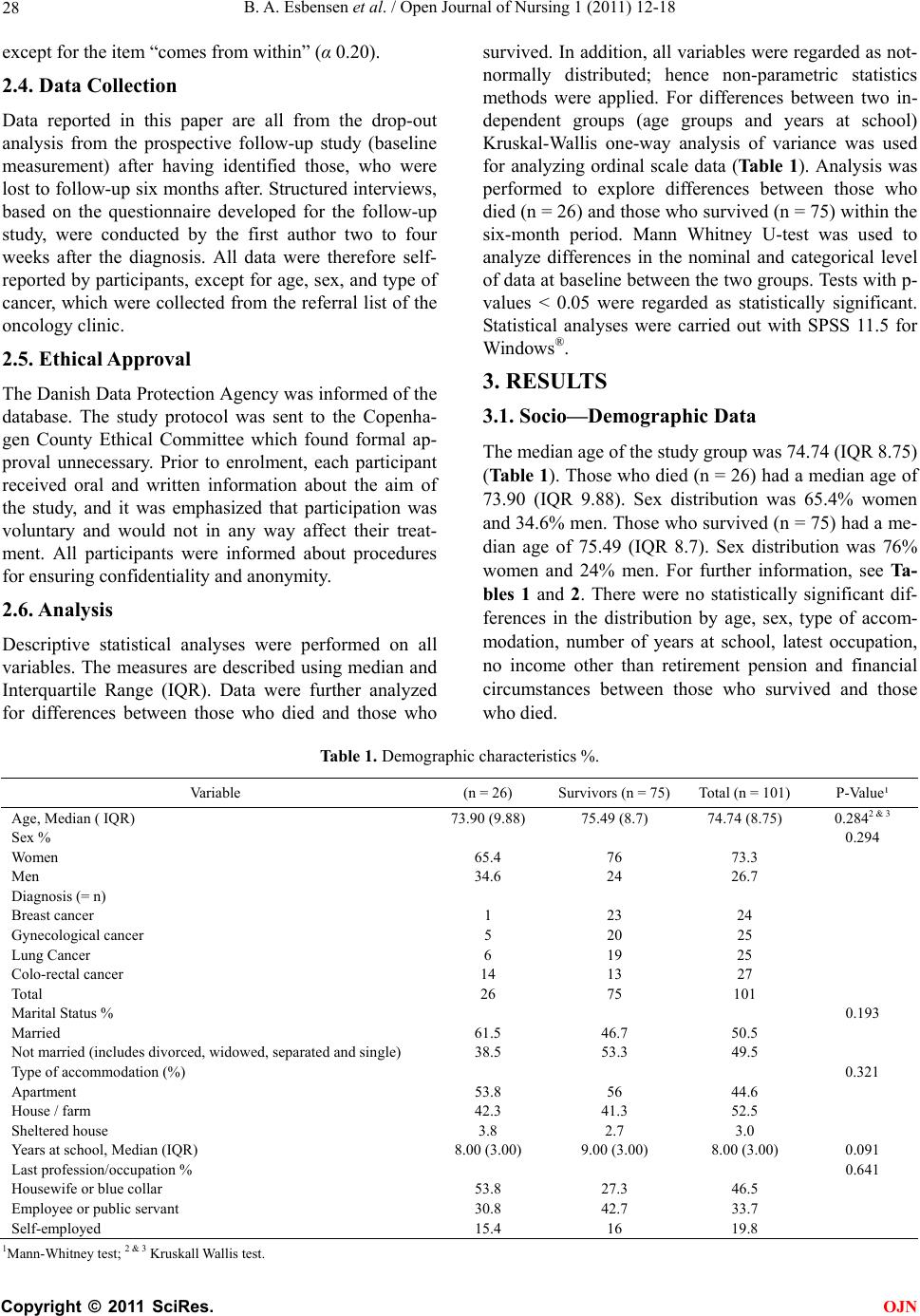 B. A. Esbensen et al. / Open Journal of Nursing 1 (2011) 12-18 Copyright © 2011 SciRes. 28 OJN except for the item “comes from within” (α 0.20 ). 2.4. Data Collection Data reported in this paper are all from the drop-out analysis from the prospective follow-up study (baseline measurement) after having identified those, who were lost to follow-up six months after. Structured interviews, based on the questionnaire developed for the follow-up study, were conducted by the first author two to four weeks after the diagnosis. All data were therefore self- reported by participants, except for age, sex, and type of cancer, which were collected from the referral list of the oncology clinic. 2.5. Ethical Approval The Danish Data Protection Agency was informed of the database. The study protocol was sent to the Copenha- gen County Ethical Committee which found formal ap- proval unnecessary. Prior to enrolment, each participant received oral and written information about the aim of the study, and it was emphasized that participation was voluntary and would not in any way affect their treat- ment. All participants were informed about procedures for ensuring conf identiality and anonymity. 2.6. Analysis Descriptive statistical analyses were performed on all variables. The measures are described using median and Interquartile Range (IQR). Data were further analyzed for differences between those who died and those who survived. In addition, all variables were regarded as not- normally distributed; hence non-parametric statistics methods were applied. For differences between two in- dependent groups (age groups and years at school) Kruskal-Wallis one-way analysis of variance was used for analyzing ordinal scale data (Ta ble 1). Analysis was performed to explore differences between those who died (n = 26) and tho se who surviv ed (n = 75) within the six-month period. Mann Whitney U-test was used to analyze differences in the nominal and categorical level of data at baseline between the two groups. Tests with p- values < 0.05 were regarded as statistically significant. Statistical analyses were carried out with SPSS 11.5 for Windows®. 3. RESULTS 3.1. Socio—Demographic Data The median age of the study group was 74.74 (IQR 8.75) (Table 1). Those who died (n = 26) had a median age of 73.90 (IQR 9.88). Sex distribution was 65.4% women and 34.6% men. Those who survived (n = 75) had a me- dian age of 75.49 (IQR 8.7). Sex distribution was 76% women and 24% men. For further information, see Ta- bles 1 and 2. There were no statistically significant dif- ferences in the distribution by age, sex, type of accom- modation, number of years at school, latest occupation, no income other than retirement pension and financial circumstances between those who survived and those who died. Table 1. Demographic characteristics %. Variable (n = 26) S urvivors (n = 75)To ta l (n = 101) P-Value¹ Age, Median ( IQR) 73.90 (9.88) 75.49 (8.7) 74.74 (8.75) 0.2842 & 3 Sex % 0.294 Women 65.4 76 73.3 Men 34.6 24 26.7 Diagnosis (= n) Breast cancer 1 23 24 Gynecological cancer 5 20 25 Lung Cancer 6 19 25 Colo-rectal cancer 14 13 27 Total 26 75 101 Marital Status % 0.193 Married 61.5 46.7 50.5 Not married (includes divorced, widowed, separated and single) 38.5 53.3 49.5 Type of accommodation (%) 0.321 Apartment 53.8 56 44.6 House / farm 42.3 41.3 52.5 Sheltered house 3.8 2.7 3.0 Years at school, Median (I QR) 8.00 (3.00) 9.00 (3.00) 8.00 (3.00) 0.091 Last profession/o ccupation % 0.641 Housewife or blue col l ar 53.8 27.3 46. 5 Employee or public servant 30.8 42.7 33.7 Self-employed 15.4 16 19.8 1Mann-Whitney test; 2 & 3 Kruskall Wallis test. 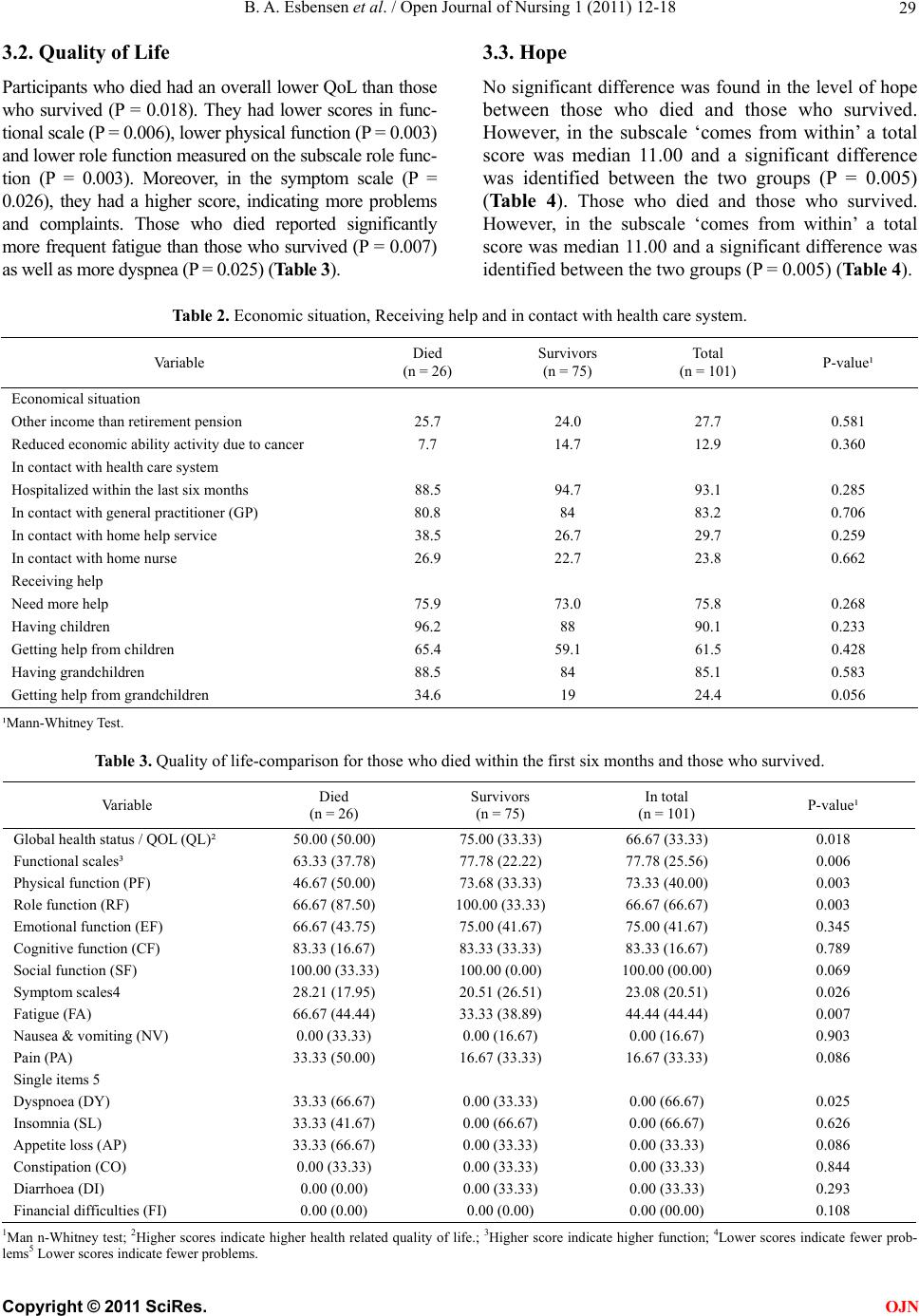 B. A. Esbensen et al. / Open Journal of Nursing 1 (2011) 12-18 29 3.2. Quality of Life Participants who d ied had an overall lower QoL than those who survived (P = 0.018). They had lower scores in func- tional scale (P = 0.006), lower physical function (P = 0.003) and lower role function measured on the subscale role func- tion (P = 0.003). Moreover, in the symptom scale (P = 0.026), they had a higher score, indicating more problems and complaints. Those who died reported significantly more frequent fatigue than those who survived (P = 0.007) as well as more dyspnea (P = 0.025) ( Table 3). 3.3. Hope No significant difference was found in the level of hope between those who died and those who survived. However, in the subscale ‘comes from within’ a total score was median 11.00 and a significant difference was identified between the two groups (P = 0.005) (Table 4). Those who died and those who survived. However, in the subscale ‘comes from within’ a total score was median 11.00 and a significant difference was identified between the two groups (P = 0.005) (Table 4). Table 2. Economic situation, Receiving help and in contact with health care system. Variable Died (n = 26) Survivors (n = 75) Total (n = 101) P-value¹ Economical situation Other income than retirement pension 25.7 24.0 27.7 0.581 Reduced economic ability activity due to cancer 7.7 14.7 12.9 0.360 In contact with health care system Hospitalized within the l ast six months 88.5 94.7 93.1 0.285 In contact with general practitioner (GP) 80.8 84 83.2 0.706 In contact with home help service 38.5 26.7 29.7 0.259 In contact with home nu rse 26.9 22.7 23.8 0.662 Receiving help Need more help 75.9 73.0 75.8 0.268 Having children 96.2 88 90.1 0.233 Getting help from children 65.4 59.1 61.5 0.428 Having grandchildren 88.5 84 85.1 0.583 Getting help from grandchildren 34.6 19 24.4 0.056 ¹Mann-Whitne y Test. Table 3. Quality of life-comparison for those who died within the first six months and those who survived. Variable Died (n = 26) Survivors (n = 75) In total (n = 101) P-value¹ Global health status / QOL (QL)² 50.00 (50.00) 75.00 (33.33) 66.67 (33.3 3) 0.018 Functional scales³ 63.33 (37.78) 77.78 (22.22) 77.78 (25.5 6) 0.006 Physical function (PF) 46.67 (50.00) 73.68 (33.33) 73.33 (40.00) 0.003 Role function (RF) 66.67 (87.50) 100.00 (33.33) 66.67 (66.67) 0.003 Emotional function (EF) 66.67 ( 43.75) 75.00 (41.67) 75.00 (41.67) 0.345 Cognitive function (CF) 83.33 (16.67) 83.33 (33.33) 83.33 (16.67) 0.789 Social function (SF) 100.00 (33.33) 100.00 (0.00) 100.00 (00.00) 0.069 Symptom scales4 28.21 (17.95) 20.51 (26.51) 23.08 (20.51) 0.026 Fatigue (FA) 66.67 (44.44) 33.33 (38.89) 44.44 (44.44) 0.007 Nausea & vomiting (NV) 0.00 (33.33) 0.00 (16.67) 0.00 (16.67) 0.903 Pain (PA) 33.33 (50.00) 16.67 (33.33) 16.67 (33.33) 0.086 Single items 5 Dyspnoea (DY) 33.33 (66.67) 0.00 (33.33) 0.00 (66.67) 0. 02 5 Insomnia (SL) 33.33 (41.67) 0.00 (66.67) 0.00 (66. 67) 0.626 Appetite loss (AP) 33.33 (66.67) 0.00 (33.33) 0.00 (33.33) 0.086 Constipation (CO) 0.00 (33.33) 0.0 0 (33.33) 0.00 (33.33) 0.844 Diarrhoea (DI) 0.00 (0.00) 0.00 (33.33) 0.00 (33.33) 0.293 Financial difficulties (FI) 0.00 (0.00) 0.00 (0.00) 0.00 (00.00) 0.108 1Man n-Whitney test; 2Higher scores indicate higher health related quality of life.; 3Higher score indicate higher function; 4Lower scores indicate fewer prob- lems5 Lower scores indicate fewer problems. C opyright © 2011 SciRes. OJN 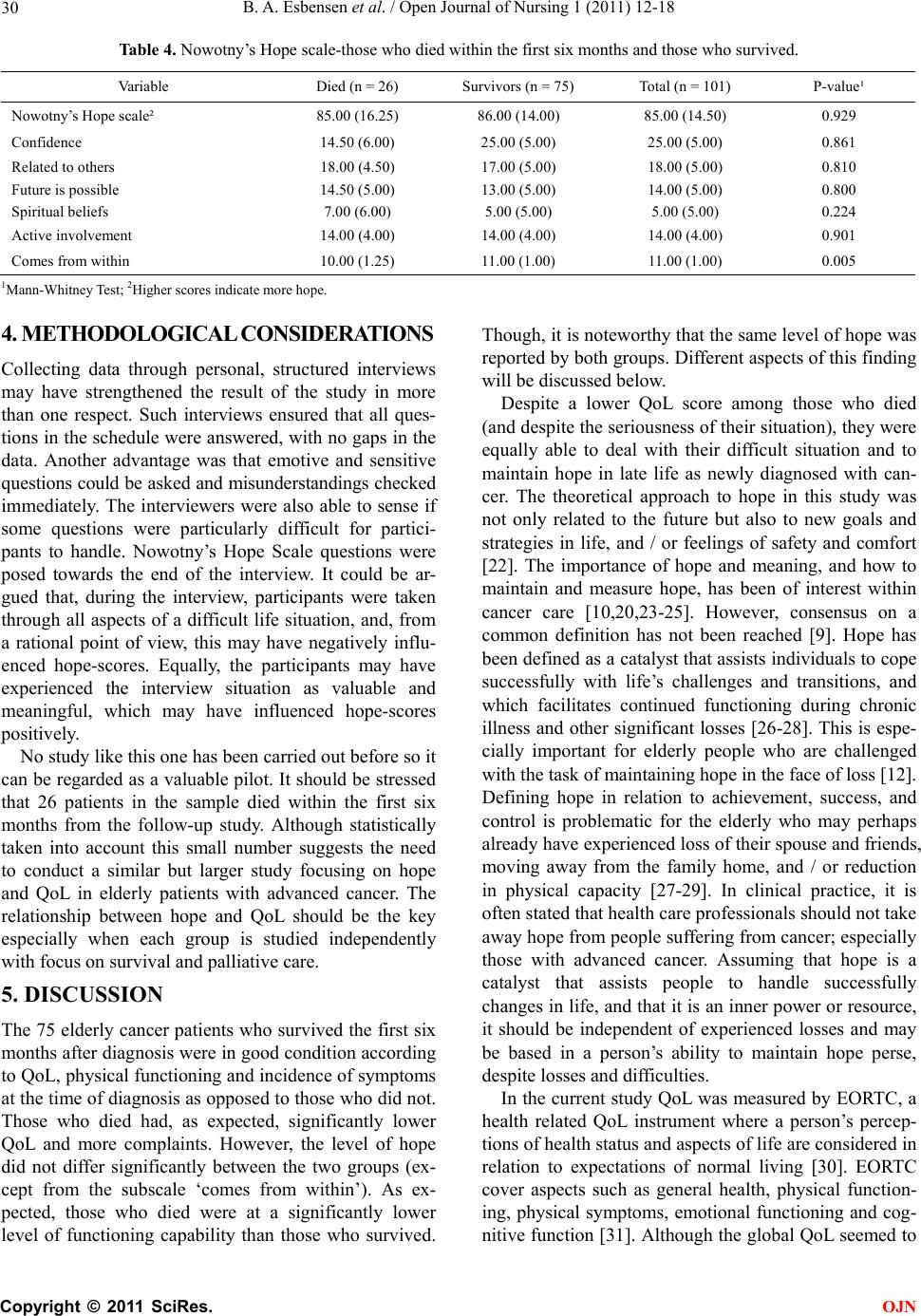 B. A. Esbensen et al. / Open Journal of Nursing 1 (2011) 12-18 30 Table 4. Nowotny’s Hope scale-those who died within the first six months and those who survived. Variable Died (n = 26) Survivors (n = 75) To t al (n = 101) P-value¹ Nowotny’s Hope scale² 85.00 (16.25) 86.00 (14.00) 85.00 (14.50) 0.929 Confidence 14.50 (6.00) 25.00 (5.00) 25.00 (5.00) 0.861 Related to others 1 8.00 (4.50) 17.00 (5.00) 18.00 (5.00) 0.810 Future is possible 14.50 (5.00) 13.00 (5.00) 14.00 (5.00) 0.800 Spiritual beliefs 7.00 (6.00) 5.00 (5.00) 5.00 (5.00) 0.224 Active involvement 14.00 (4.00) 14.00 (4.00) 14.00 (4.00) 0.901 Comes from within 10.00 (1.25) 11.00 (1.00) 11.00 (1.00) 0.005 1Mann-Whitne y Test; 2Higher scores indicate more hope. 4. METHODOLOGICAL CONSIDERATIONS Collecting data through personal, structured interviews may have strengthened the result of the study in more than one respect. Such interviews ensured that all ques- tions in the schedu le were answered, with no gaps in the data. Another advantage was that emotive and sensitive questions could be asked and misunderstandings checked immediately. The interviewers were also able to sense if some questions were particularly difficult for partici- pants to handle. Nowotny’s Hope Scale questions were posed towards the end of the interview. It could be ar- gued that, during the interview, participants were taken through all aspects of a difficult life situation, and, from a rational point of view, this may have negatively influ- enced hope-scores. Equally, the participants may have experienced the interview situation as valuable and meaningful, which may have influenced hope-scores positively. No study like this one has been carried out before so it can be regarded as a valuable pilot. It should be stressed that 26 patients in the sample died within the first six months from the follow-up study. Although statistically taken into account this small number suggests the need to conduct a similar but larger study focusing on hope and QoL in elderly patients with advanced cancer. The relationship between hope and QoL should be the key especially when each group is studied independently with focus on survival and palliative care. 5. DISCUSSION The 75 elderly cancer patients who survived the first six months after diagnosis were in good condition according to QoL, physical functioning and incidence of symptoms at the time of diagnosis as opposed to those who did not. Those who died had, as expected, significantly lower QoL and more complaints. However, the level of hope did not differ significantly between the two groups (ex- cept from the subscale ‘comes from within’). As ex- pected, those who died were at a significantly lower level of functioning capability than those who survived. Though, it is noteworthy that th e same level of hope was reported by bo th gro ups. D ifferent aspects of this f inding will be discussed below. Despite a lower QoL score among those who died (and despite the seriousness of their situation ), they were equally able to deal with their difficult situation and to maintain hope in late life as newly diagnosed with can- cer. The theoretical approach to hope in this study was not only related to the future but also to new goals and strategies in life, and / or feelings of safety and comfort [22]. The importance of hope and meaning, and how to maintain and measure hope, has been of interest within cancer care [10,20,23-25]. However, consensus on a common definition has not been reached [9]. Hope has been defined as a catalyst that assists individuals to cope successfully with life’s challenges and transitions, and which facilitates continued functioning during chronic illness and other significant losses [26-28]. This is espe- cially important for elderly people who are challenged with the task of maintaining hope in the face of loss [12]. Defining hope in relation to achievement, success, and control is problematic for the elderly who may perhaps already have experienced loss of their spouse and friends, moving away from the family home, and / or reduction in physical capacity [27-29]. In clinical practice, it is often stated that health care professionals should not take away hope from people suffering from cancer; especially those with advanced cancer. Assuming that hope is a catalyst that assists people to handle successfully changes in life, and th at it is an inner power or resource, it should be independent of experienced losses and may be based in a person’s ability to maintain hope perse, despite losses and difficulties. In the current study QoL was measured by EORTC, a health related QoL instrument where a person’s percep- tions of health status and aspects of life are considered in relation to expectations of normal living [30]. EORTC cover aspects such as general health, physical function- ing, physical symptoms, emotional functioning and cog- nitive function [31 ]. Although the global QoL seemed to C opyright © 2011 SciRes. OJN 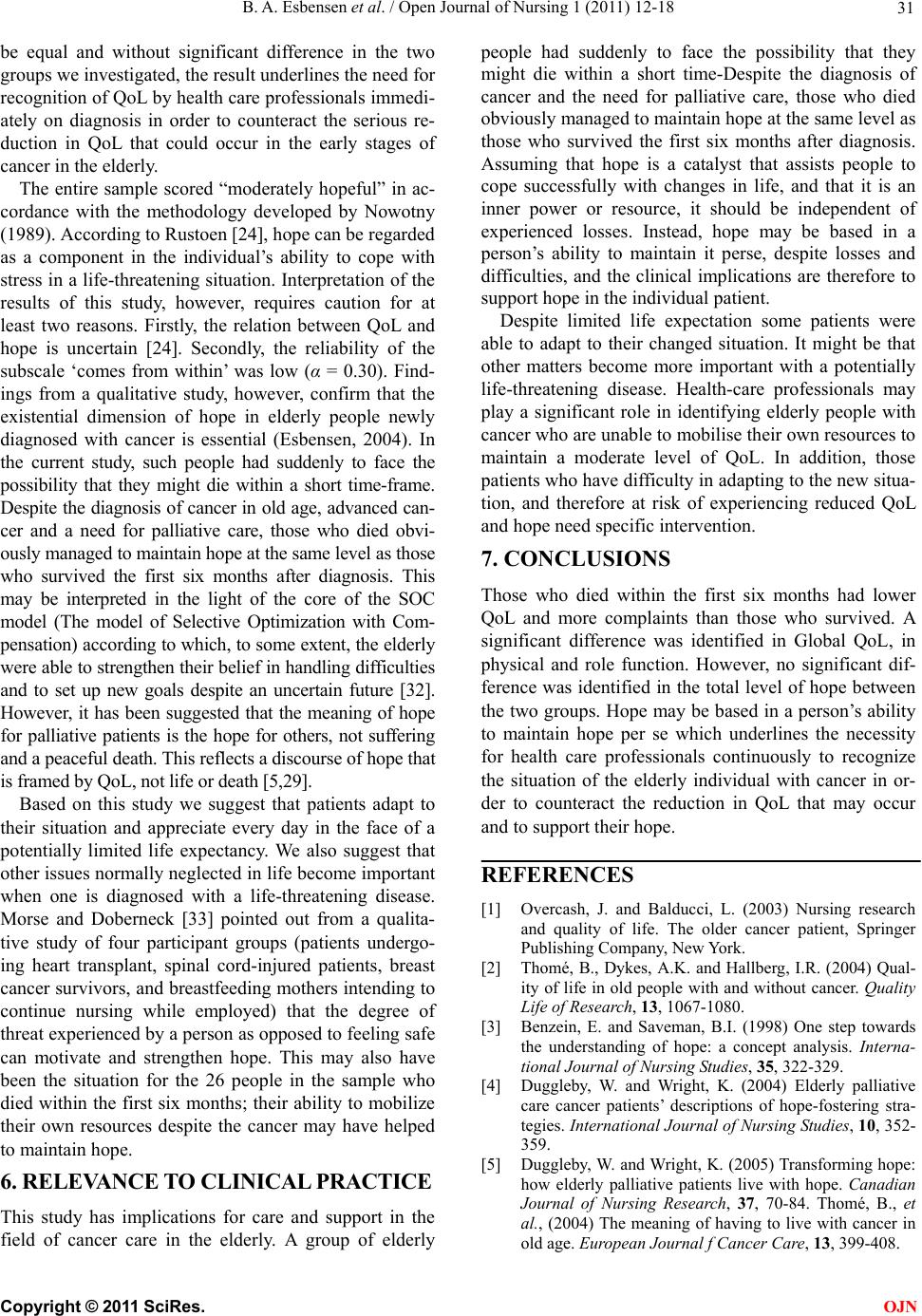 B. A. Esbensen et al. / Open Journal of Nursing 1 (2011) 12-18 31 be equal and without significant difference in the two groups we investigated, the result und erlines the need for recognition of QoL by health care professionals immedi- ately on diagnosis in order to counteract the serious re- duction in QoL that could occur in the early stages of cancer in the elderly. The entire sample scored “moderately hopeful” in ac- cordance with the methodology developed by Nowotny (1989). Accor ding to Rustoen [2 4] , ho pe ca n be re garded as a component in the individual’s ability to cope with stress in a life-threatening situation. In terpretation of the results of this study, however, requires caution for at least two reasons. Firstly, the relation between QoL and hope is uncertain [24]. Secondly, the reliability of the subscale ‘comes from within’ was low (α = 0.30). Find- ings from a qualitative study, however, confirm that the existential dimension of hope in elderly people newly diagnosed with cancer is essential (Esbensen, 2004). In the current study, such people had suddenly to face the possibility that they might die within a short time-frame. Despite the diagnosis of cancer in old age, advanced can- cer and a need for palliative care, those who died obvi- ously managed to maintain hope at the same level as those who survived the first six months after diagnosis. This may be interpreted in the light of the core of the SOC model (The model of Selective Optimization with Com- pensation) according to which, to some extent, the elderly were able to strengthen their belief in handling difficulties and to set up new goals despite an uncertain future [32]. However, it has been suggested that the meaning of hope for palliative patients is the hope for others, not suffering and a peaceful death. This reflects a discourse of hope that is framed by QoL, not li fe or death [5,29] . Based on this study we suggest that patients adapt to their situation and appreciate every day in the face of a potentially limited life expectancy. We also suggest that other issues normally neglected in life become important when one is diagnosed with a life-threatening disease. Morse and Doberneck [33] pointed out from a qualita- tive study of four participant groups (patients undergo- ing heart transplant, spinal cord-injured patients, breast cancer survivors, and breastfeeding mothers intending to continue nursing while employed) that the degree of threat experienced by a person as opposed to feeling safe can motivate and strengthen hope. This may also have been the situation for the 26 people in the sample who died within the first six months; their ability to mobilize their own resources despite the cancer may have helped to maintain hope. 6. RELEVANCE T O CLINICAL PRACTICE This study has implications for care and support in the field of cancer care in the elderly. A group of elderly people had suddenly to face the possibility that they might die within a short time-Despite the diagnosis of cancer and the need for palliative care, those who died obviously managed to maintain hope at the same level as those who survived the first six months after diagnosis. Assuming that hope is a catalyst that assists people to cope successfully with changes in life, and that it is an inner power or resource, it should be independent of experienced losses. Instead, hope may be based in a person’s ability to maintain it perse, despite losses and difficulties, and the clinical implications are therefore to support hope in the individual patient. Despite limited life expectation some patients were able to adapt to their changed situation. It might be that other matters become more important with a potentially life-threatening disease. Health-care professionals may play a significant role in identifying elderly people with cancer who are unable to mobilise their own resources to maintain a moderate level of QoL. In addition, those patients who have difficulty in adapting to the new situa- tion, and therefore at risk of experiencing reduced QoL and hope need specific intervention. 7. CONCLUSIONS Those who died within the first six months had lower QoL and more complaints than those who survived. A significant difference was identified in Global QoL, in physical and role function. However, no significant dif- ference was identified in the total level of hope between the two groups. Hope may be based in a person’s ability to maintain hope per se which underlines the necessity for health care professionals continuously to recognize the situation of the elderly individual with cancer in or- der to counteract the reduction in QoL that may occur and to support their hope. REFERENCES [1] Overcash, J. and Balducci, L. (2003) Nursing research and quality of life. The older cancer patient, Springer Publishing Company, New York. [2] Thomé, B., Dykes, A.K. and Hallberg, I.R. (2004) Qual- ity of life in old people with and without cancer. Quality Life of Research, 13, 1067-1080. [3] Benzein, E. and Saveman, B.I. (1998) One step towards the understanding of hope: a concept analysis. Interna- tional Journal of Nursing Studies, 35, 322-329. [4] Duggleby, W. and Wright, K. (2004) Elderly palliative care cancer patients’ descriptions of hope-fostering stra- tegies. International Journal of Nursing Studies, 10, 352- 359. [5] Duggleby, W. and Wright, K. (2005) Transforming hope: how elderly palliative patients live with hope. Canadian Journal of Nursing Research, 37, 70-84. Thomé, B., et al., (2004) The meaning of having to live with cancer in old age. European Journal f Cancer Care, 13, 399-408. C opyright © 2011 SciRes. OJN  B. A. Esbensen et al. / Open Journal of Nursing 1 (2011) 12-18 Copyright © 2011 SciRes. 32 OJN [6] Nowotny, M.L. (1991) Every tomorrow, a vision of hope. Journal of Psychosocial Oncology, 9, 117-126. [7] Esbensen, B.A., Osterlind K. and Hallberg, I.R. (2007) Quality of life of e lderly persons with cancer: A 6-month follow-up. Scandinavian Journal of Caring Sciences, 21, 178-190. [8] Rustoen, T., Cooper, B.A. and Miaskowski, C. (2010) The importance of hope as a mediator of psychological distress and life satisfaction in a community sample of cancer patients. Cancer Nursing, 33, 258-267. [9] Rustoen, T. and Hanestad, B.R. (1998) Nursing interven- tion to increase hope in cancer patients. Journal of Clini- cal Nursing, 7, 19-27. [10] Herth, K.A. and Cutcliffe, J.R. (2002) The concept of hope in nursing 6: research/education/policy/practice. British Journal of Nursing, 11, 1404-1411. [11] Herth, K.A. and J.R. Cutcliffe, (2002) The concept of hope in nursing 4: Hope and gerontological nursing. Brit- ish Journal of Nursing, 11 , 1148-1156. [12] Penson, J., (2000) A hope is not a promise: fostering hope within palliative care. International Journal of Pal- liative Nursing, 6, 94-98. [13] Hallberg, I.R., (2006) Palliative care as a framework for older people’s long-term care. International Journal of Palliative Nursing, 12, 224-229. [14] Esbensen, B.A., et al. (2004) Quality of life of elderly persons with newly diagnosed cancer. European Journal of Cancer Care, 13, 443-453. [15] Anderson, R.T., Aaronson, N.K. and Wilkin, D. (1993) Critical review of the international assessments of health-related quality of life. Quality Life Research, 2, 369-395. [16] Carlsson, M. and Hamrin, E. (1996) Measurement of quality of life in women with breast cancer. Development of a Life Satisfaction Questionnaire (LSQ-32) and a comparison with the EORTC QLQ-C30. Quality Life Research, 5, 265-274. [17] Aaronson, N.K., et al. (1993) The European Organization for research and treatment of cancer QLQ-C30: A qual- ity-of-life instrument for use in international clinical trials in oncology. Journal of National Cancer Institute, 85, 365-376. [18] Fayers, P. and Bottomley, A. (2002) Quality of life re- search within the EORTC-the EORTC QLQ-C30. Euro- pean Organisation for Research and Treatment of Cancer. European Journal of Cancer Care, 38, S125-S133. [19] Nowotny, M.L. (1989) Assessment of hope in patients with cancer: Development of an instrument. Oncology Nursing Forum, 16, 57-61. [20] Streiner, D.L. and Norman, G.R. (1989) Health meas- urement scales. A practical guide to their development and use. 2nd Edition, Oxford University Press, Oxford. [21] Nowotny, M.L. (1986) Measurement of hope as exhibited by a general adult population after a stressful event. Col- lege of Nursing, Texas: Texa s Woman’s University, De nton, 1-144. [22] Hinds, P.S. (1984) Inducing a definition of ‘hope’ through the use of grounded theory methodology. Jour- nal of Advanced Nursing, 9, 357-362. [23] Rustoen, T., (1995) Hope and quality of life, two central issues for cancer patients: A theoretical analysis. Cancer Nursing, 18, 355-361. [24] Rustoen, T. and Wiklund, I. (2000) Hope in newly diag- nosed patients with cancer . Cancer Nursing, 23, 214-219. [25] Raleigh, E.D., (1992) Sources of hope in chronic illness. Oncology Nursing Forum, 19, 443-448. [26] Farran, C.J., Herth, K.A. and Popovich, J.M. (1995) Hope and hopelessness: Critical clinical constructs, Thousand Oaks, Sage, Califomia. [27] Forbes, M.A. (1999) Hope in the older adult with chronic illness: A comparison of two research methods in theory building. ANS Advanced Nursing Science, 22, 74-87. [28] Herth, K. (1990) Fostering hope in terminally-ill people. Journal of Advanced Nursing, 15, 1250-1259. [29] Harrison, M.B., Juniper, E.F. and Mitchell-DiCenso, A. (1996) Quality of life as an outcome measure in nursing research: May you have a long and healthy life. Cana- dian Journal of Nursing Research, 28, 49-68. [30] Fayers, P.M. and Machin, D. (2000) Quality of life: As- sessment, analysis and interpretation. John Wiley & Sons Ltd., Chichester. [31] Baltes, P.B. and Baltes, M.M. (1993 ) Psychol ogical pe r spec- tives on successful aging: The model of selective optimiza- tion with compensation, in Successful aging. Perspectives from t he behaviora l science s, Baltes, P.B. a nd Baltes, M.M. Editors, Cambridge Un ivers ity Press, Cambridge, 1- 34. [32] Morse, J.M. and Doberneck, B. (1995) Delineating the concept of hope. Image Journal of Nursing Scholarship, 27, 277-285. |