

Paper Menu >>
Journal Menu >>
 Open Jo urnal of Obstetr ics and Gynecology, 2011, 1, 144-148 OJOG doi:10.4236 /ojog.2011.13027 Published Online September 2011 (http://www.SciRP.org/jo urnal/ojog/). Published Online September 2011 in SciRes. http://www.scirp.org/journal/OJOG Awareness and perception of assisted reproductive technology practice amongst wome n with infertility in Northern Nigeria Adebiyi Gbadebo Adesiyun*, Nkeiruka Ameh , Solomon Avidime, Abdulsalam Muazu Department of Obstetrics Gyna ecology, Ahmadu Bello University Teaching Hospital, Zaria, Nigeria. E-mai l : * HHUU[email protected]UUHH Received 20 April 2011; revised 26 April 2011; acce pt e d 5 A ug us t 2011. ABSTRACT Background: Involuntary infertility is a tragedy in most African setting. This is due to premium placed on fertility as a result of roles children fulfill in the family and the socie ty. Aetiologic factors of infertility in sub-Saharan Africa are mostly infection related and they are mainly associated with poor treatment outcome to conventional non assisted conception technique. Objective: To evaluate the level of aware- ness and perception of assisted conception treatment among women attending fertility clinic. Methods: A descriptive cross-sectio nal study. Results: One hun- dred and ninety six women attending fertility clinic were interviewed. Mean age was 34.8 years a nd mean duration of infertility of 4.1 years. Of the 196 infertile women interviewed, 150 (76.5%) have heard of As- sisted Reproductive Technology treatment. Sources of information were mainly family relation (46%) and friends (28.7%). Knowledge on some of Assisted Reproductive Technology practices showed that 50.7% were aware that the treatment could fail, 36.8% knew it could be applied for male infertility treatment, 9.3% and 18.7% respectively are aware that do nor oocyte and sperm coul d be used for tre at- ment. Perception on babies conceived from assist ed conception treatment revealed that 52% of patients interviewed could not comment if they are normal and natural babies. Majority of patients could not affirm if they will agree to the use of donor ga mete or zygote for their treatment. Conclusio n: Aw areness of assisted conception treatment was high, however knowle dge on spec ifics of trea tment w as low a nd per- ception on some of the practices was unfavorable. Sensitization of the public will help overcome some beliefs that may be at tangent to some practices of assisted co nc e ption. Keywords: Awareness; Perception; Infertility; Assisted Reproductive Technology 1. INTRODUCTION In sub-Saharan Africa, about one-third of couples are reported to be infertile [1] . Female infertility was re- ported to a ccount for about 5 5% of infertilit y cases, male factor for about 30% to 40% of cases and unexplained infertility accounted for the remaining 5 to 15 percent [2, 3,4]. In most African setting, parenthood is culturally mandatory and childlessness is socially unacceptable; this is beca use c hil d re n ar e hi ghly des i re d ad d iti o n to the family and the society [5]. The repercussions of inferti- lit y go b e yo nd ‘ no t j ust ha vi n g a chil d of yo ur o wn ’. I t is associated with incomprehensible and immeasurable psychological and social consequences which impact more on the female. In Africa, infectio n is the most com- mon cause of infertility [2,6]. Sexually transmitted in- fections mainly from gonorrhoea and Chlamydia, and pregnancy related infections d uring or after abortion and childbirth are the main culprit. In Africa, infections re- sulting in tubo-peritoneal factor and oligo-azoospermia are the two leading causes of infertility [2,3,4 ] . The place of tubal surgery versus IVF (in vitro fertilization) in the treatment of tubal infertility showed that patients are optimally treated with IV F [7]. A st udy fr om Nigeria, reported an estimate of 30 to 40 percent of patients with tubal factor infertility would need ART (assisted repro- ductive tech no logy) treatment [ 8 ]. Assisted Reproductive technology has been reported to relieve more than 50 percent of infertility cases [9]. However, to set up this technology in the developing world is capital intensive and to access the treatment is reciprocally expensive. These pose barrier s to the spread of ART treatment in the developing world where this technology is mostly needed. On the contrary, in the de- veloped countries, ART treatment has made substantial contribution to the alleviation of infertility burden. In Latin America and Egypt, the proportion of the popula- tion that have access to ART treatment is less than 2 percent, while rates as high as 37 p ercent have access to ART treat ment in Denmark [9]. Deter mining the level o f 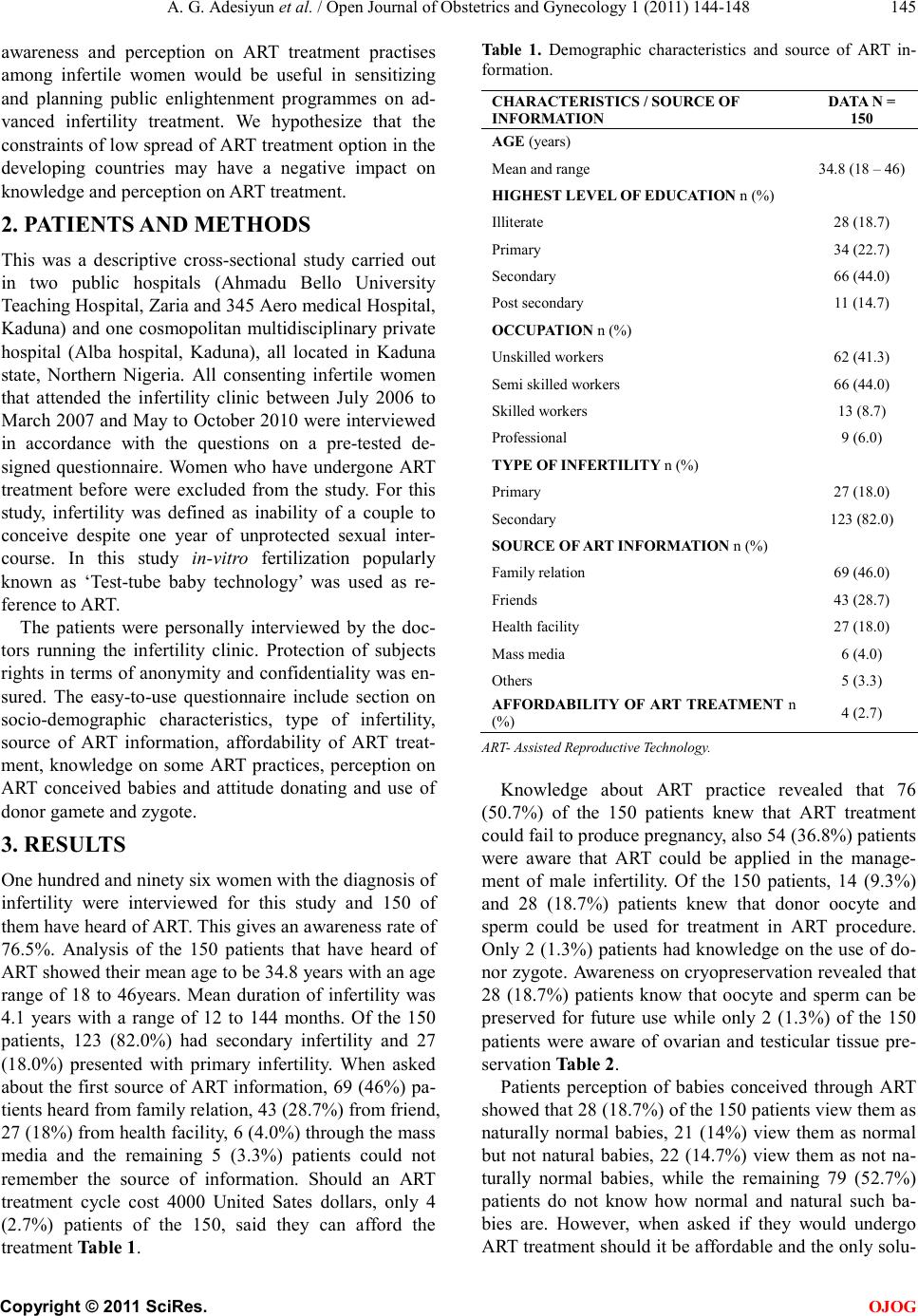 A. G. Ad e s i yu n et al. / Open Journal of Obstetrics and Gynecology 1 (20 11) 144-148 Copyright © 2011 Sc iRes. OJ OG 145 awareness and perception on ART treatment practises among infertile women would be useful in sensitizing and planning public enlightenment programmes on ad- vanced infertility treatment. We hypothesize that the constraints of lo w sp read of ART treatment option in the developing countries may have a negative impact on knowledge and perception on ART treatment. 2. PATIENTS AND METHODS This was a descriptive cross-sectional study carried out in two public hospitals (Ahmadu Bello University Teaching Hospital, Zaria and 34 5 Aero medical Hospital, Kaduna) and one cosmopolitan multidisciplinary private hospital (Alba hospital, Kaduna), all located in Kaduna state, Northern Nigeria. All consenting infertile women that attended the infertility clinic between July 2006 to March 2007 and May to October 2010 were interviewed in accordance with the questions on a pre-tested de- signed questionnaire. Women who have undergone ART treatment before were excluded from the study. For this study, infertility was defined as inability of a couple to conceive despite one year of unprotected sexual inter- course. In this study in-vitro fertilization popularly known as ‘Test-tube baby technology’ was used as re- ference to ART. The patients were personally interviewed by the doc- tors running the infertility clinic. Protection of subjects right s in ter ms of ano nymity a nd confi dentiali ty was e n- sured. The easy-to-use questionnaire include section on socio-demographic characteristics, type of infertility, source of ART information, affordability of ART treat- ment, knowledge on some ART practices, perception on ART conceived babies and attitude donating and use of donor ga mete and zygote. 3. RESULTS One hundred and ninety six wome n with the diagnosis of infertility were interviewed for this study and 150 of them have heard o f ART. This gives an awareness rate of 76.5%. Analysis of the 150 patients that have heard of ART showed t hei r mean age to be 34.8 year s with an age range of 18 to 46years. Mean duration of infertility was 4.1 years with a range of 12 to 144 months. Of the 150 patients, 123 (82.0%) had secondary infertility and 27 (18.0%) presented with primary infertility. When asked about the first source of ART infor mation, 69 (46%) pa- tient s heard fro m fa mily relation, 43 (28.7%) from friend, 27 (18%) from health facility, 6 (4.0 %) thr o ug h t he ma s s media and the remaining 5 (3.3%) patients could not remember the source of information. Should an ART treatment cycle cost 4000 United Sates dollars, only 4 (2.7%) patients of the 150, said they can afford the treatment Table 1. Table 1. Demographic characteristics and source of ART in- formation. CHARACTERIS TICS / SOURCE OF INFOR MATION DATA N = 150 AGE (years) Mean and r ange 34.8 (18 – 46) HIGHEST LEVEL O F EDUCATION n (%) Illiterate 28 (18.7) Primary 34 (22.7) Secon dary 66 (44.0) Post sec ondary 11 (14.7) OCCUPATION n (%) Unskilled workers 62 (41.3) Semi skilled workers 66 (44.0 ) Skilled workers 13 (8.7) Professional 9 (6.0) TYPE OF INFERTILITY n (%) Primary 27 (18.0) Secon dary 123 (82.0) SOURCE OF ART INFORMATION n (%) Family relation 69 (46.0) Friends 43 (28.7) Health facility 27 (18.0) Mass media 6 (4.0) Others 5 (3.3) AFFORDABILITY OF ART TREATMENT n (%) 4 (2.7) ART- Assisted Repr oductive Technology. Knowledge about ART practice revealed that 76 (50.7%) of the 150 patients knew that ART treatment could fail to produce pregnancy, also 54 (36.8%) patients were aware that ART could be applied in the manage- ment of male infertility. Of the 150 patients, 14 (9.3%) and 28 (18.7%) patients knew that donor oocyte and sperm could be used for treatment in ART procedure. Only 2 (1.3%) patients had kno wledge on the use of do- nor zygote. Awareness on cryop reservatio n revealed that 28 (18.7%) patients know that oocyte and sperm can be preserved for future use while only 2 (1.3%) of the 150 patients were aware of ovarian and testicular tissue pre- servation Table 2. Patients perception of babies conceived through ART sho wed tha t 28 (18.7%) of the 150 patients vie w them a s naturally normal babies, 21 (14%) view them as normal but not natural babies, 22 (14.7%) view them as not na- turally normal babies, while the remaining 79 (52.7%) patients do not know how normal and natural such ba- bies are. However, when asked if they would undergo ART treatme nt should it be affordable and the only solu- 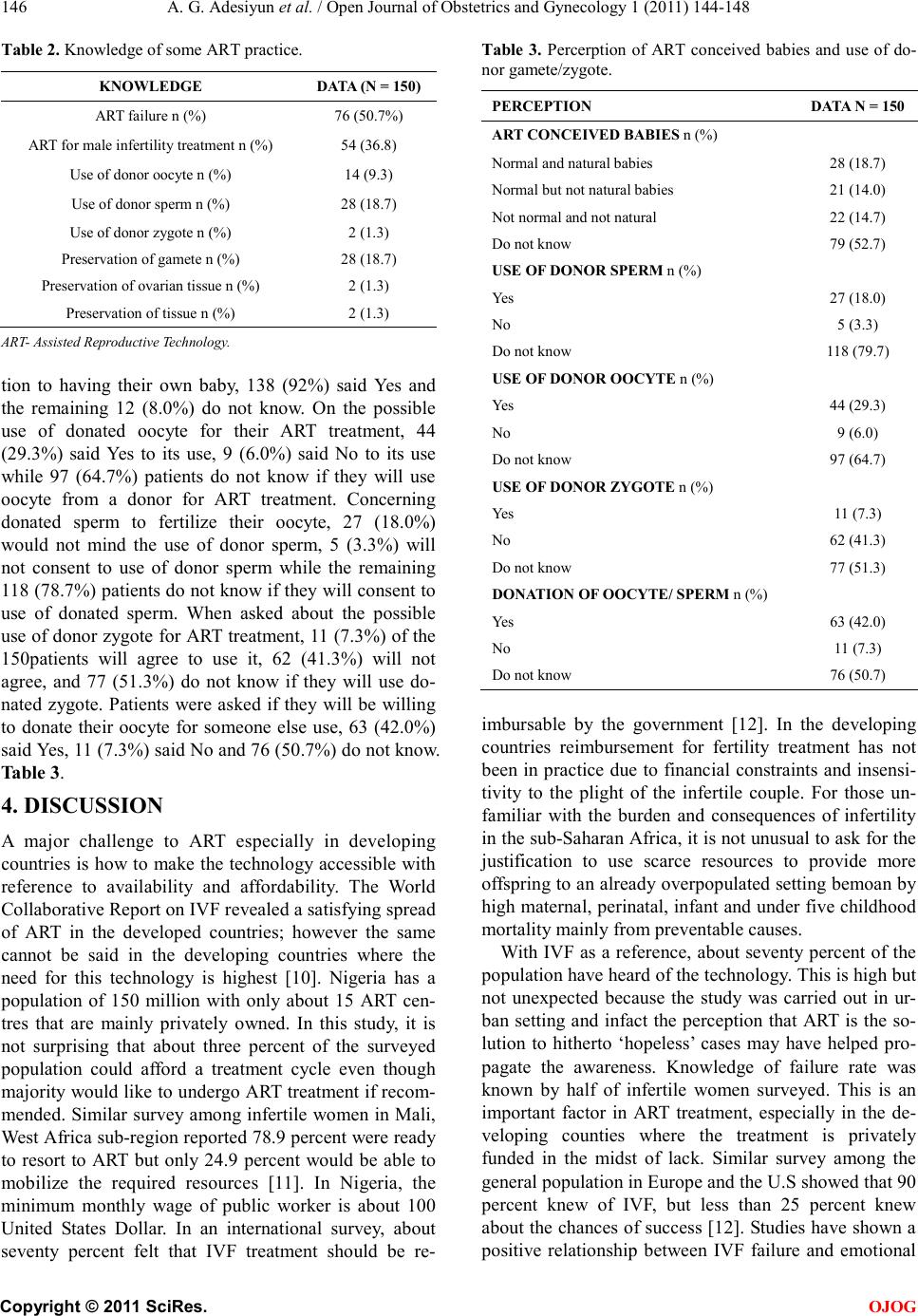 A. G. Ad e s i yu n et al. / Open Journal of Obstetrics and Gynecology 1 (2 011) 144-148 Copyright © 2011 Sc iRes. OJ OG 146 Table 2. Knowledge of some ART practice. KNOWLEDGE DATA (N = 150) ART failure n (%) 76 (50.7%) ART for male infertility treatment n (%) 54 (36.8) Use of donor oocyte n (%) 14 (9.3) Use of donor s perm n (%) 28 (18.7) Use of donor zygote n (%) 2 (1.3) Preservation of ga m ete n (%) 28 (18.7) Preservation of ova rian tissue n (%) 2 (1.3) Preservation of ti s sue n (%) 2 (1.3) ART- Assisted Repr oductive Technology. tion to having their own baby, 138 (92%) said Yes and the remaining 12 (8.0%) do not know. On the possible use of donated oocyte for their ART treatment, 44 (29.3%) said Yes to its use, 9 (6.0%) said No to its use while 97 (64.7%) patients do not know if they will use oocyte from a donor for ART treatment. Concerning donated sperm to fertilize their oocyte, 27 (18.0%) would not mind the use of donor sperm, 5 (3.3%) will not co nsent to use of donor sperm while the remaining 118 (78.7%) patients do not know if t hey will conse nt to use of donated sperm. When asked about the possible use o f donor zygote for ART treat ment, 11 (7.3%) of the 150patients will agree to use it, 62 (41.3%) will not agree, and 77 (51.3%) do not know if they will use do- nated zygote. Patients were asked if they will be willing to donate their oocyte for someone else use, 63 (42.0%) said Yes, 11 (7.3%) said No and 76 (50.7%) do not know. Ta ble 3. 4. DISCUSSION A major challenge to ART especially in developing countries is how to make the technology accessible with reference to availability and affordability. The World Collaborative Report on IVF revealed a satisfying spread of ART in the developed countries; however the same cannot be said in the developing countries where the need for this technology is highest [10]. Nigeria has a population of 150 million with only about 15 ART cen- tres that are mainly privately owned. In this study, it is not surprising that about three percent of the surveyed population could afford a treatment cycle even though majority wo uld like to undergo ART treatment if recom- mended. Similar survey among infertile women in Mali, West Africa sub-region reported 78.9 percent were ready to resort to ART but only 24.9 percent would be able to mobilize the required resources [11 ]. In Nigeria, the minimum monthly wage of public worker is about 100 United States Dollar. In an international survey, about seventy percent felt that IVF treatment should be re- Table 3. Percerption of ART conceived babies and use of do- no r gamete/zygote. PERCEPTION DATA N = 150 ART CO NCEIVED BABIES n (%) Normal and natural babies 28 (18.7) Nor m a l but no t na t ural babies 21 (14.0) Not nor m al a n d not natural 22 (14.7 ) Do not know 79 (52.7) USE OF DONOR SPERM n (%) Yes 27 (18.0) No 5 (3.3) Do not know 118 (79.7) USE OF DONOR OOCYTE n (%) Yes 44 (29.3) No 9 (6.0) Do not know 97 (64.7) USE OF DONOR ZYGOTE n (%) Yes 11 (7.3) No 62 (41.3) Do not know 77 (51.3) DONATION OF OOCYTE/ SPERM n (%) Yes 63 (42.0) No 11 (7.3) Do not know 76 (50.7) imbursable by the government [12]. In the developing countries reimbursement for fertility treatment has not been in practice due to financial constraints and insensi- tivity to the plight of the infertile couple. For those un- familiar with the burden and consequences of infertility in the sub -Saha ra n Afric a, i t i s not unus ual t o as k fo r the justification to use scarce resources to provide more offspring to a n already overpopulated setting bemoan by high materna l, p erinata l, infa nt a nd unde r five child hood mortality mainly from preventable causes. With IVF as a reference, about seventy percent of the pop ul ati o n have hea rd o f the t ec hno lo g y. T his i s hig h b ut not unexpected because the study was carried out in ur- ban setting a nd infact the perception that ART is the so- lution to hitherto ‘hopeless’ cases may have helped pro- pagate the awareness. Knowledge of failure rate was known by half of infertile women surveyed. This is an important factor in ART treatment, especially in the de- veloping counties where the treatment is privately funded in the midst of lack. Similar survey among the gener al population in E urope and the U .S showed t hat 90 percent knew of IVF, but less than 25 percent knew about the chances of s ucces s [12]. Studi es have sho wn a positive relationship between IVF failure and emotional  A. G. Ad e s i yu n et al. / Open Journal of Obstetrics and Gynecology 1 (20 11) 144-148 Copyright © 2011 Sc iRes. OJ OG 147 trauma [13] and increased level of anxiety and depres- sion that negatively impacts on their life [14,15]. Treat- ment of male infertility in this sub-region is of para- mount importance because the often domineering male par tners do confuse sexual potenc y with fe rtility c apabi - lity there by transferrin g the bla me to the woman in most situations. This study showed that 36 percent of the women knew that ART could be applied for treatment of male infertility. This figure is low considering that male infertility due to oligospermia is the second common cause of infertility in Africa after tubo-peritoneal factor [2,3,4]. Knowledge on the use of donor gamete and zy- gote and their preservation was low in this study. This may not be unrelated to the rarity of ART treatment in this part of the world and the depth and correctness of the patient’s source of ART information which was mainly from family relation and friends in this study. In contrast to an Iranian study that reported ART centre as the source of information among their infertile women, thereby exposing them to acc urate and detailed informa- tion [16]. Respo nse from this study showed that perception on ART babies and use of donate d gametes and z ygotes for their ART treatment was mainly. I do not know by pa- tients. This response may be interpreted as uncertainty and ignora nce sur rounding ART tre atment or some of the ART practices may be in collision with their cultural a nd religious belie fs. Similarly, authors fro m Turkey reported low acceptance rates of donated gametes by infertile women if needed for their treatment [17]. On the con- trary, st udies from Greece revealed that about 50 percent of the surveyed participant would be prepared to use donated gametes, though men are more likely than women to use donated gametes [18]. Although that s tud y pointed out that confidence in emotional relationship is negat ivel y a ssoc iated with intention to use donor gamete [18]. In consonance with this, authors from a develop- ing country found out that most respondents would ac- cept do no r gamete for their treat me nt only if it was kept private for others to consider their offspring as biologica l [19]. On the issue of donating gamete for other persons treatment, ab out 42 pe rcent si gnified inte ntion to do nate, which is similar to rate from a developed country, al- though donor anonymity and refusal of children’s right were enhancing factors in that study [20]. On the con- trary, a Meta analysis revealed that a significant propor- tion of oocyte donors and women from the general pop- ulation were prepared to donate their oocyte as iden- tifiable donor s [21]. Societal institu tion may be slow to cope with the ideas and practice of ART especially i n Afr ica where the tech- nology is still relatively ne w. Contentious issues like re- production without sex, sanctity of family genetic line- age, involvement of third party and c ommercialization of gametes and embryos are some of the attitudinal chal- lenges to contend with in primitive societal settings of Africa. International machinery to facilitate globalization of ART services with special attention to man power trai ni ng, sub si di za t io n o f d r ug s s up ply and establishment of linkages towards global partne rship as ob tained in the Millennium Development Goals are enhancing steps to be taken for the benefit of the less privileged countries. REFERENCES [1] Reproductive Health Outlook. (RHO) Overview and les- sons learned. Infertility. HHhttp://www.rho.org/html/infertility-overview.htmlHH. [2] W. C ates, Farley, T.M. and Rowe, P.J. (1985) World- wide patterns of infertility: Is Afr ica differen t? Lancet, 2, 596-598. HHUUdoi:10.1016/S0140-6736(85)90594-XUU [3] Giwa-Osagie, O.F. (1984) Aetiologic classification and sociomedical characteristics of infertility in 250 couples. International Journ al of Fertility, 29, 104-108. [4] Osegbe, D.N. and Amaku, E.O. (1985) The causes of male infertility in 504 consecutive Nigerian patients. International Urology Nephrology, 17, 349. [5] Inhorn, M.C. and Buss, K.A. (1994). Ethnography epide- miology and infertility in Eqypt. Social Science Medicine, 39, 671-686. [6] O ye -Adenir an, B.A. and Giwa-Osagie, O.F. (2000) Bact- erio-spermia in fertile and infertile men. Nig Medicine Journal, 38, 53-56. [7] Hul l, M.G.R. and Fleming, C.E. (1995) Tubal surgery versus assisted reproduction: Assessing their role in inf- ertility therapy. C u rrent Opinion in Obstetrics and Gyn- ecology, 7, 160-167. HHdoi:10.1097/00001703-199506000-00002UU [8] Ogedengbe, O.K., Gi wa-Osagie, O.F. and Ogunyemi, O. (1987) Implications of pattern of tubal disease for microsurgery and in vitro fertilization in Lagos. Journal of National Medical Association, 79, 510-512. [9] Cooke, I.D. (2007) The globalization of reproductive technology. In Kruger TF, van der Spuy Z, Kemper BD (eds). Advances in fertility studies and reproductive medicine. Cape Town Juticalpa, 234-240. [10] Adamson, G.D., de-Mauzo n, J., Lancaster, P., Nygren, K.G., Sullivan, E. and Zegers-Hochschild, F. (2006) World Collaborative Report on in-vitro fertilization, 2000. Fertility and Sterility, 85, 1586-1662. HHUUdoi:10.1016/j.fertnstert.2006.01.011UU [11] Moreira, P., Fall, C., Dieng, T., Fall, A., Diouf, A. and Moreau, J.C. (2008) Assisted reproductive technology- indications and perceptions among couple presenting with infertility at Dakar university hospital. Medicine for Mali , 28, 50-56. [12] The Bertarelli Foundation Scientific Board (2000) Pub- lic perception on infertility and its treatment: An inter- national survey. Human Reproduction, 15, 330-334. HHUUdoi:10.1093/humrep/15.2.330UU [13] Milne, B. (1988) Couples experience with in vitro ferti- lization. Journal of Obstetric Gyna eco logic Neonatal Nursing , 17, 347-352.  A. G. Ad e s i yu n et al. / Open Journal of Obstetrics and Gynecology 1 (2 011) 144-148 Copyright © 2011 Sc iRes. OJOG 148 HHUUdoi:10.1111/j.1552-6909.1988.tb00454.xUU [14] Laffont, I. and Edelmann, R.J. (1994) Psychological aspects of in vitro fertilization: A gender comparison. Journal of Psychosomatic Obstrics and Gynaecology, 5, 85-92. [15] Newton, C.R., Hearn, M.T. and Yuspe, A.A. (1990) Psychological assessment and follow-up after in vitro fertilization: Assessing the impact of failure. Fertility and Sterility, 54, 879-886. [16] Sohrabuand, F. and Jafarabadi, M. (2005) Knowledge and attitudes of infertile couples about assisted repr- oductive technology. Iranian Journal of Reprod Medicine, 3, 90-94. [17] Ba yk al , B., K ork ma z , C., C eyh a n, S.T., Gokto lga , U. and Baser, I. (2008) Opinion of infertile Turkish women on gamete donation and gestational surrogacy. Fertility and Sterility, 89, 817-822. HHUUdoi:10.1016/j.fertnstert.2007.04.022UU [18] Chliaoutakis, J.E. (2002) A relationship between tradi- tionally motivated pattern and gamete donation and sur- rogacy in u rb an area of Greece. Human Reproduction, 17, 2187-2191. HHUUdoi:10.1093/humrep/17.8.2187UU [19] Annas, G.J. (1998) The shadowlands-secrets, lies and assisted reproduction. New England Journal of Medicine, 339, 935-939. doi:10.1056/NEJM199809243391325UU [20] Chlaoutakis, J.E., kouko ul i, S. and Papadakaki, M. (2002) Using attitudinal indicators to explain the public’s inten- tion to have resource to gamete donation and surrogacy. Human Reproduction, 17, 2995-3002. HHUUdoi:10.1093/humrep/17.11.2995UU [21] Purewal, S., van den Akker, O.B.A. (2009) Systematic review of oocyte donation: Investigating attitudes, mo t i- vations and experiences. Human Reproduction Update, 15, 499-515. HHUUdoi:10.1093/humupd/dmp018UU |