

Paper Menu >>
Journal Menu >>
 Open Journal of Obstetrics and Gynecology, 2011, 1, 139-143 doi:10.4236/ojog.2011.13026 Published Online September 2011 (http://www.SciRP.org/journal/ojog/ OJOG ). Published Online September 2011 in SciRes. http://www.scirp.org/journal/OJOG Assessing outcomes after fast track surgical management of corpus cancer Jonathan Carter1,2*, Shannon Philp1,2 1Sydney Gynaecological Oncology Group, Sydney Cancer Centre, Royal Prince Alfred Hospital, Sydney, Australia; 2The University of Sydney, Sydney, Australia. E-mail: *[email protected] Received 12 June 2011; revised 15 July 2011; accepted 22 July 2011. ABSTRACT Objective: The aim of the study was to audit the out- comes of patients with corpus cancer managed with a fast track surgery (FTS) program. Design: Clinical audit of outcomes after laparotomy for corpus cancer and managed by FTS principles. Setting: Tertiary hospital, University based subspecialty gynaecological oncology practice. Population or Sample: Consecutive patients with uterine corpus cancer. There were no exclusions. Methods: Three year audit of FTS Data- base. Main Outcome Measures: Ability to tolerate early oral feeding (EOF), length of stay (LOS), peri- operative complication rate and readmission rate. Results: Sixy six patients were operated upon whose median age was 59.5 years. Forty six (70%) had stage I disease, 7 (11%) stage II, 9 (14%) stage III and 4 (6%) had stage IV disease. Twenty seven (41%) had lymph node sampling performed. Median operating time was 2. 5 hour s. Mean BMI was 30 kg/m2 (Range: 18 - 47). Fifty patients (76%) were classified as over- weight or obese. Twenty four patients (36%) had a “non-zero” performance status. Mean intraoperative EBL was 227 ml. Median LOS was 3.0 days. There were 3 (5%) intraoperative complications. There were no intraoperative ureteric, bowel or vascular injuries. Postoperatively, 13 (20%) patients experienced a total of 24 adverse events. Only 2 (3%) patients experi- enced complications greater than grade 2. Conclusion: This audit shows that in an unselected group of pati- ents undergoing laparotomy as management for their uterine malignancy and managed by a FTS protocol, overall excellent results can be achieved. Keywords: Fast Track Surgery; Clinical Audit; Corpus Cancer 1. INTRODUCTION Endometrial cancer is the most common gynaecological cancer affecting women, and with an increasing inci- dence, a safe, cost effective and tolerated management is important [1]. Treatment remains removal of the uterus and adnexa, and this can be accomplished via laparotomy, vaginally, totally laparoscopic, laparoscopically assisted or robotically. Surgical staging to define the extent of disease may be added to hysterectomy, however the ra- tionale for this and data on survival impact is often de- bated [2]. Fast track surgery programs are not new, nor are they complicated. They were first described by Kehlet in Denmark in 2002 and the principles have been adopted by most surgical specialities worldwide [3,4]. FTS pro- grams incorporate a number of elements and are not just clinical pathways. Many of these elements are already practiced by surgeons, but few embrace the entirety to gain the maximum benefits for their patients. By mini- mising stress and maintaining normal physiology as much as possible, the catabolic stresses of surgery and anaesthesia can be minimised, optimising patient out- comes and as a consequence reducing length of stay (LOS). Clinical audit is one of the fundamental principles of clinical governance, the process by which clinicians im- prove the quality of the care they provide. It provides powerful information to the consumer (patient) and health care provider (Hospital, Government) as to the outcomes really achieved in a real life scenario. A clinical audit was undertaken of all patients referred to a single gynaecological oncologist with a diagnosis of uterine corpus malignancy and who subsequently under- went surgical management via laparotomy and managed with a FTS program. The aim of the audit was to docu- ment outcomes of patients managed with FTS and lapa- rotomy and to provide a reference for subsequent clinical audits. 2. METHODS This audit reports the experience of 3 full years of pa- 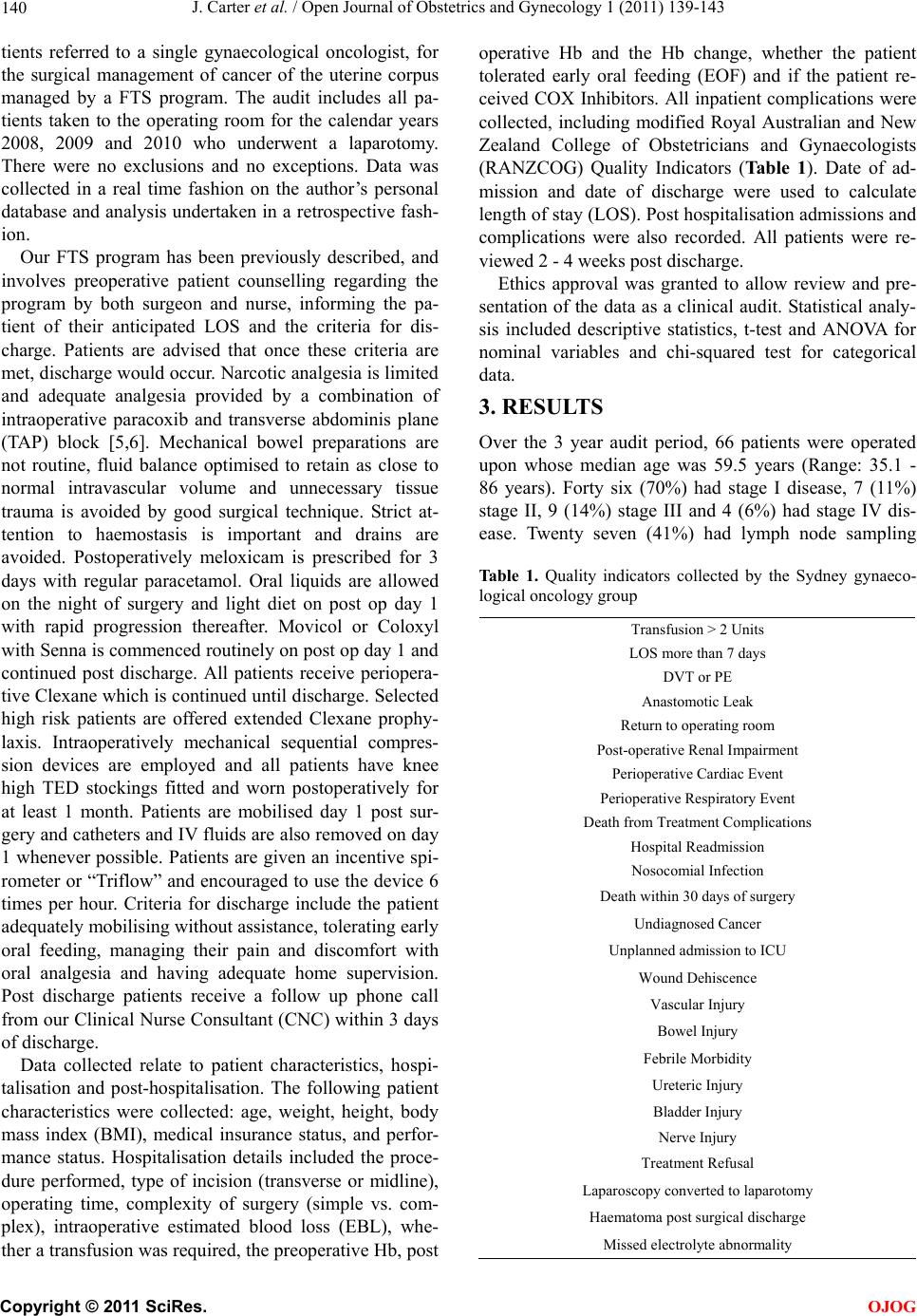 J. Carter et al. / Open Journal of Obstetrics and Gynecology 1 (2011) 139-143 140 tients referred to a single gynaecological oncologist, for the surgical management of cancer of the uterine corpus managed by a FTS program. The audit includes all pa- tients taken to the operating room for the calendar years 2008, 2009 and 2010 who underwent a laparotomy. There were no exclusions and no exceptions. Data was collected in a real time fashion on the author’s personal database and analysis undertaken in a retrospective fash- ion. Our FTS program has been previously described, and involves preoperative patient counselling regarding the program by both surgeon and nurse, informing the pa- tient of their anticipated LOS and the criteria for dis- charge. Patients are advised that once these criteria are met, discharge would occur. Narcotic analgesia is limited and adequate analgesia provided by a combination of intraoperative paracoxib and transverse abdominis plane (TAP) block [5,6]. Mechanical bowel preparations are not routine, fluid balance optimised to retain as close to normal intravascular volume and unnecessary tissue trauma is avoided by good surgical technique. Strict at- tention to haemostasis is important and drains are avoided. Postoperatively meloxicam is prescribed for 3 days with regular paracetamol. Oral liquids are allowed on the night of surgery and light diet on post op day 1 with rapid progression thereafter. Movicol or Coloxyl with Senna is commen ced routinely on post op day 1 and continued post discharge. All patients receive periopera- tive Clexane which is continued until discharge. Selected high risk patients are offered extended Clexane prophy- laxis. Intraoperatively mechanical sequential compres- sion devices are employed and all patients have knee high TED stockings fitted and worn postoperatively for at least 1 month. Patients are mobilised day 1 post sur- gery and catheters and IV fluids are also removed on day 1 whenever possible. Patients are given an incentive spi- rometer or “Triflow” and encouraged to use the device 6 times per hour. Criteria for discharge include the patient adequately mobilising without assistance, to lerating early oral feeding, managing their pain and discomfort with oral analgesia and having adequate home supervision. Post discharge patients receive a follow up phone call from our Clinical Nurse Consultant (CNC) within 3 days of discharge. Data collected relate to patient characteristics, hospi- talisation and post-hospitalisation. The following patient characteristics were collected: age, weight, height, body mass index (BMI), medical insurance status, and perfor- mance status. Hospitalisation details included the proce- dure performed, type of incision (transverse or midline), operating time, complexity of surgery (simple vs. com- plex), intraoperative estimated blood loss (EBL), whe- ther a transfusion was required, the preop erative Hb , post operative Hb and the Hb change, whether the patient tolerated early oral feeding (EOF) and if the patient re- ceived COX Inhibitors. All inpatient complications were collected, including modified Royal Australian and New Zealand College of Obstetricians and Gynaecologists (RANZCOG) Quality Indicators (Table 1). Date of ad- mission and date of discharge were used to calculate length of stay (LOS). Post hospitalisation admissions and complications were also recorded. All patients were re- viewed 2 - 4 weeks p ost discharge. Ethics approval was granted to allow review and pre- sentation of the data as a clinical audit. Statistical analy- sis included descriptive statistics, t-test and ANOVA for nominal variables and chi-squared test for categorical data. 3. RESULTS Over the 3 year audit period, 66 patients were operated upon whose median age was 59.5 years (Range: 35.1 - 86 years). Forty six (70%) had stage I disease, 7 (11%) stage II, 9 (14%) stage III and 4 (6%) had stage IV dis- ease. Twenty seven (41%) had lymph node sampling Table 1. Quality indicators collected by the Sydney gynaeco- logical oncology group Transfusion > 2 Units LOS more than 7 days DVT or PE Anastomotic Leak Return to operating room Post-operative Renal Im pa irment Perioperative Cardiac Event Perioperative Respiratory E ven t Death from Treatment Complications Hospital Readmission Nosocomial Infection Death within 30 days of surgery Undiagnosed Cancer Unplanned admission to ICU Wound Dehiscence Vascular Injury Bowel Injury Febrile Morbidity Ureteric Injury Bladder Injury Nerve Injury Treatment Refusal Laparoscopy converted to lap arotomy Haematoma post surgical dischar ge Missed electrolyte abnorm a lity C opyright © 2011 SciRes. OJOG 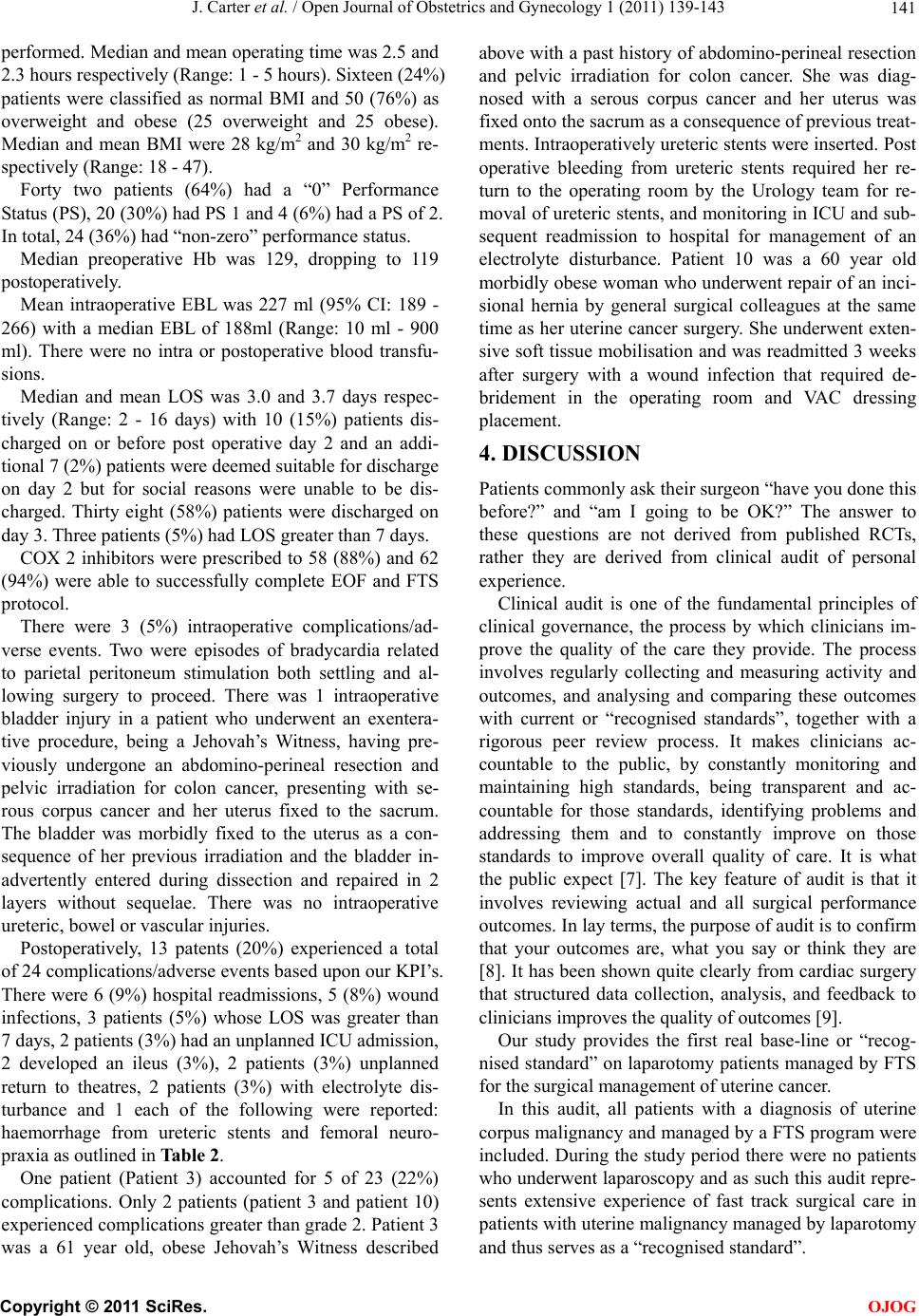 J. Carter et al. / Open Journal of Obstetrics and Gynecology 1 (2011) 139-143 141 performed. Median and mean operating time was 2.5 and 2.3 hours respectively (Range: 1 - 5 hours). Sixteen (24%) patients were classified as normal BMI and 50 (76%) as overweight and obese (25 overweight and 25 obese). Median and mean BMI were 28 kg/m2 and 30 kg/m2 re- spectively (Range: 18 - 47). Forty two patients (64%) had a “0” Performance Status (PS), 20 (30%) had PS 1 and 4 (6%) had a PS of 2. In total, 24 (36%) had “non-zero” performance status. Median preoperative Hb was 129, dropping to 119 postoperatively. Mean intraoperative EBL was 227 ml (95% CI: 189 - 266) with a median EBL of 188ml (Range: 10 ml - 900 ml). There were no intra or postoperative blood transfu- sions. Median and mean LOS was 3.0 and 3.7 days respec- tively (Range: 2 - 16 days) with 10 (15%) patients dis- charged on or before post operative day 2 and an addi- tional 7 (2%) patients were deemed suitable for discharge on day 2 but for social reasons were unable to be dis- charged. Thirty eight (58%) patients were discharged on day 3. T hree pa t i en t s (5%) had LOS greater than 7 days. COX 2 inhibitors were prescribed to 58 (88%) and 62 (94%) were able to successfully complete EOF and FTS protocol. There were 3 (5%) intraoperative complications/ad- verse events. Two were episodes of bradycardia related to parietal peritoneum stimulation both settling and al- lowing surgery to proceed. There was 1 intraoperative bladder injury in a patient who underwent an exentera- tive procedure, being a Jehovah’s Witness, having pre- viously undergone an abdomino-perineal resection and pelvic irradiation for colon cancer, presenting with se- rous corpus cancer and her uterus fixed to the sacrum. The bladder was morbidly fixed to the uterus as a con- sequence of her previous irradiation and the bladder in- advertently entered during dissection and repaired in 2 layers without sequelae. There was no intraoperative ureteric, bowel or vascular injuries. Postoperatively, 13 patents (20%) experienced a total of 24 complications/adverse events based upon our KPI’s. There were 6 (9%) hospital readmissions, 5 (8%) wou nd infections, 3 patients (5%) whose LOS was greater than 7 days, 2 patients (3%) had an unplanned ICU admission, 2 developed an ileus (3%), 2 patients (3%) unplanned return to theatres, 2 patients (3%) with electrolyte dis- turbance and 1 each of the following were reported: haemorrhage from ureteric stents and femoral neuro- praxia as outlined in Table 2. One patient (Patient 3) accounted for 5 of 23 (22%) complications. Only 2 patients (patient 3 and patient 10) experienced complications greater than grade 2. Patient 3 was a 61 year old, obese Jehovah’s Witness described above with a past history of abdo mino-perineal r esection and pelvic irradiation for colon cancer. She was diag- nosed with a serous corpus cancer and her uterus was fixed onto the sacrum as a consequence of previous treat- ments. Intraoperativ ely ureteric stents were inserted. Post operative bleeding from ureteric stents required her re- turn to the operating room by the Urology team for re- moval of ureteric stents, and monitoring in ICU an d sub- sequent readmission to hospital for management of an electrolyte disturbance. Patient 10 was a 60 year old morbidly obese woman who underwent repair of an inci- sional hernia by general surgical colleagues at the same time as her uterine cancer surgery. She underwent exten- sive soft tissue mobilisation an d was readmitted 3 weeks after surgery with a wound infection that required de- bridement in the operating room and VAC dressing placement. 4. DISCUSSION Patients commonly ask their surgeon “have you done this before?” and “am I going to be OK?” The answer to these questions are not derived from published RCTs, rather they are derived from clinical audit of personal experience. Clinical audit is one of the fundamental principles of clinical governance, the process by which clinicians im- prove the quality of the care they provide. The process involves regularly collecting and measuring activity and outcomes, and analysing and comparing these outcomes with current or “recognised standards”, together with a rigorous peer review process. It makes clinicians ac- countable to the public, by constantly monitoring and maintaining high standards, being transparent and ac- countable for those standards, identifying problems and addressing them and to constantly improve on those standards to improve overall quality of care. It is what the public expect [7]. The key feature of audit is that it involves reviewing actual and all surgical performance outcomes. In lay terms, the purpose of audit is to confirm that your outcomes are, what you say or think they are [8]. It has been shown quite clearly from cardiac surgery that structured data collection, analysis, and feedback to clinicians improves the qu ality of outcomes [9]. Our study provides the first real base-line or “recog- nised standard” on laparotomy patients managed by FTS for the surgical management of uterine cancer. In this audit, all patients with a diagnosis of uterine corpus malignancy and managed by a FTS program were included. During the study period there were no patients who underwent laparo scopy and as such this audit repre- sents extensive experience of fast track surgical care in patients with uterine malignancy managed by laparotomy and thus serves as a “recognised standard”. C opyright © 2011 SciRes. OJOG  J. Carter et al. / Open Journal of Obstetrics and Gynecology 1 (2011) 139-143 Copyright © 2011 SciRes. 142 OJOG Table 2. Intraoperative and postoperative quality indicators. Pt Age LOS PS BMI Grade Complication/Adverse Event Comment Intraoperative Complications 1 80 13 1 40 2 Bradycardia Elderly obese woman, developed bradycardia during packing. Surgery continued. ICU monitoring. Developed post opera- tive ileus, UTI, wound infection, resulting in increased LOS 2 66 6 0 26 2 Bradycardia Bradycardia settled spontaneously. Surgery continued. 3 61 16 0 30 1 Bladder injury Jehovah’s Witness with past history of abdomino-perineal resection and pelvic irradiation for colon cancer. Uterus fixed on sacrum. Intraoperative bladder injury. R epaired in 2 layers, no sequelae Postoperative Complications 1 80 13 1 40 2 ICU Admission Ileus Wound infection LOS >7 days Elderly obese woman, developed bradycardia during packing. Surgery continued. ICU monitoring. Developed post opera- tive ileus, wound infection, resulting in increased LOS 3 61 16 0 30 3 Haematuria/haemorrhage Return to theatre ICU Admission LOS >7days Hospital readmission Jehovah’s Witness with past history of abdomino-perineal resection and pelvic irradiation for colon cancer. Uterus fixed on sacrum. Ureteric stents inserted. Post operative bleeding from ureteric stents requiring return to OR by Urology team for removal of stents. Monitoring in ICU. Subsequent read- mission to hospital for management of electrolyte disturbance 4 58 3 0 38 2 Wound infection Diagnosed 4 weeks post op. Treated with oral antibiotics by GP 5 57 3 0 29 2 Wound infection Wound haematoma/infection treated with oral antibiotics by GP. No sequelae 6 43 4 0 23 1 Hospital readmission Constipation. Readmitted but no specific management 7 61 3 0 25 1 Hospital readmission Unable to void after catheter removal. Readmitted 1 week post op for successful trial of void 8 61 3 0 40 1 Hospital readmission Resuture vaginal vault 9 46 2 0 29 2 Hospital readmission Wound infection Readmitted with wound infection, conservatively managed with IV antibio t i c s a n d VAC dressing 10 60 6 1 43 3 Hospi t a l r e a dmission Wound Infection Return to theatre Readmission with wound infection 3 weeks after extensive wound mobilization for repair of incisional hernia in obese patient. Return to theatre for wound debridement and VAC dressing 11 59 2 1 17 1 Other Femoral neuropraxia, settled prior to discharge 12 61 3 1 28 1 Electrolyte Raised creatinine. Settled prior to discharge 13 68 10 2 34 2 Electrolyte Ileus LOS >7 days Preexisting CRF, post operative electrolyte disturbance, and ileus settling with conservative management. Length of stay 10 days CRF: Chronic renal failure; VAC: Vacuum assisted closure; ICU: Intensive care unit; LOS: Length of stay; UTI: Urinary tract infec tion; GP: Genera l prac titioner. The extended experience confirms our earlier work that the majority of patients can complete a FTS program, with minimal morbidity and a low incidence of readmis- sion and as a consequence, a shorter hospital stays [5]. In a health care and financial environment where monetary constraints are ever increasing and medical technology is becoming more complex and expensive, clinicians and hospital administrators need to have access to audit data to confirm whether inve stment in expensive technology provides an enhanced outcome. It is note- worthy that the LOS and outcomes in the audit patients reported in this article were not too dissimilar to those reported in recent RCTs comparing laparotomy and lapa- roscopy [10-13]. This audit provides a baseline data set for a large group of patients with uterine corpus cancer operated upon with laparotomy and managed by FTS. It allows for subsequent data to be compared against and as such is a  J. Carter et al. / Open Journal of Obstetrics and Gynecology 1 (2011) 139-143 143 powerful tool for the gynaecological oncologist embark- ing upon surgery for cancer of the uterine corpus. 5. ACKNOWLEDGEMENTS The authors acknowledge financial support from The Chris O’Brien Lifehouse at RPA. REFERENCES [1] AIHW (Australian Institute of Health and Welfare) & AACR (Australasian association of cancer registries) (2008) Cancer in Australia: An overview, Cancer series, 46. [2] Kitchener, H., Swart, A.M., Qian, Q., Amos, C. and Parmar, M.K. (2009) Efficacy of systematic pelvic lym- phadenectomy in endometrial cancer (MRC ASTEC trial): A randomised study. Lancet, 10, 373, 125-36. [3] Kehlet, H. (2009) Principles of fast track surgery. Mul- timodal perioperative therapy programme. Chirurg, 80, 687-689. doi:10.1007/s00104-009-1675-2 [4] Kehlet, H. and Wilmore, D.W. (2002) Multimodal strat- egies to improve surgical outcome. American Journal of Surgery, 183, 630-641. doi:10.1016/S0002-9610(02)00866-8 [5] Carter, J., Szabo, R., Sim, W., Pather, S., Philp, S., Nattress, K., et al. (2010) Fast track surgery in gyn- aecological oncology. A clinical audit. The Australian and New Zealand Journal of Obstetrics and Gynaecology, 50, 159-163. doi:10.1111/j.1479-828X.2009.01134.x [6] McDonnell, J., O’Donnell, B., Curley, G., Heffernan, A., Power, C. and Laffey, J. (2007) The analgesic efficacy of transverse abdominis plane block after abdominal surgery: A prospective randomized controlled trial. Anesthesia and Analgesia, 104, 193-197. doi:10.1213/01.ane.0000250223.49963.0f [7] Scally, G. and Donaldson, L. (1998) Clinical governance and the drive for quality improvement in the new NHS in England. British Medicine Jou rnal, 4, 61-65. [8] RACS. (2008) A Guide by the Royal Australian College of Surgeons. Royal Australian College of Surgeons Stat- ement, Surgical Audit and Peer Review. [9] Grover, F.L., Shroyer, A.L, Hammermeister, K., Edwards, F.H., Ferguson, T.B., Dziuban, S.W., et al. (2001) A decade’s experience with quality improvement in cardiac surgery using the veterans affairs and society of thoracic surgeons national databases. Annual Surgery, 234, 464- 472. doi:10.1097/00000658-200110000-00006 [10] Janda, M., Gebski, V., Brand, A., Hogg, R., Jobling, T., Land, R., et al. (2010) Quality of life after total laparoscopic hysterectomy versus total abdominal hyster- ectomy for stage I endometrial cancer (LACE): A ran- domised trial. The Lancet Oncology, 16, 1-9. [11] Kornblith, A.B., Huang, H.Q., Walker, J.L., Spirtos, N.M., Rotmensch, J. and Cella, D. (2009) Quality of life of patients with endometrial cancer undergoing lapar- oscopic international federation of gynecology and obs- tetrics staging compared with laparotomy: A Gyneco- logic Oncology Group Study. Journal of Clinical On- cology, 27, 5337-5542. doi:10.1200/JCO.2009.22.3529 [12] Mourits, M., Bijen, C., Art, H., Brugge H.T., Sijde, R.V.D., Paulsen, et al. (2010) Safety of laparoscopy versus laparotomy in early-stage endometrial cancer: A randomised trial. Lancet Oncology, 16, 1-9. [13] Walker, J.L., Piedmonte, M.R., Spirtos, N.M., Eisenkop, S.M., Schlaerth, J.B., Mannel, R.S., et al. (2009) Lap- aroscopy compared with laparotomy for comprehensive surgical staging of uterine cancer: Gynecologic oncology group study LAP2. Journal Clinical Oncology, 27, 5331. doi:10.1200/JCO.2009.22.3248 C opyright © 2011 SciRes. OJOG |