B. A. Akin et al. / Open Journal of Obstetrics and Gynecology 1 (2011) 128-130 129
2. WOMEN AND METHODS
The study protocol was approved by the Committee for
Human Research of the University of the Witwatersrand,
Johannesburg South Africa. Thirty-six low risk women
who were to deliver at a tertiary hospital setting in Jo-
hannesburg, South Africa were recruited and gave in-
formed consent. They were randomly allocated during
the third stage of labor to four groups using a computer
generated random sequence, in sequentially labeled treat-
ment packs.
GROUP A 600 mcg rectal misoprostol as the active
uterotonic agent.
GROUP B. 600 mcg oral misoprostol as the active
agent.
GROUP C. 10 International Units oxytocin intramu-
scularly on delivery of the anterior shoulder. .
GROUP D. 10 International Units oxytocin 30 minutes
after delivery.
A Hewlett Packard cardiotocogram monitor was acti-
vated to run the paper strip at 3 cm per minute. The to-
cogram pressure was zeroed after connection of a trans-
ducer tipped pressure catheter. Calibration was effected
at 0 cm and 60 cm of water by immersion of the trans-
ducer in a 60 cm sterile water column. The time of deli-
very of the baby was noted. At delivery, with the pla-
centa in situ, the pressure tip catheter was fed through the
umbilical vein into the placental circulation and a soft
clamp used to hold the catheter in place in the umbilical
cord and prevent blood loss from the placental vascula-
ture. The tocogram recording continued until either the
placenta was spontaneously expelled or 30 minutes after
insertion of the catheter.
The next in the sequence of refrigerated opaque enve-
lopes containing the various randomized medications
was opened to administer the contents, early or delayed
oxytocin, and rectal or oral misoprostol. Oxytocin or
ergometrine was to have been administered at any stage
of the study if excessive uterine bleeding had occurred.
3. RESULTS
It was technically easy to insert the catheter through the
umbilical vein in all mothers.
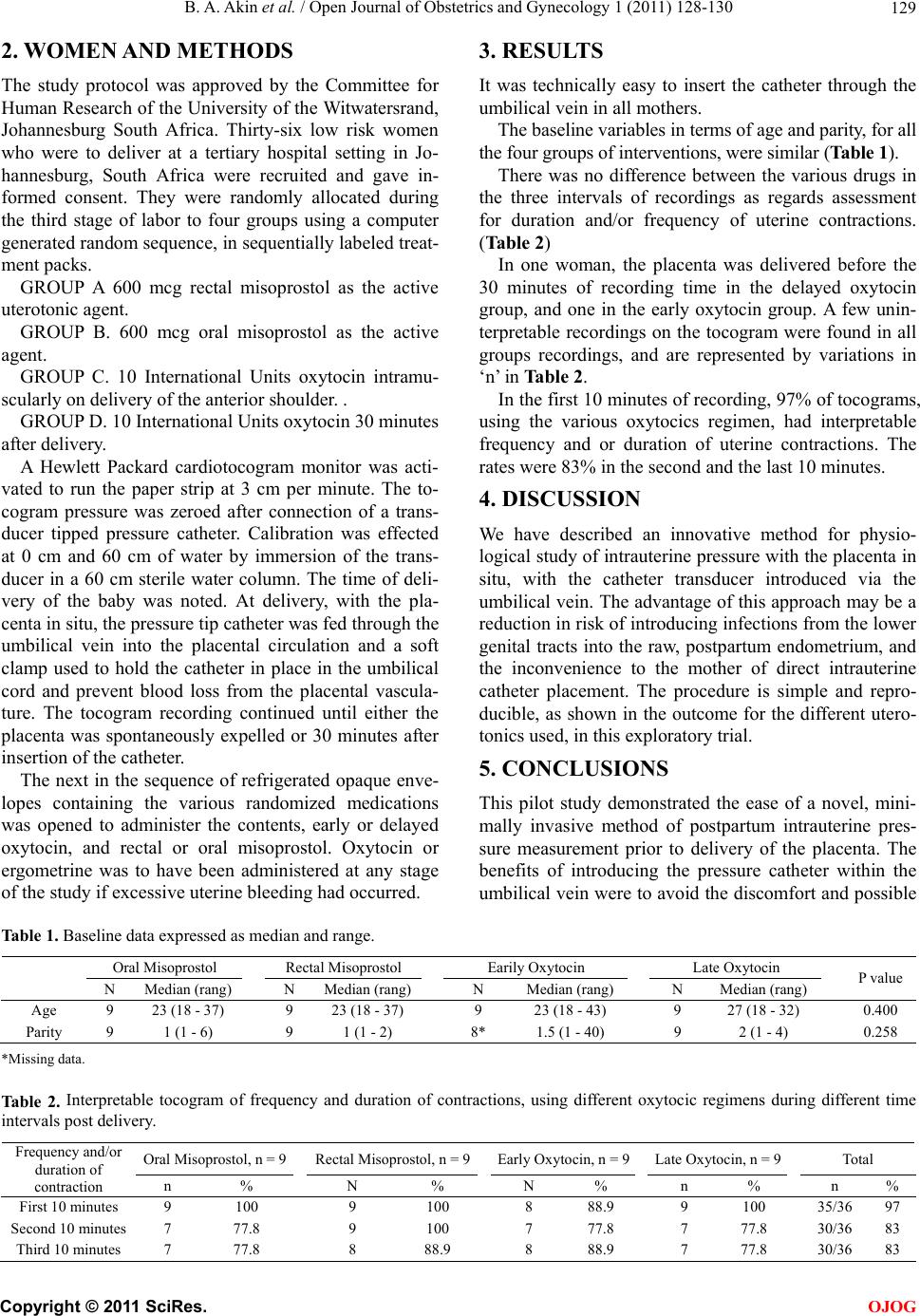
The baseline variables in terms of age and parity, for all
the four groups of interventions, were similar (Table 1).
There was no difference between the various drugs in
the three intervals of recordings as regards assessment
for duration and/or frequency of uterine contractions.
(Table 2)
In one woman, the placenta was delivered before the
30 minutes of recording time in the delayed oxytocin
group, and one in the early oxytocin group. A few unin-
terpretable recordings on the tocogram were found in all
groups recordings, and are represented by variations in
‘n’ in Table 2.
In the fir st 10 minutes of reco rding, 97% of toco grams,
using the various oxytocics regimen, had interpretable
frequency and or duration of uterine contractions. The
rates were 83% in the second and th e last 10 minutes.
4. DISCUSSION
We have described an innovative method for physio-
logical study of intrauterine pressure with the placenta in
situ, with the catheter transducer introduced via the
umbilical vein. The advantage of this approach may be a
reduction in risk of introducing infections from the lower
genital tracts into the raw, postpartum endometrium, and
the inconvenience to the mother of direct intrauterine
catheter placement. The procedure is simple and repro-
ducible, as shown in the outcome for the different utero-
tonics used, in this exploratory trial.
5. CONCLUSIONS
This pilot study demonstrated the ease of a novel, mini-
mally invasive method of postpartum intrauterine pres-
sure measurement prior to delivery of the placenta. The
benefits of introducing the pressure catheter within the
umbilical vein were to avoid the discomfort and possible
Table 1. Baseline data expressed as median and range.
Oral Misoprostol Rectal Misoprostol Earily Oxytocin Late Oxytocin
N Median (rang) N Median (rang)N Median (rang)N Me dia n (rang) P value
Age 9 23 (18 - 37) 9 23 (18 - 37) 9 23 (18 - 43) 9 27 (18 - 32) 0.400
Parity 9 1 (1 - 6) 9 1 (1 - 2) 8* 1.5 (1 - 40) 9 2 (1 - 4) 0.258
*Missing data.
Ta b l e 2 . Interpretable tocogram of frequency and duration of contractions, using different oxytocic regimens during different time
intervals post delivery.
Oral Misoprostol, n = 9 Rectal Misoprostol, n = 9Early Oxytocin, n = 9Late Oxytocin, n = 9 Total
Frequency and/or
duration of
contraction n % N % N % n % n %
First 10 minutes 9 100 9 100 8 88.9 9 100 35/36 97
Second 10 minutes 7 77.8 9 100 7 77.8 7 77.8 30/36 83
Third 10 minutes 7 77.8 8 88.9 8 88.9 7 77.8 30/36 83
C
opyright © 2011 SciRes. OJOG