

Paper Menu >>
Journal Menu >>
 Vol.3, No.9, 743-749 (2011) Natural Science http://dx.doi.org/10.4236/ns.2011.39099 Copyright © 2011 SciRes. OPEN ACCESS The basic blocks of the universe matter: Boltzmann fundamental particle and energy quanta of dark matter and dark energy Murad Shibli1*, Sohail Anwar2 1College Requirement Unit, Abu Dhabi Polytechnic, Institute of Applied Technology, Abu Dhabi, United Arab Emirates; *Corresponding Author: [email protected] 2Pennsylvania State University, Altoona College, Altoona, USA. Received 30 November 2010; revised 15 February 2011; accepted 10 March 2011. ABSTRACT Recent astronomical NASA observations indi- cates that visible matter contributes only to about 4% of the universe total energy density, meanwhile, dark matter and dark energy con- tributes to 26% and 70% of the universe total energy, respectively, with an average density close to 10–26 kg/m3. This paper proposes an equation of state of dark energy and dark matter as one unified entity. This equation is derived based on the ideal gas equation, Boltzmann constant, Einstein energy-mass principle and based on the assumption that dark energy and dark matter behave as a perfect fluid. This analysis presents what could be the most fun- damental particle and quanta of dark matter and dark energy. Considering NASA’s Cosmic Mi- crowave Background Explorer (CMB) which es- timated that the sky has an average temperature close to 2.7251 Kelvin, then the equivalent mass and energy of the proposed fundamental particle is determined. It is found that this candidate particle has an equivalent mass of 4.2141 × 10–40 Kg which is equivalent to 3.7674 × 10⁻²³ J. Sur- prisingly, this value has the same order of Boltzmann constant KB = 1.38 × 10⁻²³ J/K. This candidate particle could be the most funda- mental and lightest particle in Nature and serves as the basic block of matter (quarks and gluons). Moreover, assuming a uniform space dark en- ergy/dark matter density, then the critical tem- perature at which the dark matter has a unity entity per volume is determined as 34.983 × 10¹² K. Analytically, it proposes that at this trillion temperature scale, the dark matter particles uni- fied into a new quark-hydron particle. Finally, tentative experimental verification can be con- ducted using the Relativistic Heavy Ion Collider (RHIC). Keywords: Dark Energy; Dark Matter; Equation of State; Boltzmann Constant; Boltzamnn Particles; Einstine’s Cosmological Constant 1. INTRODUCTION Recent astronomical observations by the Supernova Cosmology Project, the High-z Supernova Search Team and cosmic microwave background (CMB) have pro- vided strong evidence that our universe is not only ex- panding, but also expanding at an accelerating rate [1-8]. It was only in 1998 when dark energy proposed for the first time, after two groups of astronomers made a survey of exploding stars, or supernovas Ia, in a number of dis- tant galaxies [1,3]. These researchers found that the su- pernovas were dimmer than they should have been, and that meant they were farther away than they should have been. The only way for that to happen, the astronomers realized, was if the expansion of the universe had sped up at some time in the past, as well as accounting for a significant portion of a missing component in the uni- verse [9,10]. The only explanation is that there is a kind of force that has a strong negative pressure and acting outward in opposition to gravitational force at large scales which was proposed for the first time by Einstein in his General Relativity and given the name the cosmo- logical constant Lambda [2]. This force is given the name Dark Energy, since it is transparent and cannot be observed or detected directly. The fourth law of thermo- dynamics is proposed by the author to account for the dark energy [11]. These cosmological observations strongly suggest that the universe is dominated by a smoothly homogenous  M. Shibli et al. / Natural Science 3 (2011) 743-749 Copyright © 2011 SciRes. OPEN ACCESS 744 distributed dark energy component [12-20]. The quantity and composition of matter and energy in the universe is a fundamental and important issue in cosmology and physics. Based on the Lambda-Cold Dark Matter Model (Lambda-CDM 2006), dark energy contributes about 70% of the critical density and has a negative pressure. The cold dark matter contributes 25%, Hydrogen, He- lium and stars contributes 5% and, finally the radiation contributes 5 × 10⁻⁵. The measurements of the Wilkinson Microwave Anisotropy Probe (WMAP) satellite indicate the universe geometry is very close to flat [21]. Using the Doppler Shift phenomena, scientists can learn much about the motions of galaxies. They know that galaxies rotate because, when viewed edge-on, the light from one side of the galaxy is blue shifted and the light from the other side is red shifted. One side is mov- ing toward the Earth, the other is moving away. They can also determine the speed at which the galaxy is rotating from how far the light is shifted. Knowing how fast the galaxy is rotating, they can then figure out the mass of the galaxy mathematically. According to Newton’s laws, the rotation speed satisfies vGMr, where M is the mass within radius r, and G is the Universal Gravitation constant. But as scientists look closer at the speeds of galactic rotation, they find something strange. The indi- vidual stars in a galaxy should act like the planets in our solar system—the farther away from the center, the slower they should move. But the Doppler Shift reveals that the stars in many galaxies do not slow down at far- ther distances. On the contrary, the stars move at flat speeds (see Figures 1 and 2) that should rip the galaxy apart because there is not enough measured mass to sup- ply the gravity needed to hold the galaxy together. These high rotational speeds suggest that the galaxy contains more mass than was calculated. Scientists theorize that, if the galaxy was surrounded by a halo of unseen matter, the galaxy could remain stable at such high rotational speeds. Much of the evidence for dark matter comes from the study of the motions of galaxies. Many of these appear to be fairly uniform, by the virial theorem the total kinetic energy should be half the total gravitational binding en- ergy of the galaxies. Experimentally, however, the total kinetic energy is found to be much greater: in particular, assuming the gravitational mass is due to only the visible matter of the galaxy, stars far from the center of galaxies have much higher velocities than predicted by the virial theorem. Galactic rotation curves, which illustrate the velocity of rotation versus the distance from the galactic center, cannot be explained by only the visible matter. Assuming that the visible material makes up only a small part of the cluster is the most straightforward way of accounting for Figure 1. Rotation following Kepler’s 3rd law is shown above as planet-like or differential rotation. Notice that the orbital speeds falls off as you go to greater radii within the Galaxy. This is called a Keplerian rotation curve. Figure 2. The observed rotation curve for the our galaxy Milky Way. To determine the rotation curve of the Galaxy, stars are not used due to interstellar extinction. Instead, 21-cm maps of neutral hydrogen are used. When this is done, one finds that the rotation curve of the Galaxy stays flat out to large distances, instead of falling off as in the figure above. This means that the mass of the Galaxy increases with increasing distance from the center. this. Galaxies show signs of being composed largely of a roughly spherically symmetric, centrally concentrated halo of dark matter with the visible matter concentrated in a disc at the center. Accordingly, dark matter can be defined as the matter of unknown composition that does not emit or reflect  M. Shibli et al. / Natural Science 3 (2011) 743-749 Copyright © 2011 SciRes. OPEN ACCESS 745 enough electromagnetic radiation to be observed directly, but its presence can be inferred from gravitational effects on visible matter like galaxies and stars [22-25]. Ac- cording to present observations of structures larger than galaxy-sized as well as Big Bang cosmology, dark matter accounts for the vast majority of mass in the observable universe (22%). The observed phenomena consistent with dark matter observations include the rotational speeds of galaxies, orbital velocities of galaxies in clu- sters, gravitational lensing of background objects by ga- laxy clusters, (Figure 3) and the temperature distribution of hot gas in galaxies and clusters of galaxies. This paper introduces a proposed equation of state of dark energy and dark matter as one unified entity (Sec- tion 2). Such an equation is derived based on the as- sumption that dark energy and dark matter behave as a perfect fluid and using the ideal gas equation, Boltzmann constant and the energy-mass principle of Einstein. Moreover, this paper suggests what could be the most fundamental particle and quanta of dark matter and dark energy and its characteristics (Section 3). Moreover, based on NASA’s Cosmic Microwave Background Ex- plorer (CMB) which estimated that the sky has an aver- age temperature close to 2.7251 Kelvin, then the equiva- lent mass and energy of fundamental particle of the dark matter/dark energy is determined with an equivalent mass of 40 4.2141 10 Kg which is equivalent to 23 3.767410 J . Since this value has the same order of Boltzmann constant 23 1.38 10 B K J/K. Furthermore, dark matter particle could be the most fundamental and lightest particle in Nature and serves the basic block of matter (quarks and gluons). Moreover, assuming a uniform space dark energy/dark matter den- sity, then the critical temperature at which the dark mat- ter has a unity entity per volume is determined as 12 34.98310 K. At this temperature Boltzmann particles are melt (unified) to generate quarks which are consi- dered the basic blocks of physical matter (Section 4). Fi- nally, conclusions are discussed. 2. PRELIMINARY: THE EQUATION OF STATE OF DARK ENERGY AND DARK MATTER: THE UNIFIED ENTITY This equation relates the pressure P, temperature T and the volume V of a substance behaves as an ideal gas [26], that is PV mRT (1) As it can be seen easily that Eq.1 represents the en- ergy associated with an ideal gas at given pressure P, temperature T and the volume V, that is PV mRT E (2) Note that both sides of the equation has the units of Figure 3. Gravitational lenses (Hubble Space Telescope, NASA). energy (work done by pressure P). Assume now that dark energy behaves like an ideal gas with a negative pressure (−P) that causes the universe to expand with a total vol- ume V, then by dividing both side of the equation of state (5) by V, then mE PRT VV (3) Defining the mass density as m m V and energy density as E E V , Eq.3 yields to mE PRT (4) Now by taking the ratio between the mass density and energy density then E m RT (5) It can be concluded that the ratio between the mass density and energy density are proportional to the pro- duct of the temperature T and dark energy-dark matter constant R (known as Universal gas constant). It is worth to mention that NASA’s Cosmic Microwave Background Explorer (CMB) in 1992 estimated that the sky has a temperature close to 2.7251 Kelvin. Moreover, the Wil- kinson Microwave Anisotropy Probe (WMAP) in 2003 has made a map of the temperature fluctuations of the CMB with more accuracy [27-29]. The Boltzmann constant B K is a physical constant that relates temperature to microscopic energy. B A K RN , where NA is the Avogadro Number. 23 1.38 10 B K J/K The numerical value of B K measures the conversion factor for mapping from this microscopic energy E to the macroscopically-derived temperature scale.  M. Shibli et al. / Natural Science 3 (2011) 743-749 Copyright © 2011 SciRes. OPEN ACCESS 746 The ideal gas law can now be expressed in terms of Boltzmann constant such that B PVNK T (6) where N is the actual number of entities (particles). Now dividing both sides of (10) by volume to get the energy density then B NB E N PKTKT V (7) This shows that the ratio between the energy density and the entities density is proportional to the absolute temperature times the Boltzmann constant. The Boltzmann constant B K is a physical constant that relates temperature to energy. B A K RN where A N is the Avogadro Number [27]. 23 1.3806505 10 B K J/K. The numerical value of B K measures the conversion factor for mapping from this characteristic microscopic energy E to the macro- scopically-derived temperature scale. The ideal gas law can now be expressed in terms of Boltzmann constant such that B PVNK TE (8) where N is the actual number of molecules. Now divid- ing both sides of (8) by the volume to get the energy density then B NB E N PKTKT V (9) By taking the ration between the energy density E and number of molecules density N/V, one gets E B N KT (10) or E N B K T (11) This shows that the ratio between the energy density and the molecular density is proportional to the absolute temperature times the Boltzmann constant. The simula- tion results demonstrate such a model. 3. PROPOSED DARK MATTER PARTICLE CANDIDATE A quark-gluon plasma (QGP) or quark soup is a phase of quantum chromodynamics (QCD) which exists at ex- tremely high temperature and/or density. This phase con- sists of (almost) free quarks and gluons, which are se- veral of the basic building blocks of matter. Recent analyses from the Relativistic Heavy Ion Collider (RHIC), a 2.4-mile-circumference (atom smasher) at the US Department of Energy’s (DOE) Brookhaven Na- tional Laboratory, establish that collisions of gold ions traveling at nearly the speed of light have created matter at a temperature of about 4 trillion degrees Celsius—the hottest temperature ever reached in a laboratory, about 250,000 times hotter than the center of the Sun [30]. This temperature, based upon measurements by the PHENIX collaboration at RHIC, is higher than the temperature needed to melt protons and neutrons into a plasma of quarks and gluons. These new temperature measure- ments, combined with other observations analyzed over nine years of operations by RHIC’s four experimental collaborations of BRAHMS, PHENIX, PHOBOS, and STAR indicate that RHIC’s gold-gold collisions produce a freely flowing liquid composed of quarks and gluons. Such a substance, often referred to as quark-gluon plasma, or QGP, filled the universe a few microseconds after it came into existence 13.7 billion years ago. At RHIC, this liquid appears, and the quoted temperature is reached, in less time than it takes light to travel across a single proton. Search for the axions is investigated in work [30,31]. The axion is a proposed candidate particle for dark energy. The Hadron Epoch covers the time from 10–6 seconds to 1 second after the Big Bang as shown in Figure 4. The temperature during this epoch is estimated to decrease from 1013 K to 1010 K. At 10–6 seconds Electrons and positrons annihilate each other during the hadron epoch. At 10–5 seconds, the temperature of the Universe is ap- proximately 1013 K. Quarks combine to form protons and neutrons. The lowering temperature allows quark/anti- quark pairs to combine into mesons. After this period quarks and anti-quarks can no longer exist as free parti- cles. At 10–4 seconds the temperature of the Universe is approximately 1010 (10 million) Kelvin. The existence of antimatter is cancelled out, as lepton/anti-lepton pairs are annihilated by existing photons. Neutrinos break free and exist on their own. Now consider the estimations which show that values of universe dark energy density (=1.2622 × 10⁻²⁶ kg/m3 = 6.8023 GeV), universe critical density (=1.8069 × 10⁻²⁶ kg/m3 = 9.7378 GeV), universe matter density (= 0.54207 × 10⁻²⁶ kg/m3 = 2.9213 GeV), and universe radi- ation density (= 2.73 × 10⁻³¹ kg/m3 = 1.4558 MeV). In this proposed paper and based on astronomical ob- servations that the average density of dark matter and dark energy is approximately 26 10 Kg/m3 and based on previous published work [12] that the density of dark matter is 26 0.54 10 Kg/m3 which is equivalent to 10 4.8277 10 J/m3. Now benefiting from (7) at CMB temperature T = 2.73 K, then 12 3 12.8110entities m N (12) Since 12 3 12.8110entitiesm N is corresponding to 26 0.54 10 Kg/m3, then each entity has a mass of 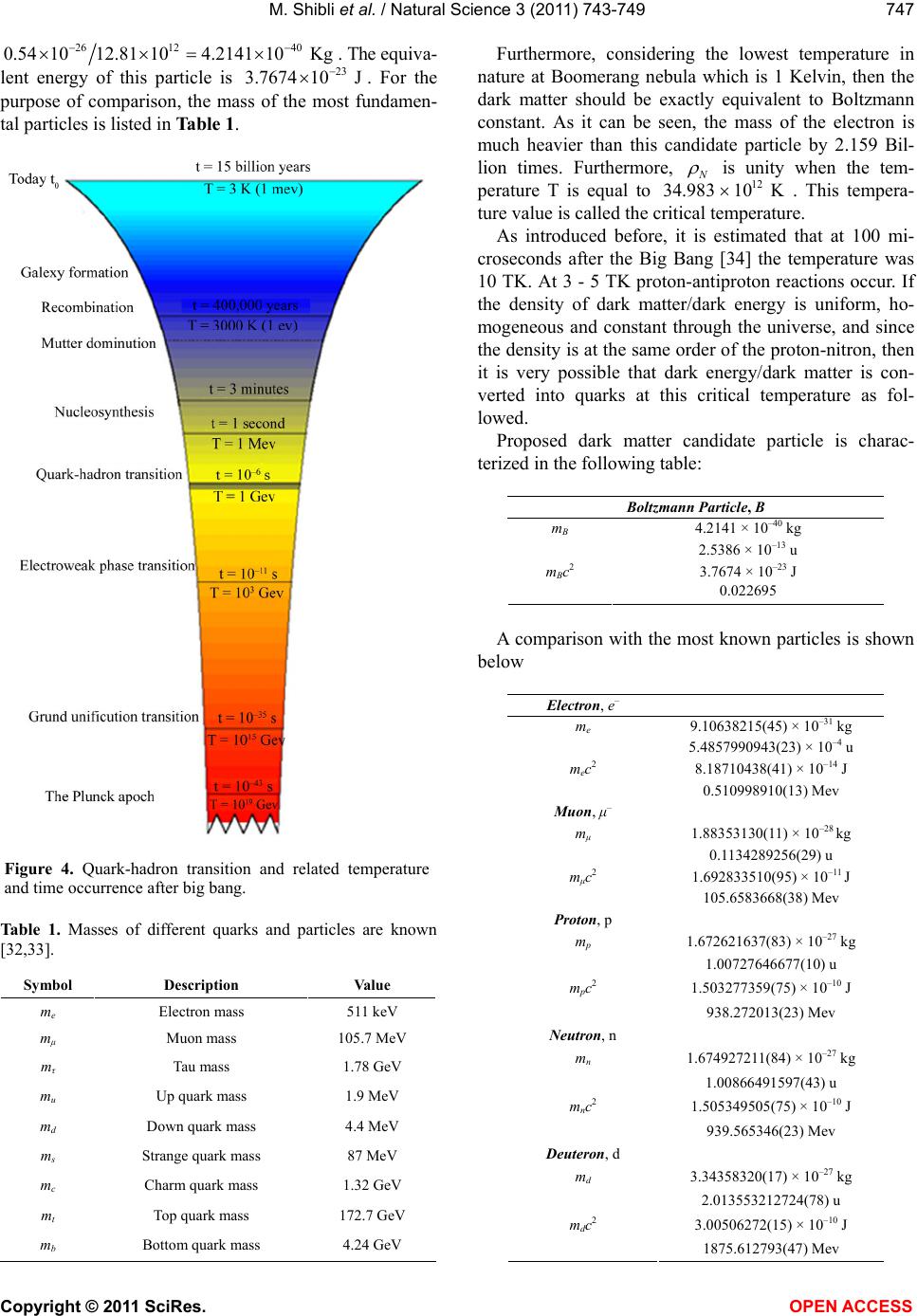 M. Shibli et al. / Natural Science 3 (2011) 743-749 Copyright © 2011 SciRes. OPEN ACCESS 747 26 1240 0.541012.81104.214110 Kg . The equiva- lent energy of this particle is 23 3.767410 J . For the purpose of comparison, the mass of the most fundamen- tal particles is listed in Table 1. Figure 4. Quark-hadron transition and related temperature and time occurrence after big bang. Table 1. Masses of different quarks and particles are known [32,33]. Symbol Description Value me Electron mass 511 keV mμ Muon mass 105.7 MeV mτ Tau mass 1.78 GeV mu Up quark mass 1.9 MeV md Down quark mass 4.4 MeV ms Strange quark mass 87 MeV mc Charm quark mass 1.32 GeV mt Top quark mass 172.7 GeV mb Bottom quark mass 4.24 GeV Furthermore, considering the lowest temperature in nature at Boomerang nebula which is 1 Kelvin, then the dark matter should be exactly equivalent to Boltzmann constant. As it can be seen, the mass of the electron is much heavier than this candidate particle by 2.159 Bil- lion times. Furthermore, N is unity when the tem- perature T is equal to 12 34.98310 K . This tempera- ture value is called the critical temperature. As introduced before, it is estimated that at 100 mi- croseconds after the Big Bang [34] the temperature was 10 TK. At 3 - 5 TK proton-antiproton reactions occur. If the density of dark matter/dark energy is uniform, ho- mogeneous and constant through the universe, and since the density is at the same order of the proton-nitron, then it is very possible that dark energy/dark matter is con- verted into quarks at this critical temperature as fol- lowed. Proposed dark matter candidate particle is charac- terized in the following table: Boltzmann Particle, B mB 4.2141 × 10–40 kg 2.5386 × 10⁻¹³ u 3.7674 × 10⁻²³ J mBc2 0.022695 A comparison with the most known particles is shown below Electron, e– me 9.10638215(45) × 10–31 kg 5.4857990943(23) × 10–4 u 8.18710438(41) × 10–14 J mec2 0.510998910(13) Mev Muon, μ– mμ 1.88353130(11) × 10–28 kg 0.1134289256(29) u 1.692833510(95) × 10–11 J mμc2 105.6583668(38) Mev Proton, p mp 1.672621637(83) × 10–27 kg 1.00727646677(10) u 1.503277359(75) × 10–10 J mpc2 938.272013(23) Mev Neutron, n mn 1.674927211(84) × 10–27 kg 1.00866491597(43) u 1.505349505(75) × 10–10 J mnc2 939.565346(23) Mev Deuteron, d md 3.34358320(17) × 10–27 kg 2.013553212724(78) u 3.00506272(15) × 10–10 J mdc2 1875.612793(47) Mev 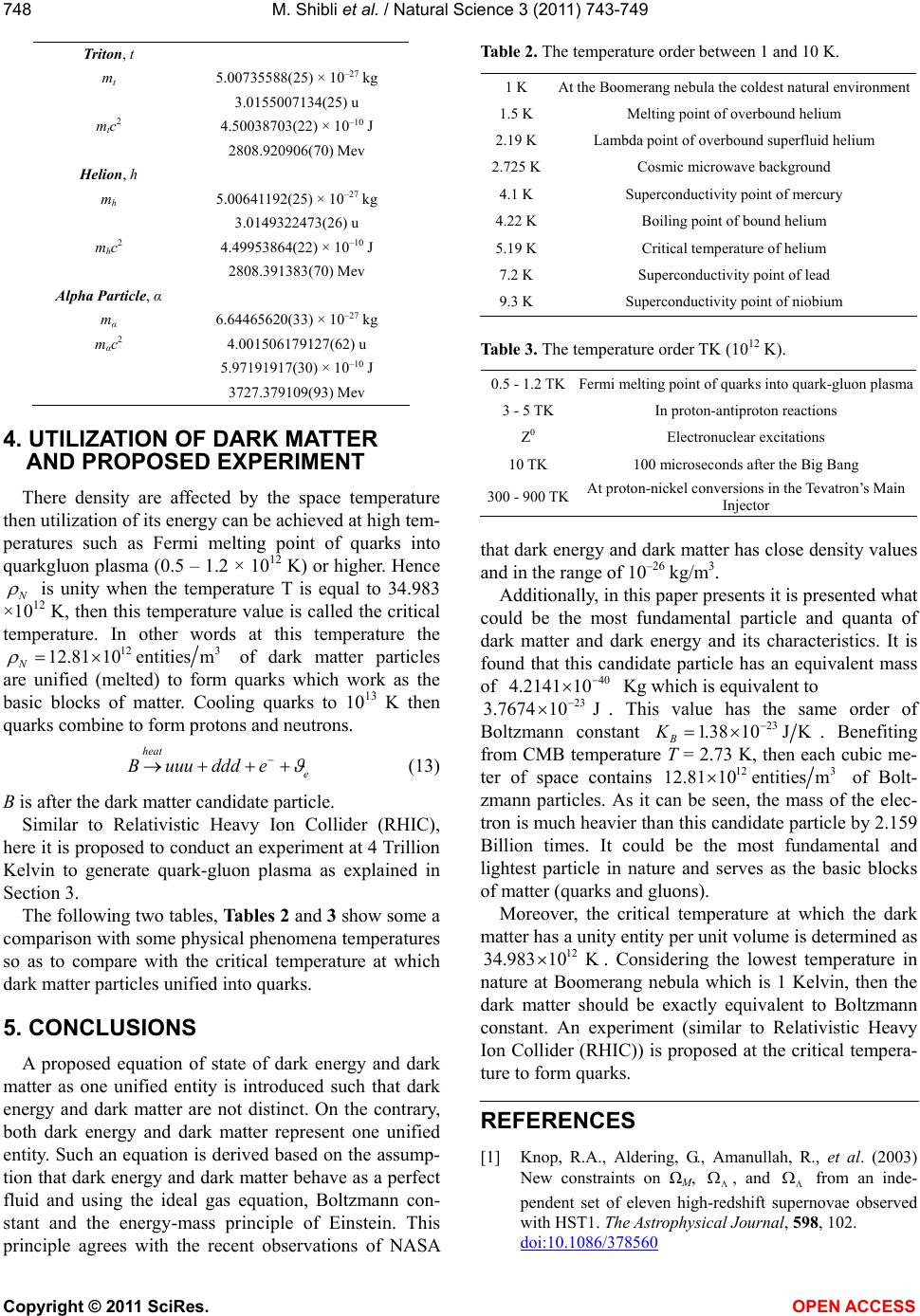 M. Shibli et al. / Natural Science 3 (2011) 743-749 Copyright © 2011 SciRes. OPEN ACCESS 748 Triton, t mt 5.00735588(25) × 10–27 kg 3.0155007134(25) u 4.50038703(22) × 10–10 J mtc2 2808.920906(70) Mev Helion, h mh 5.00641192(25) × 10–27 kg 3.0149322473(26) u 4.49953864(22) × 10–10 J mhc2 2808.391383(70) Mev Alpha Particle, α mα 6.64465620(33) × 10–27 kg mαc2 4.001506179127(62) u 5.97191917(30) × 10–10 J 3727.379109(93) Mev 4. UTILIZATION OF DARK MATTER AND PROPOSED EXPERIMENT There density are affected by the space temperature then utilization of its energy can be achieved at high tem- peratures such as Fermi melting point of quarks into quarkgluon plasma (0.5 – 1.2 × 10¹² K) or higher. Hence N is unity when the temperature T is equal to 34.983 ×10¹² K, then this temperature value is called the critical temperature. In other words at this temperature the 12 3 12.8110entities m N of dark matter particles are unified (melted) to form quarks which work as the basic blocks of matter. Cooling quarks to 1013 K then quarks combine to form protons and neutrons. heat e Buuu ddde (13) B is after the dark matter candidate particle. Similar to Relativistic Heavy Ion Collider (RHIC), here it is proposed to conduct an experiment at 4 Trillion Kelvin to generate quark-gluon plasma as explained in Section 3. The following two tables, Tables 2 and 3 show some a comparison with some physical phenomena temperatures so as to compare with the critical temperature at which dark matter particles unified into quarks. 5. CONCLUSIONS A proposed equation of state of dark energy and dark matter as one unified entity is introduced such that dark energy and dark matter are not distinct. On the contrary, both dark energy and dark matter represent one unified entity. Such an equation is derived based on the assump- tion that dark energy and dark matter behave as a perfect fluid and using the ideal gas equation, Boltzmann con- stant and the energy-mass principle of Einstein. This principle agrees with the recent observations of NASA Table 2. The temperature order between 1 and 10 K. 1 K At the Boomerang nebula the coldest natural environment 1.5 K Melting point of overbound helium 2.19 KLambda point of overbound superfluid helium 2.725 KCosmic microwave background 4.1 K Superconductivity point of mercury 4.22 KBoiling point of bound helium 5.19 KCritical temperature of helium 7.2 K Superconductivity point of lead 9.3 K Superconductivity point of niobium Table 3. The temperature order TK (1012 K). 0.5 - 1.2 TKFermi melting point of quarks into quark-gluon plasma 3 - 5 TK In proton-antiproton reactions Z0 Electronuclear excitations 10 TK 100 microseconds after the Big Bang 300 - 900 TKAt proton-nickel conversions in the Tevatron’s Main Injector that dark energy and dark matter has close density values and in the range of 10–26 kg/m3. Additionally, in this paper presents it is presented what could be the most fundamental particle and quanta of dark matter and dark energy and its characteristics. It is found that this candidate particle has an equivalent mass of 40 4.2141 10 Kg which is equivalent to 23 3.767410 J . This value has the same order of Boltzmann constant 23 1.3810J K B K . Benefiting from CMB temperature T = 2.73 K, then each cubic me- ter of space contains 12 3 12.8110entitiesm of Bolt- zmann particles. As it can be seen, the mass of the elec- tron is much heavier than this candidate particle by 2.159 Billion times. It could be the most fundamental and lightest particle in nature and serves as the basic blocks of matter (quarks and gluons). Moreover, the critical temperature at which the dark matter has a unity entity per unit volume is determined as 12 34.98310 K. Considering the lowest temperature in nature at Boomerang nebula which is 1 Kelvin, then the dark matter should be exactly equivalent to Boltzmann constant. An experiment (similar to Relativistic Heavy Ion Collider (RHIC)) is proposed at the critical tempera- ture to form quarks. REFERENCES [1] Knop, R.A., Aldering, G., Amanullah, R., et al. (2003) New constraints on ΩM, , and from an inde- pendent set of eleven high-redshift supernovae observed with HST1. The Astrophysical Journal, 598, 102. doi:10.1086/378560  M. Shibli et al. / Natural Science 3 (2011) 743-749 Copyright © 2011 SciRes. OPEN ACCESS 749 [2] Permutter, S., et al. (1999) Measurements of omega and lambda from 42 high redshift supernovae. Astrophysical Journal, 57, 565-586. [3] Riess, A.G., et al. (1998) Observational evidence from supernovae for an accelerating universe and cosmological constant. Astronomical Journal, 116, 1009-1038. doi:10.1086/300499 [4] Maartens, R. and Majerotto, E. (2006) Observational constraints on self-accelerating cosmology. Journal of Astrophysics, 74, 2-6. [5] Perlmutter, S. Turner, M.S. and White, M. (1999) Con- straining dark energy with sne ia and large-scale structure. Journal of Astrophysics, 83, 1-5. [6] Freedman, W.L., et al., (2000) Final results from the hub- ble space telescope key project to measure the hubble constant. Journal of Astrophysics, 553, 57-72. [7] Tonry, J.L. et al. (2003) Cosmological results from High-z supernovae. Journal of Astrophysics, 594, 1-24. doi:10.1086/376865 [8] Spergel, D.N., et al. (2006) Willkinson Microwave Ani- sotropy Probe (WMAP) three years results: Implications for cosmology. NASA Publications, New York. [9] Carroll, S.M. (2003) Why is the universe accelerating? Journal of Astrophysics, 743, 16-32. [10] Carroll, S.M. (2006) The cosmological constant. Living Reviews in Relativity, Living Reviews. [11] Shibli, M. (2007) The foundation of the fourth law of thermodynamics: Dark energy and its nature: Can dark energy be generated? International Conference on Re- newable Energies and Power Quality (ICREPQ’07), European Association for the Development of Renewable Energies, Environment and Power Quality, Sevilha, 26-28 March 2007. http://www.icrepq.com/icrepq07/286-shibli.pdf.Seville, [12] Turner, M.S. (1999) Dark matter and dark energy in the universe. The 3rd Stromlo Symposium: The Galactic Halo ASP Conference Series, 666. [13] Huterer, D. and Turner, M.S. (1999) Prospects for prob- ing the dark energy via supernova distance measurements. Physical Review D, 60, 081301. doi:10.1103/PhysRevD.60.081301 [14] Carroll, S.M., Hoffman, M. and Trodden, M., (2003) Can the dark energy equation-of-state parameter w be less than −1? Physical Review D, 68, 9-20. doi:10.1103/PhysRevD.68.023509 [15] Huterer, D. and Turner, M.S. (2001) Probing dark energy: Methods and strategies. Physical Review D, 64, 123527. doi:10.1103/PhysRevD.64.123527 [16] Peebles, P.J.E. and Ratra, B. (2003) The cosmological constant and dark energy. Reviews of Modern Physics, 75, 559-606. doi:10.1103/RevModPhys.75.559 [17] Copeland, E.J., Sami, M. and Tsujikawa, S. (2006) Dy- namics of dark energy. International Journal of Modern Physics, 15, 1753-1935. [18] Volovik, G.E. (2006) Vcauum energy: Myths and reality. International Journal of Modern Physics A, 15, 1987- 2010. [19] Carroll, S.M., Sawicki, I., Silvestri, A. and Trodden, M. (2006) Modified-source gravity and cosmological struc- ture formation. Journal of Astrophysics, 8, 323. [20] Dvali, G. and Turner, M. (2003) Dark energy as a modifi- cations of the friedmann equation. Journal of Astrophys- ics, 2, 11. [21] Spergel, D.N., et al. (2006) Wilkinson Microwave Ani- sotropy Probe (WMAP) three year results: Implications for cosmology. WMAP Collaboration. [22] Shibli, M. (2008) The equation of state of dark energy and dark matter: Boltzmann constant and the unified en- tity: Utilization of space energy. International Conference on Renewable Energies and Power Quality (ICREPQ’08), European Association for the Development of Renewable Energies, Environment and Power Quality, Santander, 12-14 March 2008. http://www.icrepq.com/icrepq-08/461_Shibli.pdf. [23] Shibli, M. (2009) The fundamental particle and energy quanta of dark matter and dark energy: Boltzmann parti- cles and utilization its energy. International Conference on Renewable Energies and Power Quality (ICREPQ’09), Valencia, 15-17 April 2009. [24] Shibli, M. (2006) Canonical modeling approach of a mi- cro/nano free-flying space robot: A proposal towards de- tecting the nature of space-time. 1st IEEE International Symposium on Systems and Control in Aerospace and As- tronautics (ISSCAA 2006), Co-Sponsored by AIAA, Harbin, 19-21 January 2006. [25] Shibli, M. (2011) The foundation of the theory of the universe dark energy and its nature. Journal of Natural Science, 3, 165-185. doi:10.4236/ns.2011.33023 [26] Cengel, Y.A. and Boles, M.A. (2006) Thermodynamics: An engineering approach. 5th Edition, McGraw Hill, Boston. [27] Jarosik, N., et al. (2007) Three-year Wilkinson Micro- wave Anisotropy Probe (WMAP) observations. Astro- physics Journal, 170, 377-408. [28] Spergel, D.N., et al. (2003) First year Wilkinson Micro- wave Anisotropy Probe (WMAP) observations: Determi- nation of cosmological parameters. Journal of Astrophys- ics, 148, 175-194. doi:10.1086/377226 [29] U.S. Department of Energy’s (DOE) (2010) Brookhaven National Laboratory new findings on Hot Quark Soup produced at RHIC. 16 February 2010. [30] Kuster, M., Raffelt, G. and Beltrán, B. (2008) Recent results from the PVLAS experiment on the magnetized vacuum. Axions: Theory, Cosmology, and Experimental Searches (Lecture Notes in Physics), 741, 157. [31] Peccei, R.D. and Quinn, H.R. (1977) An important paper for understanding the role of the axion in CP conservation. Physical Review D, 16. [32] Mohr, P.J. Taylor, B.N. and Newell, D.B. (2007) CO- DATA recommended values of the fundamental physical constants. National Institute of Standards and Technology, Gaithersburg, Maryland, 28 December 2007. [33] Coughlan, G.D., Dodd, J.E. and Gripaios, B.M. (2006). The ideas of particle physics: An introduction for scien- tists. Cambridge University Press, Cambridge. [34] Hawking, S.W. (1998) A brief history of time: From the big bang to black holes. Bantam Books, Inc, New York. |