

Paper Menu >>
Journal Menu >>
 American Journal of Plant Sciences, 2011, 2, 507-510 doi:10.4236/ajps.2011.23059 Published Online September 2011 (http://www.SciRP.org/journal/ajps) Copyright © 2011 SciRes. AJPS 507 Chemical Compositions of the Leaf Essential Oils of Aralia spinosa from Three Habitats in Northern Alabama Purva C. Davé, Bernhard Vogler, William N. Setzer Department of Chemistry, University of Alabama in Huntsville, Huntsville, USA. Email: [email protected] Received May 7th, 2011; revised June 10th, 2011; accepted July 10th, 2011. ABSTRACT Aralia spinosa leaves were collected from three different habitats in north Alabama. The leaf essential oils were col- lected by hydrodistillation and analyzed by gas chromatography/mass spectrometry (GC-MS). The most abundant components of A. spinosa essential oils were the sesquiterpenes germacrene D (28.0% - 37.3%), (E)-caryophyllene (8.2% - 15.7%), and α-humulene (1.9% - 4.9%); the monoterpene myrcene (up to 15.1%), and the fatty-acid-derivative (2E)-hexenal (trace to 28.9%). Fatty-acid derivatives and monoterpene hydrocarbons were more abundant in samples from suburban Huntsville than those from “natural” habitats (Monte Sano Mountain, Wheeler National Wildlife Ref- uge), while sesquiterpene hydrocarbons were more abundant in the natural/wild samples. Keywords: Aralia Spinosa, Araliaceae, Leaf Essential Oil, Chemical Composition, Germacrene D, Myrcene, (E)-Caryophyllene, (2E)-Hexenal 1. Introduction Aralia spinosa L. (Araliaceae), “devil’s walking stick”, is a large shrub/medium-sized (up to 10 m tall) tree native to the southeastern United States. The leaves are very large (up to 1.5 m long, 1 m wide), bipinnate with ovate leaflets, 2 cm - 10 cm long. The plant produces numerous tiny white flowers in umbels (July-September) and bluish drupes [1]. To our knowledge, the leaf essential oil of A. spinosa has not been previously examined. In this work, we present and compare the chemical compositions of the leaf essential oils of A. spinosa from three habitats in north Alabama. 2. Materials and Methods 2.1. Plant Material Leaves of A. spinosa were collected (July, 2010) from four mature trees growing in north Alabama: two trees from suburban Huntsville city (34˚38"77'N, 86˚33"45'W, 187 m elevation), one tree from Monte Sano Mountain (34˚44"85′N, 86˚31"77'W, 427 m elevation), and one tree from Wheeler National Wildlife Refuge (34˚37"40'N, 86˚57"08'W, 122 m elevation). The plants were identi- fied and collected by P. Davé, and a voucher specimen has been deposited in the University of Alabama in Huntsville herbarium. The freshly chopped leaves from each plant were hydrodistilled using a Likens-Nickerson apparatus. Continuous extraction of the distillates with CH2Cl2 for three hours gave clear colorless essential oils (Huntsville #1, 9.52%; Huntsville #2, 6.18%; Monte Sano, 1.05%; Wheeler NWR, 1.07%). 2.2. Gas Chromatography―Mass Spectrometry The leaf essential oils of A. spinosa were subjected to gas chromatographic-mass spectral analysis on an Agilent system consisting of a Model 6890 gas chromatograph, a Model 5973 mass selective detector [MSD, operated in the EI mode (electron energy = 70 eV), scan range = 45 amu - 400 amu, and scan rate = 3.99 scans/sec], and an Agilent ChemStation data system. The GC column was an HP-5ms fused silica capillary with a (5% phenyl)-poly- methylsiloxane stationary phase, film thickness of 0.25 μm, a length of 30 m, and an internal diameter of 0.25 mm. The carrier gas was helium with a column head pressure of 48.7 kPa and a flow rate of 1.0 mL/min. Inlet temperature was 200˚C and interface temperature was 280˚C. The GC oven temperature program was used as follows: 40˚C initial temperature, hold for 10 mins; in- 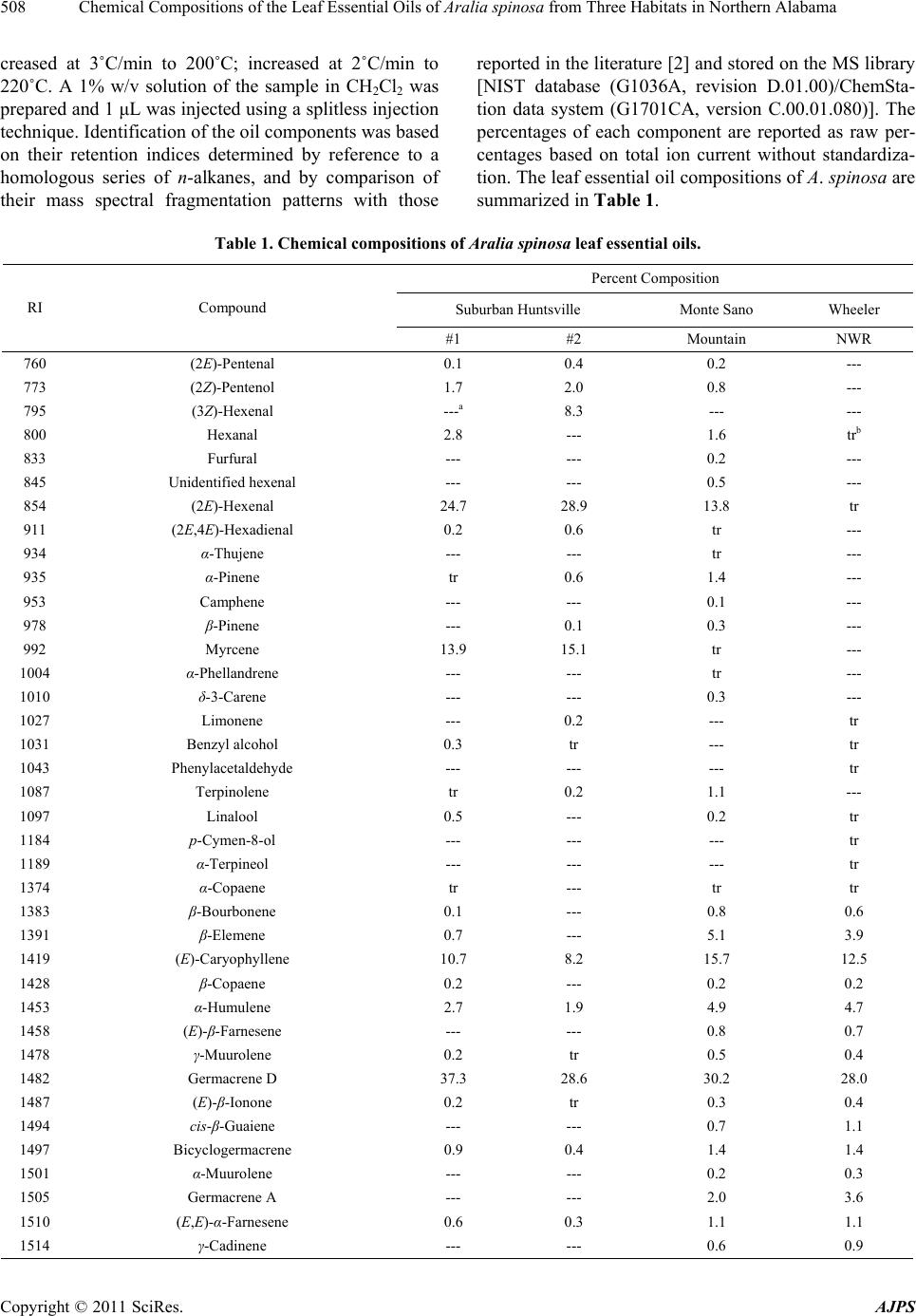 Chemical Compositions of the Leaf Essential Oils of Aralia spinosa from Three Habitats in Northern Alabama 508 creased at 3˚C/min to 200˚C; increased at 2˚C/min to 220˚C. A 1% w/v solution of the sample in CH2Cl2 was prepared and 1 μL was injected using a splitless injection technique. Identification of the oil components was based on their retention indices determined by reference to a homologous series of n-alkanes, and by comparison of their mass spectral fragmentation patterns with those reported in the literature [2] and stored on the MS library [NIST database (G1036A, revision D.01.00)/ChemSta- tion data system (G1701CA, version C.00.01.080)]. The percentages of each component are reported as raw per- centages based on total ion current without standardiza- tion. The leaf essential oil compositions of A. spinosa are summarized in Table 1. Table 1. Chemical compositions of Aralia spinosa leaf essential oils. Percent Composition Suburban Huntsville Monte Sano Wheeler RI Compound #1 #2 Mountain NWR 760 (2E)-Pentenal 0.1 0.4 0.2 --- 773 (2Z)-Pentenol 1.7 2.0 0.8 --- 795 (3Z)-Hexenal ---a 8.3 --- --- 800 Hexanal 2.8 --- 1.6 trb 833 Furfural --- --- 0.2 --- 845 Unidentified hexenal --- --- 0.5 --- 854 (2E)-Hexenal 24.7 28.9 13.8 tr 911 (2E,4E)-Hexadienal 0.2 0.6 tr --- 934 α-Thujene --- --- tr --- 935 α-Pinene tr 0.6 1.4 --- 953 Camphene --- --- 0.1 --- 978 β-Pinene --- 0.1 0.3 --- 992 Myrcene 13.9 15.1 tr --- 1004 α-Phellandrene --- --- tr --- 1010 δ-3-Carene --- --- 0.3 --- 1027 Limonene --- 0.2 --- tr 1031 Benzyl alcohol 0.3 tr --- tr 1043 Phenylacetaldehyde --- --- --- tr 1087 Terpinolene tr 0.2 1.1 --- 1097 Linalool 0.5 --- 0.2 tr 1184 p-Cymen-8-ol --- --- --- tr 1189 α-Terpineol --- --- --- tr 1374 α-Copaene tr --- tr tr 1383 β-Bourbonene 0.1 --- 0.8 0.6 1391 β-Elemene 0.7 --- 5.1 3.9 1419 (E)-Caryophyllene 10.7 8.2 15.7 12.5 1428 β-Copaene 0.2 --- 0.2 0.2 1453 α-Humulene 2.7 1.9 4.9 4.7 1458 (E)-β-Farnesene --- --- 0.8 0.7 1478 γ-Muurolene 0.2 tr 0.5 0.4 1482 Germacrene D 37.3 28.6 30.2 28.0 1487 (E)-β-Ionone 0.2 tr 0.3 0.4 1494 cis-β-Guaiene --- --- 0.7 1.1 1497 Bicyclogermacrene 0.9 0.4 1.4 1.4 1501 α-Muurolene --- --- 0.2 0.3 1505 Germacrene A --- --- 2.0 3.6 1510 (E,E)-α-Farnesene 0.6 0.3 1.1 1.1 1514 γ-Cadinene --- --- 0.6 0.9 Copyright © 2011 SciRes. AJPS 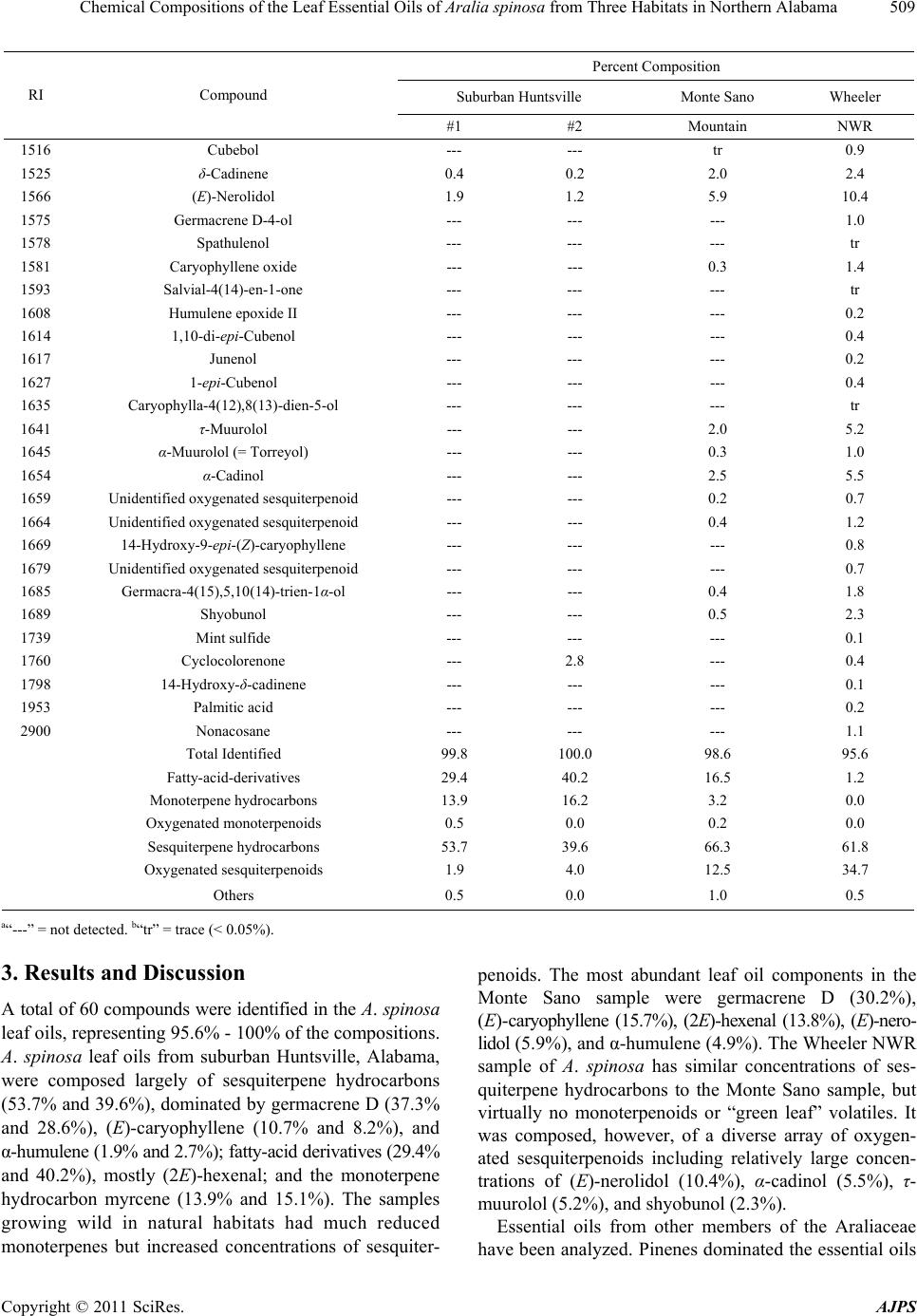 Chemical Compositions of the Leaf Essential Oils of Aralia spinosa from Three Habitats in Northern Alabama509 Percent Composition Suburban Huntsville Monte Sano Wheeler RI Compound #1 #2 Mountain NWR 1516 Cubebol --- --- tr 0.9 1525 δ-Cadinene 0.4 0.2 2.0 2.4 1566 (E)-Nerolidol 1.9 1.2 5.9 10.4 1575 Germacrene D-4-ol --- --- --- 1.0 1578 Spathulenol --- --- --- tr 1581 Caryophyllene oxide --- --- 0.3 1.4 1593 Salvial-4(14)-en-1-one --- --- --- tr 1608 Humulene epoxide II --- --- --- 0.2 1614 1,10-di-epi-Cubenol --- --- --- 0.4 1617 Junenol --- --- --- 0.2 1627 1-epi-Cubenol --- --- --- 0.4 1635 Caryophylla-4(12),8(13)-dien-5-ol --- --- --- tr 1641 τ-Muurolol --- --- 2.0 5.2 1645 α-Muurolol (= Torreyol) --- --- 0.3 1.0 1654 α-Cadinol --- --- 2.5 5.5 1659 Unidentified oxygenated sesquiterpenoid --- --- 0.2 0.7 1664 Unidentified oxygenated sesquiterpenoid --- --- 0.4 1.2 1669 14-Hydroxy-9-epi-(Z)-caryophyllene --- --- --- 0.8 1679 Unidentified oxygenated sesquiterpenoid --- --- --- 0.7 1685 Germacra-4(15),5,10(14)-trien-1α-ol --- --- 0.4 1.8 1689 Shyobunol --- --- 0.5 2.3 1739 Mint sulfide --- --- --- 0.1 1760 Cyclocolorenone --- 2.8 --- 0.4 1798 14-Hydroxy-δ-cadinene --- --- --- 0.1 1953 Palmitic acid --- --- --- 0.2 2900 Nonacosane --- --- --- 1.1 Total Identified 99.8 100.0 98.6 95.6 Fatty-acid-derivatives 29.4 40.2 16.5 1.2 Monoterpene hydrocarbons 13.9 16.2 3.2 0.0 Oxygenated monoterpenoids 0.5 0.0 0.2 0.0 Sesquiterpene hydrocarbons 53.7 39.6 66.3 61.8 Oxygenated sesquiterpenoids 1.9 4.0 12.5 34.7 Others 0.5 0.0 1.0 0.5 a“---” = not detected. b“tr” = trace (< 0.05%). 3. Results and Discussion A total of 60 compounds were identified in the A. spinosa leaf oils, representing 95.6% - 100% of the compositions. A. spinosa leaf oils from suburban Huntsville, Alabama, were composed largely of sesquiterpene hydrocarbons (53.7% and 39.6%), dominated by germacrene D (37.3% and 28.6%), (E)-caryophyllene (10.7% and 8.2%), and α-humulene (1.9% and 2.7%); fatty-acid derivatives (29.4% and 40.2%), mostly (2E)-hexenal; and the monoterpene hydrocarbon myrcene (13.9% and 15.1%). The samples growing wild in natural habitats had much reduced monoterpenes but increased concentrations of sesquiter- penoids. The most abundant leaf oil components in the Monte Sano sample were germacrene D (30.2%), (E)-caryophyllene (15.7%), (2E)-hexenal (13.8%), (E)-nero- lidol (5.9%), and α-humulene (4.9%). The Wheeler NWR sample of A. spinosa has similar concentrations of ses- quiterpene hydrocarbons to the Monte Sano sample, but virtually no monoterpenoids or “green leaf” volatiles. It was composed, however, of a diverse array of oxygen- ated sesquiterpenoids including relatively large concen- trations of (E)-nerolidol (10.4%), α-cadinol (5.5%), τ- muurolol (5.2%), and shyobunol (2.3%). Essential oils from other members of the Araliaceae have been analyzed. Pinenes dominated the essential oils Copyright © 2011 SciRes. AJPS  Chemical Compositions of the Leaf Essential Oils of Aralia spinosa from Three Habitats in Northern Alabama 510 of Acanthopanax trifoliatus [3], Schefflera heptaphylla [4], and Aralia cachemirica [5], while δ-3-carene was the most abundant component of Dendropanax capillaris [6]. The sesquiterpene hydrocarbons (E)-caryophyllene, α- humulene, and germacrene D were the dominant com- ponents of Schefflera stellata [7], Schefflera rodrigu- eziana [6], and Oreopanax nubigenus [6]; (E)-nerolidol was abundant in both Pseudopanax discolor [8] and Op- lopanax horridus [9]; and (2E)-hexenal was a major com- ponent of Dendropanax gonatopodus [10]. The essential oils of Pseudopanax discolor and Pseudopanax lessonii had notable quantities of τ-muurolol [8], while Dendro- panax arboreus and Oreopanax xalapensis were rich in shyobunol [11]. 4. Acknowledgements PCD is thankful for the summer research stipend provided by the University of Alabama in Huntsville Research and Creative Experiences for Undergraduates (RCEU) pro- gram. WNS is grateful to an anonymous private donor for the generous gift of the GC-MS instrumentation. REFERENCES [1] C. L. Brown and L. K. Kirkman, “Trees of Georgia and Adjacent States,” Timber Press, Portland, 1990, pp. 208-209. [2] R. P. Adams, “Identification of Essential Oil Components by Gas Chromatography/Mass Spectrometry,” 4th Edition, Allured Publishing, Carol Stream, 2007. [3] A. Muselli, T. M. Hoi, L. D. Cu, L. D. Moi, J. M. Bessière, A. Bighelli and J. Casanova, “Composition of the Essential Oil of Acanthopanax trifoliatus (L.) Merr. (Araliaceae) from Vietnam,” Flavour and Fragrance Journal, Vol. 14, No. 1, 1999, pp. 41-44. doi:10.1002/(SICI)1099-1026(199901/02)14:1<41:AID-F FJ781>3.0.CO;2-B [4] Y. L. Li, C. M. Yeung, L. C. M. Chiu, Y. Z. Cen and V. E. C. Ooi, “Chemical Composition and Antiproliferative Activity of Essential Oil from the Leaves of a Medicinal Herb, Schefflera heptaphylla,” Phytotherapy Research, Vol. 23, No. 1, 2009, pp. 140-142. doi:10.1002/ptr.2567 [5] R. S. Verma, R. C. Padalia, A. Yadav and A. Chauhan, “Essential Oil Composition of Aralia cachemirica from Uttarakhand, India,” Records of Natural Products, Vol. 4, No. 3, 2010, pp. 163-166. [6] J. D. Richmond, B. R. Agius, B. S. Wright, W. A. Haber, D. M. Moriarity and W. N. Setzer, “Essential Oil Compo- sitions and Cytotoxic Activities of Dendropanax capil- laris, Oreopanax nubigenus and Schefflera rodrigueziana from Monteverde, Costa Rica,” Natural Product Commu- nications, Vol. 4, No. 2, 2009, pp. 271-274. [7] B. Sabulal, V. George, S. P. Nediyaparambu and M. Dan, “Volatile Oils from the Root, Stem and Leaves of Schef- flera stellata (Gaertn.) Harms (Araliaceae): Chemical Characterization and Antimicrobial Activity,” Journal of Essential Oil Research, Vol. 20, No. 1, 2008, pp. 79-82. [8] R. J. Weston, “Essential Oils from the Leaves of Three New Zealand Species of Pseudopanax (Araliaceae),” Zeitschrift für Naturforschung, Vol. 59c, 2004, pp. 39-42. [9] F. X. Garneau, G. Collin, H. Gagnon, F. I. Jean, H. Strobl and A. Pichette, “The Essential Oil Composition of Devil’s Club, Oplopanax horridus J. E. Smith Miq.,” Flavour and Fragrance Journal, Vol. 21, No. 5, 2006, pp. 792-794. doi:10.1002/ffj.1716 [10] W. N. Setzer, “Essential Oil Composition of Dendro- panax gonatopodus from Monteverde, Costa Rica. An ab initio Examination of Aromadendrane Sesquiterpenoids,” Natural Product Communications, Vol. 3, No. 9, 2008, pp. 1557-1561. [11] J. S. Werka, A. K. Boehme and W. N. Setzer, “Biological Activities of Essential Oils of Monteverde, Costa Rica,” Natural Product Communications, Vol. 2, No. 12, 2007, pp. 1215-1219. Copyright © 2011 SciRes. AJPS |