

Paper Menu >>
Journal Menu >>
 Advances in Materials Physics and Chemistry, 2011, 1, 26-30 doi:10.4236/ampc.2011.12005 Published Online September 2011 (http://www.SciRP.org/journal/ampc) Copyright © 2011 SciRes. AMPC Fabrication and Studying the Mechanical Properties of A356 Alloy Reinforced with Al2O3-10% Vol. ZrO2 Nanoparticles through Stir Casting Mohsen Hajizamani, Hamidreza Baharvandi Faculty of Materials and Manufacturing Processes, MUT, Tehran, Iran E-mail: [email protected] Received May 28, 2011; revised July 6, 2011; accepted July 20, 2011 Abstract Al2O3-ZrO2 with a high level of hardness and toughness is known as ceramic steel. Due to its unique proper- ties it can be used as a reinforcement in fabrication of metal matrix composites. In this study, nanoparticles of Al2O3-10% ZrO2 with an average size of 80 nm were used to fabricate Al matrix composites containing 0.5, 1, 1.5 and 2 wt.% of the reinforcement. The fabrication route was stir casting at 850˚C. There is no re- port about usage of this reinforcement in fabrication of composites in the literature. The microstructures of the as-cast composites were studied by scanning electron microscope (SEM). Density measurement, hard- ness and tensile properties were carried out to identify the mechanical properties of the composites. The re- sults revealed that with increasing the reinforcement content, density decreased while yield, ultimate tensile strength and compressive strength increased. Also, hardness increased by increasing the reinforcement con- tent up to 1 wt.% Al2O3-10% ZrO2 but it decreased in the samples containing higher amounts of reinforce- ment. Keywords: Stir Casting, Al Matrix Composite, Al2O3-10% ZrO2 Nanoparticles 1. Introduction Composites containing discontinuous reinforcements es- pecially particulate metal matrix composites have found commercial applications [1-3] because they can be fab- ricated economically by conventional techniques. Al- alloy based composites have attracted attentions due to their processing flexibility, low density, high wear resis- tance, heat treatment capability and improved elastic modulus and strength [4]. AMCs are fabricated by inc- orporating ceramic particles like SiC, B4C, and Al2O3 with particle size of micron or nano-scale into Al-alloy matrix [5]. Ultra fine particles such as nanoparticles noticeably reduce interparticle spacing resulting in increased me- chanical properties. On the other hand, nanoparticles have a high tendency to form agglomerates. Thus, for each technique and matrix, it is important to find out the optimum size, reinforcement content and parameters of fabrication to minimize agglomeration [6]. Factors such as different particle sizes, density, ge- ometries, flow or the development of an electrical charge during mixing may lead to agglomeration [7]. In this process, mixing of matrix and reinforcement is a critical step to obtain a homogenous distribution of reinforcing particles in matrix. Since by reducing ceramic particle size the stress concentration level on each particle is de- creased and makes it difficult to be fractured, nanoscale ceramic particles have attracted attentions in academia and industry [8,9]. Generally, wettability of the reinforcement ceramic particles by a liquid metal is very poor. Good wetting between ceramic particles and liquid metals leads to a proper bonding between these two during and after cast- ing.Various techniques like pretreatment of particles [11], adding elements such as magnesium and lithium into the matrix as surface active agents [12,13], coating or oxi- dizing the ceramic particles [14,15], cleaning the particle surface by ultrasonication and different etching methods [16,17] have been tried to improve wettability. Among various techniques to fabricate metal matrix composites reinforced with ceramic particles, stir casting is one of acceptable routes for commercial production. However, this method needs delicate optimization of parameters 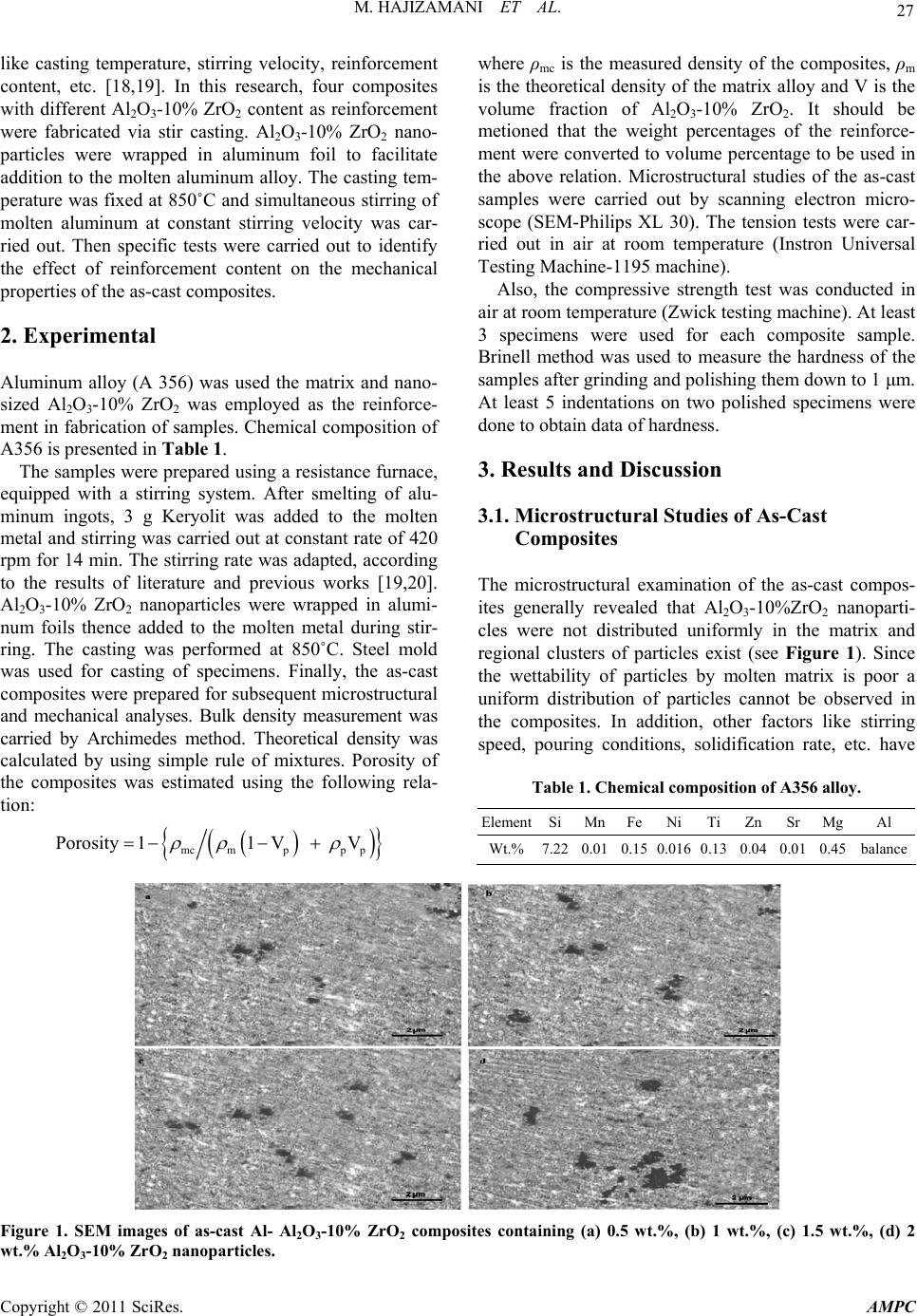 27 M. HAJIZAMANI ET AL. like casting temperature, stirring velocity, reinforcement content, etc. [18,19]. In this research, four composites with different Al2O3-10% ZrO2 content as reinforcement were fabricated via stir casting. Al2O3-10% ZrO2 nano- particles were wrapped in aluminum foil to facilitate addition to the molten aluminum alloy. The casting tem- perature was fixed at 850˚C and simultaneous stirring of molten aluminum at constant stirring velocity was car- ried out. Then specific tests were carried out to identify the effect of reinforcement content on the mechanical properties of the as-cast composites. 2. Experimental Aluminum alloy (A 356) was used the matrix and nano- sized Al2O3-10% ZrO2 was employed as the reinforce- ment in fabrication of samples. Chemical composition of A356 is presented in Table 1. The samples were prepared using a resistance furnace, equipped with a stirring system. After smelting of alu- minum ingots, 3 g Keryolit was added to the molten metal and stirring was carried out at constant rate of 420 rpm for 14 min. The stirring rate was adapted, according to the results of literature and previous works [19,20]. Al2O3-10% ZrO2 nanoparticles were wrapped in alumi- num foils thence added to the molten metal during stir- ring. The casting was performed at 850˚C. Steel mold was used for casting of specimens. Finally, the as-cast composites were prepared for subsequent microstructural and mechanical analyses. Bulk density measurement was carried by Archimedes method. Theoretical density was calculated by using simple rule of mixtures. Porosity of the composites was estimated using the following rela- tion: mcmpp p Porosity11V V where ρmc is the measured density of the composites, ρm is the theoretical density of the matrix alloy and V is the volume fraction of Al2O3-10% ZrO2. It should be metioned that the weight percentages of the reinforce- ment were converted to volume percentage to be used in the above relation. Microstructural studies of the as-cast samples were carried out by scanning electron micro- scope (SEM-Philips XL 30). The tension tests were car- ried out in air at room temperature (Instron Universal Testing Machine-1195 machine). Also, the compressive strength test was conducted in air at room temperature (Zwick testing machine). At least 3 specimens were used for each composite sample. Brinell method was used to measure the hardness of the samples after grinding and polishing them down to 1 μm. At least 5 indentations on two polished specimens were done to obtain data of hardness. 3. Results and Discussion 3.1. Microstructural Studies of As-Cast Composites The microstructural examination of the as-cast compos- ites generally revealed that Al2O3-10%ZrO2 nanoparti- cles were not distributed uniformly in the matrix and regional clusters of particles exist (see Figure 1). Since the wettability of particles by molten matrix is poor a uniform distribution of particles cannot be observed in the composites. In addition, other factors like stirring speed, pouring conditions, solidification rate, etc. have Table 1. Chemical composition of A356 alloy. ElementSiMnFe NiTi Zn Sr MgAl Wt.%7.22 0.01 0.150.016 0.13 0.04 0.01 0.45balance Figure 1. SEM images of as-cast Al- Al2O3-10% ZrO2 composites containing (a) 0.5 wt.%, (b) 1 wt.%, (c) 1.5 wt.%, (d) 2 t.% Al2O3-10% ZrO2 nanoparticles. w Copyright © 2011 SciRes. AMPC 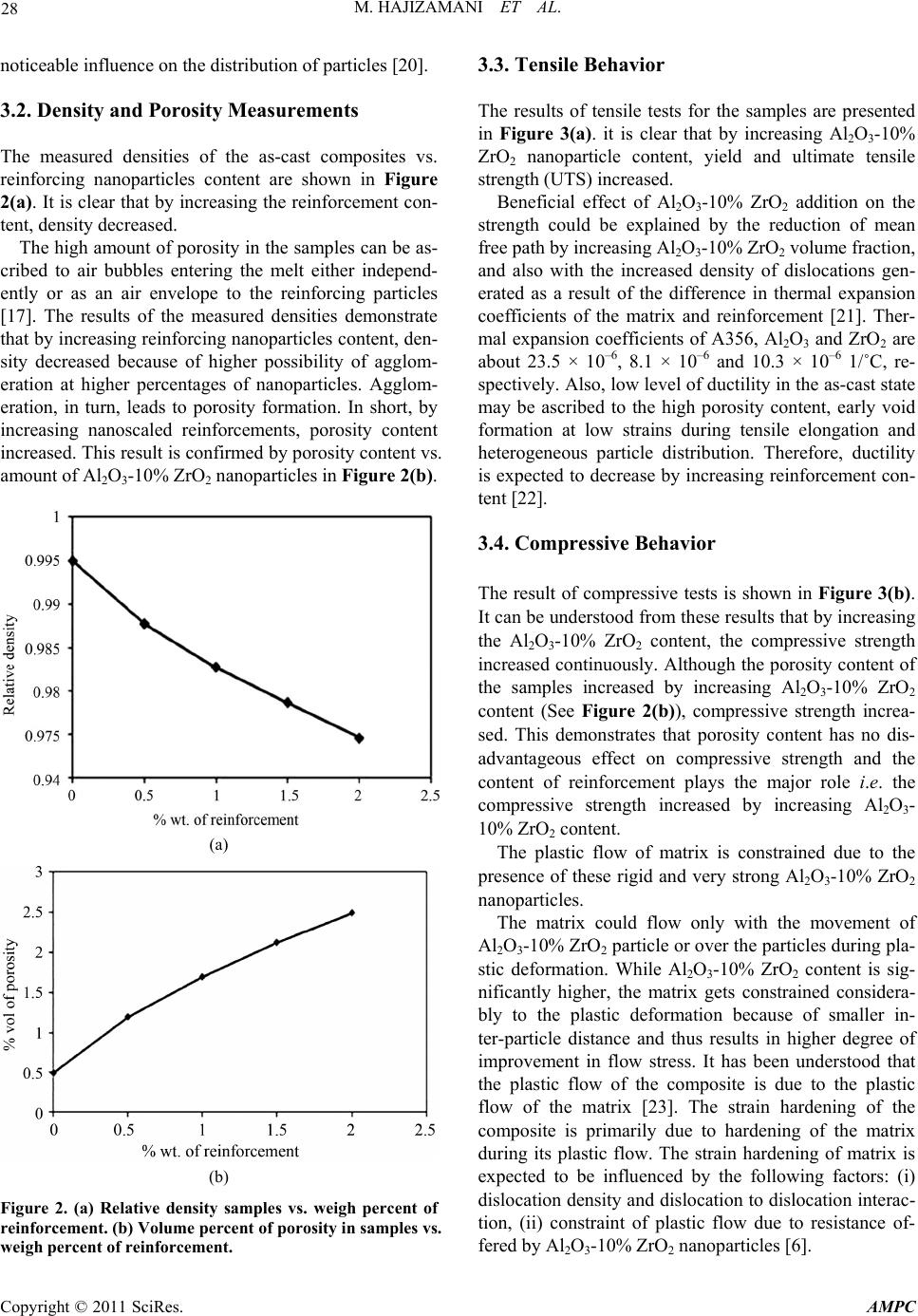 M. HAJIZAMANI ET AL. 28 noticeable influence on the distribution of particles [20]. 3.2. Density and Porosity Measurements The measured densities of the as-cast composites vs. reinforcing nanoparticles content are shown in Figure 2(a). It is clear that by increasing the reinforcement con- tent, density decreased. The high amount of porosity in the samples can be as- cribed to air bubbles entering the melt either independ- ently or as an air envelope to the reinforcing particles [17]. The results of the measured densities demonstrate that by increasing reinforcing nanoparticles content, den- sity decreased because of higher possibility of agglom- eration at higher percentages of nanoparticles. Agglom- eration, in turn, leads to porosity formation. In short, by increasing nanoscaled reinforcements, porosity content increased. This result is confirmed by porosity content vs. amount of Al2O3-10% ZrO2 nanoparticles in Figure 2(b). (a) (b) Figure 2. (a) Relative density samples vs. weigh percent of reinforcement. (b) Volume percent of porosity in samples vs. weigh percent of reinforcement. 3.3. Tensile Behavior The results of tensile tests for the samples are presented in Figure 3(a). it is clear that by increasing Al2O3-10% ZrO2 nanoparticle content, yield and ultimate tensile strength (UTS) increased. Beneficial effect of Al2O3-10% ZrO2 addition on the strength could be explained by the reduction of mean free path by increasing Al2O3-10% ZrO2 volume fraction, and also with the increased density of dislocations gen- erated as a result of the difference in thermal expansion coefficients of the matrix and reinforcement [21]. Ther- mal expansion coefficients of A356, Al2O3 and ZrO2 are about 23.5 × 10⁻⁶, 8.1 × 10⁻⁶ and 10.3 × 10⁻⁶ 1/˚C, re- spectively. Also, low level of ductility in the as-cast state may be ascribed to the high porosity content, early void formation at low strains during tensile elongation and heterogeneous particle distribution. Therefore, ductility is expected to decrease by increasing reinforcement con- tent [22]. 3.4. Compressive Behavior The result of compressive tests is shown in Figure 3(b). It can be understood from these results that by increasing the Al2O3-10% ZrO2 content, the compressive strength increased continuously. Although the porosity content of the samples increased by increasing Al2O3-10% ZrO2 content (See Figure 2(b)), compressive strength increa- sed. This demonstrates that porosity content has no dis- advantageous effect on compressive strength and the content of reinforcement plays the major role i.e. the compressive strength increased by increasing Al2O3- 10% ZrO2 content. The plastic flow of matrix is constrained due to the presence of these rigid and very strong Al2O3-10% ZrO2 nanoparticles. The matrix could flow only with the movement of Al2O3-10% ZrO2 particle or over the particles during pla- stic deformation. While Al2O3-10% ZrO2 content is sig- nificantly higher, the matrix gets constrained considera- bly to the plastic deformation because of smaller in- ter-particle distance and thus results in higher degree of improvement in flow stress. It has been understood that the plastic flow of the composite is due to the plastic flow of the matrix [23]. The strain hardening of the composite is primarily due to hardening of the matrix during its plastic flow. The strain hardening of matrix is expected to be influenced by the following factors: (i) dislocation density and dislocation to dislocation interac- tion, (ii) constraint of plastic flow due to resistance of- fered by Al2O3-10% ZrO2 nanoparticles [6]. Copyright © 2011 SciRes. AMPC 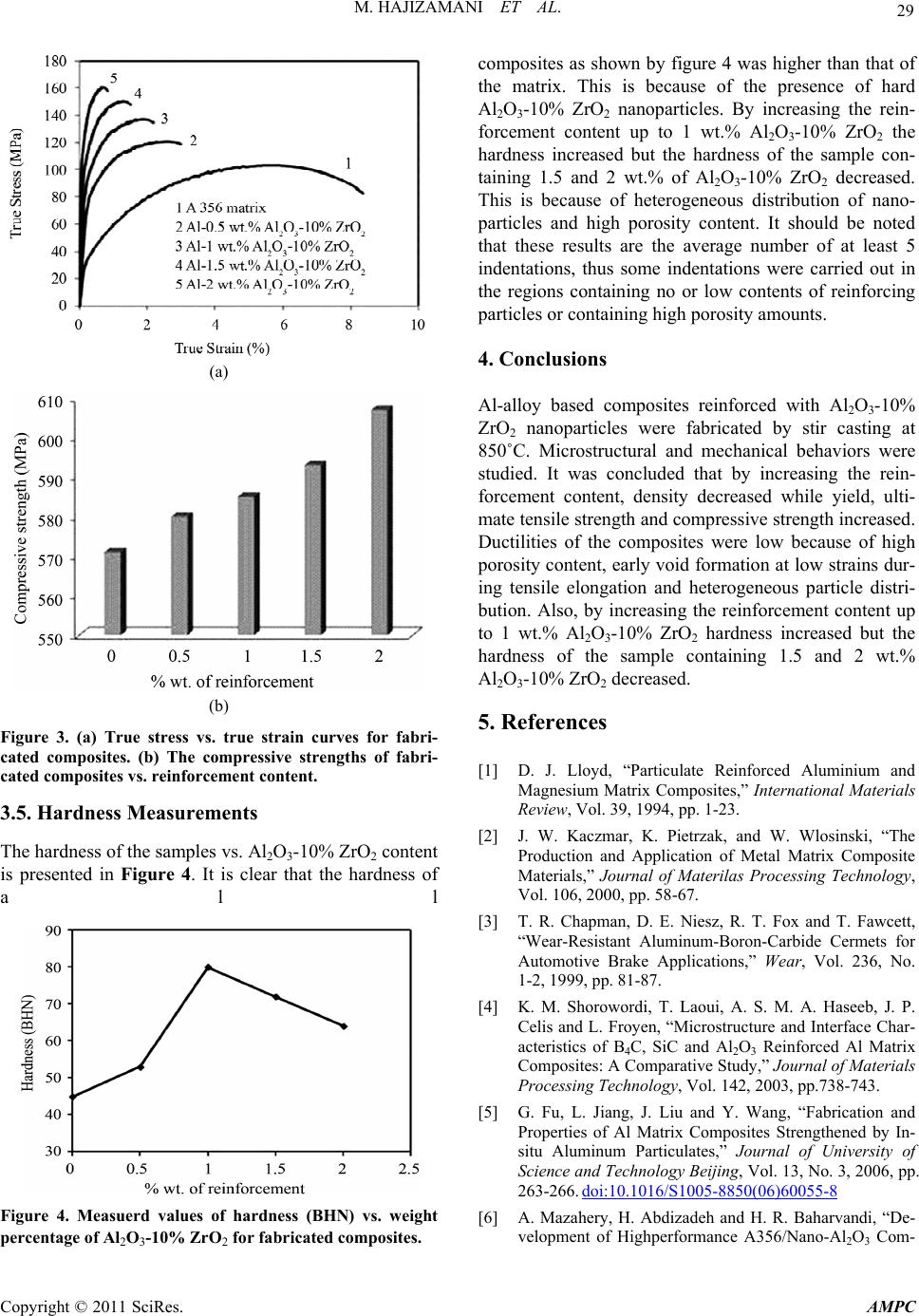 29 M. HAJIZAMANI ET AL. (a) (b) Figure 3. (a) True stress vs. true strain curves for fabri- cated composites. (b) The compressive strengths of fabri- cated composites vs. reinforcement content. 3.5. Hardness Measurements The hardness of the samples vs. Al2O3-10% ZrO2 content is presented in Figure 4. It is clear that the hardness of all Figure 4. Measuerd values of hardness (BHN) vs. weight percentage of Al2O3-10% ZrO2 for fabricated compo sites. composites as shown by figure 4 was higher than that of the matrix. This is because of the presence of hard Al2O3-10% ZrO2 nanoparticles. By increasing the rein- forcement content up to 1 wt.% Al2O3-10% ZrO2 the hardness increased but the hardness of the sample con- taining 1.5 and 2 wt.% of Al2O3-10% ZrO2 decreased. This is because of heterogeneous distribution of nano- particles and high porosity content. It should be noted that these results are the average number of at least 5 indentations, thus some indentations were carried out in the regions containing no or low contents of reinforcing particles or containing high porosity amounts. 4. Conclusions Al-alloy based composites reinforced with Al2O3-10% ZrO2 nanoparticles were fabricated by stir casting at 850˚C. Microstructural and mechanical behaviors were studied. It was concluded that by increasing the rein- forcement content, density decreased while yield, ulti- mate tensile strength and compressive strength increased. Ductilities of the composites were low because of high porosity content, early void formation at low strains dur- ing tensile elongation and heterogeneous particle distri- bution. Also, by increasing the reinforcement content up to 1 wt.% Al2O3-10% ZrO2 hardness increased but the hardness of the sample containing 1.5 and 2 wt.% Al2O3-10% ZrO2 decreased. 5. References [1] D. J. Lloyd, “Particulate Reinforced Aluminium and Magnesium Matrix Composites,” International Materials Review, Vol. 39, 1994, pp. 1-23. [2] J. W. Kaczmar, K. Pietrzak, and W. Wlosinski, “The Production and Application of Metal Matrix Composite Materials,” Journal of Materilas Processing Technology, Vol. 106, 2000, pp. 58-67. [3] T. R. Chapman, D. E. Niesz, R. T. Fox and T. Fawcett, “Wear-Resistant Aluminum-Boron-Carbide Cermets for Automotive Brake Applications,” Wear, Vol. 236, No. 1-2, 1999, pp. 81-87. [4] K. M. Shorowordi, T. Laoui, A. S. M. A. Haseeb, J. P. Celis and L. Froyen, “Microstructure and Interface Char- acteristics of B4C, SiC and Al2O3 Reinforced Al Matrix Composites: A Comparative Study,” Journal of Materials Processing Technology, Vol. 142, 2003, pp.738-743. [5] G. Fu, L. Jiang, J. Liu and Y. Wang, “Fabrication and Properties of Al Matrix Composites Strengthened by In- situ Aluminum Particulates,” Journal of University of Science and Technology Beijing, Vol. 13, No. 3, 2006, pp. 263-266. doi:10.1016/S1005-8850(06)60055-8 [6] A. Mazahery, H. Abdizadeh and H. R. Baharvandi, “De- velopment of Highperformance A356/Nano-Al2O3 Com- Copyright © 2011 SciRes. AMPC  M. HAJIZAMANI ET AL. Copyright © 2011 SciRes. AMPC 30 posites,” Materials Science and Engineering A, Vol. 518, No. 1-2, pp. 61-64. doi:10.1016/j.msea.2009.04.014 [7] J. B. Fogagnolo, M. H. Robert and J. M. Torralba, “Me- chanically Alloyed AlN Particlereinforced Al-6061 Ma- trix Composites: Powder Processing, Consolidation and Mechanical Strength and Hardness of the As-Extruded Materials,” Materials Science and Engineering A, Vol. 426, No. 1-2, 2006, pp. 85-94. doi:10.1016/j.msea.2006.03.074 [8] Y. Q. Liu, H. T. Cong, W. Wang, C. H. Sun and H. M. Cheng, “AlN Nanoparticle-Reinforced Nanocrystalline Al Matrix Composites: Fabrication and Mechanical Properties,” Materials Science and Engineering A, Vol. 505, No. 1-2, 2009, pp. 151-156. [9] H. Zhang, K. T. Ramesh and E. S. C. Chin, “High Strain Rate Response of Aluminum 6092/B4C Composites,” Materials Science and Engineering A, Vol. 384, No. 1-2, 2004, pp. 26-34. [10] S. Oh, J. A. Cornie and K. C. Russel, “Wetting of Ce- ramic Particulates with Liquid Aluminium Alloys. Part II. Study of Wettability,” Metalls Transactions A, Vol. 20, 1989, pp. 533-541. [11] B. P. Krishnan, M. K. Surappa and P. K. Rohatgi, “UPAL Process: A Direct Method for Producing Cast Aluminum Alloy Graphite Composites,” Journal of Materials Sci- ence, Vol. 16, 1981, pp. 1209-1216. [12] F. Dellanney, L. Rozen and A. Deryterre, “The Wetting of Solids by Molten Metals and Its Relation to the Prepa- ration of Metal-Matrix Composites,” Journal of Materials Science Letters, Vol. 22, 1987, pp. 1-16. [13] Y. Kimura, “Compatibility between Carbon Fiber and Binary Aluminum Alloys,” Journal of Materials Science, Vol. 19, 1984, pp. 3107-3114. [14] B. C. Pai, A. G. Kulkarni, T. A. Bhasker and N. Balasubramanian, “Coating Structure of Metal-Coated Carbon-Fibers,” Journal of Materials Science, Vol. 15, No. 7, 1980, pp. 1860-1863. [15] J. P. Rocher, J. M. Quinisset and R. Naslain, “A New Casting Process for Carbon (or SiC Based) Fi- bre-Aluminium Matrix Low-Cost Composite Materials,” Journal of Materials Science Letters, Vol. 4, 1985, pp. 1527-1529. [16] J. Hashim, L. Looney and M. S. J. Hashmi, “The Atomic Arrangement in Glass,” Journal of Materilas Processing Technology, Vol. 119, 2001, pp. 324-328. [17] J. Hashim, L. Looney and M. S. J. Hashmi, “Metal Ma- trix Composites: Production by the Stir Casting Method,” Journal of Materials Processing Technology, Vol. 92-93, 1999, pp.1-7. doi:10.1016/S0924-0136(99)00118-1 [18] X. J. Wang, X. S. Hu, K. Wu, K. K. Deng, W. M. Gan, C. Y. Wang and M. Y. Zheng, “Hot Deformation Behavior of SiCp/AZ91 Magnesium Matrix Composite Fabricated by Stir Casting,” Materials Science and Engineering A, Vol. 492, 2008, pp. 481-485. [19] B. Previtali, D. Pocci and C. Taccardo, “Application of Traditional Investment Casting Process to Aluminium Matrix Composites,” Composites Part A: Applied Science and Manufacturing, Vol. 39, 2008, pp. 1606-1617. [20] A. Daoud and M. Abo-Elkhar, “Influence of Al2O3 or ZrO2 Particulate Addition on the Microstructure Aspects of AlNi and AlSi Alloys,” Journal of Materilas Process- ing Technology, Vol. 120, 2002, pp. 296-302. [21] U. Cocen and K. Onel, “Ductility and Strength of Ex- truded SiCp/Aluminium-Alloy Composites,” Composites Science and Technology, Vol. 62, 2002, pp. 275-282. [22] A. Pakdel and H. Farhangi, “Influence of Extrusion on the Mechanical Behavior of AA6061/SiC Composites,” The Arabian Journal of Science and Engineering, Vol. 34, 2009, pp. 167-174. [23] M. Karimi, H. R. Baharvandi, H. Abdizadeh, B. Pak Beyrami and M. A. Mobarhan Bonab, “Microstructure and Mechanical Properties of Al-Nano ZrO2 Composites Produced by Casting Route,” Proceedings of Interna- tional Conference on Smart Materials and Nanotechnol- ogy in Engineering, Harbin, 1 July 2007, Vol. 6423, pp. 64235Y-1 to 64235Y-7. |