

Paper Menu >>
Journal Menu >>
 American Journal of Plant Sciences, 2011, 2, 354-358 doi:10.4236/ajps.2011.23040 Published Online September 2011 (http://www.SciRP.org/journal/ajps) Copyright © 2011 SciRes. AJPS Effect of Kaolin Film Particle Applications (Surround WP®) and Water Deficit on Physiological Characteristics in Rose Cut Plants (Rose spp L.) Yuly Marcela Sotelo-Cuitiva, Hermann Restrepo-Díaz*, Alexandra García-Castro, Augusto Ramírez-Godoy, Victor Julio Flórez-Roncancio Faculty of Agronomy, National University of Colombia, Bogotá, Colombia. Email: *[email protected] Received May 7th, 2011; revised June 10th, 2011; accepted July 17th, 2011. ABSTRACT The effect of foliar applica tions of a kaolin clay particle film (Surround WP) on leaf temperature (Tlf), chlorophyll fl uo- rescence (Fv/Fm), shoot length, production and water relations in well-irrigated and water-stressed rose cut plants (Rose spp) were studied during ten weeks. Plants were sprayed twice at first and fifth week a fter the experiment star ted with aqueous suspensions of Kaolin (Surround) at a dose of 5% (w/v). The interaction between Kaolin applica tions an d water status did not showed significances. Water stress decreased the stomatal conductance (gs), leaf water content (LWC), shoot length and the number of marketable floral stems. Kaolin sprays did not affect on SPAD readings, chlo- rophyll fluorescence, gs, LWC and shoot length. Kaolin reduced leaf temperature by 2.5˚C approximately at midday compared to plants non-sprayed with kao lin. These results show that kaolin foliar applicatio ns could be considered an useful tool at early growth stage in improving rose plant acclimation to high temperatures levels under greenhouse conditions in trop ical regions. Keywords: Surround WP, Leaf Water Content, Stomatal Conductance, Leaf Temperature, Shoot Length 1. Introduction Rose is one of the main ornamental plants in the world [1], being Colombia the first roses-producing country in Latin American and the second roses-exporting country in the world with a exportation of 59,499 tons of rose for cutflower during 2009 [2]. Temperatures are often higher than optimal in orna- mental production systems. This situation may stress plants, causing a reduction of quality and/or yield of or- namental crops [3]. The high solar radiation and tem- peratures cause high rates of plant water loss and plants regularly show symptoms of burn or withering in leaves or fruits [4]. In Colombia, it is common find high tem- peratures (above 35˚C) in greenhouses during dry season (period of time without rains) or the Niño phenomenon [5]. High temperatures may reduce flower quality be- cause of excessive plant transpiration and respiration [6]. On the other hand, low leaf water content causes nega- tive effect on leaf area, CO2 assimilation rate, stomatal conductance and yield in rose plants [7]. To diminish the negative influence of water and heat stress on plant physiology and productivity, particle film applications such as kaolin have been used [8]. Kaolin cools tissues and protects plants from extreme heat and ultraviolet radiation by increasing leaf reflectance and reducing transpiration rate [9,10]. Kaolin has been tested in different horticultural crops and its response has been heterogeneous [8]. Kaolin showed a reduction on leaf temperature in apple trees [11], and improved light-saturated CO2 assimilation rate (Amax) and stomatal conductance (gs) in citrus at midday [12]. However, kaolin has no effect on gas exchange pa- rameters in pepper [13] and did not suffice to mitigate the adverse effects of heat and water stress on photo- synthesis in almond and walnut [8], and enhanced water loss from fruit in tomato [9]. Combined studies on the influence of kaolin particle film applications and water stress have been limited in ornamental plants. Only, the  Effect of Kaolin Film Particle Applications (Surround WP®) and Water Deficit on 355 Physiological Characteristics in Rose Cut Plants (Rose spp L.) literature stated studies performed by Moftah and Al-Humaid [14] that the kaolin sprays enhanced water status, water use efficiency (WUE) and the photosyn- thetic activity in an ornamental plant (Polianthes tube- rosa L.) under water deficit. However, there are not studies that have evaluated the use of foliar applications of kaolin on ornamental plants established under water deficit conditions in tropical regions. For that reason, the aim of the present work was to study and compare the influence of kaolin film particle applications and the water status on the stomatal conduc- tance, chlorophyll fluorescence, chlorophyll content, shoot length, yield of marketable stems, leaf water content and leaf temperature in rose cut plants. 2. Materials and Method This study was carried out at “Centro de Biotecnologia del SENA” in Mosquera, Colombia (latitude 4.7˚ N, lon- gitude 74.2˚ W) for 10 weeks under greenhouse condi- tions. The greenhouse conditions during the experiment were the following: maximum temperature 35.5˚C, minimum temperature 10˚C, solar radiation 85.41 W/m2, relative humidity between 50% - 90% and a photoperiod of 12 h, approximately. Four-year-old “Charlotte” rose plants grafted on “Natal Briar” were used. Two plants were cultivated into 8-l plastic pots containing rice husk (burnt at 65%) as substrate. The plants received routine horticultural care suitable for commercial production such as weed and pest control. Treatments were established after shoot pinch. Rose plants were split into two groups (well-fertigated (W) and water-stressed (S) plants). Well-fertigated plants were watered daily with 850 ml of a nutrient solution which had the following composition in ppm: N 170, P 35, K 150, Ca 110, Mg 60, S 82, Mn 1, Zn 0.5, Cu 0.5, Fe 3, B 0.5 and Mo 0.1. This volume of irrigation is common used by rose’s growers in Colombia [15]. Water-stressed plants were irrigated daily with the 50% of the nutrient solution’s volume (475 ml), which also had the same nutritional concentration mentioned above. This water quantity was chosen as water stress treatment because growing is affected [7]. Additionally, water stressed plant received complementary fertilization in order to have plants with similar nutritional conditions. Then, plants in both water statuses were also separated into plants sprayed with kaolin and plants without kaolin. Kaolin foliar ap- plications were performed at 6 and 30 days after shoot pinch (DAP). Foliar applications of kaolin (300 ml/plant) were carried out with an air blast sprayer, wetting the upper and lower surfaces. Foliar applications were per- formed at early morning at a rate of 5% (w/v) kaolin wa- ter suspension (Surround WP, Tessenderlo Kerley, US), with no adhesive or other compounds. Leaf chlorophyll content and leaf temperature were measured at 15, 30, 45 and 60 DAP on a fully mature ex- panded leaf using a SPAD chlorophyll meter as a nonde- structive tool for estimating leaf Chlorophyll (SPAD-502, Konica Minolta Sensing, Inc., Ramsey, NJ) and an infra- red thermometer (MX2SL3U, Cole-Parmer Instrument Company, Vernon Hills, IL), respectively. Leaf tempera- ture readings were carried out at mid-day. Leaf chlorophyll fluorescence was estimated at 60 DAP using a continuous excitation chlorophyll fluorescence analyzer (Handy PEA, Hansatech Instruments, Kings Lynn, UK) in order to evaluate the maximum efficiency of photosystem II (Fv/Fm). Previously, leaves were acclimated to the dark using lightweight leaf clips for at least half an hour before measurements were performed. Stomatal conductance was measured on a fully ex- panded mature leaf from the midportion of canopy using a leaf-porometer (SC-1 Decagon Devices, Inc., Pullman, WA). This measurement was performed at 60 DAP be- tween 0900 h and 1500 h. Fully expanded mature leaves from the midportion of canopy were collected. Leaves were introduced into a cooler with ice to avoid dehydration and then taken to the laboratory where fresh weight (FW) and dry weight (DW) were determined. Leaf water content (LWC) was esti- mated by the equation: LWC = 100 × (FW – DW)/(FW). Soil water content (SWC) was also determined by a soil humidity probe (Kelway Soil tester, Kel instruments Co., Inc., Wyckoff, NJ). LWC and SWC were obtained at 15, 30, 45 and 60 DAP. Shoot length was estimated from eight stems per pot and recorded every week starting 15 DAP until harvest. The portion of light intercepted by the canopy was calculated using the technique described by Naab et al. [16] at 60 DAP. Leaf area index (LAI) was calculated at the end of experiment by a ceptometer (Accupar LP-80, Decagon Devices, Inc., Pullman, WA). Marketable floral stems were counted at harvesting time. A floral stem was considered marketable when its length was higher than 50 cm. A factorial experiment with two factors, Kaolin sprays (Kaolin versus without kaolin) and plant water status (well-irrigated versus water-stressed) with four blocks, was established in the above-mentioned greenhouse. The experimental unit was composed of six plastic pots. An- alyses of variance were performed on the data to com- pare the effect of the treatments. All percentage values were transformed using the arcsine transformation before analysis. Where a significant F-test was observed, mean separation between treatments was obtained by Tukey’s test. Data were analyzed using Statistix Version 8.0 (Ana- lytical Software, Tallahassee, FL, US). Copyright © 2011 SciRes. AJPS 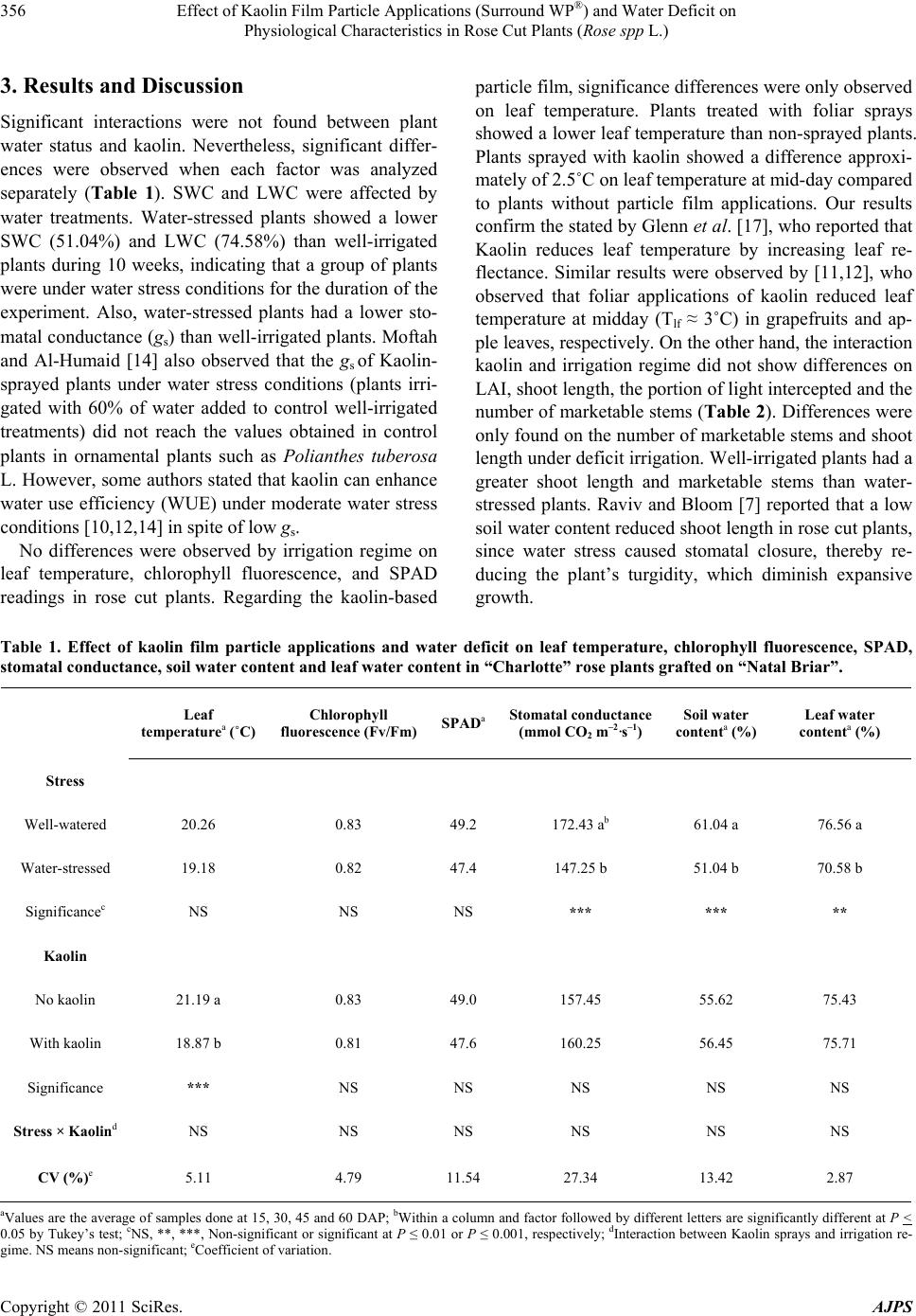 Effect of Kaolin Film Particle Applications (Surround WP®) and Water Deficit on Physiological Characteristics in Rose Cut Plants (Rose spp L.) Copyright © 2011 SciRes. AJPS 356 3. Results and Discussion Significant interactions were not found between plant water status and kaolin. Nevertheless, significant differ- ences were observed when each factor was analyzed separately (Table 1). SWC and LWC were affected by water treatments. Water-stressed plants showed a lower SWC (51.04%) and LWC (74.58%) than well-irrigated plants during 10 weeks, indicating that a group of plants were under water stress conditions for the duration of the experiment. Also, water-stressed plants had a lower sto- matal conductance (gs) than well-irrigated plants. Moftah and Al-Humaid [14] also observed that the gs of Kaolin- sprayed plants under water stress conditions (plants irri- gated with 60% of water added to control well-irrigated treatments) did not reach the values obtained in control plants in ornamental plants such as Polianthes tuberosa L. However, some authors stated that kaolin can enhance water use efficiency (WUE) under moderate water stress conditions [10,12,14] in spite of low gs. No differences were observed by irrigation regime on leaf temperature, chlorophyll fluorescence, and SPAD readings in rose cut plants. Regarding the kaolin-based particle film, significance differences were only observed on leaf temperature. Plants treated with foliar sprays showed a lower leaf temperature than non-sprayed plants. Plants sprayed with kaolin showed a difference approxi- mately of 2.5˚C on leaf temperature at mid-day compared to plants without particle film applications. Our results confirm the stated by Glenn et al. [17], who reported that Kaolin reduces leaf temperature by increasing leaf re- flectance. Similar results were observed by [11,12], who observed that foliar applications of kaolin reduced leaf temperature at midday (Tlf ≈ 3˚C) in grapefruits and ap- ple leaves, respectively. On the other hand, the interaction kaolin and irrigation regime did not show differences on LAI, shoot length, the portion of light intercepted and the number of marketable stems (Table 2). Differences were only found on the number of marketable stems and shoot length under deficit irrigation. Well-irrigated plants had a greater shoot length and marketable stems than water- stressed plants. Raviv and Bloom [7] reported that a low soil water content reduced shoot length in rose cut plants, since water stress caused stomatal closure, thereby re- ducing the plant’s turgidity, which diminish expansive growth. Table 1. Effect of kaolin film particle applications and water deficit on leaf temperature, chlorophyll fluorescence, SPAD, stomatal conductance, soil wate r conte nt and le af water c o nt ent in “Charlotte” rose plants grafted on “Natal Briar”. Leaf temperaturea (˚C) Chlorophyll fluorescence (Fv/Fm)SPADa Stomatal conductance (mmol CO2 m–2·s–1) Soil water contenta (%) Leaf water contenta (%) Stress Well-watered 20.26 0.83 49.2 172.43 ab 61.04 a 76.56 a Water-stressed 19.18 0.82 47.4 147.25 b 51.04 b 70.58 b Significancec NS NS NS *** *** ** Kaolin No kaolin 21.19 a 0.83 49.0 157.45 55.62 75.43 With kaolin 18.87 b 0.81 47.6 160.25 56.45 75.71 Significance *** NS NS NS NS NS Stress × Kaolind NS NS NS NS NS NS CV (%)e 5.11 4.79 11.54 27.34 13.42 2.87 aValues are the average of samples done at 15, 30, 45 and 60 DAP; bWithin a column and factor followed by different letters are significantly different at P < 0.05 by Tukey’s test; cNS, **, ***, Non-significant or significant at P ≤ 0.01 or P ≤ 0.001, respectively; dInteraction between Kaolin sprays and irrigation re- gime. NS means non-significant; eCoefficient of variation. 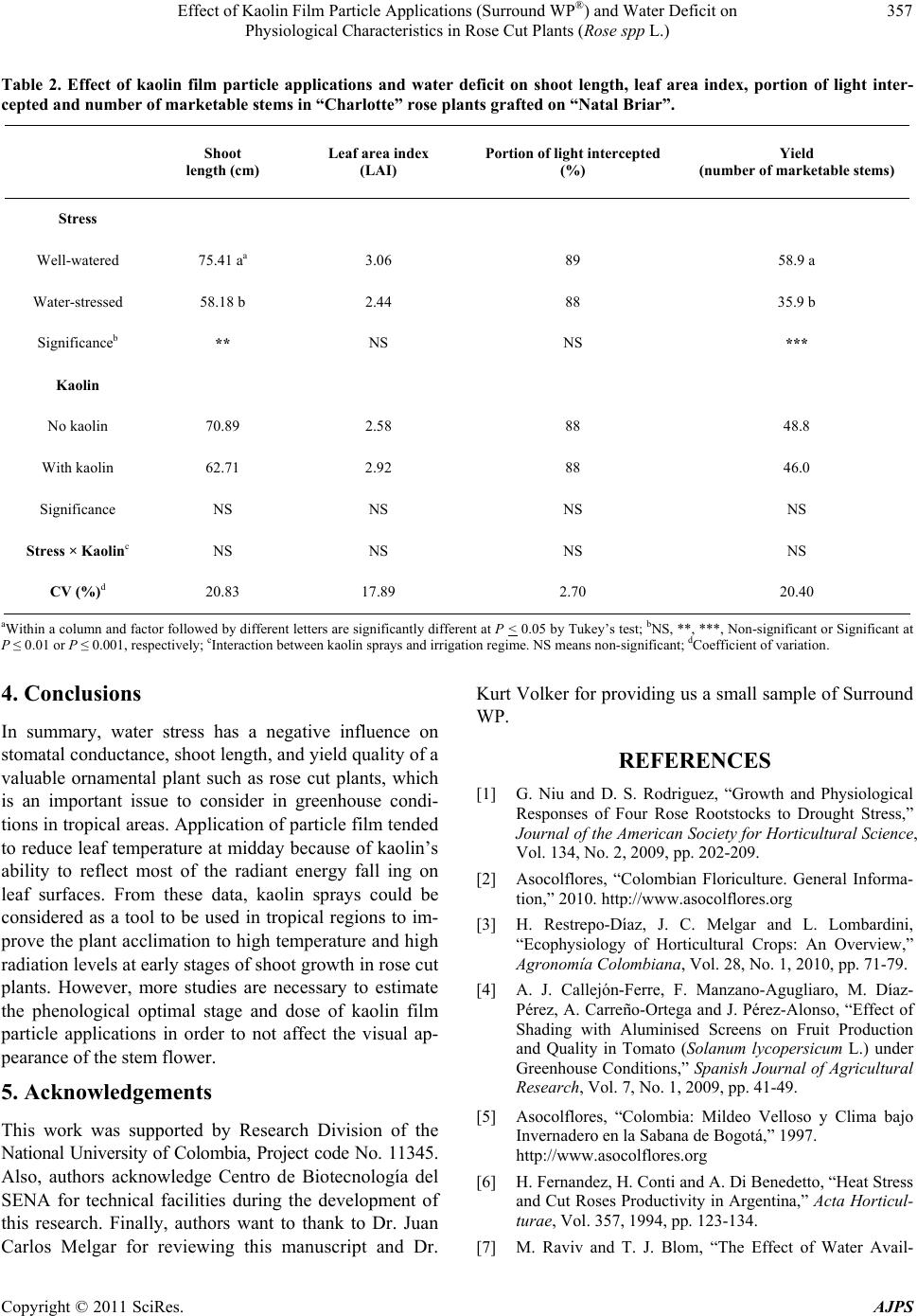 Effect of Kaolin Film Particle Applications (Surround WP®) and Water Deficit on 357 Physiological Characteristics in Rose Cut Plants (Rose spp L.) Table 2. Effect of kaolin film particle applications and water deficit on shoot length, leaf area index, portion of light inter- cepted and number of marketable stems in “Charlotte” rose plants grafted on “Natal Briar”. Shoot length (cm) Leaf area index (LAI) Portion of light intercepted (%) Yield (number of marketable stems) Stress Well-watered 75.41 aa 3.06 89 58.9 a Water-stressed 58.18 b 2.44 88 35.9 b Significanceb ** NS NS *** Kaolin No kaolin 70.89 2.58 88 48.8 With kaolin 62.71 2.92 88 46.0 Significance NS NS NS NS Stress × Kaolinc NS NS NS NS CV (%)d 20.83 17.89 2.70 20.40 aWithin a column and factor followed by different letters are significantly different at P < 0.05 by Tukey’s test; bNS, **, ***, Non-significant or Significant at P ≤ 0.01 or P ≤ 0.001, respectively; cInteraction between kaolin sprays and irrigation regime. NS means non-significant; dCoefficient of variation. 4. Conclusions In summary, water stress has a negative influence on stomatal conductance, shoot length, and yield quality of a valuable ornamental plant such as rose cut plants, which is an important issue to consider in greenhouse condi- tions in tropical areas. Application of particle film tended to reduce leaf temperature at midday because of kaolin’s ability to reflect most of the radiant energy fall ing on leaf surfaces. From these data, kaolin sprays could be considered as a tool to be used in tropical regions to im- prove the plant acclimation to high temperature and high radiation levels at early stages of shoot growth in rose cut plants. However, more studies are necessary to estimate the phenological optimal stage and dose of kaolin film particle applications in order to not affect the visual ap- pearance of the stem flower. 5. Acknowledgements This work was supported by Research Division of the National University of Colombia, Project code No. 11345. Also, authors acknowledge Centro de Biotecnología del SENA for technical facilities during the development of this research. Finally, authors want to thank to Dr. Juan Carlos Melgar for reviewing this manuscript and Dr. Kurt Volker for providing us a small sample of Surround WP. REFERENCES [1] G. Niu and D. S. Rodriguez, “Growth and Physiological Responses of Four Rose Rootstocks to Drought Stress,” Journal of the American Society for Horticultural Science, Vol. 134, No. 2, 2009, pp. 202-209. [2] Asocolflores, “Colombian Floriculture. General Informa- tion,” 2010. http://www.asocolflores.org [3] H. Restrepo-Díaz, J. C. Melgar and L. Lombardini, “Ecophysiology of Horticultural Crops: An Overview,” Agronomía Colombiana, Vol. 28, No. 1, 2010, pp. 71-79. [4] A. J. Callejón-Ferre, F. Manzano-Agugliaro, M. Díaz- Pérez, A. Carreño-Ortega and J. Pérez-Alonso, “Effect of Shading with Aluminised Screens on Fruit Production and Quality in Tomato (Solanum lycopersicum L.) under Greenhouse Conditions,” Spanish Journal of Agricultural Research, Vol. 7, No. 1, 2009, pp. 41-49. [5] Asocolflores, “Colombia: Mildeo Velloso y Clima bajo Invernadero en la Sabana de Bogotá,” 1997. http://www.asocolflores.org [6] H. Fernandez, H. Conti and A. Di Benedetto, “Heat Stress and Cut Roses Productivity in Argentina,” Acta Horticul- turae, Vol. 357, 1994, pp. 123-134. [7] M. Raviv and T. J. Blom, “The Effect of Water Avail- Copyright © 2011 SciRes. AJPS  Effect of Kaolin Film Particle Applications (Surround WP®) and Water Deficit on 358 Physiological Characteristics in Rose Cut Plants (Rose spp L.) abilty and Quality on Photosynthesis and Productivity of Soilless-Grown Cut Roses,” Scientia Horticulturae, Vol. 88, 2001, pp. 257-276. [8] A. Rosati, S. G. Metcalf, R. P. Buchner, A. E. Fulton and B. D. Lampinen, “Physiological Effects of Kaolin Appli- cations in Well-Irrigated and Water-Stressed Walnut and Almond Trees,” Annals of Botany, Vol. 98, No. 1, 2006, pp. 267-275. doi:10.1093/aob/mcl100 [9] A. Nakano and Y. Uehara, “The Effects of Kaolin Clay on Cuticle Transpiration in Tomato,” Acta Horticulturae, Vol. 440, 1996, pp. 233-238. [10] D. M. Glenn, N. Cooley, R. Walker, P. Clingeleffer and K. Shellie, “Impact of Kaolin Particle Film and Water Deficit on Wine Grape Water Use Efficiency and Plant Water Relation,” HortScience, Vol. 45, No. 8, 2010, pp. 1178-1187. [11] N. Wunsche, L. Lombardini and D. H. Greer, “‘Surround’ Particle Film Applications―Effects on Whole Canopy Physiology of Apple,” Acta Horticulturae, Vol. 636, 2004, pp. 565-575. [12] J. L. Jifon and J. P. Syvertsen, “Kaolin Particle Film Ap- lications Can Increase Photosynthesis and Water Use Ef- ficiency of ‘Ruby Red’ Grapefruit Leaves,” Journal of the American Society for Horticultural Science, Vol. 128, No. 1, 2003, pp. 104-112. [13] V. M. Russo and J. C. Diaz-Perez, “Kaolin-Based Particle Film Has No Effect on Physiological Measurements, Disease Incidence or Yield in Peppers,” HortScience, Vol. 40, No. 1, 2005, pp. 98-101. [14] A. E. Moftah and A. I. Al-Humaid, “Effects of Kaolin and Pinolene Film-Forming Polymers on Water Relations and Photosynthetic Rate of Tuberose (Polianthes tube- rosa L.),” Agricultural Sciences, Vol. 18, No. 1, 2005, pp. 35-49. [15] V. Flórez, A. Fernández, D. Miranda, B. Chaves and J. Guzmán, “Avances Sobre Fertirriego en la Floricultura Colombiana,” Unibiblos, Bogotá, 2006. [16] J. B. Naab, K. J. Boote, P. V. Prasad, S. S. Seini and J. W. Jones, “Influence of Fungicide and Sowing Density on the Growth and Yield of Two Groundnut Cultivars,” The Journal of Agrcultural Science, Vol. 147, 2009, pp. 179-191. [17] D. M. Glenn, E. Prado, A. Erez, J. McFerson and G. J. Puterka, “A Reflective, Processed-Kaolin Particle Film Affects Fruit Temperature, Radiation Reflection, and So- lar Injury in Apple,” Journal of the American Society for Horticultural Science, Vol. 127, No. 2, 2002, pp. 188- 193. Copyright © 2011 SciRes. AJPS |