

Paper Menu >>
Journal Menu >>
 Open Journal of Soil Science, 2011, 1, 40-44 doi:10.4236/ojss.2011.12005 Published Online September 2011 (http://www.SciRP.org/journal/ojss) Copyright © 2011 SciRes. OJSS A Rapid Technique for Prediction of Nutrient Release from Polymer Coated Controlled Release Fertilizers Shengsen Wang1, Ashok K. Alva1*, Yuncong Li2, M in Zhang3 1USDA-ARS, 24106 N. Bunn Road, Prosser, WA99350; 2University of Florida, Tropical Research and Education Center, Homestead, USA; 3Shandong Agricultural University, College of Resources and Environment, Taian, China. Email: *[email protected] Received July 28th, 2011; revised August 15th, 2011; accepted August 21st, 2011 ABSTRACT Controlled release fertilizers (CRF) are produced with different rates and durations of nutrient release to cater to dif- ferent crops with wide ranges of nutrien t requirements. A rapid technique is needed to verify the lab el specifications of nutrient release rate and duration. Polymer-coated urea (PCU) (43% nitrogen [N]) an d polymer-coated N, phospho rus (P), potassium (K) (PC_NPK; 14-14-14) fertilizer products were used in this study. Soil incubation of the above CRF products at 25˚C showed that 63.6% to 70.8% of tota l N was released over 220 da ys (d). At 100˚C in water 100% of N release occurred in about 168 to 216 hours (h). Regression equations were developed for cumulative nutrient release as a function of release time separately at 25˚C and 100˚C. Using the above regressions, the release duration for a given percent nutrient release at each temperature was calculated. These values were then used to establish a relationship between the release duration at 25˚C as a function of that at 100˚C. This relationship is useful to predict the release duration at 25˚C of an unknown CRF product by conducting a rapid release test in water at 100˚C. This study demon- strated that a rapid nutrient release test at 100˚C successfully predicted nutrient relea se rate and duration at 25˚C, for polymer coated fertilizers. Therefore, this rapid test can be used to verify the label release rate and duration of most CRF products. Keywords: Nutrient Requirement, Nutrient Management, polymer Coated Fertilizer, Slow Release Fertilizer 1. Introduction Potential benefit of controlled release fertilizers (CRF) is the ability to manipulate the rate and duration of nutrient release, so that the product can be applied once a year to supply the nutrient requirement over the entire annual growing period [1,2]. The duration of nutrient release can vary for several months depending on the coating speci- fication and duration of crop growth. Although coating can be applied on any nutrient granules, much of the in- terest and justification for coating is on nitrogen (N) source. This is due to the complexity of N transforma- tions in the soil that ultimately produces nitrate (NO3-N) form, which is highly vulnerable to leaching down the soil profile if not taken up by the plant roots. Under con- ditions that favour downward transport of water below the root zone, the NO3-N can be carried by leaching wa- ter deeper into the vadose zone and can contaminate surficial aquifer. Hence, there is a need to develop tech- niques to mitigate NO3-N leaching below the rootzone. Most of the studies on nutrient release by the CRF prod- ucts are based on the N release [3,4]. In a coated N, phosphorus (P), potassium (K) fertilizer the release of N was faster than that of P and K [4]. Verification of nutrient release pattern of CRF is criti- cal for evaluation of effectiveness of these fertilizers for supplying plant nutrients according to the crop needs and the duration of crop growth. Despite a variety of predic- tion models and methods to evaluate the nutrient release [5-10] being developed in the past, there is no consistent and standardized method being recognized to date [10- 12]. However, these predictions were relying heavily on the characteristics of the coating materials. Nutrient re- lease of polymer-coated CRF is primarily temperature dependent [4,13-16]. However, verification of nutrient release pattern and total duration at the ambient soil tem- perature is not feasible due to the prolonged duration of  A Rapid Technique for Prediction of Nutrient Release from Polymer Coated Controlled Release Fertilizers41 release expected for most CRF, i.e., 3 to 6 months. Me- dina et al. [17] used a laboratory procedure to predict N release rate of several slow release fertilizers. The method include extractions in 0.2% citric acid solution at 4 temperatures; i.e. 2 h at 25˚C, 2 h at 40˚C, and 20 h at 50˚C, and 50 h at 60˚C. They reported that the above accelerated laboratory extraction procedure was success- ful in predicting N release rate of some slow release fer- tilizers. However, this method was not satisfactory for some other type of slow release fertilizers. Hence the need for a rapid nutrient release evaluation for verifica- tion of the product label nutrient release duration. An alternate approach is desirable to establish correlation between the nutrient release at high temperature (in a few d) vs. that at prevailing soil temperature during the grow- ing season (several d to months). This correlation can be used to predict the rate and duration of nutrient release at ambient soil temperature by using the nutrient release measurement over a short duration at high temperature. Dai and Fan [18] and Dai et al., [19,20], evaluated the nutrient release from two resin-coated N, P, K fertilizers (Trincote 1 and 2) at 25˚C, 50˚C, 60˚C, 70˚C, 80˚C and 90˚C. They used the calibration of nutrient release at 80˚C and 25˚C as a model to predict the nutrient release rate at 25˚C (in d) using the release results at 80˚C (in h). The objective of this study was to develop and validate a rapid test for prediction of nutrient release at 25˚C from polymer coated CRF products by using the measured nutrient release rate at 100˚C temperature. 2. Materials and Methods Two CRF products used in this study included: polymer- coated urea (PCU); 43% N and polymer-coated N, P, K (14-14-14) (PC_NPK) fertilizers. Nitrogen release from these products was determined in water over 220 d at 25˚C, and 220 h at 100˚C. 2.1. Nutrient Release at 100˚C A constant temperature extractor (Model HKQT, assem- bled at Shandong Agricultural University, Taian, China) was used to determine the nutrient release characteristics from the above two CRF products in deionized water at 100˚C. The extractor consisted of air-tight incubation chambers (500 ml), stainless steelwire mesh containers, water bath, and temperature and pressure regulators. Ten grams of each CRF was placed in one of six wire mesh containers which submerged into 250 ml deionized water in incubation chamber in three replications. The incuba- tion chamber was preheated to 100˚C at 100 kPa. The extractions (50 ml) were collected at various time inter- vals from 1 to 220 h following incubation for analysis of total N in the extract using a total N analyzer (Liqui- TOCII, Elementar Americas, Inc., Mt. Laurel, NJ). At each sampling, the remaining extract was depleted and another 250 ml deionized water was added for the sub- sequent extraction. 2.2. Incubation at 25˚C Nutrient release characteristics from CRF products in free water at 25˚C was evaluated by following the pro- cedure described by Dai et al. (2006). Ten grams of CRF product was weighed, sealed in nylon mesh bags, placed into plastic bottles containing 250 ml deionized water, and bottles were incubated at 25˚C. Each treatment was replicated three times. Nutrient release at various sam- pling time, over 220 d, was measured by sacrificing three bottles per treatment at each sampling time. Total N in an aliquot of the total extract was measured, as described above, and total N released from ten grams of the product at each sampling time was calculated. 2.3. Model Development Total duration for over 90% release of nutrients at 100˚C is in the range of several h or few d as compared to sev- eral d or months for similar magnitude of nutrient release at 25˚C. Therefore, a calibration between the nutrient release rates at 100˚C and 25˚C can be used to predict the nutrient release rate at 25˚C by measuring the release rate at 100˚C. This can be accomplished by the following steps: Determine nutrient release rates in water for a given CRF product at 100˚C and 25˚C, until at least 80% to 90% of total nutrients are released at the respective tem- peratures. Develop relationship between the cumulative nutrient release as percent of total nutrients in the product (Y) and time (X) at each temperature: 2 111111 Y=A +BX +CX [1] where Y1 = cumulative release at 100˚C; X1 = release time (in h); A1, B1, and C1 are constants 2 22 22 22 Y=A +BX +CX [2] where Y2 = cumulative release at 25˚C; X2 = release time (in d); A2, B2, and C2 are constants. From the above equations, we can calculate the time required for release of different percentages (P1, P2, P3, P4 and P5 etc.) of total nutrients as Z21, Z22, Z23, Z24 and Z25 etc. (in d) at 25˚C; and Z11, Z12, Z13, Z14, and Z15 etc. (in h) at 100˚C. Notice that the percent of total nutrient released is similar for a given pair of release times at two different temperatures, i.e., Z21 and Z11, Z22 and Z12 and so on. Using the above paired values, we can then establish relationship between the nutrient release time at 25˚C as a function of that at 100˚C as follows: Copyright © 2011 SciRes. OJSS 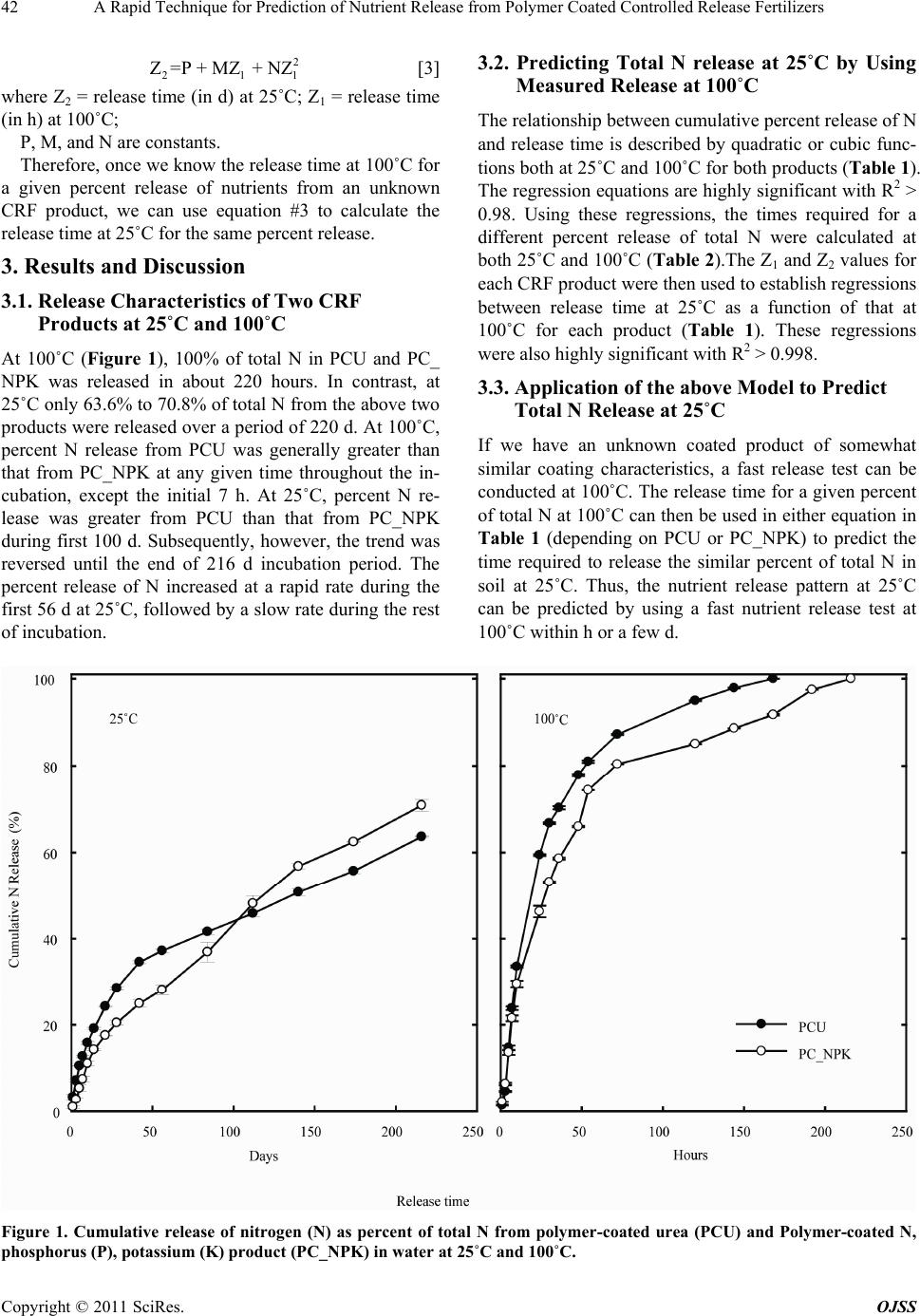 A Rapid Technique for Prediction of Nutrient Release from Polymer Coated Controlled Release Fertilizers Copyright © 2011 SciRes. OJSS 42 13.2. Predicting Total N release at 25˚C by Using Measured Release at 100˚C 2 21 Z=P + MZ + NZ [3] where Z2 = release time (in d) at 25˚C; Z1 = release time (in h) at 100˚C; The relationship between cumulative percent release of N and release time is described by quadratic or cubic func- tions both at 25˚C and 100˚C for both products (Table 1). The regression equations are highly significant with R2 > 0.98. Using these regressions, the times required for a different percent release of total N were calculated at both 25˚C and 100˚C (Table 2).The Z1 and Z2 values for each CRF product were then used to establish regressions between release time at 25˚C as a function of that at 100˚C for each product (Table 1). These regressions were also highly significant with R2 > 0.998. P, M, and N are constants. Therefore, once we know the release time at 100˚C for a given percent release of nutrients from an unknown CRF product, we can use equation #3 to calculate the release time at 25˚C for the same percent release. 3. Results and Discussion 3.1. Release Characteristics of Two CRF Products at 25˚C and 100˚C At 100˚C (Figure 1), 100% of total N in PCU and PC_ NPK was released in about 220 hours. In contrast, at 25˚C only 63.6% to 70.8% of total N from the above two products were released over a period of 220 d. At 100˚C, percent N release from PCU was generally greater than that from PC_NPK at any given time throughout the in- cubation, except the initial 7 h. At 25˚C, percent N re- lease was greater from PCU than that from PC_NPK during first 100 d. Subsequently, however, the trend was reversed until the end of 216 d incubation period. The percent release of N increased at a rapid rate during the first 56 d at 25˚C, followed by a slow rate during the rest of incubation. 3.3. Application of the above Model to Predict Total N Release at 25˚C If we have an unknown coated product of somewhat similar coating characteristics, a fast release test can be conducted at 100˚C. The release time for a given percent of total N at 100˚C can then be used in either equation in Table 1 (depending on PCU or PC_NPK) to predict the time required to release the similar percent of total N in soil at 25˚C. Thus, the nutrient release pattern at 25˚C can be predicted by using a fast nutrient release test at 100˚C within h or a few d. Figure 1. Cumulative release of nitrogen (N) as percent of total N from polymer-coated urea (PCU) and Polymer-coated N, phosphorus (P), potassium (K) product (PC_NPK) in wate r at 25˚C and 100˚C. 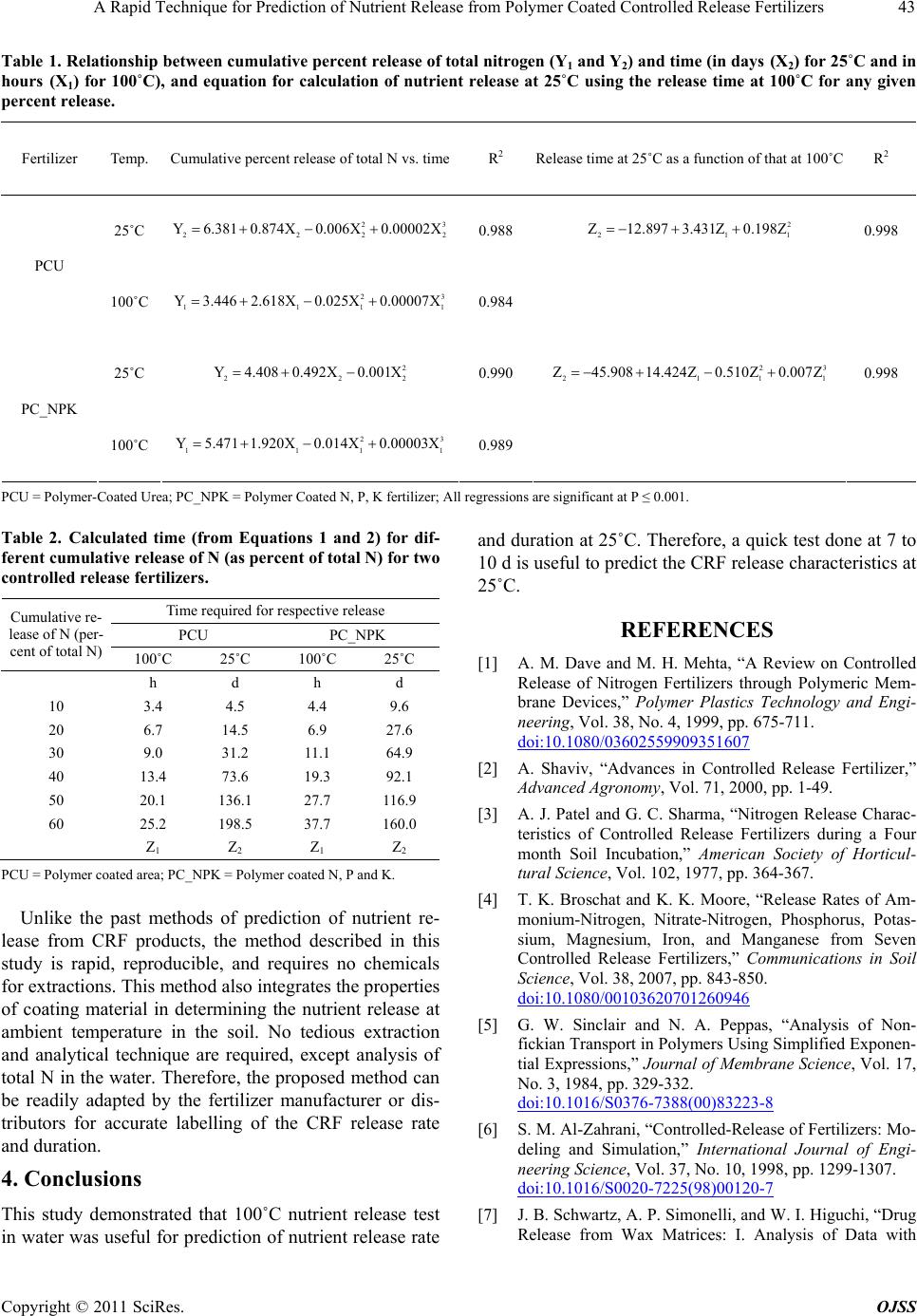 A Rapid Technique for Prediction of Nutrient Release from Polymer Coated Controlled Release Fertilizers43 Table 1. Relationship between cumulative percent release of total nitrogen (Y1 and Y2) and time (in days (X2) for 25˚C and in hours (X1) for 100˚C), and equation for calculation of nutrient release at 25 ˚C using the release time at 100˚C for any given percent release. Fertilizer Temp. Cumulative percent release of total N vs. timeR2 Release time at 25˚C as a function of that at 100˚CR 2 25˚C 23 222 Y6.381 0.874X0.006X0.00002X 21 0.988 2 21 Z12.897 3.431Z0.198Z 0.998 PCU 100˚C 2 111 Y3.446 2.618X0.025X0.00007X 3 1 2 3 1 3 1 0.984 25˚C 2 22 Y4.408 0.492X0.001X 0.990 2 211 Z45.908 14.424Z0.510Z0.007Z 0.998 PC_NPK 100˚C 2 111 Y5.471 1.920X0.014X0.00003X 0.989 PCU = Polymer-Coated Urea; PC_NPK = Polymer Coated N, P, K fertilizer; All regressions are significant at P ≤ 0.001. Table 2. Calculated time (from Equations 1 and 2) for dif- ferent cumulative release of N (as percent of total N) for two controlled release fertilizers. Time required for respective release PCU PC_NPK Cumulative re- lease of N (per- cent of total N) 100˚C 25˚C 100˚C 25˚C h d h d 10 3.4 4.5 4.4 9.6 20 6.7 14.5 6.9 27.6 30 9.0 31.2 11.1 64.9 40 13.4 73.6 19.3 92.1 50 20.1 136.1 27.7 116.9 60 25.2 198.5 37.7 160.0 Z 1 Z2 Z 1 Z 2 PCU = Polymer coated area; PC_NPK = Polymer coated N, P and K. Unlike the past methods of prediction of nutrient re- lease from CRF products, the method described in this study is rapid, reproducible, and requires no chemicals for extractions. This method also integrates the properties of coating material in determining the nutrient release at ambient temperature in the soil. No tedious extraction and analytical technique are required, except analysis of total N in the water. Therefore, the proposed method can be readily adapted by the fertilizer manufacturer or dis- tributors for accurate labelling of the CRF release rate and duration. 4. Conclusions This study demonstrated that 100˚C nutrient release test in water was useful for prediction of nutrient release rate and duration at 25˚C. Therefore, a quick test done at 7 to 10 d is useful to predict the CRF release characteristics at 25˚C. REFERENCES [1] A. M. Dave and M. H. Mehta, “A Review on Controlled Release of Nitrogen Fertilizers through Polymeric Mem- brane Devices,” Polymer Plastics Technology and Engi- neering, Vol. 38, No. 4, 1999, pp. 675-711. doi:10.1080/03602559909351607 [2] A. Shaviv, “Advances in Controlled Release Fertilizer,” Advanced Agronomy, Vol. 71, 2000, pp. 1-49. [3] A. J. Patel and G. C. Sharma, “Nitrogen Release Charac- teristics of Controlled Release Fertilizers during a Four month Soil Incubation,” American Society of Horticul- tural Science, Vol. 102, 1977, pp. 364-367. [4] T. K. Broschat and K. K. Moore, “Release Rates of Am- monium-Nitrogen, Nitrate-Nitrogen, Phosphorus, Potas- sium, Magnesium, Iron, and Manganese from Seven Controlled Release Fertilizers,” Communications in Soil Science, Vol. 38, 2007, pp. 843-850. doi:10.1080/00103620701260946 [5] G. W. Sinclair and N. A. Peppas, “Analysis of Non- fickian Transport in Polymers Using Simplified Exponen- tial Expressions,” Journal of Membrane Science, Vol. 17, No. 3, 1984, pp. 329-332. doi:10.1016/S0376-7388(00)83223-8 [6] S. M. Al-Zahrani, “Controlled-Release of Fertilizers: Mo- deling and Simulation,” International Journal of Engi- neering Science, Vol. 37, No. 10, 1998, pp. 1299-1307. doi:10.1016/S0020-7225(98)00120-7 [7] J. B. Schwartz, A. P. Simonelli, and W. I. Higuchi, “Drug Release from Wax Matrices: I. Analysis of Data with Copyright © 2011 SciRes. OJSS  A Rapid Technique for Prediction of Nutrient Release from Polymer Coated Controlled Release Fertilizers 44 First-Order Kinetics and with the Diffusion Controlled Model,” Journal of Pharmaceutical Science, Vol. 57, No. 2, 1996, pp. 274-278. doi:10.1002/jps.2600570206 [8] A. Shaviv, “Plant Response and Environment Aspects as Affected by Rate and Pattern of Nitrogen Release from Controlled Release N Fertilizers,” The Netherlands, Klu- wer Academy, 1996. [9] A. Shaviv, S. Raban and E. Zaidel, “Modeling Controlled Nutrient Release from a Population of Polymer Coated Fertilizers: Statistically Based Model for Diffusion Re- lease,” Environmental Science and Technology, Vol. 37, No. 10, 2003, pp. 2257-2261. doi:10.1021/es0205277 [10] C. Du, D. Tang, J. Zhou, H. Wang and A. Shaviv, “Pre- diction of Nitrate Release from Polymer-Coated Fertiliz- ers Using an Artificial Neural Network Model,” Biopro- cesses and Biosystems, Vol. 99, No. 4, 2007, pp. 478-486. doi:10.1016/j.biosystemseng.2007.12.003 [11] D. P. Li, X. C. Xu and H. B. Wang, “Review on the Standards of Slow Controlled Release Fertilizer at Home and Abroad,” Phosphate Compounds and Fertilizer, Vol. 20, 2005, pp. 41-42. [12] B. Q. Zhao, et al., “Research on Development Strategies of Fertilizer in China,” Plant Nutrition and Fertilizer Sci- ence, Vol. 10, 2004, pp. 536-545. [13] S. E. Allen, L. M. Hunt and G. Terman, “Nitrogen Re- lease from Sulfur-Coated Urea as Affected by Coating Weight, Placement, and Temperature,” Agronomy Jour- nal, Vol. 63, No. 4, 1971, pp. 529-533. doi:10.2134/agronj1971.00021962006300040004x [14] J. J. Oertli and O. R. Lunt, “Controlled Release of Fertil- izer Materials by Incaspulating Membranes, I. Factors In- fluencing the Rate of Release,” Soil Science Society of America Proceedings, Vol. 26, No. 6, 1962, pp. 579-583. doi:10.2136/sssaj1962.03615995002600060019x [15] J. H. Chen, Y. P. Cao, H. Xu, Z. G. Fang and D. R. Mao, “Appraisal of Nitrogen Releasing Characteristics of Or- ganic Polymer Coating Controlled Release Fertilizer,” Plant Nutrition and Fertilizer, Vol. 8, 2002, pp. 44-47. [16] M. Zhang, Y. C. Yang, F. P. Song and Y. X. Shi, “Study and Industrialized Development of Coated Controlled Release Fertilizers,” Journal of Chemical Fertilizer In- dustry, Vol. 32, 2005, pp. 7-12. [17] L. C. Medina, J. B. Sartain and T. A. Obreza, “Estimation of Release Properties of Slow-Release Fertilizer Mate- rial,” Horticu lture T ech nolog y, Vol. 19, pp. 13-15, 2009. [18] J. J. Dai and X. L. Fan, “Study on the Rapid Method to Predict Longevity of Controlled Release Fertilizer Coated by Water Soluble Resin,” Agricultural Science in China, Vol. 7, No. 9, 2008, pp. 1127-1132. doi:10.1016/S1671-2927(08)60155-8 [19] J. J. Dai, X. L. Fan, Y. L. Liang and L. X. Sun, “Study on Calibration of Standard Regression Curve of Fertilizer Solution Concentration by Conductivity Level,” Phos- phate Compound Fertilizers, Vol. 20, 2005, pp. 15-17. [20] J. J. Dai, X. L. Fan, J. G. Yu and F. L. Wu, “The Method of Quickly Predicting Longevity of Controlled Release Fertilizer Coated with Thermoset Resin,” Plant Nutrition and Fertilizer Science, Vol. 12, 2006, pp. 431-436. Copyright © 2011 SciRes. OJSS |