

Paper Menu >>
Journal Menu >>
 American Journal of Plant Sciences, 2011, 2, 303-307 doi:10.4236/ajps.2011.23034 Published Online September 2011 (http://www.SciRP.org/journal/ajps) Copyright © 2011 SciRes. AJPS 303 Introgressive Hybrids of Arisaema sikokianum and A. tosaense (Araceae) Confirmed through Nuclear and Chloroplast DNA Comparisons Hiroshi Hayakawa1,2, Hidenori Hamachi1, Kanako Matsuyama3, Yuko Muramatsu3, Yukio Minamiya1, Katsura Ito1, Jun Yokoyama4, Tatsuya Fukuda1* 1Faculty of Agriculture, Kochi University, Nankoku, Japan; 2United Graduate School of Agricultural Sciences, Ehime University, Nankoku, Japan; 3The Graduate School of Integrated Arts and Sciences, Kochi University, Nankoku, Japan; 4Faculty of Science, Yamagata University, Yamagata, Japan. Email: *[email protected] Received January 22nd, 2011; revised March 24th, 2011; accepted April 1st, 2011. ABSTRACT Morphologically putative introgressive hybrids of Arisaema sikokianum Franch. et Sav. and A. tosaense Makino were newly found in Kochi and Tokush ima Prefectures in Japan. All the individ uals have the same morph ological char acter- istics as A. tosaense excluding a purple spathe. Molecular analysis using PCR-RFLP of internal transcribed spacer (ITS) in nuclear DNA (nrDNA) indicates that these putative introgressive hybrids have the same pa ttern as A. tosaense. Moreover, the sequences of chloroplast DNA (cpDNA) of the putative introgressive hybrids were identical to A. si- kokianum from Kochi Prefecture and A. tosaense from Tokushima Prefecture. The results suggest that the plants are introgressive hybrids of A. sikokian um and A. tosaense and that they ha ve highly exchanged genes with A. tosaense. Keywords: Araceae, Arisaema, A. sikokianum, A. tosaense, Chloroplast Capture, Introgression, ITS, Molecular Analysis, PCR-RFLP, Trn 1. Introduction Studies of natural hybridization and introgression and their genetic composition can shed new light on issues concerning reproductive barriers and fitness of them and give important insights into evolutionary processes and the adaptation of species [1]. The genus Arisaema Martius (Araceae), which has a large, often colored and conspicuous bract (spathe), sub- tending and enveloping a bisexual or unisexual spadix with numerous small flowers, comprises 40 - 85 species in Japan [2,3]. Species of Arisaema in the section Pistil- lata Nakai have a slender appendage at the base and are mostly distributed in Japan [3]. Section Pistillata is in- cluded in 35 - 80 species in Japan [3], and presents many taxonomic difficulties caused by the concentration of closely related species with few morphological differ- ences [4]. Sixteen patterns of putative natural hybrids among the species in section Pistillata have been reported in Ari- saema (e.g., [5]). Of them, the hybrids between Arisaema sikokianum Franch. et Sav. and Arisaema tosaense Maki- no grow only in Kochi Prefecture in Japan [2,6]. How- ever, Hayakawa et al. [7] newly found hybrids of these two species in Tokushima Prefecture and, using molecu- lar analysis, revealed that the hybrids occur bidirection- ally and that they have exchanged genes with the two parental species. A. sikokianum has a purple upward sp a- the, a white capitate appendage and leaves with 3 to 5 leaflets (Figure 1(a), See detail Table 1). A. tosa en se has a characteristic green spathe extending approx. 30 - 45 cm before it bends downward to the ground and has leaves with 7 to 11 leaflets (Figure 1(b), Table 1 ). These species have the same chromosome numbers (2n = 28) [8,9]. Sympatry of the two species extends over a wide area in Shikoku, and the hybrids of them share various morphological characters [7,8]. Therefore, it is possible that the parental species could make the hybrid progenies and introduce gene(s) in each other through chloroplast captures, backcrossing and recombination, but introgres- sive hybrids including near isogenic lines (NILs) and recombinant lines (RLs) have not been made so far. To clarify chloroplast captures of the introgressive hy- brids of Arisaema sikokianum and A. tosaense, we con- 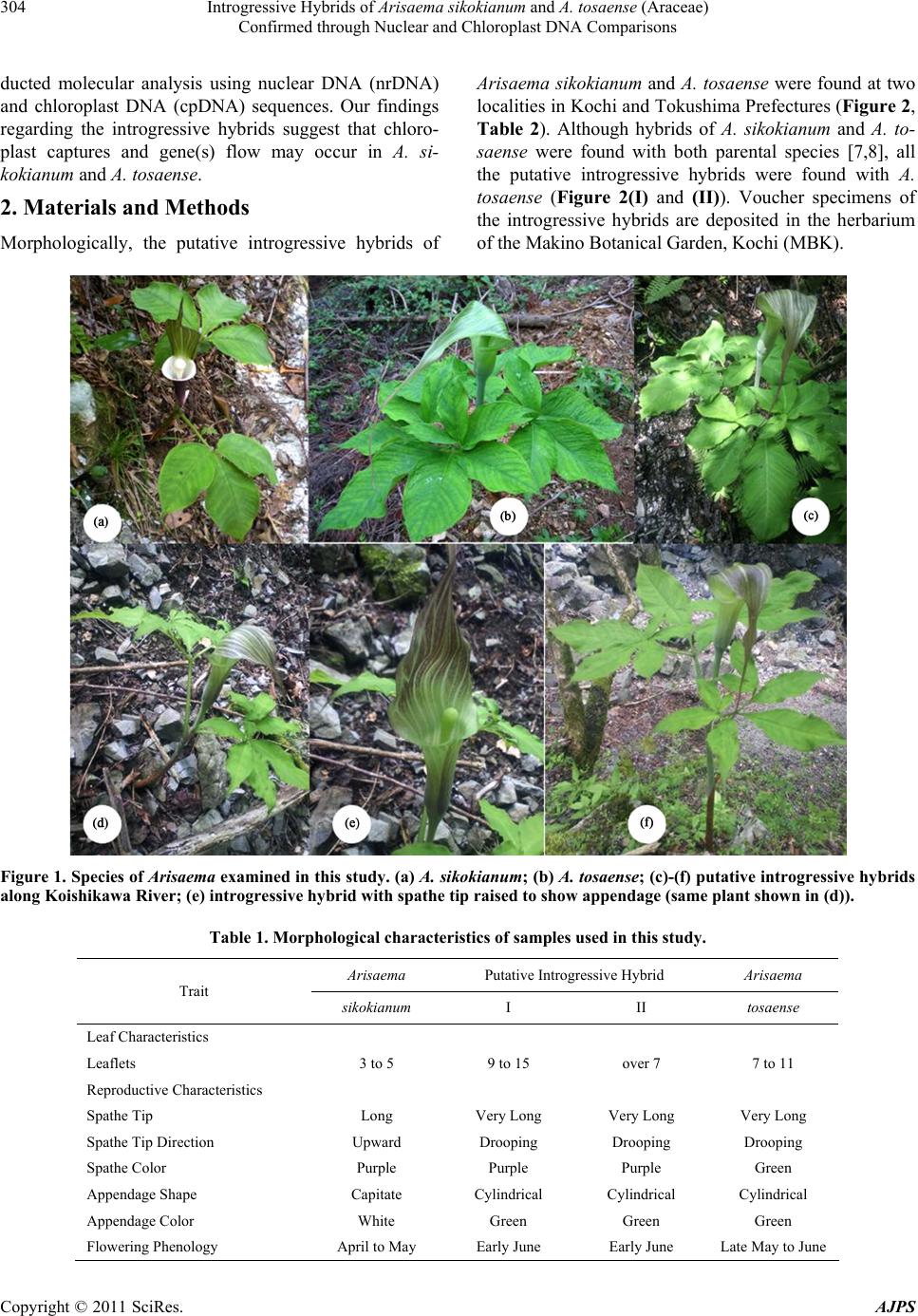 Introgressive Hybrids of Arisaema sikokianum and A. tosaense (Araceae) 304 Confirmed through Nuclear and Chloroplast DNA Comparisons ducted molecular analysis using nuclear DNA (nrDNA) and chloroplast DNA (cpDNA) sequences. Our findings regarding the introgressive hybrids suggest that chloro- plast captures and gene(s) flow may occur in A. si- kokianum and A. tosaense. 2. Materials and Methods Morphologically, the putative introgressive hybrids of Arisaema sikokianum and A. tosaense were found at two localities in Kochi and Tokushima Prefectures (Figure 2, Table 2). Although hybrids of A. sikokianum and A. to- saense were found with both parental species [7,8], all the putative introgressive hybrids were found with A. tosaense (Figure 2(I) and (II)). Voucher specimens of the introgressive hybrids are deposited in the herbarium of the Makino Botanical Garden, Kochi (MBK). Figure 1. Species of Arisaema examined in this study. (a) A. sikokianum; (b) A. tosaense; (c)-(f) putative introgressive hybrids along Koishikawa River; (e) introgressive hybrid with spathe tip raised to show appendage (same plant shown in (d)). Table 1. Morphological characteristics of samples used in this study. Arisaema Putative Introgressive Hybrid Arisaema Trait sikokianum I II tosaense Leaf Characteristics Leaflets 3 to 5 9 to 15 over 7 7 to 11 Reproductive Characteristics Spathe Tip Long Very Long Very Long Very Long Spathe Tip Direction Upward Drooping Drooping Drooping Spathe Color Purple Purple Purple Green Appendage Shape Capitate Cylindrical Cylindrical Cylindrical Appendage Color White Green Green Green Flowering Phenology April to May Early June Early June Late May to June Copyright © 2011 SciRes. AJPS 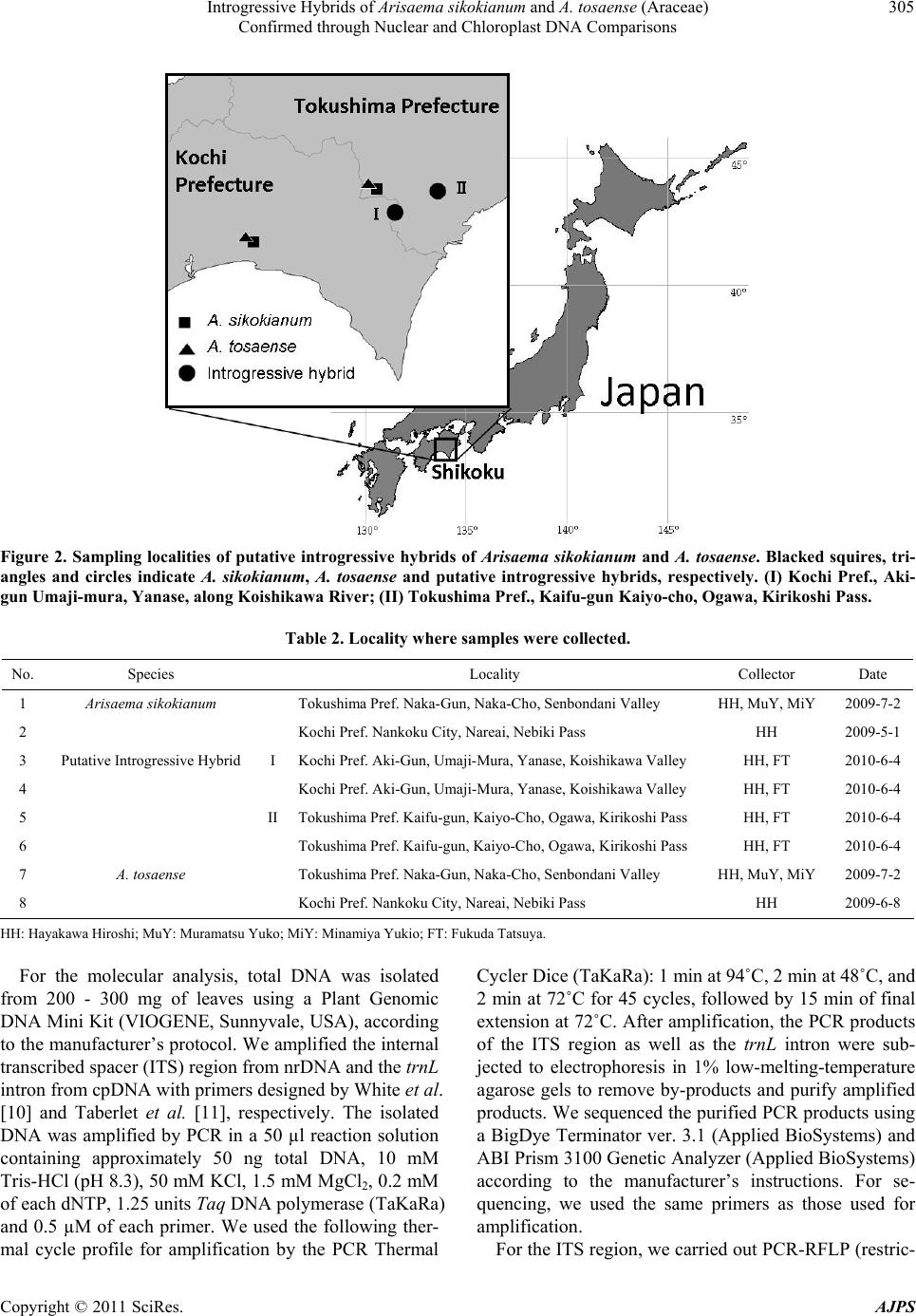 Introgressive Hybrids of Arisaema sikokianum and A. tosaense (Araceae) 305 Confirmed through Nuclear and Chloroplast DNA Comparisons Figure 2. Sampling localities of putative introgressive hybrids of Arisaema sikokianum and A. tosaense. Blacked squires, tri- angles and circles indicate A. sikokianum, A. tosaense and putative introgressive hybrids, respectively. (I) Kochi Pref., Aki- gun Umaji-mura, Yanase, along Koishikaw a River ; (II) Tokushima P re f., Kaifu-gun Kaiyo-cho, Ogawa, Kirikoshi Pass. Table 2. Locality where samples were collected. No. Species Locality Collector Date 1 Arisaema sikokianum Tokushima Pref. Naka-Gun, Naka-Cho, Senbondani Valley HH, MuY, MiY 2009-7-2 2 Kochi Pref. Nankoku City, Nareai, Nebiki Pass HH 2009-5-1 3 Putative Introgressive Hybrid I Kochi Pref. Aki- G un, Umaji-Mura, Yanase, Koishikawa Valley HH, FT 2010-6-4 4 Kochi Pref. Aki-Gun, Umaji-Mura, Yanase, Koishikawa Valley HH, FT 2010-6-4 5 II Tokushima Pref. Kaifu-gun, Kaiyo-Cho, Ogawa, Kirikoshi PassHH, FT 201 0 -6-4 6 Tokushim a Pref. Kaifu-gun, K ai yo-Cho, Ogawa, Kirikoshi Pa s sHH, FT 2010-6-4 7 A. tosaense Tokushima Pref. Naka-Gun, Naka-Cho, Senbondani Valley HH, MuY, MiY 2009-7-2 8 Kochi Pref. Nankoku City, Nareai, Nebiki Pass HH 2009-6-8 HH: Hayakawa Hiroshi; MuY: Muramatsu Yuk o; MiY: Minamiya Yukio; FT: Fukuda Tatsuya. For the molecular analysis, total DNA was isolated from 200 - 300 mg of leaves using a Plant Genomic DNA Mini Kit (VIOGENE, Sunnyvale, USA), according to the manufacturer’s protocol. We amplified the internal transcribed sp acer (I TS) region fro m nrDNA and the trnL intron from cpDNA with primers designed by White et al. [10] and Taberlet et al. [11], respectively. The isolated DNA was amplified by PCR in a 50 µl reaction solution containing approximately 50 ng total DNA, 10 mM Tris-HCl (pH 8.3), 50 mM KCl, 1.5 mM MgCl2, 0.2 mM of each dNTP, 1.25 units Taq DNA polymerase (TaKaRa) and 0.5 µM of each primer. We used the following ther- mal cycle profile for amplification by the PCR Thermal Cycler Dice (TaKaRa): 1 min at 94˚C, 2 min at 48˚C, and 2 min at 72˚C for 45 cycles, followed by 15 min of final extension at 72˚C. After amplification, the PCR products of the ITS region as well as the trnL intron were sub- jected to electrophoresis in 1% low-melting-temperature agarose gels to remove by-products and purify amplified products. We sequenced the purified PCR products using a BigDye Terminator ver. 3.1 (Applied BioSystems) and ABI Prism 3100 Genetic Analyzer (Applied BioSystems) according to the manufacturer’s instructions. For se- quencing, we used the same primers as those used for amplification. For the ITS region, we carried out PCR-RFLP (restric- Copyright © 2011 SciRes. AJPS  Introgressive Hybrids of Arisaema sikokianum and A. tosaense (Araceae) 306 Confirmed through Nuclear and Chloroplast DNA Comparisons tion fragment length polymorphism) analysis, because an autapomorphic character of the nrDNA is the restriction site Mse I (TTAA) [7]. After designating the restriction sites, the amplified products were digested by Mse I at 37˚C for more than an hour. The digested DNAs were separated on 1.5% agarose gel and the size of each band was determined. 3. Results and Discussion From the results of the molecular analysis we determined that five putative introgressive hybrids occurred at each locality. The morphological analysis showed that all the putative introgressive hybrids have a purple spathe (Fig- ures 1(c)-(f)) which is similar to Arisaema sikokianum, but have a green cylindrical appendage as an elongate spathe tip and a large number of leaflets, which is similar to A. tosaense (Figure 1, Table 1). The putative intro- gressive hybrids seem to have the same characteristics as A. tosaense excluding the color of the spathe, and share the same morphological features. We conducted PCR-RFLP in nrDNA because the ITS region of Arisaema sikokianu m has one Mse I site, while A. tosaense has two sites digested by this restriction en- zyme [7]. The digestion patterns of all samples of A. si- kokianum and A. tosaense showed expected patterns and all the putative introgressive hybrids showed the same patterns as those of A. tosaense (Figure 3). We therefore confirmed that the putative introgressive hybrids have an A. tosaense type of ITS in nrDNA. The trnL intron region in cpDNA is a good molecular marker for distinguishing Arisaema sikokianum, because the trnL intron h as a 17 bp -insertion or deletio n (indel) in the sequence of A. sikokianum (450 bp) and A. tosaense (467 bp) [7]. We therefore determined the sequences of the trnL intron. In the introgressive hybrids, the sequence results from the cpDNA analysis were identical to the A. sikokianum from Kochi Prefecture and to A. tosaense from Tokushima Prefecture (Table 3), and we could not find any different pattern of cpDNA for the introgressive hybrids in any of the two localities. From the results of morphological and molecular analyses using nrDNA and cpDNA, the introgressive hybrids from Kochi Prefecture can be determined but no t from Tokushima Prefecture. The flowering phenology of the hybrids between Arisaema sikokianum and A. to- saense was inherited from A. tosaense [7]. Ther efore, the flowering phenology of hybrid progenies may overlap with that of A. tosaense and would intr oduce A. tosaense genes. In this study, although all the putative introgres- sive hybrids in Tokushima Prefecture had a purple spathe and had an outward appearance of A. tosaense, we could not detect any molecular evidence using the ITS region. Figure 3. PCR-RFLP profile of Arisaema sikokianum, A. to- saense and putative introgressive hybrids. Arrows indicate expected fragments of both A. sikokianum and A. tosaense. M: size marker. The cpDNA types correspond to the types in Table 3. Table 3. Genotype of samples used in this study. Species Locality nrDNA (ITS) cpDNA (trnL intron) Arisaema sikokianum S S Putative Introgressive Hybrid IKoishikawa T S Putative Introgressive Hybrid IIKirikoshi pass T T A. tosaense T T S: Arisaema sikokianum type. Accession numbers; AB513178 (ITS) and AB513176 (trnL intron). T: A. tosaense type. Accession numbers; AB513179 (ITS) and AB513177 (trnL intron). Additional nrDNA sequences such as TPI and PGI may provide the answers about the putative introgressive hy- brids in Tokushima Prefecture. From our results and previous reports [6-8], the hy- bridization and introgressive hybrids of Arisaema si- kokianum and A. tosaense seem to be widely distributed in eastern Shikoku. In some limited areas of Shikoku and its margin areas, the appearance of A. tosaense is varied, not only in spathe color but also the shape of the leaflets (wide to narrow) and the shape of the appendage (cylin- drical to capitate) ([12] and Hayakawa unpubl.), imply- ing that various characteristics are generated in intro- gressive hybrids. More detailed investigations around eastern Shikoku will be needed because it may reveal new localities of introgressive hybrids carrying different characteristics to those in this study. Moreover, in Shi- zuoka Prefecture, Kakishima et al. [13] indicated that introgressive gene flow occurs from A. angutatum Fran- ch et Sav. to A. suwoense Nakai. Those reports, along with our findings, suggest that endemic species might have occurred through introgressive h ybrids in some Arisaema Copyright © 2011 SciRes. AJPS  Introgressive Hybrids of Arisaema sikokianum and A. tosaense (Araceae) Confirmed through Nuclear and Chloroplast DNA Comparisons Copyright © 2011 SciRes. AJPS 307 sect. Pistillata. 4. Acknowledgements We wish to thank N. Tanaka, curator of the MBK her- barium, for allowing us to examine specimens of Ari- saema, and R. Arakawa, A. Hirata, M. Saito, K. Ohga, and N. Yokoyama for providing additional help. I would also like to thank Dennis Murphy from the United Graduate School of Agricultural Sciences, Ehime Uni- versity, for checking the English in th is manuscript. This study was partly supported by a Grant-in-Aid for Scien- tific Research from the Ministry of Education, Science and Culture of Japan (to T.F. and J.Y.). REFERENCES [1] J. F. Wendel and J. J. Doyle, “Phylogenetic Incongruence: Window into Genome History and Molecular Evolution,” In: D. E. Soltis, P. S. Soltis and J. J. Doyle, Eds., Mo- lecular Systematics of Plants II and Sequencing, Kluwer Academic Publishers, Norwell, 1998, pp. 265-296. [2] H. Ohashi, “Araceae,” In: Y. Satake, J. Ohwi, S. Kita- mura, S. Watari and T. Tominari, Eds., Wild Flowers of Japan Vol. I, Heibonsha, Tokyo, 1982, pp. 127-139. [3] J. Murata, “Should Arisaema serratum Group Be Classi- fied into One or 30 Species? With Reference to the Geo- graphic Structure of Aucuba japonica Widely Distributed in Japan,” Seibutu Kagaku, Vol. 55, No. 2, 2004, pp. 87-94. [4] J. Murata, “Diversity in the Arisaema serratum Group,” Acta Phytotaxonomica et Geobotanica, Vol. 46, No. 2, 1995, pp. 185-208. [5] T. Kobayashi, J. Murata and K. Watanabe, “Two New Putative Natural Hybrids in Japanese Arisaema (Araceae),” Acta Phytotaxonomica et Geobotanica, Vol. 56, No. 1, 2005, pp. 105-110. [6] S. Kobayashi, “Araceae,” In: Kochi Prefecture and Ma- kino Foundation of Kochi Prefecture, Eds., Flora of Ko- chi, Koubun Printing Office, Kochi, 2009, pp. 604-607. [7] H. Hayakawa, H. Hamachi, Y. Muramatsu, A. Hirata, Y. Minamiya, K. Matsuyama, K. Ito, J. Yokoyama and T. Fukuda, “Interspesific Hybridization between Arisaema sikokianum and A. tosaense (Araceae) Confirmed through Nuclear and Chloroplast DNA Comparisons,” Acta Phy- totaxonomica et Geobotanica, Vol. 61, No. 2, 2010, pp. 57-63. [8] G. Murata, “Taxonomical Note 7,” Acta Phytotaxonomica et Geobotanica, Vol. 19, No. 2-3, 1962, pp. 67-72. [9] J. Murata and M. Iijima, “New or Noteworthy Chromo- some Records in Arisaema,” Journal of Japanese Botany, Vol. 58, No. 9, 1983, pp. 270-280. [10] T. J. White, T. Bruns, S. Lee and J. Taylor, “Amplifica- tion and Direct Sequencing of Fungal Ribosomal RNA Genes for Phylogenetics,” In: M. Innis, D. Gelfand, J. Sninsky and T. J. White, Eds., PCR Protocols: A Guide to Methods and Application, Academic Press, San Diego, 1990, pp. 315-322. [11] P. Taberlet, L. Gielly, G. Pautou and J. Bouvet, “Univer- sal Primers for Amplification of Three Non-Coding Re- gions of Chloroplast DNA,” Plant Molecular Biology, Vol. 17, No. 15, 1991, pp. 1105-1109. doi:10.1007/BF00037152 [12] J. Murata, “Enumeration of Arisaema in Japan” In: J. Mu- rata, Ed., The Picture Book of Plant Systematics in Color Arisaema in Jap an, Hokurikukan, Tokyo, 2011, pp. 71-216. [13] S. Kakishima, T. Tohma and J. Murata, “Diversity and Crossing in Arisaema serratum Group in Japanese Ar- chipelago,” Annual meeting of Ecological Society of Ja- pan, Vol. 56, 2009, p. 386. |