

Paper Menu >>
Journal Menu >>
 American Journal of Plant Sciences, 2011, 2, 297-302 doi:10.4236/ajps.2011.23033 Published Online September 2011 (http://www.SciRP.org/journal/ajps) Copyright © 2011 SciRes. AJPS 297 Effect of Nutrient Management and Planting Geometry on Productivity of Hybrid Rice (Oryza sativa L.) Cultivars Ranjita Bezbaruha, Ravi Chandra Sharma, Pabitra Banik* Agricultural and Ecological Research Unit, Indian Statistical Institute, Kolkata, India. Email: *[email protected] Received December 29th, 2010; revised May 13th, 2011; accepted July 14th, 2011. ABSTRACT Field experiments were conducted during the wet seasons of 2006 and 2007 at the Agricultural Experimental Farm of the Indian Statistical Institute, Giridih, a part of eastern plateau region of India. The study was designed to investigate the effect of planting geometry and nutrient management practices on productivity of two hybrid rice cultivars. Split-plot design with three replications was adopted to carry out the experiment by allocating combinations of treat- ments of planting geometry and rice cultivar in main-plots and nutrient management treatments in sub-plots. “CNRH-3” rice proved its efficiency in terms of grain yield that was also reflected in yield attributing characters such as number of productive tillers, number of grains per panicle, length of panicle, panicle weight, test weight and harvest index. Higher rice grain yield was reg istered when th e cultivars gro wn in 20 cm × 20 cm planting geometry. Rice culti- vars grown with the application of ino rganic fertilizers alone produced maximum grain yield and also recorded higher values of ancillary characters. The maximum amount of N, P and K was taken up by the “CNRH-3” rice, whereas maximum residual soil fertility was recorded in “Pro Agro 6201” rice. Maximum N, P and K uptake values were re- corded in 20 cm × 20 cm crop geometry and inorganic fertilizers treatment. Keywords: Hybrid Rice Cultivars, Planting Geometry, Vermicompost, Nutrient Uptake, Soil Fertility 1. Introduction One of every three peoples depends on rice for more than half of their daily food and one in nine (approximately 700 million) depends on rainfed rice. Ninety percent of the world’s rice is grown and consumed in Asia. Rice is also an important staple food in some countries of Latin Amer- ica and Africa. Asian rice production has increased by 24% during 1965 t o 1980 and that was at t ribut ed to the use of higher rate of fertilizers, mainly N-fertilizer. Rice pro- ductivity is now at stagnant situation or declining in areas where N-fertilizer application is very high; it has also rai- sed the concerns about sustainability of monoculture rice [1]. Food security in India (1.6 billion by 2050 that will require 450 Mt of food grain production) is a challenge [2]. To achieve food security, hybrid rice can be one of the most feasible options to increase 15% to 20% of food pro- duction [3,4]. The hybrid cultivars are more responsive to higher doses of nutrients [5,6] and thereby the yield poten- tiality is all high. It is a big concern that whether the agronomic prac- tices, especially planting geometry for hybrid rice are same as for conventional rice. Thus, there is a need to optimize the planting geometry for hybrid rice [7]. Proper planting geometry have m ore advantages such as, to maximize light utilization efficiency, improves aeration within crop can- opy, enhances soil respiration and provides better weed control thereby higher crop yields [8] . Of late, there has been serious concern about long- term adverse effect of continuous and indiscriminate use of inorganic fertilizers on soil health, biodiversity and environment [9]. The organic matter in sub-tropics soils is low because of high temperature and intense microbial activity. Soil organic matter is the key attribute of soil quality [10] therefore organic matter has to be replen- ished to maintain the soil health. Apart from nutritional effects [11], application of organic manure influences plant physiologically. It also provides growth regulating substances to plants and modifies soil physical behaviour [12]. Vermicompost is a good source of organic manure that can be used as an alternative to chemical fertilizers in rice cultivation [1 3]. Organic matter dynamics is simi- lar in different cropping systems but its significance for  Effect of Nutrient Management and Planting Geometry on Productivity of Hybrid Rice (Oryza sativa L.) Cultivars 298 specific soil properties or crop productivity varies con- siderably with soil type [14,15]. With the above back drop the experiments have been undertaken to measure the effect of crop geometry and the usefulness of organic materials on yiel d of low la nd hybri d rice and soil fertili ty. 2. Materials and Methods 2.1. Study Site A study was carried out at the Agricultural Experimental Farm of the Indian Statistical Institute, Giridih (at 24˚1'N, 86˚3'E and altitude 920'), India during the wet seasons of 2006 and 2007. The average annual rainfall of the study area is 1343 mm but the distribution is highly seasonal (about 86% of total rainfall occurs in between June to September). The average maximum and minimum tem- peratures are 23.8˚C and 12.6˚C respectively. Average annual potential evapotranspiration is 1293 mm with the relative humidity ranges from 78% to 95%. The so il was moderately well drained lateritic sandy loam (30.0% coarse sand, 26.8% fine sand, 25.0% silt and 18.2% clay). Soil was slightly acidic in reaction (6.4) with low in or- ganic carbo n (0.52%), available N (132 kg N ha –1) and P (12 kg P ha–1) but medium in K (156 kg K ha–1). 2.2. Experimental Setup The experiment was laid out in split-plot design an d rep- licated thrice. Combinations of rice cultiv ars (V1: CNRH 3 and V2: Pro Agro-6201) and crop geometry (G1: 15 cm × 15 cm, G2: 20 cm × 20 cm and G3: 25 cm × 25 cm) were allocated in the main-plots and nutrient manage- ment practices such as F0: absolute control, F1: recom- mended dose (RD, 140:60:60 kg N, P2O5, K2O ha–1) through inorganic sources, F2: RD of N through vermi- compost, F3: 50% RD of NPK through inorganic +50% RD of N through vermicompost and F4: 75% RD of NPK through inorganic +25% through vermicompost were assigned in sub-plots. The recommended dose of NPK was applied in the form of urea (46-0-0), single super phosphate (0-16-0) and muriate of potash (0-0-60). Ver- micompost (1.25-0.8-0.65) was incorporated in soil as per the treatment at the time of final ploughing. Rice cu l- tivars were transplanted on 15th July and 18th July and were harvested on 9th December and 11th December in 2006 and 2007, respectively. Agronomic management practices and plant protection measures were followed as per the recommendation. 2.3. Soil Sampling and Analysis Soil samples were collected from each plot at the depth of 0 - 20 cm just after harvest of rice in both the years. These soil samples were sieved (2 mm) and analyzed for available N by alkaline potassium permanganate method [16] and organic carbon by wet oxidation method [17]. Mineralizable P and exchangeable K were estimated by Olsen’s method [18] and neutral normal ammonium ace- tate method [19], respectively. Concentrations of N, P and K in rice grain and str aw wer e esti mated by using th e standard methods as advocated by Jackson [19]. 2.4. Statistical Analysis The data obtained during the study were subjected to statistical analysis using the IRRISTAT (software devel- oped by International Rice Research Inst itute, Phili ppines). 3. Results 3.1. Plant Height Plant height of rice cultiv ars was significantly influenced by the crop geometry and nutrient management practices (Table 1). Plant height of “CNRH 3” rice was higher (88.66 cm) over the Pro Agro 6201 (85.88 cm). Rice grown at 15 cm × 15 cm apart recorded higher plant height (88.42 cm) whereas 25 cm × 25 cm spacing re- corded shortest ones (86.16 cm). Rice grown with 100% RD of NPK supplied through inorganic sources (F1) produced tallest plants but it was statistically at par with that of the F4 treatment. 3.2. Productive Tillers “CNRH 3” rice produced maximum numbers of repro- ductive tillers (349 m–2) (Table 1). Rice grown at 20 cm × 20 cm spacing, irrespective of cultivars and fertilizer treatments, produced highest reproductive tillers per unit area (395 m–2) and which was followed by 25 cm × 25 cm treatment. Among the nutrient management practices, F1 treatment was reco rd ed 46% hi gh er rep ro du c tive tillers over the F0 treatment. 3.3. Filled Grains per Panicle “CNRH 3” rice produced 31% higher filled grains per panicle over Pro Agro 6201 (Table 1). Rice transplanted in 20 cm × 20 cm spacing produced maximum number of filled grains per panicle (73.13) followed by rice when grown at 25 cm × 25 cm spacing (64.38). Rice had 85% and 63% higher grains per panicle when grown with F1 and F4 treatments respectively over the F0. 3.4. Panicle Length and Weight Both panicle leng th (21.65 cm) and weight (2 .55 g) were recorded maximum in “CNRH 3” rice (Table 1). Irre- spective of cultivars, both the values were higher when rice was grown at 20 cm × 20 cm apart followed by at 25 cm × 25 cm spacing. Fertilizer treatment F1 had 65% higher panicle length over the control (F0). Copyright © 2011 SciRes. AJPS 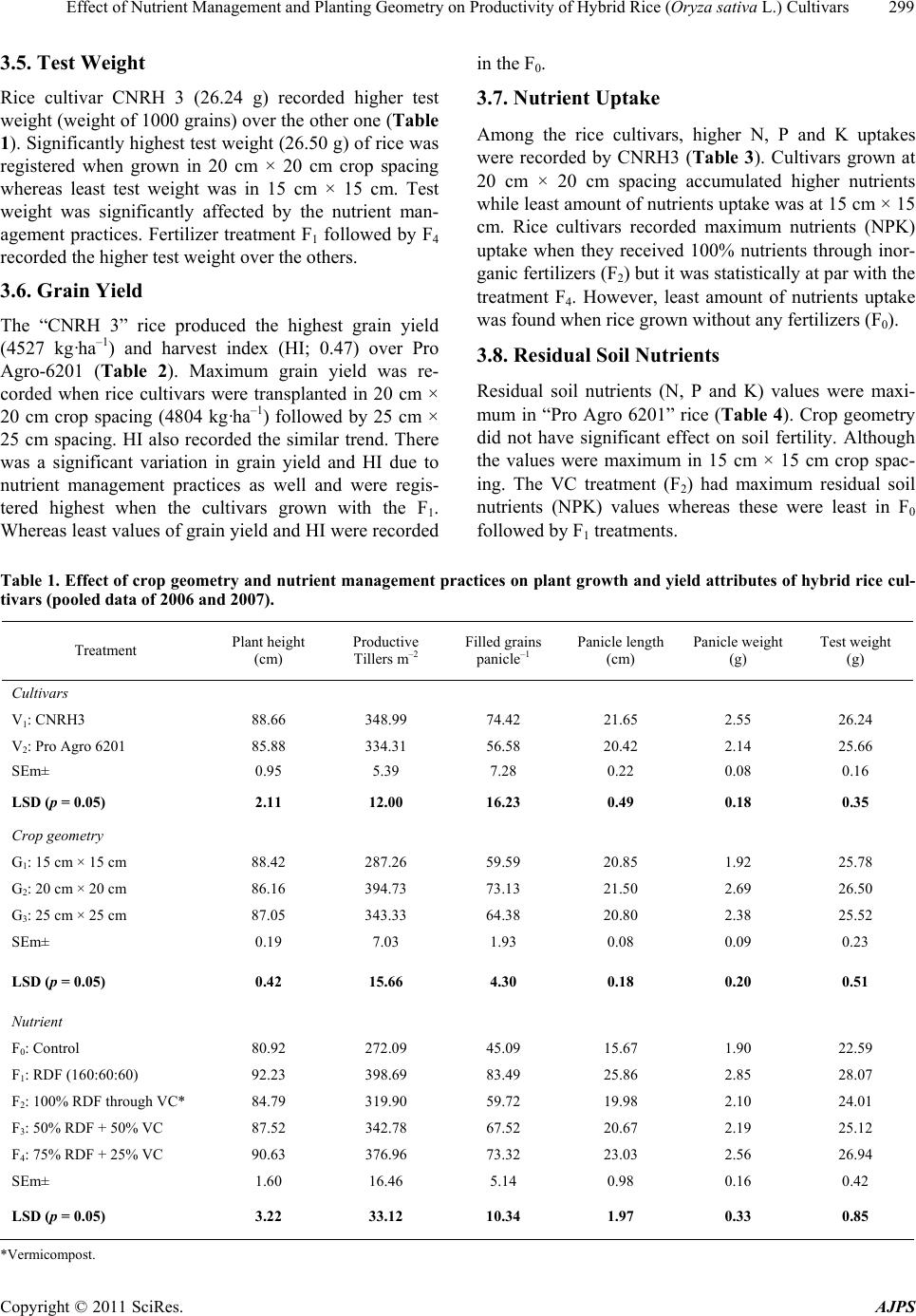 Effect of Nutrient Management and Planting Geometry on Productivity of Hybrid Rice (Oryza sativa L.) Cultivars Copyright © 2011 SciRes. AJPS 299 3.5. Test Weight Rice cultivar CNRH 3 (26.24 g) recorded higher test weight (weight of 1000 grains) over the other one (Table 1). Significantly highest test weight (26.50 g) of rice was registered when grown in 20 cm × 20 cm crop spacing whereas least test weight was in 15 cm × 15 cm. Test weight was significantly affected by the nutrient man- agement practices. Fertilizer treatment F1 followed by F4 recorded the higher test weight over the others. 3.6. Grain Yield The “CNRH 3” rice produced the highest grain yield (4527 kg·ha–1) and harvest index (HI; 0.47) over Pro Agro-6201 (Table 2). Maximum grain yield was re- corded when rice cultivars were transplanted in 20 cm × 20 cm crop spacing (4804 kg·ha–1) followed by 25 cm × 25 cm spacing. HI also recorded the similar trend. There was a significant variation in grain yield and HI due to nutrient management practices as well and were regis- tered highest when the cultivars grown with the F1. Whereas least values of grain yield and HI were recorded in the F0. 3.7. Nutrient Uptake Among the rice cultivars, higher N, P and K uptakes were recorded by CNRH3 (Table 3). Cultivars grown at 20 cm × 20 cm spacing accumulated higher nutrients while least amount of nutrients uptake was at 15 cm × 15 cm. Rice cultivars recorded maximum nutrients (NPK) uptake when they received 100% nutrients through inor- ganic fertilizers (F2) but it was statistically at par with the treatment F4. However, least amount of nutrients uptake was found when rice grown w i t hout any fert ilizers (F0). 3.8. Residual Soil Nutrients Residual soil nutrients (N, P and K) values were maxi- mum in “Pro Agro 6201” rice (Table 4). Crop geometry did not have significant effect on soil fertility. Although the values were maximum in 15 cm × 15 cm crop spac- ing. The VC treatment (F2) had maximum residual soil nutrients (NPK) values whereas these were least in F0 followe d by F1 treatments. Table 1. Effect of crop geometry and nutrient management practices on plant growth and yield attributes of hybrid rice c ul- tivars (pooled data of 2006 and 2007). Treatment Plant height (cm) Productive Tillers m–2 Filled grains panicle–1 Panicle length (cm) Panicle weight (g) Test weight (g) Cultivars V1: CNRH3 88.66 348.99 74.42 21.65 2.55 26.24 V2: Pro Agro 6201 85.88 334.31 56.58 20.42 2.14 25.66 SEm± 0.95 5.39 7.28 0.22 0.08 0.16 LSD (p = 0.05) 2.11 12.00 16.23 0.49 0.18 0.35 Crop geometry G1: 15 cm × 15 cm 88.42 287.26 59.59 20.85 1.92 25.78 G2: 20 cm × 20 cm 86.16 394.73 73.13 21.50 2.69 26.50 G3: 25 cm × 25 cm 87.05 343.33 64.38 20.80 2.38 25.52 SEm± 0.19 7.03 1.93 0.08 0.09 0.23 LSD (p = 0.05) 0.42 15.66 4.30 0.18 0.20 0.51 Nutrient F0: Control 80.92 272.09 45.09 15.67 1.90 22.59 F1: RDF (160:60:60) 92.23 398.69 83.49 25.86 2.85 28.07 F2: 100% RDF through VC* 84.79 319.90 59.72 19.98 2.10 24.01 F3: 50% RDF + 50% VC 87.52 342.78 67.52 20.67 2.19 25.12 F4: 75% RDF + 25% VC 90.63 376.96 73.32 23.03 2.56 26.94 SEm± 1.60 16.46 5.14 0.98 0.16 0.42 LSD (p = 0.05) 3.22 33.12 10.34 1.97 0.33 0.85 *Vermicompost. 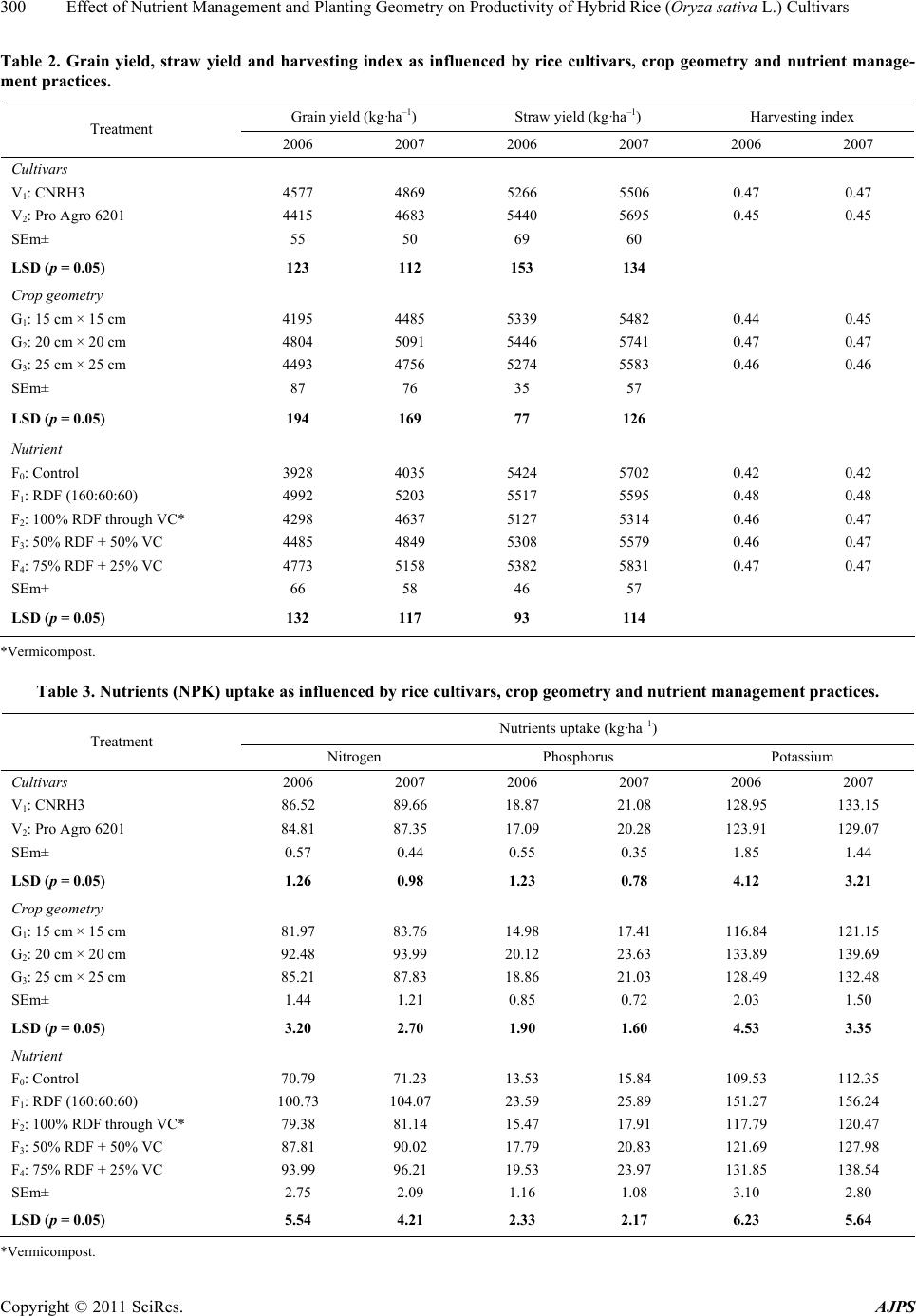 Effect of Nutrient Management and Planting Geometry on Productivity of Hybrid Rice (Oryza sativa L.) Cultivars 300 Table 2. Grain yield, straw yield and harvesting index as influenced by rice cultivars, crop geometry and nutrient manage- ment practices. Grain yield (kg·ha–1) Straw yield (kg·ha–1) Harvesting index Treatment 2006 2007 2006 2007 2006 2007 Cultivars V1: CNRH3 4577 4869 5266 5506 0.47 0.47 V2: Pro Agro 6201 4415 4683 5440 5695 0.45 0.45 SEm± 55 50 69 60 LSD (p = 0.05) 123 112 153 134 Crop geometry G1: 15 cm × 15 cm 4195 4485 5339 5482 0.44 0.45 G2: 20 cm × 20 cm 4804 5091 5446 5741 0.47 0.47 G3: 25 cm × 25 cm 4493 4756 5274 5583 0.46 0.46 SEm± 87 76 35 57 LSD (p = 0.05) 194 169 77 126 Nutrient F0: Control 3928 4035 5424 5702 0.42 0.42 F1: RDF (160:60:60) 4992 5203 5517 5595 0.48 0.48 F2: 100% RDF through VC* 4298 4637 5127 5314 0.46 0.47 F3: 50% RDF + 50% VC 4485 4849 5308 5579 0.46 0.47 F4: 75% RDF + 25% VC 4773 5158 5382 5831 0.47 0.47 SEm± 66 58 46 57 LSD (p = 0.05) 132 117 93 114 *Vermicompost. Table 3. Nutrients (NPK) uptake as influenc ed by rice cultivars, crop geometry and nutrient management practices. Nutrients uptake (kg·ha–1) Treatment Nitrogen Phosphorus Potassium Cultivars 2006 2007 2006 2007 2006 2007 V1: CNRH3 86.52 89.66 18.87 21.08 128.95 133.15 V2: Pro Agro 6201 84.81 87.35 17.09 20.28 123.91 129.07 SEm± 0.57 0.44 0.55 0.35 1.85 1.44 LSD (p = 0.05) 1.26 0.98 1.23 0.78 4.12 3.21 Crop geometry G1: 15 cm × 15 cm 81.97 83.76 14.98 17.41 116.84 121.15 G2: 20 cm × 20 cm 92.48 93.99 20.12 23.63 133.89 139.69 G3: 25 cm × 25 cm 85.21 87.83 18.86 21.03 128.49 132.48 SEm± 1.44 1.21 0.85 0.72 2.03 1.50 LSD (p = 0.05) 3.20 2.70 1.90 1.60 4.53 3.35 Nutrient F0: Control 70.79 71.23 13.53 15.84 109.53 112.35 F1: RDF (160:60:60) 100.73 104.07 23.59 25.89 151.27 156.24 F2: 100% RDF through VC* 79.38 81.14 15.47 17.91 117.79 120.47 F3: 50% RDF + 50% VC 87. 81 90.02 17.79 2 0 .83 121.69 127.98 F4: 75% RDF + 25% VC 93. 99 96.21 19.53 2 3 .97 131.85 138.54 SEm± 2.75 2.09 1.16 1.08 3.10 2.80 LSD (p = 0.05) 5.54 4.21 2.33 2.17 6.23 5.64 *Vermicompost. Copyright © 2011 SciRes. AJPS 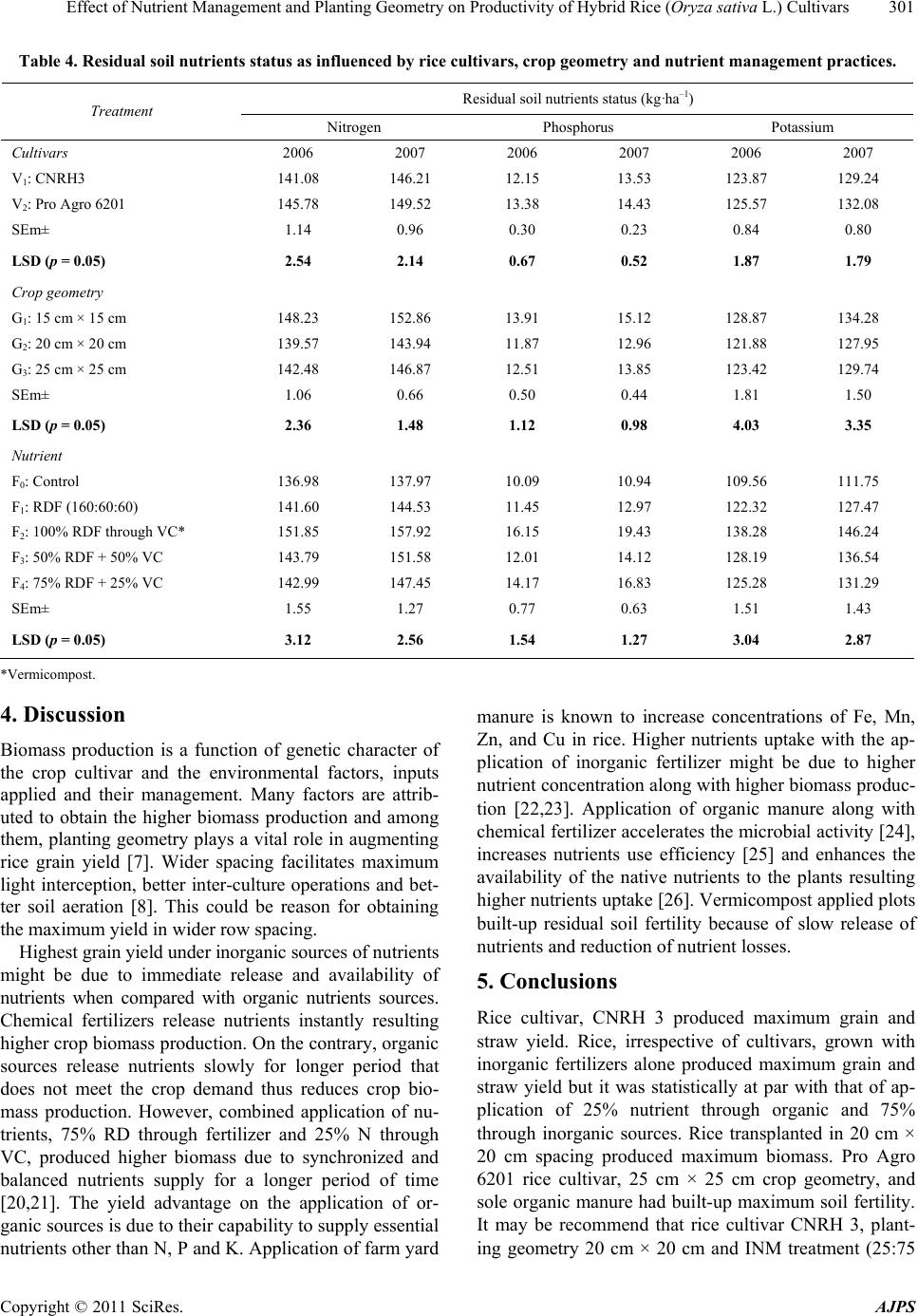 Effect of Nutrient Management and Planting Geometry on Productivity of Hybrid Rice (Oryza sativa L.) Cultivars Copyright © 2011 SciRes. AJPS 301 Table 4. Residual soil nutrients status as influence d by rice cultivars, crop geometry and nutrient management practices. Residual soil nutrients status (kg·ha–1) Treatment Nitrogen Phosphorus Potassium Cultivars 2006 2007 2006 2007 2006 2007 V1: CNRH3 141.08 146.21 12.15 13.53 123.87 129.24 V2: Pro Agro 6201 145.78 149.52 13.38 14.43 125.57 132.08 SEm± 1.14 0.96 0.30 0.23 0.84 0.80 LSD (p = 0.05) 2.54 2.14 0.67 0.52 1.87 1.79 Crop geometry G1: 15 cm × 15 cm 148.23 152.86 13.91 15.12 128.87 134.28 G2: 20 cm × 20 cm 139.57 143.94 11.87 12.96 121.88 127.95 G3: 25 cm × 25 cm 142.48 146.87 12.51 13.85 123.42 129.74 SEm± 1.06 0.66 0.50 0.44 1.81 1.50 LSD (p = 0.05) 2.36 1.48 1.12 0.98 4.03 3.35 Nutrient F0: Control 136.98 137.97 10.09 10.94 109.56 111.75 F1: RDF (160:60:60) 141.60 1 4 4.53 11.45 12.97 122.32 127.47 F2: 100% RDF through VC* 151.85 157.92 16.15 19.43 138.28 146.24 F3: 50% RDF + 50% VC 143.79 151.58 12.01 14.12 128.19 136.54 F4: 75% RDF + 25% VC 142.99 147.45 14.17 16.83 125.28 131.29 SEm± 1.55 1.27 0.77 0.63 1.51 1.43 LSD (p = 0.05) 3.12 2.56 1.54 1.27 3.04 2.87 *Vermicompost. 4. Discussion Biomass production is a function of genetic character of the crop cultivar and the environmental factors, inputs applied and their management. Many factors are attrib- uted to obtain the higher biomass production and among them, planting geometry plays a vital role in augmenting rice grain yield [7]. Wider spacing facilitates maximum light interception, better inter-culture operations and bet- ter soil aeration [8]. This could be reason for obtaining the maximum yield in wider row spacing. Highest grain yield under inorganic sources of nutrients might be due to immediate release and availability of nutrients when compared with organic nutrients sources. Chemical fertilizers release nutrients instantly resulting higher crop biomass production. On the contrary, organic sources release nutrients slowly for longer period that does not meet the crop demand thus reduces crop bio- mass production. However, combined application of nu- trients, 75% RD through fertilizer and 25% N through VC, produced higher biomass due to synchronized and balanced nutrients supply for a longer period of time [20,21]. The yield advantage on the application of or- ganic sources is due to their capab ility to supp ly essential nutrients other than N, P and K. Application of farm yard manure is known to increase concentrations of Fe, Mn, Zn, and Cu in rice. Higher nutrients uptake with the ap- plication of inorganic fertilizer might be due to higher nutrient concentration along with higher biomass produc- tion [22,23]. Application of organic manure along with chemical fertilizer accelerates the microbial activity [24], increases nutrients use efficiency [25] and enhances the availability of the native nutrients to the plants resulting higher nutrients uptake [26]. Vermicompost applied plots built-up residual soil fertility because of slow release of nutrients and reduction of nutrient losses. 5. Conclusions Rice cultivar, CNRH 3 produced maximum grain and straw yield. Rice, irrespective of cultivars, grown with inorganic fertilizers alone produced maximum grain and straw yield but it was statistically at par with that of ap- plication of 25% nutrient through organic and 75% through inorganic sources. Rice transplanted in 20 cm × 20 cm spacing produced maximum biomass. Pro Agro 6201 rice cultivar, 25 cm × 25 cm crop geometry, and sole organic manure had built-up maximum soil fertility. It may be recommend that rice cultivar CNRH 3, plant- ing geometry 20 cm × 20 cm and INM treatment (25:75 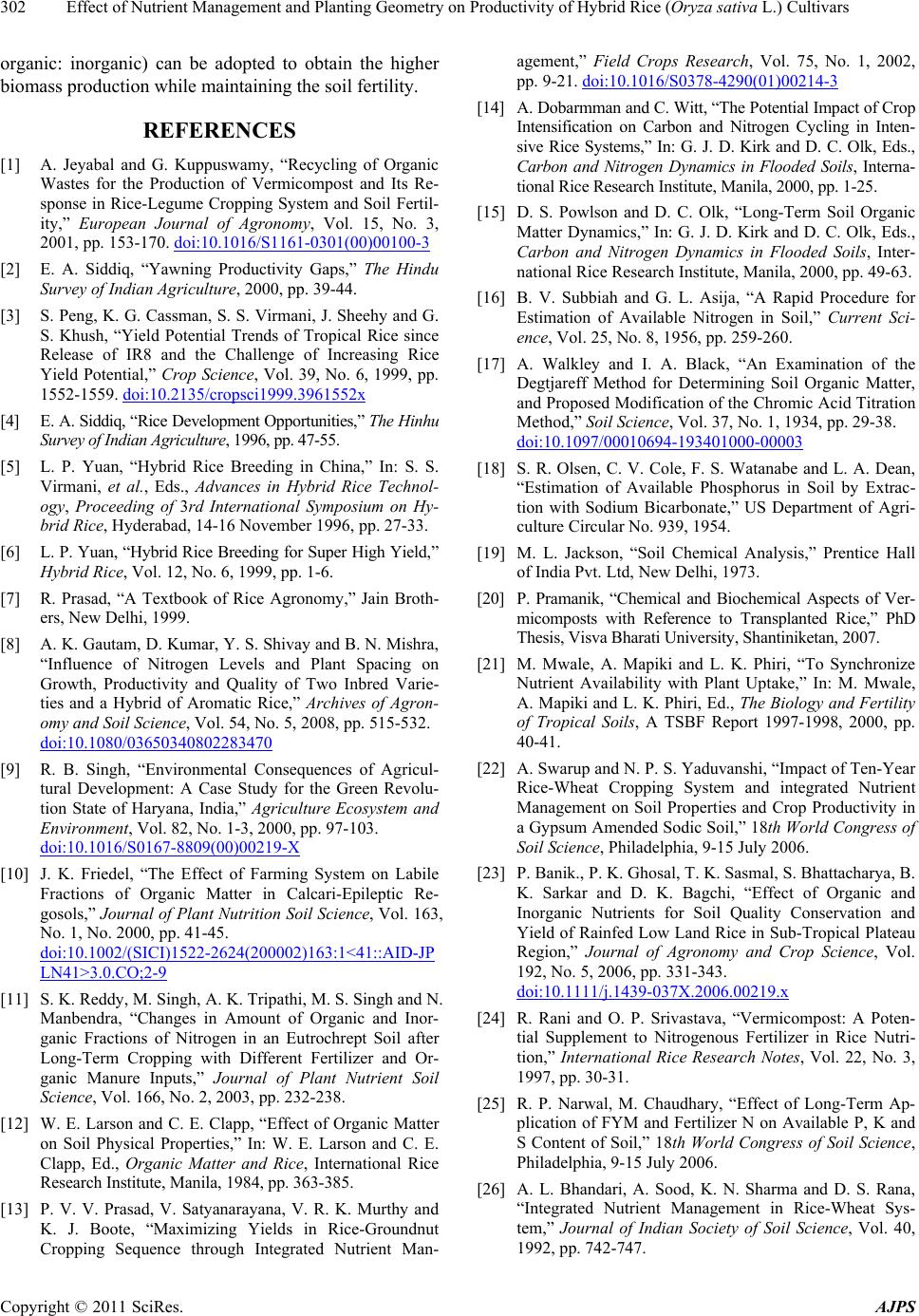 Effect of Nutrient Management and Planting Geometry on Productivity of Hybrid Rice (Oryza sativa L.) Cultivars 302 organic: inorganic) can be adopted to obtain the higher biomass production while maintaining the soil fertility. REFERENCES [1] A. Jeyabal and G. Kuppuswamy, “Recycling of Organic Wastes for the Production of Vermicompost and Its Re- sponse in Rice-Legume Cropping System and Soil Fertil- ity,” European Journal of Agronomy, Vol. 15, No. 3, 2001, pp. 153-170. doi:10.1016/S1161-0301(00)00100-3 [2] E. A. Siddiq, “Yawning Productivity Gaps,” The Hindu Survey of Indian Agriculture, 2000, pp. 39-44. [3] S. Peng, K. G. Cassman, S. S. Virmani, J. Sheehy and G. S. Khush, “Yield Potential Trends of Tropical Rice since Release of IR8 and the Challenge of Increasing Rice Yield Potential,” Crop Science, Vol. 39, No. 6, 1999, pp. 1552-1559. doi:10.2135/cropsci1999.3961552x [4] E. A. Siddiq, “Rice Development Opportunities,” The Hinhu Survey of Indian Agriculture, 1996, pp. 47-5 5. [5] L. P. Yuan, “Hybrid Rice Breeding in China,” In: S. S. Virmani, et al., Eds., Advances in Hybrid Rice Technol- ogy, Proceeding of 3rd International Symposium on Hy- brid Rice, Hyderabad, 14-16 November 1996, pp. 27-33. [6] L. P. Yuan, “Hybrid Rice Breeding for Super High Yield, ” Hybrid Rice, Vol. 12, No. 6, 1999, pp. 1-6. [7] R. Prasad, “A Textbook of Rice Agronomy,” Jain Broth- ers, New Delhi, 1999. [8] A. K. Gautam, D. Kumar, Y. S. Shivay and B. N. Mishra, “Influence of Nitrogen Levels and Plant Spacing on Growth, Productivity and Quality of Two Inbred Varie- ties and a Hybrid of Aromatic Rice,” Archives of Agron- omy and Soil Science, Vol. 54, No. 5, 2008, pp. 515-532. doi:10.1080/03650340802283470 [9] R. B. Singh, “Environmental Consequences of Agricul- tural Development: A Case Study for the Green Revolu- tion State of Haryana, India,” Agriculture Ecosystem and Environment, Vol. 82, No. 1-3, 2000, pp. 97-103. doi:10.1016/S0167-8809(00)00219-X [10] J. K. Friedel, “The Effect of Farming System on Labile Fractions of Organic Matter in Calcari-Epileptic Re- gosols,” Journal of Plant Nutrition Soil Science, Vol. 163, No. 1, No. 2000, pp. 41-45. doi:10.1002/(SICI)1522-2624(200002)163:1<41::AID-JP LN41>3.0.CO;2-9 [11] S. K. Reddy, M. Singh, A. K. Tripathi, M. S. Singh and N. Manbendra, “Changes in Amount of Organic and Inor- ganic Fractions of Nitrogen in an Eutrochrept Soil after Long-Term Cropping with Different Fertilizer and Or- ganic Manure Inputs,” Journal of Plant Nutrient Soil Science, Vol. 166, No. 2, 2003, pp. 232-238. [12] W. E. Larson and C. E. Clapp, “Effect of Organic Matter on Soil Physical Properties,” In: W. E. Larson and C. E. Clapp, Ed., Organic Matter and Rice, International Rice Research Institute, Manila, 1984, pp. 363-385. [13] P. V. V. Prasad, V. Satyanarayana, V. R. K. Murthy and K. J. Boote, “Maximizing Yields in Rice-Groundnut Cropping Sequence through Integrated Nutrient Man- agement,” Field Crops Research, Vol. 75, No. 1, 2002, pp. 9-21. doi:10.1016/S0378-4290(01)00214-3 [14] A. Dobarmman and C. Witt, “The Potential Impact of Crop Intensification on Carbon and Nitrogen Cycling in Inten- sive Rice Systems,” In: G. J. D. Kirk and D. C. Olk, Eds., Carbon and Nitrogen Dynamics in Flooded Soils, Interna- tional Rice Research Institute, Manila, 2000, pp. 1-25. [15] D. S. Powlson and D. C. Olk, “Long-Term Soil Organic Matter Dy namics,” In: G. J. D. Kirk and D. C. Olk, Eds., Carbon and Nitrogen Dynamics in Flooded Soils, Inter- national Rice Research Institute, Manila, 2000, pp. 49-63. [16] B. V. Subbiah and G. L. Asija, “A Rapid Procedure for Estimation of Available Nitrogen in Soil,” Current Sci- ence, Vol. 25, No. 8, 1956, pp. 259-260. [17] A. Walkley and I. A. Black, “An Examination of the Degtjareff Method for Determining Soil Organic Matter, and Proposed Modification of the Chromic Acid Titration Method,” Soil Science, Vol. 37, No. 1, 1934, pp. 29-38. doi:10.1097/00010694-193401000-00003 [18] S. R. Olsen, C. V. Cole, F. S. Watanabe and L. A. Dean, “Estimation of Available Phosphorus in Soil by Extrac- tion with Sodium Bicarbonate,” US Department of Agri- culture Circular No. 939, 1954. [19] M. L. Jackson, “Soil Chemical Analysis,” Prentice Hall of India Pvt. Ltd, New Delhi, 1973. [20] P. Pramanik, “Chemical and Biochemical Aspects of Ver- micomposts with Reference to Transplanted Rice,” PhD Thesis, Visva Bharati University, Shantiniketan, 2007. [21] M. Mwale, A. Mapiki and L. K. Phiri, “To Synchronize Nutrient Availability with Plant Uptake,” In: M. Mwale, A. Mapiki and L. K. Phiri, Ed., The Biology and Fertility of Tropical Soils, A TSBF Report 1997-1998, 2000, pp. 40-41. [22] A. Swarup and N. P. S. Yaduvanshi, “Impact of Ten-Year Rice-Wheat Cropping System and integrated Nutrient Management on Soil Properties and Crop Productivity in a Gypsum Amended Sodic Soil,” 18th World Congress of Soil Science, Philadelphia, 9-15 July 2006. [23] P. Banik., P. K. Ghosal, T. K. Sasma l, S. Bhattachary a, B. K. Sarkar and D. K. Bagchi, “Effect of Organic and Inorganic Nutrients for Soil Quality Conservation and Yield of Rainfed Low Land Rice in Sub-Tropical Plateau Region,” Journal of Agronomy and Crop Science, Vol. 192, No. 5, 2006, pp. 331-343. doi:10.1111/j.1439-037X.2006.00219.x [24] R. Rani and O. P. Srivastava, “Vermicompost: A Poten- tial Supplement to Nitrogenous Fertilizer in Rice Nutri- tion,” International Rice Research Notes, Vol. 22, No. 3, 1997, pp. 30-31. [25] R. P. Narwal, M. Chaudhary, “Effect of Long-Term Ap- plication of FYM and Fertilizer N on Available P, K and S Content of Soil,” 18th World Congress of Soil Science, Philadelphia, 9-15 July 2006. [26] A. L. Bhandari, A. Sood, K. N. Sharma and D. S. Rana, “Integrated Nutrient Management in Rice-Wheat Sys- tem,” Journal of Indian Society of Soil Science, Vol. 40, 1992, pp. 742-747. Copyright © 2011 SciRes. AJPS |