

Paper Menu >>
Journal Menu >>
 American Journal of Plant Sciences, 2011, 2, 283-286 doi:10.4236/ajps.2011.23031 Published Online September 2011 (http://www.SciRP.org/journal/ajps) Copyright © 2011 SciRes. AJPS 283 Studies on the Associates of Conocephalum conicum L. (Dumort.) and Dumortiera hirsuta Sw. (Nees) Mudassar Iqbal1*, Fayaz Ahmad Butt1, Anima Langer1, Afroz Alam2 1Department of Botany University of Jammu, Jammu, India; 2Deapertment of Bioscience and Biotechnology, Banasthali University, Rajasthan, India. Email: *[email protected] Received December 28th, 2010; revised March 16th, 2011; accepted March 28th, 2011. ABSTRACT Paper includes info rmation on as sociatio n of 46 populations of Conocephalum conicum L. (Dumort.) and 25 of Dumor- tiera hirsuta Sw. (Nees) with diverse organisms, including fungi, bryophytes, pteridophytes, gymnosperms, angiosperms and an insect. Keywords: Liverworts, Assoc i ation, Conocephalum conicum, Dumort i era hirsuta 1. Introduction Bryophytes are known to grow in close association with organisms as diverse as algae, fungi, bryophytes, pteri- dophytes, gymnosperms and angiosperms among plants and protozoa, rotifers, nematodes, earthworms, molluscs, insects and spiders among animals. Direct interaction of bryophytes includes providing food, shelter and nesting material for small mammals and invertebrates. Indirectly, they serve as a matrix for a variety of interaction between organisms [1]. 2. Material and Method Plants of Conocephalum conicum and Dumortiera hir- suta were collected along with their associates growing in diverse habitats, from different sites of tehsil Bhader- wah of district Doda of Jammu (India) region growing at altitude between 1230 - 2600 m, the district falls between 32 degree-53' and 34 degree 21' North latitude and 75 degree-1' and 76 degree-47' East longitude. Periodical explorations were undertaken and field photography was done for the populations growing in natural habitats. 3. Observations and Discussion A total of 12 plants and one insect species have presently been found associated with the two liverwort taxa. Am- ong these, the most frequent association existed between Conocephalum conicum and Dumortiera hirsuta them- selves. A number of algal taxa are reported to grow in asso- ciation with bryophytes. In the terrestrial habitat, cyano- bacteria, especially Nostoc, are common, and green algae frequent. Nostoc is endophytic in some hepatics, for ex- ample Blasia (Metzgeriales), and in Anthocerotales, with which there is an obligate relationship. Since Nostoc is a nitrogen fixer, its advantage to the bryophytes is apparent. Frullania tamarisci is also reported as phorophyte for Stigonema cf. minutum [2]. Observations on plant asso- ciation of liverworts with other plant taxa were also ear- lier made by Fardos [3] for Reboulia hemispherica and reported its occurrence in association with one algal taxon Lyngbya. Similarly, Kapoor [4] observed filaments of Anabaena sp. and Vaucheria sp. growing on the dorsal surface of thalli of Riccia. Bryophytes are also known to harbor the mycelia of zygomycetous and other fungi. Both hepatic taxa pres- ently studied have been observed to grow in association with Glomus sp. (Figure 1(a)). Fungal hyphae were found associated with the smooth walled as well as tuberculated rhizoids. Their frequency, however, was far more in smooth walled one. Conocephalum conicum has earlier been reported to grow mixed with mosses, such as Thuidium delicatulum and Mirella careyana [5,6]. Association of Conocephalum conicum with Marchantia sp., Preissia quad rata, Rebou- lia hemispherica and occasionally with Riccardia pinguis, Pellia fabbronia na, Mannia rupestris and Clevea hyalina has also been reported [7]. Report on the colonization of 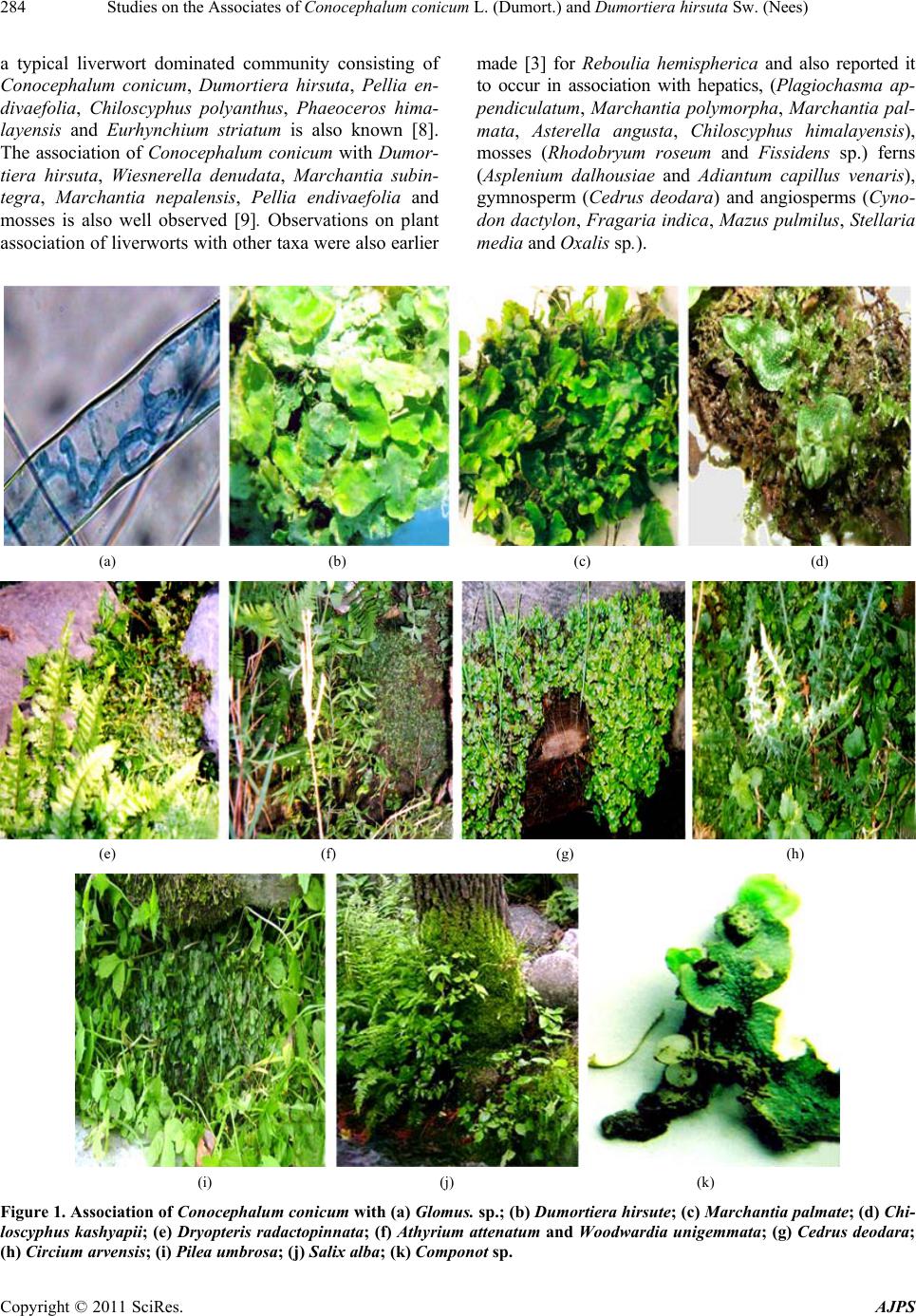 Studies on the Associates of Con ocephalum conicum L. (Dumort.) and Dumortiera hirsuta Sw. (Nees) 284 a typical liverwort dominated community consisting of Conocephalum conicum, Dumortiera hirsuta, Pellia en- divaefolia, Chiloscyphus polyanthus, Phaeoceros hima- layensis and Eurhynchium striatum is also known [8]. The association of Conocephalum conicum with Dumor- tiera hirsuta, Wiesnerella denudata, Marchantia subin- tegra, Marchantia nepalensis, Pellia endivaefolia and mosses is also well observed [9]. Observations on plant association of liverworts with other taxa were also earlier made [3] for Reboulia hemispherica and also reported it to occur in association with hepatics, (Plagiochasma ap- pendiculatum, Marchantia polymorpha, Marchantia pal- mata, Asterella angusta, Chiloscyphus himalayensis), mosses (Rhodobryum roseum and Fissidens sp.) ferns (Asplenium dalhousiae and Adiantum capillus venaris), gymnosperm (Cedrus deodara) and angiosperms (Cyno- don dactylon, Fragaria indica, Mazus pulmilus, Stellaria media and Oxalis sp.). (a) (b) (c) (d) (e) (f) (g) (h) (i) (j) (k) Figure 1. Association of Conocephalum conicum with (a) Glomus. sp.; (b) Dumortiera hirsute; (c) Marchantia palmate; (d) Chi- loscyphus kashyapii; (e) Dryopteris radactopinnata; (f) Athyrium attenatum and Woodwardia unigemmata; (g) Cedrus deodara; (h) Circium arvensis; (i) Pilea umbrosa; (j) Salix alba; (k) Componot sp. Copyright © 2011 SciRes. AJPS  Studies on the Associates of Con ocephalum conicum L. (Dumort.) and Dumortiera hirsuta Sw. (Nees)285 Conocephalum conicum has presently been observed to grow in association with other hepatics, such as Du- mortiera hirsuta, Marchantia palmata, Pellia endivaefo- lia (Figure 1(c)) and Chiloscyphus kashyapii (Figure 1(d)); pteridophytes; Dryopteris radactopinnata, Athy- rium attenatum (Figure 1(e)) and Woodwardia unigem- mata (Figure 1(f)); on the rotten log of Cedrus deodara (gymnoperm) (Figure 1(g)) and angiosperms like Cir- cium arvensis (Figure 1(h)), Pilea umbrosa (Figure 1(i)) and Salix alba (Figure 1(j)) taxa, and an insect (Compo- notus sp.) (Figure 1(k)) belonging to hymenoptera order. Thalli of Dumortiera hirsuta grew found in association with hepatics like Cono cephalum conicum (Figure 2(a)), Marchantia palmata, Chiloscyphus kashyapii (Figure 2(a)), Pellia endivaefolia (Figure 2(b)) and moss a Rhodobryum roseum (Figure 2(c)). Two Pteridophytes namely Woodwardia unigemmata and Dryopteris radac- topinnata (Figure 2(c)) were also found associated with it. Angiosperm associates of Dumortiera hirsuta were Salix alba, Urtica dioica (Figure 2(c)), Impatiens edg- worthi (Figure 2(d)), Valleriana jatomansi and Pilea umbrosa (Figure 2(e)). Of the various plant associates recorded presently for the two plant species the best association was among Conocephalum conicum and Dumortiera hirsuta them- selves. The reason behind such a strong association be- tween these two thalloid liverworts is their ability to oc- cupy the same microsites. Microhabitats and habitat structure are the basic requirement for plants to flourish in an ecological niche, which is almost same and coop- erative for these thalloid liverworts. Data available for plant associates of the two taxa are summarized in the following Table 1. The diversity patterns of among the associated organ- ism groups along the investigated geographical gradient come out to be influenced by both climatic and manage- ment related factors (habitat fragmentation). There is no uncertainty that an increase in the habitats in the forests will increase diversity. The composition of substratum, microclimatic conditions and the habitat position are key (a) (b) (c) (d) (e) Figure 2. Plant associates of (a) Dumortiera hirsute; (b) Marchantia palmata, Chiloscyphus kashyapii and Pellia endivaefolia; (c) Rhodobrium roseum, Woodwardia unigemmata, Dryopteris radactopinnata, Salix alba, Urtica dioica; (d) Imtatiens edgworthi; (e) Valleriana jatomansi and Pilea umbrosa. Copyright © 2011 SciRes. AJPS  Studies on the Associates of Con ocephalum conicum L. (Dumort.) and Dumortiera hirsuta Sw. (Nees) 286 Table 1. Different associates of Conoc e phalum conic um and Dumortiera hirsute. Sl. No Associates Conocephalum conicum Dumortiera hirsuta 1. Fungus Glomus sp. + + 2. Bryophytes Conocephalum conicum - + Dumortiera hirsuta + - Marchantia palmata + + Pellia endivaefolia + + Chiloscyphus kashyapii + + Wiesenerella denudata - + Rhodobryum roseum - + 3. Pteridophytes Woodwardia unigemmata + + Dryopteris radactopinnata + + Athyrium attenatum + - 4. Gymnosperm Cedrus deodara + - 5. Angiosperms Salix alba + + Circium arvensis + - Pilea umbrosa + - Impatiens edgeworthi - + Valleriana jatomansi - + Urtica dioica - + 6. Insect Componotus sp. + - Note: Both Conocephalum conicum and Dumortiera hirsuta have a number of common plant associates among non flowering plant groups (Glomus sp., Marchantia palmata, Chiloscyphus kashyapii, Pellia endivaefolia, Woodwardia unigemmata and Dryopteris radactopinnata) and only one flowering plant species (Salix alba) was common between the two indicating that the substratum requirement and habitat preference for these common plants growing in association with one another is same. This clearly indicates that the two hepatics studied presently have similar microhabitat requirements. variables influencing species composition. It can be con- cluded that the studied taxa are an important factor in maintaining forest integrity and they are helpful as one conservation endpoint that integrates desirable character- istics such as natural biodiversity, stand structure and continuity. Bryophytes have been proposed as surrogates, because they are important components of forest integrity. 4. Acknowledgements We thank the Head, Department of Botany, University of Jammu, Jammu for providing necessary library and la- boratory facilities. REFERENCES [1] S. C. Srivastava and A. Alam, “Frullania tamarisci (L.) Dum.―A New Phorophyte for Stigonema Cf. minutum (C.A.Agardh) Hassal,” Indian Journal of Forestry, Vol. 28, No. 4, 2005, pp. 429-432. [2] U. Gerson, “Bryophytes and Invertebrates,” In: A. J. E. Smith, Ed., Bryophyte Ecology, Chapman and Hall, New York, 1982. [3] T. Fardos, “Studies on Intraspecific Variability in Rebou- lia hemispherica (L.) Raddi,” M.Phil. Dissertation, Uni- versity of Jammu, Jammu, 2003. [4] R. Kapoor, “Studies on the Life History Patterns of Some Species of Riccia (Mich.) L.,” M.Phil. Dissertation, Uni- versity of Jammu, Jammu, 2009. [5] R. F. Cain and M. Fulford, “Contribution to the Hepaticae of Ontario,” The Bryologist, Vol. 16, 1948, pp. 184-186. [6] G. B. Pant, “Threatened Bryophytes of Nainital,” In: S. K. Jain and R. R. Rao, Eds., Assessment of Threatened Plants of India Botanical Survey of India, Department of Environment, Botanical Garden, Howrah, 1983, pp. 313-317. [7] R. M. Schuster, “Boreal Hepaticae—A Manual of the Liverworts of Minnesota and Adjacent Regions,” The American Midland Naturalist, Vol. 49, No. 2, 1953, pp. 257-684. doi:10.2307/2422089 [8] M. Tanwir, “Studies on the Diversity of Hepatic Flora of District Poonch (North-West Himalaya),” PhD Disserta- tion, University of Jammu, Jammu, 2005. [9] S. D. Tiwari and G. B. Pant, “Bryophytes of Kumaon Himalaya,” Bishen Singh Mahinder Pal Singh, Dehradun, 1994. Copyright © 2011 SciRes. AJPS |