

Paper Menu >>
Journal Menu >>
 Natural Resources, 2011, 2, 173-179 doi:10.4236/nr.2011.23023 Published Online September 2011 (http://www.SciRP.org/journal/nr) Copyright © 2011 SciRes. NR 173 Trehalose and Sucrose Osmolytes Accumulated by Algae as Potential Raw Material for Bioethanol Ma. del Pilar Bremauntz1, Luis G. Torres-Bustillos1, Rosa-Olivia Cañizares-Villanueva2, Enrique Duran-Paramo1, Luis Fernández-Linares1 1Laboratory of Bioprocesses, Department of Bioprocesses, Unidad Profesional Interdisciplinaria de Biotecnología UPIBI-Instituto Politécnico Nacional, Mexico City, Mexico; 2Departamento de Biotecnología y Bioingeniería, Centro de Investigación y de Estudios Avanzados- IPN, Mexico City, Mexico. Email: [email protected] Received April 29th, 2011; revised June 30th, 2011; accepted July 10th, 2011. ABSTRACT Currently, obtaining sustainable fuels, such as biodiesel and bioethanol, from cheap and renewable materials is a challenge. In recent years, a new approach being developed consists of producing, sugars from algae by pho tosyn the sis. Sugar accumulation can be increased under osmotic stress (osmoregulation). The aim of this study is to show the pro- duction of sugars from algae, isolated from natural sources, and the effect of osmotic stress on fermentable sugars ac- cumulation. S train isolation, produ ction of sugars from each alga and th e effect of osmotic stress on gro wth and sugar production are described. Twelve algal strains were isolated, showing growths between 0.6 and 1.8 g of biomass dry weight /L, all with production of intra cellu lar and extra cellular su ga rs. The strain iden tified a s Ch lorella sp. showed an increase in sugar production from 23.64 to 421 mg of sugars/g of biomass dry weight after 24 h of osmotic stress with 0.4 M NaCl. Sucrose and trehalose, both fermentable sugars, were the compatible osmolytes accumulated in response to the osmotic stress. The isolated strains are potential producers of fermentable sugars, using the photosynthetic pathway and osmotic stress. Keywords: Algae, Biofuels, Osmoregulators, Carbohydrates, Bioethanol 1. Introduction Carbon neutral renewable fuels, as bioethanol, are deci- sive in contributing to the replacement of petroleum- derived fuels that contribute to global warming. Produc- tion of biodiesel from oil crops and bioethanol from sug- arcane and crops in large amounts are not sustainable. An alternative offered by microalgae results from photosyn- thesis-produced sugars. This production can be increased via osmotic stress as osmolytes accumulation in algae. One mechanism developed by microorganisms as a re- sponse to osmotic stress, is the ability to accumulate com- patible low-molecular-weight organic solutes such as car- bohydrates [1-5]. Three categories of microalgae have been proposed according to their response to salt, a) low stress tolerance to salinity (0.7 M NaCl), with production of sucrose and trehalose, b) medium tolerance to salinity (0.7 - 1.8 M NaCl) with production of glucosylglycerol, and c) high tolerance to salinity (more than 2.7 M NaCl) with produc- tion of amino compounds such as glycine, betaine, or glutamate [6-9]. The mechanism by which microalgae produce sucrose is through the production of a complex enzyme sucrose-phosphate synthetase/phosphatase (SPS/ SPP) [10]. The aim of this study is to show the effect of osmotic stress in algae fermentable sugars accumulation, as a potential supply source of raw material for alcoholic fermentation. 2. Material and Methods 2.1. Algae Isolation and Culture Samples were taken from four different places: the Lake of Texcoco, located in the Metropolitan area of Mexico City (salinity 2000 ppm, pH 8 - 10) [11]; the Lake of Guadalupe, in the State of Mexico (fresh water, pH 7.2, salinity 0.3 ppm); a lake in Tabasco, southeastern Mex- ico (pH 7.2 - 7.8, salinity 2000 ppm); and the river Thames, in Ontario, Canada (pH 6.7, salinity 0.5 ppm). 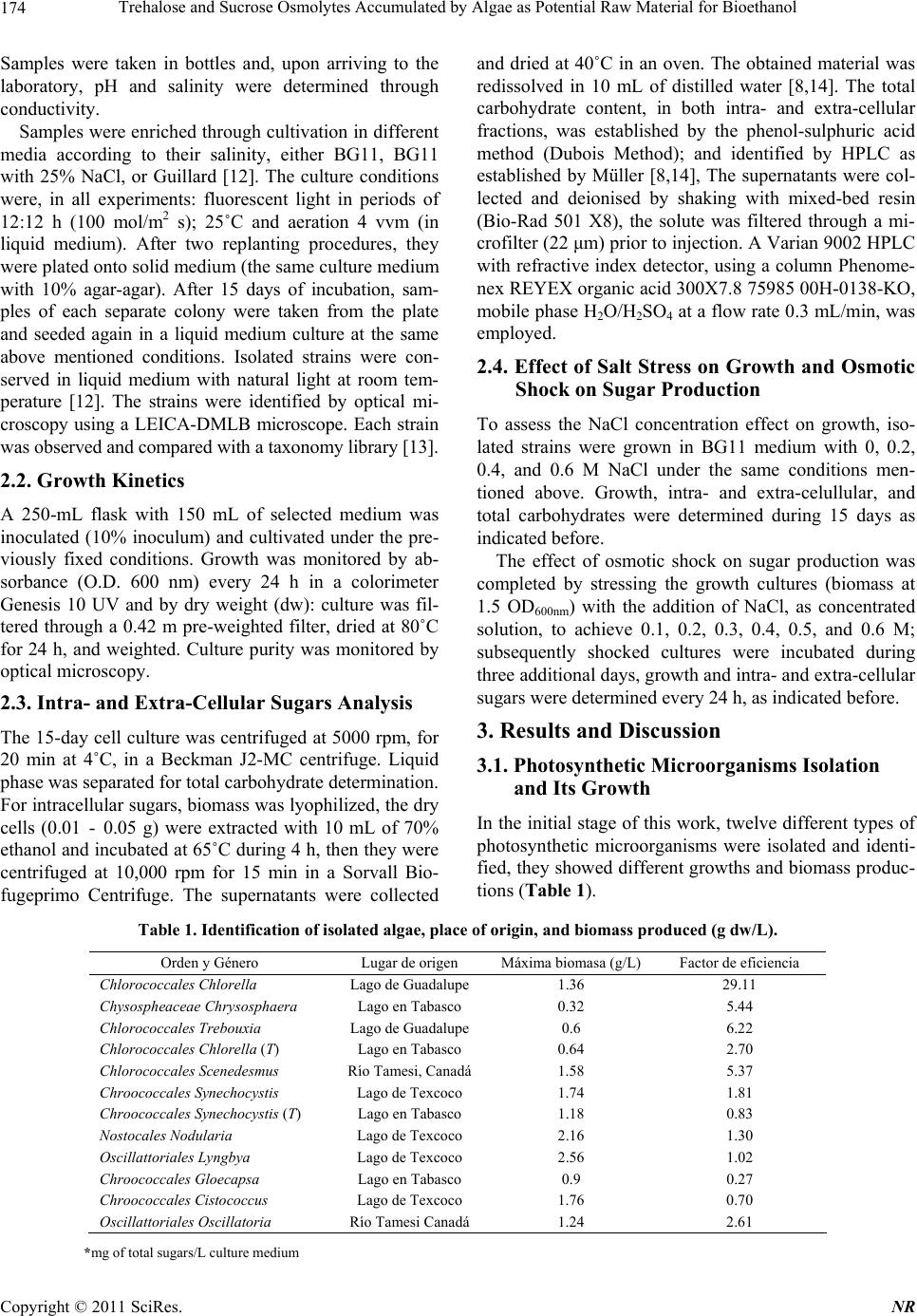 Trehalose and Sucrose Osmolytes Accumulated by Algae as Potential Raw Material for Bioethanol 174 Samples were taken in bottles and, upon arriving to the laboratory, pH and salinity were determined through conductivity. Samples were enriched through cultivation in different media according to their salinity, either BG11, BG11 with 25% NaCl, or Guillard [12]. The culture conditions were, in all experiments: fluorescent light in periods of 12:12 h (100 mol/m2 s); 25˚C and aeration 4 vvm (in liquid medium). After two replanting procedures, they were plated onto solid medium (the same culture medium with 10% agar-agar). After 15 days of incubation, sam- ples of each separate colony were taken from the plate and seeded again in a liquid medium culture at the same above mentioned conditions. Isolated strains were con- served in liquid medium with natural light at room tem- perature [12]. The strains were identified by optical mi- croscopy using a LEICA-DMLB microscope. Each strain was observed and compared with a taxonomy library [13]. 2.2. Growth Kinetics A 250-mL flask with 150 mL of selected medium was inoculated (10% inoculum) and cultivated under the pre- viously fixed conditions. Growth was monitored by ab- sorbance (O.D. 600 nm) every 24 h in a colorimeter Genesis 10 UV and by dry weight (dw): culture was fil- tered through a 0.42 m pre-weighted filter, dried at 80˚C for 24 h, and weighted. Culture purity was monitored by optical microscopy. 2.3. Intra- and Extra-Cellular Sugars Analysis The 15-day cell culture was centrifuged at 5000 rpm, for 20 min at 4˚C, in a Beckman J2-MC centrifuge. Liquid phase was separated for total carbohydrate determination. For intracellular sugars, biomass was lyophilized, the dry cells (0.01 - 0.05 g) were extracted with 10 mL of 70% ethanol and incubated at 65˚C during 4 h, then they were centrifuged at 10,000 rpm for 15 min in a Sorvall Bio- fugeprimo Centrifuge. The supernatants were collected and dried at 40˚C in an oven. The obtained material was redissolved in 10 mL of distilled water [8,14]. The total carbohydrate content, in both intra- and extra-cellular fractions, was established by the phenol-sulphuric acid method (Dubois Method); and identified by HPLC as established by Müller [8,14], The supernatants were col- lected and deionised by shaking with mixed-bed resin (Bio-Rad 501 X8), the solute was filtered through a mi- crofilter (22 μm) prior to injection. A Varian 9002 HPLC with refractive index detector, using a column Phenome- nex REYEX organic acid 300X7.8 75985 00H-0138-KO, mobile phase H2O/H2SO4 at a flow rate 0.3 mL/min, was employed. 2.4. Effect of Salt Stress on Growth and Osmotic Shock on Sugar Production To assess the NaCl concentration effect on growth, iso- lated strains were grown in BG11 medium with 0, 0.2, 0.4, and 0.6 M NaCl under the same conditions men- tioned above. Growth, intra- and extra-celullular, and total carbohydrates were determined during 15 days as indicated before. The effect of osmotic shock on sugar production was completed by stressing the growth cultures (biomass at 1.5 OD600nm) with the addition of NaCl, as concentrated solution, to achieve 0.1, 0.2, 0.3, 0.4, 0.5, and 0.6 M; subsequently shocked cultures were incubated during three additional days, growth and intra- and extra-cellular sugars were determined every 24 h, as indicated before. 3. Results and Discussion 3.1. Photosynthetic Microorganisms Isolation and Its Growth In the initial stage of this work, twelve different types of photosynthetic microorganisms were isolated and identi- fied, they showed different growths and biomass produc- tions (Table 1). Table 1. Identification of isolated algae, place of origin, and biomass produced (g dw/L). Orden y Género Lugar de origen Máxima biomasa (g/L)Factor de eficiencia Chlorococcales Chlorella Lago de Guadalupe 1.36 29.11 Chysospheaceae Chrysosphaera Lago en Tabasco 0.32 5.44 Chlorococcales Trebouxia Lago de Guadalupe 0.6 6.22 Chlorococcales Chlorella (T) Lago en Tabasco 0.64 2.70 Chlorococcales Scenedesmus Río Tamesi, Canadá 1.58 5.37 Chroococcales Synechocystis Lago de Texcoco 1.74 1.81 Chroococcales Synechocystis (T) Lago en Tabasco 1.18 0.83 Nostocales Nodularia Lago de Texcoco 2.16 1.30 Oscillattoriales Lyngbya Lago de Texcoco 2.56 1.02 Chroococcales Gloecapsa Lago en Tabasco 0.9 0.27 Chroococcales Cistococcus Lago de Texcoco 1.76 0.70 Oscillattoriales Oscillatoria Río Tamesi Canadá 1.24 2.61 *mg of total sugars/L culture medium Copyright © 2011 SciRes. NR 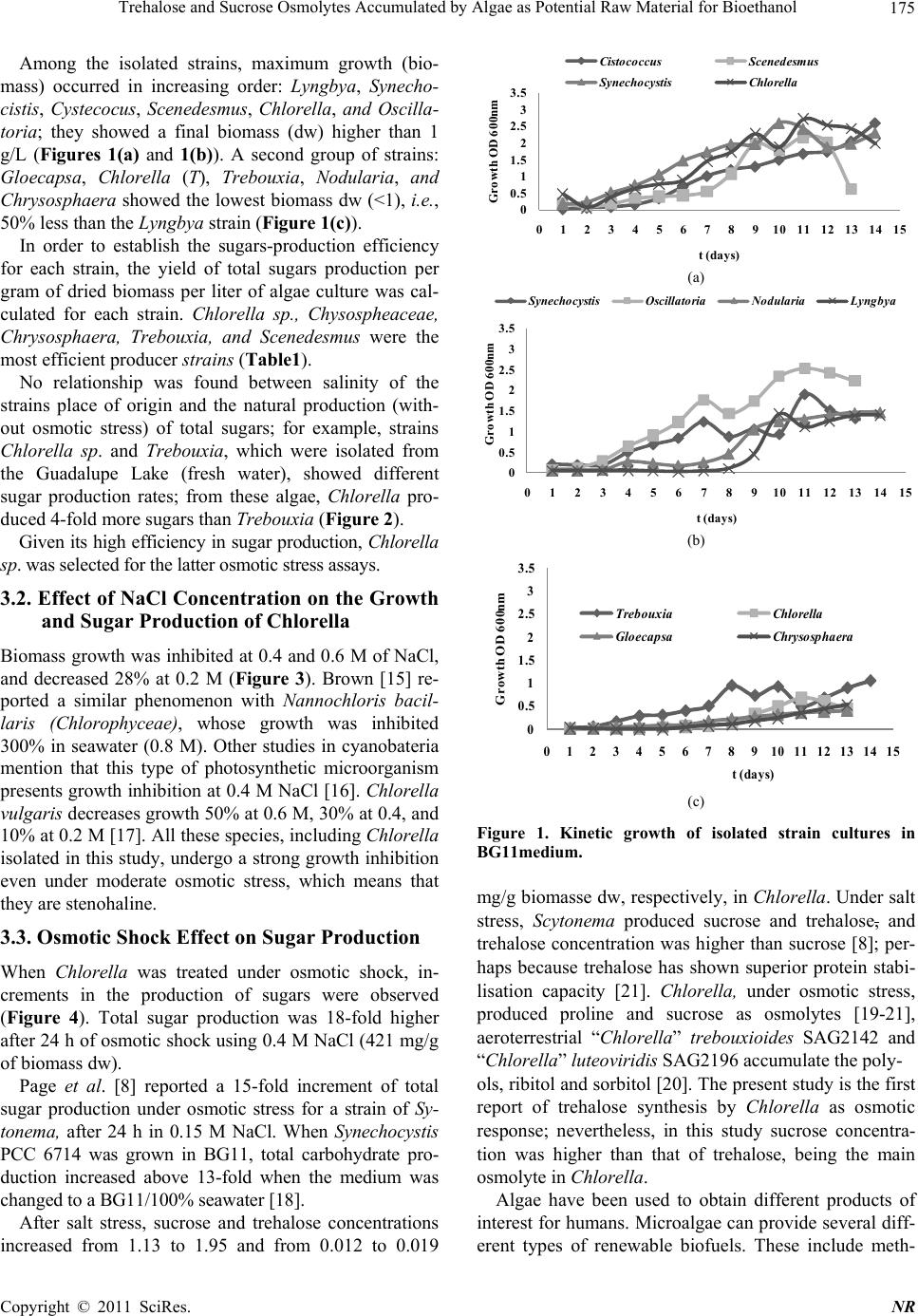 Trehalose and Sucrose Osmolytes Accumulated by Algae as Potential Raw Material for Bioethanol 175 Among the isolated strains, maximum growth (bio- mass) occurred in increasing order: Lyngbya, Synecho- cistis, Cystecocus, Scenedesmus, Chlorella, and Oscilla- toria; they showed a final biomass (dw) higher than 1 g/L (Figures 1(a) and 1(b)). A second group of strains: Gloecapsa, Chlorella (T), Trebouxia, Nodularia, and Chrysosphaera showed the lowest biomass dw (<1), i.e., 50% less than the Lyngbya strain (Figure 1(c)). In order to establish the sugars-production efficiency for each strain, the yield of total sugars production per gram of dried biomass per liter of algae culture was cal- culated for each strain. Chlorella sp., Chysospheaceae, Chrysosphaera, Trebouxia, and Scenedesmus were the most efficient producer strains (Table1). No relationship was found between salinity of the strains place of origin and the natural production (with- out osmotic stress) of total sugars; for example, strains Chlorella sp. and Trebouxia, which were isolated from the Guadalupe Lake (fresh water), showed different sugar production rates; from these algae, Chlorella pro- duced 4-fold more sugars than Trebouxia (Figure 2). Given its high efficiency in sugar production, Chlorella sp. was selected for the latter osmotic stress assays. 3.2. Effect of NaCl Concentration on the Growth and Sugar Production of Chlorella Biomass growth was inhibited at 0.4 and 0.6 M of NaCl, and decreased 28% at 0.2 M (Figure 3). Brown [15] re- ported a similar phenomenon with Nannochloris bacil- laris (Chlorophyceae), whose growth was inhibited 300% in seawater (0.8 M). Other studies in cyanobateria mention that this type of photosynthetic microorganism presents growth inhibition at 0.4 M NaCl [16]. Chlorella vulgaris decreases growth 50% at 0.6 M, 30% at 0.4, and 10% at 0.2 M [17]. All these species, including Chlorella isolated in this study, undergo a strong growth inhibition even under moderate osmotic stress, which means that they are stenohaline. 3.3. Osmotic Shock Effect on Sugar Production When Chl orella was treated under osmotic shock, in- crements in the production of sugars were observed (Figure 4). Total sugar production was 18-fold higher after 24 h of osmotic shock using 0.4 M NaCl (421 mg/g of biomass dw). Page et al. [8] reported a 15-fold increment of total sugar production under osmotic stress for a strain of Sy- tonema, after 24 h in 0.15 M NaCl. When Synechocyst i s PCC 6714 was grown in BG11, total carbohydrate pro- duction increased above 13-fold when the medium was changed to a BG11/100% seawater [18]. After salt stress, sucrose and trehalose concentrations increased from 1.13 to 1.95 and from 0.012 to 0.019 0 0.5 1 1.5 2 2.5 3 3.5 0123456789101112131415 Grow th OD 600 n m t (d ays) Cistococcus Scenedesmus Synechocystis Chlorella (a) 0 0.5 1 1.5 2 2.5 3 3.5 0 1 2 3 4 5 6 7 8 9101112131415 Grow th OD 600nm t (d ays ) S ynechocystis Oscillatoria NodulariaLyngbya (b) 0 0.5 1 1.5 2 2.5 3 3.5 0 1 2 3 4 5 6 7 8 9101112131415 Grow th OD 600 n m t (d ays) Trebouxia Chlorella Gloecapsa Chrysosphaera (c) Figure 1. Kinetic growth of isolated strain cultures in BG11medium. mg/g biomasse dw, respectively, in Chlorella. Under salt stress, Scytonema produced sucrose and trehalose, and trehalose concentration was higher than sucrose [8]; per- haps because trehalose has shown superior protein stabi- lisation capacity [21]. Chlorella, under osmotic stress, produced proline and sucrose as osmolytes [19-21], aeroterrestrial “Chlorella” trebouxioides SAG2142 and “Chlorella” luteoviridis SAG2196 accumulate the poly- ols, ribitol and sorbitol [20]. The present study is the first report of trehalose synthesis by Chlorella as osmotic response; nevertheless, in this study sucrose concentra- tion was higher than that of trehalose, being the main osmolyte in Chlorella. Algae have been used to obtain different products of interest for humans. Microalgae can provide several diff- erent types of renewable biofuels. These include meth- Copyright © 2011 SciRes. NR 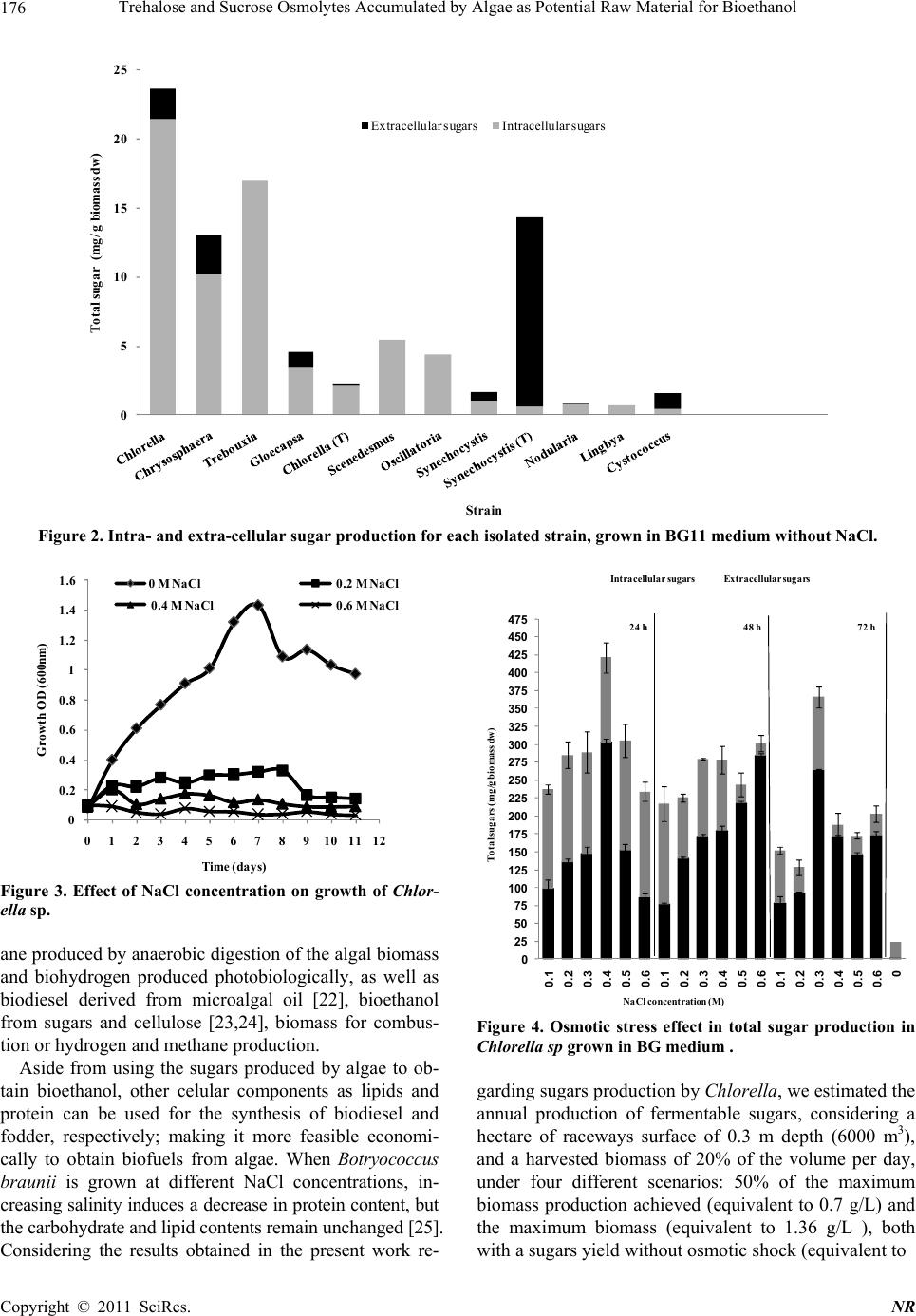 Trehalose and Sucrose Osmolytes Accumulated by Algae as Potential Raw Material for Bioethanol 176 0 5 10 15 20 25 T otal su gar (m g/ g b i o m as s d w ) Strain Extracellular sugarsIntracellular sugars Figure 2. Intra- and extra-cellular sugar production for each isolated strain, grown in BG11 medium without NaCl. 0 0.2 0.4 0.6 0.8 1 1.2 1.4 1.6 0123456789101112 Growth OD (60 0nm ) T i m e (d ays ) 0 M N aC l0.2 M N aCl 0.4 M N aCl0.6 M N aCl Figure 3. Effect of NaCl concentration on growth of Chlor- ella sp. ane produced by anaerobic digestion of the algal biomass and biohydrogen produced photobiologically, as well as biodiesel derived from microalgal oil [22], bioethanol from sugars and cellulose [23,24], biomass for combus- tion or hydrogen and methane production. Aside from using the sugars produced by algae to ob- tain bioethanol, other celular components as lipids and protein can be used for the synthesis of biodiesel and fodder, respectively; making it more feasible economi- cally to obtain biofuels from algae. When Botryococcus braunii is grown at different NaCl concentrations, in- creasing salinity induces a decrease in protein content, but the carbohydrate and lipid contents remain unchanged [25]. Considering the results obtained in the present work re- 24 h48 h72 h 0 25 50 75 100 125 150 175 200 225 250 275 300 325 350 375 400 425 450 475 0.1 0.2 0.3 0.4 0.5 0.6 0.1 0.2 0.3 0.4 0.5 0.6 0.1 0.2 0.3 0.4 0.5 0.6 0 NaClconcentration( M) Total sugars (mg/g biomass dw) Intracellular sugars Extracellular sugars Figure 4. Osmotic stress effect in total sugar production in Chlorella sp grown in BG me dium . garding sugars production by Chlorella, we estimated the annual production of fermentable sugars, considering a hectare of raceways surface of 0.3 m depth (6000 m3), and a harvested biomass of 20% of the volume per day, under four different scenarios: 50% of the maximum biomass production achieved (equivalent to 0.7 g/L) and the maximum biomass (equivalent to 1.36 g/L ), both with a sugars yield without osmotic shock (equivalent to Copyright © 2011 SciRes. NR 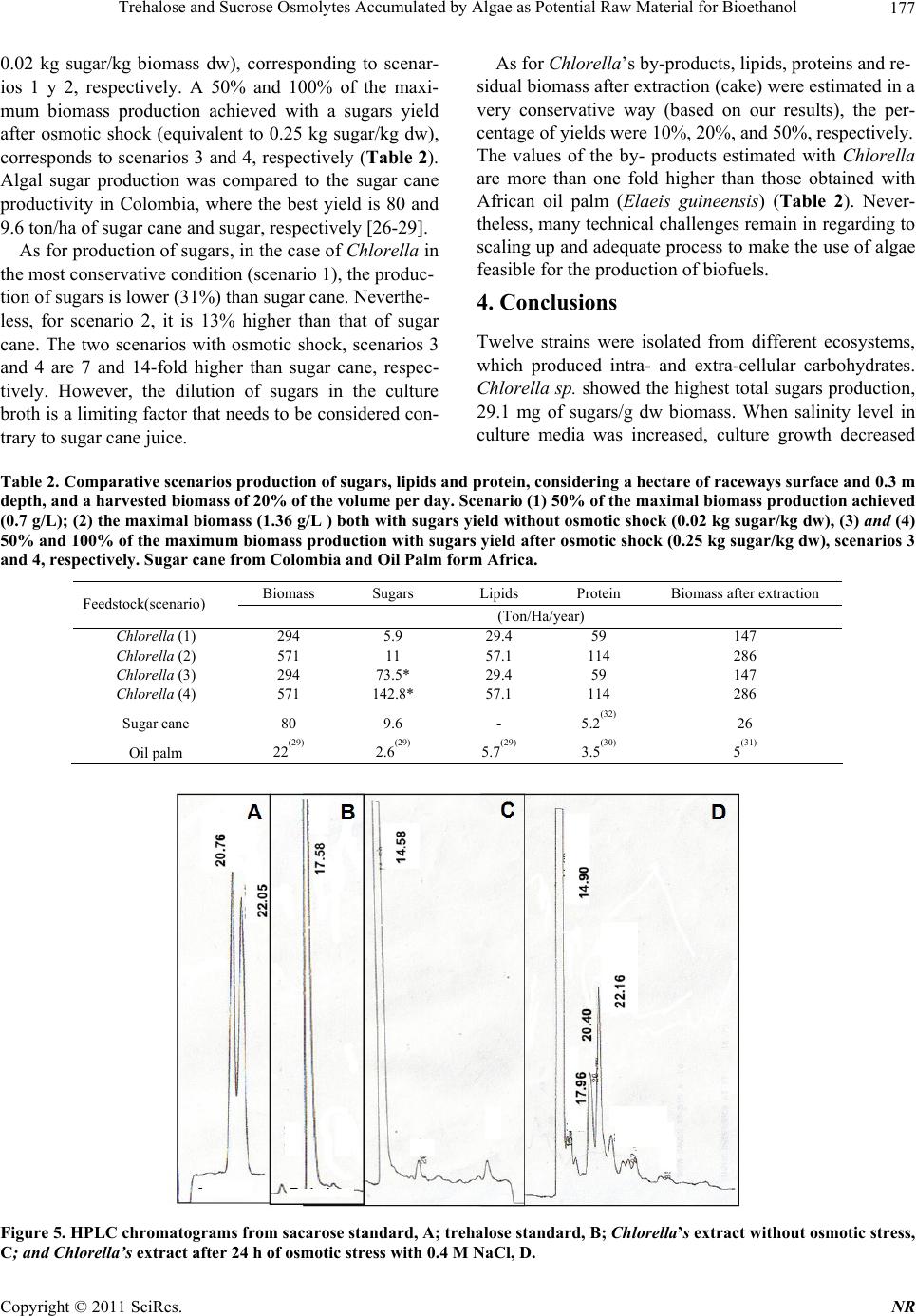 Trehalose and Sucrose Osmolytes Accumulated by Algae as Potential Raw Material for Bioethanol177 0.02 kg sugar/kg biomass dw), corresponding to scenar- ios 1 y 2, respectively. A 50% and 100% of the maxi- mum biomass production achieved with a sugars yield after osmotic shock (equivalent to 0.25 kg sugar/kg dw), corresponds to scenarios 3 and 4, respectively (Table 2). Algal sugar production was compared to the sugar cane productivity in Colombia, where the best yield is 80 and 9.6 ton/ha of sugar cane and sugar, respectively [26-29]. As for production of sugars, in the case of Chlorella in the most conservative condition (scenario 1), the produc- tion of sugars is lower (31%) than sugar cane. Neverthe- less, for scenario 2, it is 13% higher than that of sugar cane. The two scenarios with osmotic shock, scenarios 3 and 4 are 7 and 14-fold higher than sugar cane, respec- tively. However, the dilution of sugars in the culture broth is a limiting factor that needs to be considered con- trary to sugar cane juice. As for Chlorella’s by-products, lipids, proteins and re- sidual biomass after extraction (cake) were estimated in a very conservative way (based on our results), the per- centage of yields were 10%, 20%, and 50%, respectively. The values of the by- products estimated with Chlorella are more than one fold higher than those obtained with African oil palm (Elaeis guineensis) (Table 2). Never- theless, many technical challenges remain in regarding to scaling up and adequate process to make the use of algae feasible for the production of biofuels. 4. Conclusions Twelve strains were isolated from different ecosystems, which produced intra- and extra-cellular carbohydrates. Chlorella sp. showed the highest total sugars production, 29.1 mg of sugars/g dw biomass. When salinity level in culture media was increased, culture growth decreased Table 2. Comparative scenarios production of sugars, lipids and protein, considering a hectare of raceways surface and 0.3 m depth, and a harvested biomass of 20% of the volume per day. Sce nario (1) 50% of the maximal biomass production achieved (0.7 g/L); (2) the maximal biomass (1.36 g/L ) both with sugars yield without osmotic shock (0.02 kg sugar/kg dw), (3) and (4) 50% and 100% of the maximum biomass production with sugars yield after osmotic shock (0.25 kg sugar/kg dw), scenarios 3 and 4, respectively. Sugar cane from Colombia and Oil Palm form Africa. Biomass Sugars Lipids Protein Biomass after extraction Feedstock(scenario) (Ton/Ha/year) Chlorella (1) 294 5.9 29.4 59 147 Chlorella (2) 571 11 57.1 114 286 Chlorella (3) 294 73.5* 29.4 59 147 Chlorella (4) 571 142.8* 57.1 114 286 Sugar cane 80 9.6 - 5.2(32) 26 Oil palm 22(29) 2.6(29) 5.7(29) 3.5(30) 5 (31) Figure 5. HPLC chromatograms from sacarose standard, A; trehalose standard, B; Chlorella’s extract without osmotic stress, C; and Chlorella’s extract after 24 h of osmotic stress with 0.4 M NaCl, D. Copyright © 2011 SciRes. NR 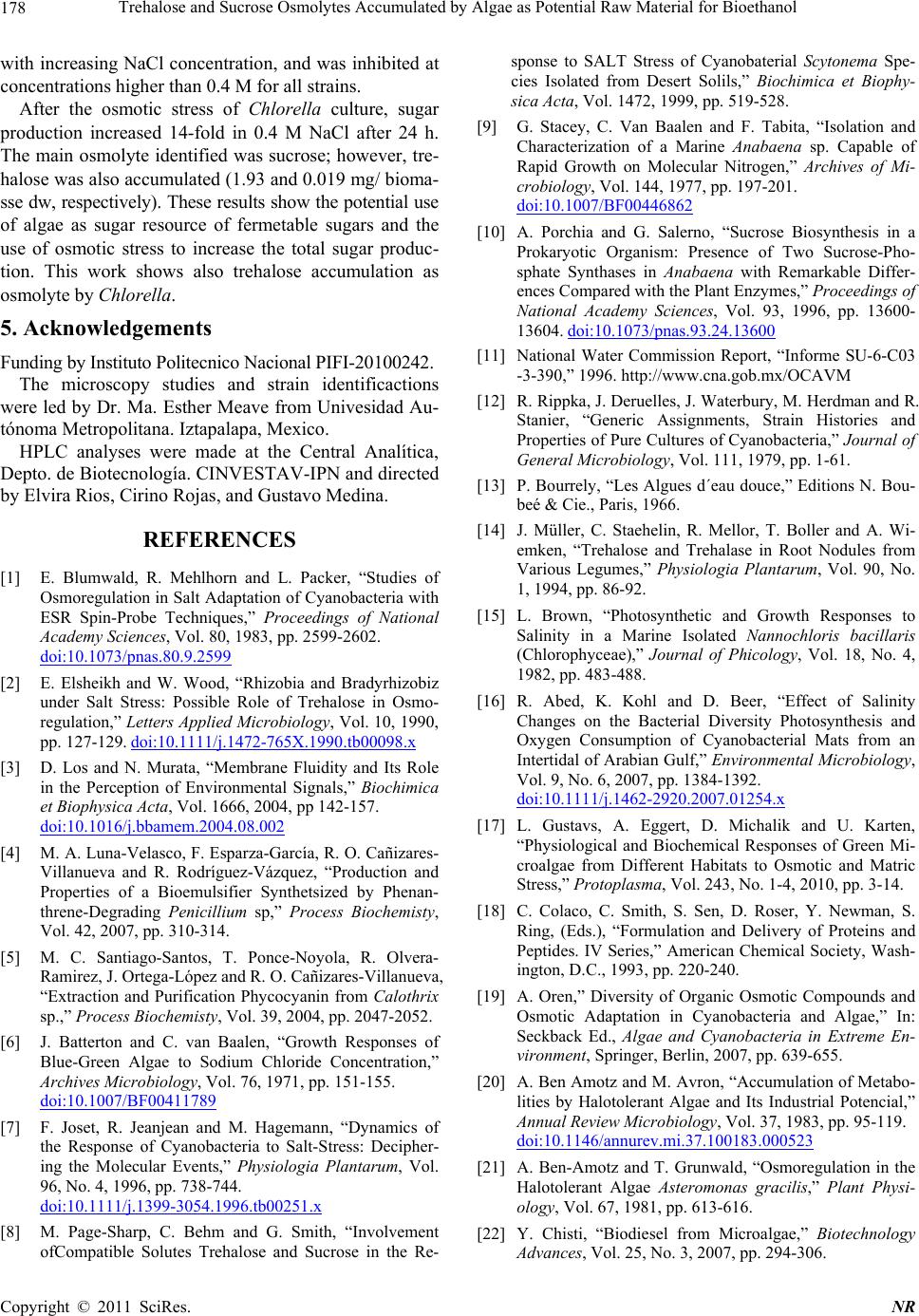 Trehalose and Sucrose Osmolytes Accumulated by Algae as Potential Raw Material for Bioethanol 178 with increasing NaCl concentration, and was inhibited at concentrations higher than 0.4 M for all strains. After the osmotic stress of Chlorella culture, sugar production increased 14-fold in 0.4 M NaCl after 24 h. The main osmolyte identified was sucrose; however, tre- halose was also accumulated (1.93 and 0.019 mg/ bioma- sse dw, respectively). These results show the potential use of algae as sugar resource of fermetable sugars and the use of osmotic stress to increase the total sugar produc- tion. This work shows also trehalose accumulation as osmolyte by Chlorella. 5. Acknowledgements Funding by Instituto Politecnico Nacional PIFI-20100242. The microscopy studies and strain identificactions were led by Dr. Ma. Esther Meave from Univesidad Au- tónoma Metropolitana. Iztapalapa, Mexico. HPLC analyses were made at the Central Analítica, Depto. de Biotecnología. CINVESTAV-IPN and directed by Elvira Rios, Cirino Rojas, and Gustavo Medina. REFERENCES [1] E. Blumwald, R. Mehlhorn and L. Packer, “Studies of Osmoregulation in Salt Adaptation of Cyanobacteria with ESR Spin-Probe Techniques,” Proceedings of National Academy Sciences, Vol. 80, 1983, pp. 2599-2602. doi:10.1073/pnas.80.9.2599 [2] E. Elsheikh and W. Wood, “Rhizobia and Bradyrhizobiz under Salt Stress: Possible Role of Trehalose in Osmo- regulation,” Letters Applied Microbiology, Vol. 10, 1990, pp. 127-129. doi:10.1111/j.1472-765X.1990.tb00098.x [3] D. Los and N. Murata, “Membrane Fluidity and Its Role in the Perception of Environmental Signals,” Biochimica et Biophysica Acta, Vol. 1666, 2004, pp 142-157. doi:10.1016/j.bbamem.2004.08.002 [4] M. A. Luna-Velasco, F. Esparza-García, R. O. Cañizares- Villanueva and R. Rodríguez-Vázquez, “Production and Properties of a Bioemulsifier Synthetsized by Phenan- threne-Degrading Penicillium sp,” Process Biochemisty, Vol. 42, 2007, pp. 310-314. [5] M. C. Santiago-Santos, T. Ponce-Noyola, R. Olvera- Ramirez, J. Ortega-López and R. O. Cañizares-Villanueva, “Extraction and Purification Phycocyanin from Calothrix sp.,” Process Biochemisty, Vol. 39, 2004, pp. 2047-2052. [6] J. Batterton and C. van Baalen, “Growth Responses of Blue-Green Algae to Sodium Chloride Concentration,” Archives Microbiology, Vol. 76, 1971, pp. 151-155. doi:10.1007/BF00411789 [7] F. Joset, R. Jeanjean and M. Hagemann, “Dynamics of the Response of Cyanobacteria to Salt-Stress: Decipher- ing the Molecular Events,” Physiologia Plantarum, Vol. 96, No. 4, 1996, pp. 738-744. doi:10.1111/j.1399-3054.1996.tb00251.x [8] M. Page-Sharp, C. Behm and G. Smith, “Involvement ofCompatible Solutes Trehalose and Sucrose in the Re- sponse to SALT Stress of Cyanobaterial Scytonema Spe- cies Isolated from Desert Solils,” Biochimica et Biophy- sica Acta, Vol. 1472, 1999, pp. 519-528. [9] G. Stacey, C. Van Baalen and F. Tabita, “Isolation and Characterization of a Marine Anabaena sp. Capable of Rapid Growth on Molecular Nitrogen,” Archives of Mi- crobiology, Vol. 144, 1977, pp. 197-201. doi:10.1007/BF00446862 [10] A. Porchia and G. Salerno, “Sucrose Biosynthesis in a Prokaryotic Organism: Presence of Two Sucrose-Pho- sphate Synthases in Anabaena with Remarkable Differ- ences Compared with the Plant Enzymes,” Proceedings of National Academy Sciences, Vol. 93, 1996, pp. 13600- 13604. doi:10.1073/pnas.93.24.13600 [11] National Water Commission Report, “Informe SU-6-C03 -3-390,” 1996. http://www.cna.gob.mx/OCAVM [12] R. Rippka, J. Deruelles, J. Waterbury, M. Herdman and R. Stanier, “Generic Assignments, Strain Histories and Properties of Pure Cultures of Cyanobacteria,” Journal of General Microbiology, Vol. 111, 1979, pp. 1-61. [13] P. Bourrely, “Les Algues d´eau douce,” Editions N. Bou- beé & Cie., Paris, 1966. [14] J. Müller, C. Staehelin, R. Mellor, T. Boller and A. Wi- emken, “Trehalose and Trehalase in Root Nodules from Various Legumes,” Physiologia Plantarum, Vol. 90, No. 1, 1994, pp. 86-92. [15] L. Brown, “Photosynthetic and Growth Responses to Salinity in a Marine Isolated Nannochloris bacillaris (Chlorophyceae),” Journal of Phicology, Vol. 18, No. 4, 1982, pp. 483-488. [16] R. Abed, K. Kohl and D. Beer, “Effect of Salinity Changes on the Bacterial Diversity Photosynthesis and Oxygen Consumption of Cyanobacterial Mats from an Intertidal of Arabian Gulf,” Environmental Microbiology, Vol. 9, No. 6, 2007, pp. 1384-1392. doi:10.1111/j.1462-2920.2007.01254.x [17] L. Gustavs, A. Eggert, D. Michalik and U. Karten, “Physiological and Biochemical Responses of Green Mi- croalgae from Different Habitats to Osmotic and Matric Stress,” Protoplasma, Vol. 243, No. 1-4, 2010, pp. 3-14. [18] C. Colaco, C. Smith, S. Sen, D. Roser, Y. Newman, S. Ring, (Eds.), “Formulation and Delivery of Proteins and Peptides. IV Series,” American Chemical Society, Wash- ington, D.C., 1993, pp. 220-240. [19] A. Oren,” Diversity of Organic Osmotic Compounds and Osmotic Adaptation in Cyanobacteria and Algae,” In: Seckback Ed., Algae and Cyanobacteria in Extreme En- vironment, Springer, Berlin, 2007, pp. 639-655. [20] A. Ben Amotz and M. Avron, “Accumulation of Metabo- lities by Halotolerant Algae and Its Industrial Potencial,” Annual Review Microbi ol ogy, Vol. 37, 1983, pp. 95-119. doi:10.1146/annurev.mi.37.100183.000523 [21] A. Ben-Amotz and T. Grunwald, “Osmoregulation in the Halotolerant Algae Asteromonas gracilis,” Plant Physi- ology, Vol. 67, 1981, pp. 613-616. [22] Y. Chisti, “Biodiesel from Microalgae,” Biotechnology Advances, Vol. 25, No. 3, 2007, pp. 294-306. Copyright © 2011 SciRes. NR  Trehalose and Sucrose Osmolytes Accumulated by Algae as Potential Raw Material for Bioethanol Copyright © 2011 SciRes. NR 179 doi:10.1016/j.biotechadv.2007.02.001 [23] J. Zaldivar, J. Nielsen and L. Olsson, “Fuel Ethanol from Lignocelluloses: A Challenge for Methabolic Engineering and Process Integration,” Applied Microbiology and Bio- technology, Vol. 56, No. 1-2, 2001, pp. 17-34. doi:10.1007/s002530100624 [24] C. Posten and G. Schaub, “Microalgae and Terrestrial Bio- mass as Source for Fuels—A Process View,” Journal of Biotechology, Vol. 142, No. 1, 2009, pp. 142: 64-69. [25] R. Vazquez-Duhalt and B. Arredondo, “Haloadaptation of a Green Alga Botryococcus braunii (Race A),” Phyto- chemistry, Vol. 30, No. 9, 1991, pp. 2919-2915. [26] E. Visser, D. Filhi, M. Martins and B. Steward, “Bioetha- nol Production Potential from Brazilian Biodiesel Co- Products,” Biomass and Bioenerg y, Vol. 35, 2011, pp. 489- 494. doi:10.1016/j.biombioe.2010.09.009 [27] L. P. F. Carvalho, A. R. J. Cabrita, R. J. Dewhurst, T. E. J. Vicente, Z. M. C. Lopes and A. J. M. Fonseca, “Eva- luation of Palm Kernel Meal and Corn Distillers Grains in Corn Silage-Based Diets for Lactating Dairy Cows,” Journal of Dairy Science, Vol. 89, No. 7, 2006, pp. 2705- 2715. [28] S. Yusoff, “Renewable Energy from Palm Oil-Innovation on Effective Utilization of Waste,” Journal of Cleaner Production, Vol. 14, No.1, 2006, pp. 87-93. doi:10.1016/j.jclepro.2004.07.005 [29] A. Córdova-Izquierdo, J. A. Lara Torres, R. Amaro Guti- érrez, S. D. Peña Betancourt and V. M. Xolalpa Campos, “Composition of Milk from Holstein Cows Supplemented with Sugar Cane Enriched Comprehensive Paperback Saccharina,” Revista Veterinria, Vol. 1, No. 1, 2010, pp. 66-68. |