

Paper Menu >>
Journal Menu >>
 World Journal of AIDS, 2011, 1, 100-103 doi:10.4236/wja.2011.13015 Published Online September 2011 (http://www.SciRP.org/journal/wja) Copyright © 2011 SciRes. WJA Health Care Discrimination in HIV Care Jayakumar Palanisamy1, Senthilkumar Subramanian2 1Primary Health Center, Periyapothu, Pollachi, Coimbatore, India; 2Department of Public Health and Preventive Medicine, Coimba- tore, India. Email: [email protected] Received July 21st, 2011; revised August 14th, 2011; accepted August 26th, 2011. ABSTRACT Human Immunodeficiency Virus (HIV) infected population is experiencing enormous amount of social discrimination and stigmatization compared to other patients with any other chronic illness. Healthcare setup is not an exception where the HIV infected patients are shuttled from one place to another to get their basic services compared to HIV negative patients. This referral game of manipulation imparts additional stress to the already stressed HIV infected population. The physica l and psychological impacts caused b y other chronic conditions will be supplemen ted by social impact in the HIV infected population. Th is referral game in healthcare can cause the HIV infected to avoid their health seeking behavior and it may bring them back to their high risk activities, which can result in higher mortality/morbidity and failure in prevention and in tervention strategies. Keywords: HI V , AIDS, Discrimination, Healthcare 1. Introduction HIV (Human Immunodeficiency Virus) infection and its social impacts stigma/discrimination are always traveling together like a train track. With education stigma/dis- crimination in the society coming down but still the changes are not up to the mark. The situation is same for the health care setting too [1,3-9]. In this review article the social impacts of stigma and discrimination in the healthcare setting are tried to get explored and the net effect is hypothesized. 2. Hypothesis 2.1. The Discrimination and Referral Game Even though the healthcare professionals are ready to treat HIV patients along with other diseases with their improved knowledge and newer development, the dis- criminatory behavior while treating HIV patients still exists [1-6]. Patients coming to the outpatient department for medical or surgical problem may be referred for HIV screening [6] to Integrated Counseling and Testing Cen- ter (ICTC) and if the patient is found to be positive for HIV then they will be referred to Antiretroviral Therapy (ART) Centre, where the client is going to stay for their remaining lifetime. When HIV patients are referred to other medical or surgical specialties, they are less likely to be treated/ad- mitted in respective departments as inpatients [5-7]. Most often the referred departments refer back the patients with the advice of conservative management, even for the genuine cases which need an intensive specialized management. Few cases which get admitted are managed by case sheet entries not the clinical management. These patients are also segregated in the wards.{Example: A meningoencephalitis patient is getting Ryle’s tube feed- ing and intravenous(IV) antibiotics as per case records but in the ward that patient is neither on Ryle’s tube nor on IV line}. 2.2. Tyndal Effect to Pinball Effect Here we explain the above mentioned referral game by combining the physics of Tindal effect (When the ray of light hit the particle in a media, the ligh t ray get dev iated) and the ball game Pinball (Manipulation by hitting the ball away in a closed playfield). When a person is found to be HIV positive he/sh e may gain entrance into the playfield of health system. The positive person is referred from one department to an- other department particularly when they are critically ill and need specialist care which is comparable with the manipulation of pinball to score more. Most of the times healthcare professionals are not ready to admit or treat HIV infected patients. This manipulation of referral 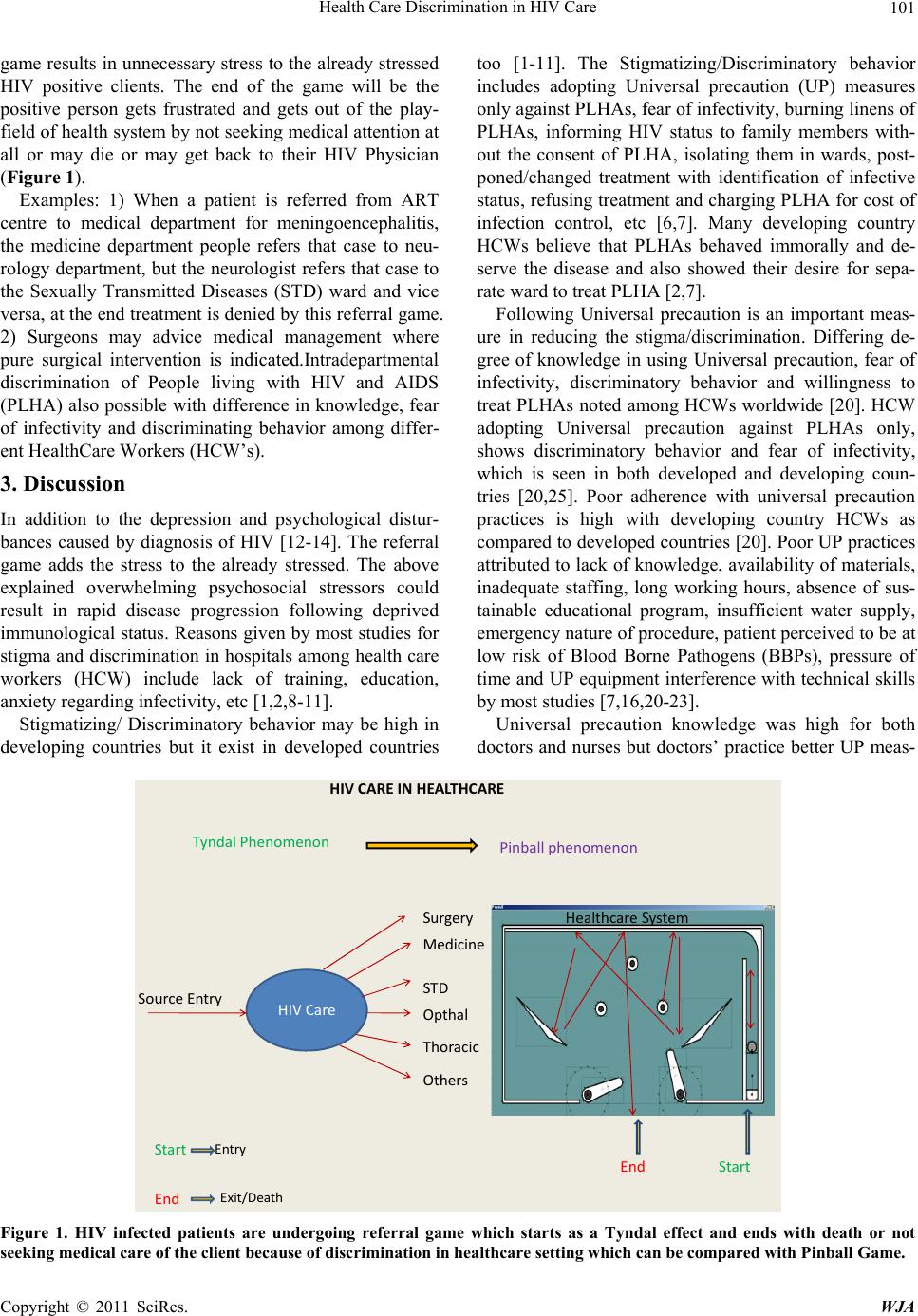 Health Care Discrimination in HIV Care101 game results in unnecessary stress to the already stressed HIV positive clients. The end of the game will be the positive person gets frustrated and gets out of the play- field of health system by not seeking medical attention at all or may die or may get back to their HIV Physician (Figure 1). Examples: 1) When a patient is referred from ART centre to medical department for meningoencephalitis, the medicine department people refers that case to neu- rology department, but the neurologist refers that case to the Sexually Transmitted Diseases (STD) ward and vice versa, at the end treatment is denied by this referral game. 2) Surgeons may advice medical management where pure surgical intervention is indicated.Intradepartmental discrimination of People living with HIV and AIDS (PLHA) also possible with difference in knowledge, fear of infectivity and discriminating behavior among differ- ent HealthCare Workers (HCW’s). 3. Discussion In addition to the depression and psychological distur- bances caused by diagnosis of HIV [12-14]. The referral game adds the stress to the already stressed. The above explained overwhelming psychosocial stressors could result in rapid disease progression following deprived immunological status. Reasons given by most studies for stigma and discrimination in hospitals among health care workers (HCW) include lack of training, education, anxiety regarding infectivity, etc [1,2,8-11]. Stigmatizing/ Discriminatory behavior may be high in developing countries but it exist in developed countries too [1-11]. The Stigmatizing/Discriminatory behavior includes adopting Universal precaution (UP) measures only against PLHAs, fear of infectivity, burn ing linens of PLHAs, informing HIV status to family members with- out the consent of PLHA, isolating them in wards, post- poned/changed treatment with identification of infective status, refusing treatment and charging PLHA for cost of infection control, etc [6,7]. Many developing country HCWs believe that PLHAs behaved immorally and de- serve the disease and also showed their desire for sepa- rate ward to treat PLHA [2,7]. Following Universal precaution is an important meas- ure in reducing the stigma/discrimination. Differing de- gree of knowledge in using Universal precaution, fear of infectivity, discriminatory behavior and willingness to treat PLHAs noted among HCWs worldwide [20]. HCW adopting Universal precaution against PLHAs only, shows discriminatory behavior and fear of infectivity, which is seen in both developed and developing coun- tries [20,25]. Poor adherence with universal precaution practices is high with developing country HCWs as compared to developed countries [20]. Poor UP practices attributed to lack of knowledg e, availability of materials, inadequate staffing, long working hours, absence of sus- tainable educational program, insufficient water supply, emergency nature of procedure, patient perceived to be at low risk of Blood Borne Pathogens (BBPs), pressure of time and UP equipment interference with tech nical skills by most studies [7,16,20-23]. Universal precaution knowledge was high for both doctors and nurses but doctors’ practice better UP meas- HIVCare Surgery Medicine ST D Opthal Thoracic Others SourceEntry Tyndal PhenomenonPinballphenomenon End E Start HIVCAREINHEALTHCARE Start Entry Exit/Death nd HealthcareSystem Figure 1. HIV infected patients are undergoing referral game which starts as a Tyndal effect and ends with death or not seeking medical care of the client because of discrimination in healthcare setting which can be compared with Pinball Game. Copyright © 2011 SciRes. WJA  Health Care Discrimination in HIV Care 102 ures compared to nurses except hand washing practices where nurses are better [20,22]. There is no difference in knowledge and discriminatory attitude with doctors/nur- ses [8,21]. Some studies show incomplete knowledge among nurses but even a perceived knowledge has weak effect on compliance with UP and willingness to care BBP infected [18,19]. High risk perception was noted with doctors and poor knowledge of UP and Post Expo- sure Prophylaxis (PEP) was noted with surgical trainee [15,17]. Some studies notified least discriminatory behavior with physician compared to nurses and the same is high with servants [1,2], which may reflect knowledge and educational influence on HCW towards attitude with PLHAs. Provider not adopting UP and inadequate train- ing are more likely to favor restrictive policies towards PLHA [7]. Discriminatory attitud e and fear of infectivity among HCWs decreases as contact with PLHAs/Homo- sexuals increased [9]. Adequate UP training improves the knowledge, adherence and supplies of UP in hospitals [24]. Various studies done across the world so far have proven that the mindset of HCWs regarding the immoral behavior of PLHAs, the lacunae in adopting UP meas- ures and lack of knowledge are mainly responsible for the discriminatory behavior among HCWs towards PLHAs. 4. Conclusions After the decades of HIV identification contact with PLHAs over the time might made HCWs sensitized and involved in caring PLHAs. Varying degr ee of knowledge among professionals and countries should be tackled with targeting multidisciplinary approach by providing knowledge with training, workshop and creating profes- sional/social models to interact. To improve the care of the HIV infected the referral game should be demolished. So training for all healthcare professionals is necessary regardless of their branch in medicine. The hypothesized referral game should be ex- plored by further studies to improve the care in HIV in- fected clients. REFERENCES [1] V. S. Mahendra, L. Gilborn, S. Bharat, R. Mudoi, I. Gupta, B. George, L. Samson, C. Daly and J. Pulerwitz, “Understanding and Measuring AIDS-Related Stigma in Health Care Settings: A Developing Country Perspec- tive,” Journal of Social Aspects of HIV/AIDS, Vol. 4, No. 2, 2007, pp. 616-625. [2] V. Menon and K. Bharucha, “Acquired Immunodefi- ciency Syndrome and Health Care Professionals,” Jour- nal of Association of Physicians of India, Vol. 42, No. 1, 1994, pp. 22-23. [3] V. Chakrapani, P. A. Newman, M. Shunmugam, A. K. Kurian and R. Dubrow, “Barriers to Free Antiretroviral Treatment Access for Female Sex Workers in Chennai, India, AIDS Patient Care and STDs, Vol. 23, No. 11, 2009, pp. 973-980. doi:10.1089/apc.2009.0035 [4] N. Kumarasamy, S. A. Sa fren, S. R. Ramina ni, R. Pickard, R. James, A. K. Krishnan, S. Solomon and K. H. Mayer, “Barriers and Facilitators to Antiretroviral Medication Adherence among Patients with HIV in Chennai, India: A Qualitative Study,” AIDS Patient Care and STDs, Vol. 19, No. 8, 2005, pp. 526-537. doi:10.1089/apc.2005.19.526 [5] B. Thomas, A. Nyamathi and S. Swaminathan, “Impact of HIV/AIDS on Mothers in Southern India: A Qualitative Study,” AIDS and Behavior, Vol. 13, No. 5, 2009, pp. 989-996. doi:10.1007/s10461-008-9478-x [6] M. Kurien, K. Thomas, R. C. Ahuja , A. Patel, P. R. Shyla, N. Wig, M. Mangalani, Sathyanathan, A. Kasthuri, B. Vyas, A. Brogen, T. D. Sudarsanam, A. Chaturvedi, O. C. Abraham, P. Tharyan, K. G. Selvaraj and J. Mathew, “In- diaCLEN HIV Screening Study Group. Screening for HIV Infection by Health Professionals in India,” The Na- tional Medical Journal of India, Vol. 20, No. 2, 2007, pp. 59-66. [7] C. Reis, M. Heisler, L. L. Amowitz, R. S. Moreland, J. O. Mafeni, C. Anyamele and V. Iacopino, “Discriminatory Attitudes and Practices by Health Workers toward Pa- tients with HIV/AIDS in Nigeria,” PLoS M edic ine , Vol. 2, No. 8, 2005, p. e246. doi:10.1371/journal.pmed.0020246 [8] A. O. Aisien and M. O. Shobowale, “Health Care work- ers’ Knowledge on HIV and AIDS: Universal Precautions and Attitude towards PLWHA in Benin-City, Nigeria,” Nigerian Journal Clinical Practice, Vol. 8, No. 2, 2005, pp. 74-82. [9] S. Bermingham and S. Kippax, “HIV-Related Discrimi- nation: A Survey of New South Wales General Practitio- ners,” The Australian and New Zealand Journal Public Health, Vol. 22, No. 1, 1998, pp. 92-97. doi:10.1111/j.1467-842X.1998.tb01151.x [10] T. V. McCann and R. J. Sharkey, “Educational Interven- tion with International Nurses and Changes in Knowledge, Attitudes and Willingness to Provide Care to Patients with HIV/AIDS,” Journal Advanced Nursing, Vol. 27, No. 2, 1998, pp. 267-273. doi:10.1046/j.1365-2648.1998.00513.x [11] M. Fusilier, M. R. Manning, A. J. Santini Villar and D. T. Rodriguez, “AIDS Knowledge and Attitudes of Health- Care Workers in Mexico,” The Journal of Social Psycho- logy, Vol. 138, No. 2, 1998, pp. 203-210. doi:10.1080/00224549809600371 [12] U. Sambamoorthi, J. Walkup, M. Olfson and S. Crystal, “Antidepressant Treatment and Health Services Utiliza- tion among HIV-Infected Medicaid Patients Diagnosed with Depression,” Journal of Genenal Internl Medicine, Vol. 15, No. 5, 2000, pp. 311-320. doi:10.1046/j.1525-1497.2000.06219.x [13] R. N. Alves, M. J. Kovacs, R. Stall and V. Paiva, “Psy- chosocial Aspects of HIV Infection among Women in Brazil,” Revista de Saúde Pública, Vol. 36, Supplement 4, 2002, pp. 32-39. Copyright © 2011 SciRes. WJA  Health Care Discrimination in HIV Care103 [14] J. G. Rabkin, R. R. Goetz, R. H. Remien, J. B. Williams, G. Todak and J. M. Gorman, “Stability of Mood Despite HIV Illness Progression in a Group of Homosexual Men,” The American Journal Psychiatry, Vol. 154, No. 2, 1997, pp. 231-238. [15] T. O. Nwankwo and U. U. Aniebue, “Percutaneous Inju- ries and Accidental Blood Exposure in Surgical Residents: Awareness and Use of Prophylaxis in Relation to HIV,” Nigerian Journal of Clinical Practice, Vol. 14, No. 1, 2011, pp. 34-37. [16] J. Chacko and R. Isaac, “Percutaneous Injuries among Medical Interns and Their Knowledge & Practice of Post-Exposure Prophylaxis for HIV,” Indian Journal of Public Health, Vol. 51, No. 2, 2007, pp. 127-129. [17] P. Lal, M. M. Singh, R. Malhotra and G. K. Ingle, “Per- ception of Risk and Potential Occupational Exposure to HIV/AIDS among Medical Interns in Delhi,” The Journal Communicable Diseases, Vol. 39, No. 2, 2007, pp. 95-99. [18] I. Kagan, K. L. Ovadia and T. Kaneti , “Perceiv ed Knowl- edge of Blood-Borne Pathogens and Avoidance of Con- tact with Infected Patients,” Journal of Nursing Scholar- ship, Vol. 41, No. 1, 2009, pp. 13-19. doi:10.1111/j.1547-5069.2009.01246.x [19] C. Roberts, “Universal Precautions: Improving the Know- ledge of Trained Nurses,” British Journal Nursing, Vol. 9, No. 1, 2000, pp. 13-26. [20] A. Kotwal and D. Taneja, “Health Care Workers and Universal Precautions: Perceptions and Determinants of Non-Compliance,” Indian Journal of Community Medi- cine, Vol. 35, No. 4, 2010, pp. 526-528. doi:10.4103/0970-0218.74373 [21] A. O. Aisien and M. O. Shobowale, “Health Care Work- ers’ Knowledge on HIV and AIDS: Universal Precautions and Attitude towards PLWHA in Benin-City, Nigeria,” Nigerian Journal of Clinical Practice, Vol. 5, No. 2, 2005, pp. 74-82. [22] E. D. Adinma, C. Ezeama, J. I. Adinma and M. C. Asuzu, “Knowledge and Practice of Universal Precautions against Blood Borne Pathogens amongst House Officers and Nurses in Tertiary Health Institutions in Southeast Nigeria,” Nigerian Journal of Clinical Practice, Vol. 12, No. 4, 2009, pp. 398-402. [23] M. Chelenyane and R. Endacott, “Self-Reported Infection Control Practices and Perceptions of HIV/AIDS Risk amongst Emergency Department Nurses in Botswana,” Accident and Emergency Nursing, Vol. 14, No. 3, 2006, pp. 148-154. doi:10.1016/j.aaen.2006.03.002 [24] L. Li, C. Lin, Z. Wu, J. Guan, M. Jia and Z. Yan, “HIV- Related Avoidance and Universal Precaution in Medical Settings: Opportunities to Intervene,” Health Services Resesch, Vol. 46, No. 2, 2011, pp. 617-631. doi:10.1111/j.1475-6773.2010.01195.x [25] S. Bermingham and S. Kippax, “Infection Control and HIV-Related Discrimination and Anxiety. Glove Use dur- ing Venipuncture,” Australian Family Physician, Vol. 27, Supplement 2, 1998. Copyright © 2011 SciRes. WJA |