

Paper Menu >>
Journal Menu >>
 Journal of Service Science and Management, 2011, 4, 351-356 doi:10.4236/jssm.2011.43041 Published Online September 2011 (http://www.SciRP.org/journal/jssm) Copyright © 2011 SciRes. JSSM 351 Does Ownership Structure Affect the Motivation of Compensation Contract of Earnings Management? —From China’s Data Jing Long, Yanxi Li, Xiuwen Xu, Linlin Fu School of Management & Economics, Dalian University of Technology, Dalian, China. Email: [email protected], [email protected], {xxw133, franfulinlin}@hotmail.com Received July 10th, 2011; revised August 16th, 2011; accepted August 25th, 2011. ABSTRACT This paper is to explore that if ownership structure exactly affects on earnings management, especially on how to con- strain executive compensation motivation to earnings management in the emerging market of China. We use five vari- ables to quantify various corporate governance mechanisms including ownership structure and executive compensation for 1024 listed firms sample within two years. We find that earnings management is positively affected by executive compensation motivation, while this influence is constrained mostly by ownership concentration. This finding reflects the current situation for the weak corporate governance in the emerging market of China. Therefore, such a significant relationship is useful to control level of earnings management and improve the China’s emerging market developing healthily, stably and harmoniously. Keywords: Ownership Concentration, Executive Compensation, Earnings Management, Corporate Governance 1. Introduction Over three hundred years ago, Adam Smith raised the issue of the separation of ownership and stewardship in joint-stock corporations in his masterwork “The Wealth of Nations”. It was therefore suggested that a set of ef- fective mechanisms should be in place to resolve the conflict of interests between firm owners and managers. The early 2000s were the years in which a numbers of high-profile corporate financial frauds took place, in- cluding large companies such as Enron, WorldCom, Tyco, Global Crossing and others [1]. To respond to these corporate financial frauds, the US Congress en- acted the Sarbanes-Oxley (SOX) Act in 2002 and intro- duced a new era of corporate governance, including re- quirements for auditor independence, independence of a firm’s audit committee, the responsibility of a firm’s CEO and CFO on financial reports, and the protections on whistleblowers. Since the occurrence of financial frauds and the enactment of SOX in early 2000s, corpo- rate governance has become a crucial mechanism for government regulations on both corporate and capital market operations. Berle and Means [2] believed that when cooperate shares are widely spread over to a great number of small shareholders, there is a good separation between the ownership and the power of operational management, in which the managers act as the agents for the shareholders. However, Fama [3], and Jensen and Meckling [4] argued that when the managers do not own a great number of shares, they may pursue personal interest at the expense of the interest of shareholders while making managerial decisions. Therefore, the business in a form of corpora- tion exists with interest conflicts between owners and managers, which is referred as traditional agency theory or equity agency problem. Moreover, this equity agency problem would become a central agency problem, in which new conflicts arise between controlling and non- controlling shareholders when mangers also own signifi- cant amount of shares through stock options, pyramidal ownership structure, or crossing holdings [5,6]. Healy [7] has empirically researched on bonus plan and earnings management. He found that the managers would choose the correspondingly policies and process to lower the report earnings if the bonus plan proposed the minimum and maximum process to lower the report earnings. While the managers would choose the opposite policies to increase the report earnings, as there is no limitation on bonus plan.  Does Ownership Structure Affect the Motivation of Compensation Contract of Earnings Management? 352 —From China’s Data Watts and Zimmerman [8] found that corporate gov- ernance attributes help investors by aligning the interests of managers with the interests of shareholders and also by enhancing the reliability of financial information and the integrity of reporting process. It confirmed that the mechanism of corporate governance helps restrict man- gers in the behavior of earnings management. The purpose of this paper is to explore the mechanisms of corporate governance used by listed firms in the Chi- nese emerging capital market, and the effect of govern- ance and ownership on earnings management, especially on how to constrain executive compensation’s motiva- tion to earnings management. The results of this research will help users better analyze and understand the finan- cial statements prepared by the Chinese listed firms. In addition, our results will also help regulators and policy makers in policy making, enactment of regulations/laws and their enforcement. In addition of this section of Introduction, the remain- der of this paper is organized into six more sections. Sec- tion 2 presents research framework and hypothesis. Sec- tion 3 discusses the methodology used in this research. Section 4 presents data, descriptive statistics and the re- search results. Section 5 provides the sensitivity test and section 6 proposes conclusion and suggestion. 2. Research Framework and Hypothesis Dennis and McConnell [9] defines corporate governance as “… the set of mechanisms that maintain an appropri- ate balance between the rights of shareholders … and the needs of the board and management to direct and manage the corporation’s affairs.” The corporate governance mechanisms may help resolve the two sets of conflicts: between owners and managers, and between controlling shareholders and minority shareholders. It consist own- ership structure, board of directors, executive compensa- tions, financial disclosure, etc. In this paper, we consider and assess ownership structure (e.g. concentration own- ership), board of directors (e.g. board size, proportion of independent directors, the duality of CEO), and the man- agers (e.g. the top3 executive compensations), which effect on earnings management. 2.1. Executive Compensation We define the top managers as CEO, the chairperson of the board of directors or supervisors, and the general manager of a firm. Watts and Zimmerman [8] stated that managers have incentives to advance the earnings from the future to the current accounting period when a bonus award plan exists. In their later studies, Dechow and Sloan [10] consistently confirmed that managers would use accounting judgments to increase earnings-based bo- nus awards. We define sata-3 is the annual salaries of the 3 top managers. The following hypothesis flows from the literature discussed as: Hypotheses 1: The executive compensation (sala_3) has a negative impact on earnings management. 2.2. Ownership Structure It is believed that one of the most important ways through which a firm maximizes its value is through well-de- signed ownership structure of the firm’s shares. Concen- trated equity ownership can be bad for the governance of the firm since it gives the largest shareholders too much discretionary powers of using firm resources in ways that serve their own interest at the expense of other share- holders. That is, too much concentrated ownership (the largest shareholders) may accentuate the earnings man- agement we mentioned earlier. We investigate the related issue of how ownership concentration affects earnings management, a topic which has received a significant impact by the corporate gov- ernance literature on the Chinese market. We define that h10 is the ownership concentration variable represented by the sum of the square of shares held by the ten largest shareholders. Herfindahl is included to examine if the power sharing among the largest shareholders was a bet- ter mechanism of corporate governance rather than one shareholder. Thus, hypothesis 2 is developed as follows: Hypotheses 2: The ownership concentration (h10) has a negative impact on earnings management. Long, Li and Fu [11] suggested to use a cross item to test the constrain of ownership structure. Then we use sala_t3 × h10 as a multiplication cross item between ex- ecutive compensation and ownership concentration to test if compensation plan can be constrained by owner- ship structure for the level of earnings management. Based upon the aforementioned theory and studies, we formulate hypothesis 3 as: Hypotheses 3: The multiplication cross item between executive compensation and ownership concentration (sala_t3 × h10) has an impact on constraining motivation of compensation plan to earnings management. 2.3. Board of Directors 2.3.1. Board Size Beasley [12], Dechow [13] found that, the more numbers of the board, the less ineffective supervision to the man- agers, and the more possible to do earnings management. Bai et al. [14] suggested board size have a positive effect on earnings management. We define n_d as the number of the board. Hypotheses 4: When the number of the board (n_d) is larger, there is a lower level of earnings management. Copyright © 2011 SciRes. JSSM  Does Ownership Structure Affect the Motivation of Compensation Contract of Earnings Management? 353 —From China’s Data 2.3.2. Propor t i on of Independent Directors Dechow [13] corroborated that when there is a higher proportion of independent directors, there is lower level of earnings management. We define the proportion of independent directors as id. Thus, we develop hypothesis 5 as: Hypotheses 5: When the proportion of independent directors (id) is higher in a firm, there is a lower level of earnings management. 2.3.3. CEO Duality Fama and Jensen (1983) assert that when the CEO dual- ity exists I a firm, the monitoring function of the board will be weaker, that would also likely lead to more earn- ings management. We define CEO Duality as dua. Thus, hypothesis 6 is developed as follows: Hypotheses 6: The CEO duality (dua) has a positive impact on earnings management. 3. Methodology of the Research Earnings management has also been rampant in the emerging market of China. China Securities Regulatory Commission (CSRC) requires listed companies to meet certain return on equity (ROE) criteria before they can apply for permission to issue additional shares to existing shareholders; the most important criterion for delisting a listed company is a reported net loss for three consecu- tive years. Whenever a contract or regulation is based on accounting numbers, managers have an incentive to ma- nipulate those numbers to serve their own or the firm’s interests. We try to illuminate how controlling share- holder and the board affect the level of earnings man- agement. In order to examine the relationships among ownership concentration, the board of directors, and earnings man- agement, we first establish the following regression equa- tion: DA = + 1 sala_t3 + 2 h10 + 3 sala_t3 × h10 + 4 n_d + 5 id + 6 dua + 7 size_a + 8 leve + (1) where: DA = discretionary accruals of the firm, as an indica- tor for earnings management; sala_t3 = natural logarithm of the total salary of the top 3 executives h10 = index of Herfindahl for ownership concentra- tion; sala_t3 × h10 = the multiplication cross item equaling sala_t3 multiplied by h10; n_d = number of the directors. id = the proportion of independent directors; dua = a dummy variable that equals 1 if the CEO is the chairman or a vice chairman of the board of directors, and 0 otherwise; size_a = logarithm of the total assets; leve = Debt ratio calculated by dividing liabilities by assets After the regression equation has been properly con- structed, the next step is to find a way to measure the discretionary accruals (DA). Jones[15] suggested that earnings management can be achieved by various means such as the use of accruals, changes in accounting meth- ods, and changes in capital structure (e.g., debt defea- sance, debt-equity swaps). This study focuses on total accruals (TA) as the source of earnings management. Total accruals (TA) include discretionary accruals (DA) and non-discretionary accruals (NDA). Discretionary accruals (DA) are used to measure the level of earnings management of a firm, and are calculated as follows: TAit =α1(1/Ait–1) + α2(ΔREVit/Ait-1) + α3(PPEit/Ait–1)+ εit NDAit = α1(1/Ait-1)+α2(ΔREVit – ΔRECit )/Ait–1 + α3(PPEit/Ait–1) DAit = TAit – NDAit (2) where: DAit = dealing accruals in year t for firm i; NDAit = non-dealing accruals in year t for firm i; TAit = total accruals in year t for firm i; ΔREVit =revenues in year t less revenues in year 1 – t for firm i; ΔRECit = accounts receivables in year t less accounts receivables in year t – 1for firm i; PPEit = gross property, plant, and equipment in year t for firm i; Ait = total assets in year t – 1for firm i; εit = error term in year t for firm i 4. Data and Descriptive Statistics 4.1. Data Collection We conduct our analysis with the full set of non-financial companies which were continuously listed on the Shang- hai Stock Exchange (SHSE) and the Shenzhen Stock Exchange (SZSE) from 2006 to 2008 period. In these three years, there are both top performance and bottom influence in China’s stock market as a emerging market of China. And this time period provides more recent data and at the same time avoids duplication of time spans with previous studies. Based on above criteria, we extract 1024 SHSE and SZSE listed firms each year and total 2048 firms for our analyses. We use RESSET and CSMAR data sources to collect the data required. These databases are used to collect the corporate governance data and the accounting data. Copyright © 2011 SciRes. JSSM 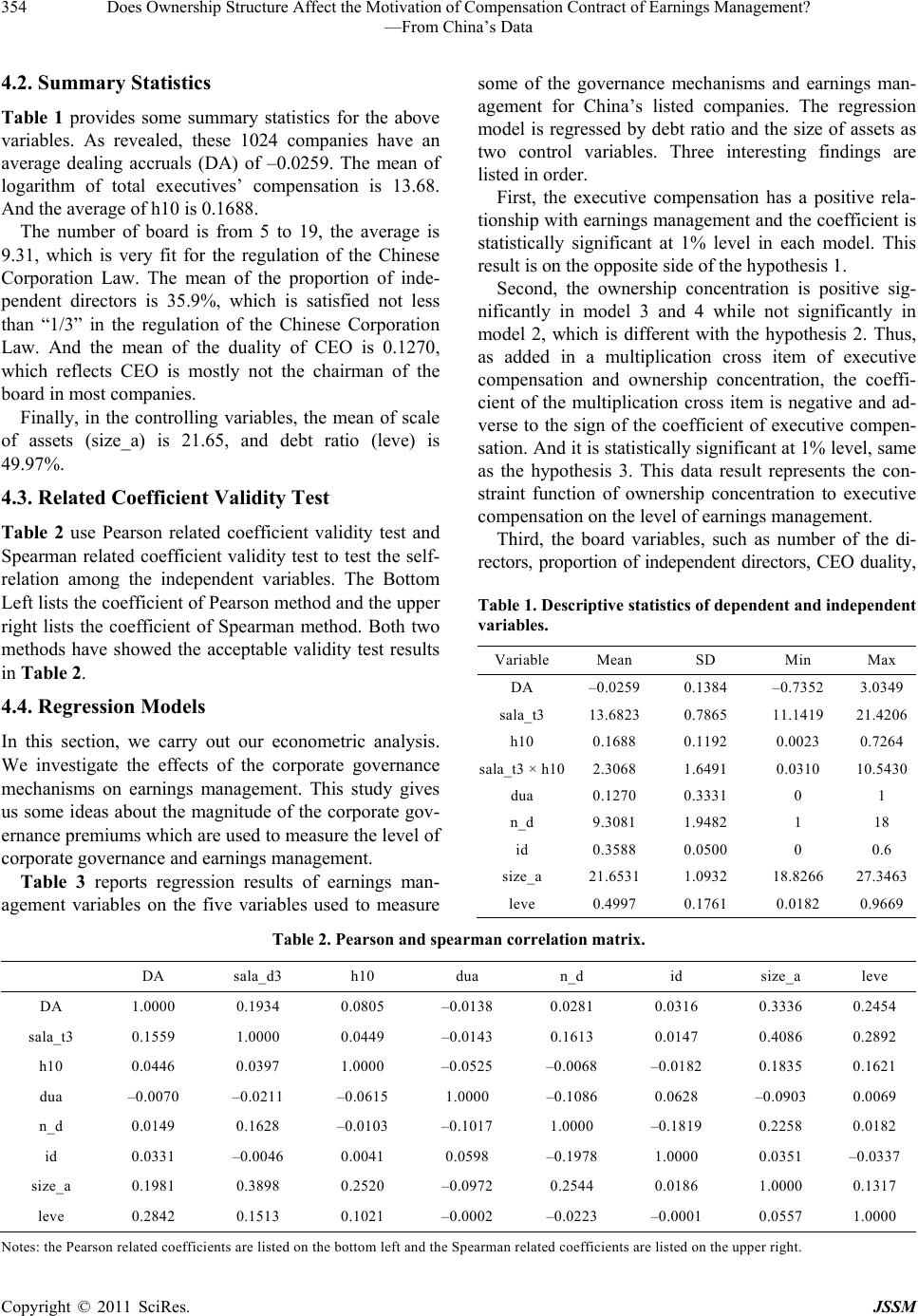 Does Ownership Structure Affect the Motivation of Compensation Contract of Earnings Management? —From China’s Data Copyright © 2011 SciRes. JSSM 354 4.2. Summary Statistics Table 1 provides some summary statistics for the above variables. As revealed, these 1024 companies have an average dealing accruals (DA) of –0.0259. The mean of logarithm of total executives’ compensation is 13.68. And the average of h10 is 0.1688. The number of board is from 5 to 19, the average is 9.31, which is very fit for the regulation of the Chinese Corporation Law. The mean of the proportion of inde- pendent directors is 35.9%, which is satisfied not less than “1/3” in the regulation of the Chinese Corporation Law. And the mean of the duality of CEO is 0.1270, which reflects CEO is mostly not the chairman of the board in most companies. Finally, in the controlling variables, the mean of scale of assets (size_a) is 21.65, and debt ratio (leve) is 49.97%. 4.3. Related Coefficient Validity Test Table 2 use Pearson related coefficient validity test and Spearman related coefficient validity test to test the self- relation among the independent variables. The Bottom Left lists the coefficient of Pearson method and the upper right lists the coefficient of Spearman method. Both two methods have showed the acceptable validity test results in Table 2. 4.4. Regression Models In this section, we carry out our econometric analysis. We investigate the effects of the corporate governance mechanisms on earnings management. This study gives us some ideas about the magnitude of the corporate gov- ernance premiums which are used to measure the level of corporate governance and earnings management. Table 3 reports regression results of earnings man- agement variables on the five variables used to measure some of the governance mechanisms and earnings man- agement for China’s listed companies. The regression model is regressed by debt ratio and the size of assets as two control variables. Three interesting findings are listed in order. First, the executive compensation has a positive rela- tionship with earnings management and the coefficient is statistically significant at 1% level in each model. This result is on the opposite side of the hypothesis 1. Second, the ownership concentration is positive sig- nificantly in model 3 and 4 while not significantly in model 2, which is different with the hypothesis 2. Thus, as added in a multiplication cross item of executive compensation and ownership concentration, the coeffi- cient of the multiplication cross item is negative and ad- verse to the sign of the coefficient of executive compen- sation. And it is statistically significant at 1% level, same as the hypothesis 3. This data result represents the con- straint function of ownership concentration to executive compensation on the level of earnings management. Third, the board variables, such as number of the di- rectors, proportion of independent directors, CEO duality, Table 1. Descriptive statistics of dependent and independent variables. Variable Mean SD Min Max DA –0.0259 0.1384 –0.7352 3.0349 sala_t3 13.6823 0.7865 11.1419 21.4206 h10 0.1688 0.1192 0.0023 0.7264 sala_t3 × h102.3068 1.6491 0.0310 10.5430 dua 0.1270 0.3331 0 1 n_d 9.3081 1.9482 1 18 id 0.3588 0.0500 0 0.6 size_a 21.6531 1.0932 18.8266 27.3463 leve 0.4997 0.1761 0.0182 0.9669 Table 2. Pearson and spearman correlation matrix. DA sala_d3 h10 dua n_d id size_a leve DA 1.0000 0.1934 0.0805 –0.0138 0.0281 0.0316 0.3336 0.2454 sala_t3 0.1559 1.0000 0.0449 –0.0143 0.1613 0.0147 0.4086 0.2892 h10 0.0446 0.0397 1.0000 –0.0525 –0.0068 –0.0182 0.1835 0.1621 dua –0.0070 –0.0211 –0.0615 1.0000 –0.1086 0.0628 –0.0903 0.0069 n_d 0.0149 0.1628 –0.0103 –0.1017 1.0000 –0.1819 0.2258 0.0182 id 0.0331 –0.0046 0.0041 0.0598 –0.1978 1.0000 0.0351 –0.0337 size_a 0.1981 0.3898 0.2520 –0.0972 0.2544 0.0186 1.0000 0.1317 leve 0.2842 0.1513 0.1021 –0.0002 –0.0223 –0.0001 0.0557 1.0000 Notes: the Pearson related coefficients are listed on the bottom left and the Spearman related coefficients are listed on the upper right. 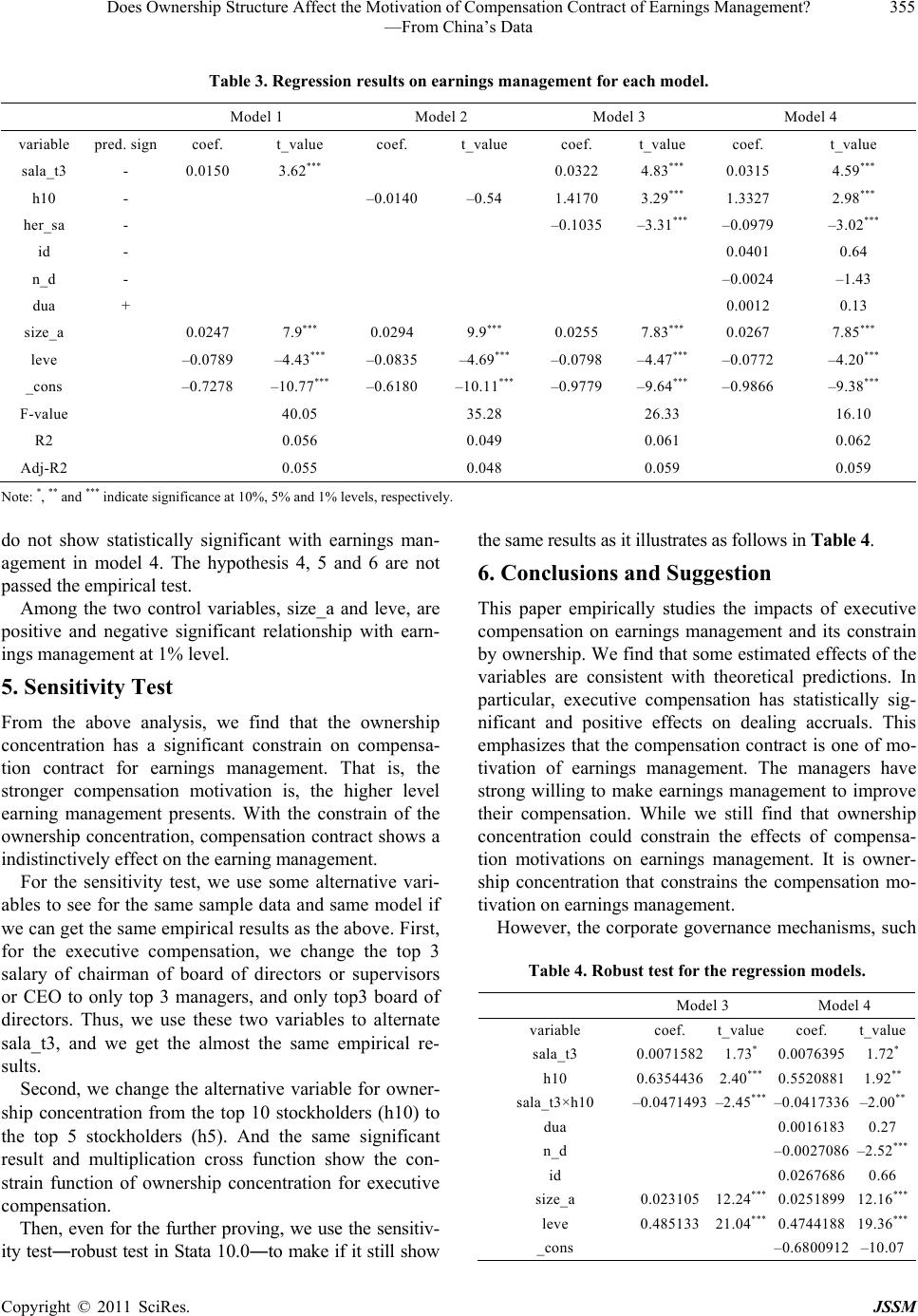 Does Ownership Structure Affect the Motivation of Compensation Contract of Earnings Management? 355 —From China’s Data Table 3. Regression results on earnings management for each model. Model 1 Model 2 Model 3 Model 4 variable pred. sign coef. t_value coef. t_value coef. t_value coef. t_value sala_t3 - 0.0150 3.62*** 0.0322 4.83*** 0.0315 4.59*** h10 - –0.0140 –0.54 1.4170 3.29*** 1.3327 2.98*** her_sa - –0.1035 –3.31*** –0.0979 –3.02*** id - 0.0401 0.64 n_d - –0.0024 –1.43 dua + 0.0012 0.13 size_a 0.0247 7.9*** 0.0294 9.9*** 0.0255 7.83*** 0.0267 7.85*** leve –0.0789 –4.43*** –0.0835 –4.69*** –0.0798 –4.47*** –0.0772 –4.20*** _cons –0.7278 –10.77*** –0.6180 –10.11*** –0.9779 –9.64*** –0.9866 –9.38*** F-value 40.05 35.28 26.33 16.10 R2 0.056 0.049 0.061 0.062 Adj-R2 0.055 0.048 0.059 0.059 Note: *, ** and *** indicate significance at 10%, 5% and 1% levels, respectively. do not show statistically significant with earnings man- agement in model 4. The hypothesis 4, 5 and 6 are not passed the empirical test. Among the two control variables, size_a and leve, are positive and negative significant relationship with earn- ings management at 1% level. 5. Sensitivity Test From the above analysis, we find that the ownership concentration has a significant constrain on compensa- tion contract for earnings management. That is, the stronger compensation motivation is, the higher level earning management presents. With the constrain of the ownership concentration, compensation contract shows a indistinctively effect on the earning management. For the sensitivity test, we use some alternative vari- ables to see for the same sample data and same model if we can get the same empirical results as the above. First, for the executive compensation, we change the top 3 salary of chairman of board of directors or supervisors or CEO to only top 3 managers, and only top3 board of directors. Thus, we use these two variables to alternate sala_t3, and we get the almost the same empirical re- sults. Second, we change the alternative variable for owner- ship concentration from the top 10 stockholders (h10) to the top 5 stockholders (h5). And the same significant result and multiplication cross function show the con- strain function of ownership concentration for executive compensation. Then, even for the further proving, we use the sensitiv- ity test―robust test in Stata 10.0―to make if it still show the same results as it illustrates as follows in Table 4. 6. Conclusions and Suggestion This paper empirically studies the impacts of executive compensation on earnings management and its constrain by ownership. We find that some estimated effects of the variables are consistent with theoretical predictions. In particular, executive compensation has statistically sig- nificant and positive effects on dealing accruals. This emphasizes that the compensation contract is one of mo- tivation of earnings management. The managers have strong willing to make earnings management to improve their compensation. While we still find that ownership concentration could constrain the effects of compensa- tion motivations on earnings management. It is owner- ship concentration that constrains the compensation mo- tivation on earnings management. However, the corporate governance mechanisms, such Table 4. Robust test for the regression models. Model 3 Model 4 variable coef. t_value coef. t_value sala_t3 0.0071582 1.73* 0.0076395 1.72* h10 0.6354436 2.40*** 0.55208811.92** sala_t3×h10 –0.0471493 –2.45*** –0.0417336–2.00** dua 0.00161830.27 n_d –0.0027086–2.52*** id 0.02676860.66 size_a 0.023105 12.24*** 0.0251899 12.16*** leve 0.485133 21.04*** 0.4744188 19.36*** _cons –0.6800912–10.07 Copyright © 2011 SciRes. JSSM 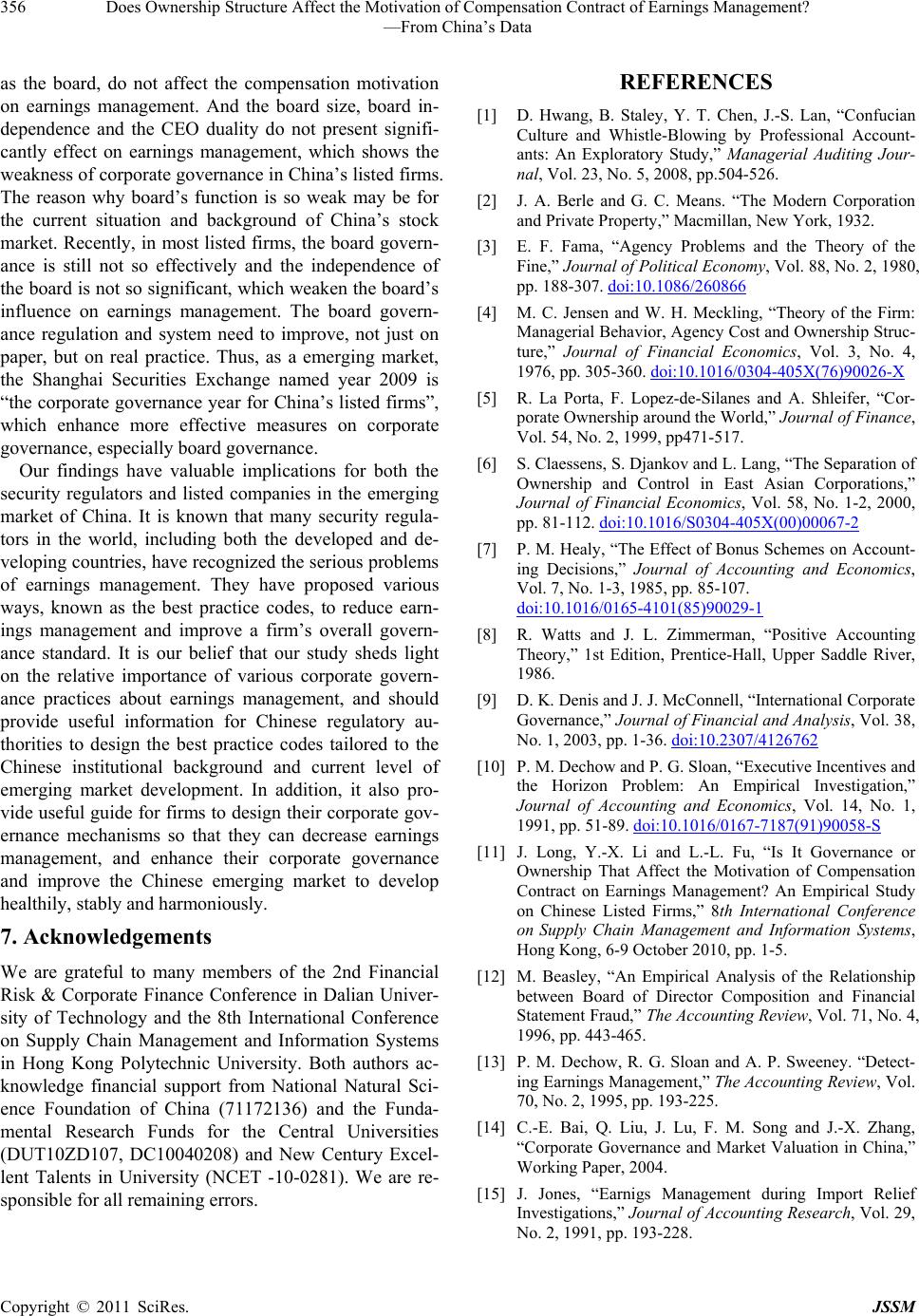 Does Ownership Structure Affect the Motivation of Compensation Contract of Earnings Management? 356 —From China’s Data as the board, do not affect the compensation motivation on earnings management. And the board size, board in- dependence and the CEO duality do not present signifi- cantly effect on earnings management, which shows the weakness of corporate governance in China’s listed firms. The reason why board’s function is so weak may be for the current situation and background of China’s stock market. Recently, in most listed firms, the board govern- ance is still not so effectively and the independence of the board is not so significant, which weaken the board’s influence on earnings management. The board govern- ance regulation and system need to improve, not just on paper, but on real practice. Thus, as a emerging market, the Shanghai Securities Exchange named year 2009 is “the corporate governance year for China’s listed firms”, which enhance more effective measures on corporate governance, especially board governance. Our findings have valuable implications for both the security regulators and listed companies in the emerging market of China. It is known that many security regula- tors in the world, including both the developed and de- veloping countries, have recognized the serious problems of earnings management. They have proposed various ways, known as the best practice codes, to reduce earn- ings management and improve a firm’s overall govern- ance standard. It is our belief that our study sheds light on the relative importance of various corporate govern- ance practices about earnings management, and should provide useful information for Chinese regulatory au- thorities to design the best practice codes tailored to the Chinese institutional background and current level of emerging market development. In addition, it also pro- vide useful guide for firms to design their corporate gov- ernance mechanisms so that they can decrease earnings management, and enhance their corporate governance and improve the Chinese emerging market to develop healthily, stably and harmoniously. 7. Acknowledgements We are grateful to many members of the 2nd Financial Risk & Corporate Finance Conference in Dalian Univer- sity of Technology and the 8th International Conference on Supply Chain Management and Information Systems in Hong Kong Polytechnic University. Both authors ac- knowledge financial support from National Natural Sci- ence Foundation of China (71172136) and the Funda- mental Research Funds for the Central Universities (DUT10ZD107, DC10040208) and New Century Excel- lent Talents in University (NCET -10-0281). We are re- sponsible for all remaining errors. REFERENCES [1] D. Hwang, B. Staley, Y. T. Chen, J.-S. Lan, “Confucian Culture and Whistle-Blowing by Professional Account- ants: An Exploratory Study,” Managerial Auditing Jour- nal, Vol. 23, No. 5, 2008, pp.504-526. [2] J. A. Berle and G. C. Means. “The Modern Corporation and Private Property,” Macmillan, New York, 1932. [3] E. F. Fama, “Agency Problems and the Theory of the Fine,” Journal of Political Economy, Vol. 88, No. 2, 1980, pp. 188-307. doi:10.1086/260866 [4] M. C. Jensen and W. H. Meckling, “Theory of the Firm: Managerial Behavior, Agency Cost and Ownership Struc- ture,” Journal of Financial Economics, Vol. 3, No. 4, 1976, pp. 305-360. doi:10.1016/0304-405X(76)90026-X [5] R. La Porta, F. Lopez-de-Silanes and A. Shleifer, “Cor- porate Ownership around the World,” Journal of Finance, Vol. 54, No. 2, 1999, pp471-517. [6] S. Claessens, S. Djankov and L. Lang, “The Separation of Ownership and Control in East Asian Corporations,” Journal of Financial Economics, Vol. 58, No. 1-2, 2000, pp. 81-112. doi:10.1016/S0304-405X(00)00067-2 [7] P. M. Healy, “The Effect of Bonus Schemes on Account- ing Decisions,” Journal of Accounting and Economics, Vol. 7, No. 1-3, 1985, pp. 85-107. doi:10.1016/0165-4101(85)90029-1 [8] R. Watts and J. L. Zimmerman, “Positive Accounting Theory,” 1st Edition, Prentice-Hall, Upper Saddle River, 1986. [9] D. K. Denis and J. J. McConnell, “International Corporate Governance,” Journal of Financial and Analysis, Vol. 38, No. 1, 2003, pp. 1-36. doi:10.2307/4126762 [10] P. M. Dechow and P. G. Sloan, “Executive Incentives and the Horizon Problem: An Empirical Investigation,” Journal of Accounting and Economics, Vol. 14, No. 1, 1991, pp. 51-89. doi:10.1016/0167-7187(91)90058-S [11] J. Long, Y.-X. Li and L.-L. Fu, “Is It Governance or Ownership That Affect the Motivation of Compensation Contract on Earnings Management? An Empirical Study on Chinese Listed Firms,” 8th International Conference on Supply Chain Management and Information Systems, Hong Kong, 6-9 October 2010, pp. 1-5. [12] M. Beasley, “An Empirical Analysis of the Relationship between Board of Director Composition and Financial Statement Fraud,” The Accounting Review, Vol. 71, No. 4, 1996, pp. 443-465. [13] P. M. Dechow, R. G. Sloan and A. P. Sweeney. “Detect- ing Earnings Management,” The Accounting Review, Vol. 70, No. 2, 1995, pp. 193-225. [14] C.-E. Bai, Q. Liu, J. Lu, F. M. Song and J.-X. Zhang, “Corporate Governance and Market Valuation in China,” Working Paper, 2004. [15] J. Jones, “Earnigs Management during Import Relief Investigations,” Journal of Accounting Research, Vol. 29, No. 2, 1991, pp. 193-228. Copyright © 2011 SciRes. JSSM |