

Paper Menu >>
Journal Menu >>
 Journal of Environmental Protection, 2011, 2, 996-1001 doi:10.4236/jep.2011.27114 Published Online September2011 (http://www.SciRP.org/journal/jep) Copyright © 2011 SciRes. JEP The New Methods for Purifying the Industrial Effluents by Submerged Biofilm Reactors Seyed Alireza Mousavi Shirazi Department of Physics, South Tehran Branch, Islamic Azad University, Tehran, Iran. Email: [email protected] Received June 12th, 2011; revised July 18th, 2011; accepted August 27th, 2011. ABSTRACT Life on the earth is dependent on dynamic interactions between its physical, chemical and biological components. In fact, all the individual processes are responsible for regulating the environmental equilibrium which can provide bio- sphere for multiple forms o f human life. In order to overcome on shortcomings, the use of immob ilized cell bioreactor technology which provides a valuable effective for treatment of waste water is discussed. An immobilized system which in this matter is applied is about absorbed or captured microorganisms in a solid substratum to retain them in a reactor or analytical system. The multiply of these immobilized cells is done when by nutrients be supplied and then migrate to the surfaces which are referred to biofilms. The biofilms can be developed on various support systems such as polypro- pylene pall, rocks, sands, charcoal, ceramics, and glass beads. The controllable reaction vessels which are used for these colonized surfaces are referred to bioreactors. Bioreactors in both up flows and down flows mode which use of either batch or continuous processes principle can be operated. Synchronic with development in biotechnology, there is also an extensive development in the field of bioreactors like: pumped tower loop reactor (PTLR), liquid impelled loop reactor (LILR), multipurpose tower bioreactor (MTB), fluidized-bed and packed-bed bioreactor, that in this a rticle are discussed them. Keywords: Biofilm, Bioreactor, Effluent, Environment, Liquid, Waste Water 1. Introduction These facts that increasing the human population and excessive agricultural activities and modern industriali- zation can damage environment and biosphere, as an important and serious problem are enumerated. The deleterious effects of human activities on the biosphere are collectively known as pollution. The pollution pre- vention and its controlling have been caused a major problem in present century. Waste waters management and environment protection is commensurate with social and economical relations and public health of society. The waste water of various industries is including the complex mixtures of solid materials and dissolved parti- cles which have either high biological oxygen demand (BOD) or chemical oxygen demand (COD) values and it indicates their toxic effects on the plankton. Heretofore abundant researches that deal on activities for elimination, conversion the toxic pollution on industrial waste waters have been reported. There is a similar problem which is related to sewages produced due nutrients and beverage industries [1]. The influence of the ratio carbon-nitrogen and phos- phorus concentration on the performance of a biofilm fluidized bed reactor has already bee used for denitrifica- tion [2]. The thickness and the density of the biofilms were related mainly with the shear stress in the reactor and the composition of biofilms was dependent on the composition of the medium and related with higher ac- tivities of the microorganisms. Th e surface concentration depended on the surface characteristics of the biofilms. The biofilm is a dynamical structure, in which formation of cracks and fissures is taking place continuously [3]. There are two process configurations based on the BAS reactors, for nitrogen removal from wastewater by integration of nitrification in biofilms and denitrification in suspension. The first setup consists of a conventional nitrifying BAS reactor coupled with a suspended biomass reactor. The second process configuration is a single BAS reactor which is sequentially aerated and non-aer- ated, by cyclically recirculation the off gas [4]. A wake model is used to predict the liquid holdup, while the solids holdup is obtained by iteration based on 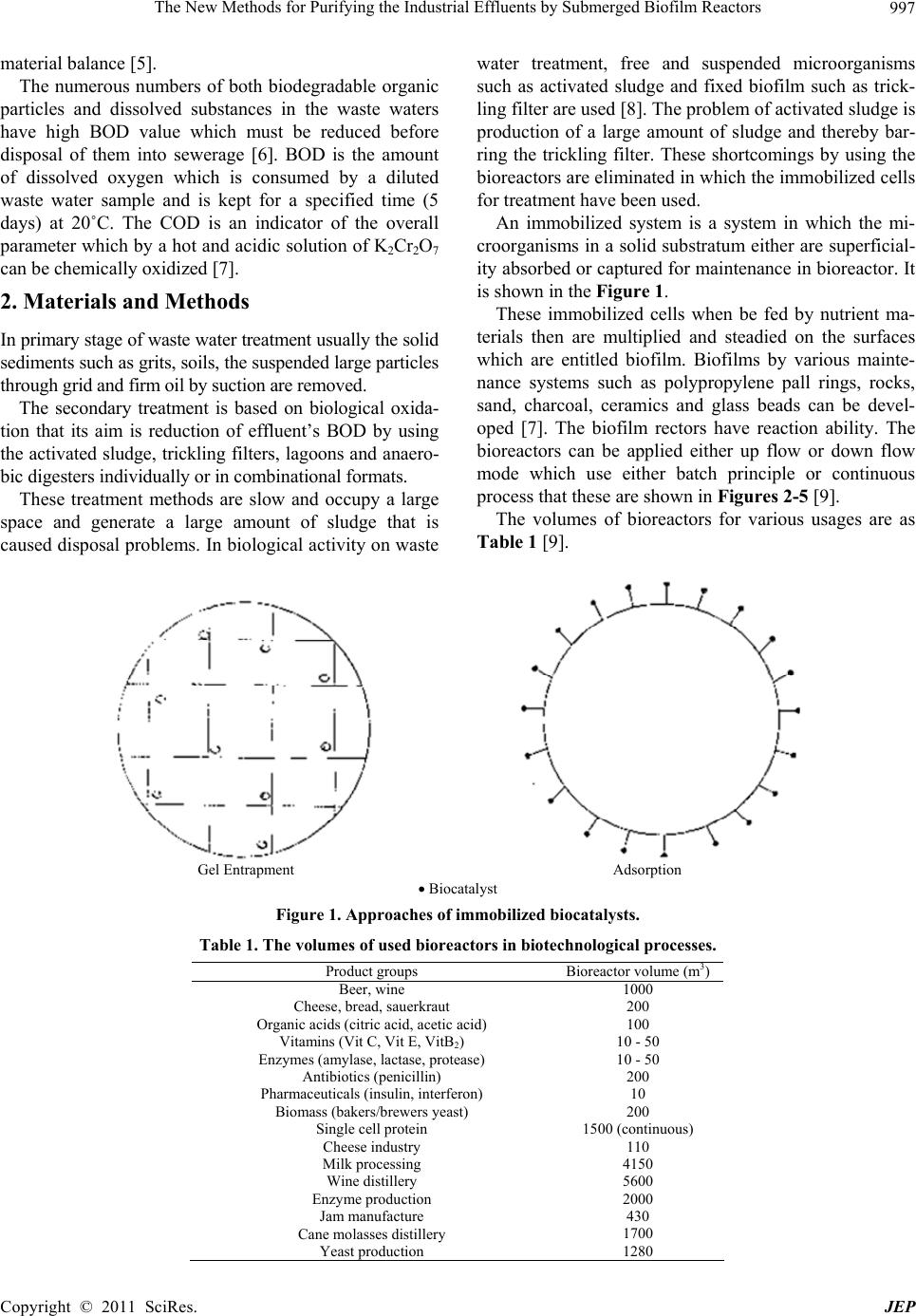 The New Methods for Purifying the Industrial Effluents by Submerged Biofilm Reactors997 material balance [5]. The numerous numbers of both biodegradable organic particles and dissolved substances in the waste waters have high BOD value which must be reduced before disposal of them into sewerage [6]. BOD is the amount of dissolved oxygen which is consumed by a diluted waste water sample and is kept for a specified time (5 days) at 20˚C. The COD is an indicator of the overall parameter which by a hot and acidic solution of K2Cr2O7 can be chemically oxidized [7]. 2. Materials and Methods In primary stage of waste water treatment usually the sol id sediments such as grits, soils, the suspended large particles through grid and firm oil by suction are rem oved. The secondary treatment is based on biological oxida- tion that its aim is reduction of effluent’s BOD by using the activated sludge, trickling filters, lagoons and anaero- bic digesters individual l y or i n combinational form at s. These treatment methods are slow and occupy a large space and generate a large amount of sludge that is caused disposal problems. In biological activity on waste water treatment, free and suspended microorganisms such as activated sludge and fixed biofilm such as trick- ling filter are used [8]. The problem of activated slud ge is production of a large amount of sludge and thereby bar- ring the trickling filter. These shortcomings by using the bioreactors are eliminated in which the immobilized cells for treatment have been used. An immobilized system is a system in which the mi- croorganisms in a solid substratum either are superficial- ity absorbed or captured for maintenance in bioreactor. It is shown in the Figure 1. These immobilized cells when be fed by nutrient ma- terials then are multiplied and steadied on the surfaces which are entitled biofilm. Biofilms by various mainte- nance systems such as polypropylene pall rings, rocks, sand, charcoal, ceramics and glass beads can be devel- oped [7]. The biofilm rectors have reaction ability. The bioreactors can be applied either up flow or down flow mode which use either batch principle or continuous process that these are shown in Figures 2-5 [9]. The volumes of bioreactors for various usages are as Table 1 [9]. Gel Entrapment Adsorption Biocatalyst Figure 1. Approaches of immobilized biocatalysts. Table 1. The volumes of used bioreactors in biotechnological processes. Product groups Bioreactor volume (m3) Beer, wine Cheese, bread, sauerkraut Organic acids (citric acid, acetic acid) Vitamins (Vit C, Vit E, VitB2) Enzymes (amylase, lactase, protease) Antibiotics (penicillin) Pharmaceuticals (insulin, interferon) Biomass (bakers/brewers yeast) Single cell protein Cheese industry Milk processing Wine distillery Enzyme production Jam manufacture Cane molasses distillery Yeast production 1000 200 100 10 - 50 10 - 50 200 10 200 1500 (continuous) 110 4150 5600 2000 430 1700 1280 Copyright © 2011 SciRes. JEP  The New Methods for Purifying the Industrial Effluents by Submerged Biofilm Reactors 998 Figure 2. Batch reactor (Type 1 of bioreactor). Figure 3. Continuous reactor (Type 2 of bioreactor). Figure 4. Up-flow reactor (Type 3 of bioreactor). Figure 5. Down-flow reactor (Type 4 of bioreactor). Figure 6. Pumped tower loop reactor (PTLR). The PTLR reactor for batch production of Xanthan has specially been developed and it eliminates the posed problems in treatment by high viscosity and plastically behavior of polysaccharide. These achievements by helping a specially designed- pump are afforded that this pump for keeping the liquid in kinetic movement and shorter time of fermentation and more concentration is applied. The LILR bioreactor for some instances among applications for biocatalyst in organic solvents is developed. This bioreactor consists of two parallel tubes connected at the top and bottom. The bioreactors which have newly been developed are illustrated as Figures 6-12 [9]. In the LILR bioreactor the organic solvent which has low density into a continuous non organic fluid with high density from bottom is distributed and through difference between densities, the fluid with continuous phase is cir- culated. The MTB bioreactor uses of the air lift principle and for cells of sensitive to shear can be used. Both mi- crobe flocculating and microorganisms culturing in three different modes can be performed: 1) bubble column. 2) Bioreactor with inner loop that this loop has relevancy to airlift which by riser pipe its activity is performed. 3) Bioreactor with inner loop dependent on airlift which by down comer pipe its activity is performed [8]. The ad- vantage of the MTB bioreactor is that in this bioreactor the modular design is causer for preparation of a system based on biological processes requirements. The fluid- ized bed and packed bed reactors which are as samples of bioreactors, for decrement of related processes fees and prevention of biocatalysts have been developed. In the fluidized bed reactors, the immobilized catalyst floated in water exists freely around airlift source while in the packed bed reactors the catalyst along with oxygen is almost saturated. These bioreactors including biofilm reactors have ei- ther round or flat drum. Copyright © 2011 SciRes. JEP  The New Methods for Purifying the Industrial Effluents by Submerged Biofilm Reactors 999 Figure 7. Liquid impelled loop reactor (LILR). Figure 8. As a bubble column. Figure 9. Airlift loop reactor with draft tube as riser. Figure 10. Airlift loop reactor with draft tube as down comer. Figure 11. Fluidized bed reactor. Copyright © 2011 SciRes. JEP 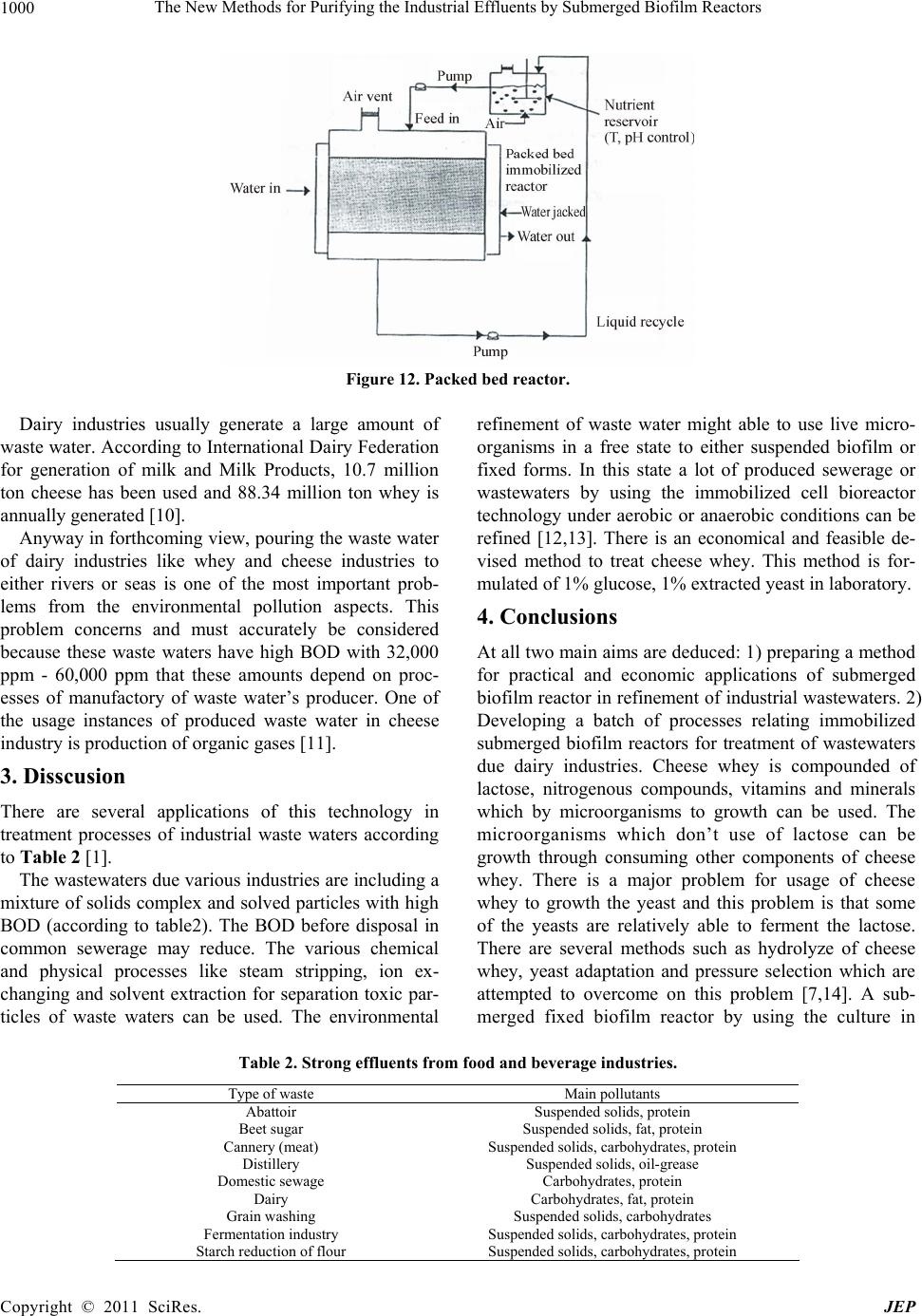 The New Methods for Purifying the Industrial Effluents by Submerged Biofilm Reactors 1000 Figure 12. Packed bed reactor. Dairy industries usually generate a large amount of waste water. According to Internationa l Dairy Federation for generation of milk and Milk Products, 10.7 million ton cheese has been used and 88.34 million ton whey is annually generated [10]. Anyway in forthcoming view, pouring the waste water of dairy industries like whey and cheese industries to either rivers or seas is one of the most important prob- lems from the environmental pollution aspects. This problem concerns and must accurately be considered because these waste waters have high BOD with 32,000 ppm - 60,000 ppm that these amounts depend on proc- esses of manufactory of waste water’s producer. One of the usage instances of produced waste water in cheese industry is pro duct i o n o f or ganic gases [11]. 3. Disscusion There are several applications of this technology in treatment processes of industrial waste waters according to Table 2 [1]. The wastewaters due various industries are including a mixture of solids complex and solved particles with high BOD (according to table2). The BOD before disposal in common sewerage may reduce. The various chemical and physical processes like steam stripping, ion ex- changing and solvent extraction for separation toxic par- ticles of waste waters can be used. The environmental refinement of waste water might able to use live micro- organisms in a free state to either suspended biofilm or fixed forms. In this state a lot of produced sewerage or wastewaters by using the immobilized cell bioreactor technology under aerobic or anaerobic conditions can be refined [12,13]. There is an economical and feasible de- vised method to treat cheese whey. This method is for- mulated of 1% glucose, 1% extracted yeast in laboratory. 4. Conclusions At all two main aims are deduced: 1) preparing a method for practical and economic applications of submerged biofilm reactor in refinement of industrial wastewaters. 2) Developing a batch of processes relating immobilized submerged biofilm reactors for treatment of wastewaters due dairy industries. Cheese whey is compounded of lactose, nitrogenous compounds, vitamins and minerals which by microorganisms to growth can be used. The microorganisms which don’t use of lactose can be growth through consuming other components of cheese whey. There is a major problem for usage of cheese whey to growth the yeast and this problem is that some of the yeasts are relatively able to ferment the lactose. There are several methods such as hydrolyze of cheese whey, yeast adaptation and pressure selection which are attempted to overcome on this problem [7,14]. A sub- merged fixed biofilm reactor by using the culture in Table 2. Strong effluents from food and beve rage industr ie s. Type of waste Main pollutants Abattoir Beet sugar Cannery (meat) Distillery Domestic sewage Dairy Grain washing Fermentation industry Starch reduction of flour Suspended solids, protein Suspended solids, fat, protein Suspended solids, carbohydrates, protein Suspended solids, oil-grease Carbohydrates, protein Carbohydrates, fat, protein Suspended solids, carbohydrates Suspended solids, carbohydrates, protein Suspended solids, carbohydrates, protein Copyright © 2011 SciRes. JEP 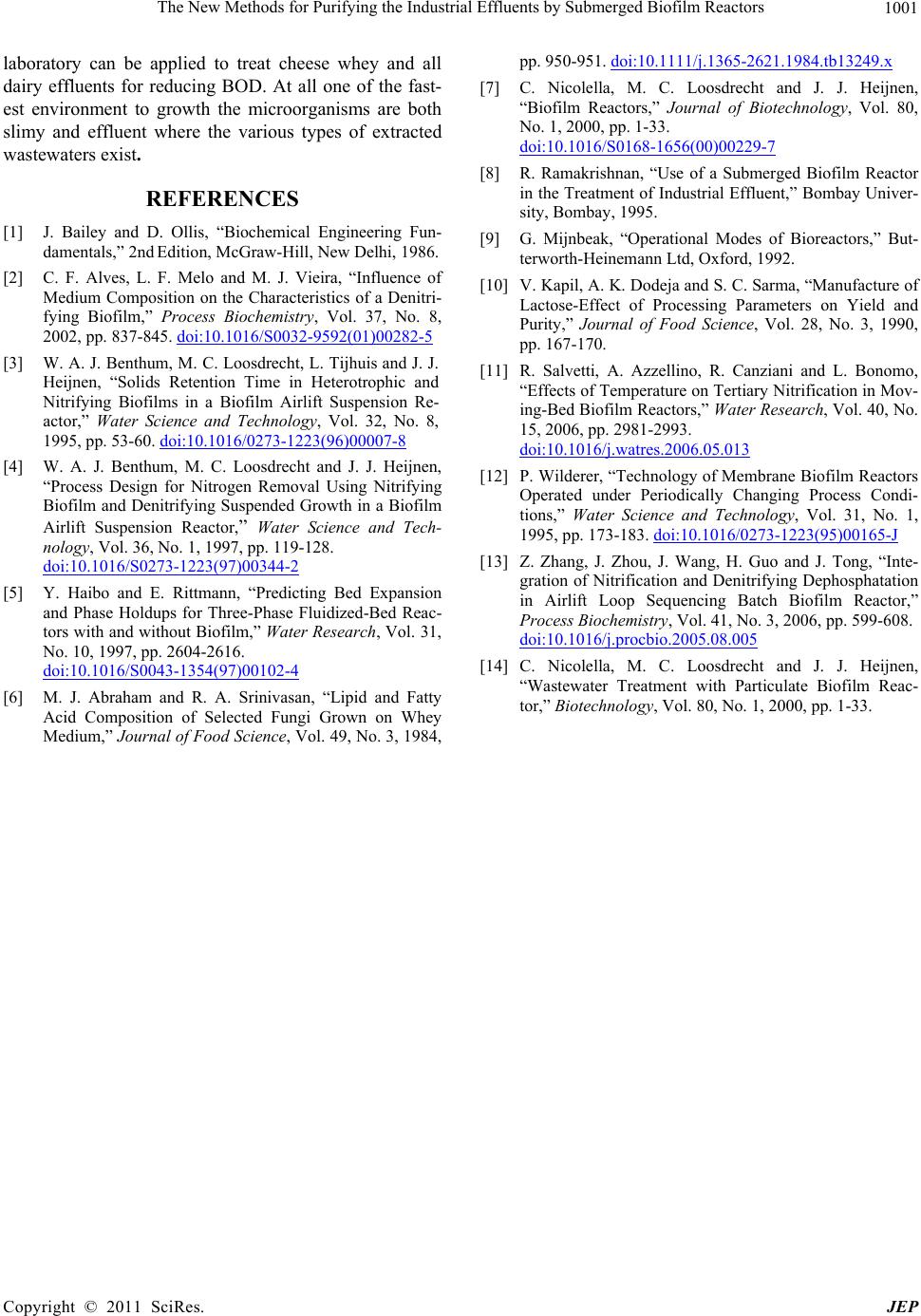 The New Methods for Purifying the Industrial Effluents by Submerged Biofilm Reactors 1001 laboratory can be applied to treat cheese whey and all dairy effluents for reducing BOD. At all one of the fast- est environment to growth the microorganisms are both slimy and effluent where the various types of extracted wastewaters exist. REFERENCES [1] J. Bailey and D. Ollis, “Biochemical Engineering Fun- damentals,” 2nd Edition, McGraw-Hill, New Delhi, 1986. [2] C. F. Alves, L. F. Melo and M. J. Vieira, “Influence of Medium Composition on the Characteristics of a Denitri- fying Biofilm,” Process Biochemistry, Vol. 37, No. 8, 2002, pp. 837-845. doi:10.1016/S0032-9592(01)00282-5 [3] W. A. J. Benthum, M. C. Loosdrecht, L. Tijhuis and J. J. Heijnen, “Solids Retention Time in Heterotrophic and Nitrifying Biofilms in a Biofilm Airlift Suspension Re- actor,” Water Science and Technology, Vol. 32, No. 8, 1995, pp. 53-60. doi:10.1016/0273-1223(96)00007-8 [4] W. A. J. Benthum, M. C. Loosdrecht and J. J. Heijnen, “Process Design for Nitrogen Removal Using Nitrifying Biofilm and Denitrifying Suspended Growth in a Biofilm Airlift Suspension Reactor,” Water Science and Tech- nology, Vol. 36, No. 1, 1997, pp. 119-128. doi:10.1016/S0273-1223(97)00344-2 [5] Y. Haibo and E. Rittmann, “Predicting Bed Expansion and Phase Holdups for Three-Phase Fluidized-Bed Reac- tors with and without Biofilm,” Water Research, Vol . 31, No. 10, 1997, pp. 2604-2616. doi:10.1016/S0043-1354(97)00102-4 [6] M. J. Abraham and R. A. Srinivasan, “Lipid and Fatty Acid Composition of Selected Fungi Grown on Whey Medium,” Journal of Food Science, Vol. 49, No. 3, 1984, pp. 950-951. doi:10.1111/j.1365-2621.1984.tb13249.x [7] C. Nicolella, M. C. Loosdrecht and J. J. Heijnen, “Biofilm Reactors,” Journal of Biotechnology, Vol. 80, No. 1, 2000, pp. 1-33. doi:10.1016/S0168-1656(00)00229-7 [8] R. Ramakrishnan, “Use of a Submerged Biofilm Reactor in the Treatment of Industrial Effluent,” Bombay Univer- sity, Bombay, 1995. [9] G. Mijnbeak, “Operational Modes of Bioreactors,” But- terworth-Heinemann Ltd, Oxford, 1992. [10] V. Kapil, A. K. Dodeja and S. C. Sarma, “Manufacture of Lactose-Effect of Processing Parameters on Yield and Purity,” Journal of Food Science, Vol. 28, No. 3, 1990, pp. 167-170. [11] R. Salvetti, A. Azzellino, R. Canziani and L. Bonomo, “Effects of Temperature on Tertiary Nitrification in Mov- ing-Bed Biofilm Reactors,” Water Research, Vol. 40, No. 15, 2006, pp. 2981-2993. doi:10.1016/j.watres.2006.05.013 [12] P. Wilderer, “Technology of Membrane Biofilm Reactors Operated under Periodically Changing Process Condi- tions,” Water Science and Technology, Vol. 31, No. 1, 1995, pp. 173-183. doi:10.1016/0273-1223(95)00165-J [13] Z. Zhang, J. Zhou, J. Wang, H. Guo and J. Tong, “Inte- gration of Nitrification and Denitrifying Dephosphatation in Airlift Loop Sequencing Batch Biofilm Reactor,” Process Biochemistry, Vol. 41, No. 3, 2006, pp. 599-608. doi:10.1016/j.procbio.2005.08.005 [14] C. Nicolella, M. C. Loosdrecht and J. J. Heijnen, “Wastewater Treatment with Particulate Biofilm Reac- tor,” Biotechnology, Vol. 80, No. 1, 2000, pp. 1-33. Copyright © 2011 SciRes. JEP |