

Paper Menu >>
Journal Menu >>
 Creative Education, 2009, 25-31 Published Online September 2009 in SciRes (http://www.SciRP.org/journal/ce) Copyright © 2009 SciRes CE Semantic Perspectives on Knowledge Management and E-Learning ABSTRACT Knowledge Management (KM) and E-Learning (EL) applications interface more and more as their objects of concern consist in ‘captured knowledge’ resp. ‘learning objects’, i.e. content. In this paper, we want to discuss the potential synergy from their fusion with respect to two area-specific difficulties: KM’s Authoring Problem (“Where are the con- tent authors?”) and EL’s Control Problem (“Who is in charge?”). In order to understand the underlying assumptions when developing and using such systems, we will point to the relevance of their interaction design (in contrast to inter- face design) and introduce the notion of “Semantic Interaction Design” requiring a closer look at the evaluation of software products. We will distinguish between the micro-and macro-perspective on KM and EL, particularly on the retrieval question of precision and recall and the motivational optimization problem for software adoption. We suggest that KM’s Authoring Problem as well as EL’s Control Problem are implications of above semantic perspectives. Moreover, it turns out that KM and EL’s resp. strengths and weaknesses are complementary, so that they offer potential resolutions. Keywords: Knowledge Management (KM), E-Learning (EL), Authoring Problem, Control Problem 1. Introduction Unfortunately, KM as well as E-Learning weren’t as successful as expected (with occasional exceptions). Therefore a joint venture was undertaken to harvest syn- ergy effects as both deal in their own specific way with content on the one hand and the user on the other. In this paper we address the question, which arises with respect to each field’s specific problems: can the fusion remedy them? Knowledge Management (KM) systems as well as E- Learning (EL) systems are built on knowledge1 blocks that contain reified knowledge, i.e. information about knowledge (often called content or learning object (LO)). As objects these knowledge chunks can e.g. be managed, shared, reused, or aggregated-which are KM tasks. In contrast, as reified knowledge they can be used peda- gogically as e.g. REINMANN declares them to be “the link between learning and teaching” [Reinmann, 2005, p. 117]-these are EL tasks. In particular, software can con- struct or help to construct learning contexts based on them: knowledge contexts (like ontologies or intersubjec- tive knowledge), didactical contexts (like learning paths), or subjective contexts (like personal learning environ- ments), for examples and ideas we suggest [Kohlhase, 2006c], [Libbrecht and Gross, 2006], or [Maus et al., 2005, p. 53]. At first sight the strength of KM consists in offering the data of their underlying databases to its customers, which we comprise under “effectiveness”, whereas EL’s strength builds on enabling users to learn what they need to learn, which we subsume with “customization”. Merging the two, we theoretically obtain adaptable sys- tems that are effective as well as customizable. Even though this evolving synergy from an intertwinement of KM and EL is quite intuitive, the technological infra- structures are (historically) incompatible: KM developed from the field of Information Technologies and heads for a “corporate storybook” [Dunn and Iliff, 2005, p. 3], whereas EL grew out of Human Resources and aims at a “class-in-a-box model” [ibid.]. Moreover, a fusion of two fields typically doesn’t involve their strengths alone, their weaknesses have to be addressed as well. So, what are these weaknesses? 1In [Kornwachs, 2005] KORNWACHS critically discusses the use o f the terms ’knowledge’ versus ’information’ and points to their “fun- damental difference”[p. 34]. In particular, he points to the “self- ref- erential characteristics”[p. 36] of knowledge that makes its handling via technological systems problematic. Keeping this (as well as [Probst et al., 1997, p. 16], [Liessmann, 2006, 27ff.], and [Brown and Duguid, 2000, p. 125]) in mind, we use the term “knowledge” never- theless. 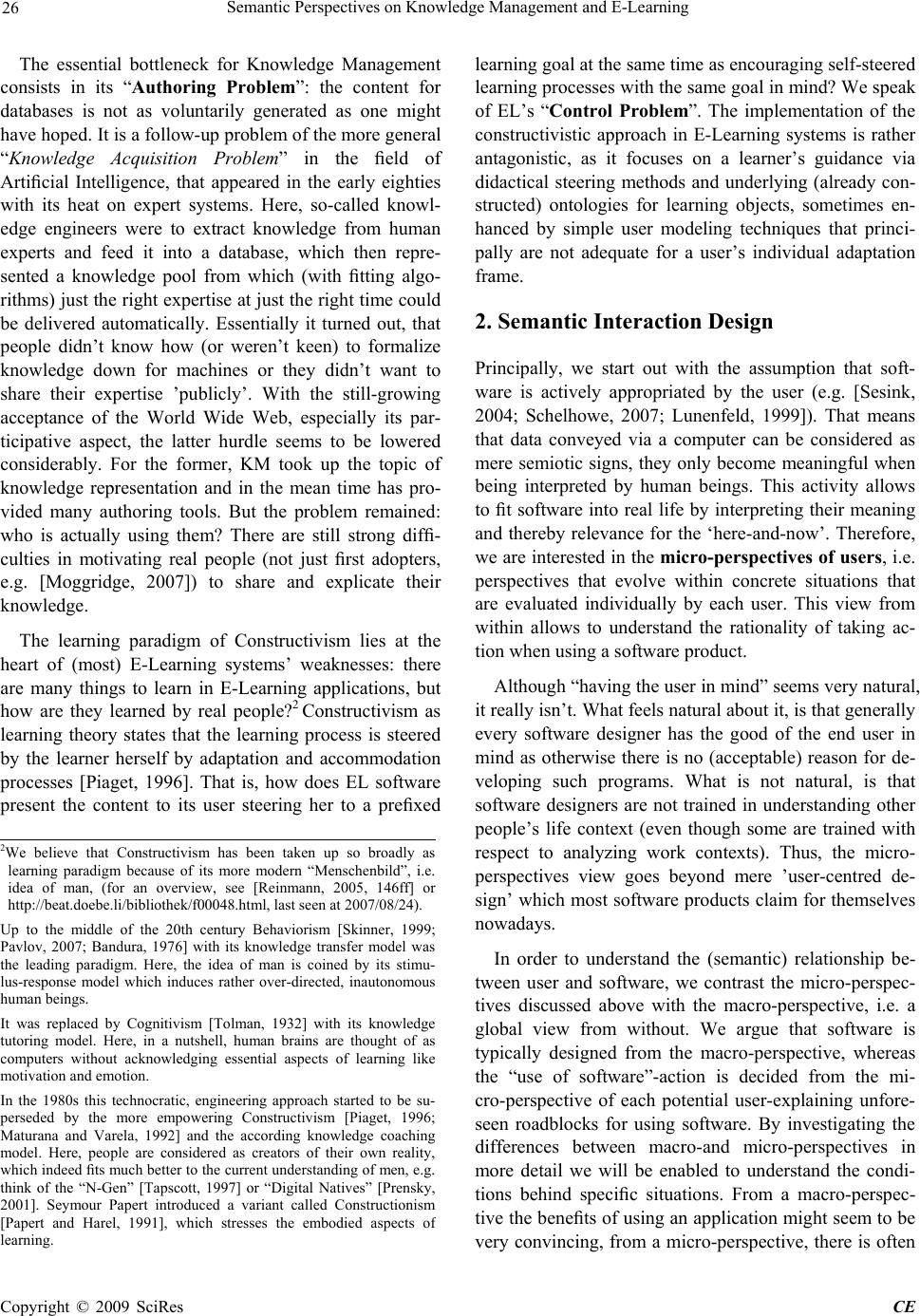 Semantic Perspectives on Knowledge Management and E-Learning 26 The essential bottleneck for Knowledge Management consists in its “Authoring Problem”: the content for databases is not as voluntarily generated as one might have hoped. It is a follow-up problem of the more general “Knowledge Acquisition Problem” in the field of Artificial Intelligence, that appeared in the early eighties with its heat on expert systems. Here, so-called knowl- edge engineers were to extract knowledge from human experts and feed it into a database, which then repre- sented a knowledge pool from which (with fitting algo- rithms) just the right expertise at just the right time could be delivered automatically. Essentially it turned out, that people didn’t know how (or weren’t keen) to formalize knowledge down for machines or they didn’t want to share their expertise ’publicly’. With the still-growing acceptance of the World Wide Web, especially its par- ticipative aspect, the latter hurdle seems to be lowered considerably. For the former, KM took up the topic of knowledge representation and in the mean time has pro- vided many authoring tools. But the problem remained: who is actually using them? There are still strong diffi- culties in motivating real people (not just first adopters, e.g. [Moggridge, 2007]) to share and explicate their knowledge. The learning paradigm of Constructivism lies at the heart of (most) E-Learning systems’ weaknesses: there are many things to learn in E-Learning applications, but how are they learned by real people?2 Constructivism as learning theory states that the learning process is steered by the learner herself by adaptation and accommodation processes [Piaget, 1996]. That is, how does EL software present the content to its user steering her to a prefixed learning goal at the same time as encouraging self-steered learning processes with the same goal in mind? We speak of EL’s “Control Problem”. The implementation of the constructivistic approach in E-Learning systems is rather antagonistic, as it focuses on a learner’s guidance via didactical steering methods and underlying (already con- structed) ontologies for learning objects, sometimes en- hanced by simple user modeling techniques that princi- pally are not adequate for a user’s individual adaptation frame. 2. Semantic Interaction Design Principally, we start out with the assumption that soft- ware is actively appropriated by the user (e.g. [Sesink, 2004; Schelhowe, 2007; Lunenfeld, 1999]). That means that data conveyed via a computer can be considered as mere semiotic signs, they only become meaningful when being interpreted by human beings. This activity allows to fit software into real life by interpreting their meaning and thereby relevance for the ‘here-and-now’. Therefore, we are interested in the micro-perspectives of users, i.e. perspectives that evolve within concrete situations that are evaluated individually by each user. This view from within allows to understand the rationality of taking ac- tion when using a software product. Although “having the user in mind” seems very natural, it really isn’t. What feels natural about it, is that generally every software designer has the good of the end user in mind as otherwise there is no (acceptable) reason for de- veloping such programs. What is not natural, is that software designers are not trained in understanding other people’s life context (even though some are trained with respect to analyzing work contexts). Thus, the micro- perspectives view goes beyond mere ’user-centred de- sign’ which most software products claim for themselves nowadays. 2We believe that Constructivism has been taken up so broadly as learning paradigm because of its more modern “Menschen b ild”, i.e. idea of man, (for an overview, see [Reinmann, 2005, 146ff] o r http://beat.doebe.li/bibliothek/f00048.html, last seen at 2007/08/24). Up to the middle of the 20th century Behaviorism [Skinner, 1999; Pavlov, 2007; Bandura, 1976] with its knowledge transfer model was the leading paradigm. Here, the idea of man is coined by its stimu- lus-response model which induces rather over-directed, inautonomous human beings. It was replaced by Cognitivism [Tolman, 1932] with its knowledge tutoring model. Here, in a nutshell, human brains are thought of as computers without acknowledging essential aspects of learning like motivation and emotion. In the 1980s this technocratic, engineering approach started to be su- p erseded by the more empowering Constructivism [Piaget, 1996; Maturana and Varela, 1992] and the according knowledge coaching model. Here, people are considered as creators of their own reality, which indeed fits much better to the current understanding of men, e.g. think of the “N-Gen” [Tapscott, 1997] or “Digital Natives” [Prensky, 2001]. Seymour Papert introduced a variant called Constructionism [Papert and Harel, 1991], which stresses the embodied aspects o f learning. In order to understand the (semantic) relationship be- tween user and software, we contrast the micro-perspec- tives discussed above with the macro-perspective, i.e. a global view from without. We argue that software is typically designed from the macro-perspective, whereas the “use of software”-action is decided from the mi- cro-perspective of each potential user-explaining unfore- seen roadblocks for using software. By investigating the differences between macro-and micro-perspectives in more detail we will be enabled to understand the condi- tions behind specific situations. From a macro-perspec- tive the benefits of using an application might seem to be very convincing, from a micro-perspective, there is often Copyright © 2009 SciRes CE 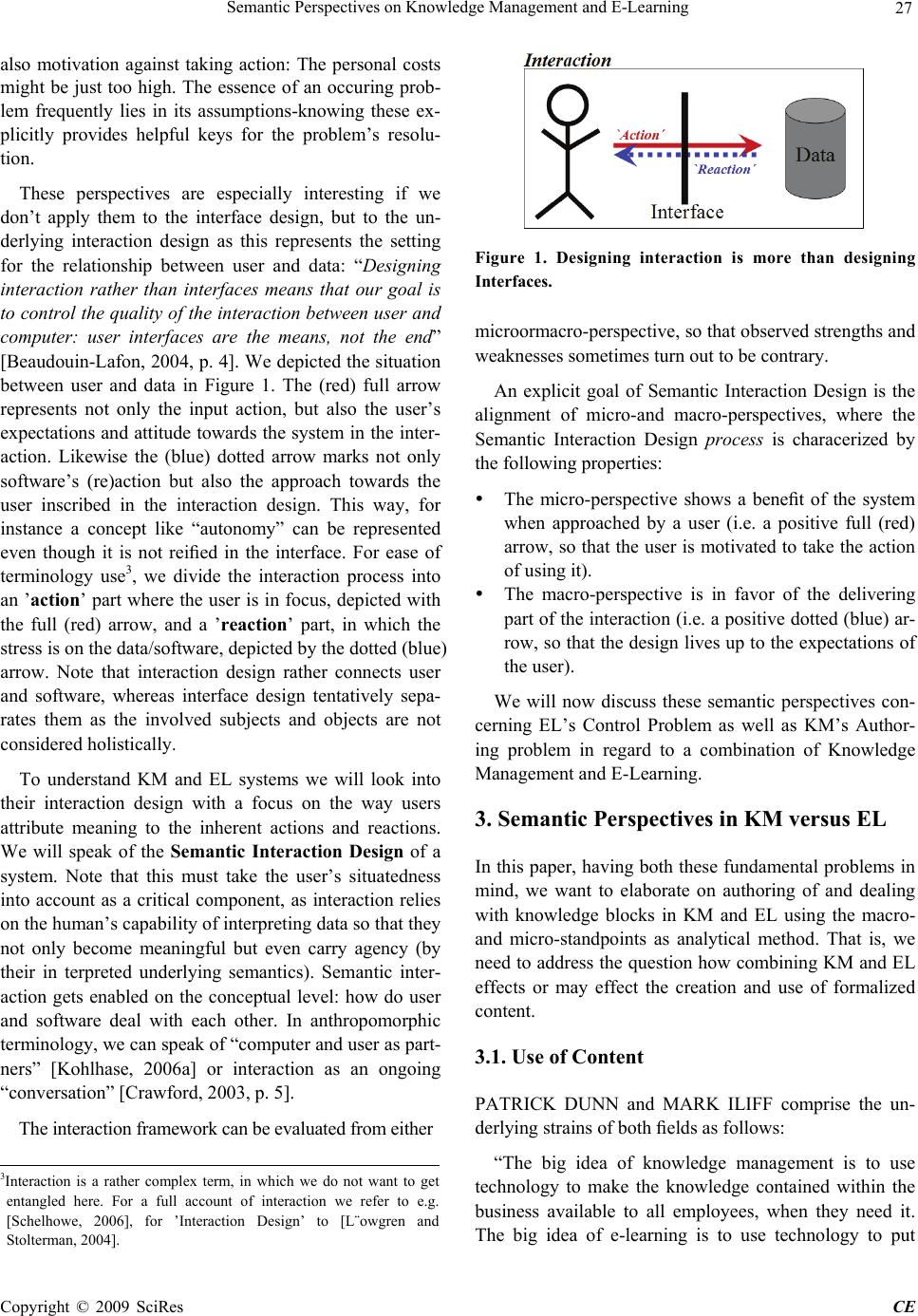 Semantic Perspectives on Knowledge Management and E-Learning Copyright © 2009 SciRes CE 27 also motivation against taking action: The personal costs might be just too high. The essence of an occuring prob- lem frequently lies in its assumptions-knowing these ex- plicitly provides helpful keys for the problem’s resolu- tion. These perspectives are especially interesting if we don’t apply them to the interface design, but to the un- derlying interaction design as this represents the setting for the relationship between user and data: “Designing interaction rather than interfaces means that our goal is to control the quality of the interaction between user and computer: user interfaces are the means, not the end” [Beaudouin-Lafon, 2004, p. 4]. We depicted the situation between user and data in Figure 1. The (red) full arrow represents not only the input action, but also the user’s expectations and attitude towards the system in the inter- action. Likewise the (blue) dotted arrow marks not only software’s (re)action but also the approach towards the user inscribed in the interaction design. This way, for instance a concept like “autonomy” can be represented even though it is not reified in the interface. For ease of terminology use3, we divide the interaction process into an ’action’ part where the user is in focus, depicted with the full (red) arrow, and a ’reaction’ part, in which the stress is on the data/software, depicted by the dotted (blue) arrow. Note that interaction design rather connects user and software, whereas interface design tentatively sepa- rates them as the involved subjects and objects are not considered holistically. Figure 1. Designing interaction is more than designing Interfaces. microormacro-perspective, so that observed strengths and weaknesses sometimes turn out to be contrary. An explicit goal of Semantic Interaction Design is the alignment of micro-and macro-perspectives, where the Semantic Interaction Design process is characerized by the following properties: The micro-perspective shows a benefit of the system when approached by a user (i.e. a positive full (red) arrow, so that the user is motivated to take the action of using it). The macro-perspective is in favor of the delivering part of the interaction (i.e. a positive dotted (blue) ar- row, so that the design lives up to the expectations of the user). We will now discuss these semantic perspectives con- cerning EL’s Control Problem as well as KM’s Author- ing problem in regard to a combination of Knowledge Management and E-Learning. To understand KM and EL systems we will look into their interaction design with a focus on the way users attribute meaning to the inherent actions and reactions. We will speak of the Semantic Interaction Design of a system. Note that this must take the user’s situatedness into account as a critical component, as interaction relies on the human’s capability of interpreting data so that they not only become meaningful but even carry agency (by their in terpreted underlying semantics). Semantic inter- action gets enabled on the conceptual level: how do user and software deal with each other. In anthropomorphic terminology, we can speak of “computer and user as part- ners” [Kohlhase, 2006a] or interaction as an ongoing “conversation” [Crawford, 2003, p. 5]. 3. Semantic Perspectives in KM versus EL In this paper, having both these fundamental problems in mind, we want to elaborate on authoring of and dealing with knowledge blocks in KM and EL using the macro- and micro-standpoints as analytical method. That is, we need to address the question how combining KM and EL effects or may effect the creation and use of formalized content. 3.1. Use of Content PATRICK DUNN and MARK ILIFF comprise the un- derlying strains of both fields as follows: The interaction framework can be evaluated from either “The big idea of knowledge management is to use technology to make the knowledge contained within the business available to all employees, when they need it. The big idea of e-learning is to use technology to put 3Interaction is a rather complex term, in which we do not want to get entangled here. For a full account of interaction we refer to e.g. [Schelhowe, 2006], for ’Interaction Design’ to [L¨owgren and Stolterman, 2004]. 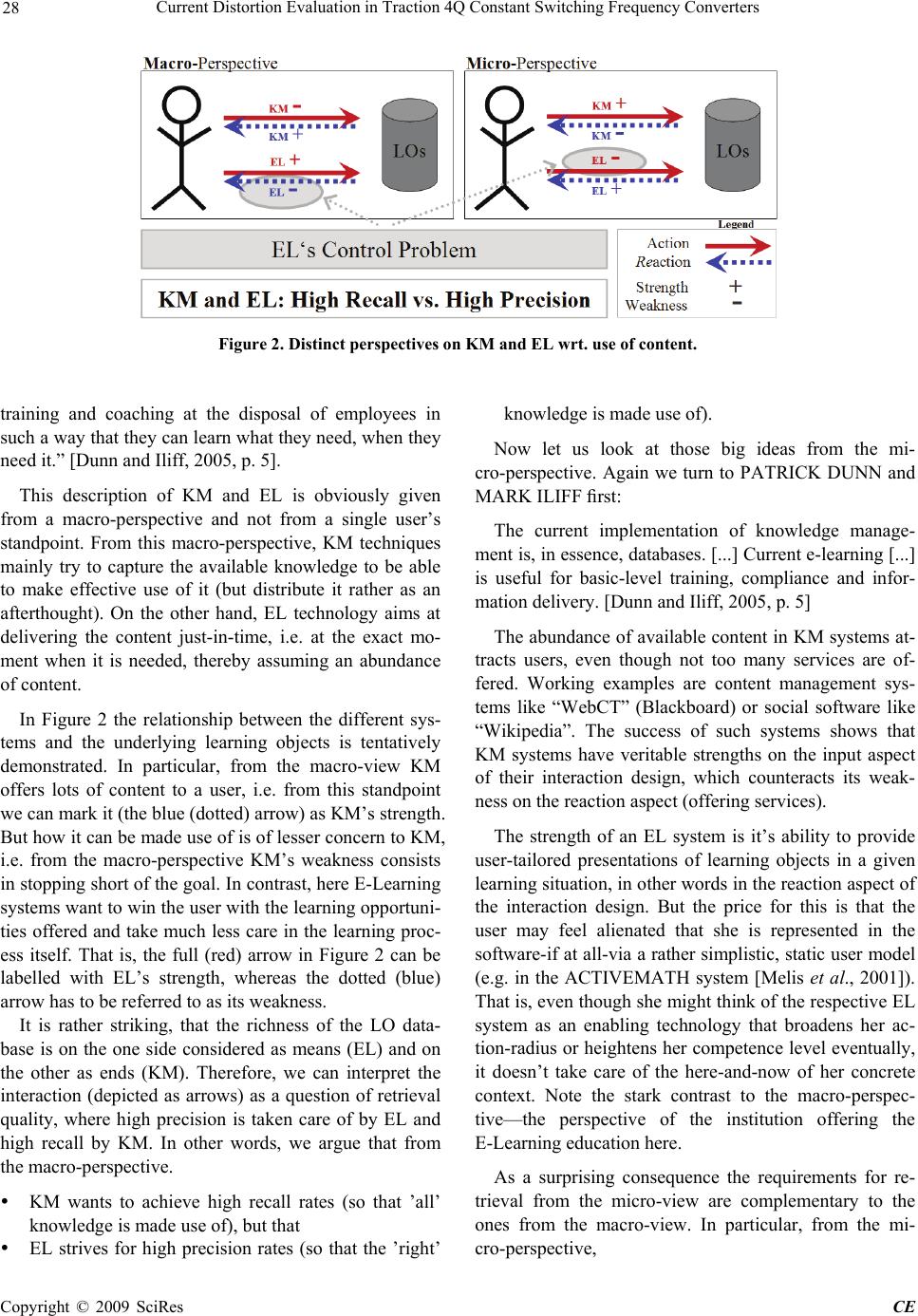 Current Distortion Evaluation in Traction 4Q Constant Switching Frequency Converters 28 Figure 2. Distinct perspectives on KM and EL wrt. use of content. training and coaching at the disposal of employees in such a way that they can learn what they need, when they need it.” [Dunn and Iliff, 2005, p. 5]. This description of KM and EL is obviously given from a macro-perspective and not from a single user’s standpoint. From this macro-perspective, KM techniques mainly try to capture the available knowledge to be able to make effective use of it (but distribute it rather as an afterthought). On the other hand, EL technology aims at delivering the content just-in-time, i.e. at the exact mo- ment when it is needed, thereby assuming an abundance of content. In Figure 2 the relationship between the different sys- tems and the underlying learning objects is tentatively demonstrated. In particular, from the macro-view KM offers lots of content to a user, i.e. from this standpoint we can mark it (the blue (dotted) arrow) as KM’s strength. But how it can be made use of is of lesser concern to KM, i.e. from the macro-perspective KM’s weakness consists in stopping short of the goal. In contrast, here E-Learning systems want to win the user with the learning opportuni- ties offered and take much less care in the learning proc- ess itself. That is, the full (red) arrow in Figure 2 can be labelled with EL’s strength, whereas the dotted (blue) arrow has to be referred to as its weakness. It is rather striking, that the richness of the LO data- base is on the one side considered as means (EL) and on the other as ends (KM). Therefore, we can interpret the interaction (depicted as arrows) as a question of retrieval quality, where high precision is taken care of by EL and high recall by KM. In other words, we argue that from the macro-perspective. KM wants to achieve high recall rates (so that ’all’ knowledge is made use of), but that EL strives for high precision rates (so that the ’right’ knowledge is made use of). Now let us look at those big ideas from the mi- cro-perspective. Again we turn to PATRICK DUNN and MARK ILIFF first: The current implementation of knowledge manage- ment is, in essence, databases. [...] Current e-learning [...] is useful for basic-level training, compliance and infor- mation delivery. [Dunn and Iliff, 2005, p. 5] The abundance of available content in KM systems at- tracts users, even though not too many services are of- fered. Working examples are content management sys- tems like “WebCT” (Blackboard) or social software like “Wikipedia”. The success of such systems shows that KM systems have veritable strengths on the input aspect of their interaction design, which counteracts its weak- ness on the reaction aspect (offering services). The strength of an EL system is it’s ability to provide user-tailored presentations of learning objects in a given learning situation, in other words in the reaction aspect of the interaction design. But the price for this is that the user may feel alienated that she is represented in the software-if at all-via a rather simplistic, static user model (e.g. in the ACTIVEMATH system [Melis et al., 2001]). That is, even though she might think of the respective EL system as an enabling technology that broadens her ac- tion-radius or heightens her competence level eventually, it doesn’t take care of the here-and-now of her concrete context. Note the stark contrast to the macro-perspec- tive—the perspective of the institution offering the E-Learning education here. As a surprising consequence the requirements for re- trieval from the micro-view are complementary to the ones from the macro-view. In particular, from the mi- cro-perspective, Copyright © 2009 SciRes CE  29 Semantic Perspectives on Knowledge Management and E-Learning KM wants to achieve high precision rates (so that a user gets what she needs at that point in time), whereas EL strives for high recall rates (so that a user can find the ’best’ learning object suiting her personal needs). Note that customization presumes potential high recall, whereas effectiveness is based on high precision. In par- ticular (cf. Figure 2), EL’s Control Problem can be inter- preted as a call for high precision from the macro-per- spective and a call for high recall from the micro-pers- pective when retrieving content. 3.1.1. Semantic KM Addresses EL’s Control Problem The main thrust in EL has been developing techniques or models to answer the high precision requirement. But, we argue, that the micro-perspective has to take precedence as it is decisive for taking the action of using the respec- tive system (see [Kohlhase, 2005]). The Control Problem between user and system is a natural consequence of fa- voring the micro-perspective (high recall) over the macro -perspective (high precision) in EL. Maybe we ’just’ have to vary the assumptions: EL interaction design has to take the user’s demand for high recall into account. This can be delivered by semantic KM technology, i.e. a combina- tion of KM-and semantic technology, building on explic- itly represented knowledge objects (rather than EL text with implicit knowledge). In particular, if KM databases can offer more intelligent content, then all this content can be offered to the EL user enabling her not to choose from much too abundant content resources, but make informed decisions about her self-steered learning path. The constructivistic approach in KM Systems consists in managing microcontent, that can be aggregated, i.e. con- structed, in various ways after its production. This way, we can make use of KM’s strength to overcome EL’s Control Problem. 3.2. Creation of Content There is a common understanding in the Knowledge Management discipline that not all fabricated content can be supplied by outsiders, in the contrary that most has to be created within the context of evolvement, i.e. by col- laboration. We list just a few of the arguments in the fol- lowing. For one, as financial resources are evidently lim- ited. For two (especially in organizations), since know- ledge is far too dynamic and progresses fast. For three, because knowledge has a strong context component (see e.g. [Lave and Wenger, 1991; Brown and Duguid, 2000; 1991]). We can also spot a general tendency in the field of E-Learning to incorporate more and more collabora- tive features into their systems. Here, the reasoning is based on the social component of learning (based on e.g. [Vygotsky, 1978; Dewey, 1933; Lave and Wenger, 1991]). Together with the general trend from private data to public data on the Web, showcased by the considerable success of Social Software like DEL.ICIO.US, FLICKR, or SECONDLIFE in terms of user rates and described intriguingly in [Weinberger, 2002] and [Dourish, 2003], we restrict our analysis to collaborative creation of con- tent. In [Kohlhase and Kohlhase, 2004] we showed that the benefits of formalizing content for KM lie principally with its “readers”, while the sacrifices remain with its “authors”-creating what we call the “Authoring Di- lemma”4 as we based our argument on the well-known “Prisoner’s Dilemma” [Axelrod, 1984], which is often used for analyzing short term decision-making processes in cooperation scenarios, where the actors do not have any specific expectations about future interactions or col- laborations. Moreover, in [Kohlhase, 2006b] the Author- ing Dilemma was traced back to differing perspectives on the problem: the micro-perspective and the macro-per- spective, where the first one is disabling content collabo- ration. In particular, the problem was formulated in terms of a value ’landscape’ where the action of creating can be optimized towards distinct optima. That is, here we can think about the according creation tasks in terms of opti- mizing action from the macro-perspective as follows: KM wants to achieve the global optimum (so that all available content is captured), but that EL strives for the local optimum (so that a user can progress on her chosen way). In contrast, E-Learning software simply assumes the existence of qualitatively high learning resources and focuses on setting it up in the right context. That is, EL technology offers itself to the user notwithstanding the quality of learning objects. Again rather surprisingly, the resulting action optimizations from the micro-view are complementary to the ones from the macro-view. In par- ticular, from the micro-perspective, KM wants to achieve the local optimum (so that a user gets done what needs to get done), whereas. 4In the field of Mathematical Knowledge Management (MKM) this is also referred to as “MKM’s chicken-and-egg problem”. Copyright © 2009 SciRes CE  Current Distortion Evaluation in Traction 4Q Constant Switching Frequency Converters 30 Figure 3 . Distinct perspectives on KM and EL wrt. creation of content EL strives for the global optimum (comprised in a “Lifelong Learning” goal or aiming at lifting each individual’s educational level). Note that customization tends to go for the local opti- mum, whereas effectiveness is aimed at the global opti- mum. 3.2.1. Semantic EL Addressing KM’s Authoring Problem Figure 3 visualizes the strengths and weaknesses of KM and EL with respect to the creation of content. We have argued elsewhere that the macro-perspective on KM technologies stresses its potential, but the actual offer- ings are rather simple and consist in authoring tools. From the micro-perspective however, the lack of sup- portive services prevents users from using the available authoring tools. Therefore, the Authoring Problem is a consequence of neglecting the micro-perspective and the failure of supplying Added-Value Services [Kohl- hase and M¨uller, 2007] based on the content. Even though the fashionable paradigm of the “user as pro- ducer and consumer” is appealing from a macro-per- spective-from a micro-per- spective, the hurdle to be- come a producer is a serious one and has to be ac- knowledged in software-design. How can this be done? We suggest to use a combina- tion of El and semantic technology, which we call se- mantic EL technologies. In particular, if EL data con- sisted of more intelligent content, then this could be tai- lored to the KM author enabling her to appreciate direct, intelligent services for her here-and-now situation. EL systems use the provided metadata of microcontent to construct a use context for the user. This approach makes use of EL’s strength to alleviate KM’s Authoring Prob- lem. 4. Conclusions In order to understand the benefits of a fusion of Knowl- edge Management and E-Learning technologies, we have focused on KM’s Authoring Problem and EL’s Control Problem. For this, we have looked at the strengths and weaknesses of their semantic interaction designs with respect to using and creating content within them. Here, we noted that both problems are characterized by weak user approaches from the micro-perspective and weak software deliveries from the macro-perspective. At the same time, KM and EL turned out to be rather comple- mentary with respect to these actions under the distinct views. Therefore, we expect that merging the technolo- gies will alleviate the respective problems. Moreover, we suggest that KM as well as EL technologies that are en- riched by semantic technologies will enhance the poten- tial resolution process. REFERENCES [1] [Althoff et al., 2005] Klaus-Dieter Althoff, Andreas Den-gel, Ralph Bergmann, Markus Nick, and Thomas Roth-Berghofer, editors. Professional Knowledge Man- agement, number 3782 in LNCS. Springer Verlag, 2005. [2] [Axelrod, 1984] Robert Axelrod. The Evolution of Coop- eration. Basic Books, New York, 1984. [3] [Bandura, 1976] Albert Bandura. Lernen am Modell. Ans¨atze zu einer sozial-kognitiven Lerntheorie. Klett- Cotta, 1976. [4] [Beaudouin-Lafon, 2004] Michel Beaudouin-Lafon. De- signing interaction, not interfaces. In AVI ’04: Proceedings of the working conference on Advanced visual interfaces, pages 15–22, New York, NY, USA, 2004. ACM Press. [5] [Brown and Duguid, 1991] John Seely Brown and Paul Duguid. Organizational Learning and Communities of Practice: Toward a Unified View of working, Learning and Innovation. Organization Science, 2(1): 40–57, 1991. Copyright © 2009 SciRes CE  31 Semantic Perspectives on Knowledge Management and E-Learning [6] [Brown and Duguid, 2000] John Seely Brown and Paul Duguid. The Social Life of Information. Harvard Business School Press, 2000. [7] [Crawford, 2003] Chris Crawford. The Art of Interactive Design: A Euphonious and Illuminating Guide to Build- ing Successful Software. No Starch Press, 2003. [8] [Dewey, 1933] John Dewey. Experience and Education. New York: Macmillan, 1933. [9] [Dourish, 2003] Paul Dourish. Where the Action Is: The Foundations of Embodied Interaction. MIT Press, 2003. [10] [Dunn and Iliff, 2005] Patrick Dunn and Mark Iliff. At cross purposes: Why e-learning and knowledge manage- ment dont get along. Online at http://www.learninglight. eu, viewed at 2007/07/04, 2005. Learning Light. [11] [Kohlhase and Kohlhase, 2004] Andrea Kohlhase and Michael Kohlhase. CPoint: Dissolving the Author’s Di- lemma. In Andrea Asperti, Grzegorz Bancerek, and Andrzej Trybulec, editors, Mathematical Knowledge Management, MKM’04, number 3119 in LNAI, pages 175–189. Springer Verlag, 2004. [12] [Kohlhase and M¨uller, 2007] Andrea Kohlhase and Nor-men M¨uller. Added-Value: Getting People into Se- mantic Work Environments. Accepted for Publication in “J. Rech, B. Decker, and E. Ras (editors): Semantic Work Environments”, 2007. [13] [Kohlhase, 2005] Andrea Kohlhase. Overcoming Propri- etary Hurdles: CPoint as Invasive Editor. In Fred de Vries and Graham Attwell and Raymond Elferink and Alexan- dra T¨odt, editor, Open Source for Education in Europe: Research and Practise, pages 51–56. Open Universiteit of the Netherlands, Heerlen, 2005. Copyright © 2009 SciRes CE |