

Paper Menu >>
Journal Menu >>
 Creative Education, 2009, 1-8 Published Online September 2009 in SciRes (http://www.SciRP.org/journal/ce) Copyright © 2009 SciRes CE 1 Creative Education at Tokyo Institute of Technology* ABSTRACT Basic educational principles and detailed curriculum of creativity education that the author introduced in the Depart- ment of Mechanical and Aerospace Engineering of Tokyo Institute of Technology are discussed. The basic educational principle is to give students as much hands-on experience as possible, and challenge them with assignments to design original mechanical systems. The curriculum includes the following: a course focused on the hands-on exercise of tak- ing many types of machines apart, a course for groups of students to design and manufacture a ‘street performer robot’ consisting of mechanical and electrical components using computer control, and a course to design and draft original machines that satisfy pre-assigned objectives. Keywords: Creativity Education, TITech, Mechatronics, Machine Creation 1. Introduction AT TOKYO INSTITUTE OF TECHNOLOGY (TITech), a number of initiatives in creative education have oc- curred in recent years. In this article, I will outline an initiative taken at the Department of Mechanical and Aerospace Engineering, in which I have taken an active role. In this initiative, we are working on design training through the experience of manufacturing, with the goal of nurturing students’ creativity. I will also summarize rea- sons for the introduction of this method and its imple- mentation. 2. Why Creative Education was Introduced My active involvement in creative education dates back to around the fall of 1990, when the faculty meeting of the Mechanical and Aerospace Engineering Department asked me to teach the Design and Drawing Course start- ing in the next academic year. I was an associate profes- sor then, booked up with a number of research projects, so was not very eager to take this assignment. However, I accepted it anyway, convincing myself that it was a part of the job. When I took a design and drawing course at the Me- chanical Engineering Department at Yokohama National University nearly 30 years ago, there was a requirement for students to carry out design calculations for a diesel engine with given specifications that produced project books about 10cm (est. 4 inches) thick. From these cal- culations, we then drafted over 20 A0 drawings, (which required enormous patience). Although we could feel a sense of accomplishment on its completion, and we ac- quired knowledge and skills along the way, it lacked the touch of reality, and it could not be called ‘creative’ ac- tivity. I studied the syllabus of the conventional Design and Drawing Course held at our Department of TITech, and found that the course was similar to the one I took in my college days. As a matter of fact, as the time allocated to the Design and Drawing Course was shorter, it could not even cover the things that should have been covered in this course, much less include elements to nurture crea- tivity. After discovering this, I started an in-depth examina- tion, looking at how to reform the series of design and drawing courses so that we could address these problems, and focus on nurturing as much creativity as possible. I concluded that we cannot incorporate creative education into the educational system of design and drawing by just changing what we taught in the course, we needed to provide students with a manufacturing experience. To do this, we had to start by preparing the appropriate envi- *Acce p ted 27 November 2000.  Creative Education at Tokyo Institute of Technology 2 ronment. In short, I was facing a very tough challenge, and at one point felt intimidated by the task. However, thanks to the support of fellow faculty members, I suc- ceeded in introducing a new educational system and new facilities as shown below. 3. A New Design and Drawing Education System Aimed at Nurturing Creativity I implemented the following changes to replace the tradi- tional method of teaching design and drawing with a new method aimed at nurturing creativity. In the Department of Mechanical and Aerospace En- gineering, we focussed on so called ‘Engineering Sci- ence,’ and the time allocated to design and drawing was significantly shorter than courses offered in other me- chanical engineering departments of TITech. Design and Drawing Courses only ran during the first and final se- mesters of the third year. However, under the new scheme, we further cut the time for design and drawing practically in half, only teaching it during the final se- mester of the third year. Then we replaced the design and drawing course of the first half of the third year with a new course called ‘Machine Creation’. During this course, students make hands-on machine creations including the construction of a robot that can carry out street perform- ances. In Japan, due to the fierce competition to get into the better colleges, most students do nothing but study from grade school to pass the entrance examinations. Conse- quently, it is practically impossible to have these students create machines without adequate preparation. So we also introduced new courses to provide the students with greater opportunity to become accustomed to making things by themselves. One of these courses is called ‘An introduction to Machine Creation,’ where students re- peatedly dismantle and look inside various machines. This class replaced a conventional lecture course on the principles of mechanisms. In the Robotics Course that I teach during the first se- mester of the second year, we decided to allocate exten- sive time to studying robotic hardware using real hard- ware, not just theories such as the vector analysis of robot manipulators. There is also a requirement for students to assemble linkage mechanisms with cardboard at home, and check their movement. In addition, the Mechatronics Course, which is taught in the final semester of the sec- ond year, shifted its focus from lecture to practice. When you look at the composition of this educational system, please note that we first ask students to create machines, and then teach design and drawing. Under conventional teaching methods, the usual procedure is to introduce design and drawing courses first, then intro- duce hands-on courses, because then students can utilize the knowledge and skills of drafting in making something. When I gave a presentation on our new kind of teaching method in a conference related to education, attendees that included professors of overseas universities ques- tioned our reasoning. In their opinion, drafting is a lan- guage, and you cannot teach design properly unless you teach the language first. However, I believe it is preferable to start by teaching about making things and then teach design and drawing, based on the following reasons. ·To acquire a real sense of design, it is crucial to gain an instinctive sense about objects. Before students acquire this sense, they cannot work out adequate designs. As children, we could find various objects around us that we could dismantle. We dismantled these objects for fun, and through this experience, acquired an instinctive sense about objects. However, modern-day children rarely have this kind of oppor- tunity. Even children who are serious about studying play video games after they finish their work. If you teach traditional design and drawing courses to the students with childhood like this, all they can do is modify the sample in the textbook. I do not think we can give students a real sense of design in this way. ·While it is certainly important to draft correct draw- ings, the knowledge of drawing is not an essential part of design. There were numerous excellent de- signs even before drafting rules were established. We can discuss design issues with simple freehand drawings. In my opinion, we can make drafting courses more interesting for students by giving them experience of discussing designs with rough sketches; that way, students can more easily understand the importance of drafting as a common language. ·Frankly speaking, I do not think drafting classes are very interesting to students. Speaking from my col- lege experience, while we had various courses where we needed to exercise logical thought fully to understand the lecture, drafting classes were dull. We spent long periods of time just memorizing nu- merous simple rules. I felt that these rules could be learnt independently, when necessary. Instead, I wanted more essential knowledge. Because of my personal experience, when I reformed the educa- tional system, I tried to compact the drafting course as much as possible, so that we could utilize the sur- Copyright © 2009 SciRes CE  Creative Education at Tokyo Institute of Technology3 plus time to let students handle actual objects. By doing so, we hope that students can design with an actual sense of the objects. As for teaching drafting skills, we first give students basic drafting knowl- edge, then have them draft a drawing based on a specific design example, so that they can learn the skill on their own. 4. Establishment of the Machine Creation Center To implement design and drawing education with hands- on practice, we first needed to find workspace, then pre- pare the necessary machines and tools. It is a serious is- sue, and I could not handle it by myself, so I brought up this issue at the faculty meeting of our Department. We reached an agreement that Mechanical and Aerospace Engineering Department, as a unit, would advocate to companies the importance of the practical exercise we wanted to implement. We then sought to raise funds to establish a workshop called ‘the Machine Creation Cen- ter’ on campus. Each of us contacted companies where we had connections, and at the same time visited other companies in an effort to raise funds. Eventually, the fund reached nearly 100 million yen. With this we re- formed our old and warehouse-like space into a work- shop, installed air conditioning equipment, 13 sets of control computers, machines, and tools. For about 50 students, the equipment that we pre- pared included 4 small lathes, 4 small milling ma- chines, 6 drilling machine, 2 band saws, a belt sander, a cutting machine, etc. When we give a course with practical experience, the primary issue is to ensure student safety. I sometimes felt depressed thinking about the numerous accident possibilities; whenever teaching staff discussed safety issues, the argument often took up the logic of ‘to prevent accidents, grade-scholars shall not use a knife to sharpen pen- cils.’ In other words, they tended to suggest dropping the idea of incorporating practice into the curricu- lum. However, we drive cars in spite of the risk of car acci- dents, and we take airplanes in spite of the risk of plane crashes. I persisted with the idea that, though the risk of accidents will never be zero, we could do our best to minimize the risk, and managed successfully to persuade the faculty. We paid maximum attention to safety, in- cluding sufficient guidance and supervision of machine operation and careful arrangement of the machine layout and lighting. We also installed a special emergency brake on the small lathes. Fortunately, we have never had any serious accidents. 5. Course Description A description of the course content and key issues fol- lows: 5.1. Introduction to Machine Creation (2 Credits 3 Classes Per Week; 1 Class.45 Minutes, 1 Course.15 Weeks) The intention of this course is to give students the oppor- tunity to handle actual machinery as much as possible when they start studying mechanical engineering in the first semester of the second year. In this course, we pro- vide various machines, donated by private companies, to groups of 4±5 students. Then an engineer from the donor company explains the outline of the machine. After that, students dismantle the machine with tools provided be- forehand. The instructor explains the internal mechanisms, functions, the materials used to make the machine and the process methods, and then students reassemble the ma- chine. Table 1 shows the machines and donor companies we used in the year 2000. In this course, we provide a toolbox to each of the groups for their exclusive use. 5.2. Mechatronics (2 Credits, 2 Classes Per Week) In this course, we teach the basics of analog electronic circuits through to digital electronic circuits, operation of sensor information, motor control, and so on. Stu- dents are provided with small power units and TITech Robot Drivers [5], which are power amplifiers devel- oped for motors and commercialized in our laboratory. They use these components to fabricate a servo unit and learn computer control. At the same time, there is a requirement for students to go to Akihabara, an area in Tokyo where there are numerous electrical and elec- tronic parts shops, to purchase electronic parts for themselves. Students keep the power unit and the servo unit, (made from a DC motor and amplifier), after the course, so that they can use these units as the basic drive unit for the robot street performer we ask them to construct in the Machine Creation Course during the first semes- ter of the third year. At the beginning of the curriculum change, students made the motor amplifiers for them- selves, using analog power amplifiers. However, when they used them to drive their street artist robots, the amplifiers frequently caused trouble. This was largely Copyright © 2009 SciRes CE 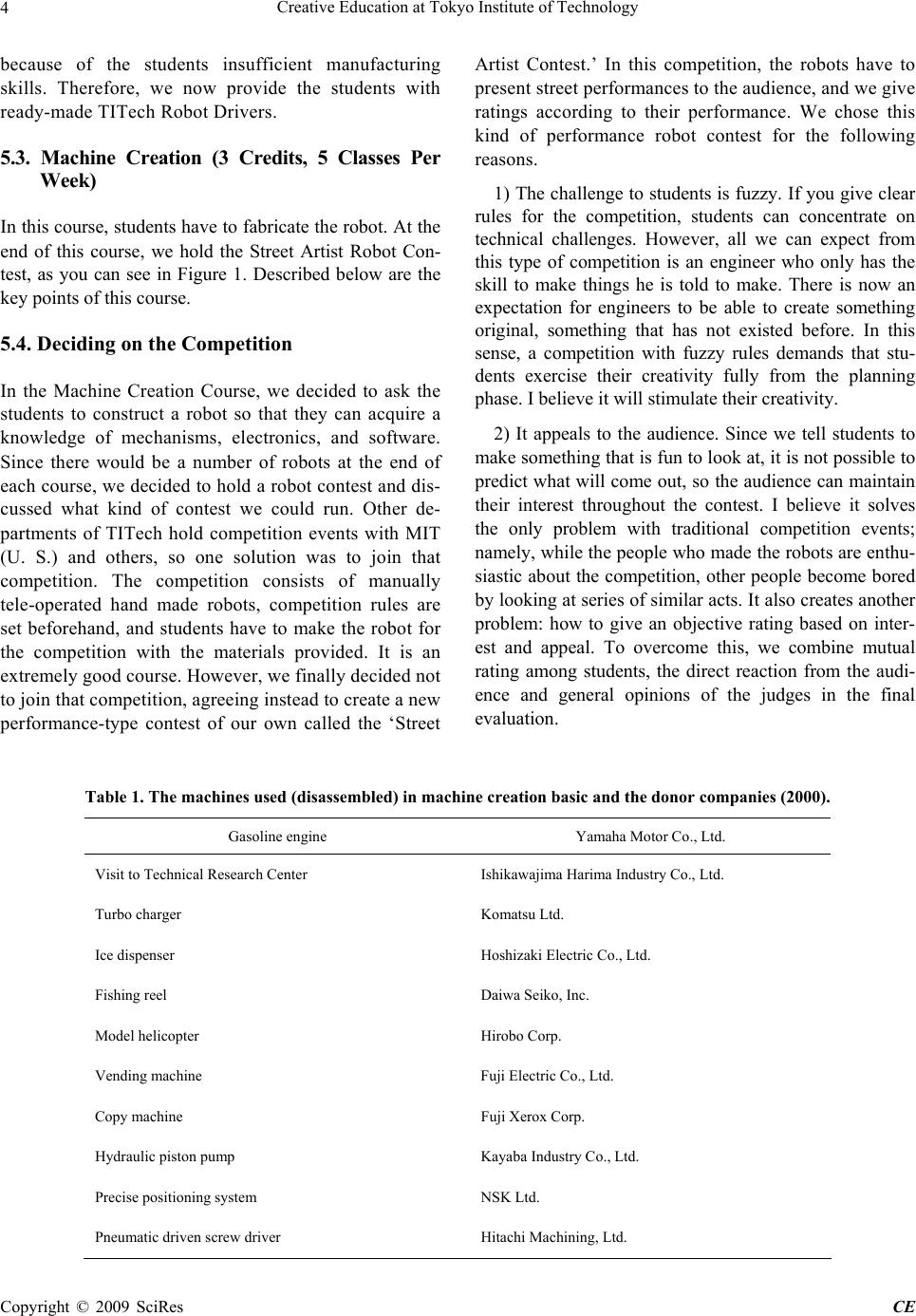 Creative Education at Tokyo Institute of Technology Copyright © 2009 SciRes CE 4 because of the students insufficient manufacturing skills. Therefore, we now provide the students with ready-made TITech Robot Drivers. 5.3. Machine Creation (3 Credits, 5 Classes Per Week) In this course, students have to fabricate the robot. At the end of this course, we hold the Street Artist Robot Con- test, as you can see in Figure 1. Described below are the key points of this course. 5.4. Deciding on the Competition In the Machine Creation Course, we decided to ask the students to construct a robot so that they can acquire a knowledge of mechanisms, electronics, and software. Since there would be a number of robots at the end of each course, we decided to hold a robot contest and dis- cussed what kind of contest we could run. Other de- partments of TITech hold competition events with MIT (U. S.) and others, so one solution was to join that competition. The competition consists of manually tele-operated hand made robots, competition rules are set beforehand, and students have to make the robot for the competition with the materials provided. It is an extremely good course. However, we finally decided not to join that competition, agreeing instead to create a new performance-type contest of our own called the ‘Street Artist Contest.’ In this competition, the robots have to present street performances to the audience, and we give ratings according to their performance. We chose this kind of performance robot contest for the following reasons. 1) The challenge to students is fuzzy. If you give clear rules for the competition, students can concentrate on technical challenges. However, all we can expect from this type of competition is an engineer who only has the skill to make things he is told to make. There is now an expectation for engineers to be able to create something original, something that has not existed before. In this sense, a competition with fuzzy rules demands that stu- dents exercise their creativity fully from the planning phase. I believe it will stimulate their creativity. 2) It appeals to the audience. Since we tell students to make something that is fun to look at, it is not possible to predict what will come out, so the audience can maintain their interest throughout the contest. I believe it solves the only problem with traditional competition events; namely, while the people who made the robots are enthu- siastic about the competition, other people become bored by looking at series of similar acts. It also creates another problem: how to give an objective rating based on inter- est and appeal. To overcome this, we combine mutual rating among students, the direct reaction from the audi- ence and general opinions of the judges in the final evaluation. Table 1. The machines used (disassembled) in machine creation basic and the donor companies (2000). Gasoline engine Yamaha Motor Co., Ltd. Visit to Technical Research Center Ishikawajima Harima Industry Co., Ltd. Turbo charger Komatsu Ltd. Ice dispenser Hoshizaki Electric Co., Ltd. Fishing reel Daiwa Seiko, Inc. Model helicopter Hirobo Corp. Vending machine Fuji Electric Co., Ltd. Copy machine Fuji Xerox Corp. Hydraulic piston pump Kayaba Industry Co., Ltd. Precise positioning system NSK Ltd. Pneumatic driven screw driver Hitachi Machining, Ltd.  Creative Education at Tokyo Institute of Technology5 Figure 1. 1997 street artist robot competition (frog-like machine blowing soap bubbles). 3) It is easy to hold the contest on a continual basis. When robots compete in performances, we can use the same rules every year, greatly reducing the burden on organizers; unlike other competition events where or- ganizers often need to work out new rules every time. If there are any doubts whether it is all right to use the same rules every year, a fancy dress contest broadcast by a Japanese TV station for a long time is a good ex- Copyright © 2009 SciRes CE 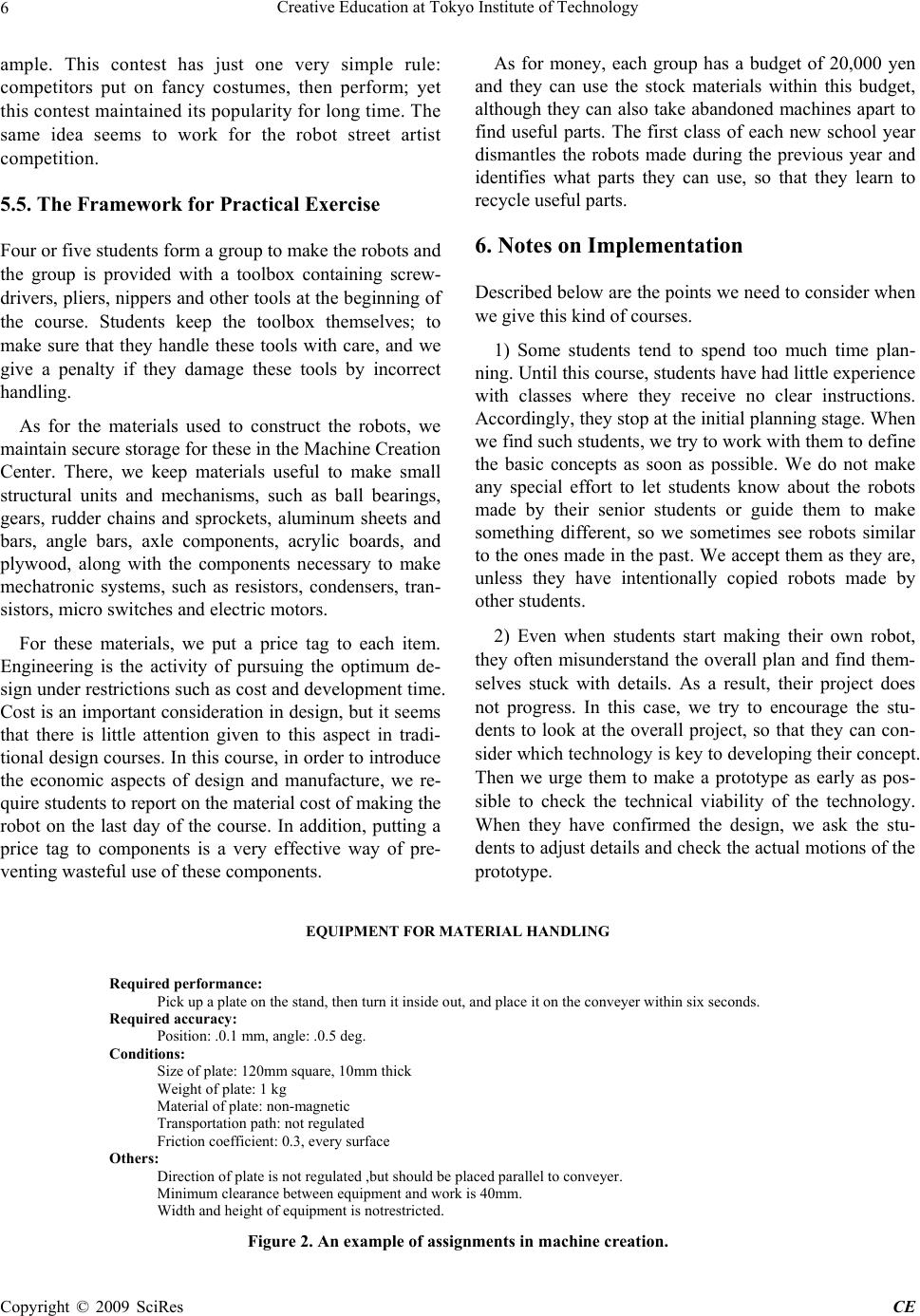 Creative Education at Tokyo Institute of Technology 6 ample. This contest has just one very simple rule: competitors put on fancy costumes, then perform; yet this contest maintained its popularity for long time. The same idea seems to work for the robot street artist competition. 5.5. The Framework for Practical Exercise Four or five students form a group to make the robots and the group is provided with a toolbox containing screw- drivers, pliers, nippers and other tools at the beginning of the course. Students keep the toolbox themselves; to make sure that they handle these tools with care, and we give a penalty if they damage these tools by incorrect handling. As for the materials used to construct the robots, we maintain secure storage for these in the Machine Creation Center. There, we keep materials useful to make small structural units and mechanisms, such as ball bearings, gears, rudder chains and sprockets, aluminum sheets and bars, angle bars, axle components, acrylic boards, and plywood, along with the components necessary to make mechatronic systems, such as resistors, condensers, tran- sistors, micro switches and electric motors. For these materials, we put a price tag to each item. Engineering is the activity of pursuing the optimum de- sign under restrictions such as cost and development time. Cost is an important consideration in design, but it seems that there is little attention given to this aspect in tradi- tional design courses. In this course, in order to introduce the economic aspects of design and manufacture, we re- quire students to report on the material cost of making the robot on the last day of the course. In addition, putting a price tag to components is a very effective way of pre- venting wasteful use of these components. As for money, each group has a budget of 20,000 yen and they can use the stock materials within this budget, although they can also take abandoned machines apart to find useful parts. The first class of each new school year dismantles the robots made during the previous year and identifies what parts they can use, so that they learn to recycle useful parts. 6. Notes on Implementation Described below are the points we need to consider when we give this kind of courses. 1) Some students tend to spend too much time plan- ning. Until this course, students have had little experience with classes where they receive no clear instructions. Accordingly, they stop at the initial planning stage. When we find such students, we try to work with them to define the basic concepts as soon as possible. We do not make any special effort to let students know about the robots made by their senior students or guide them to make something different, so we sometimes see robots similar to the ones made in the past. We accept them as they are, unless they have intentionally copied robots made by other students. 2) Even when students start making their own robot, they often misunderstand the overall plan and find them- selves stuck with details. As a result, their project does not progress. In this case, we try to encourage the stu- dents to look at the overall project, so that they can con- sider which technology is key to developing their concept. Then we urge them to make a prototype as early as pos- sible to check the technical viability of the technology. When they have confirmed the design, we ask the stu- dents to adjust details and check the actual motions of the prototype. EQUIPMENT FOR MATERIAL HANDLING Required performance: Pick up a plate on the stand, then turn it inside out, and place it on the conveyer within six seconds. Required accuracy: Position: .0.1 mm, angle: .0.5 deg. Conditions: Size of plate: 120mm square, 10mm thick Weight of plate: 1 kg Material of plate: non-magnetic Transportation path: not regulated Friction coefficient: 0.3, every surface Others: Direction of plate is not regulated ,but should be placed parallel to conveyer. Minimum clearance between equipment and work is 40mm. Width and height of equipment is notrestricted. Figure 2. An example of assignments in machine creation. Copyright © 2009 SciRes CE  Current Distortion Evaluation in Traction 4Q Constant Switching Frequency Converters 7 3) When we talk to students who are working on their robots, we try to use rough sketches to facilitate commu- nication. I believe this experience is useful for them in understanding the meaning of design and drawing, which they will study later. 4) During the course, we try to set more than one checkpoint to look at the students’ progress. If we do not make any effort to check their progress before the contest, we cannot always expect satisfactory quality even though students may stay up all night working on the robots for a couple of days preceding the contest. By checking their progress at multiple points, we can solve this problem to a certain extent. In the case of the Machine Creation Course (15 weeks), students present their concept using overhead projectors in the 3rd week, and discuss their concepts with other students. In the 7th week, we have a meeting to examine the mecha- nisms. We request that students have working mecha- nisms ready by that time to check the functionality, though they do not have to deco rate the robots for this. In the 11th week, we have a total technology examina- tion meeting to check the workmanship of the mecha- nism and its computer control system. After this meet- ing, students have to do the final tuning and finishing for the competition. 5) Documentation is also important in engineering education. We ask students to produce posters to exhibit in the corridor of the Machine Creation Center and de- tailed reports of their robot. 6) We use instructors who can teach practical ex- perience. In courses that contain practical work, it is important to secure sufficient teaching staff so that we can check on each student. We are dealing with this challenge with full assistance from part-time instructors and 3 engineering staff members, along with graduate student TAs (teaching assistants) who supervise the after-school activities. In the future, we shall also work out a scheme where we can ask assistance from senior volunteers. 6.1. Design and Drawing (2 Credits, 4 Classes Per Week) This class takes place during the final semester of the third year. In the first 4 weeks or so, we repeat lec- tures and quizzes, organizing the lectures so that stu- dents can learn the essence of drawing in the shortest possible time. Then, we give 3 specific assignments to the 54 students, so that they can work out the ma- chines that can meet the challenge then present their ideas in drawings. Currently, Mr. Shoichi Iikura from Toshiba Co. and others teach this course, and they prepare projects for their assignments that one might come across in actual business. Figure 2 shows one of these assignments. Students often submit more than a dozen different designs with different concepts for one assignment, so we examine each design separately and provide appropriate guidance. Though students have to submit the assembly drawing only, they are also required to state why they selected the motor that they did, and to check the strength and vibration fre- quencies. This enables students to recognize the ap- plicability of what they have learned in a practical setting. To assist students in researching the parts needed to complete their project, we provide numer- ous catalogues at the Machine Creation Center. Stu- dents can use these catalogues to work out their design. Figure 2. An example of assignments in machine creation. 7. Conclusions What is the ideal teaching method to nurture creativity? Unfortunately, I do not have a clear answer to this ques- tion. However, I believe that we can nurture creativity if we provide as much firsthand experience as possible that contributes to creative thinking, prepare an environment where one needs to be creative, and properly evaluate the achievement of creativity. This belief establishes a foun- dation for the principles described in this article. How- ever, it would be too late to start nurturing creativity in college. I strongly feel that we should introduce the as- pects of creativity in elementary school and junior high school. For this purpose I am now proposing to introduce ‘intelligent sports’. 8. Acknowledgements To implement this creativity education in TITech, we received a great deal of support from everywhere, and I would like to take this opportunity to acknowledge their contributions. I am particularly grateful to Mr. Hideaki Suzuki for his extensive assistance. REFERENCES [1] Shigeo Hirose, Attempts to introduce practice, feeling and creativity in education, J. Japanese Soc. Mechanical En- gineers, 94(875) pp. 874±879 (1991) in Japanese. [2] Shigeo Hirose, Creative education and street artist robot competition, J. Japan Engineering Education Association, 42(6) pp. 31±35 (1994) in Japanese. Copyright © 2009 SciRes CE  Creative Education at Tokyo Institute of Technology Copyright © 2009 SciRes CE 8 [3] Shigeo Hirose, Culture of manufacturing in the robotized society, J. Japan Soc. Mechanical Engineers, 99(926) pp. 24±28 (1996) in Japanese. [4] Shigeo Hirose, Private view about creativity education, Examples of Creative Education in Engineering, Techni- cal Education Division, Higher Education Bureau, Minis- try of Education, pp. 44±45 (1997) in Japanese. [5] Fumihiko E. Fukushima, Toshimichi Tsumaki, and Shi- geo Hirose, Development of PWM-controlled DC servo motor drive circuit, Proc. 13th Conf. Robotics Society of Japan, pp. 1153±1154 (1995) In Japanese. [6] Shigeo Hirose, Introduction of `intelligent sports', J. Ro- botics and Mechatronics, 10(1), pp. 2±6, (1997). |