

Paper Menu >>
Journal Menu >>
 Open Journal of Pediatrics, 2011, 1, 27-29 doi:10.4236/ojped.2011.13007 Published Online September 2011 (http://www.SciRP.org/journal/ojped/ OJPed ). Published Online September 2011 in SciR es. http://www.scirp.org/journal/OJPed Antimicrobial therapy using sulfamethoxazole trimethoprim for Kawasaki disease patients unresponsive to intravenous immunoglobulin Satoru Nagata1,2, Yu ichiro Yamashiro2, Makoto Fujimori3, Yukihide Chiba3, Yoshikaz u Ohtsuka3, Toshiaki Shimizu3 1Departments of Pediatrics and Neonatology, Shizuoka Hospital, Juntendo University School of Medicine, Shizuoka, Japan; 2Division of Laboratory for Probiotics Research, Juntendo University Postgraduate School, Tokyo, Japan; 3Department of Pediatrics, Juntendo University School of Medicine, Tokyo, Japan. Email: [email protected] Received 22 May 2011; revised 27 June 2011; accepted 23 August 2011. ABSTRACT Our previous study suggested that the production of superantigens and heat-shock protein 60 by small intestinal bacteria might play a role in Kawasaki disease (KD). We demonstrated that they were all re- sistant to commonly used antibiotics, except for sul- famethoxazole trimethoprim (SMX-TMP). We used SMX-TMP for 7 cases of KD that were unresponsive to intravenous immunoglobulin (IVIG) and studied the antipyretic potency of this treatment. In 6 out of the 7 cases, we demonstrated that antipyretic potency was observed without side effects within 2 days of the initial administration. Antimicrobial therapy using SMX-TMP might represent a novel strategy for cases of KD that are unresponsive to IVIG. Keywords: Antimicrobial Therapy; Intravenous Immu- noglobulin Resistance; Kawasaki Disease; Sulfameth- oxazole Trimethoprim 1. INTRODUCTION Immunoglobulin is helpful during the acute phase of Kawasaki disease (KD), but there is an approximate 5% failure rate, and close to a 30% adverse effect rate. In addition, immun oglobu lin is exp ensive, at app roximately $100 per gram [1]. Antibiotic treatments targeting the causative bacteria may be a more effective and eco- nomical treatment for KD if the detailed pathogenic mechanism of the disease can be elucidated. In our pre- vious study, we found some particular Gram-negative microbes producing heat-shock protein 60 and several Gram-positive cocci having superantigen ic properties on the surface of the gastrointestinal tract which mig ht play a role in the onset of Kawasaki disease (KD) [2]. We performed antibiotic sensitivity testing on these strains, considering them to be the cause of this disease if they participated in the onset, and found that they were all resistant to all of the commonly used antibiotics except for sulfamethoxazole trimethoprim (SMX-TMP). In this study, we used SMX-TMP for 7 cases of KD that were unresponsive to intravenous immunoglobulin (IVIG) and studied the antipyretic po tency of this treatment. 2. CASE SERIES We identified seven patients with intractable IVIG-re- fractory KD at Juntendo University and its two branch hospitals between January 2008 and February 2009 who were treated with 2 courses of IVIG at a dose of 2 g/kg given over 24 hours and 1 course of pulsed intravenous methylprednisolone (IVP: methylprednisolone intrave- nously at a dose of 30 mg/kg/day given up to a maxi- mum 1000 mg/day) therapy. This trial was approved by the Juntendo University Review Board. The demographic characteristics of the 7 patients de- scribed in this report are summarized in Ta b le 1. All of the cases had received primary IVIG therapy but ex- perienced no decline of fever within 24 hours from the end of the infusion, and were therefore defined as unre- sponsive cases. Three of the cases had received addi- tional IVIG therapy, and 4 had received IVP therapy. However, in all of the cases, the patients did not respond to the secondary therapy and did not experience any de- crease in their fever within 24 hours after treatment, and therefore, underwent tertiary therapy. For the tertiary therapy, IVP was selected for the pa- tients who had consecutively received IVIG therapy twice, and IVIG was selected for the patients who had received IVP therapy during the second round of treat- ment. However, because all 7 cases were resistant to 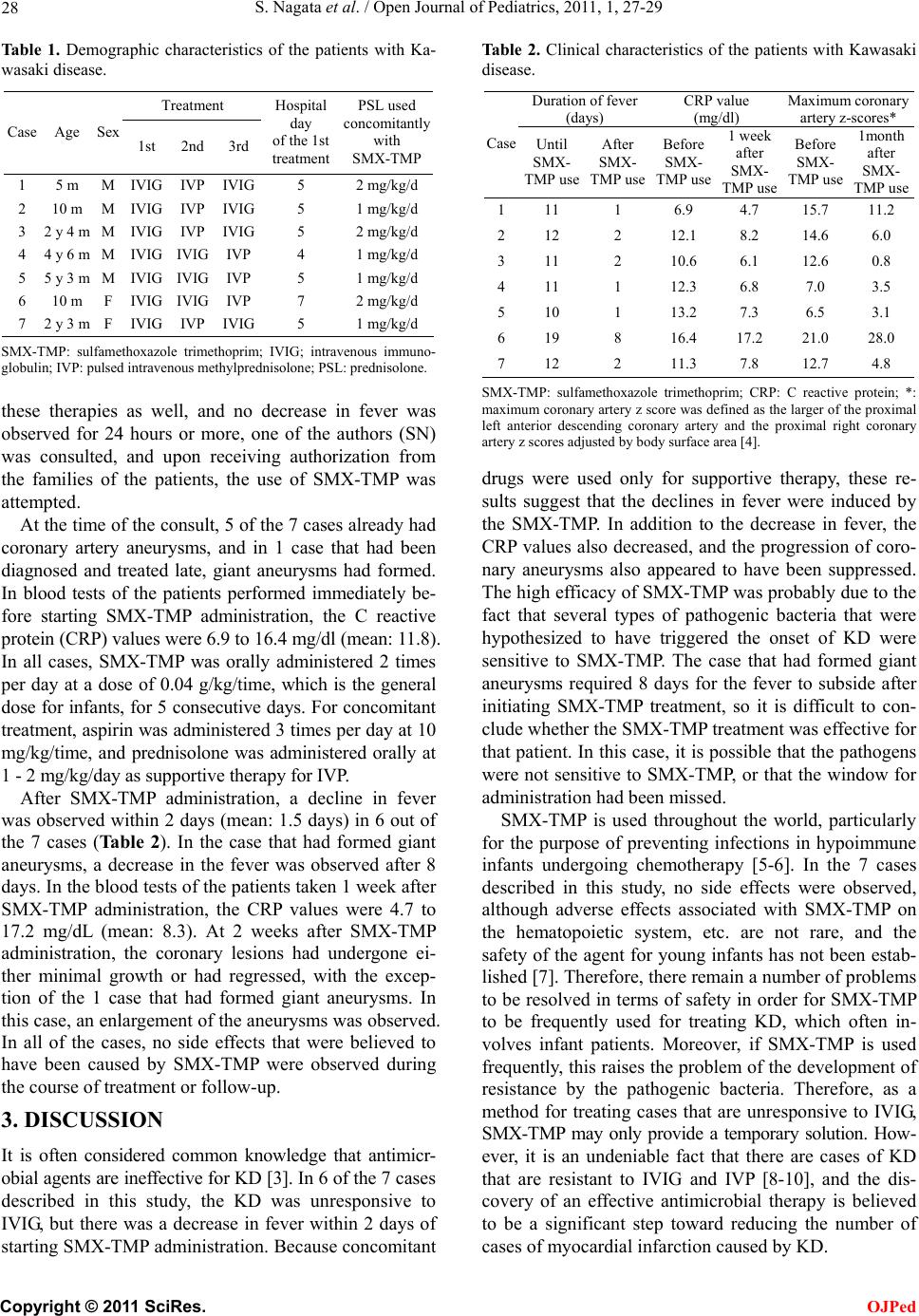 S. Nagata et al. / Open Journal of Pediatrics, 2011, 1, 27-29 28 Table 1. Demographic characteristics of the patients with Ka- wasaki disease. Treatment Case Age Sex 1st 2nd 3rd Hospital day of the 1st treatment PSL used concomitantly with SMX-TMP 1 5 m M IVIG IVP IVIG 5 2 mg/kg/d 2 10 m M IVIG IVP IVIG 5 1 mg/kg/d 3 2 y 4 m M IVIG IVP IVIG 5 2 mg/kg/d 4 4 y 6 m M IVIG IVIG IVP 4 1 mg/kg/d 5 5 y 3 m M IVIG IVIG IVP 5 1 mg/kg/d 6 10 m F IVIG IVIG IVP 7 2 mg/kg/d 7 2 y 3 m F IVIG IVP IVIG 5 1 mg/kg/d SMX-TMP: sulfamethoxazole trimethoprim; IVIG; intravenous immuno- globulin; IVP: pulsed in traveno us methylpre dnisolone; PSL: pr ednisolone. these therapies as well, and no decrease in fever was observed for 24 hours or more, one of the authors (SN) was consulted, and upon receiving authorization from the families of the patients, the use of SMX-TMP was attempted. At the time of the co nsult, 5 of the 7 cases already had coronary artery aneurysms, and in 1 case that had been diagnosed and treated late, giant aneurysms had formed. In blood tests of the patients performed immediately be- fore starting SMX-TMP administration, the C reactive protein (CRP) values were 6.9 to 16.4 mg/dl (mean: 11.8). In all cases, SMX-TMP was orally administered 2 times per day at a dose of 0.04 g/kg/time, which is the general dose for infants, for 5 consecutive days. For concomitant treatment, aspirin was administered 3 times per day at 10 mg/kg/time, and prednisolone was administered orally at 1 - 2 mg/kg/ day as supp ort i ve therapy fo r IVP. After SMX-TMP administration, a decline in fever was observed w ithin 2 days (mean: 1.5 days) in 6 out of the 7 cases (Ta bl e 2 ). In the case that had formed giant aneurysms, a decrease in the fever was observed after 8 days. In the blood tests of the patients taken 1 week after SMX-TMP administration, the CRP values were 4.7 to 17.2 mg/dL (mean: 8.3). At 2 weeks after SMX-TMP administration, the coronary lesions had undergone ei- ther minimal growth or had regressed, with the excep- tion of the 1 case that had formed giant aneurysms. In this case, an enlargement of the aneurysms was observed. In all of the cases, no side effects that were believed to have been caused by SMX-TMP were observed during the course of treatment or follow-up. 3. DISCUSSION It is often considered common knowledge that antimicr- obial agents are ineffective for KD [3]. In 6 of the 7 ca se s described in this study, the KD was unresponsive to IVIG, but there was a decrease in fever within 2 days of starting SMX-TMP administration. Because concomitant Table 2. Clinical characteristics of the patients with Kawasaki disease. Duration of fever (days) CRP value (mg/dl) Maximum cor onary artery z-scores* Case Until SMX- TMP use After SMX- TMP use Before SMX- TMP use 1 week after SMX- TMP use Before SMX- TMP use 1month after SMX- TMP use 111 1 6.9 4.7 15.7 11.2 212 2 12.1 8.2 14.6 6.0 311 2 10.6 6.1 12.6 0.8 411 1 12.3 6.8 7.0 3.5 510 1 13.2 7.3 6.5 3.1 619 8 16.4 17.2 21.0 28.0 712 2 11.3 7.8 12.7 4.8 SMX-TMP: sulfamethoxazole trimethoprim; CRP: C reactive protein; *: maximum coronary artery z score was defined as the larger of the proximal left anterior descending coronary artery and the proximal right coronary artery z score s adjusted by body surface area [4]. drugs were used only for supportive therapy, these re- sults suggest that the declines in fever were induced by the SMX-TMP. In addition to the decrease in fever, the CRP values also decreased, and the progression of coro- nary aneurysms also appeared to have been suppressed. The high efficacy of SMX-TMP w as probab ly due to the fact that several types of pathogenic bacteria that were hypothesized to have triggered the onset of KD were sensitive to SMX-TMP. The case that had formed giant aneurysms required 8 days for the fever to subside after initiating SMX-TMP treatment, so it is difficult to con- clude whether the SMX-TMP treatment was effective for that patient. In this case, it is possible that the pathogens were not sensitive to SMX-TMP, or that the window for administration had been missed. SMX-TMP is used throughout the world, particularly for the purpose of preventing infections in hypoimmune infants undergoing chemotherapy [5-6]. In the 7 cases described in this study, no side effects were observed, although adverse effects associated with SMX-TMP on the hematopoietic system, etc. are not rare, and the safety of the agen t for young infants has not been estab- lished [7]. Therefore, there remain a number of problems to be resolved in terms of safety in o rder for SMX-TMP to be frequently used for treating KD, which often in- volves infant patients. Moreover, if SMX-TMP is used frequently, th is raises the problem of the development of resistance by the pathogenic bacteria. Therefore, as a method for treating cases that are unresponsive to IVIG, SMX-TMP may only provide a temporary solution. How- ever, it is an undeniable fact that there are cases of KD that are resistant to IVIG and IVP [8-10], and the dis- covery of an effective antimicrobial therapy is believed to be a significant step toward reducing the number of cases of myocardial infarction caused by KD. C opyright © 2011 SciRes. OJPed  S. Nagata et al. / Open Journal of Pediatrics, 2011, 1, 27-29 Copyright © 2011 SciRes. 29 Although our results are promising, this study does not go beyond the realm of case reports, and in order to determine which antimicrobial agents are effective for cases of KD that are unresponsive to IVIG, further evi- dence from randomized control trials will be needed. OJPed 4. ACKNOWLEDGEMENTS We would like to express our sincere appreciation to Dr. Shun Saito and Dr. Riek o Nagaoka for their valuable cooperation in the trial. REFERENCES [1] Klassen, P., Rowe P.C. and Gafni, A. (1993) Economic evaluation of intravenous immune globulin therapy for Kawasaki disease. Journal of Pediatrics, 122, 532-542. [2] Nagata, S., Yamashiro, Y., Ohtsuka, Y., Shimizu, T., Sa- kurai, Y., Misawa, S. and Ito, T. (2009) Heat shock pro- teins and superantigenic properties of bacteria from the gastrointestinal tract of patients with Kawasaki disease. Immunology, 128, 511-520. doi:10.1111/j.1365-2567.2009.03135.x [3] Kato, H., Koike, S. and Yokoyama, T. (1979) Kawasaki disease: Effect of treatment on coronary artery involve- ment. Pediatrics, 63, 175-179. [4] McCrindle, B.W., Li, J. S., Minich, L.L., Cola n, S.D., Atz, A.M., Takahashi, M., Vetter, V.L., Gersony, W.M., Mit- chell, P.D. and Newburger, J.W. (2007) Coronary artery involvement in children with Kawasaki disease: Risk fac- tors from analysis of serial normalized measurements. Circulation, 116, 174-179. doi:10.1161/CIRCULATIONAHA.107.690875 [5] Rungoe, C., Malchau, E.L., Larsen, L.N. and Schroeder, H. (2010) Infections during induction therapy for chil- dren with acute lymphoblastic leukemia. The role of sul- famethoxazole -trimethopri m (SMX-TMP) prophy laxis. Pe- diatric Blood & Cancer, 55, 304-308. doi:10.1002/pbc.22423 [6] Lindemulder, S. and Albano, E. (2007) Successful inter- mittent prophylaxis with trimethoprim/sulfamethoxazole 2 days per week for Pneumocystis carinii (jiroveci) pneumonia in pediatric oncology patients. Pediatrics, 120, e47-e51. doi:10.1542/peds.2006-1360 [7] Asmar, B.I., Maqbool, S. and Dajani, A.S. (1981) Hema- tologic abnormalities after oral trimethoprim-sulfameth- oxazole therapy in children. American Journal of Dis- eases of Children, 135, 1100-1103. [8] Sleeper, L.A., Minich, L.L., McCrindle, B.M., Li, J.S., Mason, W., Colan, S.D., Atz, A.M., Printz, B.F., Baker, A., Vetter, V.L. and Newburger, J.W. (2011) Evaluation of Kawasaki disease risk-scoring systems for intravenous immunoglobulin resistance. Journal of Pediatrics, 158, 831-835. doi:10.1016/j.jpeds.2010.10.031 [9] Shah, I. and Prabhu, S.S. (2009) Response of refractory Kawasaki disease to intravenous methylprednisolone. An- nals of Tropical Paediatrics, 29, 51-53. doi:10.1179/146532809X402033 [10] Rowley, A.H. and Shulman, S.T. (2010) Pathogenesis and management of Kawasaki disease. Expert Review of Anti-Infective Therapy, 8, 197-203. doi:10.1586/eri.09.109 |