

Paper Menu >>
Journal Menu >>
 Vol.3, No.9, 545-548 (2011) doi:10.4236/health.2011.39092 C opyright © 2011 SciRes. Openly accessible at http://www.scirp.org/journal/HEALTH/ Health Air temperature was associated with ambulance transports in Osaka area, Japan Nobuyuki Miyatake1*, Noriko Sakano1, Shoko Murakami1, Takeshi Suzue2, Takeshi Yoda2, Akira Yoshioka2, Tomohiro Hirao2 1Department of Hygiene, Faculty of Medicine, Kagawa University, Kagawa, Japan; *Corresponding Aut hor: [email protected] 2Department of Public Health, Faculty of Medicine, Kagawa University, Kagawa, Japan. Received 4 July 2011; revised 1 August 2011; accepted 9 August 2011. ABSTRACT We investigated the link between ambulance transports and meteorological parameters of summer by using daily data in Osaka area, Ja- pan. Daily observations for ambulance trans- ports (from July 1 to September 30, 2009) were obtained from Fire Department Service in Osaka. Data of meteorological parameters in Osaka area, Japan (from July 1 to September 30, 2009) were also obtained from Japan Meteorological Agency. Effect of meteorological parameters on ambulance transports was analyzed. A total of 49,526 ambulance transports were observed from July 1 to September 30, 2009 in Osaka, Japan. Ambulance transports were significantly correlated with mean air temperature (r = 0.298), the highest air temperature (r = 0.347), the low- est air temperature (r = 0.209) and daylight hour s (r = 0.301). The higher air temperature was as- sociated with higher ambulance transports of summer in Osaka area, Japan. Keywords: Ambulance Transports; Air Temperature; Osaka Area; Daylight Hou rs 1. INTRODUCTION Global warming has become public health challenge in Japan. Global average temperatures are predicted to increase between 1.4˚C and 5.8˚C by the end of this cen- tury [1]. We have previously showed that estimated changes in mean temperature was 1.6˚C for 50 years in Osaka areas, Japan [2]. In addition, by using monthly data, higher air temperature was associated with ambu- lance transports in Takamatsu [3] and Okayama [4] areas, Japan. Basu et al. also reported that th e relation between elevated ambient air temperature and mortality in their review [5]. However, the link between ambulance trans- ports by using daily data and meteorological parameters i.e. air temperature, humidity, atmospheric pressure and daylight hours still remains to be investigated. Therefore, we investigated the relationship between ambulance transports of summer and meteorological parameters by using daily data in Osaka area, Japan. 2. METHODS 2.1. Study Area Osaka area is the second largest metropolitan area in Japan and its population is abo ut 8.7 million . Osaka city (2.6 million population, 220 km2) is located in the center of the metropolitan area, and have been mostly urban- ized for a long time in Japan. The Osaka plain is sur- rounded by Hokusetsu and Rokko mountains to the north, Ikoma mountain on the east side, Izumi Mountain in the south, and Osaka Bay to the west. 2.2. Ambulance Dat a Daily incidence data of ambulance transports was ob- tained from Fire Department Service in Osaka from July 1 to September 30, 2009 [6]. 2.3. Meteorological Parameters Daily meteorological parameters in Osaka areas in Japan for the required periods were obtained from Japan Meteorological Agency [7]. The observation spots were located at the central in the area. Daily meteorological parameters i.e. mean atmospheric pressure (land surface) (hPa), mean atmospheric pressure (sea surface) (hPa), total precipitation (mm), mean air temperature (˚C), the highest air temperature (˚C), the lowest air temperature (˚C), mean humidity (%), the lowest humidity (%), mean velocity of the wind (m/s) and daylight hours (hours) 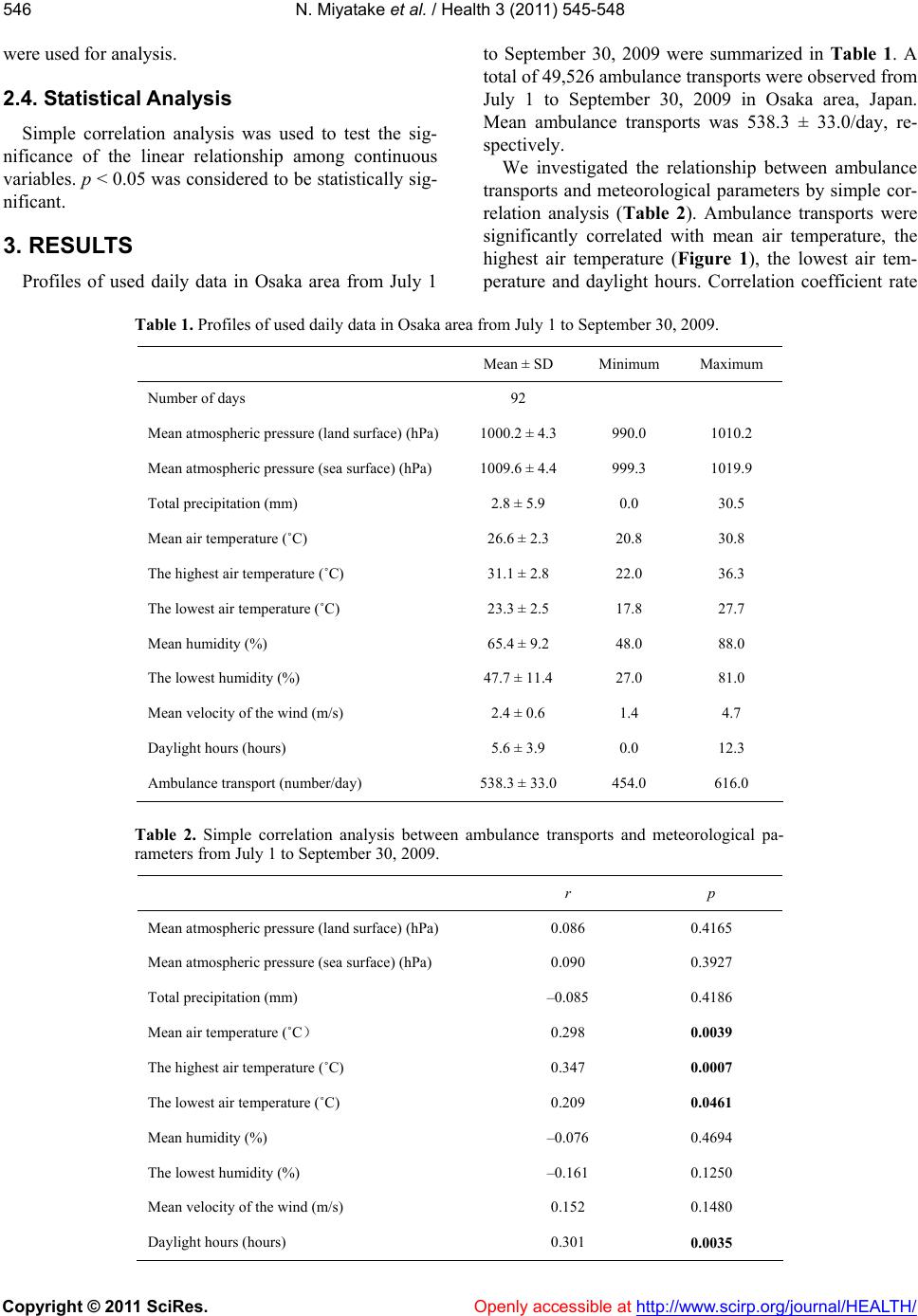 N. Miyatake et al. / Health 3 (2011) 545-548 Copyright © 2011 SciRes. Openly accessible at http://www.scirp.org/journal/HEALTH/ 546 were used for analysis. 2.4. Statistical Analysis Simple correlation analysis was used to test the sig- nificance of the linear relationship among continuous variables. p < 0.05 was considered to be statistically sig- nificant. 3. RESULTS Profiles of used daily data in Osaka area from July 1 to September 30, 2009 were summarized in Table 1. A tota l of 49,526 ambul ance transports wer e observed from July 1 to September 30, 2009 in Osaka area, Japan. Mean ambulance transports was 538.3 ± 33.0/day, re- spectively. We investigated the relationship between ambulance transports and meteorological parameters by simple cor- relation analysis (Table 2). Ambulance transports were significantly correlated with mean air temperature, the highest air temperature (Figure 1), the lowest air tem- perature and daylight hours. Correlation coefficient rate Table 1. Profiles of used daily data in Osaka area from July 1 to September 30, 2009. Mean ± SD Minimum Maximum Number of days 92 Mean atmospheric pressure (land surface) (hPa) 1000.2 ± 4.3 990.0 1010.2 Mean atmospheric pressure (sea surface) (hPa) 1009.6 ± 4.4 999.3 1019.9 Total precipitation (mm ) 2.8 ± 5.9 0.0 30.5 Mean air temperature (˚C) 26.6 ± 2.3 20.8 30.8 The highest air temperature (˚C) 31.1 ± 2.8 22.0 36.3 The lowest air temperature (˚C) 23.3 ± 2.5 17.8 27.7 Mean humidity (%) 65.4 ± 9.2 48.0 88.0 The lowest humidity (%) 47.7 ± 11.4 27.0 81.0 Mean velocity of the wind (m/s) 2.4 ± 0.6 1.4 4.7 Daylight hours (hours) 5.6 ± 3.9 0.0 12.3 Ambulance transport (number/day) 538.3 ± 33.0 454.0 616.0 Table 2. Simple correlation analysis between ambulance transports and meteorological pa- rameters from July 1 to September 30, 2009. r p Mean atmospheric pressure (land surface) (hPa) 0.086 0.4165 Mean atmospheric pressure (sea surface) (hPa) 0.090 0.3927 Total precipitation (mm ) –0.085 0.4186 Mean air temperature (˚C) 0.298 0.0039 The highest air temperature (˚C) 0.347 0.0007 The lowest air temperature (˚C) 0.209 0.0461 Mean humidity (%) –0.076 0.4694 The lowest humidity (%) –0.161 0.1250 Mean velocity of the wind (m/s) 0.152 0.1480 Daylight hours (hours) 0.301 0.0035 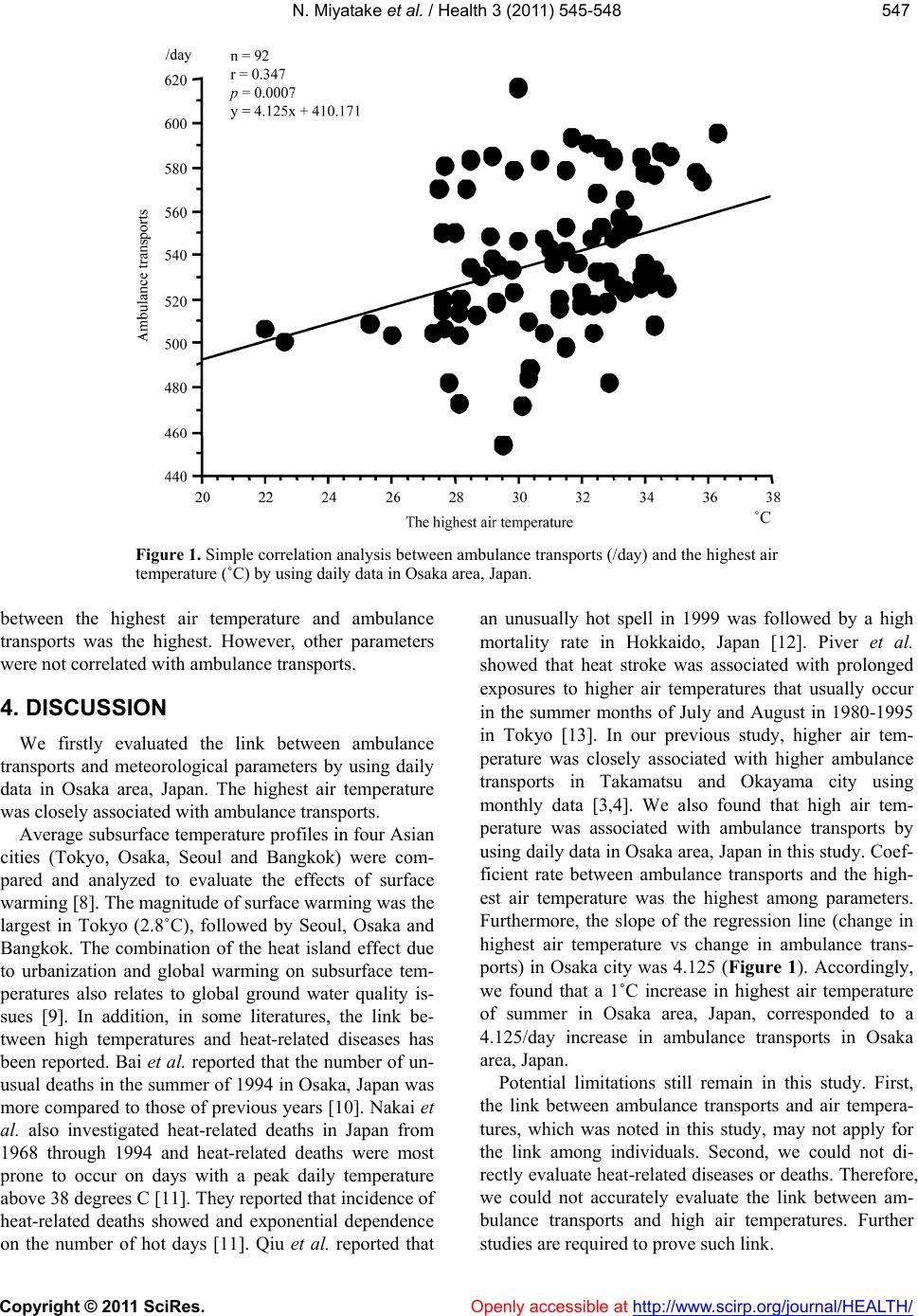 N. Miyatake et al. / Health 3 (2011) 545-548 Copyright © 2011 SciRes. Openly accessible at http://www.scirp.org/journal/HEALTH/ 547547 ˚C Figure 1. Simple correlation analy sis between ambulance transports (/day) and the highest air temperature (˚C) by using da ily data in Osaka ar ea, Japa n. between the highest air temperature and ambulance transports was the highest. However, other parameters were not correlated with ambulance transports. 4. DISCUSSION We firstly evaluated the link between ambulance transports and meteorological parameters by using daily data in Osaka area, Japan. The highest air temperature was closely associated with ambulance transports. Average subsurface temperature profiles in four Asian cities (Tokyo, Osaka, Seoul and Bangkok) were com- pared and analyzed to evaluate the effects of surface warming [8]. The magnitude of surface warming was the largest in Tokyo (2.8˚C), followed by Seoul, Osaka and Bangkok. The combination of the heat island effect due to urbanization and global warming on subsurface tem- peratures also relates to global ground water quality is- sues [9]. In addition, in some literatures, the link be- tween high temperatures and heat-related diseases has been reported. Bai et al. reported that the number of un- usual deaths in the summer of 1994 in Osaka, Japan was more compared to those of previous years [10]. Nakai et al. also investigated heat-related deaths in Japan from 1968 through 1994 and heat-related deaths were most prone to occur on days with a peak daily temperature above 38 degrees C [11]. Th ey reported that incidence of heat-related deaths showed and exponential dependence on the number of hot days [11]. Qiu et al. reported that an unusually hot spell in 1999 was followed by a high mortality rate in Hokkaido, Japan [12]. Piver et al. showed that heat stroke was associated with prolonged exposures to higher air temperatures that usually occur in the summer months of July and August in 1980-1995 in Tokyo [13]. In our previous study, higher air tem- perature was closely associated with higher ambulance transports in Takamatsu and Okayama city using monthly data [3,4]. We also found that high air tem- perature was associated with ambulance transports by using daily data in Osaka area, Jap an in this study. Coef- ficient rate between ambulance transports and the high- est air temperature was the highest among parameters. Furthermore, the slope of the regression line (change in highest air temperature vs change in ambulance trans- ports) in Osaka city was 4.125 (Figure 1). Accordingly, we found that a 1˚C increase in highest air temperature of summer in Osaka area, Japan, corresponded to a 4.125/day increase in ambulance transports in Osaka area, Japan. Potential limitations still remain in this study. First, the link between ambulance transports and air tempera- tures, which was noted in this study, may not apply for the link among individuals. Second, we could not di- rectly evaluate heat-related diseases or deaths. Therefore, we could not accurately evaluate the link between am- bulance transports and high air temperatures. Further studies are required to prove such link.  N. Miyatake et al. / Health 3 (2011) 545-548 Copyright © 2011 SciRes. Openly accessible at http://www.scirp.org/journal/HEALTH/ 548 5. ACKNOWLEDGEMENTS This research was supported in part by Research Grants from FU- KUTAKE Science & Culture Foundation, Japan. REFERENCES [1] Intergovernmental Panel on Climate Change (2001) The scientific basis: Contribution of working group 1 to the Third assessment report. Cambridge University Press, Cambridge, 1-944. [2] Miyatake, N. , Sakano, N., Murakami, S., Suna, S., Suzue, T. and Hirao, T. (2011) Comparison of the temperatures among rural, urban and metropolitan areas around the Inland Sea in Japan. Environmental Monitoring and As- sessment, 181, 525-530. [3] Miyatake, N., Nakao, M., Sakano, N., Suna, S., Suzue, T. and Hirao, T. (2011) Higher ambulance transports were closely associated with higher ambulance transports in Takamatsu area, Japan. Journal of Environmental Pro- tection, 2, 72-75. doi:10.4236/jep.2011.21007 [4] Sakano, N., Miyatake, N., Suzue, T., Suna, S., Hirao, T. and Ogino, K. (2011) The relation between high tempera- tures and ambulance transports in Okay ama city, Japan (in Japanese). Journal of Preventive Medicine, 6, 17-20. [5] Basu, R. and Samet, J.M. (2002) Relation between ele- vated ambient temperature and mortality: A review of the epidemiologic evidence. Epidemiologic Reviews, 24, 190-202. doi:10.1093/epirev/mxf007 [6] Fire Department Service in Osaka, Japan (2011) http://www.city.osaka.lg.jp/shobo/cmsfiles/contents/0000 093/93833/P45.pdf [7] Japan Meteorological Agency (2011) http://www.data.jma.go.jp/obd/stats/etrn/index.php?prec_ no=62&prec_ch=%91%E5%8D%E3%95%7B&block_n o=47772&block_ch=%91%E5%8D%E3&year=&month =&day=&view= [8] Taniguchi, M., Umemura, T. and Jago-on., K. (2007) Combined effects of urbanization and global warming on subsurface temperature in four Asian cities. Vadose Zone Journal, 6, 591-596. doi:10.2136/vzj2006.0094 [9] Knorr, W., Prentice, I.C., House, J.I. and Holland, E.A. (2005) Long-term sensitivity of soil carbon turnover to warming. Nature, 433, 298-301. doi:10.1038/nature03226 [10] Bai, H., Islam, M.N., Kuroki, H., Honda, K. and Waka- sugi, C. (1995) Deaths due to heat waves during the summer of 1994 in Osaka Prefecture, Japan. Nihon Hoi- gaku Zasshi, 49, 265-274. [11] Nakai, S., Itoh, T. and Morimoto, T. (1999) Deaths from heat-stroke in Japan: 1968-1994. International Journal of Biometeorology, 43, 124-127. doi:10.1007/s004840050127 [12] Qiu, D., Tanihata, T., Aoyama, H., Fujita, T., Inaba, Y. and Minowa, M. (1999) Relationship between a high mortality rate and extreme heat during the summer of 1999 in Hokkaido Prefecture, Japan. Journal of Epide- miology, 12, 254-257. [13] Piver, W.T., Ando, M., Ye, F. and Portier, C.J. (1999) Temperature and air pollution as risk factors for heat stroke in Tokyo, July and August 1980-1995. Environ- mental Health Perspectives, 107, 911-916. doi:10.1289/ehp.99107911 |