

Paper Menu >>
Journal Menu >>
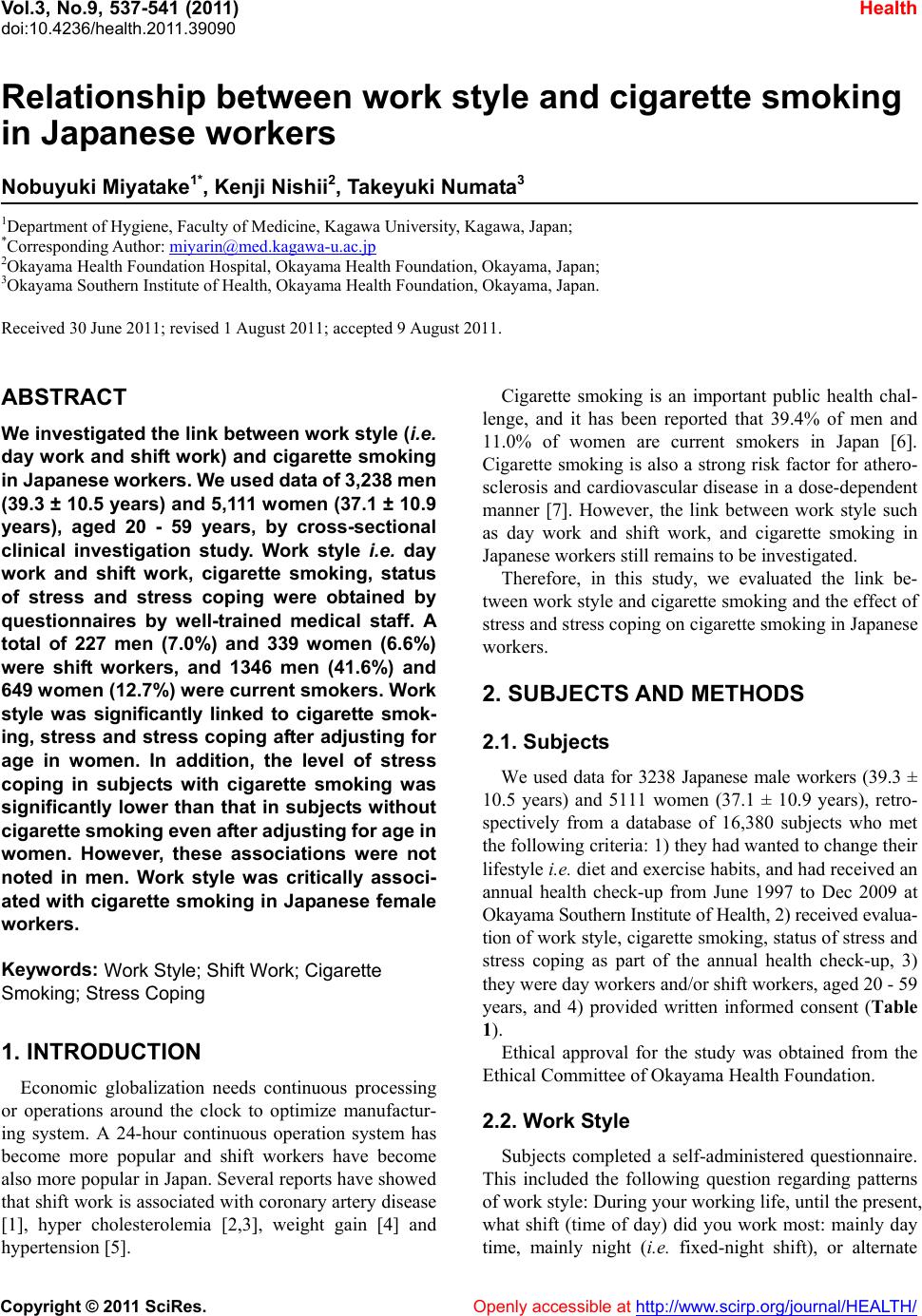 Vol.3, No.9, 537-541 (2011) doi:10.4236/health.2011.39090 C opyright © 2011 SciRes. Openly accessible at http://www.scirp.org/journal/HEALTH/ Health Relationship between work style and cigarette smoking in Japanese workers Nobuyuki Miyatake1*, Kenji Nishii2, Takeyuki Numata3 1Department of Hygiene, Faculty of Medicine, Kagawa University, Kagawa, Japan; *Corresponding Aut hor: [email protected] 2Okayama Health Foundation Hospital, Okayama Health Foundation, Okayama, Japan; 3Okayama Southern Institute of Health, Okayama Health Foundation, Okayama, Japan. Received 30 June 2011; revised 1 August 2011; accepted 9 August 2011. ABSTRACT We investigated the link between work st yle (i.e. day work and shift work) and cigarette smoking in Jap ane se worker s. W e used d at a of 3,238 men (39.3 ± 10.5 years) and 5,111 women (37.1 ± 10.9 years), aged 20 - 59 years, by cross-sectional clinical investigation study. Work style i.e. day work and shift work, cigarette smoking, status of stress and stress coping were obtained by questionnaires by well-trained medical staff. A total of 227 men (7.0%) and 339 women (6.6%) were shift workers, and 1346 men (41.6%) and 649 women (12.7%) were current smokers. W ork style was significantly linked to cigarette smok- ing, stress and stress coping after adjusting for age in women. In addition, the level of stress coping in subjects with cigarette smoking was significantly low er than that in subjects w ithout cigarette smoking ev en af ter adjustin g for age in women. However, these associations were not noted in men. Work style was critically associ- ated w ith cigarette smoking in Japanese female workers. Keywords: Work Style; Shift Work; Cigarette Smoking; Stress Coping 1. INTRODUCTION Economic globalization needs continuous processing or operations around the clock to optimize manufactur- ing system. A 24-hour continuous operation system has become more popular and shift workers have become also more popular in Jap an. Several reports h ave show ed that shift work is associated with coronary artery disease [1], hyper cholesterolemia [2,3], weight gain [4] and hypertensio n [ 5] . Cigarette smoking is an important public health chal- lenge, and it has been reported that 39.4% of men and 11.0% of women are current smokers in Japan [6]. Cigarette smoking is also a strong risk factor for athero- sclerosis and cardiovascular disease in a dose-dependent manner [7]. However, the link between work style such as day work and shift work, and cigarette smoking in Japanese workers still remains to be investigated. Therefore, in this study, we evaluated the link be- tween work style and cigarette smoking and the effect of stress and stress coping on cigarette smoking in Japanese workers. 2. SUBJECTS AND METHODS 2.1. Subjects We used data for 3238 Japanese male workers (39.3 ± 10.5 years) and 5111 women (37.1 ± 10.9 years), retro- spectively from a database of 16,380 subjects who met the following criteria: 1) they had wanted to change their lifestyle i.e. diet and exercise habits, and had received an annual health check-up from June 1997 to Dec 2009 at Okayama Southern Institu te of Health, 2) received evalua- tion of work style, cigarette smoking, status of stress and stress coping as part of the annual health check-up, 3) they were day workers and/or shift workers, aged 20 - 59 years, and 4) provided written informed consent (Table 1). Ethical approval for the study was obtained from the Ethical Committee of Okayama Health Foundation. 2.2. Work Style Subjects completed a self-administered questionnaire. This included the following question regarding patterns of work style: During your work ing life, un til the pr esen t, what shift (time of day) did you work most: mainly day time, mainly night (i.e. fixed-night shift), or alternate 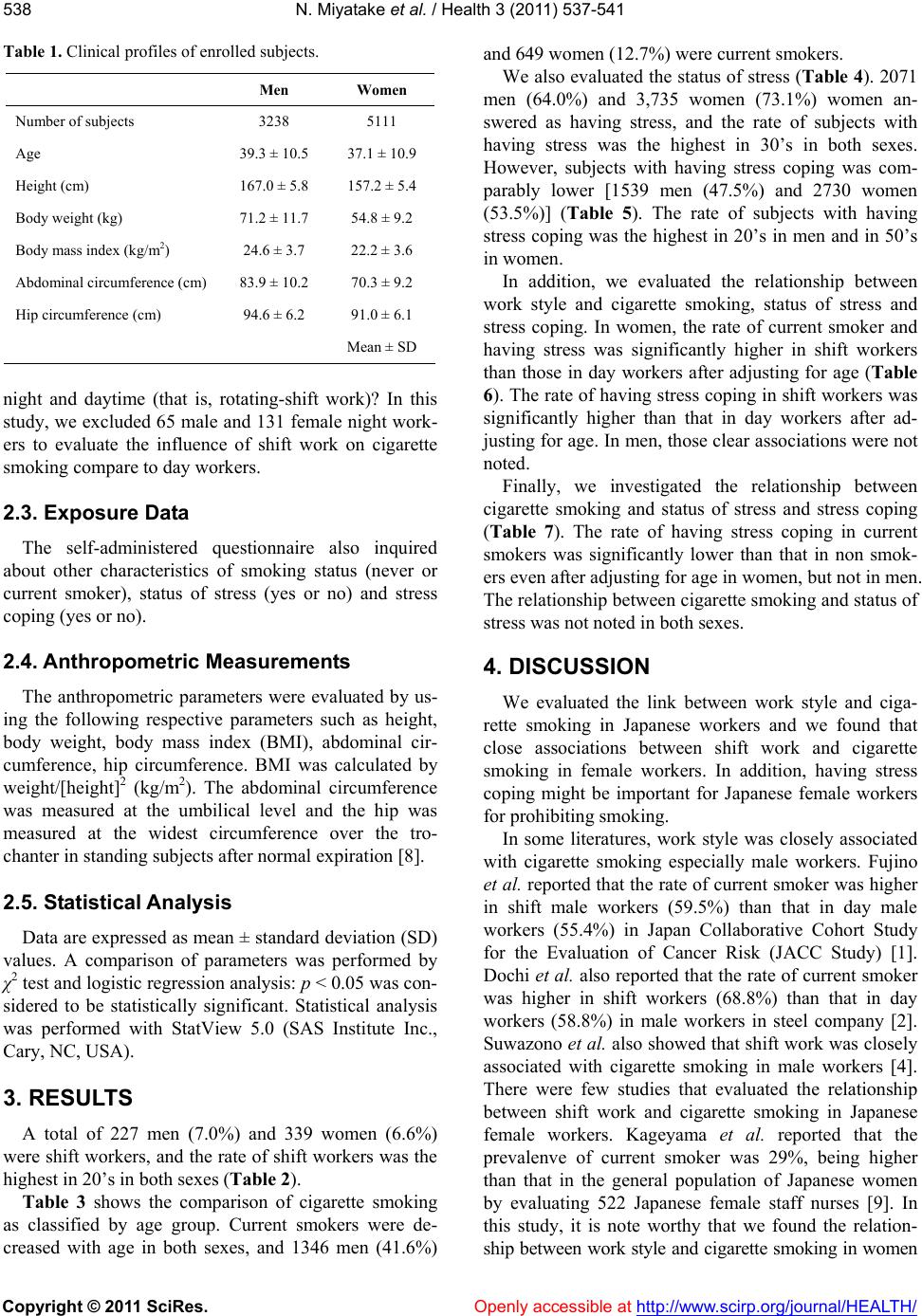 N. Miyatake et al. / Health 3 (2011) 537-541 Copyright © 2011 SciRes. Openly accessible at http://www.scirp.org/journal/HEALTH/ 538 Table 1. Clinical profiles of enrolled subjects. Men Women Number of subjects 3238 5111 Age 39.3 ± 10.5 37.1 ± 10.9 Height (cm) 167.0 ± 5.8 157.2 ± 5.4 Body weight (kg) 71.2 ± 11.7 54.8 ± 9.2 Body mass index (kg/m2) 24.6 ± 3.7 22.2 ± 3.6 Abdominal circumference ( cm) 83.9 ± 10.2 70.3 ± 9.2 Hip circ umference (cm) 94.6 ± 6.2 91.0 ± 6.1 Mean ± SD night and daytime (that is, rotating-shift work)? In this study, we excluded 65 male and 131 female night work- ers to evaluate the influence of shift work on cigarette smoking compare to day workers. 2.3. Exposure Data The self-administered questionnaire also inquired about other characteristics of smoking status (never or current smoker), status of stress (yes or no) and stress coping (yes or no ). 2.4. Anthropometric Measurement s The anthropometric parameters were evaluated by us- ing the following respective parameters such as height, body weight, body mass index (BMI), abdominal cir- cumference, hip circumference. BMI was calculated by weight/[height]2 (kg/m2). The abdominal circumference was measured at the umbilical level and the hip was measured at the widest circumference over the tro- chanter in standing subjects after normal expiration [8]. 2.5. Statistical Analysis Data are expressed as mean ± standard deviation (SD) values. A comparison of parameters was performed by χ2 test and logistic regression analysis: p < 0.05 was con- sidered to be statistically significant. Statistical analysis was performed with StatView 5.0 (SAS Institute Inc., Cary, NC, USA). 3. RESULTS A total of 227 men (7.0%) and 339 women (6.6%) were shift workers, and the rate of shift workers was the highest in 20’s in both sexes (Table 2). Table 3 shows the comparison of cigarette smoking as classified by age group. Current smokers were de- creased with age in both sexes, and 1346 men (41.6%) and 649 wom en (1 2.7%) were current sm okers. We also evaluated the status of stress (Table 4). 2071 men (64.0%) and 3,735 women (73.1%) women an- swered as having stress, and the rate of subjects with having stress was the highest in 30’s in both sexes. However, subjects with having stress coping was com- parably lower [1539 men (47.5%) and 2730 women (53.5%)] (Table 5). The rate of subjects with having stress coping was the highest in 20’s in men and in 50’s in women. In addition, we evaluated the relationship between work style and cigarette smoking, status of stress and stress coping. In women, the rate of current smoker and having stress was significantly higher in shift workers than those in day workers after adjusting for age (Table 6). The rate of having stress coping in shift workers was significantly higher than that in day workers after ad- justing for age. In men, those clear associations were not noted. Finally, we investigated the relationship between cigarette smoking and status of stress and stress coping (Table 7). The rate of having stress coping in current smokers was significantly lower than that in non smok- ers even after adjusting for age in women, but not in men. The relationship between cigarette smoking and status of stress was not noted in both sexes. 4. DISCUSSION We evaluated the link between work style and ciga- rette smoking in Japanese workers and we found that close associations between shift work and cigarette smoking in female workers. In addition, having stress coping might be important for Japanese female workers for prohibiting smoking. In some literatures, work style was closely associated with cigarette smoking especially male workers. Fujino et al. reported that the rate of current smoker was higher in shift male workers (59.5%) than that in day male workers (55.4%) in Japan Collaborative Cohort Study for the Evaluation of Cancer Risk (JACC Study) [1]. Dochi et al. also reported that the rate of current smoker was higher in shift workers (68.8%) than that in day workers (58.8%) in male workers in steel company [2]. Suwazono et al. also showed that shift work was closely associated with cigarette smoking in male workers [4]. There were few studies that evaluated the relationship between shift work and cigarette smoking in Japanese female workers. Kageyama et al. reported that the prevalenve of current smoker was 29%, being higher than that in the general population of Japanese women by evaluating 522 Japanese female staff nurses [9]. In this study, it is note worthy that we found the relation- ship between work style and cigarette smoking in wo men 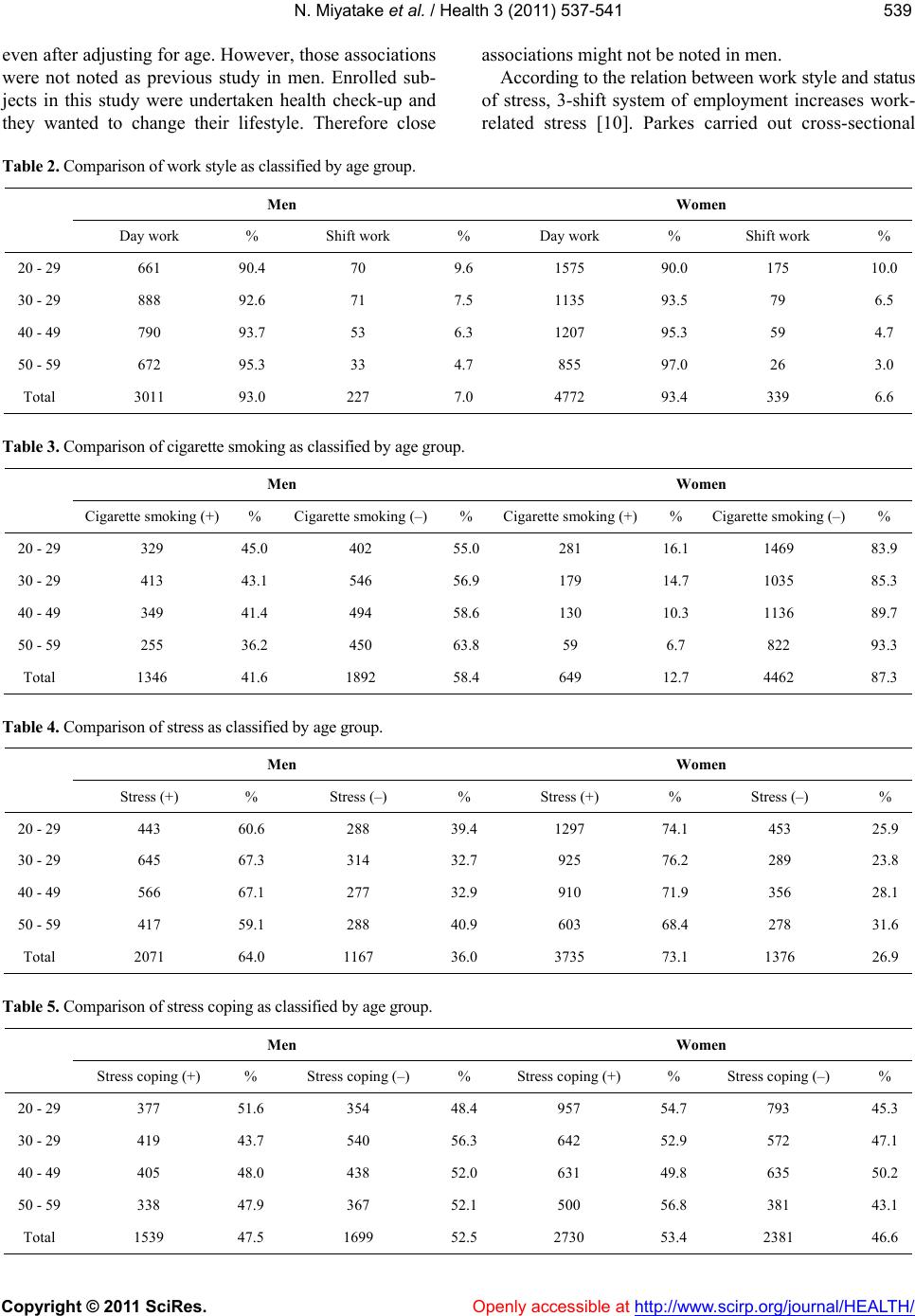 N. Miyatake et al. / Health 3 (2011) 537-541 Copyright © 2011 SciRes. http://www.scirp.org/journal/HEALTH/Openly accessible at 539539 even after adjusting for age. However, those associations were not noted as previous study in men. Enrolled sub- jects in this study were undertaken health check-up and they wanted to change their lifestyle. Therefore close associations might not be noted in men. According to the relation between work style and status of stress, 3-shift system of employment increases work- related stress [10]. Parkes carried out cross-sectional Table 2. Comparison of work style as classified by age group. Men Women Day work % Shift work % Day work % Shift work % 20 - 29 661 90.4 70 9.6 1575 90.0175 10.0 30 - 29 888 92.6 71 7.5 1135 93.579 6.5 40 - 49 790 93.7 53 6.3 1207 95.359 4.7 50 - 59 672 95.3 33 4.7 855 97.026 3.0 Total 3011 93.0 227 7.0 4772 93.4339 6.6 Table 3. Comparison of cigarette smoking as classified by age group. Men Women Cigarette smoking (+) % Cigarette smoking (–) % Cigarette smoking (+)% Cigarette smoking (–)% 20 - 29 329 45.0 402 55.0281 16.11469 83.9 30 - 29 413 43.1 546 56.9179 14.71035 85.3 40 - 49 349 41.4 494 58.6130 10.31136 89.7 50 - 59 255 36.2 450 63.859 6.7 822 93.3 Total 1346 41.6 1892 58.4649 12.74462 87.3 Table 4. Comparison of stress as classified by age group. Men Women Stress (+) % Stress (–) % Stress (+) % Stress (–) % 20 - 29 443 60.6 288 39.41297 74.1453 25.9 30 - 29 645 67.3 314 32.7925 76.2289 23.8 40 - 49 566 67.1 277 32.9910 71.9356 28.1 50 - 59 417 59.1 288 40.9603 68.4278 31.6 Total 2071 64.0 1167 36.03735 73.11376 26.9 Table 5. Comparison of stress coping as classified by age group. Men Women Stress coping (+) % Stress coping (–) % Stress coping (+) % Stress coping (–) % 20 - 29 377 51.6 354 48.4957 54.7793 45.3 30 - 29 419 43.7 540 56.3642 52.9572 47.1 40 - 49 405 48.0 438 52.0631 49.8635 50.2 50 - 59 338 47.9 367 52.1500 56.8381 43.1 Total 1539 47.5 1699 52.52730 53.42381 46.6 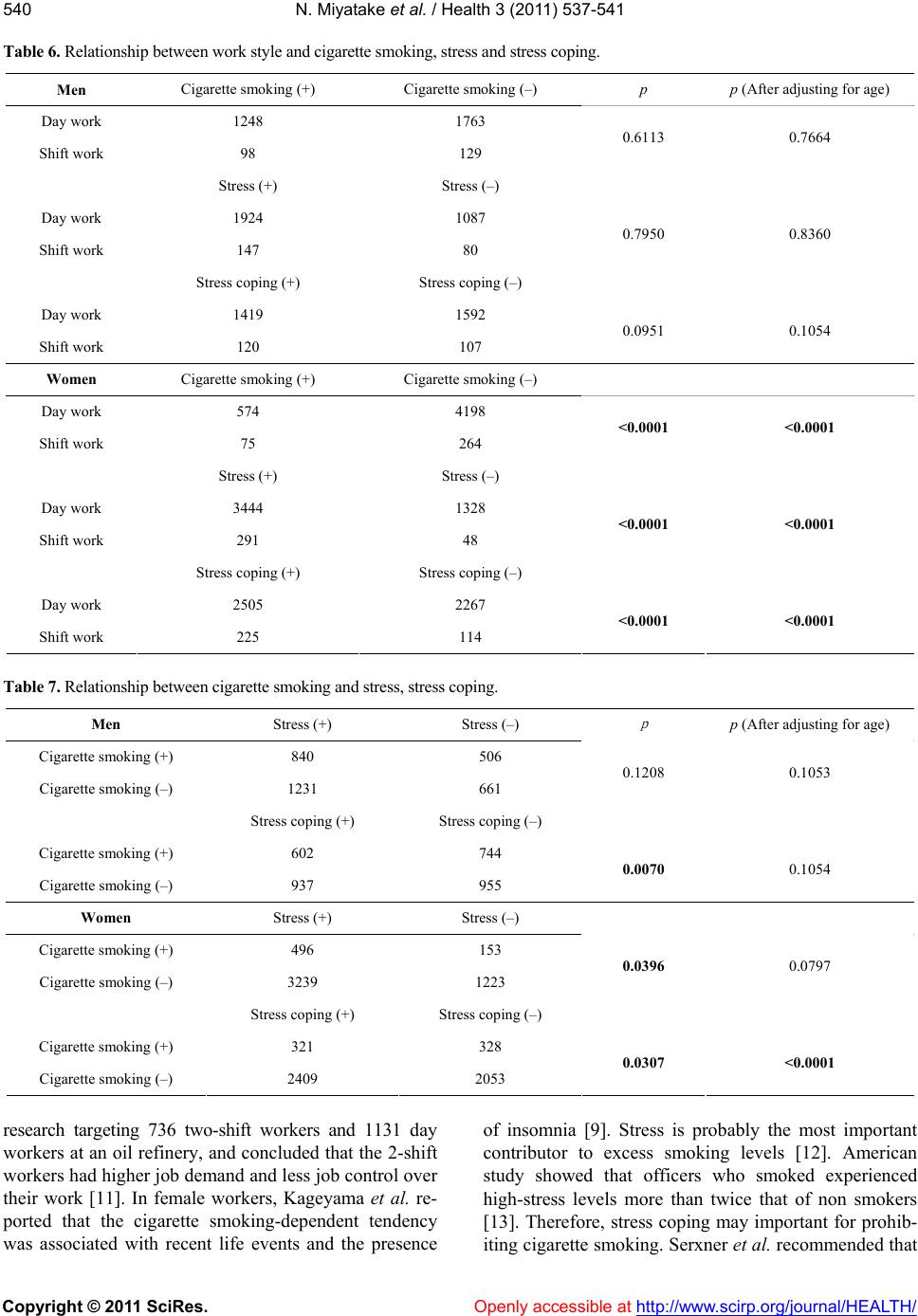 N. Miyatake et al. / Health 3 (2011) 537-541 Copyright © 2011 SciRes. Openly accessible at http://www.scirp.org/journal/HEALTH/ 540 Table 6. Relationship between work style and cigarette smoking, stress and stress coping. Men Cigarette smoking (+) Cigarette smoking (–) p p (After adjusting for age) Day work 1248 1763 Shift work 98 129 0.6113 0.7664 Stress (+) Stress (–) Day work 1924 1087 Shift work 147 80 0.7950 0.8360 Stress coping (+) Stress coping (–) Day work 1419 1592 Shift work 120 107 0.0951 0.1054 Women Cigarette smoking (+) Cigarette smoking (–) Day work 574 4198 Shift work 75 264 <0.0001 <0.0001 Stress (+) Stress (–) Day work 3444 1328 Shift work 291 48 <0.0001 <0.0001 Stress coping (+) Stress coping (–) Day work 2505 2267 Shift work 225 114 <0.0001 <0.0001 Table 7. Relationship between cigarette smoking and stress, stress coping. Men Stress (+) Stress (–) p p (After adjusting for age) Cigarette smoking (+) 840 506 Cigarette smoking (–) 1231 661 0.1208 0.1053 Stress coping (+) Stress coping (–) Cigarette smoking (+) 602 744 Cigarette smoking (–) 937 955 0.0070 0.1054 Women Stress (+) Stress (–) Cigarette smoking (+) 496 153 Cigarette smoking (–) 3239 1223 0.0396 0.0797 Stress coping (+) Stress coping (–) Cigarette smoking (+) 321 328 Cigarette smoking (–) 2409 2053 0.0307 <0.0001 research targeting 736 two-shift workers and 1131 day workers at an oil refinery, and concluded that the 2-shift workers had higher job demand and less job control over their work [11]. In female workers, Kageyama et al. re- ported that the cigarette smoking-dependent tendency was associated with recent life events and the presence of insomnia [9]. Stress is probably the most important contributor to excess smoking levels [12]. American study showed that officers who smoked experienced high-stress levels more than twice that of non smokers [13]. Therefore, stress coping may important for prohib- iting cigarette smoking. Serxner et al. recommended that  N. Miyatake et al. / Health 3 (2011) 537-541 Copyright © 2011 SciRes. Openly accessible at http://www.scirp.org/journal/HEALTH/ 541541 smoking cessation and prevention programs should fo- cus on change in individual coping mechanisms [14]. We also found that the rate of stress in shift smokers was higher than that in day workers and the rate of stress coping was also higher in shift workers than that in day workers after adjusting in women. Although the rate of stress coping was higher in shift workers than that in day workers, the rate of stress coping was significantly lo wer than in current smokers than that in non smokers in women. Taken together, it seems reasonable to suggest that simply recommending proper stress coping except cigarette smoking, might result in decreased cigarette smoking in some Japanese female workers. Potential limitations remain in this study. First, our study was a cross sectional and not a longitudinal study. Second, the 3238 Japanese male workers and 5111 women, all of whom wanted to change their lifestyle, underwent measurements for this study: they were there- fore more health-conscious than the average person. In fact, in men, clear associations were not noted the rela- tionship between shift work and cigarette smoking as previous studies [1,2,4]. Third, we could not obtain the data of the average number of cigarettes smoked per day or subject’ age when they started smoking. Subjects who smoked before the date of the analysis but who had stopped by then would have therefore been categorized as non-smokers. Fourth, status of stress and stress coping was evaluated by simple questionnaire (yes or no). Therefore, further prospective studies are needed in Jap- anese workers to prove the link between work style and cigarette smoking. 5. CONFLICT OF INTEREST There is no conflict of interest. REFERENCES [1] Fujino, Y., Iso, H., Tamakoshi, A., Ishiba, Y. , Koizumi, A ., Kubo, T. and Yoshimura, T. (2006) Japanese Collabora- tive Cohort Study Group: A prospective cohort study of shift work and risk of ischemic heart disease in Japanese male workers. American Journal of Epidemiology, 164, 128-135. doi:10.1093/aje/kwj185 [2] Dochi, M., Sakata, K., Oishi, M., Tanaka, K., Kobaya shi, E. and Suwazono, Y. (2008) Relationship between shif work and hyper cholesterolemia in Japan. Scandinavian Journal of Work, Environment & Health, 34, 33-39. [3] Dochi, M., Suwazono, Y., Sakata, K., Okubo, Y., Oishi, M., Tanaka, K., Kobayashi, E. and Nogawa, K. (2009) Shift work is a risk factor for increased total cholesterol level: A 14-year prospective cohort study in 6886 male workers. Occupational and Environmental Medicine, 66, 592-597. doi:10.1136/oem.2008.042176 [4] Suwazono, Y., Dochi, M., Sakata, K., Okubo, Y., Oishi, M., Tanaka, K., Kobayashi, E., Kido, T. and Nogawa, K. (2008) A longitudinal study on the effect of shift work on weight gain in male Japanese workers. Obesity (Silver Spring), 16, 1887-1893. doi:10.1038/oby.2008.298 [5] Suwazono, Y., Dochi, M., Sakata, K., Okubo, Y., Oishi, M., Tanaka, K., Kobayashi, E. and Nogawa, K. (2008) Shift work is a risk factor for increased blood pressure in Japanese men: A 14-year historical cohort study. Hyper- tension, 52, 581-586. doi:10.1161/HYPERTENSIONAHA.108.114553 [6] The National Nutrition Survey in Japan (2010). http://www.mhlw.go.jp/houdou/2008/12/dl/h1225-5j.pdf [7] Peto, R. (1994) Smoking and death: The past 40 years and the next 40. British Medical Journal, 209, 937-939. [8] Anonym (2005) Definition and the diagnostic standard for metabolic syndrome—Committee to Evaluate Diag- nostic Standards for Metabolic Syndrome. Nippon Naika Gakkai Zasshi, 94, 794-809. doi:10.2169/naika.94.794 [9] Kageyama, T., Kobayashi, T., Nishikido, N., Oga, J. and Kawashima, M. (2005) Associations of sleep problems and recent life events with smoking behaviors among female staff nurses in Japanese hospitals. Industrial Health, 43, 133-141. doi:10.2486/indhealth.43.133 [10] Harada, H., Suwazono, Y., Sakata, K., Okubo, Y., Oishi, M., Uetani, M., Kobayashi, E. and Nogawa, K. (2005) Three-shift system increases job-related stress in Japanese workers. Journal of Occupational Health, 47, 397-404. doi:10.1539/joh.47.397 [11] Parkes, K.R. (2003) Shift work and environment as in- teractive predictors of work perceptions. Journal of Oc- cupational Health Psychology, 8, 266-281. doi:10.1037/1076-8998.8.4.266 [12] Smith, D.R., Devine, S., Leggat, P.A. and Ishitake, T. (2005) Alcohol and tobacco consumption among police officers. Kurume Medical Journal, 52, 63-65. doi:10.2739/kurumemedj.52.63 [13] Kohan, A. and O’Connor, B.P. (2002) Police officer job satisfaction in relation to mood, well-being, and alcohol consumption. The Journal of Psychology, 136, 307-318. [14] Serxner, S., Catalano, R., Dooley, D. and Mishra, S. (1991) Tobacco use: Selection, stress, or culture? Journal of Occupational Medicine, 33, 1035-1039. |