

Paper Menu >>
Journal Menu >>
 American Journal of Anal yt ical Chemistry, 2011, 2, 533-538 doi:10.4236/ajac.2011.25063 Published Online September 2011 (http://www.SciRP.org/journal/ajac) Copyright © 2011 SciRes. AJAC A Validated Stability Indicating LC Method for Amlexanox in Bulk Drugs Bethanabhatla Syama Sundar*, Mohammed Nazeerunnisa 1Department of Chemistry, Acharya Nagarjuna University, Nagarjuna Nagar, Guntur, India E-mail: [email protected] Received March 2, 2011; revised May 10, 2011; accepted July 4, 2011 Abstract A novel and sensitive stability indicating RP-HPLC method has been developed for the quantitative deter- mination of amlexanox in bulk drugs. The separation was accomplished on C18 column using 10 mM ammo- nium dihydrogen orthophosphate (pH adjusted to 4.8 by using ortho phosphoric acid) and methanol (30:70 v/v) as mobile phase in an isocratic elution mode at a flow rate of 1.0 mL min-1. The eluents were monitored by PDA detector at 245 nm. The drug was subjected to stress conditions of hydrolysis, oxidation, photolysis and thermal degradation. Significant degradation was found under basic, acidic stress and UV light. The resolution (Rs) between amlexanox and its degradation products was found to be greater than 2.5. Regression analysis shows correlation coefficient greater than 0.999 for amlexanox. The inter and intraday precision values for amlexanox were found to be within 1.0% RSD. The method has shown good and consistent re- coveries for amlexanox in bulk drugs (98.86% - 101.05%). The developed method was validated with re- spect to linearity, accuracy, precision and robustness. Keywords: RP-HPLC, Amlexanox, Degradation, Validation, Stability indicating 1. Introduction Amlexanox is a novel anti-inflammatory and anti-aller- gic agent that has been evaluated for the treatment of recurrent aphthous ulcers (RAU) and is currently the only clinically proven product approved by the US FDA for the treatment of aphthous ulcers. The chemical name of amlexanox is 2-acid amino-7-isopropyl-5-oxo-5H- chromeno [2,3-b] pyridine-3-carboxylic acid (Figure 1). RAU is the most prevalent oral mucosal disease in hu- mans. Prior to amlexanox available treatment was largely symptomatic, with patient management being either en- tirely empiric or based on clinicians’ perception of the cause of the ulcers. Amlexanox effectively treats aphth- ous ulcers by accelerating healing of ulcer and by accel- erating complete resolution of pain. Amlexanox is com- mercially available as 5% oral paste and as biodegrad- able muco-adhesive disc. Amlexanox potently inhibits the release of histamine and leukotrienes from mast cells, basophils and neutrophils under invitro settings, possibly through increasing intracellular cyclic AMP content in inflammatory cells, a membrane-stabilizing effect or inhibition of calcium influx [1-5]. A few HPLC methods were reported in the literature for the analysis of amlexanox which includes like va lida- tion of HPLC-FL assay for the determination of amlexa- nox in human serum [6], RP-HPLC method for three distinct anti-allergic drugs to bind the proteins: Amlexa- nox, cromolyn and tranilast [7]. Study on pharmacoki- netics and demonstratio n of clinical safety for amlexanox 5% oral paste [8,9], stable viscous liquid formulations of amlexanox for the prevention and treatment of mucosal diseases and disorders [10]. Extensive literature survey reveals that there is no sta- bility-indicating LC method for determination and for the quantitative estimation of amlexanox in bulk drugs. An ideal stability indicating chromatographic method for estimation of any drug should be able to resolve from Amlexanox: O N O H 3 C H CH 3 COOH NH 2 IUPAC Name: 2- acid amino-7-isopropyl-5-oxo-5H-chromeno[2,3-b] pyridine-3-carboxylic acid Molecular Formula: C16H14N2O4 Molecular weight: 298g/mol Figure 1. Chemical Structures and labels of Amlexanox. 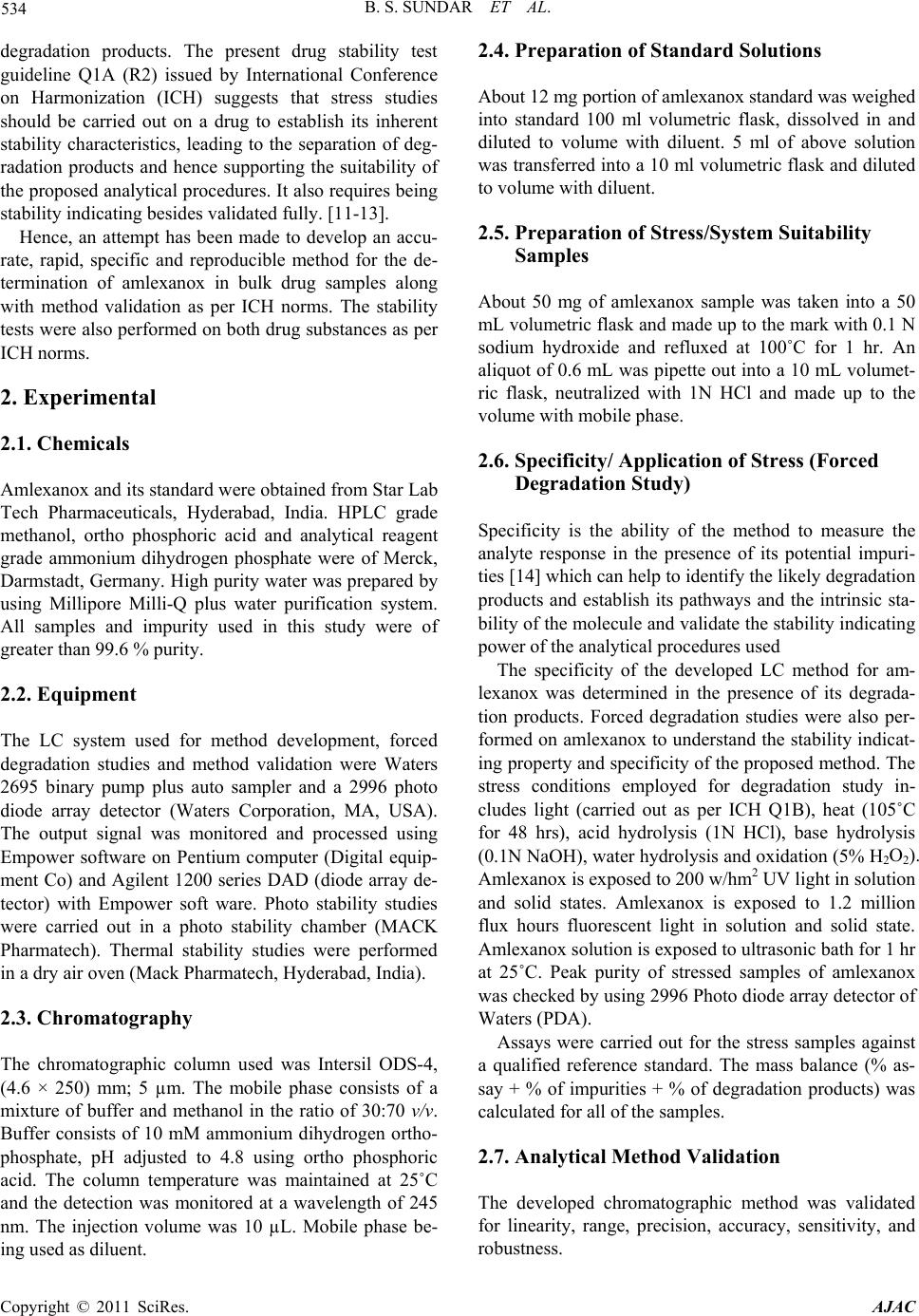 534 B. S. SUNDAR ET AL. degradation products. The present drug stability test guideline Q1A (R2) issued by International Conference on Harmonization (ICH) suggests that stress studies should be carried out on a drug to establish its inherent stability characteristics, leading to the separation of deg- radation products and hence supporting the suitability of the proposed analytical procedures. It also requires being stability indicating besides validated fully. [11-1 3]. Hence, an attempt has been made to develop an accu- rate, rapid, specific and reproducible method for the de- termination of amlexanox in bulk drug samples along with method validation as per ICH norms. The stability tests were also performed on both drug substances as per ICH norms. 2. Experimental 2.1. Chemicals Amlexanox and its standard were obtained from Star Lab Tech Pharmaceuticals, Hyderabad, India. HPLC grade methanol, ortho phosphoric acid and analytical reagent grade ammonium dihydrogen phosphate were of Merck, Darmstadt, Germany. High purity water was prepared by using Millipore Milli-Q plus water purification system. All samples and impurity used in this study were of greater than 99.6 % purity. 2.2. Equipment The LC system used for method development, forced degradation studies and method validation were Waters 2695 binary pump plus auto sampler and a 2996 photo diode array detector (Waters Corporation, MA, USA). The output signal was monitored and processed using Empower software on Pentium computer (Digital equip- ment Co) and Agilent 1200 series DAD (diode array de- tector) with Empower soft ware. Photo stability studies were carried out in a photo stability chamber (MACK Pharmatech). Thermal stability studies were performed in a dry air oven (Mack Pharmatech, Hyderabad, India). 2.3. Chromatography The chromatographic column used was Intersil ODS-4, (4.6 × 250) mm; 5 µm. The mobile phase consists of a mixture of buffer and methanol in the ratio of 30:70 v/v. Buffer consists of 10 mM ammonium dihydrogen ortho- phosphate, pH adjusted to 4.8 using ortho phosphoric acid. The column temperature was maintained at 25˚C and the detection was monitored at a wavelength of 245 nm. The injection volume was 10 µL. Mobile phase be- ing used as diluent. 2.4. Preparation of Standard Solutions About 12 mg portion of amlexanox standard was weighed into standard 100 ml volumetric flask, dissolved in and diluted to volume with diluent. 5 ml of above solution was transferred into a 10 ml volumetric flask and diluted to volume with diluent. 2.5. Preparation of Stress/System Suitability Samples About 50 mg of amlexanox sample was taken into a 50 mL volumetric flask and made up to the mark with 0.1 N sodium hydroxide and refluxed at 100˚C for 1 hr. An aliquot of 0.6 mL was pipette out into a 10 mL volumet- ric flask, neutralized with 1N HCl and made up to the volume with mobile phase. 2.6. Specificity/ Application of Stress (Forced Degradation Study) Specificity is the ability of the method to measure the analyte response in the presence of its potential impuri- ties [14] which can help to iden tify the lik ely d egradatio n products and establish its pathways and the intrinsic sta- bility of the molecule an d validate the stability ind icating power of the analytical procedures used The specificity of the developed LC method for am- lexanox was determined in the presence of its degrada- tion products. Forced degradation studies were also per- formed on amlexanox to understand th e stability indicat- ing property an d specificity of the proposed method. The stress conditions employed for degradation study in- cludes light (carried out as per ICH Q1B), heat (105˚C for 48 hrs), acid hydrolysis (1N HCl), base hydrolysis (0.1N NaOH), water hydrolysis and oxidation (5% H2O2). Amlexanox is exposed to 200 w/hm2 UV light in solution and solid states. Amlexanox is exposed to 1.2 million flux hours fluorescent light in solution and solid state. Amlexanox solution is exposed to ultrasonic bath for 1 hr at 25˚C. Peak purity of stressed samples of amlexanox was checked by using 2996 Photo diode array detector of Waters (PDA). Assays were carried out for the stress samples against a qualified reference standard. The mass balance (% as- say + % of impurities + % of degradation products) was calculated for all of the samples. 2.7. Analytical Method Validation The developed chromatographic method was validated for linearity, range, precision, accuracy, sensitivity, and robustness. Copyright © 2011 SciRes. AJAC  B. S. SUNDAR ET AL. 535 2.7.1. Precision The precision of the amlexanox method was checked by injecting six individual preparations of (60 µg mL–1) in triplicate (intraday) on the same day. The %RSD area of amlexanox was calculated. Precision study was also de- termined by performing the same procedures on three different days (inter-day precision). The intermediate precision (ruggedness) of the method was also evaluated by different experimenter, different column and different instrument in the same laboratory. Assay method precision was evaluated by carrying out six independent determinations of test sample of amlex- anox against qualified reference standard. The %RSD values of six determinations obtained were calculated. The intermediate precision of the assay method was evaluated by different experimenter and by using differ- ent instrument from the same laboratory. 2.7.2. Sensitivity Sensitivity was determined by establishing the Limit of detection (LOD) and Limit of quantitation (LOQ) for amlexanox estimated at a sign al-to-noise ratio of 3:1 and 10:1 respectively by injecting a series of dilute solutions with known concentration. The precision study was also carried out at the LOQ level by injecting six individual preparations of amlexanox and the values of %RSD cal- culated for the areas of the amlexanox. 2.7.3. Linearity and Range To establish linearity of the assay method, calibration solutions were prepared from stock solution at five con- centration levels from 80% to 120% of assay analyte concentrations (48, 54, 60, 66 and 72 µg mL–1). Linearity was checked for three consecutive days in the same con- centration range. Upper and lower levels of range were also established. 2.7.4. Accu racy The accuracy of the assay method was evaluated in trip- licate at three concentration levels, i.e. 48, 60 and 72 µg mL–1 in bulk drugs. For each concentration, three sets were prepared and injected in triplicate. The percentage of recovery was calculated at each level. 2.7.5. Robustness To determine the robustness of the developed method, experimental conditions were deliberately changed and the resolution (Rs) between amlexanox and its degradant in basic condition was evaluated. The effect of flow rate on the resolution was studied with 0.8 and 1.2 mL·min–1 while the optimized flow rate of the mobile phase was 1.0 mL·min–1. The effect of column temperature on resolution was studied at 20˚C and 30˚C instead of 25˚C. The effect of pH on resolution of impurity was studied by varying ± 0.1 pH units (i.e. buffer pH altered from 4.8 to 4.7 and 4.9). In the all above varied conditions, the components of the mobile phase were held constant. 2.7.6. Solution Stability and Mobile Phase Stability The solution stability of amlexanox in the assay method was carried out by leaving the test solutions of samples in tightly capped volumetric flasks at room temperature for 48 hrs. The same sample solutions were assayed at 0 hrs, 18 hr s, 24 hrs, 42 hrs and 48 hrs against freshly pre- pared standard solutions. The mobile phase stability was also carried out by determining the freshly prepared sample against freshly prepared reference standard solu- tions at 0 hrs, 18 hrs, 24 hrs, 42 hrs and 48 hrs. The %RSD of assay of amlexanox was calculated for the study period during mobile phase and solution stability experiments. 3. Results and Discussion 3.1. Method Development and Optimization The objective of the present work was to develop a sta- bility-indicating liquid chromatographic analytical method for the determination of amlexanox in bulk drugs. Am- lexanox standard was used during the method develop- ment. To develop a rugged and suitable LC method for the amlexanox, different mobile phases and stationary phases were employed. Preliminary trial was carried on mobile phase containing 10 mM potassium dihydrogen phosphate monohydrate, pH adjusted to 4.0 with phos- phoric acid and methanol (50:50, v/v) was chosen on a C18 stationary phase with a 25 cm length, 4.6 mm ID and 5 µ particle size and retention time found to be high and peak is not in good shape. The propo rtion of the mo- bile phase compon ents was optimized to reduce retention times and enable good resolution of amlexanox from the degradation products obtained by base degradation. When pH increased towards basic side (pH 4.8) the re- tention time and the resolution between the degradants and amlexanox was improved. To further reduce the re- tention time, the methanol proportion was increased and the observed retention time of Amlexanox was found to be about 5.9 min. Under optimized concentration of 10mM Potassium dihydrogen phosphate monohydrate, pH adjusted to 4.8 with phosphoric acid and methanol (30:70 v/v) as mobile phase, the typical retention times of degradants in basic condition an d amlexanox were found to be abou t 4.2, 4.9, 7.2 for degradants and 5.9 for amlexanox respectively (Figure 2). Copyright © 2011 SciRes. AJAC 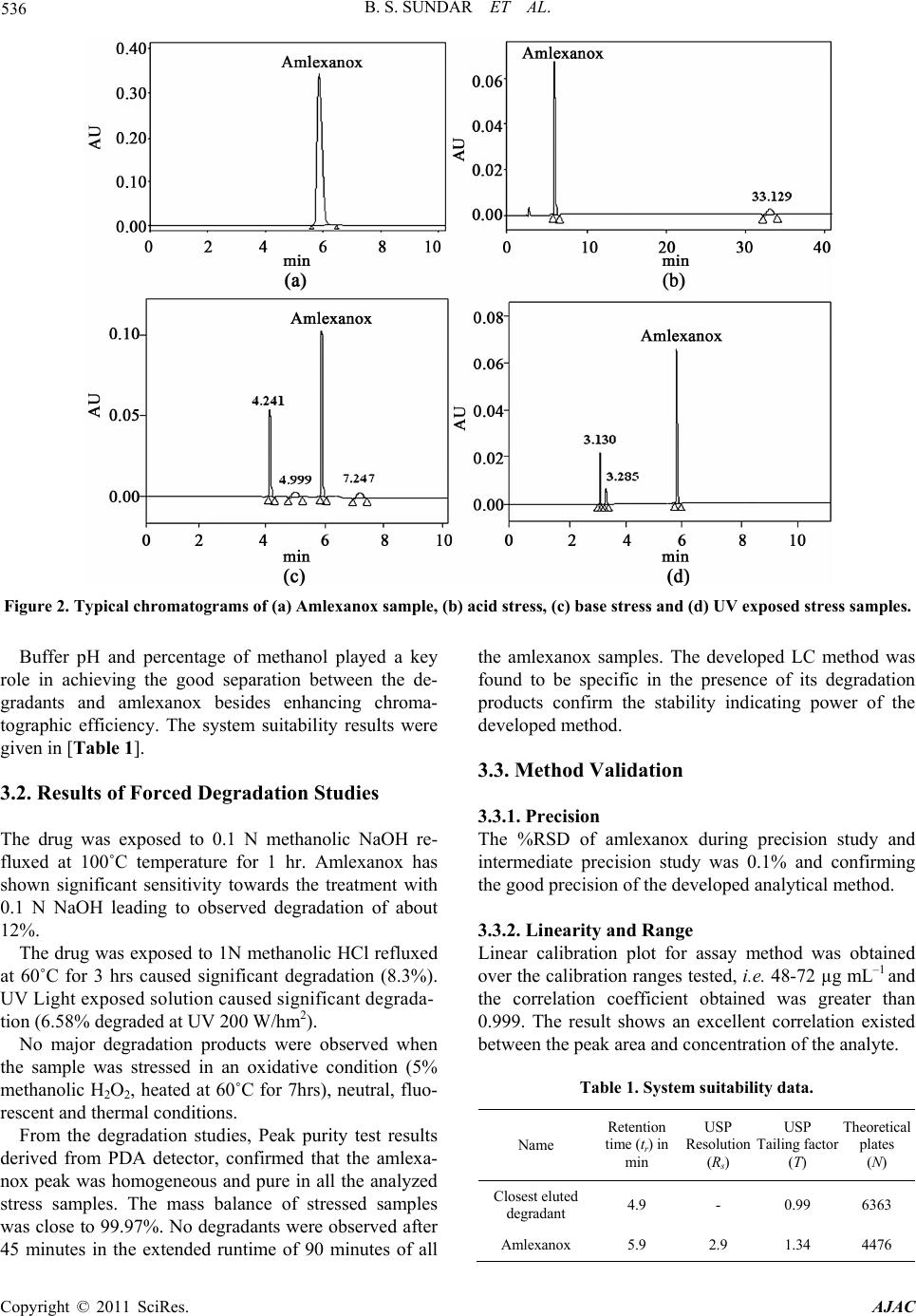 B. S. SUNDAR ET AL. Copyright © 2011 SciRes. AJAC 536 Figure 2. Typical chromatograms of (a) Amlexanox sample, (b) acid stress, (c) base stress and (d) UV e x pose d str e ss sample s. Buffer pH and percentage of methanol played a key role in achieving the good separation between the de- gradants and amlexanox besides enhancing chroma- tographic efficiency. The system suitability results were given in [Table 1]. 3.2. Results of Forced Degradation Studies The drug was exposed to 0.1 N methanolic NaOH re- fluxed at 100˚C temperature for 1 hr. Amlexanox has shown significant sensitivity towards the treatment with 0.1 N NaOH leading to observed degradation of about 12%. The drug was exposed to 1N methano lic HCl refluxed at 60˚C for 3 hrs caused significant degradation (8.3%). UV Light exposed solution caused significant degrada- tion (6.58% de graded at UV 200 W/hm2). No major degradation products were observed when the sample was stressed in an oxidative condition (5% methanolic H2O2, heated at 60˚C for 7hrs), neutral, fluo- rescent and thermal conditions. From the degradation studies, Peak purity test results derived from PDA detector, confirmed that the amlexa- nox peak was homogeneous and pure in all the analyzed stress samples. The mass balance of stressed samples was close to 99 .97%. No degradants wer e observed after 45 minutes in the extended runtime of 90 minutes of all the amlexanox samples. The developed LC method was found to be specific in the presence of its degradation products confirm the stability indicating power of the developed method. 3.3. Method Validation 3.3.1. Precision The %RSD of amlexanox during precision study and intermediate precision study was 0.1% and confirming the good precision of the developed analytical method. 3.3.2. Linearity and Range Linear calibration plot for assay method was obtained over the calibration ranges tested, i.e. 48-72 µg mL–1 and the correlation coefficient obtained was greater than 0.999. The result shows an excellent correlation existed between the peak area and concentration of the analyte. Table 1. System suitability data. Name Retention time (tr) in min USP Resolution (Rs) USP Tailing facto r (T) Theoretical plates (N) Closest eluted degradant 4.9 - 0.99 6363 Amlexanox 5.9 2.9 1.34 4476 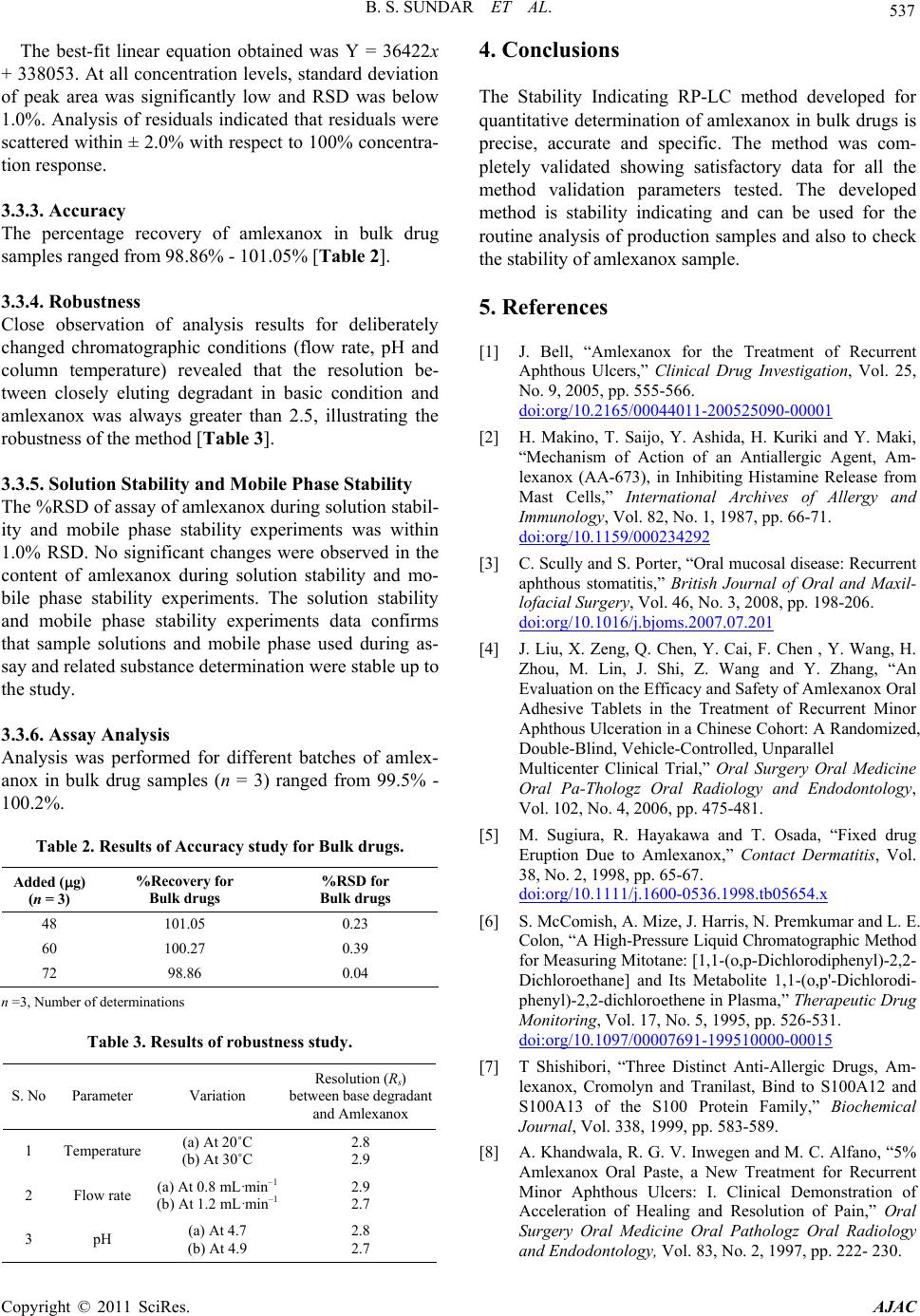 B. S. SUNDAR ET AL. 537 The best-fit linear equation obtained was Y = 36422x + 338053. At all concentration leve ls, standard deviation of peak area was significantly low and RSD was below 1.0%. Analysis of residuals indicated that residuals were scattered within ± 2.0% with respect to 100% concentra- tion response. 3.3.3. Accu racy The percentage recovery of amlexanox in bulk drug samples ranged from 98.86% - 101.05% [Table 2]. 3.3.4. Robustness Close observation of analysis results for deliberately changed chromatographic conditions (flow rate, pH and column temperature) revealed that the resolution be- tween closely eluting degradant in basic condition and amlexanox was always greater than 2.5, illustrating the robustness of the method [Table 3]. 3.3.5. Solution Stability and Mobile Phase Stability The %RSD of assay of amlexanox during solution stabil- ity and mobile phase stability experiments was within 1.0% RSD. No significant changes were observed in the content of amlexanox during solution stability and mo- bile phase stability experiments. The solution stability and mobile phase stability experiments data confirms that sample solutions and mobile phase used during as- say and related substance determination were stable up to the study. 3.3.6. Ass ay Analysis Analysis was performed for different batches of amlex- anox in bulk drug samples (n = 3) ranged from 99.5% - 100.2%. Table 2. Results of Accuracy study for Bulk drugs. Added (g) (n = 3) %Recovery for Bulk drugs %RSD for Bulk drugs 48 101.05 0.23 60 100.27 0.39 72 98.86 0.04 n =3, Number of determinations Table 3. Results of robustness study. S. No Parameter Variation Resolution (Rs) between base degradant and Amlexanox 1 Temperature (a) At 20˚C (b) At 30˚C 2.8 2.9 2 Flow rate (a) At 0.8 mL·min–1 (b) At 1.2 mL·min–1 2.9 2.7 3 pH (a) At 4.7 (b) At 4.9 2.8 2.7 4. Conclusions The Stability Indicating RP-LC method developed for quantitative determinatio n of amlexanox in bu lk drugs is precise, accurate and specific. The method was com- pletely validated showing satisfactory data for all the method validation parameters tested. The developed method is stability indicating and can be used for the routine analysis of production samples and also to check the stability of amlexanox sample. 5. References [1] J. Bell, “Amlexanox for the Treatment of Recurrent Aphthous Ulcers,” Clinical Drug Investigation, Vol. 25, No. 9, 2005, pp. 555-566. doi:org/10.2165/00044011-200525090-00001 [2] H. Makino, T. Saijo, Y. Ashida, H. Kuriki and Y. Maki, “Mechanism of Action of an Antiallergic Agent, Am- lexanox (AA-673), in Inhibiting Histamine Release from Mast Cells,” International Archives of Allergy and Immunology, Vol. 82, No. 1, 1987, pp. 66-71. doi:org/10.1159/000234292 [3] C. Scully and S. Porter, “Oral mucosal disease: Recurrent aphthous stomatitis,” British Journal of Oral and Maxil- lofacial Surgery, Vol. 46, No. 3, 2008, pp. 198-206. doi:org/10.1016/j.bjoms.2007.07.201 [4] J. Liu, X. Zeng, Q. Chen, Y. Cai, F. Chen , Y. Wang, H. Zhou, M. Lin, J. Shi, Z. Wang and Y. Zhang, “An Evaluation on the Efficacy and Safety of Amlexanox Oral Adhesive Tablets in the Treatment of Recurrent Minor Aphthous Ulceration in a Chinese Cohort: A Randomized, Double-Blind, Vehicle-Controlled, Unparallel Multicenter Clinical Trial,” Oral Surgery Oral Medicine Oral Pa-Thologz Oral Radiology and Endodontology, Vol. 102, No. 4, 2006, pp. 475-481. [5] M. Sugiura, R. Hayakawa and T. Osada, “Fixed drug Eruption Due to Amlexanox,” Contact Dermatitis, Vol. 38, No. 2, 1998, pp. 65-67. doi:org/10.1111/j.1600-0536.1998.tb05654.x [6] S. McComish, A. Mize, J. Harris, N. Pre mkumar and L. E. Colon, “A High-Pressure Liquid Chromat ographic Method for Measuring Mitotane: [1,1-(o,p-Dichlorodiphenyl)-2,2- Dichloroethane] and Its Metabolite 1,1-(o,p'-Dichlorodi- phenyl)-2,2-dichloroethene in Plasma,” Therapeutic Drug Monitoring, Vol. 17, No. 5, 1995, pp. 526-531. doi:org/10.1097/00007691-199510000-00015 [7] T Shishibori, “Three Distinct Anti-Allergic Drugs, Am- lexanox, Cromolyn and Tranilast, Bind to S100A12 and S100A13 of the S100 Protein Family,” Biochemical Journal, Vol. 338, 1999, pp. 583-589. [8] A. Khandwala, R. G. V. Inwegen and M. C. Alfano, “5% Amlexanox Oral Paste, a New Treatment for Recurrent Minor Aphthous Ulcers: I. Clinical Demonstration of Acceleration of Healing and Resolution of Pain,” Oral Surgery Oral Medicine Oral Pathologz Oral Radiology and Endodontology, Vol. 83, No. 2, 1997, pp. 222- 230. Copyright © 2011 SciRes. AJAC  B. S. SUNDAR ET AL. Copyright © 2011 SciRes. AJAC 538 [9] A. Khandwala, R. G. V. Inwegen, M. R. Charney and M. C. Alfano, “5% Amlexanox Oral Paste, a New Treatment for Recurrent Minor Aphthous Ulcers II: Pharmacokinetics and Demonstration of Clinical Safety,” Oral Surgery Oral Medicine Oral Pathologz Oral Radiology and Endodon- tology, Vol. 83, No. 2, 1997, pp. 231-238. [10] J. Jacob, “Stable Viscous Liquid Formulations of Am- lexanox for the Prevention and Treatment of Mucosal Diseases and Disorders,” US Patent App. 09/971, 2001, p. 562. [11] USP, “United States pharmacopoeia,” 32nd Edition, United States Pharmacopeial Convention, Rockville, 2008. [12] International Federation of Pharmaceutical Manufactures & Associations, “ICH Stability Testing of New Drug Substances and Products Q1A (R2),” International Con- ference on Harmonization, Geneva, 2003. [13] M. Bakshi and S. Singh, “Development of Validated Stability-Indicating Assay Methods-Critical Review,” Journal of Pharmaceutical and Biomedical Analysis, Vol. 28, No. 6, 2002, pp. 1011-1040. doi:org/10.1016/S0731-7085(02)00047-X [14] U. S. Food and Drug Administration, “ICH Guidelines on Validation of Analytical Procedures: Text and Method- ology Q2 (R1),” Federal Register, FDA, Silver Spring 2005. |