

Paper Menu >>
Journal Menu >>
 Materials Sciences and Applicatio ns, 2011, 2, 1349-1353 doi:10.4236/msa.2011.29183 Published Online September 2011 (http://www.SciRP.org/journal/msa) Copyright © 2011 SciRes. MSA 1349 Temperature Dependence of the Magnetic and Electric Properties of Ca2Fe2O5 Cléber Candido da Silva1,2*, Antonio S. B. Sombra1 1Telecommunications and Materials Science and Engineering Laboratory (LOCEM), Department of Physics, Federal University of Ceará, Campus do Pici, Fortaleza, Ceará, Brazil; 2Universidade Federal do Maranhão (UFMA), Centro de Ciências Sociais, Saúde e Tecnologia (CCSST), Departamento de Engenharia de Alimentos, Campus II, Imperatriz, MA, Brazil. Email: *[email protected].br, [email protected] Received April 6th, 2011; revised April 25th, accepted July 5th, 2011. ABSTRACT Ca2Fe2O5 powder sample, were prepared to investigate the origin of the weak ferromagnetic component reported in literature for calcium ferrite single crystals. In this work, the calcination method was used to produce nanocrystalline powders of Ca2Fe2O5. XRD measurement has shown the presence of Fe3O4 magnetite and CaO as impurity phases. The ferrimagnetic phase deeply influences the magnetic behavior with features very similar to those reported in literature for Ca2Fe2O5, both powders and single crystals. Our results support the hypothesis that the weak ferromagnetic com- ponent observed in Ca2Fe2O5 can be also due to the presence of magnetite impurity traces in the samples. The powders were submitted to calcination processes at 50 0˚C for 2 hours and 950 ˚C for 16 hours. The sintered sample was submit- ted at 1050˚C for 6 hours and characterized by X-Ray Powder diffraction (XRD), dielectric measurements, Magnetiza- tion and Scanning Electron Microscopy (SEM) analysis. Keywords: Ca2Fe2O5, Dielectric Measurements, Magnetization 1. Introduction CF (Ca2Fe2O5) is a member of the family of com- pounds with general formula A2B2O5 (A = Ca, Sr; B = Fe, Al), and it finds application in the field of catalysis, when obtained from mechano-chemical synthesis [1]. Its struc- ture is the one known for the Srebrodolskite mineral [2,3] and it is related to the perovskite (ABO3) structure by the introduction of an ordered array of oxygen vacancies and the creation of an alternate layer structure of octahedrally and tetrahedrally coordinated transition metal cations. The iron end-member CF [4,5] (mineral name srebro- dolskite) adopts space group Pnma at ambient conditions (a = 5.4, b = 14.8, c = 5.6 Ǻ). Their magnetic structures and properties have been investigated by many authors [6-12]. Physical properties of CF, such as electronic and oxygen-ionic transport [13] and catalytic [14] and photo catalytic [15] behavior, have been studied. Usage as catalyst for the combustion of volatile organic com- pounds [16,17] and for direct decomposition of NOx in exhaust streams [18,19] has been examined. Numerous entries in patent data bases also highlight a strong inter- esting brownmillerites for catalytic applications. Brown- millerite type structures exhibit two different layers, al- ternately stacked: 1) perovskite-like sheets of octahe- drally co-ordinated B cations and 2) layers of BO4 tetra- hedra, which are corner-linked to form parallel zweier single chains. Mixed occupations are observed frequently. Two phase transitions are known for the iron end-mem- ber CF: the loss of the antiferromagnetic order at the Neel temperature at 720K [7-9,20] and a structural phase transition [12,20-22] at 950K. The high-temperature phases of the end-members Ca2Fe2O5 and Ca2Al2O5 turned out to be isotypic modulated structures [6,23], with an aperiodic sequence of tetrahedral chains. These structures are described using the (3+1)-dimensional su- per space approach [24]. Their super space group is Imma(00 γ)s00. The main purpose of the work is to pre- pare CF ceramic and study the effect of the analyses of the magnetic momentum versus magnetic field (H) and dielectric comportment. X-Ray diffraction and Scanning Electron Microscopy (SEM) analysis were also done to characterize such ceramic. 2. Experimental CF crystalline powders were prepared by stoichiomet- ric quantities of CaCO3 (Aldrich 99%) and Fe2O3 (Al- 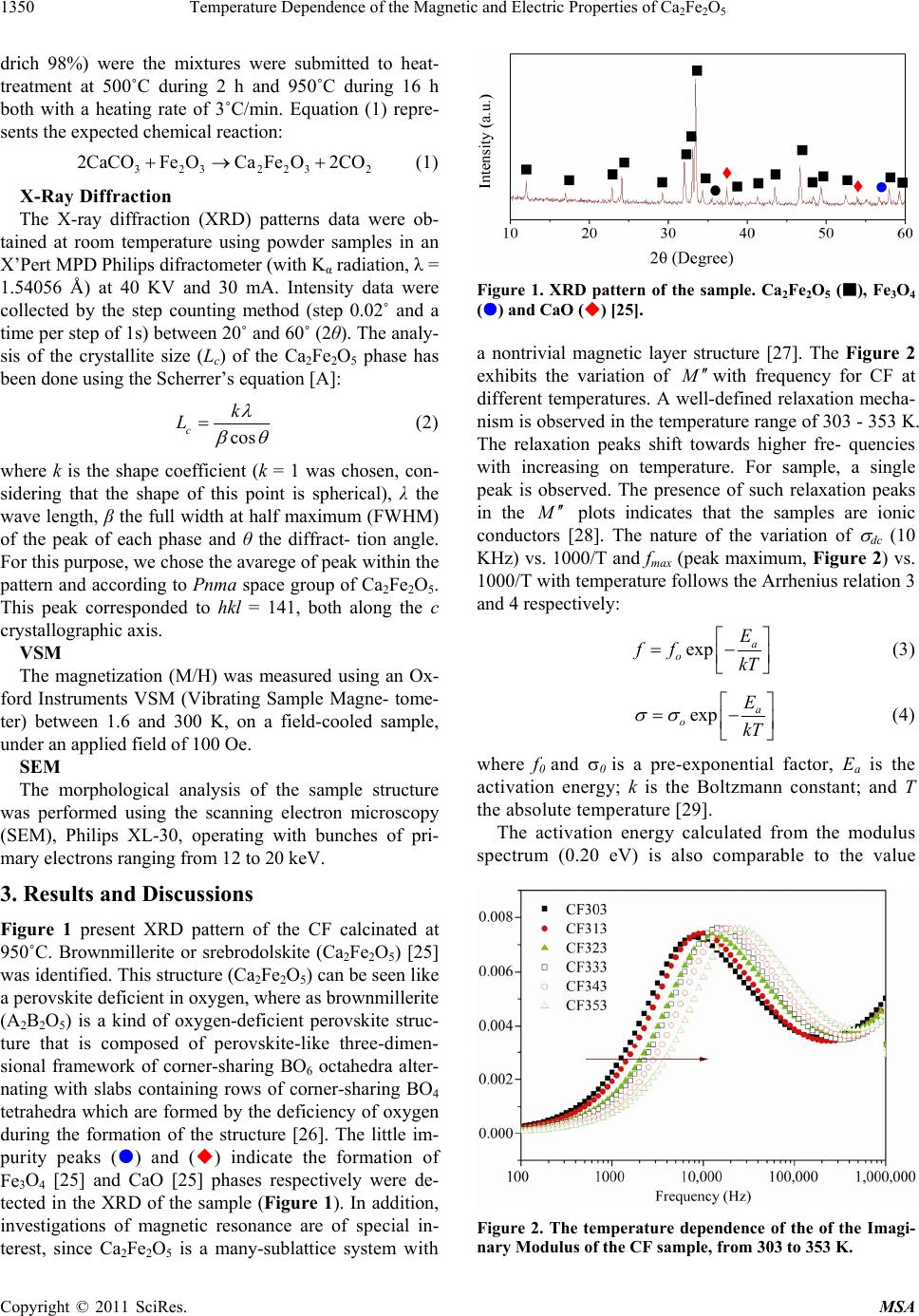 Temperature Dependence of the Magnetic and Electric Properties of CaFe O 1350 22 5 2 drich 98%) were the mixtures were submitted to heat- treatment at 500˚C during 2 h and 950˚C during 16 h both with a heating rate of 3˚C/min. Equation (1) repre- sents the expected chemical reaction: 323 223 2CaCOFeO CaFeO2CO (1) X-Ray Diffraction The X-ray diffraction (XRD) patterns data were ob- tained at room temperature using powder samples in an X’Pert MPD Philips difractometer (with Kα radiation, λ = 1.54056 Å) at 40 KV and 30 mA. Intensity data were collected by the step counting method (step 0.02˚ and a time per step of 1s) between 20˚ and 60˚ (2θ). The analy- sis of the crystallite size (Lc) of the Ca2Fe2O5 phase has been done using the Scherrer’s equation [A]: cos c k L (2) where k is the shape coefficient (k = 1 was chosen, con- sidering that the shape of this point is spherical), λ the wave length, β the full width at half maximum (FWHM) of the peak of each phase and θ the diffract- tion angle. For this purpose, we chose the avarege of peak within the pattern and according to Pnma space group of Ca2Fe2O5. This peak corresponded to hkl = 141, both along the c crystallographic axis. VSM The magnetization (M/H) was measured using an Ox- ford Instruments VSM (Vibrating Sample Magne- tome- ter) between 1.6 and 300 K, on a field-cooled sample, under an applied field of 100 Oe. SEM The morphological analysis of the sample structure was performed using the scanning electron microscopy (SEM), Philips XL-30, operating with bunches of pri- mary electrons ranging from 12 to 20 keV. 3. Results and Discussions Figure 1 present XRD pattern of the CF calcinated at 950˚C. Brownmillerite or srebrodolskite (Ca2Fe2O5) [25] was identified. This structure (Ca2Fe2O5) can be seen like a perovskite deficient in oxygen, where as brownmillerite (A2B2O5) is a kind of oxygen-deficient perovskite struc- ture that is composed of perovskite-like three-dimen- sional framework of corner-sharing BO6 octahedra alter- nating with slabs containing rows of corner-sharing BO4 tetrahedra which are formed by the deficiency of oxygen during the formation of the structure [26]. The little im- purity peaks () and () indicate the formation of Fe3O4 [25] and CaO [25] phases respectively were de- tected in the XRD of the sample (Figure 1). In addition, investigations of magnetic resonance are of special in- terest, since Ca2Fe2O5 is a many-sublattice system with Figure 1. XRD pattern of the sample. Ca2Fe2O5 (), Fe3O4 () and CaO () [25]. a nontrivial magnetic layer structure [27]. The Figure 2 exhibits the variation of M with frequency for CF at different temperatures. A well-defined relaxation mecha- nism is observed in the temperature range of 303 - 353 K. The relaxation peaks shift towards higher fre- quencies with increasing on temperature. For sample, a single peak is observed. The presence of such relaxation peaks in the M plots indicates that the samples are ionic conductors [28]. The nature of the variation of dc (10 KHz) vs. 1000/T and fmax (peak maximum, Figure 2) vs. 1000/T with temperature follows the Arrhenius relation 3 and 4 respectively: exp a o E ff kT (3) exp a o E kT (4) where f0 and 0 is a pre-exponential factor, Ea is the activation energy; k is the Boltzmann constant; and T the absolute temperature [29]. The activation energy calculated from the modulus spectrum (0.20 eV) is also comparable to the value Figure 2. The temperature dependence of the of the Imagi- nary Modulus of the CF sample, from 303 to 353 K. Copyright © 2011 SciRes. MSA 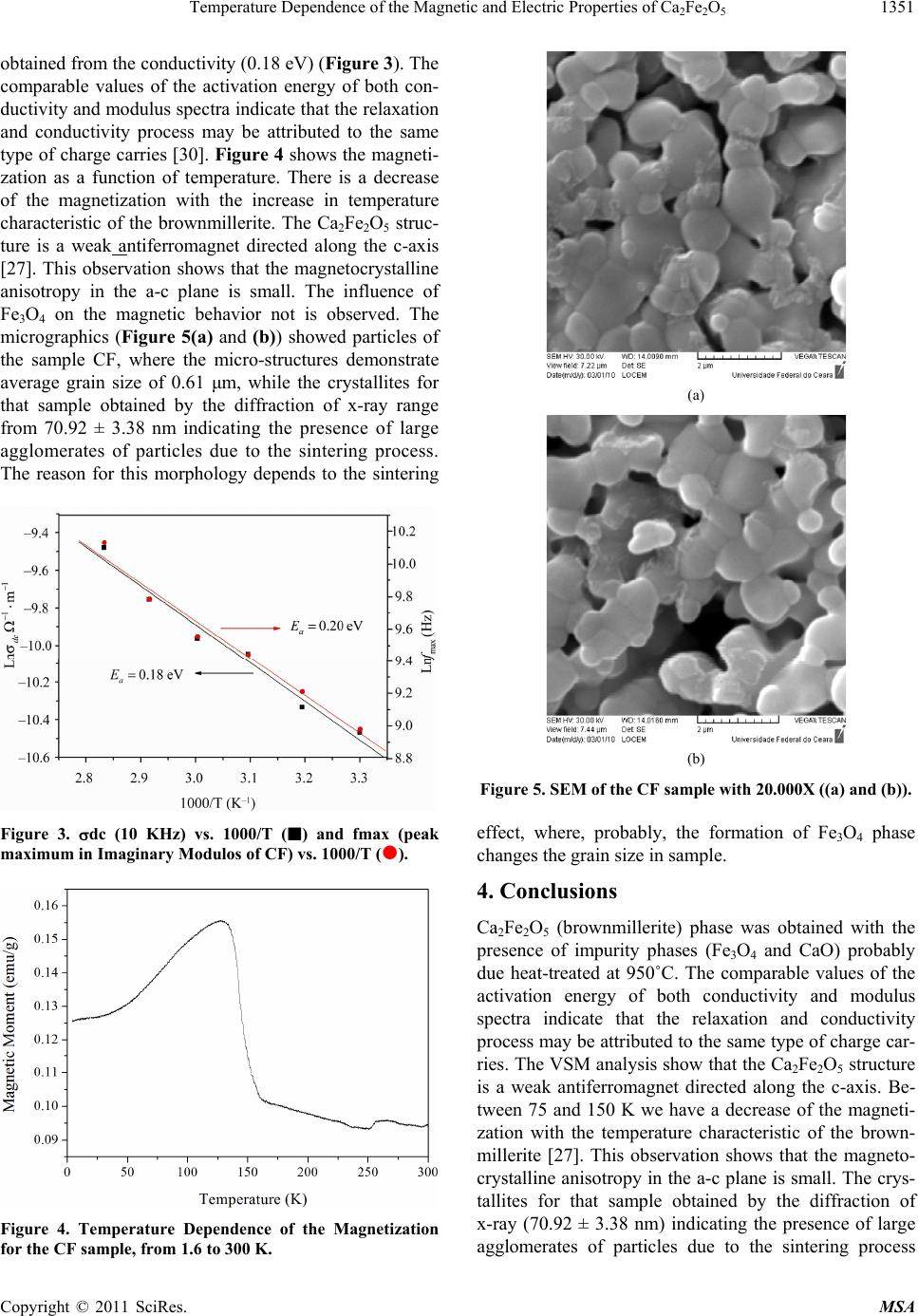 Temperature Dependence of the Magnetic and Electric Properties of CaFe O1351 22 5 obtained from the conductivity (0.18 eV) (Figure 3). The comparable values of the activation energy of both con- ductivity and modulus spectra indicate that the relaxation and conductivity process may be attributed to the same type of charge carries [30]. Figure 4 shows the magneti- zation as a function of temperature. There is a decrease of the magnetization with the increase in temperature characteristic of the brownmillerite. The Ca2Fe2O5 struc- ture is a weak antiferromagnet directed along the c-axis [27]. This observation shows that the magnetocrystalline anisotropy in the a-c plane is small. The influence of Fe3O4 on the magnetic behavior not is observed. The micrographics (Figure 5(a) and (b)) showed particles of the sample CF, where the micro-structures demonstrate average grain size of 0.61 μm, while the crystallites for that sample obtained by the diffraction of x-ray range from 70.92 ± 3.38 nm indicating the presence of large agglomerates of particles due to the sintering process. The reason for this morphology depends to the sintering Figure 3. dc (10 KHz) vs. 1000/T () and fmax (peak maximum in Imaginary Modulos of CF) vs. 1000/T (). Figure 4. Temperature Dependence of the Magnetization for the CF sample, from 1.6 to 300 K. (a) (b) Figure 5. SEM of the CF sample with 20.000X ((a) and (b)). effect, where, probably, the formation of Fe3O4 phase changes the grain size in sample. 4. Conclusions Ca2Fe2O5 (brownmillerite) phase was obtained with the presence of impurity phases (Fe3O4 and CaO) probably due heat-treated at 950˚C. The comparable values of the activation energy of both conductivity and modulus spectra indicate that the relaxation and conductivity process may be attributed to the same type of charge car- ries. The VSM analysis show that the Ca2Fe2O5 structure is a weak antiferromagnet directed along the c-axis. Be- tween 75 and 150 K we have a decrease of the magneti- zation with the temperature characteristic of the brown- millerite [27]. This observation shows that the magneto- crystalline anisotropy in the a-c plane is small. The crys- tallites for that sample obtained by the diffraction of x-ray (70.92 ± 3.38 nm) indicating the presence of large agglomerates of particles due to the sintering process Copyright © 2011 SciRes. MSA 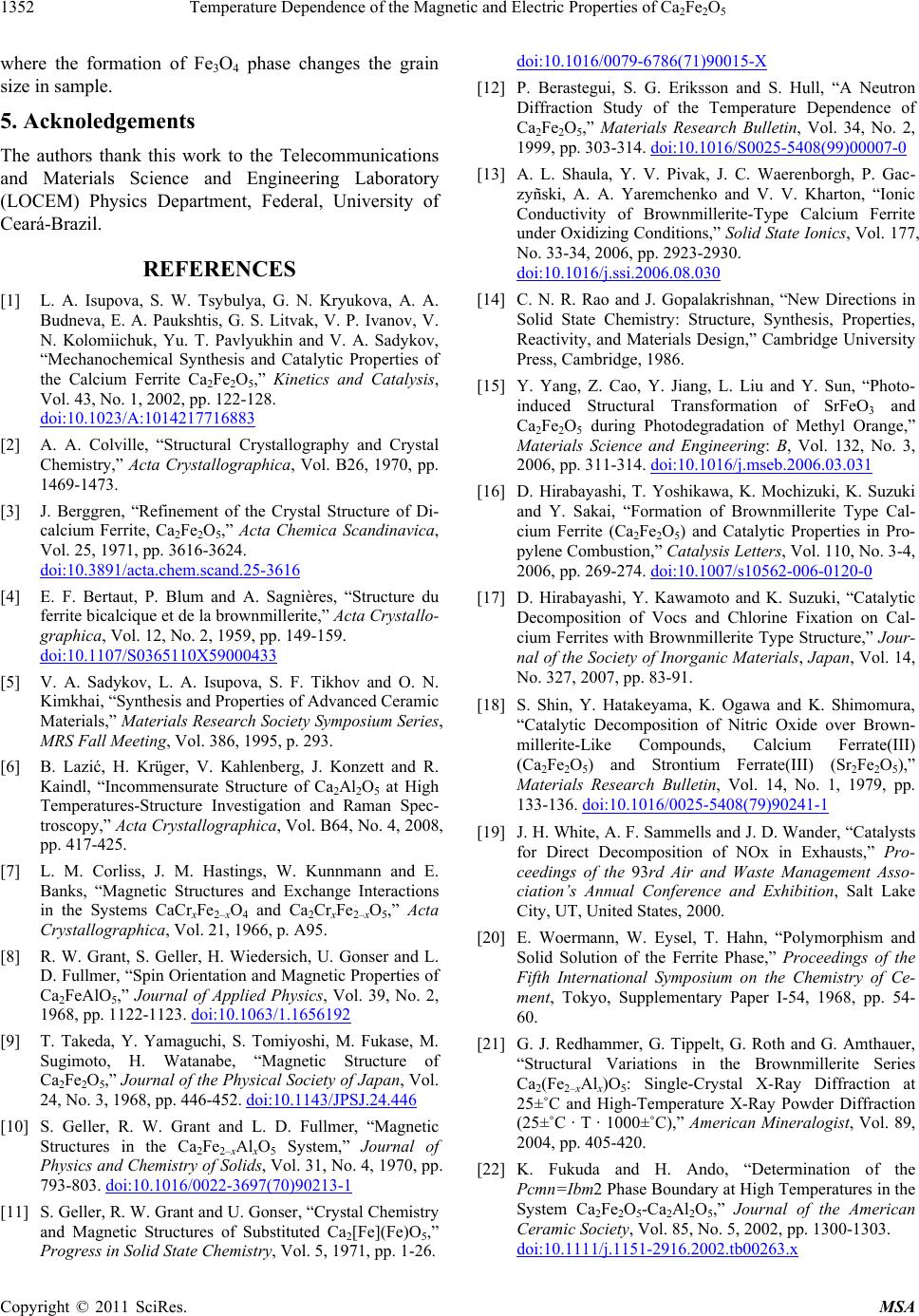 Temperature Dependence of the Magnetic and Electric Properties of CaFe O 1352 22 5 where the formation of Fe3O4 phase changes the grain size in sample. 5. Acknoledgements The authors thank this work to the Telecommunications and Materials Science and Engineering Laboratory (LOCEM) Physics Department, Federal, University of Ceará-Brazil. REFERENCES [1] L. A. Isupova, S. W. Tsybulya, G. N. Kryukova, A. A. Budneva, E. A. Paukshtis, G. S. Litvak, V. P. Ivanov, V. N. Kolomiichuk, Yu. T. Pavlyukhin and V. A. Sadykov, “Mechanochemical Synthesis and Catalytic Properties of the Calcium Ferrite Ca2Fe2O5,” Kinetics and Catalysis, Vol. 43, No. 1, 2002, pp. 122-128. doi:10.1023/A:1014217716883 [2] A. A. Colville, “Structural Crystallography and Crystal Chemistry,” Acta Crystallographica, Vol. B26, 1970, pp. 1469-1473. [3] J. Berggren, “Refinement of the Crystal Structure of Di- calcium Ferrite, Ca2Fe2O5,” Acta Chemica Scandinavica, Vol. 25, 1971, pp. 3616-3624. doi:10.3891/acta.chem.scand.25-3616 [4] E. F. Bertaut, P. Blum and A. Sagnières, “Structure du ferrite bicalcique et de la brownmillerite,” Acta Crystallo- graphica, Vol. 12, No. 2, 1959, pp. 149-159. doi:10.1107/S0365110X59000433 [5] V. A. Sadykov, L. A. Isupova, S. F. Tikhov and O. N. Kimkhai, “Synthesis and Properties of Advanced Ceramic Materials,” Materials Research Society Symposium Series, MRS Fall Meeting, Vol. 386, 1995, p. 293. [6] B. Lazić, H. Krüger, V. Kahlenberg, J. Konzett and R. Kaindl, “Incommensurate Structure of Ca2Al2O5 at High Temperatures-Structure Investigation and Raman Spec- troscopy,” Acta Crystallographica, Vol. B64, No. 4, 2008, pp. 417-425. [7] L. M. Corliss, J. M. Hastings, W. Kunnmann and E. Banks, “Magnetic Structures and Exchange Interactions in the Systems CaCrxFe2–xO4 and Ca2CrxFe2–xO5,” Acta Crystallographica, Vol. 21, 1966, p. A95. [8] R. W. Grant, S. Geller, H. Wiedersich, U. Gonser and L. D. Fullmer, “Spin Orientation and Magnetic Properties of Ca2FeAlO5,” Journal of Applied Physics, Vol. 39, No. 2, 1968, pp. 1122-1123. doi:10.1063/1.1656192 [9] T. Takeda, Y. Yamaguchi, S. Tomiyoshi, M. Fukase, M. Sugimoto, H. Watanabe, “Magnetic Structure of Ca2Fe2O5,” Journal of the Physical Society of Japan, Vol. 24, No. 3, 1968, pp. 446-452. doi:10.1143/JPSJ.24.446 [10] S. Geller, R. W. Grant and L. D. Fullmer, “Magnetic Structures in the Ca2Fe2–xAlxO5 System,” Journal of Physics and Chemistry of Solids, Vol. 31, No. 4, 1970, pp. 793-803. doi:10.1016/0022-3697(70)90213-1 [11] S. Geller, R. W. Grant and U. Gonser, “Crystal Chemistry and Magnetic Structures of Substituted Ca2[Fe](Fe)O5,” Progress in Solid State Chemistry, Vol. 5, 1971, pp. 1-26. doi:10.1016/0079-6786(71)90015-X [12] P. Berastegui, S. G. Eriksson and S. Hull, “A Neutron Diffraction Study of the Temperature Dependence of Ca2Fe2O5,” Materials Research Bulletin, Vol. 34, No. 2, 1999, pp. 303-314. doi:10.1016/S0025-5408(99)00007-0 [13] A. L. Shaula, Y. V. Pivak, J. C. Waerenborgh, P. Gac- zyñski, A. A. Yaremchenko and V. V. Kharton, “Ionic Conductivity of Brownmillerite-Type Calcium Ferrite under Oxidizing Conditions,” Solid State Ionics, Vol. 177, No. 33-34, 2006, pp. 2923-2930. doi:10.1016/j.ssi.2006.08.030 [14] C. N. R. Rao and J. Gopalakrishnan, “New Directions in Solid State Chemistry: Structure, Synthesis, Properties, Reactivity, and Materials Design,” Cambridge University Press, Cambridge, 1986. [15] Y. Yang, Z. Cao, Y. Jiang, L. Liu and Y. Sun, “Photo- induced Structural Transformation of SrFeO3 and Ca2Fe2O5 during Photodegradation of Methyl Orange,” Materials Science and Engineering: B, Vol. 132, No. 3, 2006, pp. 311-314. doi:10.1016/j.mseb.2006.03.031 [16] D. Hirabayashi, T. Yoshikawa, K. Mochizuki, K. Suzuki and Y. Sakai, “Formation of Brownmillerite Type Cal- cium Ferrite (Ca2Fe2O5) and Catalytic Properties in Pro- pylene Combustion,” Catalysis Letters, Vol. 110, No. 3-4, 2006, pp. 269-274. doi:10.1007/s10562-006-0120-0 [17] D. Hirabayashi, Y. Kawamoto and K. Suzuki, “Catalytic Decomposition of Vocs and Chlorine Fixation on Cal- cium Ferrites with Brownmillerite Type Structure,” Jour- nal of the Society of Inorganic Materials, Japan, Vol. 14, No. 327, 2007, pp. 83-91. [18] S. Shin, Y. Hatakeyama, K. Ogawa and K. Shimomura, “Catalytic Decomposition of Nitric Oxide over Brown- millerite-Like Compounds, Calcium Ferrate(III) (Ca2Fe2O5) and Strontium Ferrate(III) (Sr2Fe2O5),” Materials Research Bulletin, Vol. 14, No. 1, 1979, pp. 133-136. doi:10.1016/0025-5408(79)90241-1 [19] J. H. White, A. F. Sammells and J. D. Wander, “Catalysts for Direct Decomposition of NOx in Exhausts,” Pro- ceedings of the 93rd Air and Waste Management Asso- ciation’s Annual Conference and Exhibition, Salt Lake City, UT, United States, 2000. [20] E. Woermann, W. Eysel, T. Hahn, “Polymorphism and Solid Solution of the Ferrite Phase,” Proceedings of the Fifth International Symposium on the Chemistry of Ce- ment, Tokyo, Supplementary Paper I-54, 1968, pp. 54- 60. [21] G. J. Redhammer, G. Tippelt, G. Roth and G. Amthauer, “Structural Variations in the Brownmillerite Series Ca2(Fe2–xAlx)O5: Single-Crystal X-Ray Diffraction at 25±˚C and High-Temperature X-Ray Powder Diffraction (25±˚C · T · 1000±˚C),” American Mineralogist, Vol. 89, 2004, pp. 405-420. [22] K. Fukuda and H. Ando, “Determination of the Pcmn=Ibm2 Phase Boundary at High Temperatures in the System Ca2Fe2O5-Ca2Al2O5,” Journal of the American Ceramic Society, Vol. 85, No. 5, 2002, pp. 1300-1303. doi:10.1111/j.1151-2916.2002.tb00263.x Copyright © 2011 SciRes. MSA  Temperature Dependence of the Magnetic and Electric Properties of Ca2Fe2O5 Copyright © 2011 SciRes. MSA 1353 [23] H. Krüger and V. Kahlenberg, “Incommensurately Modulated Ordering of Tetrahedral Chains in Ca2Fe2O5 at Elevated Temperatures,” Acta Crystallographica Section B, Vol. 61, No. 6, 2005, pp. 656-662. [24] T. Janssen, A. Janner, A. Looijenga-Vos and P. M. de Wolff, “Mathematical, Physical and Chemical Tables, In- commensurate and Commensurate Modulated Struc- tures,” Kluwer Academic Publishers, Dordrecht, 2004. [25] JCPDS—Pattern 38-0408 (Ca2Fe2O5), 03-0863 (Fe3O4) and 82-1690 (CaO). [26] I. G. Minyaylova, I. A. Presnyakov, K. V. Pokholok, A. V. Sobolev, A. V. Baranov, G. Demazeau, G. A. Govor and A. K. Vetcher, “Hyperfine Interactions and Dynamic Characteristics of 119Sn Dopant Atoms in Ca2Fe2O5,” Journal of Solid State Chemistry, Vol. 151, No. 2, 2000, pp. 313-316. doi:10.1006/jssc.2000.8660 [27] C. Brotzeller, R. Geick and P. Marchukov, “Magnetic Excitations in Dicalcium Ferrite,” Solid State Communi- cations, Vol. 82, No. 11, 1992, pp. 923-925. doi:10.1016/0038-1098(92)90721-K [28] B. Yang, J. Zhou, Z. Gui, Z. Yue and L. Li, “Preparation and Magnetic Characterization of Y-Type Hexaferrites Containing Zinc, Cobalt and Copper,” Materials Science and Engineering B, Vol. 99, No. 1-3, 2003, pp. 266-269. doi:10.1016/S0921-5107(02)00545-7 [29] K. P. Padmasree, D. K. Kanchan, A. R. Kulkami, “Im- pedance and Modulus Studies of the Solid Electrolyte System 20CdI2-80[xAg2O-y(0.7V2O5-0.3B2O3)], Where 1 ≤ x/y ≤ 3,” Solid State Ionics, Vol. 177, No. 5-6, 2006, pp. 475-482 [30] S. K. Barik, P. K. Mahapatra, R. N. P. Ghoudhary, “Structural and Electrical Properties of Na1/2La1/2TiO3 Ceramics,” Applied Physics A: Materials Science & Processing, Vol. 85, 2006, pp. 199-203. |