

Paper Menu >>
Journal Menu >>
 Materials Sciences and Applicatio ns, 2011, 2, 1279-1284 doi:10.4236/msa.2011.29172 Published Online September 2011 (http://www.SciRP.org/journal/msa) Copyright © 2011 SciRes. MSA 1279 Discontinuous Precipitation in Al-8% Mass.Mg Alloy under the Effect of Temperature Said Bensaada, Mohamed Tewfik Bouziane, Ferhat Mohammedi Laboratoire Larhyss, Université Mohamed Khider BP Biskra, Biskra, Algeria. Email: [email protected] Received February 4th, 2011; revised April 20th, 2011; accepted June 23rd, 2011. ABSTRACT The precipitation in the alloy Al-Mg system has been the subject of many theoritical and experimental investigations that have contributed to the understanding of the different mechanisms which control them. The purpose of this work is to clarify the effect of temperature on the mechanisms of these during ageing of Al-8% mass.Mg alloy. The techniques of analysis used in this respect are the optical microscopy, the X-ray diffraction and the micro hardness Vickers. Keywords: Alloy Al-Mg, Precipitation, Temperature 1. Introduction The transformations of the most significant phases are those which appear in the supersaturated solid solutions representing only one phase α0 in equilibrium and of which the steady state corresponds to two phases. One α depleted in alloy components and of the same structure of the initial phase α0 and other phase precipitate β rich in alloy components and of different structure. This trans- formation is indicated by the term of precipitation and corresponds to the reaction [1]: 0 The processes of precipitation which are gouverned by diffusion phenomenon are generally classified in two principal categories: —The continues precipitation (or nucleation) is homo- geneous and completely appears randomely in the whole alloy. One of the principal characteristics of this reaction is the continues variation of the lattice parameter of the initial phase α0 and of the concentration of the solute content. —And the discontinuous precipitation where nuclea- tion is heterogeneous leading to the presence of two dis- tinct regions. One is transformed into alternate lamellar form ( ) behind a mobile grain boundary and the other not. They takes place initially and preferably on heterogeneities of the matrix phase α0 which they can be dislocations, surfaces of impurities or grain boundaries. Its characteristic during ageing is the discontinuous variation of the lattice parameter of the matrix phase [2]. Precipitation in the Alloy Al-Mg System Precipitation in this alloys system is characterized by intermediate states exibits to the metastable phases ac- cording to this scheme [3-10]. 0G.P Zones The stage of pre-precipitation in this system of alloy leads to the formation of G.P zones (small domain rich on solute content). Different technique were used for the description of G.P zones in this alloy system, such as the diffraction of X-rays with high angles used by Dauger and all [11] in alloy Al-12% mass.Mg. The measure- ments of the resistivity carried out in alloy Al-10% mass.Mg and which show an increase in the resistivity during ageing [12-14] and an electron microscopy is used on the same alloy [15]. Some authors [16,17] assume that the formation of G.P zones at room temperature is only for magnesium rates beyond 10% in atoms, whereas others estimate that this critical rate is about 5% in magnesium atoms [18, 19]. An increase in the temperature of ageing around 100˚C [20] led to the dissolution of G.P zones and the parti- cles . Thus allowing also the formation of intermedi- ate phase , metastable, semi-coherent and with a com- position of Al3 Mg2 of hexagonal structure. The precipi- tates are formed by nucleation and growth on the structural defects of the matrix. Their growth leads to a total loss of coherence by arrangement of the dislocations to the interface and consequently to the formation of the stable phase β of the same composition than the 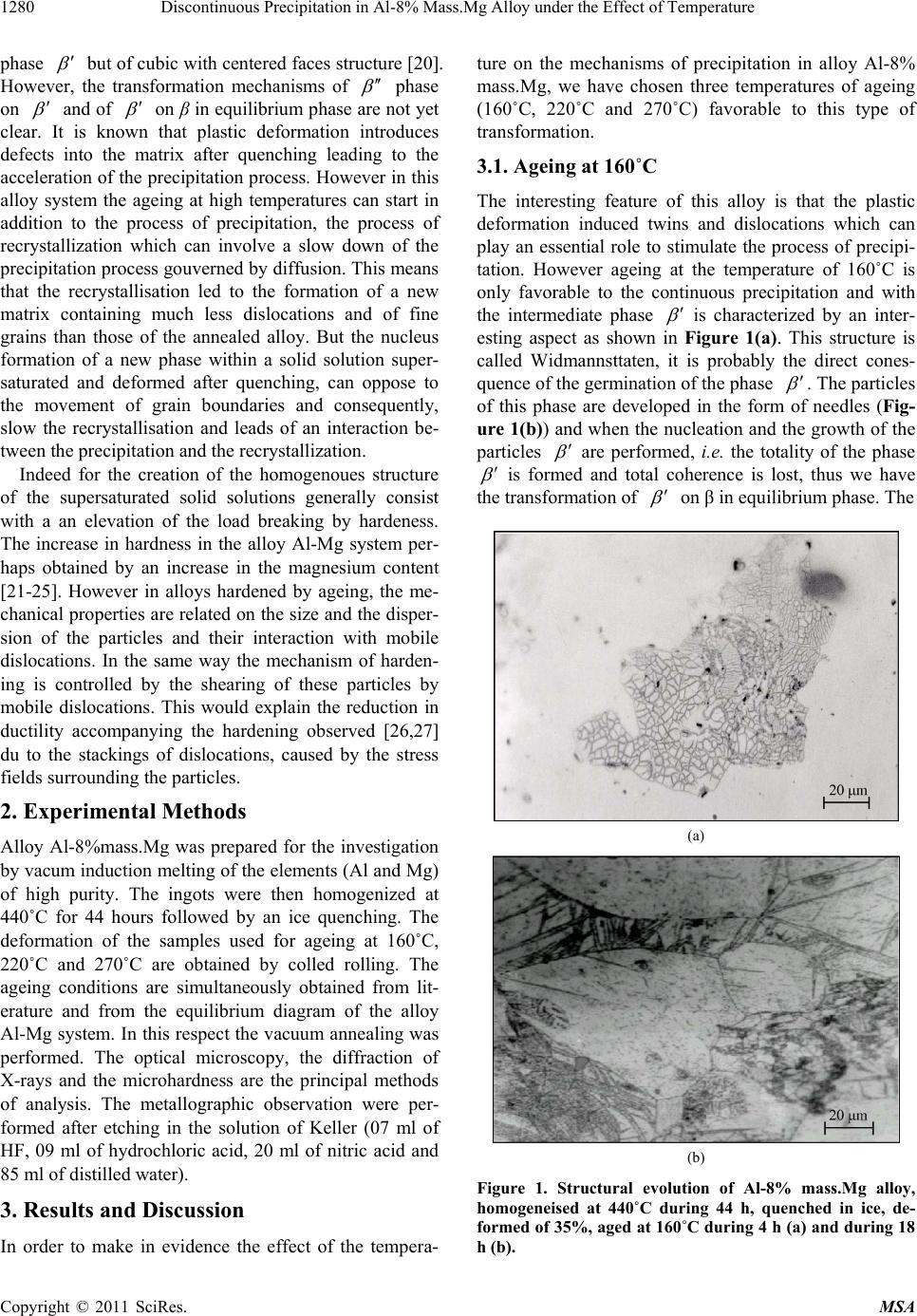 Discontinuous Precipitation in Al-8% Mass.Mg Alloy under the Effect of Temperature 1280 phase but of cubic with centered faces structure [20]. However, the transformation mechanisms of phase on and of on β in equilibrium phase are not yet clear. It is known that plastic deformation introduces defects into the matrix after quenching leading to the acceleration of the precipitation process. However in this alloy system the ageing at high temperatures can start in addition to the process of precipitation, the process of recrystallization which can involve a slow down of the precipitation process gouverned by diffusion. This means that the recrystallisation led to the formation of a new matrix containing much less dislocations and of fine grains than those of the annealed alloy. But the nucleus formation of a new phase within a solid solution super- saturated and deformed after quenching, can oppose to the movement of grain boundaries and consequently, slow the recrystallisation and leads of an interaction be- tween the precipitation and the recrystallization. Indeed for the creation of the homogenoues structure of the supersaturated solid solutions generally consist with a an elevation of the load breaking by hardeness. The increase in hardness in the alloy Al-Mg system per- haps obtained by an increase in the magnesium content [21-25]. However in alloys hardened by ageing, the me- chanical properties are related on the size and the disper- sion of the particles and their interaction with mobile dislocations. In the same way the mechanism of harden- ing is controlled by the shearing of these particles by mobile dislocations. This would explain the reduction in ductility accompanying the hardening observed [26,27] du to the stackings of dislocations, caused by the stress fields surrounding the particles. 2. Experimental Methods Alloy Al-8%mass.Mg was prepared for the investigation by vacum induction melting of the elements (Al and Mg) of high purity. The ingots were then homogenized at 440˚C for 44 hours followed by an ice quenching. The deformation of the samples used for ageing at 160˚C, 220˚C and 270˚C are obtained by colled rolling. The ageing conditions are simultaneously obtained from lit- erature and from the equilibrium diagram of the alloy Al-Mg system. In this respect the vacuum annealing was performed. The optical microscopy, the diffraction of X-rays and the microhardness are the principal methods of analysis. The metallographic observation were per- formed after etching in the solution of Keller (07 ml of HF, 09 ml of hydrochloric acid, 20 ml of nitric acid and 85 ml of distilled water). 3. Results and Discussion In order to make in evidence the effect of the tempera- ture on the mechanisms of precipitation in alloy Al-8% mass.Mg, we have chosen three temperatures of ageing (160˚C, 220˚C and 270˚C) favorable to this type of transformation. 3.1. Ageing at 160˚C The interesting feature of this alloy is that the plastic deformation induced twins and dislocations which can play an essential role to stimulate the process of precipi- tation. However ageing at the temperature of 160˚C is only favorable to the continuous precipitation and with the intermediate phase is characterized by an inter- esting aspect as shown in Figure 1(a). This structure is called Widmannsttaten, it is probably the direct cones- quence of the germination of the phase . The particles of this phase are developed in the form of needles (Fig- ure 1(b)) and when the nucleation and the growth of the particles are performed, i.e. the totality of the phase is formed and total coherence is lost, thus we have the transformation of on β in equilibrium phase. The (a) (b) Figure 1. Structural evolution of Al-8% mass.Mg alloy, homogeneised at 440˚C during 44 h, quenched in ice, de- formed of 35%, aged at 160˚C during 4 h (a) and during 18 h (b). Copyright © 2011 SciRes. MSA 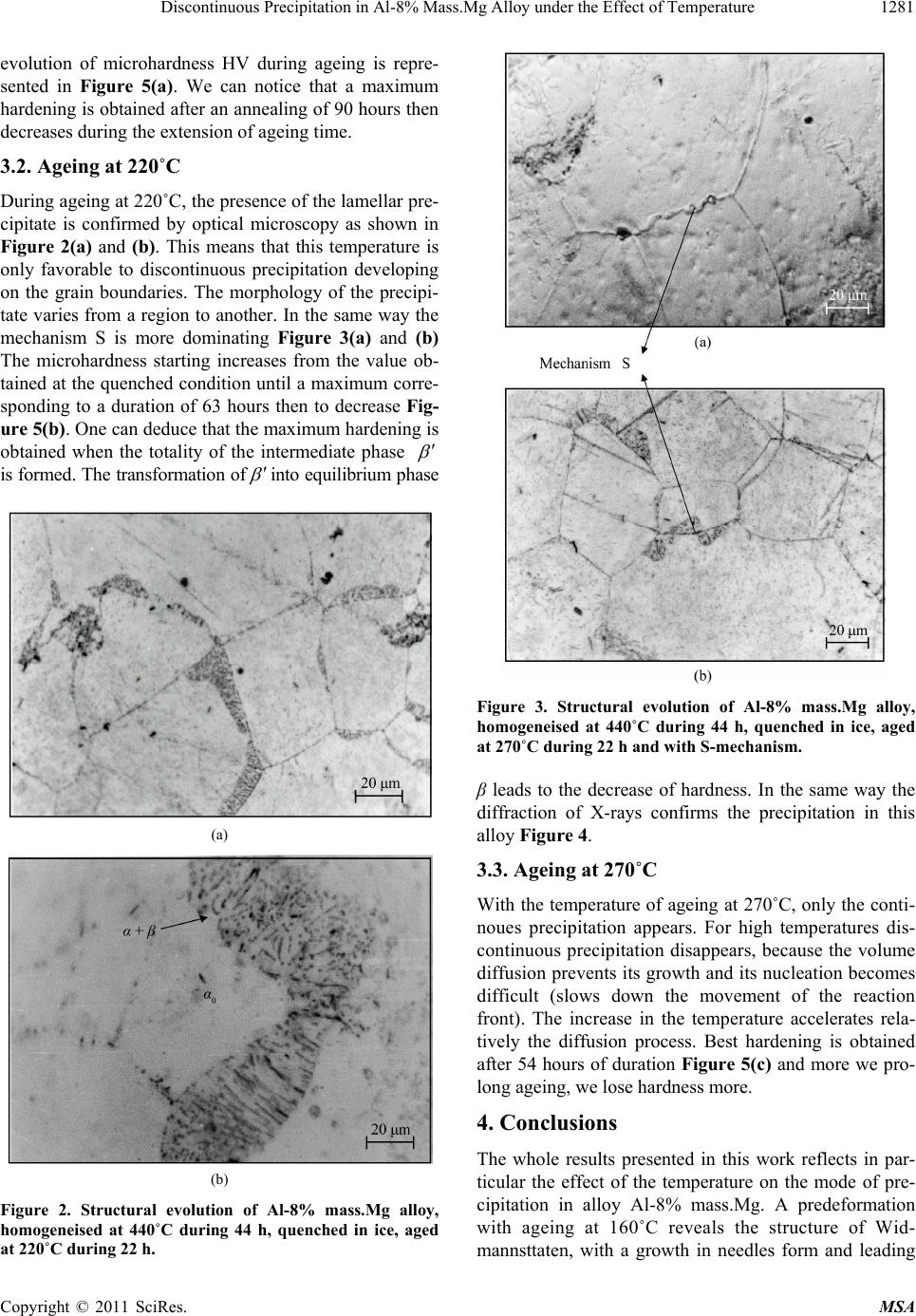 Discontinuous Precipitation in Al-8% Mass.Mg Alloy under the Effect of Temperature Copyright © 2011 SciRes. MSA 1281 evolution of microhardness HV during ageing is repre- sented in Figure 5(a). We can notice that a maximum hardening is obtained after an annealing of 90 hours then decreases during the extension of ageing time. 3.2. Ageing at 220˚C During ageing at 220˚C, the presence of the lamellar pre- cipitate is confirmed by optical microscopy as shown in Figure 2(a) and (b). This means that this temperature is only favorable to discontinuous precipitation developing on the grain boundaries. The morphology of the precipi- tate varies from a region to another. In the same way the mechanism S is more dominating Figure 3(a) and (b) The microhardness starting increases from the value ob- tained at the quenched condition until a maximum corre- sponding to a duration of 63 hours then to decrease Fig- ure 5(b). One can deduce that the maximum hardening is obtained when the totality of the intermediate phase is formed. The transformation of into equilibrium phase Figure 3. Structural evolution of Al-8% mass.Mg alloy, homogeneised at 440˚C during 44 h, quenched in ice, aged at 270˚C during 22 h and with S-mechanism. β leads to the decrease of hardness. In the same way the diffraction of X-rays confirms the precipitation in this alloy Figure 4. (a) 3.3. Ageing at 270˚C With the temperature of ageing at 270˚C, only the conti- noues precipitation appears. For high temperatures dis- continuous precipitation disappears, because the volume diffusion prevents its growth and its nucleation becomes difficult (slows down the movement of the reaction front). The increase in the temperature accelerates rela- tively the diffusion process. Best hardening is obtained after 54 hours of duration Figure 5(c) and more we pro- long ageing, we lose hardness more. 4. Conclusions The whole results presented in this work reflects in par- ticular the effect of the temperature on the mode of pre- cipitation in alloy Al-8% mass.Mg. A predeformation with ageing at 160˚C reveals the structure of Wid- mannsttaten, with a growth in needles form and leading (b) Figure 2. Structural evolution of Al-8% mass.Mg alloy, homogeneised at 440˚C during 44 h, quenched in ice, aged at 220˚C during 22 h. 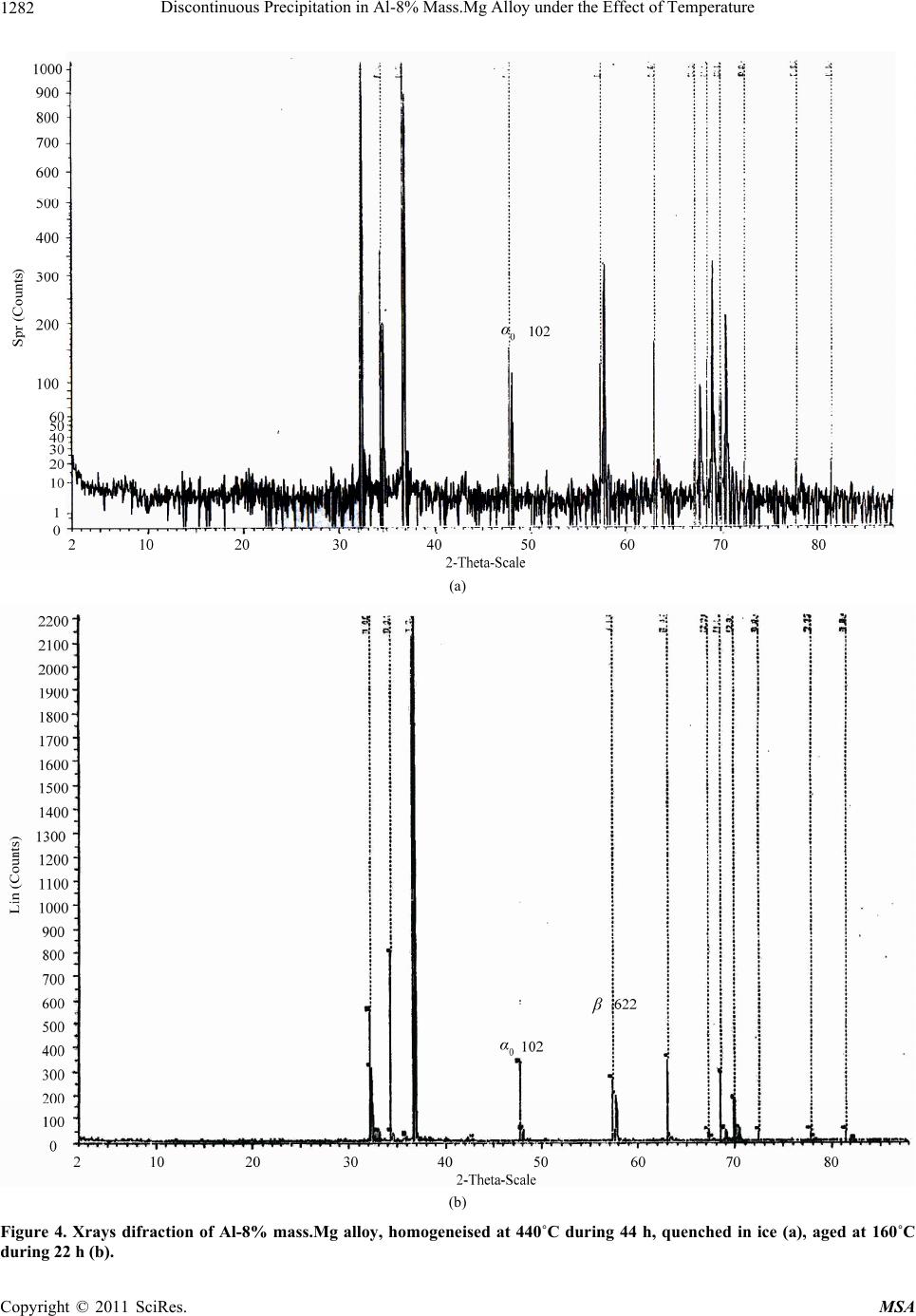 Discontinuous Precipitation in Al-8% Mass.Mg Alloy under the Effect of Temperature 1282 (a) (b) Figure 4. Xrays difraction of Al-8% mass.Mg alloy, homogeneised at 440˚C during 44 h, quenched in ice (a), aged at 160˚C during 22 h (b). Copyright © 2011 SciRes. MSA 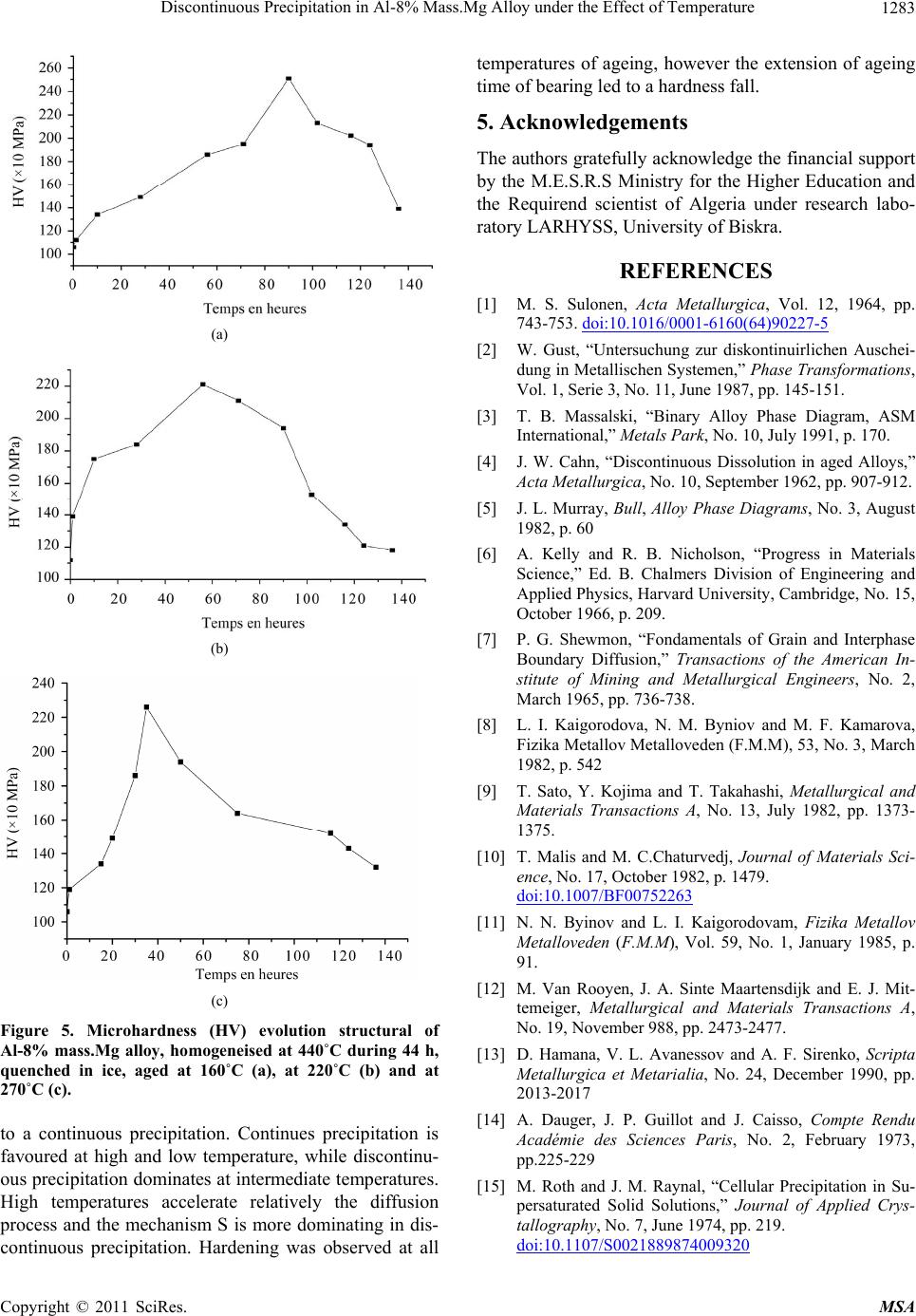 Discontinuous Precipitation in Al-8% Mass.Mg Alloy under the Effect of Temperature1283 (a) (b) (c) Figure 5. Microhardness (HV) evolution structural of Al-8% mass.Mg alloy, homogeneised at 440˚C during 44 h, quenched in ice, aged at 160˚C (a), at 220˚C (b) and at 270˚C (c). to a continuous precipitation. Continues precipitation is favoured at high and low temperature, while discontinu- ous precipitation dominates at intermediate temperatures. High temperatures accelerate relatively the diffusion process and the mechanism S is more dominating in dis- continuous precipitation. Hardening was observed at all temperatures of ageing, however the extension of ageing time of bearing led to a hardness fall. 5. Acknowledgements The authors gratefully acknowledge the financial support by the M.E.S.R.S Ministry for the Higher Education and the Requirend scientist of Algeria under research labo- ratory LARHYSS, University of Biskra. REFERENCES [1] M. S. Sulonen, Acta Metallurgica, Vol. 12, 1964, pp. 743-753. doi:10.1016/0001-6160(64)90227-5 [2] W. Gust, “Untersuchung zur diskontinuirlichen Auschei- dung in Metallischen Systemen,” Phase Transformations, Vol. 1, Serie 3, No. 11, June 1987, pp. 145-151. [3] T. B. Massalski, “Binary Alloy Phase Diagram, ASM International,” Metals Park, No. 10, July 1991, p. 170. [4] J. W. Cahn, “Discontinuous Dissolution in aged Alloys,” Acta Metallurgica, No. 10, September 1962, pp. 907-912. [5] J. L. Murray, Bull, Alloy Phase Diagrams, No. 3, August 1982, p. 60 [6] A. Kelly and R. B. Nicholson, “Progress in Materials Science,” Ed. B. Chalmers Division of Engineering and Applied Physics, Harvard University, Cambridge, No. 15, October 1966, p. 209. [7] P. G. Shewmon, “Fondamentals of Grain and Interphase Boundary Diffusion,” Transactions of the American In- stitute of Mining and Metallurgical Engineers, No. 2, March 1965, pp. 736-738. [8] L. I. Kaigorodova, N. M. Byniov and M. F. Kamarova, Fizika Metallov Metalloveden (F.M.M), 53, No. 3, March 1982, p. 542 [9] T. Sato, Y. Kojima and T. Takahashi, Metallurgical and Materials Transactions A, No. 13, July 1982, pp. 1373- 1375. [10] T. Malis and M. C.Chaturvedj, Journal of Materials Sci- ence, No. 17, October 1982, p. 1479. doi:10.1007/BF00752263 [11] N. N. Byinov and L. I. Kaigorodovam, Fizika Metallov Metalloveden (F.M.M), Vol. 59, No. 1, January 1985, p. 91. [12] M. Van Rooyen, J. A. Sinte Maartensdijk and E. J. Mit- temeiger, Metallurgical and Materials Transactions A, No. 19, November 988, pp. 2473-2477. [13] D. Hamana, V. L. Avanessov and A. F. Sirenko, Scripta Metallurgica et Metarialia, No. 24, December 1990, pp. 2013-2017 [14] A. Dauger, J. P. Guillot and J. Caisso, Compte Rendu Académie des Sciences Paris, No. 2, February 1973, pp.225-229 [15] M. Roth and J. M. Raynal, “Cellular Precipitation in Su- persaturated Solid Solutions,” Journal of Applied Crys- tallography, No. 7, June 1974, pp. 219. doi:10.1107/S0021889874009320 Copyright © 2011 SciRes. MSA  Discontinuous Precipitation in Al-8% Mass.Mg Alloy under the Effect of Temperature Copyright © 2011 SciRes. MSA 1284 [16] A. Dauger, E. K. Boudili and M. Roth, Scripta Materialia, No. 10, October 1976, pp. 1119-1123. [17] M. Bernole, R. Graf and P. Guyot, Philosophical Maga- zine, No. 28, September 1973, pp. 771. doi:10.1080/14786437308220982 [18] R. Nozato and G. Nakai, Materials Transactions JIM, No. 18, November 1977, pp. 679-684. [19] J. W.Cahn, Acta Metallurgica, No. 10, 1962, pp. 907-911 [20] W. A. Pollard, Journal Institute of Metals, No. 3, July 1964, pp. 339-342. [21] M. Hillert, “The Mechanism of phase transformations in Crystalline Solids,” Journal de Physique et Le Radium, No. 23, June 1984, p. 835 [22] K. Osamura and T. Ogura, Metallurgical and Materials Transactions A, No. 15, September 1984, pp. 835-838. [23] M. Bernole, J. Raynal and R. Graf, Journal of Micros- copy, No. 8, August 1969, pp. 831-833 [24] C. Pensiri, T. Federighi and S. Ceresara, Metallurgical and Materials Transactions, No. 2, August 1963, pp. 1122-1124. [25] K. Detert and L. Thomas, Acta Metallurgica, No. 12, December 1964, p. 431 [26] H. Suzuki, M. Kanno and T. Kitayama, Journal of Japan Institute of Light Metals, No. 28, May 1978, pp. 292-295. [27] Y. Kojima and K. Watanabem, “In Precipitation from Solid Solution,” Journal of Japan Institute of Light Met- als, No. 30, March 1980, pp. 270-273. |