

Paper Menu >>
Journal Menu >>
 Open Journal of Bloo d Di seases, 2011, 1, 3-7 doi:10.4236/ojbd.2011.11002 Published Online September 2011 (http://www.SciRP.org/journal/ojbd) Copyright © 2011 SciRes. OJBD 1 Is Iron-Chelation Therapy Useful in Persons with Myelodysplastic Syndrome? Chaim Hershko1,*, Robert Peter Gale2 1Department of Hematology, Shaare Zedek Medical Center, Jerusalem, Israel; 2Haematology Section, Division of Experimental Medicine, Department of Medicine, Imperial College, London, UK. Email: *[email protected] Received July 28th, 2011; revised August 29th, 2011; accepted September 6th, 2011. ABSTRACT Iron overload in myelodysplastic syndrome (MDS) results from multiple RBC-trans fusions and inap propriate increased iron absoption associated with ineffective erythropoiesis. Data from hereditary iron-loading anemias indicate long- term consequences of iron toxicity are preventable and potentially reversible by effective iron-chelation therapy (ICT). There is increasing interest in using ICT in persons with MDS because of the recent introduction of orally effective iron-chelators which are suitable for older persons. Ideally, opinions supporting the benefit of ICT in MDS should be evidenced-based, especially data from randomized trials showing better survival and, in exceptional cases, improved heart function. Such data are lacking. Nevertheless, it is possible to rely on the extensive data from trials of ICT in per- sons with thalassemia and to use well-d efined predictors of increased risks of life-th reatening complicatio ns to identify persons with MDS most likely to benefit from ICT. Keywords: Myelodyspla stic Syndrome, MDS, Iron-Chelation, NTBI, Deferoxamine, Deferiprone, Deferasirox, Transfusion Siderosis 1. Selection of Persons with MDS for Iron-Chelating Therapy The choice of persons with MDS who may benefit from ICT is of continued interest and controversy [1-5]. De- spite some differences, principles underlying recom- mendations are remarkably similar for persons with MDS and those with thalassemia. First, it is recognized that life-threatening RBC-transfusion-induced iron overload is only relevant to persons with MDS with a favorable prognosis. Second, magnitude and rate of iron-accumu- lation are critical. Substantial heart iron-accumulation is expected only after about 100 units (U) of RBCs [6-11; Table 1]. A person receiving 2 - 4 U RBCs monthly will only be at risk after about 2 - 4 years. Thus, recommend- dations to start ICT after 20 U RBCs are too liberal and merits consideration only if the rate of RBC-transfusions predicts ≥100 U RBCs in ≤4 years. Lastly, because se- rum ferritin in persons with MDS is affected by inflam- mation, infection and leukemia burden, it is an unreliable indicator of iron-overload [12,13]. Hence, currently pro- posed threshold ferritin levels of 1000 - 2500 ng/dL should be supplemented or replaced by estimates of iron- overload based on state-of-the-art MRI methodology which directly assesses tissue iron-accumulation. When such technology is unavailable, the RBC-transfusion threshold of ≥100 U is a practical way to identify persons with MDS at high-risk of life-threatening iron-accumulation. The importance of ICT in MDS is not universally ac- cepted [14]. Although favorable effects of ICT in thalas- semia include reversal of arrhythmias, improvement in left ventricular ejection-fraction, arrest of hepatic fibrosis and decreased glucose tolerance are well-documented, it is uncertain whether these outcomes apply to persons with MDS receiving ICT. 2. Choice of Iron-Chelators in Persons with MDS A comparison of the 3 leading chelators is presented in Table 2. Deferox amin e: Because of its proved efficacy and the extensive experience in persons with thalassemia, defer- oxamine (DFO) is considered the gold-standard for ICT [15]. However, compliance with the rigorous require- ments of daily subcutaneous DFO infusions is a serious limiting-factor. In practice, elderly persons with MDS are not reasonable candidates to receive DFO. 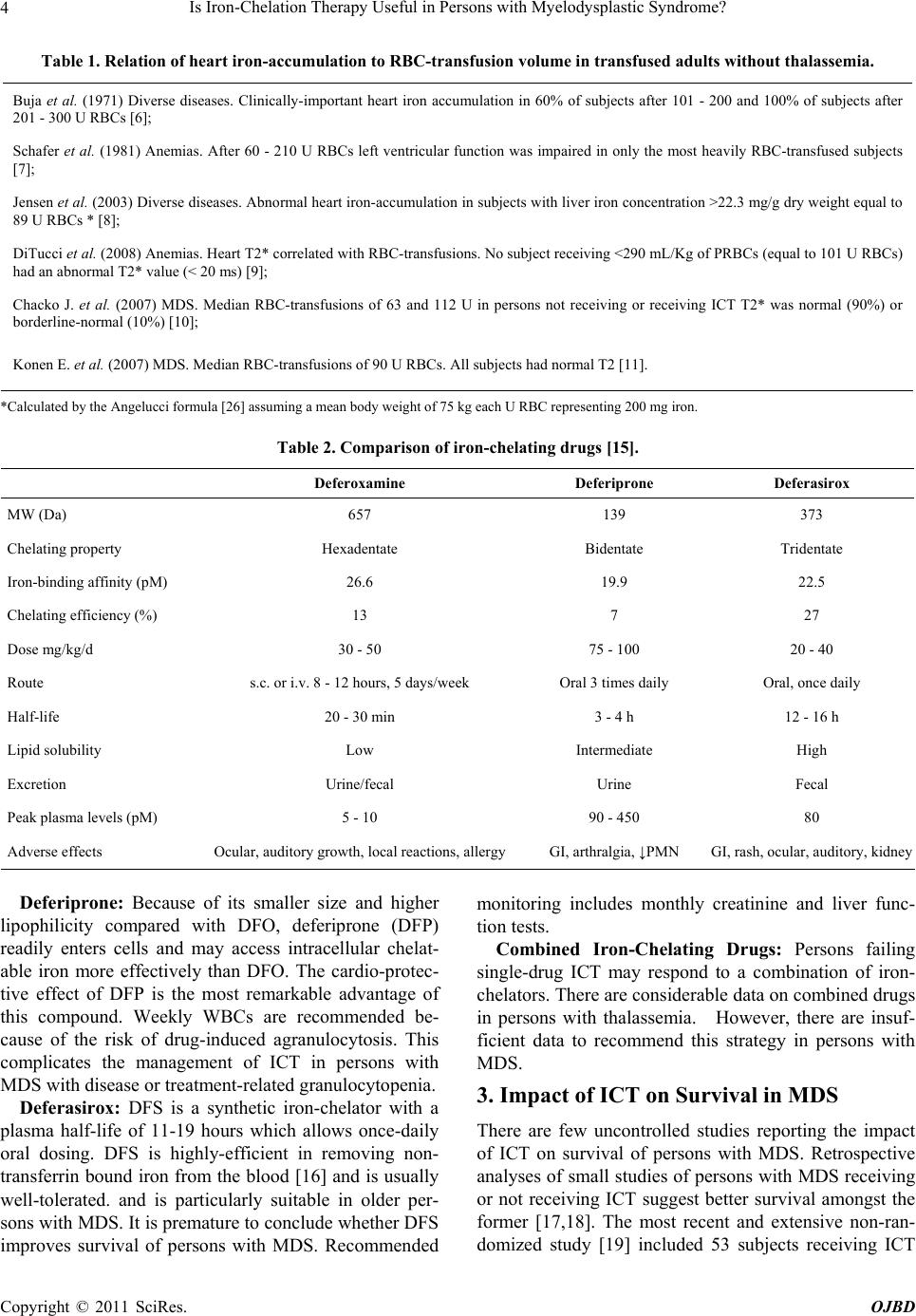 Is Iron-Chelation Therapy Useful in Persons with Myelodysplastic Syndrome? 4 Table 1. Relation of heart iron-accumulation to RBC-transfusion volume in transfused adults without thalassemia. Buja et al. (1971) Diverse diseases. Clinically-important heart iron accumulation in 60% of subjects after 101 - 200 and 100% of subjects after 201 - 300 U RBCs [6]; Schafer et al. (1981) Anemias. After 60 - 210 U RBCs left ventricular function was impaired in only the most heavily RBC-transfused subjects [7]; Jensen et al. (2003) Diverse diseases. Abnormal heart iron-accumulation in subjects with liver iron concentration >22.3 mg/g dry weight equal to 89 U RBCs * [8]; DiTucci et al. (2008) Anemias. Heart T2* correlated with RBC-transfusions. No subject receiving <290 mL/Kg of PRBCs (equal to 101 U RBCs) had an abnormal T2* value (< 20 ms) [9]; Chacko J. et al. (2007) MDS. Median RBC-transfusions of 63 and 112 U in persons not receiving or receiving ICT T2* was normal (90%) or borderline-normal (10%) [10]; Konen E. et al. (2007) MDS. Median RBC-transfusions of 90 U RBCs. All subjects had normal T2 [11]. *Calculated by the Angelucci formula [26] assuming a mean body weight of 75 kg each U RBC representing 200 mg iron. Table 2. Comparison of iron-chelating drugs [15]. Deferasirox Deferiprone Deferoxamine 373 139 657 MW (Da) Tridentate Bidentate Hexadentate Chelating property 22.5 19.9 26.6 Iron-binding affinity (pM) 27 7 13 Chelating efficiency (%) 20 - 40 75 - 100 30 - 50 Dose mg/kg/d Oral, once daily Oral 3 times daily s.c. or i.v. 8 - 12 hours, 5 days/week Route 12 - 16 h 3 - 4 h 20 - 30 min Half-life High Intermediate Low Lipid solubility Fecal Urine Urine/fecal Excretion 80 90 - 450 5 - 10 Peak plasma levels (pM) GI, rash, ocular, auditory, kidneyGI, arthralgia, ↓PMN Ocular, auditory growth, local reactions, allergyAdverse effects Deferiprone: Because of its smaller size and higher lipophilicity compared with DFO, deferiprone (DFP) readily enters cells and may access intracellular chelat- able iron more effectively than DFO. The cardio-protec- tive effect of DFP is the most remarkable advantage of this compound. Weekly WBCs are recommended be- cause of the risk of drug-induced agranulocytosis. This complicates the management of ICT in persons with MDS with disease or treatment-related granulocytopenia. Deferasirox: DFS is a synthetic iron-chelator with a plasma half-life of 11-19 hours which allows once-daily oral dosing. DFS is highly-efficient in removing non- transferrin bound iron from the blood [16] and is usually well-tolerated. and is particularly suitable in older per- sons with MDS. It is premature to conclude whether DFS improves survival of persons with MDS. Recommended monitoring includes monthly creatinine and liver func- tion tests. Combined Iron-Chelating Drugs: Persons failing single-drug ICT may respond to a combination of iron- chelators. There are considerable data on combined drugs in persons with thalassemia. However, there are insuf- ficient data to recommend this strategy in persons with MDS. 3. Impact of ICT on Survival in MDS There are few uncontrolled studies reporting the impact of ICT on survival of persons with MDS. Retrospective analyses of small studies of persons with MDS receiving or not receiving ICT suggest better survival amongst the former [17,18]. The most recent and extensive non-ran- domized study [19] included 53 subjects receiving ICT Copyright © 2011 SciRes. OJBD 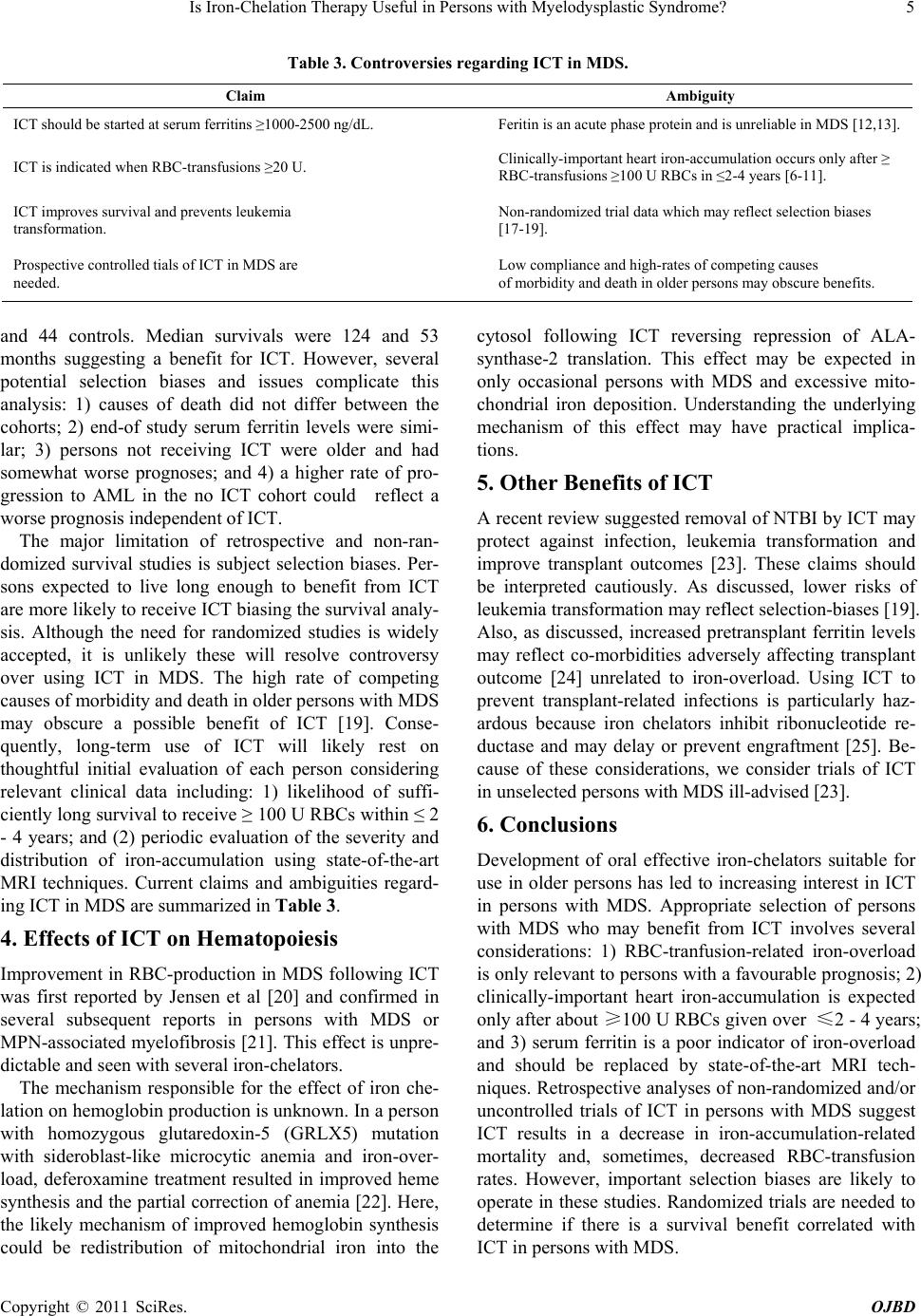 Is Iron-Chelation Therapy Useful in Persons with Myelodysplastic Syndrome?5 Table 3. Controversies regarding ICT in MDS. Claim Ambiguity ICT should be started at serum ferritins ≥1000-2500 ng/dL. Feritin is an acute phase protein and is unreliable in MDS [12,13]. ICT is indicated when RBC-transfusions ≥20 U. Clinically-important heart iron-accumulation occurs only after ≥ RBC-transfusions ≥100 U RBCs in ≤2-4 years [6-11]. ICT improves survival and prevents leukemia transformation. Non-randomized trial data which may reflect selection biases [17-19]. Prospective controlled tials of ICT in MDS are needed. Low compliance and high-rates of competing causes of morbidity and death in older persons may obscure benefits. and 44 controls. Median survivals were 124 and 53 months suggesting a benefit for ICT. However, several potential selection biases and issues complicate this analysis: 1) causes of death did not differ between the cohorts; 2) end-of study serum ferritin levels were simi- lar; 3) persons not receiving ICT were older and had somewhat worse prognoses; and 4) a higher rate of pro- gression to AML in the no ICT cohort could reflect a worse prognosis independent of ICT. The major limitation of retrospective and non-ran- domized survival studies is subject selection biases. Per- sons expected to live long enough to benefit from ICT are more likely to receive ICT biasing the survival analy- sis. Although the need for randomized studies is widely accepted, it is unlikely these will resolve controversy over using ICT in MDS. The high rate of competing causes of morbidity and death in older persons with MDS may obscure a possible benefit of ICT [19]. Conse- quently, long-term use of ICT will likely rest on thoughtful initial evaluation of each person considering relevant clinical data including: 1) likelihood of suffi- ciently long survival to receive ≥ 100 U RBCs within ≤ 2 - 4 years; and (2) periodic evaluation of the severity and distribution of iron-accumulation using state-of-the-art MRI techniques. Current claims and ambiguities regard- ing ICT in MDS are summarized in Table 3. 4. Effects of ICT on Hematopoiesis Improvement in RBC-production in MDS following ICT was first reported by Jensen et al [20] and confirmed in several subsequent reports in persons with MDS or MPN-associated myelofibrosis [21]. This effect is unpre- dictable and seen with several iron-chelators. The mechanism responsible for the effect of iron che- lation on hemoglobin production is unknown. In a person with homozygous glutaredoxin-5 (GRLX5) mutation with sideroblast-like microcytic anemia and iron-over- load, deferoxamine treatment resulted in improved heme synthesis and the partial correction of anemia [22]. Here, the likely mechanism of improved hemoglobin synthesis could be redistribution of mitochondrial iron into the cytosol following ICT reversing repression of ALA- synthase-2 translation. This effect may be expected in only occasional persons with MDS and excessive mito- chondrial iron deposition. Understanding the underlying mechanism of this effect may have practical implica- tions. 5. Other Benefits of ICT A recent review suggested removal of NTBI by ICT may protect against infection, leukemia transformation and improve transplant outcomes [23]. These claims should be interpreted cautiously. As discussed, lower risks of leukemia transformation may reflect selection-biases [19]. Also, as discussed, increased pretransplant ferritin levels may reflect co-morbidities adversely affecting transplant outcome [24] unrelated to iron-overload. Using ICT to prevent transplant-related infections is particularly haz- ardous because iron chelators inhibit ribonucleotide re- ductase and may delay or prevent engraftment [25]. Be- cause of these considerations, we consider trials of ICT in unselected persons with MDS ill-advised [23]. 6. Conclusions Development of oral effective iron-chelators suitable for use in older persons has led to increasing interest in ICT in persons with MDS. Appropriate selection of persons with MDS who may benefit from ICT involves several considerations: 1) RBC-tranfusion-related iron-overload is only relevant to persons with a favourable prognosis; 2) clinically-important heart iron-accumulation is expected only after about ≥100 U RBCs given over ≤2 - 4 years; and 3) serum ferritin is a poor indicator of iron-overload and should be replaced by state-of-the-art MRI tech- niques. Retrospective analyses of non-randomized and/or uncontrolled trials of ICT in persons with MDS suggest ICT results in a decrease in iron-accumulation-related mortality and, sometimes, decreased RBC-transfusion rates. However, important selection biases are likely to operate in these studies. Randomized trials are needed to determine if there is a survival benefit correlated with ICT in persons with MDS. Copyright © 2011 SciRes. OJBD  Is Iron-Chelation Therapy Useful in Persons with Myelodysplastic Syndrome? 6 REFERENCES [1] N. Gattermann, “The Treatment of Secondary Hemo- chromatosis,” Deutsch Arzteblatt International, Vol. 106, No. 30, 2009, pp. 499-504. doi: 10.3238/arztebl.2009.0499 [2] G. Metzgeroth, D. Dinter, B. Schultheis, et al., “Defera- sirox in MDS Patients with Transfusion-Caused Iron Overload—A Phase-II Study,” Annals Hematology, Vol. 88, No. 4, 2009, pp. 301-310. doi:10.1007/s00277-008-0588-3 [3] P. Fenaux and C. Rose, “Impact of Iron Overload in Myelodysplastic Syndromes,” Blood Reviews, Vol.23 Suppl. 1, 2009, pp. S15-S19. doi:10.1016/S0268-960X(09)70005-0 [4] L. Malcovati, “Red Blood Cell Transfusion Therapy and Iron Chelation in Patients with Myelodysplastic Syn- dromes,” Clinical Lymphoma Myeloma & Leukemia, Vol. 9, Suppl. 3, 2009, pp. S305-S311. [5] J. M. Bennett, “MDS Foundation’s Working Group on Transfusional Iron Overload. Consensus Statement on Iron Overload in Myelodysplastic Syndromes,” American Journal Hematology, Vol. 83, No.11, 2008, pp. 858-861. doi:10.1002/ajh.21269 [6] L. M. Buja, W. C. Roberts, “Iron in the Heart. Etiology and Clinical Significance,” American Journal Medicine, Vol. 51, No. 2, 1971, pp. 209-221. doi:10.1016/0002-9343(71)90240-3 [7] A. I. Schafer, R. G. Cheron, R. Dluhy, et al., “Clinical Consequences of Acquired Transfusional Iron Overload in Adults, The New England Journal Medicine, Vol. 304, No. 6, 1981, pp. 319-324. doi:10.1056/NEJM198102053040603 [8] P. D. Jensen, F. T. Jensen, T Christensen, et al., “Evaluation of Myocardial Iron by Magnetic Resonance Imaging during Iron Chelation Therapy with Deferrio- xamine: Indication of Close Relation between Myocardial iron Content and Chelatable Iron Pool,” Blood, Vol. 101, No. 11, 2003, pp. 4632-4639. [9] A. A. Di Tucci, G. Matta, S. Deplano, et al., “Myocardial Iron Overload Assessment by T2* Magnetic Resonance Imaging in Adult Transfusion Dependent Patients with Acquired Anemias,” Haematologica, Vol. 93, No. 9, 2008, pp. 1385-1388. [10] J. Chacko, D. J. Pennell, M. A. Tanner, et al., “Myocar- dial Iron Loading by Magnetic Resonance Imaging T2* in Good Prognostic Myelodysplastic Syndrome Patients on Long-Term Blood Transfusions,” British Journal Hae- matology, Vol. 138, No. 5, 2007, pp. 587-593. doi:10.1111/j.1365-2141.2007.06695.x [11] E. Konen, H. Ghoti, O. Goitein, et al., “No Evidence for Myocardial Iron Overload in Multitransfused Patients with Myelodysplastic Syndrome Using Cardiac Magnetic Resonance T2 Technique,” American Journal Hematol- ogy, Vol. 82, No. 11, 2007, pp. 1013-1016. doi:10.1002/ajh.20980 [12] Y. Matzner, A. M. Konijn and C. Hershko, “Serum Fer- ritin in Hematologic Malignancies,” American Journal Hematology, Vol. 9, No. 1, 1980, pp. 13-22. doi:10.1002/ajh.2830090103 [13] M. H. Lee and R. T. Means Jr, “Extremely Elevated Se- rum Ferritin Levels in a University Hospital: Associated Diseases and Clinical Significance,” American Journal Medicine, Vol. 98, No. 6, 1995, pp. 566-571. doi:10.1016/S0002-9343(99)80015-1 [14] A. Tefferi and J. W. Vardiman, “Myelodysplastic Syn- dromes,” The New England Journal Medicine, Vol. 361, No. 19, 2009, pp. 1872-1885. doi:10.1056/NEJMra0902908 [15] C. Hershko, “Oral Iron Chelators: New Opportunities and New Dilemmas,” Haematologica, Vol. 91, No. 10, 2006, 1307-1312. [16] G. Zanninelli, W. Breuer and Z. I. Cabancthik, “Daily Labile Plasma Iron as an Indicator of Chelator Activity in Thalassaemia Major Patients,” British Journal Haema- tology, Vol. 147, No. 5, 2009, pp. 744-751. doi:10.1111/j.1365-2141.2009.07907.x [17] A. Raptis, M. S. Duh, S. T. Wang, et al., “Treatment of Transfusional Iron Overload in Patients with Myelodys- plastic Syndrome or Severe Anemia: Data from Multi- center Clinical Practices,” Transfusion, Vol. 50, No. 1, 2010, pp. 190-199. [18] H. A. Leitch, J. M. Chase, T. A. Goodman, et al., “Im- proved Survival in Red Blood Cell Transfusion Depend- ent Patients with Primary Myelofibrosis (PMF) Receiving Iron Chelation Therapy,” Journal of Hematology Oncol- ogy, Vol. 28, No. 1, 2009, pp. 40-48. [19] C. Rose, S. Brechignac, D. Vassilief, et al., “GFM (Groupe Francophone des Myélodysplasies).Does Iron Chelation Therapy Improve Survival in Regularly Trans- fused Lower Risk MDS Patients? A Multicenter Study by the GFM,” Leukemia Research, Vol. 34, No. 7, 2010, pp. 864-870. doi:10.1016/j.leukres.2009.12.004 [20] P. D. Jensen, I. M. Jensen and J. Ellegaard, “Desferriox- amine Treatment Reduces Blood Transfusion Require- ments in Patients with Myelodysplastic Syndrome,” Brit- ish Journal Haematology, Vol. 80, No. 1, 1992, pp. 121-124. [21] E. Messa, D. Cilloni, F. Messa, et al., “Deferasirox Treatment Improved the Hemoglobin Level and De- creased Transfusion Requirements in Four Patients with the Myelodysplastic Syndrome and Primary Myelofibro- sis,” Acta Haematologia, Vol. 120, No. 2, 2008, pp. 70-74. [22] C. Camaschella, A. Campanella, L. De Falco, et al., “The Human Counterpart of Zebrafish Shiraz Shows Sidero- blastic-Like Microcytic Anemia and Iron Overload,” Blood, Vol. 110, No. 4, 2007, pp. 1353-1358. [23] V. Pullarkat, “Objectives of Iron Chelation Therapy in Myelodysplastic Syndromes: More than Meets the Eye?” Blood, Vol. 114, No. 26, 2009, pp. 5251-5255. [24] J. Koreth, J. H. Antin, “Iron Overload in Hematologic Malignancies and Outcome of Allogeneic Hematopoietic Stem Cell Transplantation,” Haematologica, Vol. 95, No. 3, 2010, pp. 364-366. Copyright © 2011 SciRes. OJBD  Is Iron-Chelation Therapy Useful in Persons with Myelodysplastic Syndrome? Copyright © 2011 SciRes. OJBD 7 [25] C. E. Cooper, G. R. Lynagh, K. P. Hoyes, et al., “The Relationship of Intracellular Iron Chelation to the Inhibi- tion and Regeneration of Human Ribonucleotide Reduc- tase,” The Journal of Biological Chemistry, Vol. 271, No. 34, 1996, pp. 20291-20299. doi:10.1074/jbc.271.34.20291 [26] E. Angelucci, G M. Brittenham, C. E. McLaren, et al., “Hepatic Iron Concentration and Total Body Iron Stores in Thalassemia Major,” The New England Journal Medi- cine, Vol. 343, No. 5, 2000, pp. 327-331. doi:10.1056/NEJM200008033430503 Disclosure: C. H. received travel support and honoraria from Novartis Basel Switzerland and Apotex Toronto Canada. RPG is an employee of Celgene Corp, Summit, NJ. |