

Paper Menu >>
Journal Menu >>
 Materials Sciences and Applicatio ns, 2011, 2, 1175-1179 doi:10.4236/msa.2011.29158 Published Online September 2011 (http://www.SciRP.org/journal/msa) Copyright © 2011 SciRes. MSA 1175 Synthesis and Characterization of (Ru-Sn)O2 Nanoparticles for Supercapacitors Venkata Subba Reddy Channu1*, Rudolf Holze1, Scott Ambrose Wicker Sr.2, Edwin H. Walker Jr.2 Quinton L. Williams3, Rajamohan R. Kalluru3 1Institut für Chemie, AG Elektrochemie, Technische Universität Chemnitz, Chemnitz, Germany; 2Department of Chemistry, South- ern University and A&M College, Baton Rouge, USA; 3Department of Physics, Atmospheric Sciences and Geoscience, Jackson State University, Jackson, USA. Email: [email protected] Received February 17th, 2011; revised April 26th, 2011; accepted May 31st, 2011. ABSTRACT The electrode materials SnO2, RuO2 and (Sn-Ru)O2 were synthesized through precipitation method from SnCl22H2O and RuCl22H2O solutions. The obtained nano-sized pristine products were characterized using X-ray diffractometry, Scanning Electron Microscopy (SEM), differential scanning calorimetry (DSC)-thermogravimetric analysis (TGA) and cyclic voltammetry (CV). The Debye–Scherrer formula was used to estimate the average size of the nanoparticles SnO2 (36 nm), RuO2(24 nm), and (Sn-Ru)O2 (19 nm). Electrochemical studies were carried out to examine the capacitance of SnO2, RuO2, (Sn-Ru)O2 electrodes in 0.5 M H2SO4 at various scan rates. The estimated electrode capacitance was de- termined to decrease with an increase of scan rate. Keywords: Precipitation Synthesis, (Ru-Sn)O2 Nanocomposities, Supercapacitor 1. Introduction Electrochemical capacitors (ECs) offer greater power density than well-known batteries and can be quickly discharged with no deleterious effect on lifetime. They offer greater energy densities than electrostatic dielectric capacitors, making them a better option for backup ap- plications. ECs are becoming attractive energy storage systems, particularly for applications involving high power requirements. They are also being studied as a means to improve battery performance when combined as a hybrid power source. For instance, hybrid systems consisting of batteries and electrochemical capacitors are being pursued for electric vehicle momentum. In such hybrid systems, ECs can provide the peak power during acceleration and therefore, the batteries must be opti- mized primarily for higher energy density and better cy- cle life. ECs are also attractive for other applications such as power sources for lasers, pulsed light generators, digital single lens reflex (SLR) camera and video flash equip- ment, backup power sources for computer memory and as appropriate sources to power quality applications like Statcons and DVRs [1-3]. Power can be quickly injected or absorbed to help minimize voltage fluctuations in dis- tribution systems. Energy storage mechanisms of electrochemical ca- pacitors are of two types; first, double-layer capacitance arising from the charge separation at the electrode/ elec- trolyte interface and second, pseudocapacitance arising from fast, reversible faradaic reactions occurring at or near a solid electrode surface. Carbon materials which offer high surface area are extensively used for dou- ble-layer capacitors [4]. On the other hand, transition metal oxides with relatively high surface area, such as hydrous RuO2 [5], porous NiOx [6-8], CoOx. [9], and MnO2 [10-12] have been acknowledged as possible elec- trode materials for pseudocapacitors. Tin oxide has been considered as one of the potential electrode materials for pseudocapacitors. The sol–gel process, hydrothermal synthesis and sonication methods have been reported as methods for fabricating porous SnO2 as an electrode material of ECs [13-16]. These process methods are highly sophisticated and difficult to employ in a controlled manner. For instance, the sol–gel technique is a complicated multi-step process and it is not easy to precisely control film thickness. The chemical co-precipitation method is a simple and easy way to pre- 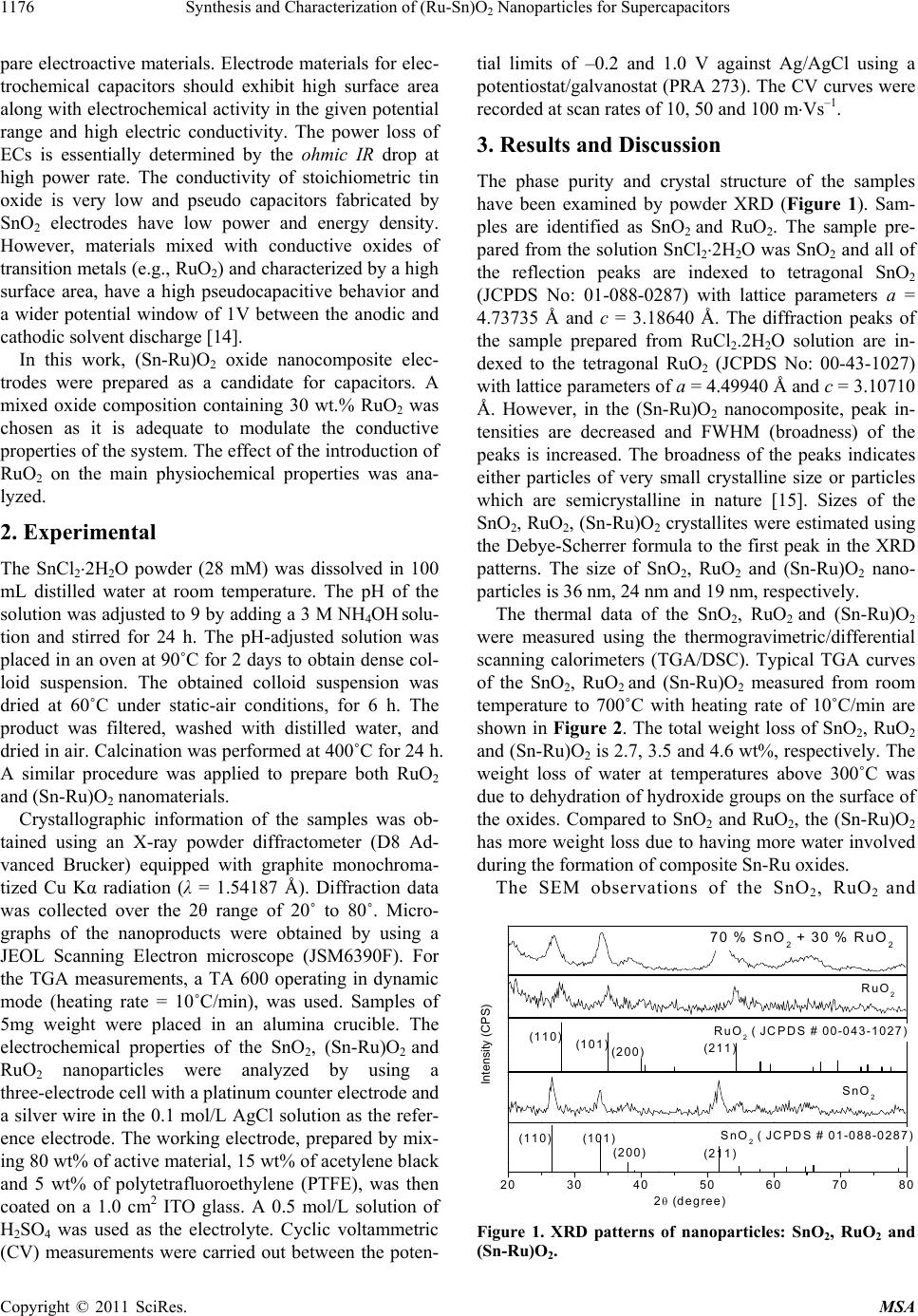 Synthesis and Characterization of (Ru-Sn)O Nanoparticles for Supercapacitors 1176 2 . pare electroactive materials. Electrode materials for elec- trochemical capacitors should exhibit high surface area along with electrochemical activity in the given potential range and high electric conductivity. The power loss of ECs is essentially determined by the ohmic IR drop at high power rate. The conductivity of stoichiometric tin oxide is very low and pseudo capacitors fabricated by SnO2 electrodes have low power and energy density. However, materials mixed with conductive oxides of transition metals (e.g., RuO2) and characterized by a high surface area, have a high pseudocapacitive behavior and a wider potential window of 1V between the anodic and cathodic solvent discharge [14]. In this work, (Sn-Ru)O2 oxide nanocomposite elec- trodes were prepared as a candidate for capacitors. A mixed oxide composition containing 30 wt.% RuO2 was chosen as it is adequate to modulate the conductive properties of the system. The effect of the introduction of RuO2 on the main physiochemical properties was ana- lyzed. 2. Experimental The SnCl22H2O powder (28 mM) was dissolved in 100 mL distilled water at room temperature. The pH of the solution was adjusted to 9 by adding a 3 M NH4OH solu- tion and stirred for 24 h. The pH-adjusted solution was placed in an oven at 90˚C for 2 days to obtain dense col- loid suspension. The obtained colloid suspension was dried at 60˚C under static-air conditions, for 6 h. The product was filtered, washed with distilled water, and dried in air. Calcination was performed at 400˚C for 24 h. A similar procedure was applied to prepare both RuO2 and (Sn-Ru)O2 nanomaterials. Crystallographic information of the samples was ob- tained using an X-ray powder diffractometer (D8 Ad- vanced Brucker) equipped with graphite monochroma- tized Cu Kα radiation (λ = 1.54187 Å). Diffraction data was collected over the 2θ range of 20˚ to 80˚. Micro- graphs of the nanoproducts were obtained by using a JEOL Scanning Electron microscope (JSM6390F). For the TGA measurements, a TA 600 operating in dynamic mode (heating rate = 10˚C/min), was used. Samples of 5mg weight were placed in an alumina crucible. The electrochemical properties of the SnO2, (Sn-Ru)O2 and RuO2 nanoparticles were analyzed by using a three-electrode cell with a platinum counter electrode and a silver wire in the 0.1 mol/L AgCl solution as the refer- ence electrode. The working electrode, prepared by mix- ing 80 wt% of active material, 15 wt% of acetylene black and 5 wt% of polytetrafluoroethylene (PTFE), was then coated on a 1.0 cm2 ITO glass. A 0.5 mol/L solution of H2SO4 was used as the electrolyte. Cyclic voltammetric (CV) measurements were carried out between the poten- tial limits of –0.2 and 1.0 V against Ag/AgCl using a potentiostat/galvanostat (PRA 273). The CV curves were recorded at scan rates of 10, 50 and 100 mVs–1 3. Results and Discussion The phase purity and crystal structure of the samples have been examined by powder XRD (Figure 1). Sam- ples are identified as SnO2 and RuO2. The sample pre- pared from the solution SnCl22H2O was SnO2 and all of the reflection peaks are indexed to tetragonal SnO2 (JCPDS No: 01-088-0287) with lattice parameters a = 4.73735 Å and c = 3.18640 Å. The diffraction peaks of the sample prepared from RuCl2.2H2O solution are in- dexed to the tetragonal RuO2 (JCPDS No: 00-43-1027) with lattice parameters of a = 4.49940 Å and c = 3.10710 Å. However, in the (Sn-Ru)O2 nanocomposite, peak in- tensities are decreased and FWHM (broadness) of the peaks is increased. The broadness of the peaks indicates either particles of very small crystalline size or particles which are semicrystalline in nature [15]. Sizes of the SnO2, RuO2, (Sn-Ru)O2 crystallites were estimated using the Debye-Scherrer formula to the first peak in the XRD patterns. The size of SnO2, RuO2 and (Sn-Ru)O2 nano- particles is 36 nm, 24 nm and 19 nm, respectively. The thermal data of the SnO2, RuO2 and (Sn-Ru)O2 were measured using the thermogravimetric/differential scanning calorimeters (TGA/DSC). Typical TGA curves of the SnO2, RuO2 and (Sn-Ru)O2 measured from room temperature to 700˚C with heating rate of 10˚C/min are shown in Figure 2. The total weight loss of SnO2, RuO2 and (Sn-Ru)O2 is 2.7, 3.5 and 4.6 wt%, respectively. The weight loss of water at temperatures above 300˚C was due to dehydration of hydroxide groups on the surface of the oxides. Compared to SnO2 and RuO2, the (Sn-Ru)O2 has more weight loss due to having more water involved during the formation of composite Sn-Ru oxides. The SEM observations of the SnO2, RuO2 and 20 30 40 50 60 70 80 (211) (200) (101) SnO2 ( JCP DS # 01-088-0287) (110) SnO2 2 (degree) (211) (200) (101) (110) Intensity (CPS) RuO2 ( JCPDS # 00-043-1027) RuO2 70 % SnO 2 + 30 % RuO2 Figure 1. XRD patterns of nanoparticles: SnO2, RuO2 and (Sn-Ru)O2. Copyright © 2011 SciRes. MSA 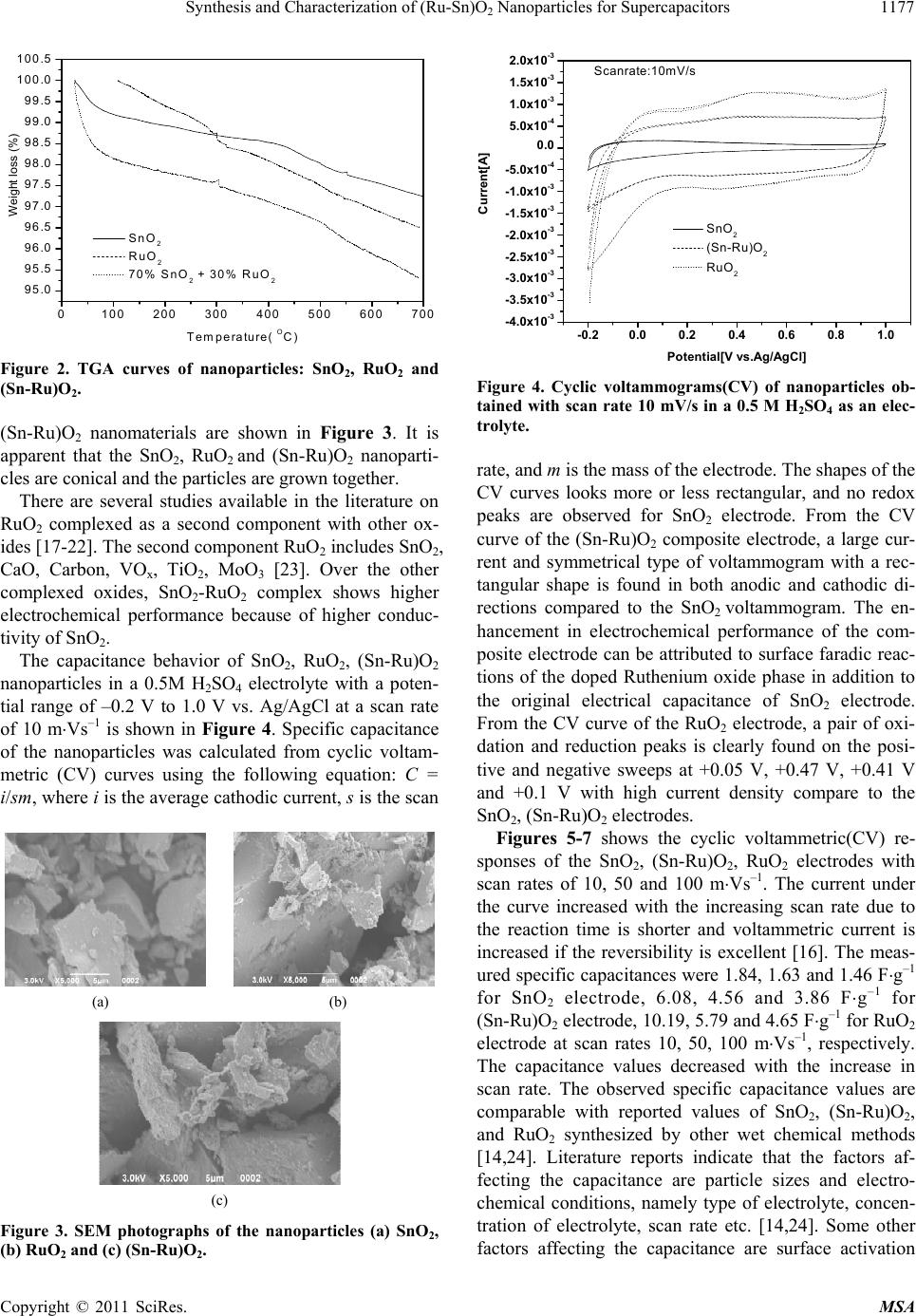 Synthesis and Characterization of (Ru-Sn)O Nanoparticles for Supercapacitors1177 2 0100 200 300 400 500 600 700 95.0 95.5 96.0 96.5 97.0 97.5 98.0 98.5 99.0 99.5 100.0 100.5 SnO2 RuO2 70% S nO 2 + 30% RuO 2 Weight loss (%) Tem perature( OC) Figure 2. TGA curves of nanoparticles: SnO2, RuO2 and (Sn-Ru)O2. (Sn-Ru)O2 nanomaterials are shown in Figure 3. It is apparent that the SnO2, RuO2 and (Sn-Ru)O2 nanoparti- cles are conical and the particles are grown together. There are several studies available in the literature on RuO2 complexed as a second component with other ox- ides [17-22]. The second component RuO2 includes SnO2, CaO, Carbon, VOx, TiO2, MoO3 [23]. Over the other complexed oxides, SnO2-RuO2 complex shows higher electrochemical performance because of higher conduc- tivity of SnO2. The capacitance behavior of SnO2, RuO2, (Sn-Ru)O2 nanoparticles in a 0.5M H2SO4 electrolyte with a poten- tial range of –0.2 V to 1.0 V vs. Ag/AgCl at a scan rate of 10 mVs–1 is shown in Figure 4. Specific capacitance of the nanoparticles was calculated from cyclic voltam- metric (CV) curves using the following equation: C = i/sm, where i is the average cathodic current, s is the scan (a) (b) (c) Figure 3. SEM photographs of the nanoparticles (a) SnO2, (b) RuO2 and (c) (Sn-Ru)O2. -0.20.00.20.40.60.81.0 -4.0x10⁻³ -3.5x10⁻³ -3.0x10⁻³ -2.5x10⁻³ -2.0x10⁻³ -1.5x10⁻³ -1.0x10⁻³ -5.0x10⁻⁴ 0.0 5.0x10⁻⁴ 1.0x10⁻³ 1.5x10⁻³ 2.0x10⁻³ SnO2 (Sn-Ru )O 2 RuO2 Current[A] Pot e n tial[ V vs.Ag/ AgCl] Scanrate:10mV/s Figure 4. Cyclic voltammograms(CV) of nanoparticles ob- tained with scan rate 10 mV/s in a 0.5 M H2SO4 as an elec- trolyte. rate, and m is the mass of the electrode. The shapes of the CV curves looks more or less rectangular, and no redox peaks are observed for SnO2 electrode. From the CV curve of the (Sn-Ru)O2 composite electrode, a large cur- rent and symmetrical type of voltammogram with a rec- tangular shape is found in both anodic and cathodic di- rections compared to the SnO2 voltammogram. The en- hancement in electrochemical performance of the com- posite electrode can be attributed to surface faradic reac- tions of the doped Ruthenium oxide phase in addition to the original electrical capacitance of SnO2 electrode. From the CV curve of the RuO2 electrode, a pair of oxi- dation and reduction peaks is clearly found on the posi- tive and negative sweeps at +0.05 V, +0.47 V, +0.41 V and +0.1 V with high current density compare to the SnO2, (Sn-Ru)O2 electrodes. Figures 5-7 shows the cyclic voltammetric(CV) re- sponses of the SnO2, (Sn-Ru)O2, RuO2 electrodes with scan rates of 10, 50 and 100 mVs–1. The current under the curve increased with the increasing scan rate due to the reaction time is shorter and voltammetric current is increased if the reversibility is excellent [16]. The meas- ured specific capacitances were 1.84, 1.63 and 1.46 Fg–1 for SnO2 electrode, 6.08, 4.56 and 3.86 Fg–1 for (Sn-Ru)O2 electrode, 10.19, 5.79 and 4.65 Fg–1 for RuO2 electrode at scan rates 10, 50, 100 mVs–1, respectively. The capacitance values decreased with the increase in scan rate. The observed specific capacitance values are comparable with reported values of SnO2, (Sn-Ru)O2, and RuO2 synthesized by other wet chemical methods [14,24]. Literature reports indicate that the factors af- fecting the capacitance are particle sizes and electro- chemical conditions, namely type of electrolyte, concen- tration of electrolyte, scan rate etc. [14,24]. Some other factors affecting the capacitance are surface activation Copyright © 2011 SciRes. MSA 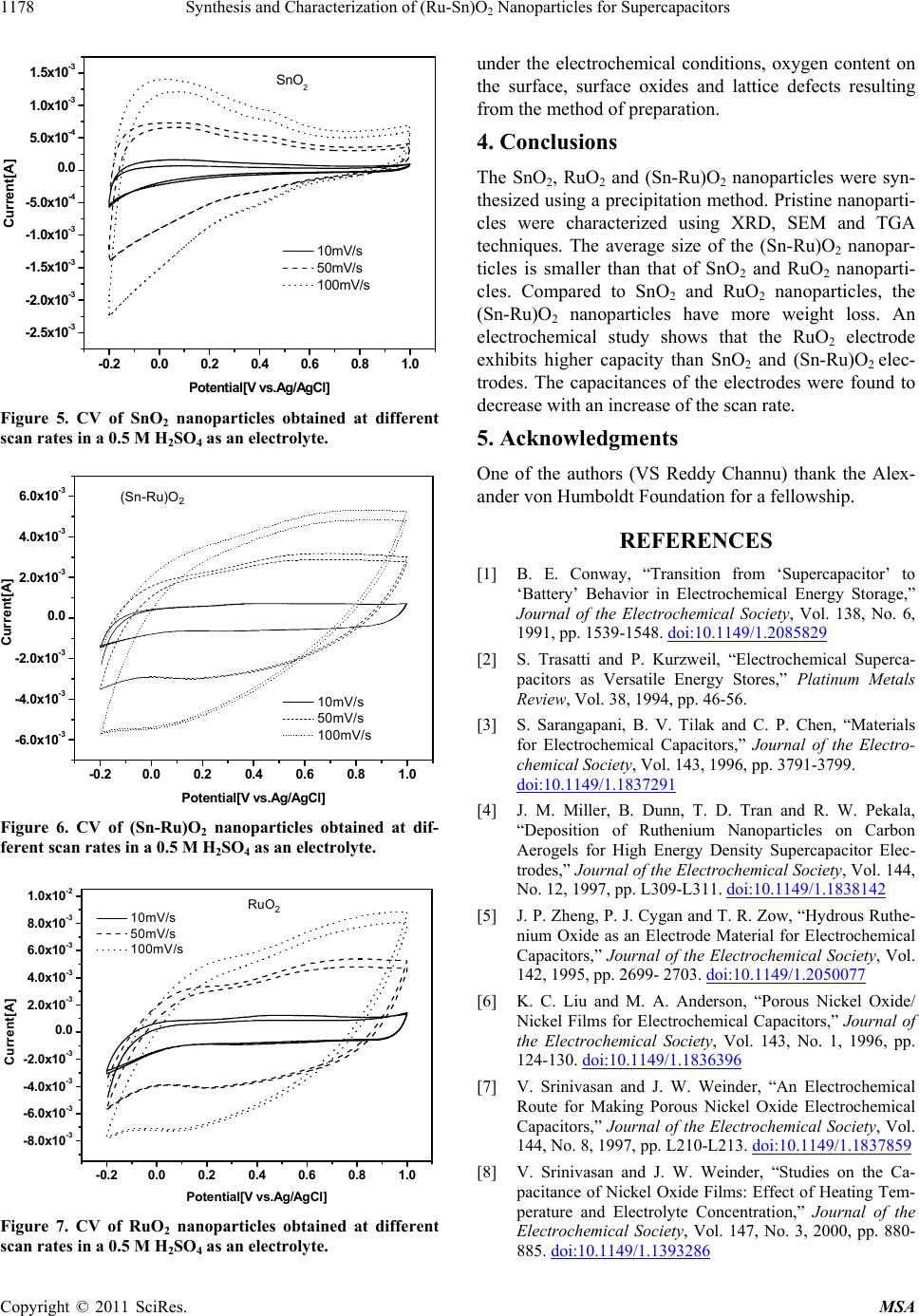 Synthesis and Characterization of (Ru-Sn)O Nanoparticles for Supercapacitors 1178 2 -0.20.0 0.2 0.4 0.6 0.8 1.0 -2.5x10⁻³ -2.0x10⁻³ -1.5x10⁻³ -1.0x10⁻³ -5.0x10⁻⁴ 0.0 5.0x10⁻⁴ 1.0x10⁻³ 1.5x10⁻³ 10mV/s 50mV/s 100mV/s Current[A] P ote n tia l[V v s . Ag/AgCl] SnO2 Figure 5. CV of SnO2 nanoparticles obtained at different scan rates in a 0.5 M H2SO4 as an electrolyte. -0.20.00.20.40.60.81.0 -6.0x10⁻³ -4.0x10⁻³ -2.0x10⁻³ 0.0 2.0x10⁻³ 4.0x10⁻³ 6.0x10⁻³ 10mV/s 50mV/s 100m V/ s Current[A] Potentia l[V vs. Ag/Ag Cl] (Sn-R u)O2 2 Figure 6. CV of (Sn-Ru)O2 nanoparticles obtained at dif- ferent scan rates in a 0.5 M H2SO4 as an electrolyte. -0.20.0 0.20.40.60.81.0 -8.0x10⁻³ -6.0x10⁻³ -4.0x10⁻³ -2.0x10⁻³ 0.0 2.0x10⁻³ 4.0x10⁻³ 6.0x10⁻³ 8.0x10⁻³ 1.0x10⁻² 10mV/s 50mV/s 100mV/s Current[A] Potential[V vs.Ag/AgCl] RuO2 2 Figure 7. CV of RuO2 nanoparticles obtained at different scan rates in a 0.5 M H2SO4 as an electrolyte. under the electrochemical conditions, oxygen content on the surface, surface oxides and lattice defects resulting from the method of preparation. 4. Conclusions The SnO2, RuO2 and (Sn-Ru)O2 nanoparticles were syn- thesized using a precipitation method. Pristine nanoparti- cles were characterized using XRD, SEM and TGA techniques. The average size of the (Sn-Ru)O2 nanopar- ticles is smaller than that of SnO2 and RuO2 nanoparti- cles. Compared to SnO2 and RuO2 nanoparticles, the (Sn-Ru)O2 nanoparticles have more weight loss. An electrochemical study shows that the RuO2 electrode exhibits higher capacity than SnO2 and (Sn-Ru)O2 elec- trodes. The capacitances of the electrodes were found to decrease with an increase of the scan rate. 5. Acknowledgments One of the authors (VS Reddy Channu) thank the Alex- ander von Humboldt Foundation for a fellowship. REFERENCES [1] B. E. Conway, “Transition from ‘Supercapacitor’ to ‘Battery’ Behavior in Electrochemical Energy Storage,” Journal of the Electrochemical Society, Vol. 138, No. 6, 1991, pp. 1539-1548. doi:10.1149/1.2085829 [2] S. Trasatti and P. Kurzweil, “Electrochemical Superca- pacitors as Versatile Energy Stores,” Platinum Metals Review, Vol. 38, 1994, pp. 46-56. [3] S. Sarangapani, B. V. Tilak and C. P. Chen, “Materials for Electrochemical Capacitors,” Journal of the Electro- chemical Society, Vol. 143, 1996, pp. 3791-3799. doi:10.1149/1.1837291 [4] J. M. Miller, B. Dunn, T. D. Tran and R. W. Pekala, “Deposition of Ruthenium Nanoparticles on Carbon Aerogels for High Energy Density Supercapacitor Elec- trodes,” Journal of the Electrochemical Society, Vol. 144, No. 12, 1997, pp. L309-L311. doi:10.1149/1.1838142 [5] J. P. Zheng, P. J. Cygan and T. R. Zow, “Hydrous Ruthe- nium Oxide as an Electrode Material for Electrochemical Capacitors,” Journal of the Electrochemical Society, Vol. 142, 1995, pp. 2699- 2703. doi:10.1149/1.2050077 [6] K. C. Liu and M. A. Anderson, “Porous Nickel Oxide/ Nickel Films for Electrochemical Capacitors,” Journal of the Electrochemical Society, Vol. 143, No. 1, 1996, pp. 124-130. doi:10.1149/1.1836396 [7] V. Srinivasan and J. W. Weinder, “An Electrochemical Route for Making Porous Nickel Oxide Electrochemical Capacitors,” Journal of the Electrochemical Society, Vol. 144, No. 8, 1997, pp. L210-L213. doi:10.1149/1.1837859 [8] V. Srinivasan and J. W. Weinder, “Studies on the Ca- pacitance of Nickel Oxide Films: Effect of Heating Tem- perature and Electrolyte Concentration,” Journal of the Electrochemical Society, Vol. 147, No. 3, 2000, pp. 880- 885. doi:10.1149/1.1393286 Copyright © 2011 SciRes. MSA  Synthesis and Characterization of (Ru-Sn)O2 Nanoparticles for Supercapacitors Copyright © 2011 SciRes. MSA 1179 [9] C. Lin, J. A. Ritter and B. N. Popov, “Characterization of Sol-Gel-Derived Cobalt Oxide Xerogels as Electro- chemical Capacitors,” Journal of the Electrochemical So- ciety, Vol. 145, No. 12, 1998, pp. 4097-4103. doi:10.1149/1.1838920 [10] S. C. Pang, M. A. Anderson and T. W. Chapman, “Novel Electrode Materials for Thin-Film Ultracapacitors: Com- parison of Electrochemical Properties of Sol-Gel-Derived and Electrodeposited Manganese Dioxide,” Journal of the Electrochemical Society, Vol.147, No. 2, 2000, pp. 444- 450. doi:10.1149/1.1393216 [11] S. C. Pang and M. A. Anderson, “Novel Electrode mate- rials for Electrochemical Capacitors: Part II. Material Characterization of Sol-Gel-Derived and Electrodeposited Manganese Dioxide Thin Films,” Journal of Materials Research, Vol. 15, No. 10, 2000, pp. 2096-2106. doi:10.1557/JMR.2000.0302 [12] X. U. Jeong and A. Manthiram, “Nanocrystalline Man- ganese Oxides for Electrochemical Capacitors with Neu- tral Electrolytes,” Journal of the Electrochemical Society, Vol. 149, No. 11, 2002, pp. A1419-A1422. doi:10.1149/1.1511188 [13] N.-L. Wu and S.-Y. Wang, “Preparation of Tin Oxide Gels with Versatile Pore Structures,” Journal of Materi- als Science, Vol. 34, No. 12, 1999, pp. 2807-2812. doi:10.1023/A:1004618915020 [14] C.-C. Hu, K.-H. Chang and C.-C. Wang, “Two-Step Hydrothermal Synthesis of Ru-Sn Oxide Composites for Electrochemical Supercapacitors,” Electrochimica Acta, Vol. 52, No. 3, 2007, pp. 4411-4418. doi:10.1016/j.electacta.2006.12.022 [15] J. Zhu, Z. Lu, S. T. Aruna, D. Aurbach and A. Gedanken, “Sonochemical Synthesis of SnO2 Nanoparticles and Their Preliminary Study as Li Insertion Electrodes,” Chemistry of Materials, Vol. 12, No. 9, 2000, pp. 2557- 2566. doi:10.1021/cm990683l [16] R. K. Selvan, I. Perelshtein, N. Perkas and A. Gedanken, “Synthesis of Hexagonal-Shaped SnO2 Nanocrystals and SnO2@C Nanocomposites for Electrochemical Redox Supercapacitors,” The Journal of Physical Chemistry C, Vol. 112, No. 6, 2008, pp. 1825-1830. doi:10.1021/jp076995q [17] C.-C. Hu and K.-H. Chang, “Cyclic Voltammetric Depo- sition of Hydrous Ruthenium Oxide for Electrochemical Capacitors: Effects of Codepositing Iridium Oxide,” Electrochimica Acta, Vol. 45, No. 17, 2000, pp. 2685- 2696. doi:10.1016/S0013-4686(00)00386-8 [18] K.-H. Chang and C.-C. Hu, “Hydrothermal Synthesis of Binary Ru-Ti Oxides with Excellent Performances for Supercapacitors,” Electrochimica Acta, Vol. 52, No. 4, 2006, pp. 1749-1757. doi:10.1016/j.electacta.2006.01.076 [19] C.-C. Hu and K.-H. Chang, “Cyclic Voltammetric Depo- sition of Hydrous Ruthenium Oxide for Electrochemical Supercapacitors: Effects of the Chloride Precursor Trans- formation,” Journal of Power Sources, Vol. 112, No. 2, 2002, pp. 401-409. doi:10.1016/S0378-7753(02)00397-X [20] C.-C. Hu, H.-Yi. Guo, K-H. Chang and C.-C. Huang, “Anodic Composite Deposition of RuO2·xH2O-TiO2 for Electrochemical Supercapacitors,” Electrochemistry Com- munica tions, Vol. 11, No. 8, 2009, pp. 1631-1634. doi:10.1016/j.elecom.2009.06.014 [21] J. Ribeiro and A. R. De Andrade, “Characterization of RuO2-Ta2O5 Coated Titanium Electrode,” Journal of the Electrochemical Society, Vol. 151, No. 10, 2004, pp. D106-D112. doi:10.1149/1.1787174 [22] C.-C. Hu, Yi-L. Yang and T.-C. Lee, “Microwave-As- sisted Hydrothermal Synthesis of RuO2·xH2O-TiO2 Nanocomposites for High Power Supercapacitors,” Elec- trochemical and Solid-State Letters, Vol. 13, No. 12, 2010, pp. A173-A176. doi:10.1149/1.3486437 [23] N.-L. Wu, “Nanocrystalline Oxide Supercapacitors,” Materials Chemistry and Physics, Vol. 75, No. 1, 2002, pp. 6-11. [24] C. C. Hu, C. C. Wang and K. H. Chang, “A Comparison Study of the Capacitive Behavior for Sol-Gel-Derived and Co-Annealed Ruthenium-Tin Oxide Composites,” Electrochimica Acta, Vol. 52, No. 7, 2007, pp. 2691-2700. doi:10.1016/j.electacta.2006.09.026 |