

Paper Menu >>
Journal Menu >>
 Psychology 2011. Vol.2, No.5, 522-525 Copyright © 2011 SciRes. DOI:10.4236/psych.2011.25081 Investigation of Prevalence and Associated Risk Factors of Depressive Symptoms Following Acute Ischemic Stroke (PSD) in the Aged Yue Chen Department of Geriatrics, the First Affiliated hospital, School of Medicine, Zhejiang University, Hangzhou, China Email: [email protected] Received April 4th, 2011; revised May 13th, 2011; accepted June 19th, 2011 Objective: The study aimed to investigate the prevalence and associated risk factors for post stroke depression (PSD), and their clinical correlations. Method: A consecutive cohort of 102 ischemic stroke patients with a mean age of 72.6 ± 7.2 years, were studied. Hamilton depression rating scale (HDRS), modified motor assess- ment scale (MMAS) and Barthel index (BI) were administered. Risk factors of PSD studied were gender, later- ality of stroke, family history of depression and post stroke functional impairment. Results: From assessment with the HDRS, 71 (69.6%) of the subjects were non-depressive and the rest 31 (30.4%) had depression. De- pressive symptoms (HDRS > 10) were relatively common, but the prevalence of severe depression (HDRS >17) was only 7.0%. Patients with depressive symptoms were more likely to be female(X2 = 4.01, P = 0.039), have a family history of depression(X2 = 3.87, P = 0.045), and a poor functional status(MMAS, t = 2.18 and P = 0.016; BI, t = 3.74 and P = 0.009). Conclusion: Our findings indicate that depressive symptoms occurred in about one third of post stroke patients. Important risk factors found for PSD included gender, family history of depression and functional impairment. Keywords: Depression, Post-Stroke, Prevalence, Risk Factors, Investigation Introduction Stroke is a common neurological problem and the third lead- ing cause of death in developed countries of the world (Katra , Dale & Crome, 1993; Warlow, 1998). Among survivors, over 50% have significant disabilities, and in clinical practice, neuro-psychiatric disturbances are also frequent (Jongbloed 1990; Hankey, 2007). Depression is an important common problem for patients who have experienced strokes, and post-stroke depression (PSD) is present in at least 30% of the survivors of strokes (Gainotti, Antonucci, Marra et al., 2001; Carson, MacHale, Allen et al., 2000). However, a consensus on the prevalence and associated factors of PSD has not been reached. Recently systematic review suggested that stroke se- verity or physical disability and functional impairment are im- portant factors associated with depression (Herrmann, Black, Lawrence et al., 1998; Singh, Black, Herrmann et al., 2000). Other possible risk factors include age, gender, lack of social support, and of psychiatric family history (Andersen, Vester- gaard, Ingemann-Nielsen et al., 1995). In China, the paucity of data on PSD and its associated risk factors prompted this study. This prospective study was to assess the prevalence of depres- sive symptoms following acute ischemic stroke in a teaching hospital in China and the associated risk factors for PSD. Subjects and Methods Patient Population One hundred-two patients were selected from consecutive inpatients in the geriatric department of No.1 affiliated hospital of medical school, Zhejiang university over two year period from October, 2008, until September, 2010 for problems related to acute ischemic stroke. The diagnosis of acute stroke met the classification of cerebrovascular diseases III of the National Institute of Neurological Disorders and Stroke (Special Report, 1990). The stroke patients were studied made up of 63(61.8%) males and 39(38.2%) females. The mean age of this group was 72.6 ± 7.2 years (ranges: 68 - 82). All patients with a known history of alcohol abuse, dementia, current antidepressant treatment, or severe Parkinson’s syndrome were excluded. Pa- tients with aphasia and difficulties for interview were also ex- cluded. The necessary socio-demographic data was obtained from each subject. Lesion location was defined by CT or MRI during the stroke onset. As part of the approved ethical clear- ance for the study, informed consent was also obtained from each patient. Instruments The subjects were studied using the following instruments: Hamilton Depression Rating Scale (HDRS) (Carr, Shepherd, Nordholm & Lynne, 1985) The post-stroke depressive symptoms were assessed by a neuropsychologist with the Hamilton Depression Rating Scale (HDRS). We defined patients as having depression if the HDRS score was above 10. Patients with an HDRS score be- tween 10 - 13 were defined as having mild depression, 14 - 17 as moderate, and above 17 as severe. Barthel’s Index (BI) (Buchanan, 1986) and Modified Motor Assessment Scale (MMAS) (Sim, Reid, Pallett &Gordon, 1975) Functional status was measured by a neurologist in the ward 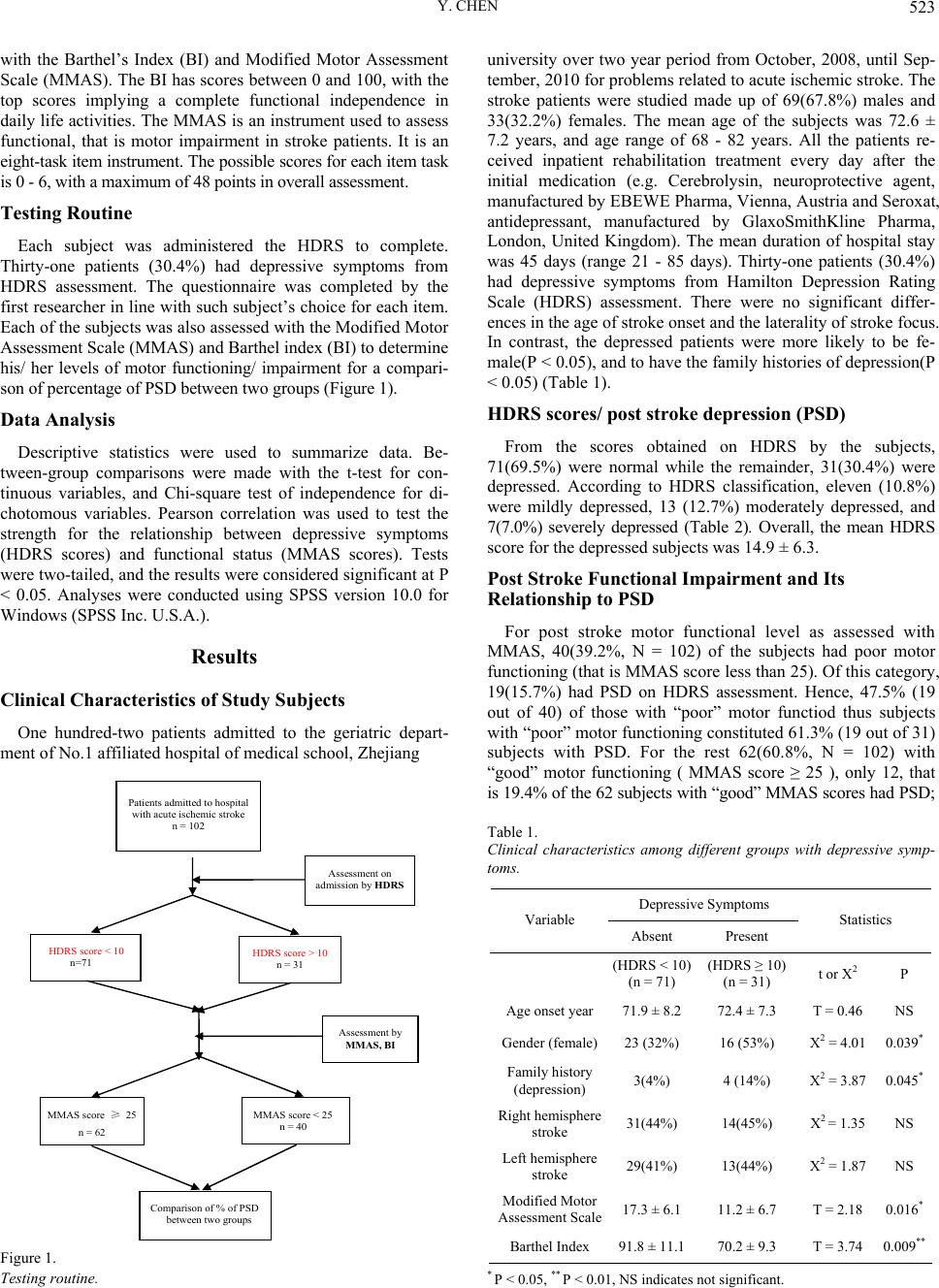 Y. CHEN 523 with the Barthel’s Index (BI) and Modified Motor Assessment Scale (MMAS). The BI has scores between 0 and 100, with the top scores implying a complete functional independence in daily life activities. The MMAS is an instrument used to assess functional, that is motor impairment in stroke patients. It is an eight-task item instrument. The possible scores for each item task is 0 - 6, with a maximum of 48 points in overall assessment. Testing Routine Each subject was administered the HDRS to complete. Thirty-one patients (30.4%) had depressive symptoms from HDRS assessment. The questionnaire was completed by the first researcher in line with such subject’s choice for each item. Each of the subjects was also assessed with the Modified Motor Assessment Scale (MMAS) and Barthel index (BI) to determine his/ her levels of motor functioning/ impairment for a compari- son of percentage of PSD between two groups (Figure 1). Data Analysis Descriptive statistics were used to summarize data. Be- tween-group comparisons were made with the t-test for con- tinuous variables, and Chi-square test of independence for di- chotomous variables. Pearson correlation was used to test the strength for the relationship between depressive symptoms (HDRS scores) and functional status (MMAS scores). Tests were two-tailed, and the results were considered significant at P < 0.05. Analyses were conducted using SPSS version 10.0 for Windows (SPSS Inc. U.S.A.). Results Clinical Characteristics of Study Subjects One hundred-two patients admitted to the geriatric depart- ment of No.1 affiliated hospital of medical school, Zhejiang Patients admitted to hospital with acute ischemic stroke n = 102 Assessment on admission by HDRS HDRS score < 10 n=71 HDRS score > 10 n = 31 Assessment by MMAS, BI MMAS score ≥ 25 n = 62 MMAS score < 25 n = 40 Comparison of % of PSD between two groups Figure 1. Testing routine. university over two year period from October, 2008, until Sep- tember, 2010 for problems related to acute ischemic stroke. The stroke patients were studied made up of 69(67.8%) males and 33(32.2%) females. The mean age of the subjects was 72.6 ± 7.2 years, and age range of 68 - 82 years. All the patients re- ceived inpatient rehabilitation treatment every day after the initial medication (e.g. Cerebrolysin, neuroprotective agent, manufactured by EBEWE Pharma, Vienna, Austria and Seroxat, antidepressant, manufactured by GlaxoSmithKline Pharma, London, United Kingdom). The mean duration of hospital stay was 45 days (range 21 - 85 days). Thirty-one patients (30.4%) had depressive symptoms from Hamilton Depression Rating Scale (HDRS) assessment. There were no significant differ- ences in the age of stroke onset and the laterality of stroke focus. In contrast, the depressed patients were more likely to be fe- male(P < 0.05), and to have the family histories of depression(P < 0.05) (Table 1). HDRS scores/ post stroke depression (PSD) From the scores obtained on HDRS by the subjects, 71(69.5%) were normal while the remainder, 31(30.4%) were depressed. According to HDRS classification, eleven (10.8%) were mildly depressed, 13 (12.7%) moderately depressed, and 7(7.0%) severely depressed (Table 2). Overall, the mean HDRS score for the depressed subjects was 14.9 ± 6.3. Post Stroke Functional Impairment and Its Relationship to PSD For post stroke motor functional level as assessed with MMAS, 40(39.2%, N = 102) of the subjects had poor motor functioning (that is MMAS score less than 25). Of this category, 19(15.7%) had PSD on HDRS assessment. Hence, 47.5% (19 out of 40) of those with “poor” motor functiod thus subjects with “poor” motor functioning constituted 61.3% (19 out of 31) subjects with PSD. For the rest 62(60.8%, N = 102) with “good” motor functioning ( MMAS score ≥ 25 ), only 12, that is 19.4% of the 62 subjects with “good” MMAS scores had PSD; Table 1. Clinical characteristics among different groups with depressive symp- toms. Depressive Symptoms Variable Absent Present Statistics (HDRS < 10) (n = 71) (HDRS ≥ 10) (n = 31) t or X2 P Age onset year 71.9 ± 8.272.4 ± 7.3 T = 0.46NS Gender (female)23 (32%) 16 (53%) X2 = 4.010.039* Family history (depression) 3(4%) 4 (14%) X2 = 3.870.045* Right hemisphere stroke 31(44%) 14(45%) X2 = 1.35NS Left hemisphere stroke 29(41%) 13(44%) X2 = 1.87NS Modified Motor Assessment Scale17.3 ± 6.111.2 ± 6.7 T = 2.180.016* Barthel Index 91.8 ± 11.170.2 ± 9.3 T = 3.740.009** * P < 0.05, ** P < 0.01, NS indicates not significant. 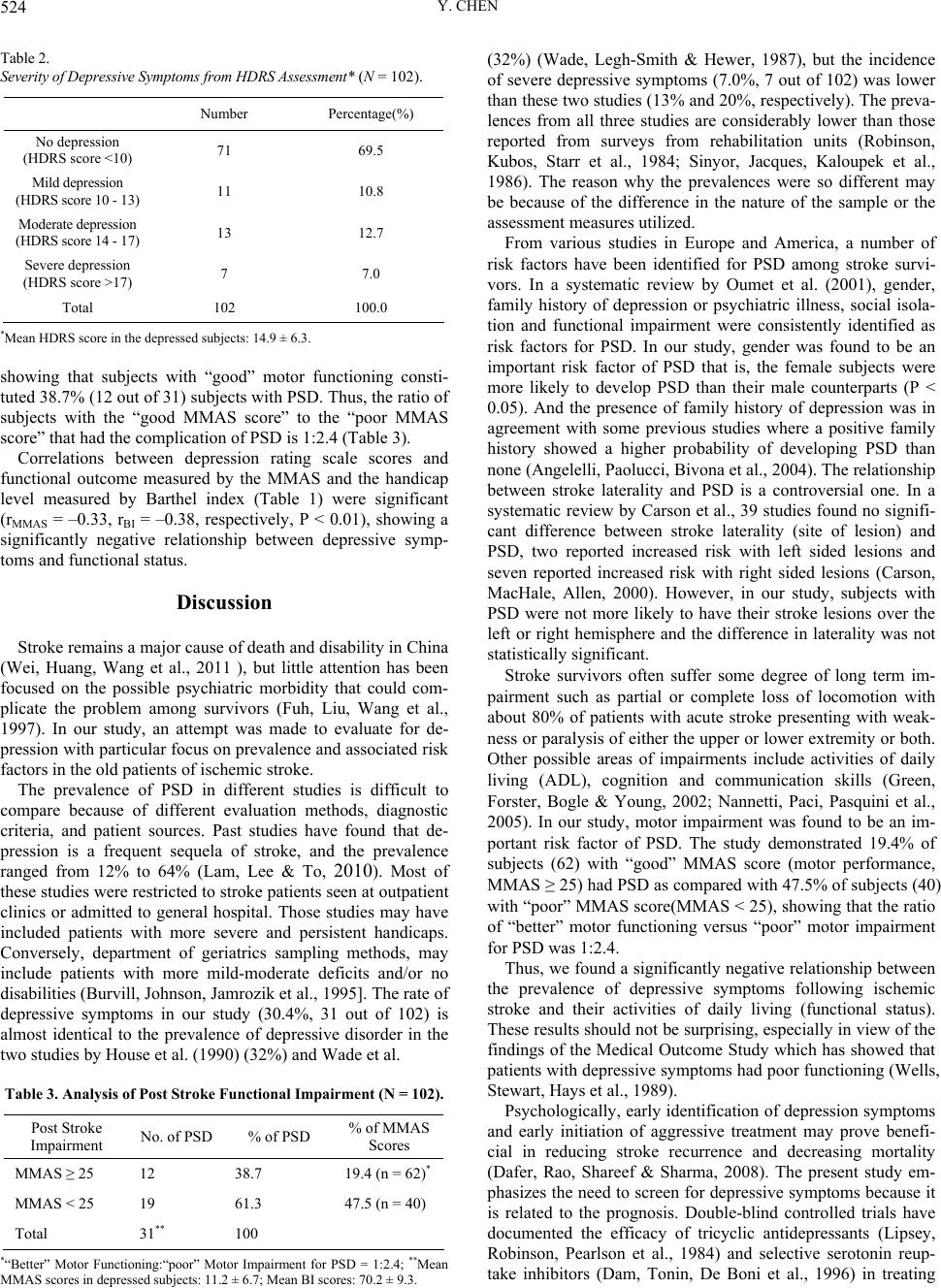 Y. CHEN 524 Table 2. Severity of Depressive Symptoms from HDRS Assessment* (N = 102). Number Percentage(%) No depression (HDRS score <10) 71 69.5 Mild depression (HDRS score 10 - 13) 11 10.8 Moderate depression (HDRS score 14 - 17) 13 12.7 Severe depression (HDRS score >17) 7 7.0 Total 102 100.0 *Mean HDRS score in the depressed subjects: 14.9 ± 6.3. showing that subjects with “good” motor functioning consti- tuted 38.7% (12 out of 31) subjects with PSD. Thus, the ratio of subjects with the “good MMAS score” to the “poor MMAS score” that had the complication of PSD is 1:2.4 (Table 3). Correlations between depression rating scale scores and functional outcome measured by the MMAS and the handicap level measured by Barthel index (Table 1) were significant (rMMAS = –0.33, rBI = –0.38, respectively, P < 0.01), showing a significantly negative relationship between depressive symp- toms and functional status. Discussion Stroke remains a major cause of death and disability in China (Wei, Huang, Wang et al., 2011 ), but little attention has been focused on the possible psychiatric morbidity that could com- plicate the problem among survivors (Fuh, Liu, Wang et al., 1997). In our study, an attempt was made to evaluate for de- pression with particular focus on prevalence and associated risk factors in the old patients of ischemic stroke. The prevalence of PSD in different studies is difficult to compare because of different evaluation methods, diagnostic criteria, and patient sources. Past studies have found that de- pression is a frequent sequela of stroke, and the prevalence ranged from 12% to 64% (Lam, Lee & To, 2010). Most of these studies were restricted to stroke patients seen at outpatient clinics or admitted to general hospital. Those studies may have included patients with more severe and persistent handicaps. Conversely, department of geriatrics sampling methods, may include patients with more mild-moderate deficits and/or no disabilities (Burvill, Johnson, Jamrozik et al., 1995]. The rate of depressive symptoms in our study (30.4%, 31 out of 102) is almost identical to the prevalence of depressive disorder in the two studies by House et al. (1990) (32%) and Wade et al. Table 3. Analysis of Post Stroke Functi on al Impairment (N = 102). Post Stroke Impairment No. of PSD % of PSD % of MMAS Scores MMAS ≥ 25 12 38.7 19.4 (n = 62)* MMAS < 25 19 61.3 47.5 (n = 40) Total 31** 100 *“Better” Motor Functioning:“poor” Motor Impairment for PSD = 1:2.4; **Mean MMAS scores in depressed subjects: 11.2 ± 6.7; Mean BI scores: 70.2 ± 9.3. (32%) (Wade, Legh-Smith & Hewer, 1987), but the incidence of severe depressive symptoms (7.0%, 7 out of 102) was lower than these two studies (13% and 20%, respectively). The preva- lences from all three studies are considerably lower than those reported from surveys from rehabilitation units (Robinson, Kubos, Starr et al., 1984; Sinyor, Jacques, Kaloupek et al., 1986). The reason why the prevalences were so different may be because of the difference in the nature of the sample or the assessment measures utilized. From various studies in Europe and America, a number of risk factors have been identified for PSD among stroke survi- vors. In a systematic review by Oumet et al. (2001), gender, family history of depression or psychiatric illness, social isola- tion and functional impairment were consistently identified as risk factors for PSD. In our study, gender was found to be an important risk factor of PSD that is, the female subjects were more likely to develop PSD than their male counterparts (P < 0.05). And the presence of family history of depression was in agreement with some previous studies where a positive family history showed a higher probability of developing PSD than none (Angelelli, Paolucci, Bivona et al., 2004). The relationship between stroke laterality and PSD is a controversial one. In a systematic review by Carson et al., 39 studies found no signifi- cant difference between stroke laterality (site of lesion) and PSD, two reported increased risk with left sided lesions and seven reported increased risk with right sided lesions (Carson, MacHale, Allen, 2000). However, in our study, subjects with PSD were not more likely to have their stroke lesions over the left or right hemisphere and the difference in laterality was not statistically significant. Stroke survivors often suffer some degree of long term im- pairment such as partial or complete loss of locomotion with about 80% of patients with acute stroke presenting with weak- ness or paralysis of either the upper or lower extremity or both. Other possible areas of impairments include activities of daily living (ADL), cognition and communication skills (Green, Forster, Bogle & Young, 2002; Nannetti, Paci, Pasquini et al., 2005). In our study, motor impairment was found to be an im- portant risk factor of PSD. The study demonstrated 19.4% of subjects (62) with “good” MMAS score (motor performance, MMAS ≥ 25) had PSD as compared with 47.5% of subjects (40) with “poor” MMAS score(MMAS < 25), showing that the ratio of “better” motor functioning versus “poor” motor impairment for PSD was 1:2.4. Thus, we found a significantly negative relationship between the prevalence of depressive symptoms following ischemic stroke and their activities of daily living (functional status). These results should not be surprising, especially in view of the findings of the Medical Outcome Study which has showed that patients with depressive symptoms had poor functioning (Wells, Stewart, Hays et al., 1989). Psychologically, early identification of depression symptoms and early initiation of aggressive treatment may prove benefi- cial in reducing stroke recurrence and decreasing mortality (Dafer, Rao, Shareef & Sharma, 2008). The present study em- phasizes the need to screen for depressive symptoms because it is related to the prognosis. Double-blind controlled trials have documented the efficacy of tricyclic antidepressants (Lipsey, Robinson, Pearlson et al., 1984) and selective serotonin reup- take inhibitors (Dam, Tonin, De Boni et al., 1996) in treating  Y. CHEN 525 post-stroke depression. It is unclear whether the amelioration in depressive symptoms will be associated with improvement of functional status. Further studies are needed. Conclusion Our study indicates that depressive symptoms occurred in about one third of post stroke patients. Important risk factors found for PSD included gender, family history of depression and functional impairment. There is a negative correlation be- tween depressive symptoms and functional status of the pa- tients. Acknowledgements The authors would like to thank Dr Jiu-jiao Wang (No.1 affiliated hospital of Zhejiang University, Hangzhou, Zhejiang Province, China) for her psychological assistance in HDRS assessment in our study. References Andersen G., Vestergaard K., Ingemann-Nielsen M., et al. (1995). Risk factors for post-stroke depression. Acta Psychiatrica Scandinavica, 92:193-198. doi:10.1111/j.1600-0447.1995.tb09567.x Angelelli P., Paolucci S., Bivona U., Piccardi L., Ciurli P., Cantagallo A., et al. (2004). Development of neuro-psychiatric symptoms in post stroke patients: A cross sectional study. Acta Psychiatrica Scandi- navica, 110, 55-63. doi:10.1111/j.1600-0447.2004.00297.x Buchanan B. F. (1986). Functional assessment: measurement with the Barthel Index and PULSES profile. Home Healthc Nurse., 4, 11-17. doi:10.1097/00004045-198611000-00004 Burvill P. W., Johnson G. A., Jamrozik K. D., et al. (1995). Prevalence of depression after stroke: the Perth Community Stroke Study. The British Journal of P sychiatry, 166, 320-327. doi:10.1192/bjp.166.3.320 Carson A. J., MacHale S., Allen K., et al. (2000). Depression after stroke and lesion location: A systematic review. Lancet, 356, 122-126. doi:10.1016/S0140-6736(00)02448-X Carson AJ, MacHale S, Allen K. (2000) Depression after stroke and lesion location: a systematic review. Lancet, 8, 122-126. Carr J. H., Shepherd R. B., Nordholm I., & Lynne D. (1985). Investiga- tion of a new motor assessment for stroke patients. Physical Therapy, 65, 175-190. Dafer R. M., Rao M., Shareef A., & Sharma A. (2008). Poststroke depression. Topics in Stroke Rehabilitation, 15, 13-21. doi:10.1310/tsr1501-13 Dam M., Tonin P., De Boni A., et al. (1996). Fluoxetine and maprotiline on functional recovery in poststroke hemiplegic patients undergoing rehabilitation therapy. Stroke, 2 7, 1211-1214. doi:10.1161/01.STR.27.7.1211 Fuh J. L., Liu H. C., Wang S. J., et al. (1997). Poststroke depression among the Chinese elderly in a rural community. Stroke, 28, 1126-1129. doi:10.1161/01.STR.28.6.1126 Gainotti G., Antonucci G., Marra C., et al. (2001). Relation between depression after stroke, antidepressant therapy, and functional recov- ery. Journal of Neurology, Neurosurgery & Psychiatry, 71, 258-261. doi:10.1136/jnnp.71.2.258 Green J, Forster A, Bogle S, & Young J. (2002). Physiotherapy for patients with mobility problems more than 1 year after stroke: A randomized controlled trial. Lancet, 359, 199-203. doi:10.1016/S0140-6736(02)07443-3 Hankey G. J. (2007). Clinical update: management of stroke. Lancet, 369, 1330-1332. doi:10.1016/S0140-6736(07)60614-X Herrmann N., Black S. E., Lawrence J., et al. (1998). The Sunnybrook Stroke Study: A prospective study of depressive symptoms and func- tional outcome. Stroke, 29, 618-624. doi:10.1161/01.STR.29.3.618 House A., Dennis M., Warlow C., et al. (1990). Mood disorders after stroke and their relation to lesion location. Brain, 113, 1113-1129. doi:10.1093/brain/113.4.1113 Jongbloed L. (1990) Problems of methodological heterogeneity in studies predicting disability after stroke. Stroke, 21, 32-34. Katra L., Dale P., & Crome P. (1993). Improving stroke rehabilitation: A controlled study. Stroke, 24, 1462-1467. doi:10.1161/01.STR.24.10.1462 Lam S. C., Lee L. Y. & To K. W. (2010). Depressive symptoms among community-dwelling, post-stroke elders in Hong Kong. International Nursing Review, 57, 269-273. doi:10.1111/j.1466-7657.2009.00789.x Lipsey J. R., Robinson R. G., Pearlson G. D., et al. (1984). Nortrip- tyline treatment of post-stroke depression: a double-blind study. Lancet, 1, 297-300. doi:10.1016/S0140-6736(84)90356-8 Nannetti L., Paci M., Pasquini J., Lombardi B., & Taiti P. G. (2005). Motor and functional recovery in patients with post stroke depression. Disability and Rehabilitation, 27, 170-175. doi:10.1080/09638280400009378 Ouimet M. A., Primeau F., &Cole M. G. (2001). Psychosocial risk factors in post-stroke depression: A systematic review Can. The American Journal of Psychia tr y, 46, 819-828. Robinson R. G., Kubos K. L., Starr L. B., et al. (1984). Mood disorders in stroke patients. Importance of location of lesion. Brain, 107, 81-93. doi:10.1093/brain/107.1.81 Special Report from the National Institute of Neurological Disorders and Stroke. (1990). Classification of cerebrovascular diseases III. Stroke, 21, 637-676. doi:10.1161/01.STR.21.4.637 Singh A, Black SE, Herrmann N, et al. (2000). Functional and neuro- anatomic correlations in post stroke depression. Stroke, 31, 637-644. doi:10.1161/01.STR.31.3.637 Sim M., Reid D., Pallett J., & Gordon E. (1975). The Hamilton rating scale. An assessment bases on a dothiepin versus imipramine clinical trial. International Pha rm ac op s yc hi atry, 10, 142-148. Sinyor D., Jacques P., Kaloupek D. G., et al. (1986). Post-stroke de- pression and lesion location: an attempted replication. Brain, 109, 537-546. doi:10.1093/brain/109.3.537 Wade D. T., Legh-Smith J., & Hewer R. A. (1987). Depressed mood after stroke: A community study of its frequency. The British Journal of Psychiatry, 151, 200-205. doi:10.1192/bjp.151.2.200 Warlow C. P. (1998). Epidemiology of stroke. Lancet, 352, S111-S1114. doi:10.1016/S0140-6736(98)90086-1 Wei J. W., Huang Y., Wang J. G., Liu M., Wong L. K., Huang Q., & Wu L. (2011). Current management of intracerebral haemorrhage in China: A national, multi-centre, hospital register study. BMC Neu- rology, 11, 16-21. Wells K. B, Stewart A., Hays R. D., et al. (1989). The functioning and well-being of depressed patients: results from the Medical Outcomes Study. The Journal of the American Medical Association, 262, 914-919. doi:10.1001/jama.262.7.914 |