

Paper Menu >>
Journal Menu >>
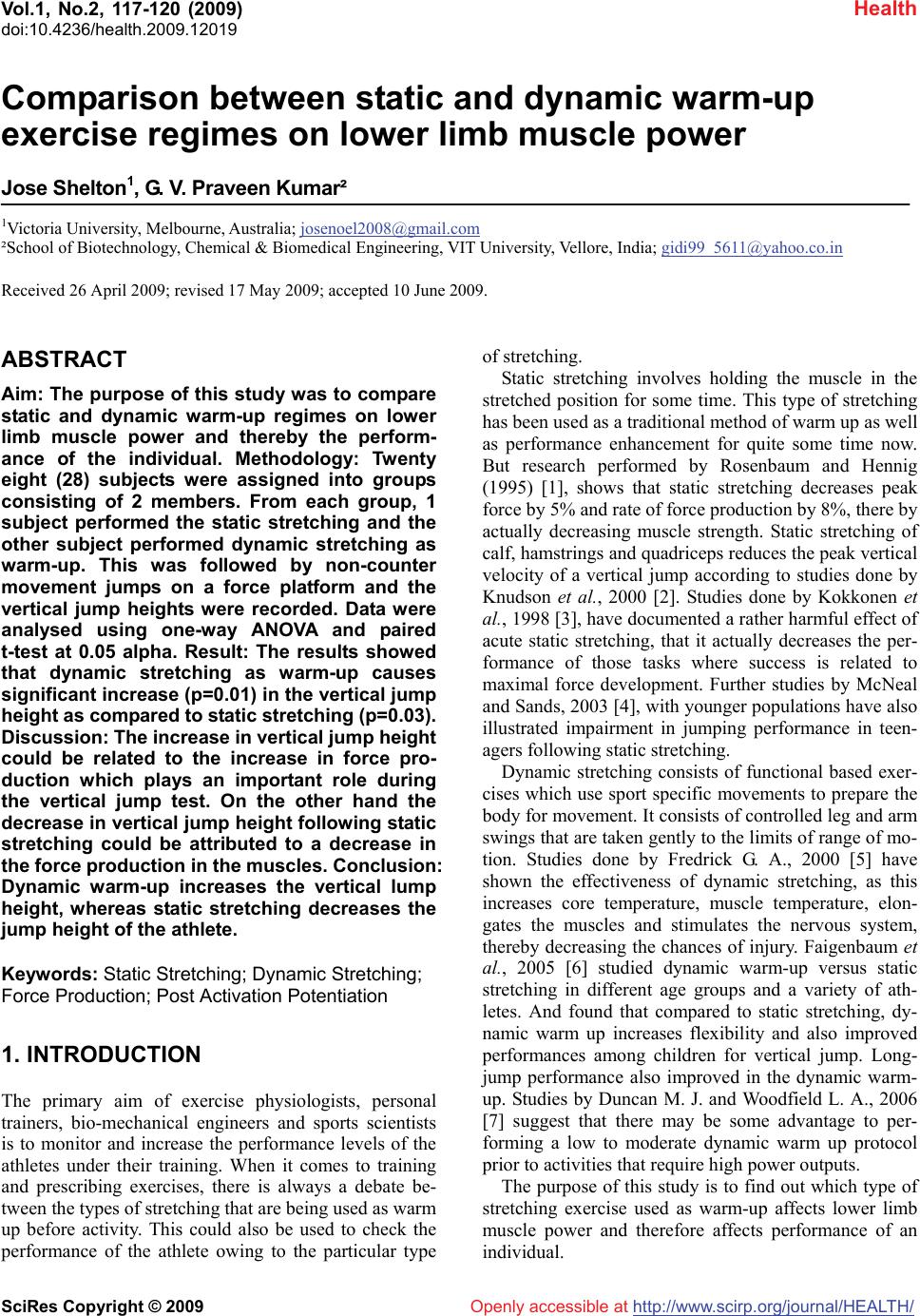 Vol.1, No.2, 117-120 (2009) doi:10.4236/health.2009.12019 SciRes Copyright © 2009 http://www.scirp.org/journal/HEALTH/ Health Openly accessible at Comparison between static and dynamic warm-up exercise regimes on lower limb muscle power Jose Shelton1, G. V. Praveen Kumar² 1Victoria University, Melbourne, Australia; [email protected] ²School of Biotechnology, Chemical & Biomedical Engineering, VIT University, Vellore, India; [email protected] Received 26 April 2009; revised 17 May 2009; accepted 10 June 2009. ABSTRACT Aim: The purpose of this study was to compare static and dynamic warm-up regimes on lower limb muscle power and thereby the perform- ance of the individual. Methodology: Twenty eight (28) subjects were assigned into groups consisting of 2 members. From each group, 1 subject performed the static stretching and the other subject performed dynamic stretching as warm-up. This was followed by non-counter movement jumps on a force platform and the vertical jump heights were recorded. Data were analysed using one-way ANOVA and paired t-test at 0.05 alpha. Result: The results showed that dynamic stretching as warm-up causes significant increase (p=0.01) in the vertical jump height as compared to static stretching (p=0.03). Discussion: The increase in vertical jump height could be related to the increase in force pro- duction which plays an important role during the vertical jump test. On the other hand the decrease in vertical jump height following static stretching could be attributed to a decrease in the force production in the muscles. Conclusion: Dynamic warm-up increases the vertical lump height, whereas static stretching decreases the jump height of the athlete. Keywords: Static Stretching; Dynamic Stretching; Force Production; Post Activation Potentiation 1. INTRODUCTION The primary aim of exercise physiologists, personal trainers, bio-mechanical engineers and sports scientists is to monitor and increase the performance levels of the athletes under their training. When it comes to training and prescribing exercises, there is always a debate be- tween the types of stretching that are being used as warm up before activity. This could also be used to check the performance of the athlete owing to the particular type of stretching. Static stretching involves holding the muscle in the stretched position for some time. This type of stretching has been used as a traditional method of warm up as well as performance enhancement for quite some time now. But research performed by Rosenbaum and Hennig (1995) [1], shows that static stretching decreases peak force by 5% and rate of force production by 8%, there by actually decreasing muscle strength. Static stretching of calf, hamstrings and quadriceps reduces the peak vertical velocity of a vertical jump according to studies done by Knudson et al., 2000 [2]. Studies done by Kokkonen et al., 1998 [3], have documented a rather harmful effect of acute static stretching, that it actually decreases the per- formance of those tasks where success is related to maximal force development. Further studies by McNeal and Sands, 2003 [4], with younger populations have also illustrated impairment in jumping performance in teen- agers following static stretching. Dynamic stretching consists of functional based exer- cises which use sport specific movements to prepare the body for movement. It consists of controlled leg and arm swings that are taken gently to the limits of range of mo- tion. Studies done by Fredrick G. A., 2000 [5] have shown the effectiveness of dynamic stretching, as this increases core temperature, muscle temperature, elon- gates the muscles and stimulates the nervous system, thereby decreasing the chances of injury. Faigenbaum et al., 2005 [6] studied dynamic warm-up versus static stretching in different age groups and a variety of ath- letes. And found that compared to static stretching, dy- namic warm up increases flexibility and also improved performances among children for vertical jump. Long- jump performance also improved in the dynamic warm- up. Studies by Duncan M. J. and Woodfield L. A., 2006 [7] suggest that there may be some advantage to per- forming a low to moderate dynamic warm up protocol prior to activities that require high power outputs. The purpose of this study is to find out which type of stretching exercise used as warm-up affects lower limb muscle power and therefore affects performance of an individual. 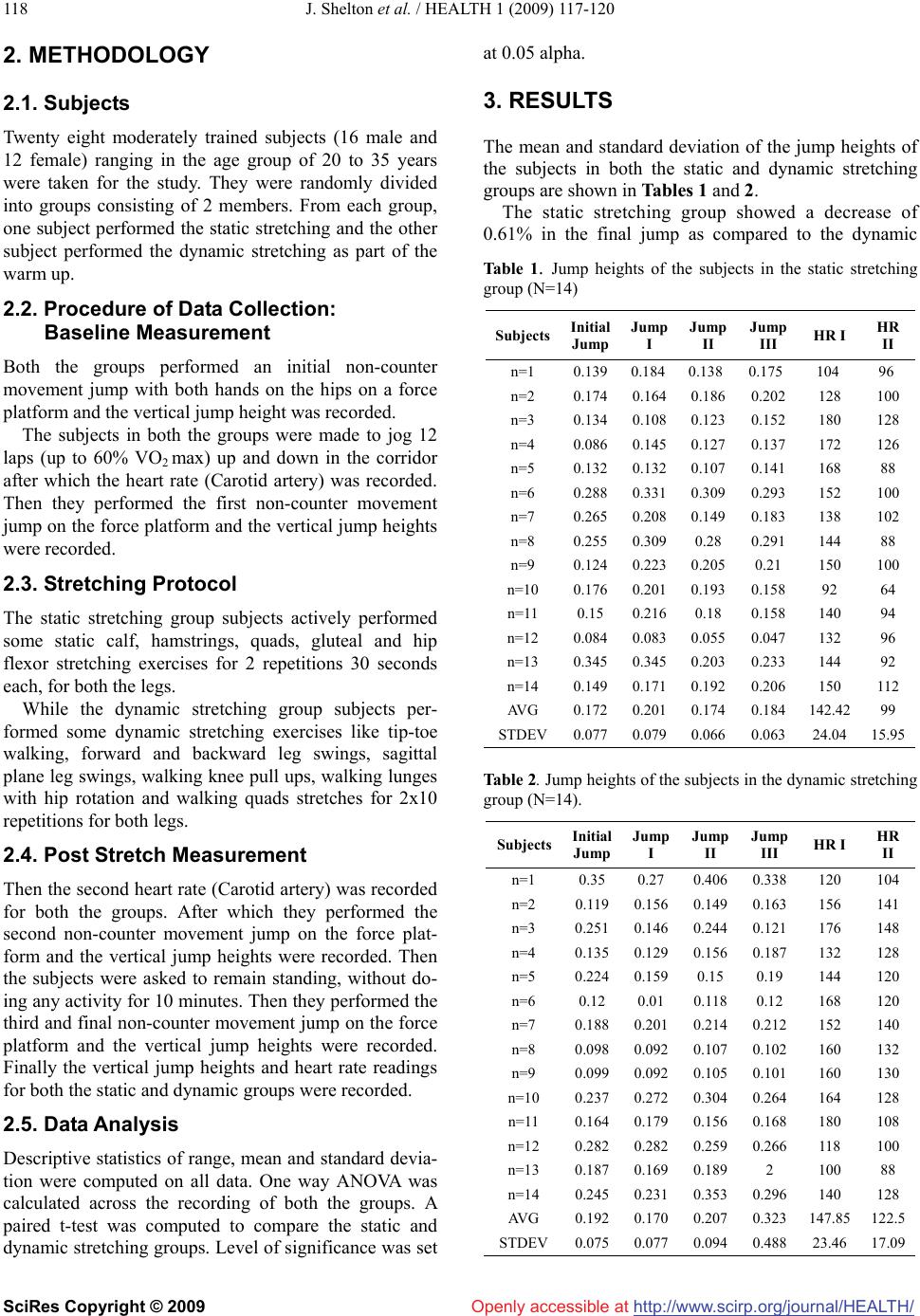 http://www.scirp.org/journal/HEALTH/ J. Shelton et al. / HEALTH 1 (2009) 117-120118 Openly accessible at 2. METHODOLOGY 2.1. Subjects Twenty eight moderately trained subjects (16 male and 12 female) ranging in the age group of 20 to 35 years were taken for the study. They were randomly divided into groups consisting of 2 members. From each group, one subject performed the static stretching and the other subject performed the dynamic stretching as part of the warm up. 2.2. Procedure of Data Collection: Baseline Measurement Both the groups performed an initial non-counter movement jump with both hands on the hips on a force platform and the vertical jump height was recorded. The subjects in both the groups were made to jog 12 laps (up to 60% VO2 max) up and down in the corridor after which the heart rate (Carotid artery) was recorded. Then they performed the first non-counter movement jump on the force platform and the vertical jump heights were recorded. 2.3. Stretching Protocol The static stretching group subjects actively performed some static calf, hamstrings, quads, gluteal and hip flexor stretching exercises for 2 repetitions 30 seconds each, for both the legs. While the dynamic stretching group subjects per- formed some dynamic stretching exercises like tip-toe walking, forward and backward leg swings, sagittal plane leg swings, walking knee pull ups, walking lunges with hip rotation and walking quads stretches for 2x10 repetitions for both legs. 2.4. Post Stretch Measurement Then the second heart rate (Carotid artery) was recorded for both the groups. After which they performed the second non-counter movement jump on the force plat- form and the vertical jump heights were recorded. Then the subjects were asked to remain standing, without do- ing any activity for 10 minutes. Then they performed the third and final non-counter movement jump on the force platform and the vertical jump heights were recorded. Finally the vertical jump heights and heart rate readings for both the static and dynamic groups were recorded. 2.5. Data Analysis Descriptive statistics of range, mean and standard devia- tion were computed on all data. One way ANOVA was calculated across the recording of both the groups. A paired t-test was computed to compare the static and dynamic stretching groups. Level of significance was set at 0.05 alpha. 3. RESULTS The mean and standard deviation of the jump heights of the subjects in both the static and dynamic stretching groups are shown in Tables 1 and 2. The static stretching group showed a decrease of 0.61% in the final jump as compared to the dynamic Table 1. Jump heights of the subjects in the static stretching group (N=14) Subjects Initial Jump Jump I Jump II Jump III HR IHR II n=1 0.1390.1840.138 0.175 104 96 n=2 0.1740.1640.186 0.202 128 100 n=3 0.1340.1080.123 0.152 180 128 n=4 0.0860.1450.127 0.137 172 126 n=5 0.1320.1320.107 0.141 168 88 n=6 0.2880.3310.309 0.293 152 100 n=7 0.2650.2080.149 0.183 138 102 n=8 0.2550.3090.28 0.291 144 88 n=9 0.1240.2230.205 0.21 150 100 n=10 0.1760.2010.193 0.158 92 64 n=11 0.15 0.2160.18 0.158 140 94 n=12 0.0840.0830.055 0.047 132 96 n=13 0.3450.3450.203 0.233 144 92 n=14 0.1490.1710.192 0.206 150 112 AVG 0.1720.2010.174 0.184 142.4299 STDEV 0.0770.0790.066 0.063 24.0415.95 Table 2. Jump heights of the subjects in the dynamic stretching group (N=14). Subjects Initial Jump Jump I Jump II Jump III HR IHR II n=1 0.35 0.27 0.406 0.338 120 104 n=2 0.1190.1560.149 0.163 156 141 n=3 0.2510.1460.244 0.121 176 148 n=4 0.1350.1290.156 0.187 132 128 n=5 0.2240.1590.15 0.19 144 120 n=6 0.12 0.01 0.118 0.12 168 120 n=7 0.1880.2010.214 0.212 152 140 n=8 0.0980.0920.107 0.102 160 132 n=9 0.0990.0920.105 0.101 160 130 n=10 0.2370.2720.304 0.264 164 128 n=11 0.1640.1790.156 0.168 180 108 n=12 0.2820.2820.259 0.266 118 100 n=13 0.1870.1690.189 2 100 88 n=14 0.2450.2310.353 0.296 140 128 AVG 0.1920.1700.207 0.323 147.85122.5 STDEV0.075 0.077 0.094 0.488 23.4617.09 SciRes Copyright © 2009 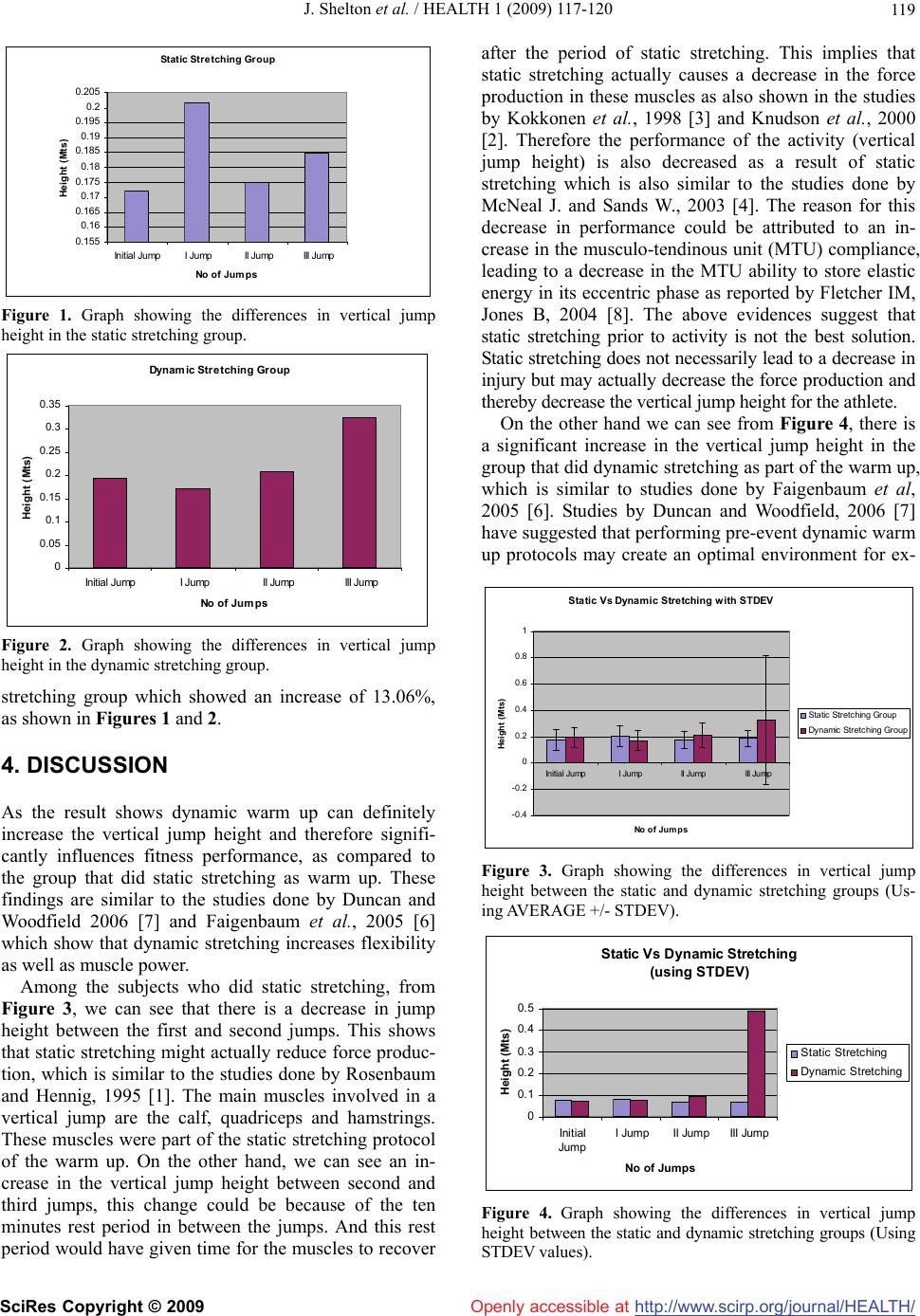 http://www.scirp.org/journal/HEALTH/ J. Shelton et al. / HEALTH 1 (2009) 117-120119 Openly accessible at Static Stretching Group 0.155 0.16 0.165 0.17 0.175 0.18 0.185 0.19 0.195 0.2 0.205 Initial Jump I Jump II Jump III Jump No of Jumps Height (Mts) Figure 1. Graph showing the differences in vertical jump height in the static stretching group. Dynamic Stretching Group 0 0.05 0.1 0.15 0.2 0.25 0.3 0.35 Initial Jump I Jump II Jump III Jump No of Jumps Height (Mts) Figure 2. Graph showing the differences in vertical jump height in the dynamic stretching group. stretching group which showed an increase of 13.06%, as shown in Figures 1 and 2. 4. DISCUSSION As the result shows dynamic warm up can definitely increase the vertical jump height and therefore signifi- cantly influences fitness performance, as compared to the group that did static stretching as warm up. These findings are similar to the studies done by Duncan and Woodfield 2006 [7] and Faigenbaum et al., 2005 [6] which show that dynamic stretching increases flexibility as well as muscle power. Among the subjects who did static stretching, from Figure 3, we can see that there is a decrease in jump height between the first and second jumps. This shows that static stretching might actually reduce force produc- tion, which is similar to the studies done by Rosenbaum and Hennig, 1995 [1]. The main muscles involved in a vertical jump are the calf, quadriceps and hamstrings. These muscles were part of the static stretching protocol of the warm up. On the other hand, we can see an in- crease in the vertical jump height between second and third jumps, this change could be because of the ten minutes rest period in between the jumps. And this rest period would have given time for the muscles to recover after the period of static stretching. This implies that static stretching actually causes a decrease in the force production in these muscles as also shown in the studies by Kokkonen et al., 1998 [3] and Knudson et al., 2000 [2]. Therefore the performance of the activity (vertical jump height) is also decreased as a result of static stretching which is also similar to the studies done by McNeal J. and Sands W., 2003 [4]. The reason for this decrease in performance could be attributed to an in- crease in the musculo-tendinous unit (MTU) compliance, leading to a decrease in the MTU ability to store elastic energy in its eccentric phase as reported by Fletcher IM, Jones B, 2004 [8]. The above evidences suggest that static stretching prior to activity is not the best solution. Static stretching does not necessarily lead to a decrease in injury but may actually decrease the force production and thereby decrease the vertical jump height for the athlete. On the other hand we can see from Figure 4, there is a significant increase in the vertical jump height in the group that did dynamic stretching as part of the warm up, which is similar to studies done by Faigenbaum et al, 2005 [6]. Studies by Duncan and Woodfield, 2006 [7] have suggested that performing pre-event dynamic warm up protocols may create an optimal environment for ex- Static Vs Dynamic Stretching with STDEV -0.4 -0.2 0 0.2 0.4 0.6 0.8 1 Initial Jump I JumpII Jump III Jump No of Jumps Height (Mts) Static Stretching Group Dynamic Stretching Group Figure 3. Graph showing the differences in vertical jump height between the static and dynamic stretching groups (Us- ing AVERAGE +/- STDEV). Static Vs Dynamic Stretching (using STDEV) 0 0.1 0.2 0.3 0.4 0.5 Initial Jump I Jump II Jump III Jump No of Jumps Height (Mts) Static Stretching Dynamic Stretching Figure 4. Graph showing the differences in vertical jump height between the static and dynamic stretching groups (Using STDEV values). SciRes Copyright © 2009  J. Shelton et al. / HEALTH 1 (2009) 117-120 SciRes Copyright © 2009 http://www.scirp.org/journal/HEALTH/ 120 plosive force production by enhancing neuromuscular function. This occurrence has been termed the ‘postac- tivation potentiation’ (PAP) [9] and is believed to in- crease the rate of force development, thereby increasing speed and power production. This finding was similar to the study done by Faigenbaum et al., 2005 [6]. Dynamic warm up activities used in the study may have influ- enced the excitability of fast twitch motor units and therefore readied these units to play a more significant role during the vertical jump test. However no tests of neuromuscular activation were performed in this study. Neuromuscular activation studies can be done in future to measure the excitability of fast twitch motor units. The results of the current study suggest that there may be some advantage to performing a low to moderate dy- namic warm up protocol prior to activities that require high power outputs. And the increase in vertical jump height following dynamic warm up compared to static warm up is considerable. Openly accessible at Faigenbaum et al. 2005 [6] in his study also says that the evidence supporting the injury-reducing and per- formance-enhancing potential of static stretching is presently lacking. So it may be desirable to perform dy- namic stretching during the warm up period and static stretching during the cool down. The purpose of warm up exercise is to warm-up the body, but static stretching seems to cause cool down of the body. 5. CONCLUSIONS From the above study it can be concluded that the effect of dynamic stretching as warm up has the following benefits. Dynamic Stretching increase force production prior to activity, which in turn can improve the vertical jump height of the athlete. As exercise physiologists and sports scientists our main objective is to decrease the injury levels and in- crease the performance levels of the athletes. And the above evidences from related literature suggest that dy- namic stretching is the best type of stretching that can be performed during warm-up in order to increase the jump height of the athlete and to increase performance levels of the athlete. From the findings of the study in order to increase the vertical jump height of the athlete we can recommend a sports performance program that includes dynamic activities during warm up and static stretching as part of the cool down. REFERENCES [1] Rosenbaum, D. and E. M. Hennig (1995) The influence of stretching and warm-up exercises on Achilles tendon reflex activity. Journal of Sport Sciences, 13(6), 481-90. [2] Knudson, D., Bennet, K., Corn, R., Leick, D., Smith, C., (2000) Acute effects of stretching are not evident in the kinematics of the vertical jump. Research Quarterly for Exercise and Sport, 71(1-Supplement), A-30. [3] Kokkonen, J., Nelson, A. G., Cornwell, A. (1998) Acute muscle stretching inhibits maximal strength performance. Research Quarterly for Exercise and Sport, 69, 411-415. [4] McNeal, J. and Sands, W., (2003) Acute static stretching reduces lower extremity power in trained children. Pedi- atric Exercise Science, 15, 139-145. [5] Frederick, G.A. (2001) Baseball part-1 dynamic flexibil- ity. Strength & Conditioning Journal, 23(1), 21-30. [6] Faigenbaum, A.D., Bellucci, M.A., Bernieri, A, Bakker, B., Hoorens, K., (2005) Acute effects of different warm up protocols on fitness performance in children. Journal of Strength & Conditioning Research, 19(2), 376–381. [7] Duncan, M.J. and Woodfield, L.A., (2006) Acute effects of warm up protocol on flexibility and vertical jump in children. Journal of Exercise Physiologyonline, online, 9 (3), 9-16. [8] Fletcher, I.M. and Jones, B., (2004) The effects of dif- ferent warm up stretch protocols on 20metre sprint per- formance in trained rugby union players. Journal of Strength and Conditioning Research, 18(4), 885. [9] Sale, D., (2002) Postactivation potentiation: Role in hu- man performance. Exercise Sport Science Review, 30(3), 138-143. |