

Paper Menu >>
Journal Menu >>
 Psychology 2011. Vol.2, No.5, 456-459 Copyright © 2011 SciRes. DOI:10.4236/psych.2011.25071 The Impact of ‘Violating the Heterosexual Norm’ on Reading Speed and Accuracy Joël Dickinson Psychology Department, Laurentian University, Sudbury, Canada. Email: [email protected] Received April 28th, 2011; revised June 9th, 2011; accepted July 15th, 2011. This study explores the impact of “schema non-congruent” content on reading speed that has been found in rela- tion to non-stereotypical gender roles. The goal of the present study is to assess if this effect translates to mate- rial that violates the “heterosexual norm”. Further, the present study explores whether the impact can be mini- mized by providing context prior to the exposure of sentences. Data indicated that the impact of sexuality was dependent on the gender of the main character and whether participants had been primed with context or not. Regardless of the time taken to read sentences, accuracy of material was recalled at a constant rate. In conclu- sion, the activation of “heterosexuality” does seem to be an automatic process such as the activation of gender. Keywords: Schema, Reading, Accuracy Introduction From a mental model perspective, readers are continually updating their ‘representation’ of what is being read as they gather more and more information from a passage (Carreiras, Garnham, Oakhill & Cain, 1996). However, much of what we read demands that we already have a representation of the topic/object/individual being read about, even prior to the read- ing of a passage (Carreiras et al., 1996). Schemas are mental representations of individuals, objects, or events, can serve to facilitate text comprehension via the organization and categori- zation of information presented within a text. Schemas have been demonstrated to aid in the organization of, and therefore understanding of information that is being read (e.g., Bransford & Johnson, 1972). However, development of schemas is not always beneficial in reading comprehension. For example, stereotypes (schemas about social groups such as women, or minorities) can sometimes interfere with processing the true meaning of a passage (e.g. Carreiras et al., 1996; Duffy & Keir, 2004; Oakhill, Garnham, & Reynolds, 2005). Data from several experiments suggest that activation of stereotypes is automatic, and for the most part, unintentional (e.g., Banaji & Hardin, 1996). Banaji and Hardin (1996) con- cluded that response latencies, such as the semantic priming procedure are quite useful in assessing implicit stereotype be- liefs. This automatic activation has also been found in the con- text of reading longer passages (e.g., Reynolds, Garnham, & Oakhill, 2006), where reading speed was shown to slow upon reaching a ‘seemingly incongruent’ part of a sentence. For ex- ample, Sanford’s (1985) now famous conundrum about the surgeon: “A father and son are driving home one day, when they are involved in a serious accident. The father is killed out- right, but the son is driven to hospital, where he is about to undergo an emergency operation. However, the surgeon refuses to operate, saying: I can’t operate on him: he’s my son” (p. 311). It was hypothesized that this slowing would not have occurred, unless the participant had previously developed a mental repre- sentation of the surgeon as “male”. Recording reading latency, combined with eye-movement measurements, Duffy and Keir (2004) investigated the effect of using reflexive pronouns which denoted a non-stereotypical gender to refer to a previously stated role name. For example, the reflexive pronoun “she” when referring back to the previ- ously stated role of “electrician”. It was hypothesized by Duffy and Keir (2004) that the reading of a stereotypical role (such as electrician) would automatically activate the gender stereotype associated with it (in this case “male”). Thus, upon reaching the non-stereotypical pronoun further in the sentence, ambiguity arises, interfering with the processing of the sentence and cre- ating a delay in the completion of the sentence. Furthermore, Duffy and Keir (2004) explored whether providing a discourse context prior to the introduction of the non-stereotypical role pronoun could diminish the impact of said pronoun. Results did support the notion of interference of sentence comprehension (with longer reading times for sentences that contained non- stereotypical gender pronouns), however, only if the stereo- typical role was previously stated without the context of gender. That is, if gender was referred to prior to the mentioning of the role, the effect was diminished. Eye-movement analysis also showed that within the “extra” time to read the sentences con- taining seemingly incongruent material, participants had in- creased fixation times for the reflexive pronouns The impact of gender on word processing speed has even been shown when the task was not in the context of gender stereotyping (Banaji & Hardin, 1996). Banaji and Hardin (1996) found that the word “he” was responded to faster when asked if it was a pronoun, than the word “she”. Banaji and Hardin’s (1998) concluded that the reason for the gender priming effect in their study was a reflection of the social position of the dif- ferent genders in society, where the faster processing of male primes reinforced the notion that society is mal e-centered. Heteronormative expectations (heterosexual Norm) are pre- sent within society and heterosexuality is taken for granted or assumed (Nielson, Walden, & Kunkel, 2000). The present 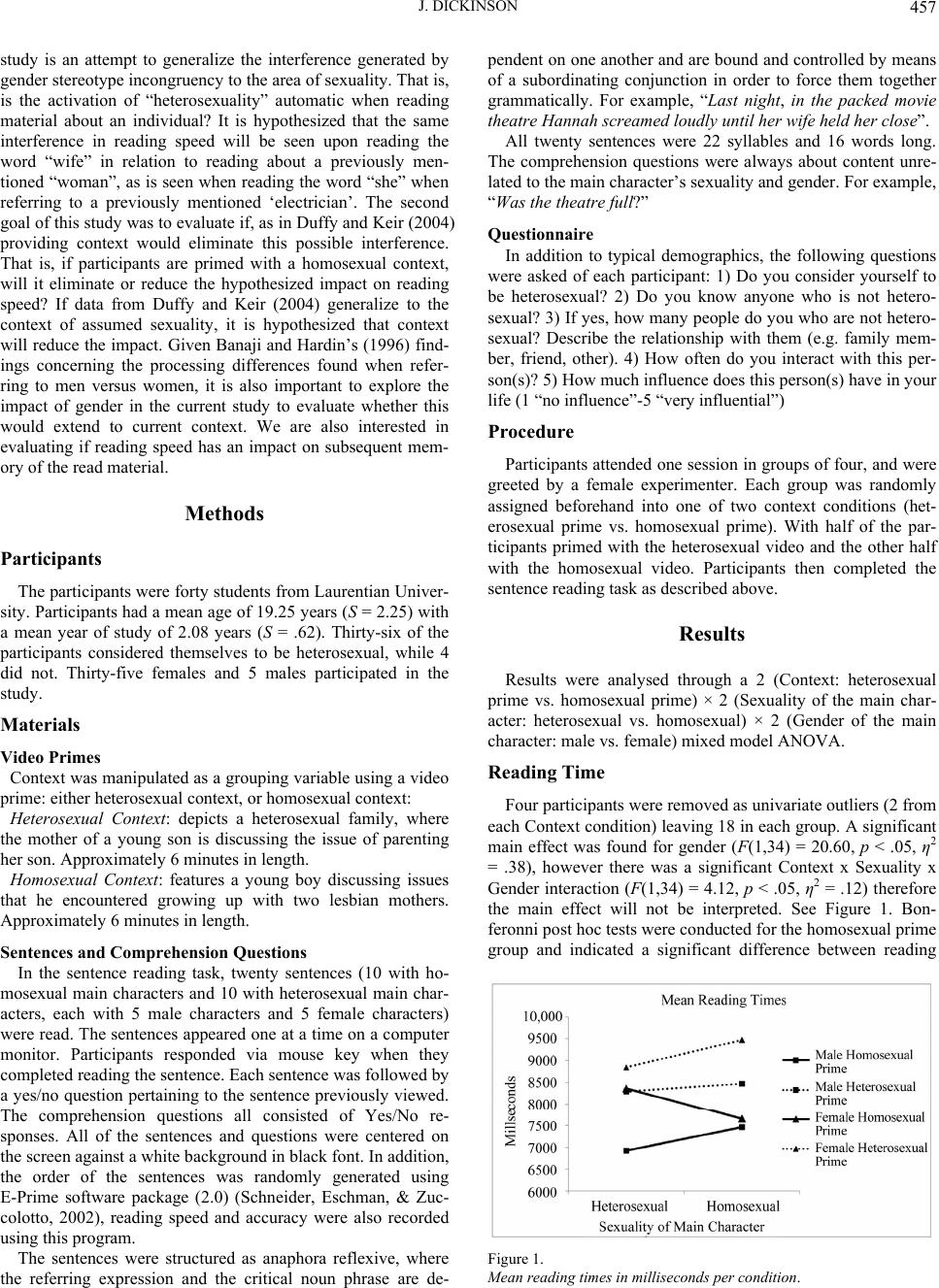 J. DICKINSON 457 study is an attempt to generalize the interference generated by gender stereotype incongruency to the area of sexuality. That is, is the activation of “heterosexuality” automatic when reading material about an individual? It is hypothesized that the same interference in reading speed will be seen upon reading the word “wife” in relation to reading about a previously men- tioned “woman”, as is seen when reading the word “she” when referring to a previously mentioned ‘electrician’. The second goal of this study was to evaluate if, as in Duffy and Keir (2004) providing context would eliminate this possible interference. That is, if participants are primed with a homosexual context, will it eliminate or reduce the hypothesized impact on reading speed? If data from Duffy and Keir (2004) generalize to the context of assumed sexuality, it is hypothesized that context will reduce the impact. Given Banaji and Hardin’s (1996) find- ings concerning the processing differences found when refer- ring to men versus women, it is also important to explore the impact of gender in the current study to evaluate whether this would extend to current context. We are also interested in evaluating if reading speed has an impact on subsequent mem- ory of the read material. Methods Participants The participants were forty students from Laurentian Univer- sity. Participants had a mean age of 19.25 years (S = 2.25) with a mean year of study of 2.08 years (S = .62). Thirty-six of the participants considered themselves to be heterosexual, while 4 did not. Thirty-five females and 5 males participated in the study. Materials Video Primes Context was manipulated as a grouping variable using a video prime: either heterosexual context, or homosexual context: Heterosexual Context: depicts a heterosexual family, where the mother of a young son is discussing the issue of parenting her son. Approximately 6 minutes in length. Homosexual Context: features a young boy discussing issues that he encountered growing up with two lesbian mothers. Approximately 6 minutes in length. Sentences and Comprehension Questions In the sentence reading task, twenty sentences (10 with ho- mosexual main characters and 10 with heterosexual main char- acters, each with 5 male characters and 5 female characters) were read. The sentences appeared one at a time on a computer monitor. Participants responded via mouse key when they completed reading the sentence. Each sentence was followed by a yes/no question pertaining to the sentence previously viewed. The comprehension questions all consisted of Yes/No re- sponses. All of the sentences and questions were centered on the screen against a white background in black font. In addition, the order of the sentences was randomly generated using E-Prime software package (2.0) (Schneider, Eschman, & Zuc- colotto, 2002), reading speed and accuracy were also recorded using this program. The sentences were structured as anaphora reflexive, where the referring expression and the critical noun phrase are de- pendent on one another and are bound and controlled by means of a subordinating conjunction in order to force them together grammatically. For example, “Last night, in the packed movie theatre Hannah screamed loudly until her wife held her close”. All twenty sentences were 22 syllables and 16 words long. The comprehension questions were always about content unre- lated to the main character’s sexuality and gender. For example, “Was the theatre full?” Questionnaire In addition to typical demographics, the following questions were asked of each participant: 1) Do you consider yourself to be heterosexual? 2) Do you know anyone who is not hetero- sexual? 3) If yes, how many people do you who are not hetero- sexual? Describe the relationship with them (e.g. family mem- ber, friend, other). 4) How often do you interact with this per- son(s)? 5) How much influence does this person(s) have in your life (1 “no influence”-5 “very influential”) Procedure Participants attended one session in groups of four, and were greeted by a female experimenter. Each group was randomly assigned beforehand into one of two context conditions (het- erosexual prime vs. homosexual prime). With half of the par- ticipants primed with the heterosexual video and the other half with the homosexual video. Participants then completed the sentence reading task as described above. Results Results were analysed through a 2 (Context: heterosexual prime vs. homosexual prime) × 2 (Sexuality of the main char- acter: heterosexual vs. homosexual) × 2 (Gender of the main character: male vs. female) mixed model ANOVA. Reading Time Four participants were removed as univariate outliers (2 from each Context condition) leaving 18 in each group. A significant main effect was found for gender (F(1,34) = 20.60, p < .05, η2 = .38), however there was a significant Context x Sexuality x Gender interaction (F(1,34) = 4.12, p < .05, η2 = .12) therefore the main effect will not be interpreted. See Figure 1. Bon- feronni post hoc tests were conducted for the homosexual prime group and indicated a significant difference between reading Figure 1. Mean reading times in milliseconds per condition. 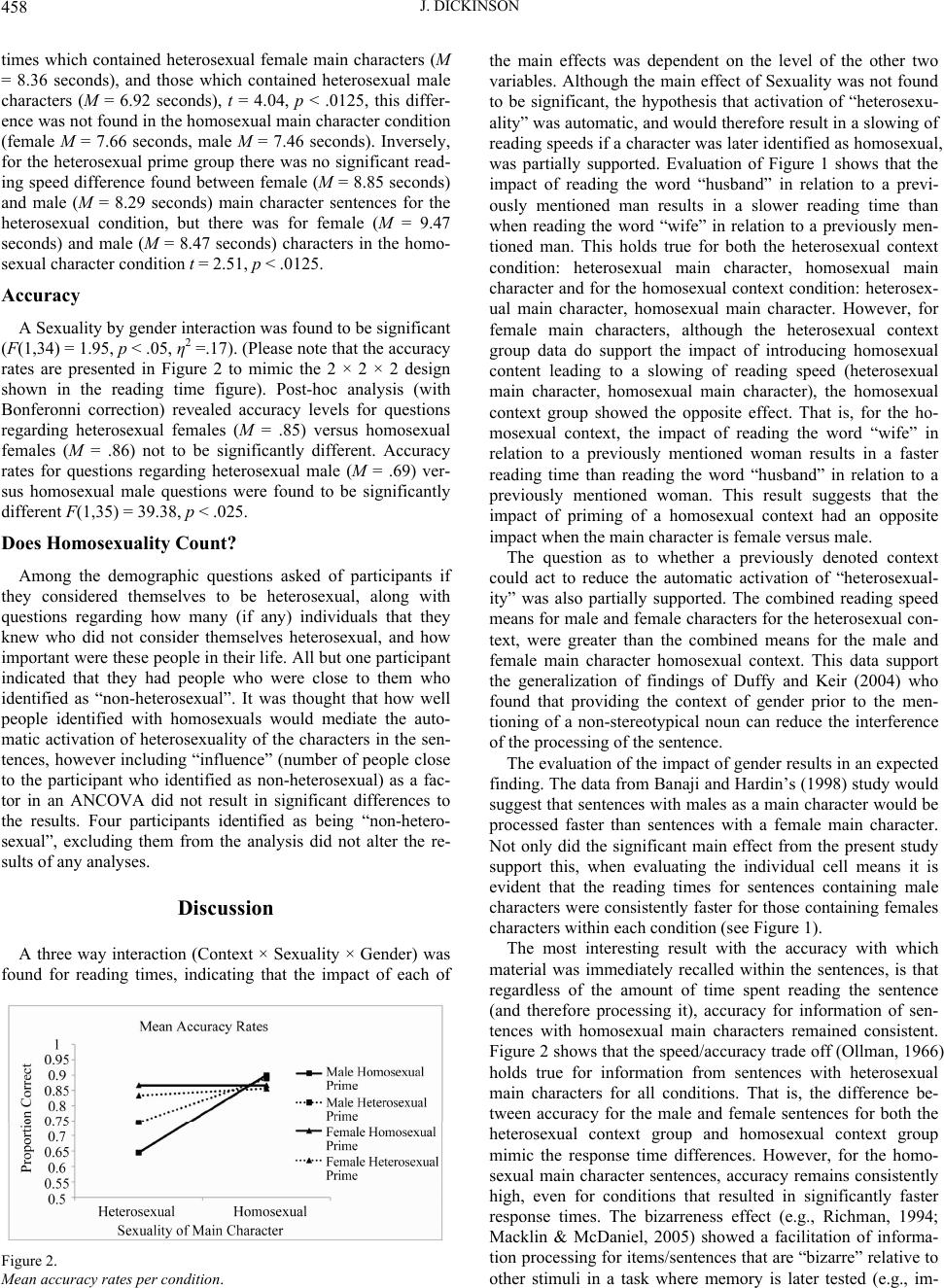 J. DICKINSON 458 times which contained heterosexual female main characters (M = 8.36 seconds), and those which contained heterosexual male characters (M = 6.92 seconds), t = 4.04, p < .0125, this differ- ence was not found in the homosexual main character condition (female M = 7.66 seconds, male M = 7.46 seconds). Inversely, for the heterosexual prime group there was no significant read- ing speed difference found between female (M = 8.85 seconds) and male (M = 8.29 seconds) main character sentences for the heterosexual condition, but there was for female (M = 9.47 seconds) and male (M = 8.47 seconds) characters in the homo- sexual character co nd iti on t = 2.51, p < .0125. Accuracy A Sexuality by gender interaction was found to be significant (F(1,34) = 1.95, p < .05, η2 =.17). (Please note that the accuracy rates are presented in Figure 2 to mimic the 2 × 2 × 2 design shown in the reading time figure). Post-hoc analysis (with Bonferonni correction) revealed accuracy levels for questions regarding heterosexual females (M = .85) versus homosexual females (M = .86) not to be significantly different. Accuracy rates for questions regarding heterosexual male (M = .69) ver- sus homosexual male questions were found to be significantly different F(1,35) = 39.38, p < .025. Does Homosexuality Count? Among the demographic questions asked of participants if they considered themselves to be heterosexual, along with questions regarding how many (if any) individuals that they knew who did not consider themselves heterosexual, and how important were these people in their life. All but one participant indicated that they had people who were close to them who identified as “non-heterosexual”. It was thought that how well people identified with homosexuals would mediate the auto- matic activation of heterosexuality of the characters in the sen- tences, however including “influence” (number of people close to the participant who identified as non-heterosexual) as a fac- tor in an ANCOVA did not result in significant differences to the results. Four participants identified as being “non-hetero- sexual”, excluding them from the analysis did not alter the re- sults of any analyses. Discussion A three way interaction (Context × Sexuality × Gender) was found for reading times, indicating that the impact of each of Figure 2. Mean accuracy rates per condition. the main effects was dependent on the level of the other two variables. Although the main effect of Sexuality was not found to be significant, the hypothesis that activation of “heterosexu- ality” was automatic, and would therefore result in a slowing of reading speeds if a character was later identified as homosexual, was partially supported. Evaluation of Figure 1 shows that the impact of reading the word “husband” in relation to a previ- ously mentioned man results in a slower reading time than when reading the word “wife” in relation to a previously men- tioned man. This holds true for both the heterosexual context condition: heterosexual main character, homosexual main character and for the homosexual context condition: heterosex- ual main character, homosexual main character. However, for female main characters, although the heterosexual context group data do support the impact of introducing homosexual content leading to a slowing of reading speed (heterosexual main character, homosexual main character), the homosexual context group showed the opposite effect. That is, for the ho- mosexual context, the impact of reading the word “wife” in relation to a previously mentioned woman results in a faster reading time than reading the word “husband” in relation to a previously mentioned woman. This result suggests that the impact of priming of a homosexual context had an opposite impact when the mai n cha r acter is female versus mal e . The question as to whether a previously denoted context could act to reduce the automatic activation of “heterosexual- ity” was also partially supported. The combined reading speed means for male and female characters for the heterosexual con- text, were greater than the combined means for the male and female main character homosexual context. This data support the generalization of findings of Duffy and Keir (2004) who found that providing the context of gender prior to the men- tioning of a non-stereotypical noun can reduce the interference of the processing of the sentence. The evaluation of the impact of gender results in an expected finding. The data from Banaji and Hardin’s (1998) study would suggest that sentences with males as a main character would be processed faster than sentences with a female main character. Not only did the significant main effect from the present study support this, when evaluating the individual cell means it is evident that the reading times for sentences containing male characters were consistently faster for those containing females characters within each condition (see Figure 1). The most interesting result with the accuracy with which material was immediately recalled within the sentences, is that regardless of the amount of time spent reading the sentence (and therefore processing it), accuracy for information of sen- tences with homosexual main characters remained consistent. Figure 2 shows that the speed/accuracy trade off (Ollman, 1966) holds true for information from sentences with heterosexual main characters for all conditions. That is, the difference be- tween accuracy for the male and female sentences for both the heterosexual context group and homosexual context group mimic the response time differences. However, for the homo- sexual main character sentences, accuracy remains consistently high, even for conditions that resulted in significantly faster response times. The bizarreness effect (e.g., Richman, 1994; Macklin & McDaniel, 2005) showed a facilitation of informa- tion processing for items/sentences that are “bizarre” relative to other stimuli in a task where memory is later tested (e.g., im- 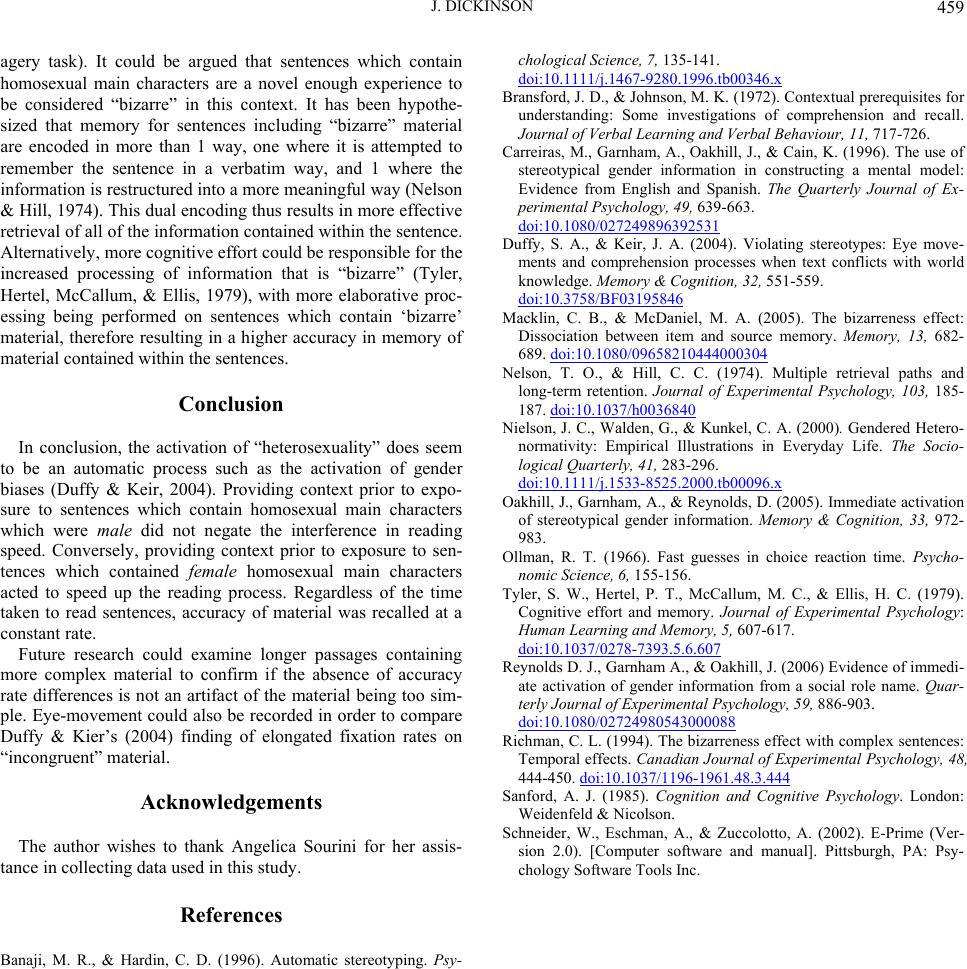 J. DICKINSON 459 agery task). It could be argued that sentences which contain homosexual main characters are a novel enough experience to be considered “bizarre” in this context. It has been hypothe- sized that memory for sentences including “bizarre” material are encoded in more than 1 way, one where it is attempted to remember the sentence in a verbatim way, and 1 where the information is restructured into a more meaningful way (Nelson & Hill, 1974). This dual encoding thus results in more effective retrieval of all of the information contained within the sentence. Alternatively, more cognitive effort could be responsible for the increased processing of information that is “bizarre” (Tyler, Hertel, McCallum, & Ellis, 1979), with more elaborative proc- essing being performed on sentences which contain ‘bizarre’ material, therefore resulting in a higher accuracy in memory of material contained within the sentences. Conclusion In conclusion, the activation of “heterosexuality” does seem to be an automatic process such as the activation of gender biases (Duffy & Keir, 2004). Providing context prior to expo- sure to sentences which contain homosexual main characters which were male did not negate the interference in reading speed. Conversely, providing context prior to exposure to sen- tences which contained female homosexual main characters acted to speed up the reading process. Regardless of the time taken to read sentences, accuracy of material was recalled at a constant rate. Future research could examine longer passages containing more complex material to confirm if the absence of accuracy rate differences is not an artifact of the material being too sim- ple. Eye-movement could also be recorded in order to compare Duffy & Kier’s (2004) finding of elongated fixation rates on “incongruent” material. Acknowledgements The author wishes to thank Angelica Sourini for her assis- tance in collecting data used in this study. References Banaji, M. R., & Hardin, C. D. (1996). Automatic stereotyping. Psy- chological Science, 7, 135-141. doi:10.1111/j.1467-9280.1996.tb00346.x Bransford, J. D., & Johnson, M. K. (1972). Contextual prerequisites for understanding: Some investigations of comprehension and recall. Journal of Verbal Learning and Verbal Behaviour, 11, 717-726. Carreiras, M., Garnham, A., Oakhill, J., & Cain, K. (1996). The use of stereotypical gender information in constructing a mental model: Evidence from English and Spanish. The Quarterly Journal of Ex- perimental Psychology, 49, 639-663. doi:10.1080/027249896392531 Duffy, S. A., & Keir, J. A. (2004). Violating stereotypes: Eye move- ments and comprehension processes when text conflicts with world knowledge. Memory & Cognition, 32, 551-559. doi:10.3758/BF03195846 Macklin, C. B., & McDaniel, M. A. (2005). The bizarreness effect: Dissociation between item and source memory. Memory, 13, 682- 689. doi:10.1080/09658210444000304 Nelson, T. O., & Hill, C. C. (1974). Multiple retrieval paths and long-term retention. Journal of Experimental Psychology, 103, 185- 187. doi:10.1037/h0036840 Nielson, J. C., Walden, G., & Kunkel, C. A. (2000). Gendered Hetero- normativity: Empirical Illustrations in Everyday Life. The Socio- logical Quarterly, 41, 283-296. doi:10.1111/j.1533-8525.2000.tb00096.x Oakhill, J., Garnham, A., & Reynolds, D. (2005). Immediate activation of stereotypical gender information. Memory & Cognition, 33, 972- 983. Ollman, R. T. (1966). Fast guesses in choice reaction time. Psycho- nomic Science, 6, 155-156. Tyler, S. W., Hertel, P. T., McCallum, M. C., & Ellis, H. C. (1979). Cognitive effort and memory. Journal of Experimental Psychology: Human Learning and Memory, 5, 607-617. doi:10.1037/0278-7393.5.6.607 Reynolds D. J., Garnham A., & Oakhill, J. (2006) Evidence of immedi- ate activation of gender information from a social role name. Quar- terly Journal of Experimental Psychology, 59, 886-903. doi:10.1080/02724980543000088 Richman, C. L. (1994). The bizarreness effect with complex sentences: Temporal effects. Canadian Journal of Experimental Psychology, 48, 444-450. doi:10.1037/1196-1961.48.3.444 Sanford, A. J. (1985). Cognition and Cognitive Psychology. London: Weidenfeld & Nicolson. Schneider, W., Eschman, A., & Zuccolotto, A. (2002). E-Prime (Ver- sion 2.0). [Computer software and manual]. Pittsburgh, PA: Psy- chology Software Tools Inc. |