

Paper Menu >>
Journal Menu >>
 Psychology 2011. Vol.2, No.5, 445-449 Copyright © 2011 SciRes. DOI:10.4236/psych.2011.25069 Prior Negative Mood Buffers Some Individuals from Subsequent Negative Events: The Moderating Role of Neuroticism Weiting Ng SIM University, Singapore City, Singapore. Email: [email protected] Received May 30th, 2011; revised July 1st, 2011; accepted August 2nd, 2011. The effects of mood on cognition are well-documented. However, would mood influence subsequent emotional reactions? The present research shows that prior moods interact with neuroticism to influence subsequent emo- tional experiences. Low-neuroticism individuals who initially felt negative subsequently experienced less nega- tive emotions toward a slightly unpleasant task, relative to those who initially felt positive. Conversely, there were no mood effects on high-neuroticism individuals. This demonstrates that surprisingly, a prior negative, rather than positive, mood buffers low- but not high-neuroticism individuals from the effect of a subsequent un- pleasant event on negative emotions. The possible mechanism underlying this effect—negative mood repair—is also discussed. Keywords: Neuroticism, Mood Effects, Buffering Effects, Negative Emotions, Mood Repair Introduction Numerous studies have documented that moods influence cognition and these mood effects on cognitive processes are moderated by personality differences (e.g., Smith & Petty, 1995; Rusting, 1998). But would prior moods also color people’s subsequent emotions? Would someone initially feeling un- happy feel better or worse, or remain as unhappy, after another slightly negative event? And would this depend on personality differences? This paper examines whether neuroticism moder- ates prior mood effects on subsequent emotions. Mood States a nd C og n i t ion Bower’s associative network theory (1981, 1991) conceptu- alized emotions as nodes that are linked to related concepts. Experiencing an emotion activates the node, and activation spreads throughout the network to other associated concepts, such as memories and beliefs. This produces a mood-congruent effect, whereby information or memories that are congruent with the activated mood state are more easily retrieved or learnt because these associations have been activated. In other words, after a pleasant mood induction, individuals encode information more positively, recall more positive memories, and make more favorable associations; after an unpleasant mood induction, individuals make more negative associations (e.g., Bower, 1981; Rusting, 1998). Although there is robust evidence of mood-congruent effects (e.g., Aspinwall, 1998; Singer & Salovey, 1988), conflicting findings of mood-incongruent effects also exist. In field and laboratory studies involving natural and induced moods, Parrott and Sabini (1990) found that participants in sad moods recalled memories that were less negative than those recalled by par- ticipants in happy moods. One possible mechanism that could explain the occurrence of mood-incongruent effects is the mo- tivation to repair negative mood states. People may attempt to regulate or eliminate their negative moods by retrieving posi- tive memories and making positive associations, resulting in mood-incongruent effects. Conversely, people in positive moods are motivated to maintain these moods, and would re- trieve positive memories or make positive associations, hence producing mood-congruent effects. There is some evidence to support this mood-management postulation. Josephson, Singer, and Salovey (1996) found that people who recalled positive memories after a negative mood induction became more positive than those who recalled nega- tive memories, indicating that the retrieval of positive memo- ries helped them regulate their negative moods. In addition, Rusting and DeHart (2000) showed that mood-incongruent memory retrieval occurred for participants who were assigned to a mood-repair condition, whereas mood-congruent retrieval occurred for those who stayed focused on the negative events. This mood-management hypothesis was strengthened by find- ings that individuals high in negative mood regulation traits (e.g., high Negative Mood Regulation scores) showed stronger mood-incongruent retrieval effects than individuals low in such traits. Conversely, individuals low in negative mood regulation expectancies showed stronger mood-congruent retrieval effects (Rusting & DeHart, 2000). Recent experimental studies con- firming that higher negative mood regulation expectancies linked to more successful negative affect repair (Hemenover, Augustine, Shulman, Tran, & Barlett, 2008) further supported this conclusion. Interactive Effects of Personality and Mood on Cognition Personality differences can also moderate mood effects on cognition. For example, Smith and Petty (1995) found that individual differences in self-esteem interacted with mood to produce mood-incongruent effects—high (but not low) self- esteem individuals who experienced a negative mood induction generated more positive memories and recalled more positive headlines than those who experienced a neutral mood induction.  W. NG 446 Individual differences in coping dispositions also yielded dif- ferent mood effects. Repressers showed mood-incongruent effects and recalled happy memories and generated pleasant thoughts after an unpleasant mood induction, whereas nonrep- ressers displayed mood-congruent effects (Boden & Baumeister, 1997). These findings illustrate how the effects of mood on cognition are influenced by personality traits. The importance of considering mood effects on cognition in tandem with personality effects was highlighted in Rusting’s (1998) review. She proposed that temporary mood states and stable personality traits interact to influence emotional process- ing in various cognitive areas, such as attention, interpretation and judgment, recall, and autobiographical memory. Her review documented numerous studies that yielded consistent evidence showing that personality traits interact with mood states to produce mood-congruent or mood-incongruent effects in the areas of memory and judgment. The preponderance of evidence substantiates the conclusion that effects of mood on cognition are partly contingent on one’s personality traits, and neither should be considered in isolation. The Present Research Extending on previous research that focused on the interac- tive effects between personality and mood states on cognition, this study investigated whether personality and moods also interact to influence subsequent emotional experiences. That is, do one’s feelings after a mildly unpleasant event depend on one’s prior mood and personality? The effects on cognition should translate to emotional experiences as emotion and cog- nitive constructs (e.g., memory) are associated concepts and should be similarly activated (/influenced). For instance, func- tional imaging revealed that mood-congruent effects on mem- ory arose because of the neural mechanisms involved in the associative networks (Lewis, Critchley, Smith, & Dolan, 2005). Specifically, the brain regions involved in the encoding of emo- tional information were also involved in retrieval. This suggests that processes responsible for mood effects on cognition apply similarly to emotion. The current research focused on the personality trait, neu- roticism, because there was evidence that mood-incongruent effects on memory and judgment occurred for individuals who scored higher in negative mood regulation tendencies (Rusting & DeHart, 2000). Moreover, individuals high in neuroticism or negative affectivity showed stronger mood-congruent effects and recalled more negative words and made more negative judgments after a negative mood induction than those low in these traits (Rusting, 1999). This suggests that neuroticism differences in mood regulation tendencies influence whether mood-incongruent or mood-congruent effects on cognition occur, and could similarly influence mood effects on emotional reactions to subsequent events. Past research has also estab- lished that individual differences in affect repair ability account for one source of individual differences in negative affect. Indi- vidual differences in negative mood regulation expectancies predicted repair ability; specifically those with higher expec- tancies showed larger decreases in negative affect and larger increases in positive affect (Hemenover et al., 2008). Similarly, attempts at negative mood regulation predicted negative emo- tions, and importantly, these differences in negative mood regulation mediated the relation between neuroticism and nega- tive emotions, accounting for neuroticism differences in nega- tive emotions (Ng & Diener, 2009). Therefore, it reasons to expect that neuroticism differences would moderate the effects of prior mood, and hence affect subsequent emotional experi- ences. The goal of this study was to determine whether prior mood would impact the effect of a subsequent unpleasant event on negative emotions, and if this would be moderated by neuroti- cism. Would a prior positive or negative mood buffer individu- als from subsequent negative events, and would this differ for individuals varying in neuroticism? In life, people often ex- perience multiple events in succession. This research hence enables us to examine how one reacts to subsequent unpleasant events after encountering an initial negative event. It should be emphasized that the “mood-incongruent effects” terminology used in this study refers to effects on emotional experiences, not on cognition, as traditionally used in the literature. Based on past research evidence documenting that individu- als higher in negative mood regulation expectancies showed mood-incongruent effects on judgment and memory, the hy- pothesis of this study was that after experiencing an initial negative mood, low-neuroticism individuals would show mood- incongruent effects for subsequent emotional experiences. Specifically, they would feel less negative toward a subse- quent mildly stressful task than those who first experienced a positive mood induction. In contrast, high-neuroticism indi- viduals should not show any mood effects, and would feel negative after the stressful second task, regardless of their initial mood. Method One hundred and thirty-two undergraduates (68 males and 64 females) from a Midwestern US university participated in the experiment for partial course credit in an introductory psychol- ogy course. Participants were randomly assigned to experience a positive or negative mood induction. Participants in the posi- tive mood induction recalled and wrote about something very positive that happened in their lives, whereas participants in the negative mood induction recalled and wrote about something very negative that happened. As a manipulation check of the mood induction effectiveness, participants’ reactivity to the mood induction was measured (1 = extremely negative; 5 = neither negative nor positive; 9 = extremely positive). Next, to let participants experience a mildly unpleasant second task, they worked on a difficult analytical reasoning task comprising six questions for ten minutes. An example of an analytical question used is illustrated here: An island has exactly seven villages—S, T, U, V, X, Y, and Z—and three roads—Routes 1, 2, and 3. The following is a complete listing of the road connections on the island: Route 1 has its ends at S and U, and passes through T only. Route 2 has its ends at T and U, and passes through V only. Route 3 has its ends at X and Z, and passes through Y only. Directly connected villages are those villages between which there is a road connection that passes through no other village on the way from one to the other. Which one of the following villages is directly connected to the most other villages? 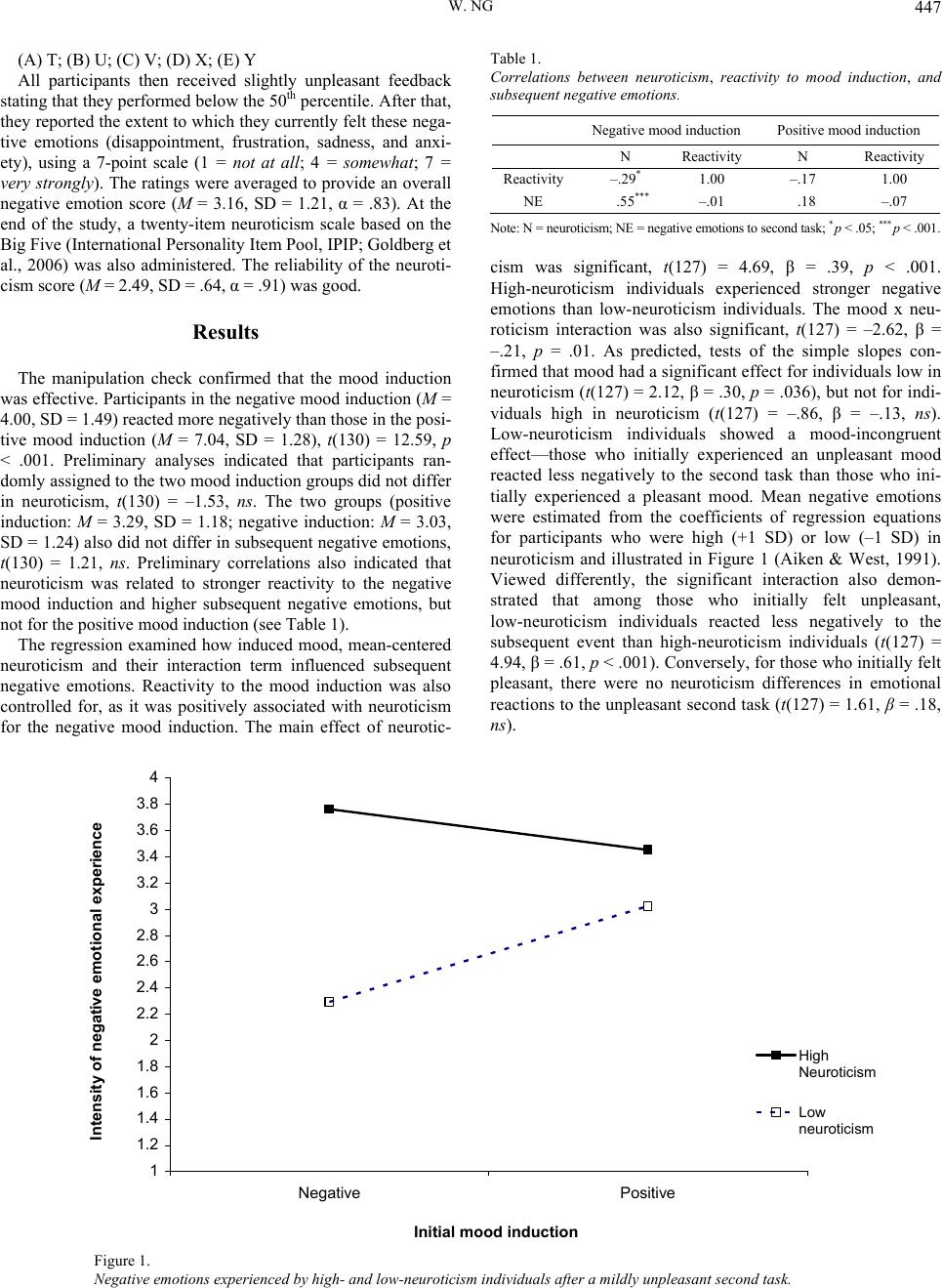 W. NG 447 Table 1. Correlations between neuroticism, reactivity to mood induction, and subsequent negative emotions. (A) T; (B) U; (C) V; (D) X; (E) Y All participants then received slightly unpleasant feedback stating that they performed below the 50th percentile. After that, they reported the extent to which they currently felt these nega- tive emotions (disappointment, frustration, sadness, and anxi- ety), using a 7-point scale (1 = not at all; 4 = somewhat; 7 = very strongly). The ratings were averaged to provide an overall negative emotion score (M = 3.16, SD = 1.21, α = .83). At the end of the study, a twenty-item neuroticism scale based on the Big Five (International Personality Item Pool, IPIP; Goldberg et al., 2006) was also administered. The reliability of the neuroti- cism score (M = 2.49, SD = .64, α = .91) was good. Negative mood induction Positive mood induction N Reactivity N Reactivity Reactivity –.29* 1.00 –.17 1.00 NE .55*** –.01 .18 –.07 Note: N = neuroticism; NE = negative emotions to second task; * p < .05; *** p < .001. cism was significant, t(127) = 4.69, β = .39, p < .001. High-neuroticism individuals experienced stronger negative emotions than low-neuroticism individuals. The mood x neu- roticism interaction was also significant, t(127) = –2.62, β = –.21, p = .01. As predicted, tests of the simple slopes con- firmed that mood had a significant effect for individuals low in neuroticism (t(127) = 2.12, β = .30, p = .036), but not for indi- viduals high in neuroticism (t(127) = –.86, β = –.13, ns). Low-neuroticism individuals showed a mood-incongruent effect—those who initially experienced an unpleasant mood reacted less negatively to the second task than those who ini- tially experienced a pleasant mood. Mean negative emotions were estimated from the coefficients of regression equations for participants who were high (+1 SD) or low (–1 SD) in neuroticism and illustrated in Figure 1 (Aiken & West, 1991). Viewed differently, the significant interaction also demon- strated that among those who initially felt unpleasant, low-neuroticism individuals reacted less negatively to the subsequent event than high-neuroticism individuals (t(127) = 4.94, β = .61, p < .001). Conversely, for those who initially felt pleasant, there were no neuroticism differences in emotional reactions to the unpleasant second task (t(127) = 1.61, β = .18, ns). Results The manipulation check confirmed that the mood induction was effective. Participants in the negative mood induction (M = 4.00, SD = 1.49) reacted more negatively than those in the posi- tive mood induction (M = 7.04, SD = 1.28), t(130) = 12.59, p < .001. Preliminary analyses indicated that participants ran- domly assigned to the two mood induction groups did not differ in neuroticism, t(130) = –1.53, ns. The two groups (positive induction: M = 3.29, SD = 1.18; negative induction: M = 3.03, SD = 1.24) also did not differ in subsequent negative emotions, t(130) = 1.21, ns. Preliminary correlations also indicated that neuroticism was related to stronger reactivity to the negative mood induction and higher subsequent negative emotions, but not for the positive mood induction (see Table 1). The regression examined how induced mood, mean-centered neuroticism and their interaction term influenced subsequent negative emotions. Reactivity to the mood induction was also controlled for, as it was positively associated with neuroticism for the negative mood induction. The main effect of neurotic- 1 1.2 1.4 1.6 1.8 2 2.2 2.4 2.6 2.8 3 3.2 3.4 3.6 3.8 4 Negative Positive Initial moo d induction Intensity of negative emotional experience High Neuroticism Low neuroticism Figure 1. Negative emotions experienced by high- and low-neuroticism individuals after a mildly unpleasant second task.  W. NG 448 Discussion Extending on previous research that documented mood ef- fects on cognition, the present study established that mood ef- fects also occurred for actual affective experiences. Specifically, neuroticism interacted with prior mood states to yield mood-incongruent effects on subsequent emotional experiences. Low-neuroticism (but not high-neuroticism) individuals showed mood-incongruent effects—those who initially felt positive re- acted more strongly to the mildly unpleasant second task and experienced more negative emotions than those who were al- ready feeling negative initially. In other words, unhappy low- neuroticism individuals were less susceptible to the double- whammy effect than unhappy high-neuroticism individuals, possibly because they were already in the process of reducing their negative emotions after the initial mood induction. What this finding implies is that prior negative mood buffers low- but not high-neuroticism individuals from subsequent negative events. And instead, a prior positive mood does not yield buff- ering effects, as would be conventionally expected. A most likely mechanism underlying the mood-incongruent effects shown here by low-neuroticism individuals could be negative mood repair. Low-neuroticism individuals who ini- tially experienced an unpleasant mood started to alleviate their negative feelings and thus subsequently felt less negative emo- tions after a second task, as compared to those who initially experienced a pleasant mood. This explanation would also be consistent with findings that high-neuroticism individuals ex- perience stronger negative emotions in response to unpleasant stimuli, and are less likely than low-neuroticism individuals to repair their negative moods (Gross, Sutton, & Ketelaar, 1998; Gross & John, 2003; Kokkonen & Pulkkinen 2001; Larsen & Ketelaar, 1989). It also concurs with the research showing that neuroticism differences in self-reported emotion regulation partly account for the differences in negative emotions (Ng & Diener, 2009). Work in the domain of mood regulation has established that individuals low in neuroticism are more likely to attempt down-regulating their negative emotions than indi- viduals high in neuroticism. Attempts to eliminate or reduce one’s negative emotions, or to turn them in a more positive direc- tion, correlated inversely with neuroticism (Davies, Stankov, & Roberts, 1998; Wood, Heimpel, & Michela, 2003). Therefore, low-neuroticism individuals’ higher proclivities to repair their negative moods after an initial unhappy experience may explain why they are more buffered from subsequent negative events than high-neuroticism individuals. The concept of contrast effects is a possible alternative ac- count that explains why people feel less negative after a second minor unpleasant event if they first experience an unpleasant event instead of a pleasant event. A contrast effect, which is likely to occur when a stimulus is compared against an extreme positive or negative event, may cause one to view a mildly negative event as slightly positive in comparison to the extreme negative event (Schwarz & Strack, 1999). Although this may contribute to the observed mood-incongruent effects, this ex- planation cannot account for the differential patterns between low- and high-neuroticism individuals. One limitation is that the present study examined only nega- tive moods induced by the recollection of negative past events and how people would subsequently react to a mildly unpleas- ant laboratory situation. Thus, one cannot generalize to predict whether similar buffering effects would be obtained for low- neuroticism individuals in real-life if negative events of similar intensity happen consecutively. It would be useful for future research to explore this by conducting diary or longitudinal studies. The present study also could not ascertain whether negative mood repair was indeed responsible for the mood effects for low-neuroticism individuals. By introducing a mood regulatory manipulation, further studies can determine whether the differential mood effects are due to neuroticism differences in negative mood regulation. In recapitulation, one can surmise that when a series of nega- tive events happen chronologically, they do not simply sum up and compound a person’s negative emotions. How one reacts to subsequent mildly unpleasant events after encountering nega- tive events is contingent on personality traits such as neuroti- cism. Not everyone necessarily feels more negative or remains as negative (e.g., mood-congruent effects). Instead, some indi- viduals (e.g., low-neuroticism individuals) may display mood- incongruent effects and show an improvement in mood. How- ever, it is likely that their ability to improve their mood is also contingent on the premise that they can repair their moods. If their mood-regulatory efforts are prevented or thwarted, or because they are instructed to engage in ineffective strategies, it is possible these mood-incongruent effects will no longer be present. References Aiken, L. S., & West, S. G. (1991). Multiple regression: Testing and interpreting interactions. Newbury Park, CA: Sage. Aspinwall, L. G. (1998). Rethinking the role of positive affect in self-regulation. Motivation and Emotion, 22, 1-32. doi:10.1023/A:1023080224401 Boden, J., & Baumeister, R. (1997). Repressive coping: Distraction using pleasant thoughts and memories. Journal of Personality and Social Psychology, 73, 45-62. doi:10.1037/0022-3514.73.1.45 Bower, G. H. (1981). Mood and memory. American Psychologist, 36, 129-148. doi:10.1037/0003-066X.36.2.129 Bower, G. H. (1991). How might emotions affect learning? In S. Christianson (Ed.), The handbook of emotion and memory (pp. 3-31). Hillsdale, NJ: Erlbaum. Clark, D. M., & Teasdale, J. D. (1985). Constraints on the effects of mood on memory. Journal of Personality and Social Psychology, 48, 1595-1608. doi:10.1037/0022-3514.48.6.1595 Davies, M., Stankov, L., & Roberts, R. D. (1998). Emotional inte- lligence: In search of an elusive construct. Journal of Personality and Social Psychology, 75, 989-1015. doi:10.1037/0022-3514.75.4.989 Forgas, J. P., & Ciarrochi, J. V. (2002). On managing moods: Evidence for the role of homeostatic cognitive strategies in affect regulation. Personality and Social Psychology Bulletin, 28, 336-345. doi:10.1177/0146167202286005 Goldberg, L. R., Johnson, J. A., Eber, H. W., Hogan, R., Ashton, M. C., Cloninger, C. R., & Gough, H. C. (2006). The international personal- ity item pool and the future of public-domain personality measures. Journal of Research in Personality, 40, 84-96. doi:10.1016/j.jrp.2005.08.007 Gross, J. J., & John, O. P. (2003). Individual differences in two emotion regulation processes: Implications for affect, relationships, and well- being. Journal of Personality and Social Psychology, 85, 348- 362. doi:10.1037/0022-3514.85.2.348 Gross, J. J., Sutton, S. K., & Ketelaar, T. (1998). Relations between affect and personality: Support for the affect-level and affective- re- activity views. Personality and Social Psychology Bulletin, 24, 279-  W. NG 449 288. doi:10.1177/0146167298243005 Hemenover, S. H., Augustine, A. A., Shulman, T., Tran, T. Q., & Bar- lett, C. P. (2008). Individual differences in negative affect repair. Emotion, 8, 468-478. doi:10.1037/1528-3542.8.4.468 Josephson, B. R., Singer, J. A., & Salovey, P. (1996). Mood regulation and memory: Repairing sad moods with happy memories. Cognition and Emotion, 10, 437-444. doi:10.1080/026999396380222 Kokkonen, M., & Pulkkinen, L. (2001). Extraversion and neuroticism as antecedents of emotion regulation and dysregulation in adulthood. European Journal of Personality, 15, 407-424. doi:10.1002/per.425 Larsen, R. J., & Ketelaar, T. (1989). Extraversion, neuroticism, and susceptibility to positive and negative mood induction procedures. Personality and Individual Differences, 10, 1221-1228. doi:10.1016/0191-8869(89)90233-X Lewis, P. A., Critchley, H. D., Smith, A. P., & Dolan, R. J. (2005). Brain mechanisms for mood congruent memory facilitation. Neuro- Image, 25, 1214-1223. doi:10.1016/j.neuroimage.2004.11.053 Ng, W., & Diener, E. (2009). Personality differences in emotions: Does emotion regulation play a role? Journal of Individual Differences, 30, 100-106. doi:10.1027/1614-0001.30.2.100 Parrott, W. G., & Sabini, J. (1990). Mood and memory under natural conditions: Evidence for mood incongruent recall. Journal of Per- sonality and Social Psychology, 59, 321-336. doi:10.1037/0022-3514.59.2.321 Rusting, C. L. (1998). Personality, mood, and cognitive processing of emotional information: Three conceptual frameworks. Psychological Bulletin, 124, 165-196. doi:10.1037/0033-2909.124.2.165 Rusting, C. L. (1999). Interactive effects of personality and mood on emotion-congruent memory and judgment. Journal of Personality and Social Psychology, 77, 1073-1086. doi:10.1037/0022-3514.77.5.1073 Rusting, C. L., & DeHart, T. (2000). Retrieving positive memories to regulate negative mood: Consequences for mood-congruent memory. Journal of Personality and Social Psychology, 78, 737-752. doi:10.1037/0022-3514.78.4.737 Schwarz, N., & Strack, F. (1999). Reports of subjective well-being: judgmental processes and their methodological implications. In D. Kahneman, E. Diener, & N. Schwarz (Eds.), Well-bein g: The foun- dations of hedonic psychology (pp. 61-84). New York, NY: Russell Sage Foundation. Singer, J. A., & Salovey, P. (1988). Mood and memory: Evaluating the network theory of affect. Clinical Psychology Review, 8, 211-251. doi:10.1016/0272-7358(88)90060-8 Smith, S. M., & Petty, R. E. (1995). Personality moderators of mood congruency effects on cognition: The role of self-esteem and nega- tive mood regulation. Journal of Personality and Social Psychology, 68, 1092-1107. doi:10.1037/0022-3514.68.6.1092 Wood, J. V., Heimpel, S. A., & Michela, J. L. (2003). Savoring versus dampening: Self-esteem differences in regulating positive affect. Journal of Personality and Social Psychology, 85, 566-580. doi:10.1037/0022-3514.85.3.566 |