

Paper Menu >>
Journal Menu >>
 Open Journal of Microphysics, 2011, 1, 19-22 doi:10.4236/ojm.2011.12003 Published Online August 2011 (http://www.SciRP.org/journal/ojm) Copyright © 2011 SciRes. OJM Structural Stabilizing Effect of Zn Substitution on MnAl and Its Magnetic Properties H. X. Wang1, P. Z. Si1,*, W. Jiang1, J. G. Lee2, C. J. Choi2, J. J. Liu3, Q. Wu1, M. Zhong1, H. L. Ge1 1School of Materials Science and Engineering, China Jiliang University, Hangzhou, China 2Korea Institute of Materials Science, Changwon, Gyeongnam, R. Korea 3Faculty of Materials Science and Chemical Engineering, Ningbo University, Ningbo, China E-mail: [email protected] Received May 17, 2011; revised June 28, 2011; accepted July 12, 2011 Abstract The effect of Zn substitution on the structure and magnetic properties of τ-MnAl has been investigated sys- tematically. It is found that Zn substitution can stabilize the structure of τ-phase and thus a significant amount of τ-phase can be produced. Zn increases the coercivity and saturation magnetization of the τ-MnAl but reduces the Currie temperature. However, excess Zn is detrimental to the magnetic parameters. The op- timum magnetic performance was found in samples with Zn substitution to 2.9% Mn atoms and 3.5% Al atoms, respectively. Keywords: MnAl, Magnetic Property, Zn Substitution 1. Introduction The development of rare earth free permanent magnets is becoming more and more important with increasing cost and decreasing reserve of rare earth resources. Ferro- magnetic τ-MnAl, as a low cost rare-earth-free magnet, has received continuous attention since its discovery in 1958 for its superior magnetic performance in compari- son with magnetically hard ferrites and Alnicos [1-3]. The τ-MnAl has a Currie temperature of 661 K, a man- ganese moment of 1.94 µB, and an enhanced magnetic anisotropy. The structure of ferromagnetic τ-MnAl is tetragonal, which can be interpreted to arise from a non- magnetic cubic structure by two subsequent steps, namely an electronic distortion due to spin polarization followed by a structural distortion into the tetragonal system [4]. Since the τ-MnAl is metastable, it is difficult to obtain pure phase of τ-MnAl, which usually is pro- duced by a rapid quench of the high temperature ε-phase followed by isothermal annealing at temperatures be- tween 400˚C and 700˚C for a short while, or by cooling the τ-phase at a rate of 10˚C/min [2]. Long time anneal- ing would result in decomposition of the τ-phase to the equilibrium γ-phase and β-phase. In order to stabilize the τ-MnAl, the doping effect of several elements, including Ti, Cu, Ni, C, B, etc., has also been studied [2,5]. It was found that the addition of carbon to MnAl can stabilize the τ-phase [6,7]. Reports on the partial substitution of Mn in MnAl by Ni or Co could also be found [8,9]. The effect of introducing other elements into MnAl system has not been studied. The purpose of this work is to in- vestigate the effect of doping Zn on the structure and magnetic properties of the Mn-Al system. 2. Experiments High purity (>99.9%) Mn, Al and Zn in nominal compo- sition of Mn54Al46-δZnδ (δ = 0, 1.6, 3.3, 4.7, 5), Mn53.5 Zn0.5Al46, Mn53.4Zn1.6Al46, Mn51.8Zn3.2Al46, and Mn49Zn5 Al46 were melted by using induction meting in an argon atmosphere. Then the melt was quenched in water. After that the quenched ingots were annealed at 420˚C for 1 h in vacuum, respectively. The structure of the samples was determined by using a powder x-ray diffractometer (XRD) with Cu Kα radiation while the magnetic proper- ties were measured by using a Vibrating Sample Magne- tometer (VSM) in fields up to 1.5 T. Thermal analysis on the samples was carried out in argon atmosphere with a 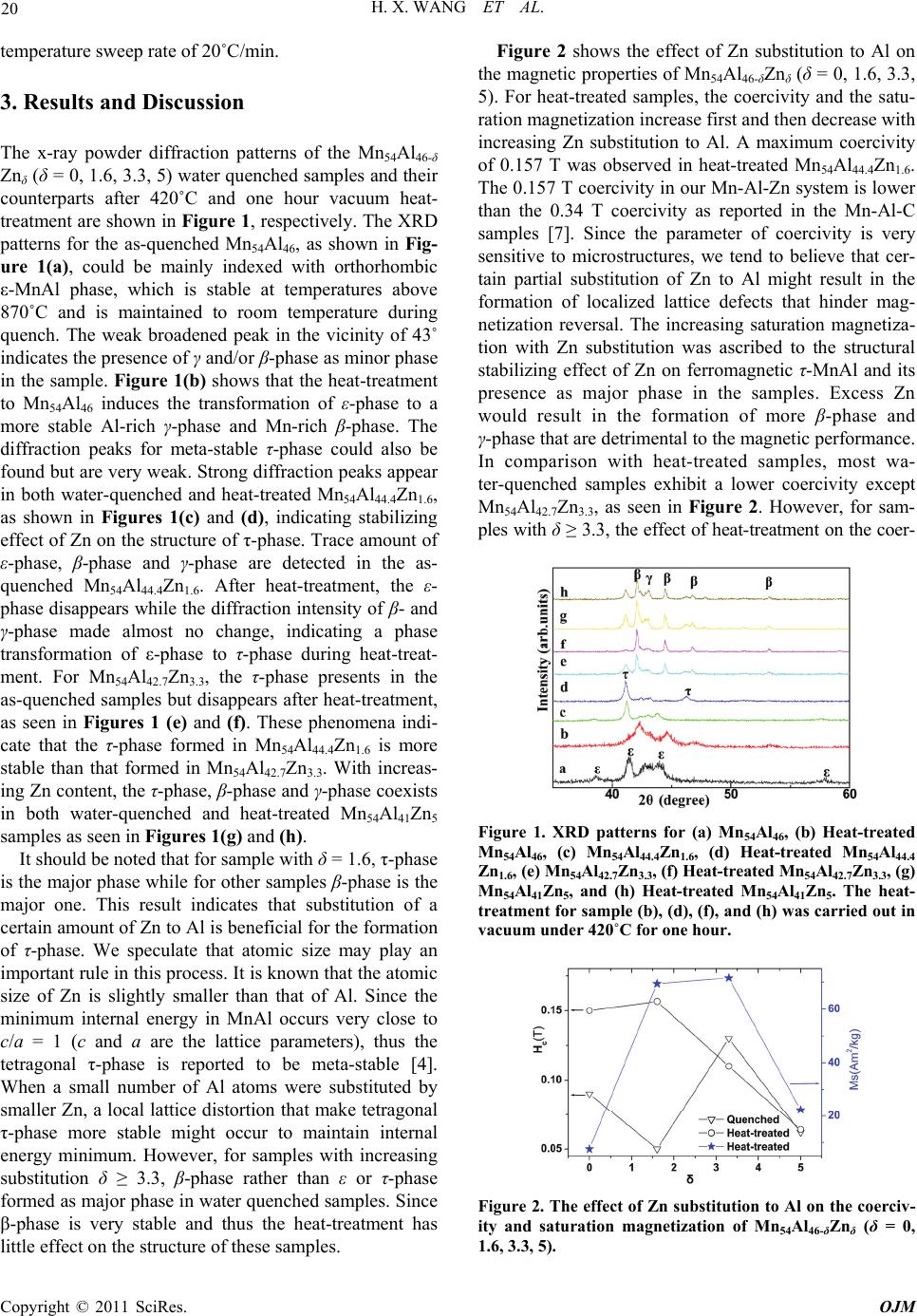 20 H. X. WANG ET AL. temperature sweep rate of 20˚C/min. 3. Results and Discussion The x-ray powder diffraction patterns of the Mn54Al46-δ Znδ (δ = 0, 1.6, 3.3, 5) water quenched samples and their counterparts after 420˚C and one hour vacuum heat- treatment are shown in Figure 1, respectively. The XRD patterns for the as-quenched Mn54Al46, as shown in Fig- ure 1(a), could be mainly indexed with orthorhombic ε-MnAl phase, which is stable at temperatures above 870˚C and is maintained to room temperature during quench. The weak broadened peak in the vicinity of 43˚ indicates the presence of γ and/or β-phase as minor phase in the sample. Figure 1(b) shows that the heat-treatment to Mn54Al46 induces the transformation of ε-phase to a more stable Al-rich γ-phase and Mn-rich β-phase. The diffraction peaks for meta-stable τ-phase could also be found but are very weak. Strong diffraction peaks appear in both water-quenched and heat-treated Mn54Al44.4Zn1.6, as shown in Figures 1(c) and (d), indicating stabilizing effect of Zn on the structure of τ-phase. Trace amount of ε-phase, β-phase and γ-phase are detected in the as- quenched Mn54Al44.4Zn1.6. After heat-treatment, the ε- phase disappears while the diffraction intensity of β- and γ-phase made almost no change, indicating a phase transformation of ε-phase to τ-phase during heat-treat- ment. For Mn54Al42.7Zn3.3, the τ-phase presents in the as-quenched samples but disappears after heat-treatment, as seen in Figures 1 (e) and (f). These phenomena indi- cate that the τ-phase formed in Mn54Al44.4Zn1.6 is more stable than that formed in Mn54Al42.7Zn3.3. With increas- ing Zn content, the τ-phase, β-phase and γ-phase coexists in both water-quenched and heat-treated Mn54Al41Zn5 samples as seen in Figures 1(g) and (h). It should be noted that for sample with δ = 1.6, τ-phase is the major phase while for other samples β-phase is the major one. This result indicates that substitution of a certain amount of Zn to Al is beneficial for the formation of τ-phase. We speculate that atomic size may play an important rule in this process. It is known that the atomic size of Zn is slightly smaller than that of Al. Since the minimum internal energy in MnAl occurs very close to c/a = 1 (c and a are the lattice parameters), thus the tetragonal τ-phase is reported to be meta-stable [4]. When a small number of Al atoms were substituted by smaller Zn, a local lattice distortion that make tetragonal τ-phase more stable might occur to maintain internal energy minimum. However, for samples with increasing substitution δ ≥ 3.3, β-phase rather than ε or τ-phase formed as major phase in water quenched samples. Since β-phase is very stable and thus the heat-treatment has little effect on the structure of these samples. Figure 2 shows the effect of Zn substitution to Al on the magnetic properties of Mn54Al46-δZnδ (δ = 0, 1.6, 3.3, 5). For heat-treated samples, the coercivity and the satu- ration magnetization increase first and then decrease with increasing Zn substitution to Al. A maximum coercivity of 0.157 T was observed in heat-treated Mn54Al44.4Zn1.6. The 0.157 T coercivity in our Mn-Al-Zn system is lower than the 0.34 T coercivity as reported in the Mn-Al-C samples [7]. Since the parameter of coercivity is very sensitive to microstructures, we tend to believe that cer- tain partial substitution of Zn to Al might result in the formation of localized lattice defects that hinder mag- netization reversal. The increasing saturation magnetiza- tion with Zn substitution was ascribed to the structural stabilizing effect of Zn on ferromagnetic τ-MnAl and its presence as major phase in the samples. Excess Zn would result in the formation of more β-phase and γ-phase that are detrimental to the magnetic performance. In comparison with heat-treated samples, most wa- ter-quenched samples exhibit a lower coercivity except Mn54Al42.7Zn3.3, as seen in Figure 2. However, for sam- ples with δ ≥ 3.3, the effect of heat-treatment on the coer- Figure 1. XRD patterns for (a) Mn54Al46, (b) Heat-treated Mn54Al46, (c) Mn54Al44.4Zn1.6, (d) Heat-treated Mn54Al44.4 Zn1.6, (e) Mn54Al42.7Zn3.3, (f) Heat-treated Mn54Al42.7Zn3.3, (g) Mn54Al41Zn5, and (h) Heat-treated Mn54Al41Zn5. The heat- treatment for sample (b), (d), (f), and (h) was carried out in vacuum under 420˚C for one hour. Figure 2. The effect of Zn substitution to Al on the coerciv- ity and saturation magnetization of Mn54Al46-δZnδ (δ = 0, 1.6, 3.3, 5). Copyright © 2011 SciRes. OJM 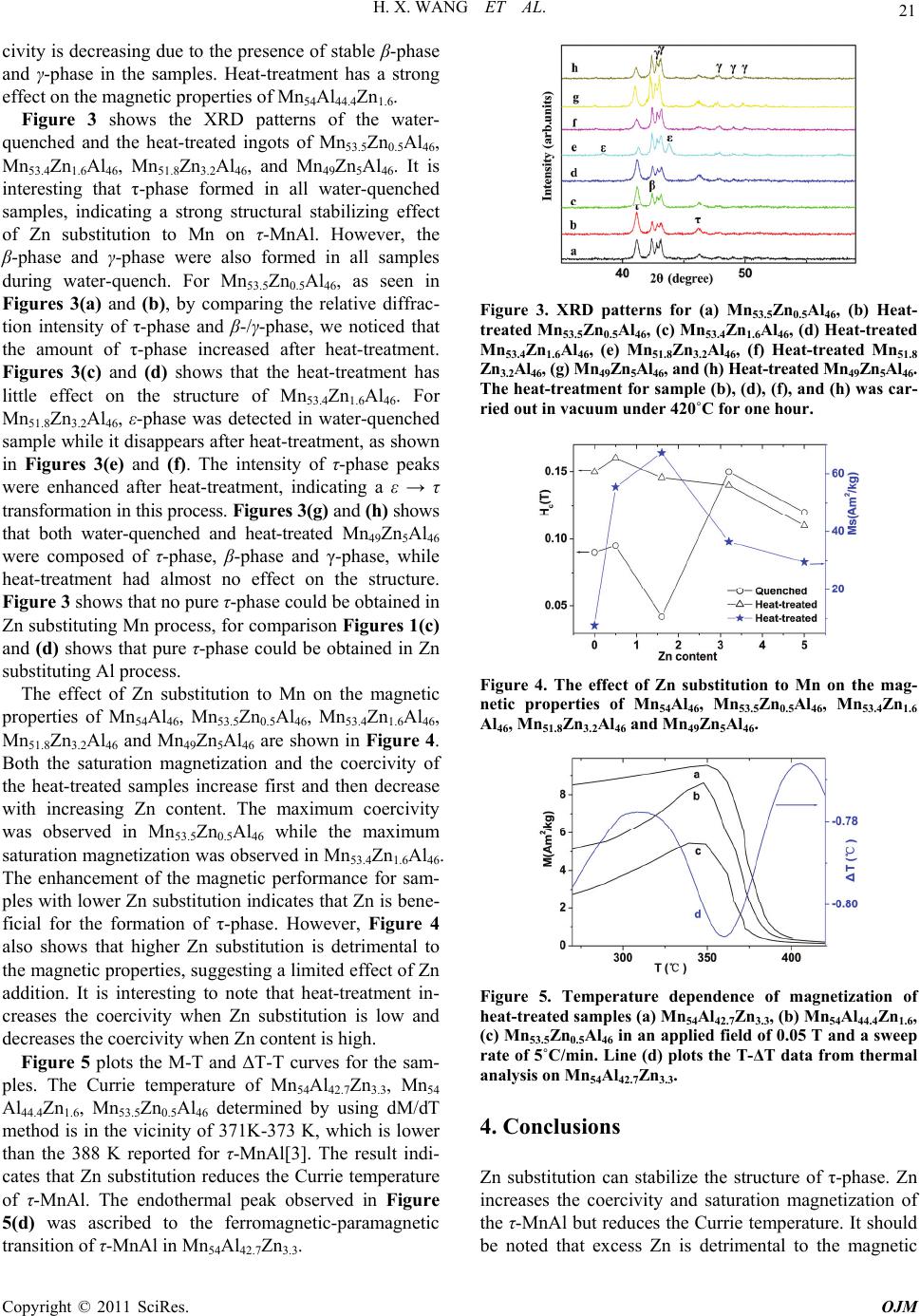 H. X. WANG ET AL. 21 civity is decreasing due to the presence of stable β-phase and γ-phase in the samples. Heat-treatment has a strong effect on the magnetic properties of Mn54Al44.4Zn1.6. Figure 3 shows the XRD patterns of the water- quenched and the heat-treated ingots of Mn53.5Zn0.5Al46, Mn53.4Zn1.6Al46, Mn51.8Zn3.2Al46, and Mn49Zn5Al46. It is interesting that τ-phase formed in all water-quenched samples, indicating a strong structural stabilizing effect of Zn substitution to Mn on τ-MnAl. However, the β-phase and γ-phase were also formed in all samples during water-quench. For Mn53.5Zn0.5Al46, as seen in Figures 3(a) and (b), by comparing the relative diffrac- tion intensity of τ-phase and β-/γ-phase, we noticed that the amount of τ-phase increased after heat-treatment. Figures 3(c) and (d) shows that the heat-treatment has little effect on the structure of Mn53.4Zn1.6Al46. For Mn51.8Zn3.2Al46, ε-phase was detected in water-quenched sample while it disappears after heat-treatment, as shown in Figures 3(e) and (f). The intensity of τ-phase peaks were enhanced after heat-treatment, indicating a ε → τ transformation in this process. Figures 3(g) and (h) shows that both water-quenched and heat-treated Mn49Zn5Al46 were composed of τ-phase, β-phase and γ-phase, while heat-treatment had almost no effect on the structure. Figure 3 shows that no pure τ-phase could be obtained in Zn substituting Mn process, for comparison Figures 1(c) and (d) shows that pure τ-phase could be obtained in Zn substituting Al process. The effect of Zn substitution to Mn on the magnetic properties of Mn54Al46, Mn53.5Zn0.5Al46, Mn53.4Zn1.6Al46, Mn51.8Zn3.2Al46 and Mn49Zn5Al46 are shown in Figure 4. Both the saturation magnetization and the coercivity of the heat-treated samples increase first and then decrease with increasing Zn content. The maximum coercivity was observed in Mn53.5Zn0.5Al46 while the maximum saturation magnetization was observed in Mn53.4Zn1.6Al46. The enhancement of the magnetic performance for sam- ples with lower Zn substitution indicates that Zn is bene- ficial for the formation of τ-phase. However, Figure 4 also shows that higher Zn substitution is detrimental to the magnetic properties, suggesting a limited effect of Zn addition. It is interesting to note that heat-treatment in- creases the coercivity when Zn substitution is low and decreases the coercivity when Zn content is high. Figure 5 plots the M-T and ΔT-T curves for the sam- ples. The Currie temperature of Mn54Al42.7Zn3.3, Mn54 Al44.4Zn1.6, Mn53.5Zn0.5Al46 determined by using dM/dT method is in the vicinity of 371K-373 K, which is lower than the 388 K reported for τ-MnAl[3]. The result indi- cates that Zn substitution reduces the Currie temperature of τ-MnAl. The endothermal peak observed in Figure 5(d) was ascribed to the ferromagnetic-paramagnetic transition of τ-MnAl in Mn54Al42.7Zn3.3. Figure 3. XRD patterns for (a) Mn53.5Zn0.5Al46, (b) Heat- treated Mn53.5Zn0.5Al46, (c) Mn53.4Zn1.6Al46, (d) Heat-treated Mn53.4Zn1.6Al46, (e) Mn51.8Zn3.2Al46, (f) Heat-treated Mn51.8 Zn3.2Al46, (g) Mn49Zn5Al46, and (h) Heat-treated Mn49Zn5Al46. The heat-treatment for sample (b), (d), (f), and (h) was car- ried out in vacuum under 420˚C for one hour. Figure 4. The effect of Zn substitution to Mn on the mag- netic properties of Mn54Al46, Mn53.5Zn0.5Al46, Mn53.4Zn1.6 Al46, Mn51.8Zn3.2Al46 and Mn49Zn 5Al46. Figure 5. Temperature dependence of magnetization of heat-treated samples (a) Mn54Al42.7Zn3.3, (b) Mn54Al44.4Zn1.6, (c) Mn53.5Zn0.5Al46 in an applied field of 0.05 T and a sweep rate of 5˚C/min. Line (d) plots the T-ΔT data from thermal analysis on Mn54Al42.7Zn3.3. 4. Conclusions Zn substitution can stabilize the structure of τ-phase. Zn increases the coercivity and saturation magnetization of the τ-MnAl but reduces the Currie temperature. It should be noted that excess Zn is detrimental to the magnetic Copyright © 2011 SciRes. OJM  H. X. WANG ET AL. Copyright © 2011 SciRes. OJM 22 parameters. The optimum magnetic performance was found in samples with Zn substitution to 2.9% Mn atoms and 3.5% Al atoms, respectively. 5. Acknowledgements This work was supported by the Natural Science Foun- dation of China (Nos. 10874159, 11074227, 50801039), Zhejiang Provincial Natural Science Foundation of China (No. R6110362), and Fundamental R&D Program for Core Technology of Materials funded by the Ministry of Knowledge Economy, R. Korea. 6. References [1] H. Kono, “On the Ferromagnetic Phase in Manga- nese-Aluminum System,” Journal of the Physical Society of Japan, Vol. 13, No. 12, 1958, pp. 1444-1451. [2] Q. Zeng, I. Baker, J. B. Cui and Z. C. Yan, “Structural and Magnetic Properties of Nanostructured Mn-Al-C Magnetic Materials,” Journal of Magnetism and Mag- netic Materials, Vol. 308, No. 2, 2007, pp. 214-226. [3] J. H. Park, Y. K. Hong, S. Bae, J. J. Lee, J. Jalli, G. S. Abo, N. Neveu, S. G. Kim, C. J. Choi and J. G. Lee, “Saturation Magnetization and Crystalline Anisotropy Calculations for MnAl Permanent Magnet,” Journal of Applied Physics, Vol. 107, No. 9, 2010, pp. 09A731. [4] Y. Kurtulus and R. Dronskowski, “Electronic Structure, Chemical Bonding, and Spin Polarization in Ferromag- netic MnAl,” Journal of Solid State Chemistry, Vol. 176, No. 2, 2003, pp. 390-399. doi:10.1016/S0022-4596(03)00242-1 [5] Y. Sakka, M. Nakamura and K. Koshimoto, “Rapid Quenching and Properties of Hard Magnetic Materials in MnAl-X (X=Ti, Cu, Ni, C, B) Systems,” Journal of Ma- terials Science, Vol. 24, No. 12, 1989, PP. 4331-4338 [6] W. H. Dreizler and A. Menth, “Transformation Kinetics of the Ferromagnetic Alloy Mn-Al-C,” IEEE Transac- tions on Magnetics, Vol. 16, No. 3, 1980, PP. 534-536. [7] D. C. Crew, P. G. McCormick and R. Street, “MnAl and MnAlC Permanent Magnets Produced by Mechanical Alloying,” Scripta Metallurgica et Materialia, Vol. 32, No. 3, 1995, PP. 315-318. [8] M. Mat, A. Mor and N. Koh, “Crystal Structure and Magnetic Properties of Mn-Al-Ni Ferromagnetic Films,” IEEE Translation Journal on Magnetics in Japan, Vol. 6, No. 2, 1991, pp. 134-140 doi:10.1109/TJMJ.1991.4565123 [9] R. Kainuma, M. Ise, K. Ishikawa, I. Ohnuma and K. Ishida, “Phase Equilibria and Stability of the B2 Phase in the Ni–Mn–Al and Co–Mn–Al systems,” Journal of Al- loys and Compounds, Vol. 269, 1998, pp. 173-180. doi:10.1016/S0925-8388(98)00127-3 |