

Paper Menu >>
Journal Menu >>
 Advances in Anthropology 2011. Vol.1, No.1, 1-8 Copyright © 2011 SciRes. DOI:10.4236/aa.2011.11001 Set up to Fail: Inadequate Educational Support for Orphans in Central Kenya Ginger A. Johnson Department of Anthropology, University of South Florida, Tampa, USA. Email: [email protected] Received July 19th, 2011; revised August 15th, 2011;accepted August 23rd, 2011 In response to Kenya’s goal of free and universal primary education for every child by 2015, this paper describes a few of the obstacles that one of the most visible periphery populations in Kenya, orphaned children, face in at- tempting to reach this objective. The most frequently cited barriers of children and their caretakers to consistent school attendance included: inability to pay school fees, lack of a school uniform, difficulty in providing assis- tance to orphaned children, presence of disease/illness in the family and disruption of education due to political violence. Conducted in a Kikuyu community in the Kinangop District of Central Kenya following the 2007/2008 presidential election riots, this study utilized multiple regression, logistic regression and MANOVA statistical tests to determine if families caring for orphaned children of primary school age differed significantly from families with no orphans in the home. Discriminant function and Mahalanobis testing further revealed differ- ences in types of households, with the presence of orphans in the home (particularly AIDS orphans) significantly increasing the amount of school fees owed per family. Qualitative data obtained from semi-structured interviews with families and open-ended interviews with their primary school aged children contextualized study results and inform policy recommendations. Keywords: HIV/AIDS, Kenya, Regression Analysis, Primary School, Orphans, Child Agency Introduction The road to success through education is continually repeated to Kenyan children from governmental billboards, radio mes- sages, parents, church leaders, and teachers. In the agricultural township of Njabini in Kenya where this research study took place this message has a desperate undertone—lack of an edu- cation equals poverty. Educational anthropologists have already stated that school, as an important vehicle for social reproduce- tion, is here to stay (Levinson, Borman & Eisenhart, 2000). The pivotal question to consider now is “What is lost and gained?” by the adoption of formal schooling (Levinson, Borman & Eisenhart, 2000). Addressing this question is especially press- ing when considering the status of vulnerable children in Kenya who are instilled during childhood with the importance of com- pleting primary school without the necessary resources to do so. We must indeed move past the “modernist conceit that school- ing is unambiguously good for the individu- als and groups that encounter it” (Hamman, 2002) and focus our attention upon those least likely to reap the benefits of a ‘formal’ education. Kenyan children and parents alike internalize messages of wealth, power, and social status as connected to educational achievement from an early age in spite of economic and social constraints which prevent them for achieving these goals (Nkinyangi, 1982). In Njabini, an agricultural township in the Central Highlands of Kenya with a population primarily con- sisting of Kikuyu tribe members, being an “educated person” means the attainment of at least a primary school certificate of completion (Levinson & Holland, 1996). Parents and care- takers in Njabini interpreted the educational success of their children as the ability to work for themselves rather than as a hired laborer. And as Levinson et al. (1996) have suggested, the cultural production of the educated person is intimately tied to the spaces in which nationalism and citizenship building take place: schools. Education in Kenya is based on an 8-4-4 system with 8 years of primary school followed by 4 years of secondary school and 4 years of university. Kenyan students must pass their Standard 8 exams before acceptance into secondary school (the equiva- lent of high school in the United States). With the implementa- tion of Structural Adjustment Programs in Kenya in the 1980’s, the costs parents and caretakers incurred for their children’s education expanded significantly (Due, 1991; Reimers, 1994; Adepoju, 1993). Child-care providers were required to purchase a school uniform, pay tuition, buy books, school supplies, their child’s desk and pay for testing materials due to the inability of the government to afford increased educational costs after gov- ernment restructuring programs imposed by the World Bank (Vos et al., 2004). The gap between a wealthy and educated elite and uneducated impoverished citizens; therefore, contin- ued to grow. Parental hope for their child’s future grew in 2003 with the Kenyan governments announcement of ‘free’ and ‘universal’ primary school by 2015 (Bruns, Mingat & Rakotomalala, 2003). School attendance rates in primary school skyrocketed in 2004 with an increase (of both boys and girls) up by 104 percent (Vos et al., 2004) after the government’s educational promise to its young citizens. But despite increased government expendi- ture on education at the beginning of the 21st century, primary school in Kenya is far from free and universal today, especially for families in poverty (Bruns, Mingat & Rakotomalala, 2003; Ackers, Migoli & Nzomo, 2001). Lack of teachers in rural vil- lages and lack of governmental funds for the building of 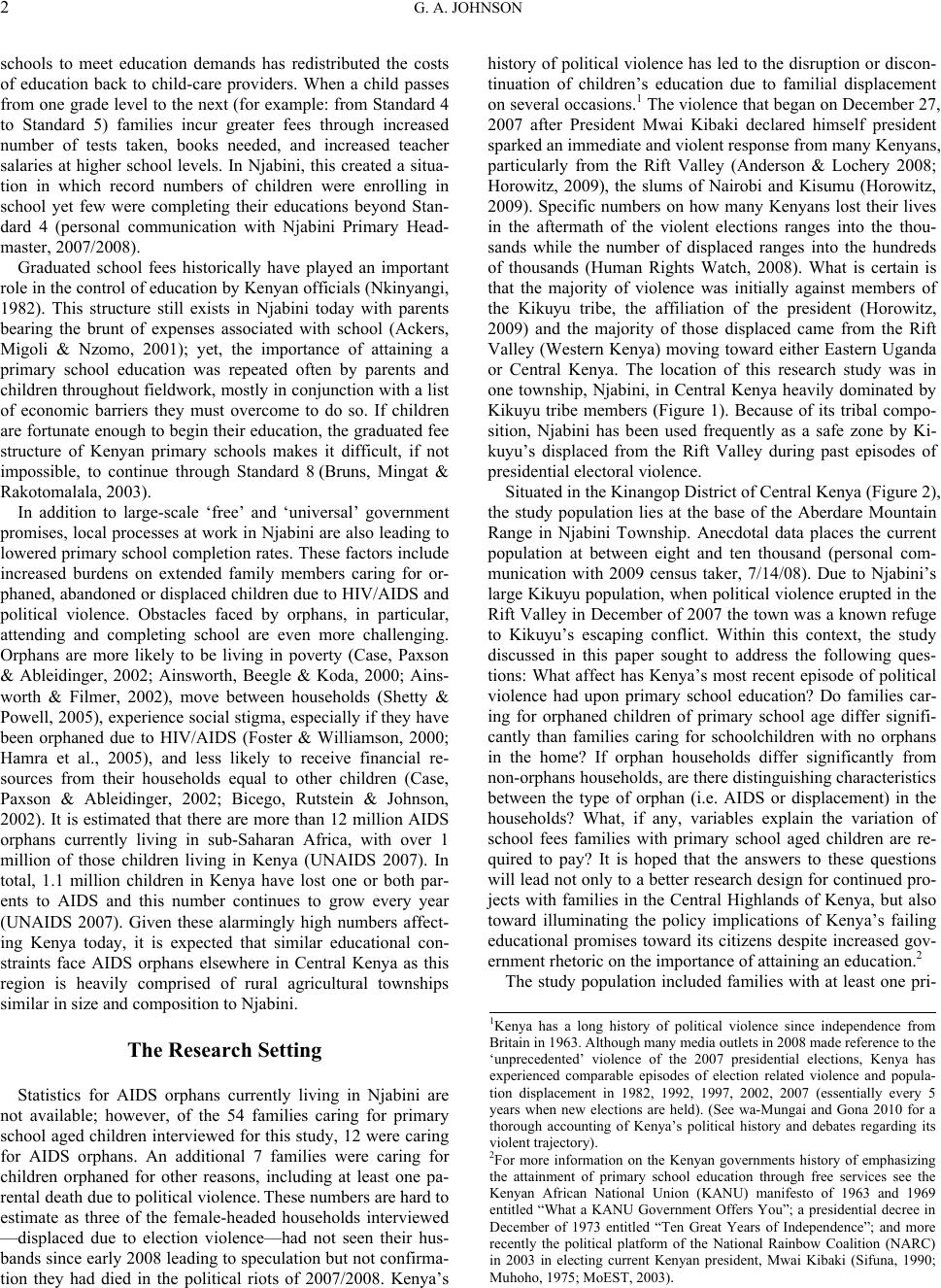 2 G. A. JOHNSON schools to meet education demands has redistributed the costs of education back to child-care providers. When a child passes from one grade level to the next (for example: from Standard 4 to Standard 5) families incur greater fees through increased number of tests taken, books needed, and increased teacher salaries at higher school levels. In Njabini, this created a situa- tion in which record numbers of children were enrolling in school yet few were completing their educations beyond Stan- dard 4 (personal communication with Njabini Primary Head- master, 2007/2008). Graduated school fees historically have played an important role in the control of education by Kenyan officials (Nkinyangi, 1982). This structure still exists in Njabini today with parents bearing the brunt of expenses associated with school (Ackers, Migoli & Nzomo, 2001); yet, the importance of attaining a primary school education was repeated often by parents and children throughout fieldwork, mostly in conjunction with a list of economic barriers they must overcome to do so. If children are fortunate enough to begin their education, the graduated fee structure of Kenyan primary schools makes it difficult, if not impossible, to continue through Standard 8 (Bruns, Mingat & Rakotomalala, 2003). In addition to large-scale ‘free’ and ‘universal’ government promises, local processes at work in Njabini are also leading to lowered primary school completion rates. These factors include increased burdens on extended family members caring for or- phaned, abandoned or displaced children due to HIV/AIDS and political violence. Obstacles faced by orphans, in particular, attending and completing school are even more challenging. Orphans are more likely to be living in poverty (Case, Paxson & Ableidinger, 2002; Ainsworth, Beegle & Koda, 2000; Ains- worth & Filmer, 2002), move between households (Shetty & Powell, 2005), experience social stigma, especially if they have been orphaned due to HIV/AIDS (Foster & Williamson, 2000; Hamra et al., 2005), and less likely to receive financial re- sources from their households equal to other children (Case, Paxson & Ableidinger, 2002; Bicego, Rutstein & Johnson, 2002). It is estimated that there are more than 12 million AIDS orphans currently living in sub-Saharan Africa, with over 1 million of those children living in Kenya (UNAIDS 2007). In total, 1.1 million children in Kenya have lost one or both par- ents to AIDS and this number continues to grow every year (UNAIDS 2007). Given these alarmingly high numbers affect- ing Kenya today, it is expected that similar educational con- straints face AIDS orphans elsewhere in Central Kenya as this region is heavily comprised of rural agricultural townships similar in size and composition to Njabini. The Research Setting Statistics for AIDS orphans currently living in Njabini are not available; however, of the 54 families caring for primary school aged children interviewed for this study, 12 were caring for AIDS orphans. An additional 7 families were caring for children orphaned for other reasons, including at least one pa- rental death due to political violence. These numbers are hard to estimate as three of the female-headed households interviewed —displaced due to election violence—had not seen their hus- bands since early 2008 leading to speculation but not confirma- tion they had died in the political riots of 2007/2008. Kenya’s history of political violence has led to the disruption or discon- tinuation of children’s education due to familial displacement on several occasions.1 The violence that began on December 27, 2007 after President Mwai Kibaki declared himself president sparked an immediate and violent response from many Kenyans, particularly from the Rift Valley (Anderson & Lochery 2008; Horowitz, 2009), the slums of Nairobi and Kisumu (Horowitz, 2009). Specific numbers on how many Kenyans lost their lives in the aftermath of the violent elections ranges into the thou- sands while the number of displaced ranges into the hundreds of thousands (Human Rights Watch, 2008). What is certain is that the majority of violence was initially against members of the Kikuyu tribe, the affiliation of the president (Horowitz, 2009) and the majority of those displaced came from the Rift Valley (Western Kenya) moving toward either Eastern Uganda or Central Kenya. The location of this research study was in one township, Njabini, in Central Kenya heavily dominated by Kikuyu tribe members (Figure 1). Because of its tribal compo- sition, Njabini has been used frequently as a safe zone by Ki- kuyu’s displaced from the Rift Valley during past episodes of presidential electoral violence. Situated in the Kinangop District of Central Kenya (Figure 2), the study population lies at the base of the Aberdare Mountain Range in Njabini Township. Anecdotal data places the current population at between eight and ten thousand (personal com- munication with 2009 census taker, 7/14/08). Due to Njabini’s large Kikuyu population, when political violence erupted in the Rift Valley in December of 2007 the town was a known refuge to Kikuyu’s escaping conflict. Within this context, the study discussed in this paper sought to address the following ques- tions: What affect has Kenya’s most recent episode of political violence had upon primary school education? Do families car- ing for orphaned children of primary school age differ signifi- cantly than families caring for schoolchildren with no orphans in the home? If orphan households differ significantly from non-orphans households, are there distinguishing characteristics between the type of orphan (i.e. AIDS or displacement) in the households? What, if any, variables explain the variation of school fees families with primary school aged children are re- quired to pay? It is hoped that the answers to these questions will lead not only to a better research design for continued pro- jects with families in the Central Highlands of Kenya, but also toward illuminating the policy implications of Kenya’s failing educational promises toward its citizens despite increased gov- ernment rhetoric on the importance of attaining an education.2 The study population included families with at least one pri- 1Kenya has a longhistory of political violence since independence from Britain in 1963. Although many media outlets in 2008 made reference to the ‘unprecedented’ violence of the 2007 presidential elections, Kenya has experienced comparable episodes of election related violence and popula- tion displacement in 1982, 1992, 1997, 2002, 2007 (essentially every 5 years when new elections are held). (See wa-Mungai and Gona 2010 for a thorough accounting of Kenya’s political history and debates regarding its violent trajectory). 2For more information on the Kenyan governments history of emphasizing the attainment of primary school education through free services see the Kenyan African National Union (KANU) manifesto of 1963 and 1969 entitled “What a KANU Government Offers You”; a presidential decree in December of 1973 entitled “Ten Great Years of Independence”; and more recently the political platform of the National Rainbow Coalition (NARC) in 2003 in electing current Kenyan president, Mwai Kibaki (Sifuna, 1990; Muhoho, 1975; MoEST, 2003). 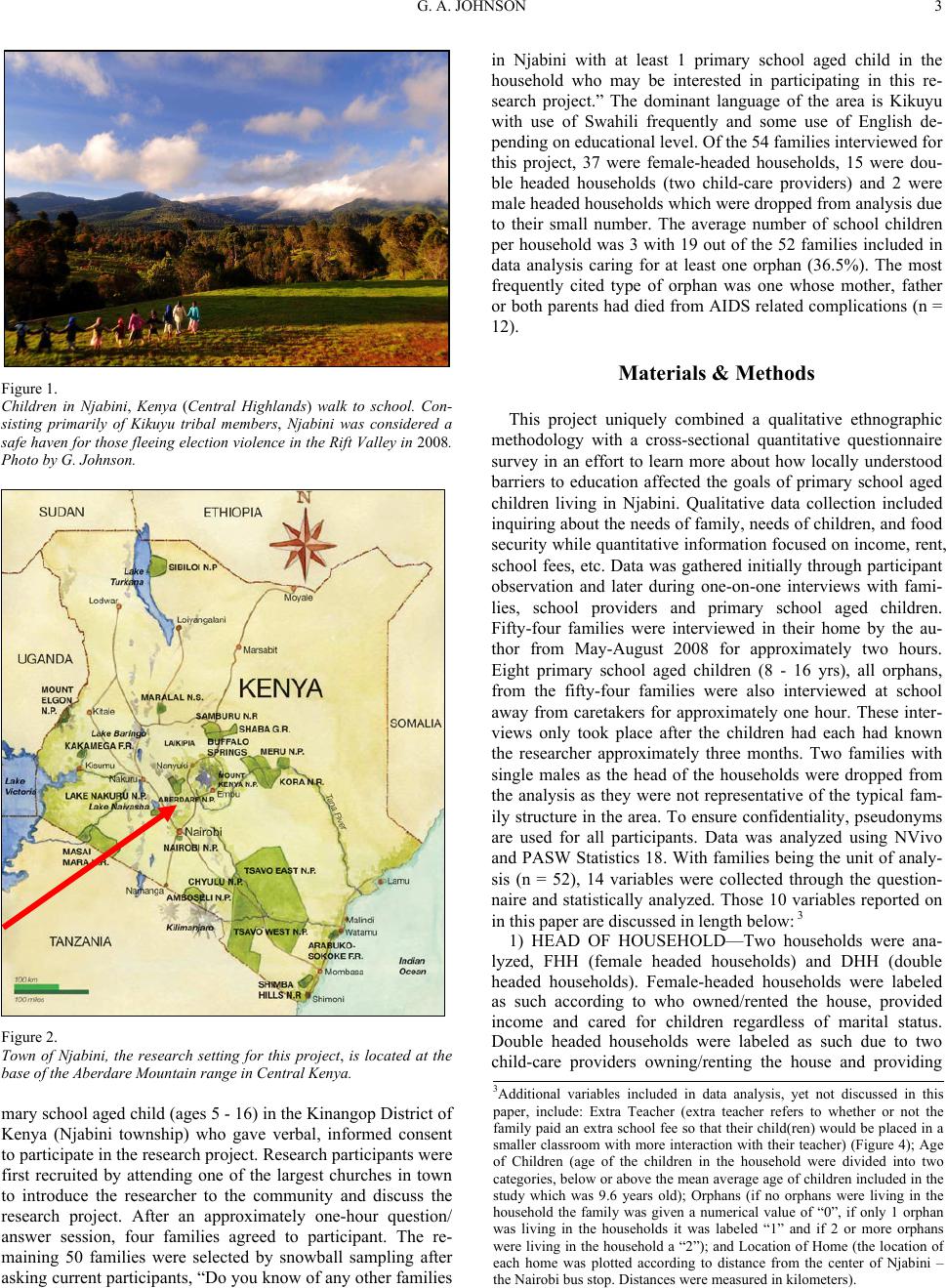 G. A. JOHNSON 3 Figure 1. Children in Njabini, Kenya (Central Highlands) walk to school. Con- sisting primarily of Kikuyu tribal members, Njabini was considered a safe haven for those fleeing election violence in the Rift Valley in 2008. Photo by G. Johnson. Figure 2. Town of Njabini, the research setting for this project, is located at the base of the Aberdare Mountain range in Central Kenya. mary school aged child (ages 5 - 16) in the Kinangop District of Kenya (Njabini township) who gave verbal, informed consent to participate in the research project. Research participants were first recruited by attending one of the largest churches in town to introduce the researcher to the community and discuss the research project. After an approximately one-hour question/ answer session, four families agreed to participant. The re- maining 50 families were selected by snowball sampling after asking current participants, “Do you know of any other families in Njabini with at least 1 primary school aged child in the household who may be interested in participating in this re- search project.” The dominant language of the area is Kikuyu with use of Swahili frequently and some use of English de- pending on educational level. Of the 54 families interviewed for this project, 37 were female-headed households, 15 were dou- ble headed households (two child-care providers) and 2 were male headed households which were dropped from analysis due to their small number. The average number of school children per household was 3 with 19 out of the 52 families included in data analysis caring for at least one orphan (36.5%). The most frequently cited type of orphan was one whose mother, father or both parents had died from AIDS related complications (n = 12). Materials & Methods This project uniquely combined a qualitative ethnographic methodology with a cross-sectional quantitative questionnaire survey in an effort to learn more about how locally understood barriers to education affected the goals of primary school aged children living in Njabini. Qualitative data collection included inquiring about the needs of family, needs of children, and food security while quantitative information focused on income, rent, school fees, etc. Data was gathered initially through participant observation and later during one-on-one interviews with fami- lies, school providers and primary school aged children. Fifty-four families were interviewed in their home by the au- thor from May-August 2008 for approximately two hours. Eight primary school aged children (8 - 16 yrs), all orphans, from the fifty-four families were also interviewed at school away from caretakers for approximately one hour. These inter- views only took place after the children had each had known the researcher approximately three months. Two families with single males as the head of the households were dropped from the analysis as they were not representative of the typical fam- ily structure in the area. To ensure confidentiality, pseudonyms are used for all participants. Data was analyzed using NVivo and PASW Statistics 18. With families being the unit of analy- sis (n = 52), 14 variables were collected through the question- naire and statistically analyzed. Those 10 variables reported on in this paper are discussed in length below: 3 1) HEAD OF HOUSEHOLD—Two households were ana- lyzed, FHH (female headed households) and DHH (double headed households). Female-headed households were labeled as such according to who owned/rented the house, provided income and cared for children regardless of marital status. Double headed households were labeled as such due to two child-care providers owning/renting the house and providing 3Additional variables included in data analysis, yet not discussed in this paper, include: Extra Teacher (extra teacher refers to whether or notthe family paid an extra school fee so that their child(ren) would be placed in a smaller classroom with more interaction with their teacher) (Figure 4); Age of Children (age of the children in the household were divided into two categories, below or above the mean average age of children included in the study which was 9.6 years old); Orphans (if no orphans were living in the household the family was given a numerical value of “0”, if only 1 or p han was living in the households it was labeled “1” and if 2 or more or p hans were living in the household a “2”); and Location of Home (the location o f each home was plotted according to distance from the center of Njabini – the Nairobi bus stop. Distances were measured in kilometers). 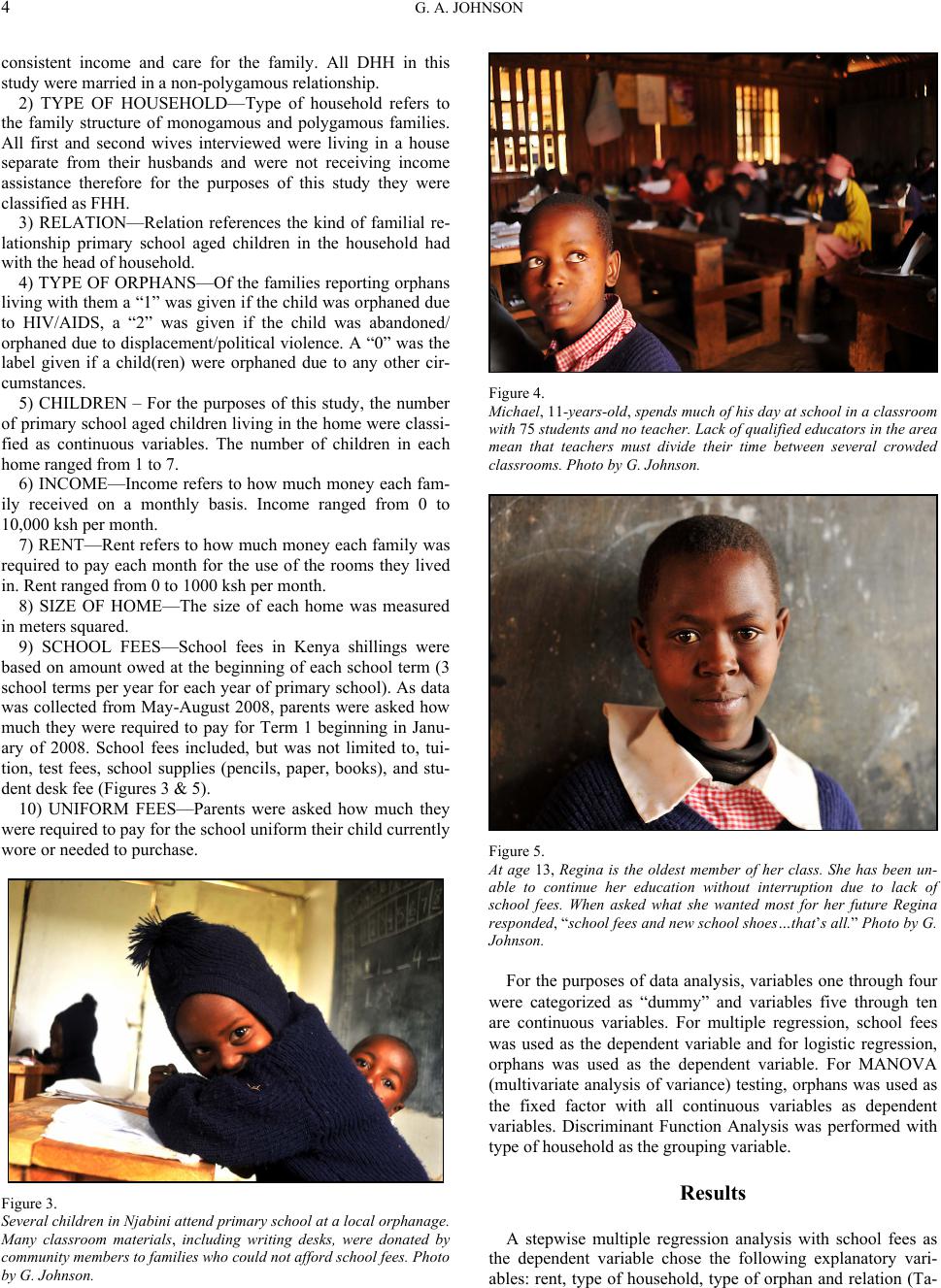 4 G. A. JOHNSON consistent income and care for the family. All DHH in this study were married in a non-polygamous relationship. 2) TYPE OF HOUSEHOLD—Type of household refers to the family structure of monogamous and polygamous families. All first and second wives interviewed were living in a house separate from their husbands and were not receiving income assistance therefore for the purposes of this study they were classified as FHH. 3) RELATION—Relation references the kind of familial re- lationship primary school aged children in the household had with the head of household. 4) TYPE OF ORPHANS—Of the families reporting orphans living with them a “1” was given if the child was orphaned due to HIV/AIDS, a “2” was given if the child was abandoned/ orphaned due to displacement/political violence. A “0” was the label given if a child(ren) were orphaned due to any other cir- cumstances. 5) CHILDREN – For the purposes of this study, the number of primary school aged children living in the home were classi- fied as continuous variables. The number of children in each home ranged from 1 to 7. 6) INCOME—Income refers to how much money each fam- ily received on a monthly basis. Income ranged from 0 to 10,000 ksh per month. 7) RENT—Rent refers to how much money each family was required to pay each month for the use of the rooms they lived in. Rent ranged from 0 to 1000 ksh per month. 8) SIZE OF HOME—The size of each home was measured in meters squared. 9) SCHOOL FEES—School fees in Kenya shillings were based on amount owed at the beginning of each school term (3 school terms per year for each year of primary school). As data was collected from May-August 2008, parents were asked how much they were required to pay for Term 1 beginning in Janu- ary of 2008. School fees included, but was not limited to, tui- tion, test fees, school supplies (pencils, paper, books), and stu- dent desk fee (Figures 3 & 5). 10) UNIFORM FEES—Parents were asked how much they were required to pay for the school uniform their child currently wore or needed to purchase. Figure 3. Several children in Njabini attend primary school at a local orphanage. Many classroom materials, including writing desks, were donated by community members to families who could not afford school fees. Photo by G. Johnson. Figure 4. Michael, 11-years-old, spends much of his day at school in a classroom with 75 students and no teacher. Lack of qualified educators in the area mean that teachers must divide their time between several crowded classrooms. Photo by G. Johnson. Figure 5. At age 13, Regina is the oldest member of her class. She has been un- able to continue her education without interruption due to lack of school fees. When asked what she wanted most for her future Regina responded, “school fees and new school shoes…that’s all.” Photo by G. Johnson. For the purposes of data analysis, variables one through four were categorized as “dummy” and variables five through ten are continuous variables. For multiple regression, school fees was used as the dependent variable and for logistic regression, orphans was used as the dependent variable. For MANOVA (multivariate analysis of variance) testing, orphans was used as the fixed factor with all continuous variables as dependent variables. Discriminant Function Analysis was performed with type of household as the grouping variable. Results A stepwise multiple regression analysis with school fees as the dependent variable chose the following explanatory vari- ables: rent, type of household, type of orphan and relation (Ta- 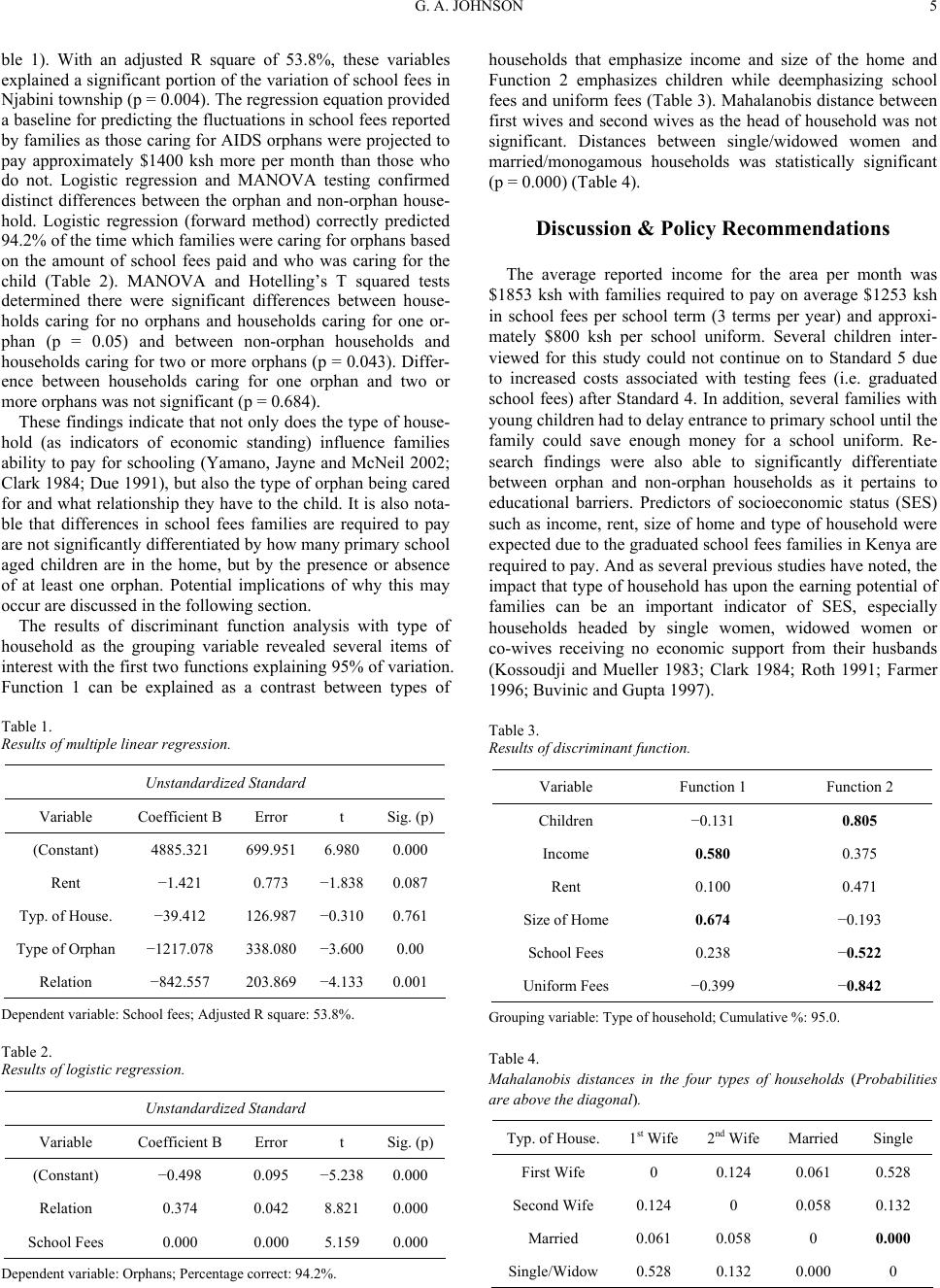 G. A. JOHNSON 5 ble 1). With an adjusted R square of 53.8%, these variables explained a significant portion of the variation of school fees in Njabini township (p = 0.004). The regression equation provided a baseline for predicting the fluctuations in school fees reported by families as those caring for AIDS orphans were projected to pay approximately $1400 ksh more per month than those who do not. Logistic regression and MANOVA testing confirmed distinct differences between the orphan and non-orphan house- hold. Logistic regression (forward method) correctly predicted 94.2% of the time which families were caring for orphans based on the amount of school fees paid and who was caring for the child (Table 2). MANOVA and Hotelling’s T squared tests determined there were significant differences between house- holds caring for no orphans and households caring for one or- phan (p = 0.05) and between non-orphan households and households caring for two or more orphans (p = 0.043). Differ- ence between households caring for one orphan and two or more orphans was not significant (p = 0.684). These findings indicate that not only does the type of house- hold (as indicators of economic standing) influence families ability to pay for schooling (Yamano, Jayne and McNeil 2002; Clark 1984; Due 1991), but also the type of orphan being cared for and what relationship they have to the child. It is also nota- ble that differences in school fees families are required to pay are not significantly differentiated by how many primary school aged children are in the home, but by the presence or absence of at least one orphan. Potential implications of why this may occur are discussed in the following section. The results of discriminant function analysis with type of household as the grouping variable revealed several items of interest with the first two functions explaining 95% of variation. Function 1 can be explained as a contrast between types of Table 1. Results of multiple linear regression. Unstandardized Standard Variable Coefficient B Error t Sig. (p) (Constant) 4885.321 699.951 6.980 0.000 Rent −1.421 0.773 −1.838 0.087 Typ. of House. −39.412 126.987 −0.310 0.761 Type of Orphan −1217.078 338.080 −3.600 0.00 Relation −842.557 203.869 −4.133 0.001 Dependent variable: School fees; Adjusted R square: 53.8%. Table 2. Results of logistic regression. Unstandardized Standard Variable Coefficient B Error t Sig. (p) (Constant) −0.498 0.095 −5.238 0.000 Relation 0.374 0.042 8.821 0.000 School Fees 0.000 0.000 5.159 0.000 Dependent variable: Orphans; Percentage correct: 94.2%. households that emphasize income and size of the home and Function 2 emphasizes children while deemphasizing school fees and uniform fees (Table 3). Mahalanobis distance between first wives and second wives as the head of household was not significant. Distances between single/widowed women and married/monogamous households was statistically significant (p = 0.000) (Table 4). Discussion & Policy Recommendations The average reported income for the area per month was $1853 ksh with families required to pay on average $1253 ksh in school fees per school term (3 terms per year) and approxi- mately $800 ksh per school uniform. Several children inter- viewed for this study could not continue on to Standard 5 due to increased costs associated with testing fees (i.e. graduated school fees) after Standard 4. In addition, several families with young children had to delay entrance to primary school until the family could save enough money for a school uniform. Re- search findings were also able to significantly differentiate between orphan and non-orphan households as it pertains to educational barriers. Predictors of socioeconomic status (SES) such as income, rent, size of home and type of household were expected due to the graduated school fees families in Kenya are required to pay. And as several previous studies have noted, the impact that type of household has upon the earning potential of families can be an important indicator of SES, especially households headed by single women, widowed women or co-wives receiving no economic support from their husbands (Kossoudji and Mueller 1983; Clark 1984; Roth 1991; Farmer 1996; Buvinic and Gupta 1997). Table 3. Results of discriminant function. Variable Function 1 Function 2 Children −0.131 0.805 Income 0.580 0.375 Rent 0.100 0.471 Size of Home 0.674 −0.193 School Fees 0.238 −0.522 Uniform Fees −0.399 −0.842 Grouping variable: Type of household; Cumulative %: 95.0. Table 4. Mahalanobis distances in the four types of households (Probabilities are above the diagonal). Typ. of House.1st Wife2nd Wife Married Single First Wife 0 0.124 0.061 0.528 Second Wife 0.124 0 0.058 0.132 Married 0.061 0.058 0 0.000 Single/Widow 0.528 0.132 0.000 0 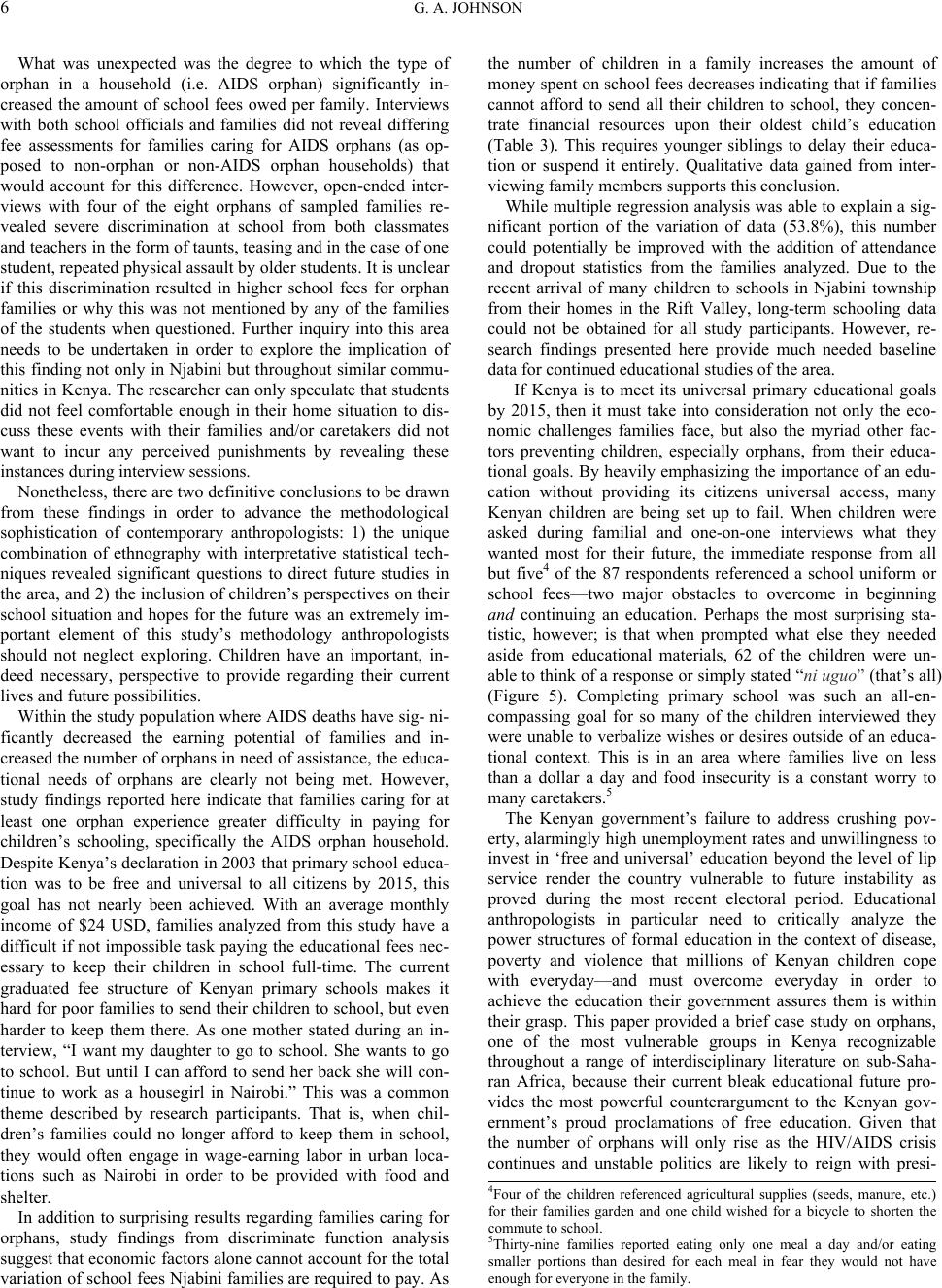 6 G. A. JOHNSON What was unexpected was the degree to which the type of orphan in a household (i.e. AIDS orphan) significantly in- creased the amount of school fees owed per family. Interviews with both school officials and families did not reveal differing fee assessments for families caring for AIDS orphans (as op- posed to non-orphan or non-AIDS orphan households) that would account for this difference. However, open-ended inter- views with four of the eight orphans of sampled families re- vealed severe discrimination at school from both classmates and teachers in the form of taunts, teasing and in the case of one student, repeated physical assault by older students. It is unclear if this discrimination resulted in higher school fees for orphan families or why this was not mentioned by any of the families of the students when questioned. Further inquiry into this area needs to be undertaken in order to explore the implication of this finding not only in Njabini but throughout similar commu- nities in Kenya. The researcher can only speculate that students did not feel comfortable enough in their home situation to dis- cuss these events with their families and/or caretakers did not want to incur any perceived punishments by revealing these instances during interview sessions. Nonetheless, there are two definitive conclusions to be drawn from these findings in order to advance the methodological sophistication of contemporary anthropologists: 1) the unique combination of ethnography with interpretative statistical tech- niques revealed significant questions to direct future studies in the area, and 2) the inclusion of children’s perspectives on their school situation and hopes for the future was an extremely im- portant element of this study’s methodology anthropologists should not neglect exploring. Children have an important, in- deed necessary, perspective to provide regarding their current lives and future possibilities. Within the study population where AIDS deaths have sig- ni- ficantly decreased the earning potential of families and in- creased the number of orphans in need of assistance, the educa- tional needs of orphans are clearly not being met. However, study findings reported here indicate that families caring for at least one orphan experience greater difficulty in paying for children’s schooling, specifically the AIDS orphan household. Despite Kenya’s declaration in 2003 that primary school educa- tion was to be free and universal to all citizens by 2015, this goal has not nearly been achieved. With an average monthly income of $24 USD, families analyzed from this study have a difficult if not impossible task paying the educational fees nec- essary to keep their children in school full-time. The current graduated fee structure of Kenyan primary schools makes it hard for poor families to send their children to school, but even harder to keep them there. As one mother stated during an in- terview, “I want my daughter to go to school. She wants to go to school. But until I can afford to send her back she will con- tinue to work as a housegirl in Nairobi.” This was a common theme described by research participants. That is, when chil- dren’s families could no longer afford to keep them in school, they would often engage in wage-earning labor in urban loca- tions such as Nairobi in order to be provided with food and shelter. In addition to surprising results regarding families caring for orphans, study findings from discriminate function analysis suggest that economic factors alone cannot account for the total variation of school fees Njabini families are required to pay. As the number of children in a family increases the amount of money spent on school fees decreases indicating that if families cannot afford to send all their children to school, they concen- trate financial resources upon their oldest child’s education (Table 3). This requires younger siblings to delay their educa- tion or suspend it entirely. Qualitative data gained from inter- viewing family members supports this conclusion. While multiple regression analysis was able to explain a sig- nificant portion of the variation of data (53.8%), this number could potentially be improved with the addition of attendance and dropout statistics from the families analyzed. Due to the recent arrival of many children to schools in Njabini township from their homes in the Rift Valley, long-term schooling data could not be obtained for all study participants. However, re- search findings presented here provide much needed baseline data for continued educational studies of the area. If Kenya is to meet its universal primary educational goals by 2015, then it must take into consideration not only the eco- nomic challenges families face, but also the myriad other fac- tors preventing children, especially orphans, from their educa- tional goals. By heavily emphasizing the importance of an edu- cation without providing its citizens universal access, many Kenyan children are being set up to fail. When children were asked during familial and one-on-one interviews what they wanted most for their future, the immediate response from all but five4 of the 87 respondents referenced a school uniform or school fees—two major obstacles to overcome in beginning and continuing an education. Perhaps the most surprising sta- tistic, however; is that when prompted what else they needed aside from educational materials, 62 of the children were un- able to think of a response or simply stated “ni uguo” (that’s all) (Figure 5). Completing primary school was such an all-en- compassing goal for so many of the children interviewed they were unable to verbalize wishes or desires outside of an educa- tional context. This is in an area where families live on less than a dollar a day and food insecurity is a constant worry to many caretakers.5 The Kenyan government’s failure to address crushing pov- erty, alarmingly high unemployment rates and unwillingness to invest in ‘free and universal’ education beyond the level of lip service render the country vulnerable to future instability as proved during the most recent electoral period. Educational anthropologists in particular need to critically analyze the power structures of formal education in the context of disease, poverty and violence that millions of Kenyan children cope with everyday—and must overcome everyday in order to achieve the education their government assures them is within their grasp. This paper provided a brief case study on orphans, one of the most vulnerable groups in Kenya recognizable throughout a range of interdisciplinary literature on sub-Saha- ran Africa, because their current bleak educational future pro- vides the most powerful counterargument to the Kenyan gov- ernment’s proud proclamations of free education. Given that the number of orphans will only rise as the HIV/AIDS crisis continues and unstable politics are likely to reign with presi- 4Four of the children referenced agricultural supplies (seeds, manure, etc.) for their families garden and one child wished for a bicycle to shorten the commute to school. 5Thirty-nine families reported eating only one meal a day and/or eating smaller portions than desired for each meal in fear they would not have enough for everyone in the family. 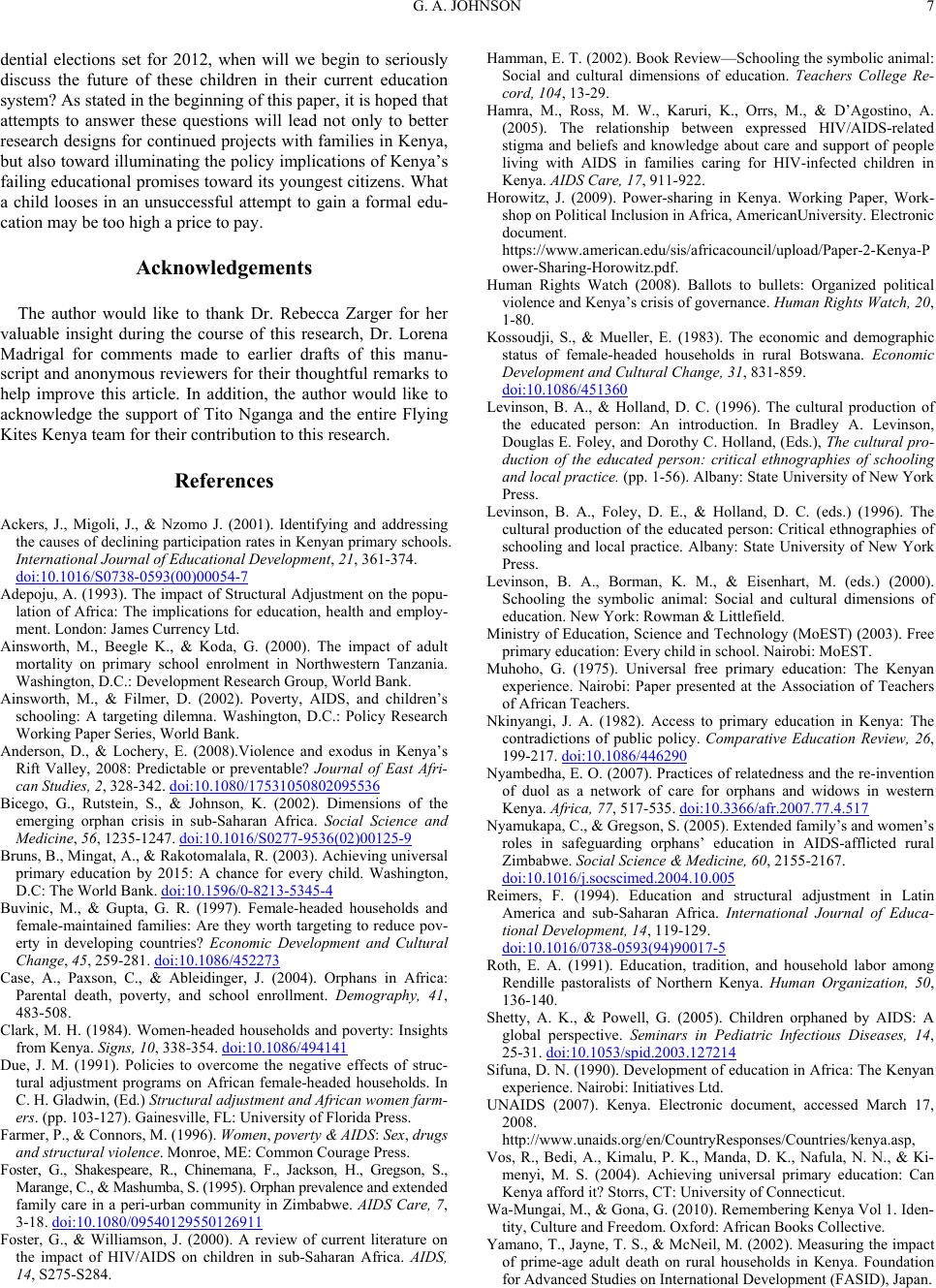 G. A. JOHNSON 7 dential elections set for 2012, when will we begin to seriously discuss the future of these children in their current education system? As stated in the beginning of this paper, it is hoped that attempts to answer these questions will lead not only to better research designs for continued projects with families in Kenya, but also toward illuminating the policy implications of Kenya’s failing educational promises toward its youngest citizens. What a child looses in an unsuccessful attempt to gain a formal edu- cation may be too high a price to pay. Acknowledgements The author would like to thank Dr. Rebecca Zarger for her valuable insight during the course of this research, Dr. Lorena Madrigal for comments made to earlier drafts of this manu- script and anonymous reviewers for their thoughtful remarks to help improve this article. In addition, the author would like to acknowledge the support of Tito Nganga and the entire Flying Kites Kenya team for their contribution to this research. References Ackers, J., Migoli, J., & Nzomo J. (2001). Identifying and addressing the causes of declining participation rates in Kenyan primary schools. International Journal of Educatio nal Development, 21, 361-374. doi:10.1016/S0738-0593(00)00054-7 Adepoju, A. (1993). The impact of Structural Adjustment on the popu- lation of Africa: The implications for education, health and employ- ment. London: James Currency Ltd. Ainsworth, M., Beegle K., & Koda, G. (2000). The impact of adult mortality on primary school enrolment in Northwestern Tanzania. Washington, D.C.: Development Research Group, World Bank. Ainsworth, M., & Filmer, D. (2002). Poverty, AIDS, and children’s schooling: A targeting dilemna. Washington, D.C.: Policy Research Working Paper Series, World Bank. Anderson, D., & Lochery, E. (2008).Violence and exodus in Kenya’s Rift Valley, 2008: Predictable or preventable? Journal of East Afri- can Studies, 2, 328-342. doi:10.1080/17531050802095536 Bicego, G., Rutstein, S., & Johnson, K. (2002). Dimensions of the emerging orphan crisis in sub-Saharan Africa. Social Science and Medicine, 56, 1235-1247. doi:10.1016/S0277-9536(02)00125-9 Bruns, B., Mingat, A., & Rakotomalala, R. (2003). Achieving universal primary education by 2015: A chance for every child. Washington, D.C: The World Bank. doi:10.1596/0-8213-5345-4 Buvinic, M., & Gupta, G. R. (1997). Female-headed households and female-maintained families: Are they worth targeting to reduce pov- erty in developing countries? Economic Development and Cultural Change, 45, 259-281. doi:10.1086/452273 Case, A., Paxson, C., & Ableidinger, J. (2004). Orphans in Africa: Parental death, poverty, and school enrollment. Demography, 41, 483-508. Clark, M. H. (1984). Women-headed households and poverty: Insights from Kenya. Signs, 10, 338-354. doi:10.1086/494141 Due, J. M. (1991). Policies to overcome the negative effects of struc- tural adjustment programs on African female-headed households. In C. H. Gladwin, (Ed.) Structural adjustment and African women farm- ers. (pp. 103-127). Gainesville, FL: University of Florida Press. Farmer, P., & Connors, M. (1996). Women, poverty & AIDS: Sex, drugs and structural violence. Monroe, ME: Common Courage Press. Foster, G., Shakespeare, R., Chinemana, F., Jackson, H., Gregson, S., Marange, C., & Mashumba, S. (1995). Orphan prevalence and extended family care in a peri-urban community in Zimbabwe. AIDS Care, 7, 3-18. doi:10.1080/09540129550126911 Foster, G., & Williamson, J. (2000). A review of current literature on the impact of HIV/AIDS on children in sub-Saharan Africa. AIDS, 14, S275-S284. Hamman, E. T. (2002). Book Review—Schooling the symbolic animal: Social and cultural dimensions of education. Teachers College Re- cord, 104, 13-29. Hamra, M., Ross, M. W., Karuri, K., Orrs, M., & D’Agostino, A. (2005). The relationship between expressed HIV/AIDS-related stigma and beliefs and knowledge about care and support of people living with AIDS in families caring for HIV-infected children in Kenya. AIDS Care, 17, 911-922. Horowitz, J. (2009). Power-sharing in Kenya. Working Paper, Work- shop on Political Inclusion in Africa, AmericanUniversity. Electronic document. https://www.american.edu/sis/africacouncil/upload/Paper-2-Kenya-P ower-Sharing-Horowitz.pdf. Human Rights Watch (2008). Ballots to bullets: Organized political violence and Kenya’s crisis of governance. Human Rights Watch, 20, 1-80. Kossoudji, S., & Mueller, E. (1983). The economic and demographic status of female-headed households in rural Botswana. Economic Development and Cultural Change, 31, 831-859. doi:10.1086/451360 Levinson, B. A., & Holland, D. C. (1996). The cultural production of the educated person: An introduction. In Bradley A. Levinson, Douglas E. Foley, and Dorothy C. Holland, (Eds.), The cultural pro- duction of the educated person: critical ethnographies of schooling and local practice. (pp. 1-56). Albany: State University of New York Press. Levinson, B. A., Foley, D. E., & Holland, D. C. (eds.) (1996). The cultural production of the educated person: Critical ethnographies of schooling and local practice. Albany: State University of New York Press. Levinson, B. A., Borman, K. M., & Eisenhart, M. (eds.) (2000). Schooling the symbolic animal: Social and cultural dimensions of education. New York: Rowman & Littlefield. Ministry of Education, Science and Technology (MoEST) (2003). Free primary education: Every child in school. Nairobi: MoEST. Muhoho, G. (1975). Universal free primary education: The Kenyan experience. Nairobi: Paper presented at the Association of Teachers of African Teachers. Nkinyangi, J. A. (1982). Access to primary education in Kenya: The contradictions of public policy. Comparative Education Review, 26, 199-217. doi:10.1086/446290 Nyambedha, E. O. (2007). Practices of relatedness and the re-invention of duol as a network of care for orphans and widows in western Kenya. Africa, 77, 517-535. doi:10.3366/afr.2007.77.4.517 Nyamukapa, C., & Gregson, S. (2005). Extended family’s and women’s roles in safeguarding orphans’ education in AIDS-afflicted rural Zimbabwe. Social Science & Medicine, 60, 2155-2167. doi:10.1016/j.socscimed.2004.10.005 Reimers, F. (1994). Education and structural adjustment in Latin America and sub-Saharan Africa. International Journal of Educa- tional Development, 14, 119-129. doi:10.1016/0738-0593(94)90017-5 Roth, E. A. (1991). Education, tradition, and household labor among Rendille pastoralists of Northern Kenya. Human Organization, 50, 136-140. Shetty, A. K., & Powell, G. (2005). Children orphaned by AIDS: A global perspective. Seminars in Pediatric Infectious Diseases, 14, 25-31. doi:10.1053/spid.2003.127214 Sifuna, D. N. (1990). Development of education in Africa: The Kenyan experience. Nairobi: Initiatives Ltd. UNAIDS (2007). Kenya. Electronic document, accessed March 17, 2008. http://www.unaids.org/en/CountryResponses/Countries/kenya.asp, Vos, R., Bedi, A., Kimalu, P. K., Manda, D. K., Nafula, N. N., & Ki- menyi, M. S. (2004). Achieving universal primary education: Can Kenya afford it? Storrs, CT: University of Connecticut. Wa-Mungai, M., & Gona, G. (2010). Remembering Kenya Vol 1. Iden- tity, Culture and Freedom. Oxford: African Books Collective. Yamano, T., Jayne, T. S., & McNeil, M. (2002). Measuring the impact of prime-age adult death on rural households in Kenya. Foundation for Advanced Studies on International Development (FASID), Japan. |