

Paper Menu >>
Journal Menu >>
 Journal of Environmental Protection, 2011, 2, 729-735 doi:10.4236/jep.2011.26084 Published Online August 2011 (http://www.SciRP.org/journal/jep) Copyright © 2011 SciRes. JEP 729 Cr(VI) Ions Removal from Aqueous Solutions Using Natural Adsorbents—FTIR Studies Biswajit Singha, Tarun Kumar Naiya, Ashim Kumar Bhattacharya, Sudip Kumar Das Department of Chemical Engineering, University of Calcutta, Kolkata, India. Email: [email protected] Received March 22nd, 2011; revised May 6th, 2011; accepted June 15th, 2011. ABSTRACT The ability of eight natural adsorbents were investigated for adsorptive removal of Cr(VI) from aqueous solutions. Various physico-chemical parameters such as pH, initial metal ion con centratio n, adsorbent dose level and equilibrium contact time were optimized in batch adsorption technique. A detailed Fourier Transform Infrared spectra (FTIR) study of adsorbents and Cr(VI) loaded adsorbents at the optimized condition was carried out to identify the different func- tional groups that were responsible for the adsorption. The important functional groups like hydroxyl, alkene, aromatic nitro, carboxilate anion, silicon oxide, sulphonic acid etc. were present in the natural adsorbent and were responsible for the chemical adsorption of Cr(VI) from aqueous solutions. The sorption energy calculated from Dubinin-Radushkevich isotherm indicated that the adsorption process were chemical in nature. Keywords: FTIR, Chromium(VI), Rice Straw, Hyacinth Roots, Saw Dust 1. Introduction Cr(VI) containing waste water discharged from various industries, including mining, tanning, cement, production of steel and other metal alloys, electroplating operations, photographic material and corrosive painting industries [1,2]. It is carcinogenic, mutagenic and toxic; thus, its presence in the environment poses a significant threat to aquatic life and as well as public health [3]. The maximum permissible limit of Cr(VI) for the dis- charge to inland surface water is 0.1 mg/L and in potable water is 0.05 mg/L [4,5]. The Ministry of Environment and Forest (MOEF), Government of India has set mini- mal national standards (MINAS) of 0.1 mg/L for safe discharge of effluent containing Cr(VI) in surface water [6]. To comply with this limit, industries have to treat their effluents to reduce the Cr(VI) concentration in wastewater to acceptable levels. In waste water treatment various technologies are available such as chemical pre- cipitation, ion exchange, electrochemical precipitation, solvent extraction, membrane separation, concentration, evaporation, reverse osmosis, emulsion per traction, ad- sorption etc. [7]. Among these technologies, adsorption is an user-friendly technique for the removal of heavy metal. This process includes the selective transfer of sol- ute components in the fluid phase onto the surface or onto the bulk of solid adsorbent materials. In recent years, several natural or agricultural wastes [8-11] have been used for the removal of heavy metal from industrial waste water. In general natural or agri- cultural waste contains different functional groups like hydroxyl, aldehyde, aliphatic acid, alkene, amide, aro- matic nitro, silicate, sulphonate etc. The present paper deals with the identification of functional groups which are responsible for Cr(VI) ion adsorption in the eight bio-adsorbents. 2. Experimental Methods 2.1. Preparation of Adsorbents Rice straw, rice bran, rice husk, hyacinth roots, neem bark, saw dust of teakwood origin, neem leaves and co- conut shell were used as low cost natural or agricultural wastes for Cr(VI) removal from aqueous solutions. All the adsorbents were collected from local area near Kolkota, West Bengal, India. Rice straw, rice bran, rice husk and hyacinth roots were boiled for 6 hr. to remove color materials. Coconut shell was crashed in roll crusher and then grinded. Saw- dust, neem bark, neem leaves and coconut shell were treated with 0.1 N NaOH to remove lignin based color materials followed by 0.1 N H2SO4. Finally all the ad- sorbents were washed with distilled water several time and dried at 105˚C for 6 hr to remove the adherent mois-  Cr(VI) Ions Removal from Aqueous Solutions Using Natural Adsorbents—FTIR Studies 730 ture. After drying, all the adsorbents were sieved to ob- tain particle size of 250 - 350 μm prior to being used for adsorption studies. 2.2. Reagents and Equipments All the necessary chemicals used in the study were of analytical grade and obtained from E. Merck Limited, Mumbai, India. The pH of the solution was measured with a EUTECH make digital microprocessor based pH meter previously calibrated with standard buffer solu- tions. UV-Spectrophotometer (U-4100 spectrophotome- ter, Hitachi, Japan) was used to determine the Cr(VI) content in standard and treated solutions after adsorption experiments. FT-IR (Jasco FT/IR-670 Plus) studies were carried out to determine the type of functional group re- sponsible for Cr(VI) adsorption. The surface area was measured on Micromeritics Surface Area Analyzer (ASAP 2020). The moisture content determination was carried out with a digital microprocessor based moisture analyzer (Metteler LP16). The point of zero charge was determined by solid addition method [12] and reported in Table 1. 2.3. Preparation of Standard Cr(VI) Solution The stock solution containing 1000 mg/L of Cr(VI) was prepared by dissolving 3.73 g of A. R. grade K2CrO4, 2H2O in 1000 ml double distilled water. Required initial concentration of Cr(VI) standards were prepared by ap- propriate dilution of the above stock Cr(VI) solution. 2.4. Batch Adsorption Studies Using the necessary adsorbents in a series of 250 ml stopper conical flask containing 100 ml of Cr(VI) solu- tion batch adsorption were carried out. pH of the solution adjusted by adding 0.1 N HCl or 0.1 N NaOH solution as required. Then the flasks were shaken for the desired contact time in an electrically thermostated reciprocating shaker with 120 - 125 strokes/minute at 30˚C. The time required to reach the equilibrium was estimated by with- drawing conical flask containing treated solution at regular intervals of time (simultaneously 8 conical flasks with same concentrations of all items). The content of these flasks were filtered through filter paper (Whatman no.1). UV-visible spectrophotometer was employed to determine the remaining Cr(VI) concentration in the sample solution using 1,5-diphenylcarbazide method as laid down in standard methods for examination of water and wastewater, APHA, AWWA, WEF, 1998 edition [13]. All the investigations were carried out in triplicate to avoid any discrepancy in experimental results with the reproducibility and the relative deviation of the order of ±0.5% and ±2.5% respectively. The solution pH adjusted to 1.0 ± 0.1 to 9.0 ± 0.1 under thermostated conditions of 30˚C ± 0.5˚C. 3. Results and Discussion 3.1. Optimum Operating Condition and Cr(VI) Adsorption Mechanism Metal sorption is depends on the solution pH. The range of variables investigated to obtain the optimum condition is shown in Table 2. In general adsorption of anion is favored at pH < pHpzc. At very low pH, chromium ions exist in the form of 4 HCrO , at higher pH up to 6 differ- ent forms such as 2 27 Cr O , 4, and HCrO2 310 Cr O , coex- ists, of which 4 HCrO predominates. As the pH increa- ses equilibrium shifted form 4 HC to rO2 4 CrO and 2 27 Cr O [14]. At very low pH values, the surface of ad- sorbent would be surrounded by the hydronium ions which enhance the Cr(VI) interaction with binding sites of the biosorbent by greater attractive forces. As the pH increased, the overall surface charge on the biosorbents- became negative and adsorption decreased [2]. The fol- lowing equilibrium may be written for the Cr(VI) anions present in aqueous solutions [9]. Table 1. Different physical characteristics of natural adsorbents. Adsorbents Surface area (m2/g) Moisture content (%) Point of zero charge Ash content (%) Rice straw 1.21 7.26 6.85 9.40 Rice bran 0.12 10.68 6.10 11.72 Rice husk 0.54 9.02 6.05 11.80 Saw dust 3.85 8.63 3.90 12.35 Neem bark 3.47 9.23 4.50 10.62 Hyacinth roots 5.78 11.25 6.59 10.74 Neem leaves 0.57 8.33 6.94 13.58 Coconut shell 0.52 6.16 6.62 9.23 Copyright © 2011 SciRes. JEP  Cr(VI) Ions Removal from Aqueous Solutions Using Natural Adsorbents—FTIR Studies731 Table 2. Range of variables for batch experiment. Adsorbent Initial pH Initial Cr(VI) concentration (mg/L) Contact time (min) Adsorbent dosage (g/L) Rice straw 1 - 9 5 - 300 0 - 420 2.5 - 12.5 Rice bran 1 - 9 5 - 300 0 - 420 2.5 - 12.5 Rice husk 1 - 9 5 - 300 0 - 420 2.5 - 12.5 Saw dust 2 - 8 3 - 300 0 - 300 2.5 - 30.0 Neem bark 2 - 8 3 - 300 0 - 300 2.5 - 30.0 Hyacinth roots 1 - 9 5 - 300 0 - 420 2.5 - 12.5 Neem leaves 1 - 9 5 - 300 0 - 300 2.5 - 12.5 Coconut shell 1 - 9 5 - 300 0 - 360 2.5 - 12.5 244 1 HCrOHCrOH 1.21k (1) 2 2724 2 CrOHO2HCrO 35.5k (2) 27 44 3 HCrOCrOH 310k (3) Adsorption of Cr(VI) was not significant at pH values more than 6 due to dual complexation of the anions ( , and ) to be adsorbed on the sur- face of the adsorbents, of which predominates [15]. The optimum adsorbent dosage, equilibrium contact time, optimum initial Cr(VI) ion concentration and maximum adsorption capacities of different natural or agricultural waste adsorbent using Langmuir adsorption isotherm model [16] were experimentally determined in batch process and the results are shown in Table 3. 2 4 CrO2 27 Cr OOH OH max max 1 e e C qqbq e C (4) Equation (4) represents the Langmuir adsorption model where Ce is the concentration of Cr(VI) in solution at equilibrium (mg/L), qe is the amount adsorb per gram of the adsorbent at equilibrium, qmax is the maximum ad- sorption capacity (mg/g) and b is the Langmuir constant (L/mg). Linear plots of Ce/qe vs. Ce were employed to determine the value of qmax (mg/g). The maximum ad- sorption capacity along with correlation coefficient (r2) obtained were listed in Table 3. 3.2. Calculation of Sorption Energy The Dubinin-Radushkevich [17] isotherm model was used to predict the nature of adsorption processes as physical or chemical by calculating sorption energy. The linear from of the model is described as, 2 ln ln abs m CX (5) where Cabs is the amount of Cr(VI) adsorbed onto ad- sorbent surface (mol/g) and Xm represents the maximum adsorption capacity of adsorbent (mmol/g), is con- stant related to sorption energy. The Polanyi potential [18] which is equal to, 1 ln 1 e RT C (6) R is the ideal gas constant in kJ/mol/K and T is the temperature in Kelvin. From the plot of lnabs C vs. 2 gave a straight line from which the values of and m X for all the adsorbents were calculated. Using the value of , the mean sorption energy, E, is evaluated as 1 2 E (7) The mean sorption energy, E, which indicated the in- formation about adsorption mechanism. If E 8 kJ/mol, the adsorption process was physical in nature and in the ranges from 8 to 16 kJ/mol, it was chemical in nature [19-21]. The estimated values of E were 14.142 kJ/mol, 13.921 kJ/mol, 13.558 kJ/mol, 9.341 kJ/mol, 9.205 kJ/mol, 12.845 kJ/mol, 14.712 kJ/mol and 15.394 kJ/mol for rice straw, rice bran, rice husk, saw dust, neem bark, hyacinth roots, neem leaves and coconut shell respec- tively which suggested the adsorption process was che- mical in nature i.e. the indication of chemical bond for- mation between metal ion species and the functional group of the adsorbents. 3.3. FTIR Analysis for Cr(VI) Adsorption Fouier transform infrared spectra (FTIR) was used to inves- tigate the changes in vibration frequency in the functional groups of the adsorbents due to Cr(VI) adsorption. Each fresh and Cr(VI) loaded adsorbents were mixed sepa- rately with KBr of spectroscopic grade and made in the form of pellets at a pressure of about 1 MPa. The pellets were about 10 mm in diameter and 1 mm thickness. Then the adsorbents were scanned i the spectral range of 4000 - n Copyright © 2011 SciRes. JEP  Cr(VI) Ions Removal from Aqueous Solutions Using Natural Adsorbents—FTIR Studies 732 Table 3. Optimum operating condition obtaining in the batch process. Langmuir isotherm model Adsorbent Initial pH Initial Cr(VI) concentration (mg/L)Contact time (min)Adsorbent dosage (g/L) qmax (mg/g) r2 Rice straw 2 25 180 10 12.17 0.9801 Rice bran 2 25 300 10 12.34 0.9476 Rice husk 1.5 25 360 10 11.39 0.9869 Saw dust 3 50 240 10 20.70 0.9963 Neem bark 3 50 240 10 19.60 0.9959 Hyacinth roots 2 25 240 10 15.28 0.9790 Neem leaves 2 25 240 10 15.95 0.9652 Coconut shell 2 25 240 10 18.69 0.9530 400 cm−1. Figures 1-3 show the FTIR spectra of rice straw, hyacinth roots and coconut shell respectively. Similar type of spectra also occurred for other adsorbents. These spectra indicated a number of absorption peaks showing the complex nature of the adsorbent. The func- tional group is one of the key factors to understand the mechanism of metal binding process on natural adsorb- ents. Tables 4 and 5 represented the shift in the wave num- ber of dominant peak associated with the fresh and Cr(VI) loaded adsorbents in the FT-IR plots. These shifts in the wave length showed that there was metal binding process taking place at the surface of the adsorbents [12,22]. The spectra display a number of absorption peaks, indicating the complex nature of the natural adsorbents. There was a clear shift from wave number of 3348.78 cm−1 (rice straw) to 3417.24 cm−1 (metal loaded rice straw), 3342.03 cm−1 (rice bran) to 3328.53 cm−1 (metal loaded rice bran) and 3385.42 cm−1 (rice husk) to 3421.10 cm−1 (metal loaded rice husk), 3297.75 cm−1 (neem bark) to 3266.82 cm−1 (metal loaded neem bark), 3328.53 cm−1 (hyacinth Figure 1. FTIR spectra of (a) rice straw and (b) Cr(VI) loaded rice straw. Figure 2. FTIR spectra of (a) hyacinth roots and (b) Cr(VI) loaded hyacinth roots. Figure 3. FTIR spectra of (a) coconut shell and (b) Cr(VI) loaded coconut shell. root) to 3305.39 cm−1 (metal loaded hyacinth roots) which indicate surface -OH group is one of the functional group responsible for adsorption Cr(VI) on rice straw, rice bran, rice husk, neem bark and hyacinth root. Though surface -OH present as functional group in saw dust but it is not responsible for metal binding in case of adsorption of Cr(VI) on saw dust. This can be inferred Copyright © 2011 SciRes. JEP 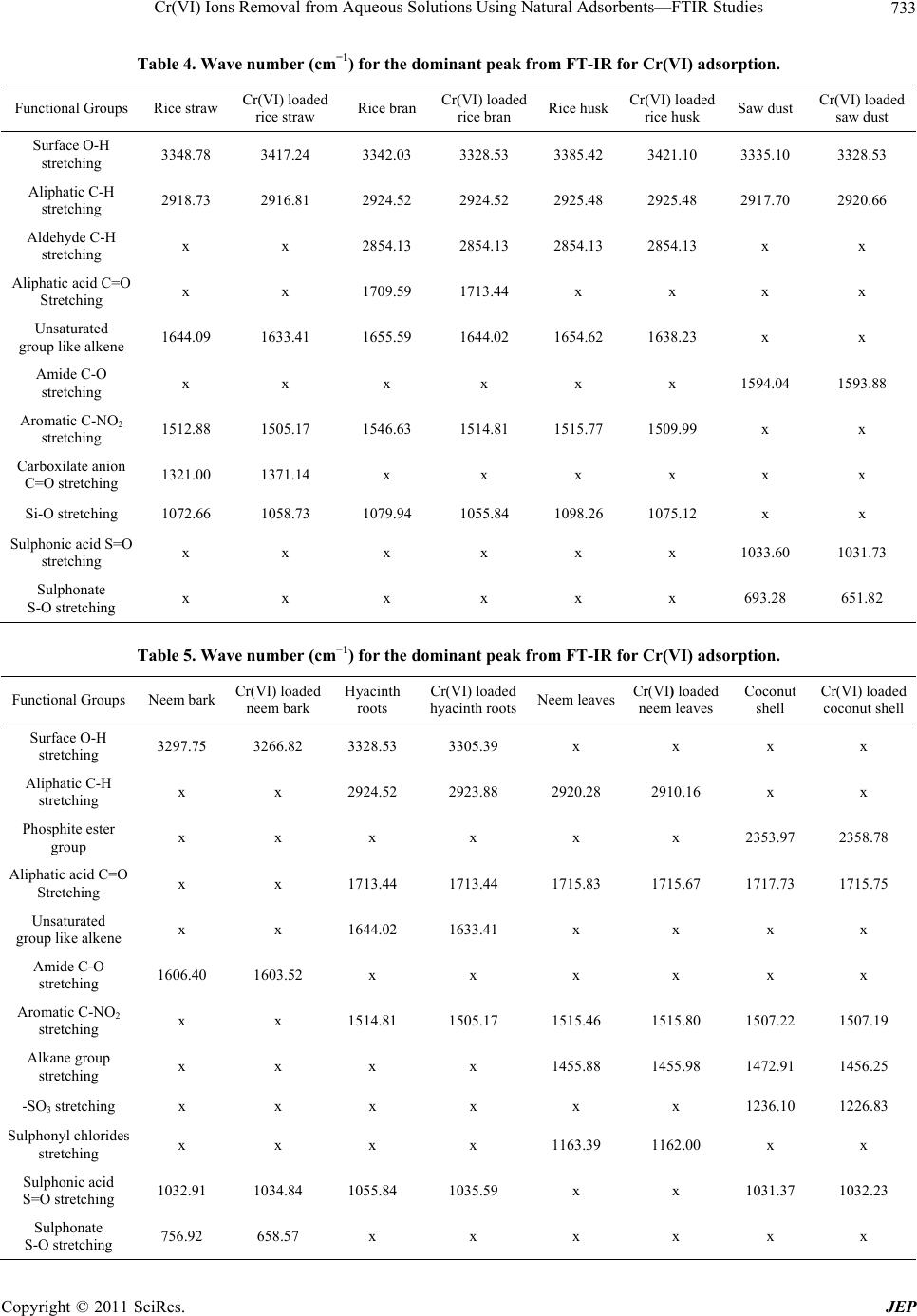 Cr(VI) Ions Removal from Aqueous Solutions Using Natural Adsorbents—FTIR Studies733 Table 4. Wave number (cm−1) for the dominant peak from FT-IR for Cr(VI) adsorption. Functional Groups Rice straw Cr(VI) loaded rice straw Rice bran Cr(VI) loaded rice bran Rice huskCr(VI) loaded rice husk Saw dust Cr(VI) loaded saw dust Surface O-H stretching 3348.78 3417.24 3342.03 3328.53 3385.42 3421.10 3335.10 3328.53 Aliphatic C-H stretching 2918.73 2916.81 2924.52 2924.52 2925.48 2925.48 2917.70 2920.66 Aldehyde C-H stretching x x 2854.13 2854.13 2854.13 2854.13 x x Aliphatic acid C=O Stretching x x 1709.59 1713.44 x x x x Unsaturated group like alkene 1644.09 1633.41 1655.59 1644.02 1654.62 1638.23 x x Amide C-O stretching x x x x x x 1594.04 1593.88 Aromatic C-NO2 stretching 1512.88 1505.17 1546.63 1514.81 1515.77 1509.99 x x Carboxilate anion C=O stretching 1321.00 1371.14 x x x x x x Si-O stretching 1072.66 1058.73 1079.94 1055.84 1098.26 1075.12 x x Sulphonic acid S=O stretching x x x x x x 1033.60 1031.73 Sulphonate S-O stretching x x x x x x 693.28 651.82 Table 5. Wave number (cm−1) for the dominant peak from FT-IR for Cr(VI) adsorption. Functional Groups Neem bark Cr(VI) loaded neem bark Hyacinth roots Cr(VI) loaded hyacinth rootsNeem leavesCr(VI) loaded neem leaves Coconut shell Cr(VI) loaded coconut shell Surface O-H stretching 3297.75 3266.82 3328.53 3305.39 x x x x Aliphatic C-H stretching x x 2924.52 2923.88 2920.28 2910.16 x x Phosphite ester group x x x x x x 2353.97 2358.78 Aliphatic acid C=O Stretching x x 1713.44 1713.44 1715.83 1715.67 1717.73 1715.75 Unsaturated group like alkene x x 1644.02 1633.41 x x x x Amide C-O stretching 1606.40 1603.52 x x x x x x Aromatic C-NO2 stretching x x 1514.81 1505.17 1515.46 1515.80 1507.22 1507.19 Alkane group stretching x x x x 1455.88 1455.98 1472.91 1456.25 -SO3 stretching x x x x x x 1236.10 1226.83 Sulphonyl chlorides stretching x x x x 1163.39 1162.00 x x Sulphonic acid S=O stretching 1032.91 1034.84 1055.84 1035.59 x x 1031.37 1032.23 Sulphonate S-O stretching 756.92 658.57 x x x x x x Copyright © 2011 SciRes. JEP 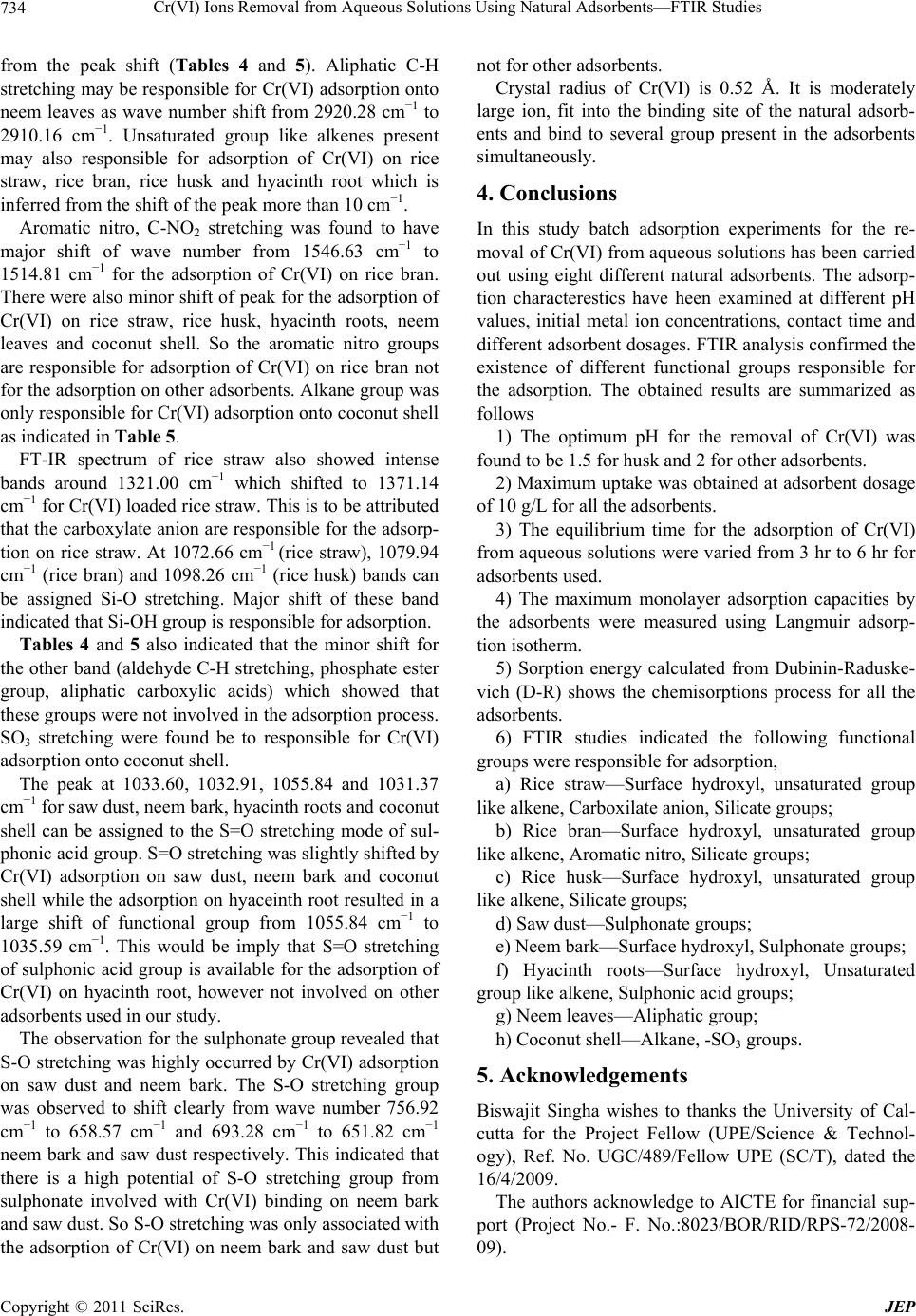 Cr(VI) Ions Removal from Aqueous Solutions Using Natural Adsorbents—FTIR Studies 734 from the peak shift (Tables 4 and 5). Aliphatic C-H stretching may be responsible for Cr(VI) adsorption onto neem leaves as wave number shift from 2920.28 cm−1 to 2910.16 cm−1. Unsaturated group like alkenes present may also responsible for adsorption of Cr(VI) on rice straw, rice bran, rice husk and hyacinth root which is inferred from the shift of the peak more than 10 cm−1. Aromatic nitro, C-NO2 stretching was found to have major shift of wave number from 1546.63 cm−1 to 1514.81 cm−1 for the adsorption of Cr(VI) on rice bran. There were also minor shift of peak for the adsorption of Cr(VI) on rice straw, rice husk, hyacinth roots, neem leaves and coconut shell. So the aromatic nitro groups are responsible for adsorption of Cr(VI) on rice bran not for the adsorption on other adsorbents. Alkane group was only responsible for Cr(VI) adsorption onto coconut shell as indicated in Table 5. FT-IR spectrum of rice straw also showed intense bands around 1321.00 cm−1 which shifted to 1371.14 cm−1 for Cr(VI) loaded rice straw. This is to be attributed that the carboxylate anion are responsible for the adsorp- tion on rice straw. At 1072.66 cm−1 (rice straw), 1079.94 cm−1 (rice bran) and 1098.26 cm−1 (rice husk) bands can be assigned Si-O stretching. Major shift of these band indicated that Si-OH group is responsible for adsorption. Tables 4 and 5 also indicated that the minor shift for the other band (aldehyde C-H stretching, phosphate ester group, aliphatic carboxylic acids) which showed that these groups were not involved in the adsorption process. SO3 stretching were found be to responsible for Cr(VI) adsorption onto coconut shell. The peak at 1033.60, 1032.91, 1055.84 and 1031.37 cm−1 for saw dust, neem bark, hyacinth roots and coconut shell can be assigned to the S=O stretching mode of sul- phonic acid group. S=O stretching was slightly shifted by Cr(VI) adsorption on saw dust, neem bark and coconut shell while the adsorption on hyaceinth root resulted in a large shift of functional group from 1055.84 cm−1 to 1035.59 cm−1. This would be imply that S=O stretching of sulphonic acid group is available for the adsorption of Cr(VI) on hyacinth root, however not involved on other adsorbents used in our study. The observation for the sulphonate group revealed that S-O stretching was highly occurred by Cr(VI) adsorption on saw dust and neem bark. The S-O stretching group was observed to shift clearly from wave number 756.92 cm−1 to 658.57 cm−1 and 693.28 cm−1 to 651.82 cm−1 neem bark and saw dust respectively. This indicated that there is a high potential of S-O stretching group from sulphonate involved with Cr(VI) binding on neem bark and saw dust. So S-O stretching was only associated with the adsorption of Cr(VI) on neem bark and saw dust but not for other adsorbents. Crystal radius of Cr(VI) is 0.52 Å. It is moderately large ion, fit into the binding site of the natural adsorb- ents and bind to several group present in the adsorbents simultaneously. 4. Conclusions In this study batch adsorption experiments for the re- moval of Cr(VI) from aqueous solutions has been carried out using eight different natural adsorbents. The adsorp- tion characterestics have heen examined at different pH values, initial metal ion concentrations, contact time and different adsorbent dosages. FTIR analysis confirmed the existence of different functional groups responsible for the adsorption. The obtained results are summarized as follows 1) The optimum pH for the removal of Cr(VI) was found to be 1.5 for husk and 2 for other adsorbents. 2) Maximum uptake was obtained at adsorbent dosage of 10 g/L for all the adsorbents. 3) The equilibrium time for the adsorption of Cr(VI) from aqueous solutions were varied from 3 hr to 6 hr for adsorbents used. 4) The maximum monolayer adsorption capacities by the adsorbents were measured using Langmuir adsorp- tion isotherm. 5) Sorption energy calculated from Dubinin-Raduske- vich (D-R) shows the chemisorptions process for all the adsorbents. 6) FTIR studies indicated the following functional groups were responsible for adsorption, a) Rice straw—Surface hydroxyl, unsaturated group like alkene, Carboxilate anion, Silicate groups; b) Rice bran—Surface hydroxyl, unsaturated group like alkene, Aromatic nitro, Silicate groups; c) Rice husk—Surface hydroxyl, unsaturated group like alkene, Silicate groups; d) Saw dust—Sulphonate groups; e) Neem bark—Surface hydroxyl, Sulphonate groups; f) Hyacinth roots—Surface hydroxyl, Unsaturated group like alkene, Sulphonic acid groups; g) Neem leaves—Aliphatic group; h) Coconut shell—Alkane, -SO3 groups. 5. Acknowledgements Biswajit Singha wishes to thanks the University of Cal- cutta for the Project Fellow (UPE/Science & Technol- ogy), Ref. No. UGC/489/Fellow UPE (SC/T), dated the 16/4/2009. The authors acknowledge to AICTE for financial sup- port (Project No.- F. No.:8023/BOR/RID/RPS-72/2008- 09). Copyright © 2011 SciRes. JEP  Cr(VI) Ions Removal from Aqueous Solutions Using Natural Adsorbents—FTIR Studies735 REFERENCES [1] A. K. Bhattacharya, T. K. Naiya, S. N. Mandal and S. K. Das, “Adsorption, Kinetics and Equilibrium Studies on the Removal of Cr(VI) from Aqueous Solutions Using Different Low-Cost Adsorbents,” Chemical Engineering Journal, Vol. 137, No. 3, 2008, pp. 529-541. doi:10.1016/j.cej.2007.05.21 [2] E. Malkoc, Y. Nuhoglu and Y. Abali, “Cr(VI) Adsorption by Waste Acorn of Quercus ithaburensis in Fixed Beds: Prediction of Breakthrough Curves,” Chemical Engi- neering Journal, Vol. 119, No. 1, 2006, pp. 61-68. doi:10.1016/j.cej.2006.01.019 [3] N. Hsu, S. Wang, Y. Liao, S. Huang, Y. Tzou and Y. Huang, “Removal of Hexavalent Chromium from Acidic Aqueous Solutions Using Rice Straw-Derived Carbon,” Journal of Hazardous Materials, Vol. 171, No. 1-3, 2009, pp. 1066-1070. doi:10.1016/j.jhazmat.2009.06.112 [4] EPA (Environmental Protection Agency), “Environmental Pollution Control Alters,” EPA/625/5-90/025, EPA/625/4- 89/023, Cincinnati, 1990. [5] Indian Standard, “Drinking water-specification,” 1st Re- vision, IS 10500, 1991. [6] MINAS, “Pollution Control Acts, Rules, and Notification There under Central Pollution Control Board, 2001,” Ministry of Environment and Forests, Government of In- dia, New Delhi, 2001. [7] T. K. Naiya, A. K. Bhattacharjee, D. Sarkar, S. K. Das, “Applicability of Shrinking Core Model on the Adsorp- tion of Heavy Metals by Clarified Sludge from Aqueous Solutions,” Adsorption, Vol. 15, 2009, pp. 354-364. doi:10.1007/s10450-009-9186-5 [8] S. K. Chatterjee, I. Bhattacharjee and G. Chandra, “Bio- sorption of Heavy Metals from Industrial Waste Water by Geobacillus thermodenitrificans,” Journal of Hazardous Materials, Vol. 175, No. 1-3, 2010, pp. 117-125. doi:10.1016/j.jhazmat.2009.09.136 [9] P. Miretzkya and A. F. Cirelli, “Cr(VI) and Cr(III) Re- moval from Aqueous Solutions by Raw and Modified Lignocellulosic Materials: A Review,” Journal of Haz- ardous Materials, Vol. 180, 2010, pp. 1-19. doi:10.1016/j.jhazmat.2010.04.060 [10] R. A. K. Rao and F. Rehman, “Adsorption Studies on Fruits of Gular (Ficus glomerata): Removal of Cr(VI) from Synthetic Wastewater,” Journal of Hazardous Ma- terials, Vol. 181, No. 1-3, 2010, pp. 405-412. doi:10.1016/j.jhazmat.2010.05.025 [11] Y. Khambhaty, K. Mody, S. Basha and B. Jha, “Kinetics, Equilibrium and Thermodynamic Studies on Biosorption of Hexavalent Chromium by Dead Fungal Biomass of Marine Aspergillus niger,” Chemical Engineering Jour- nal, Vol. 145, No. 3, 2009, pp. 489-495. doi:10.1016/j.cej.2008.05.002 [12] V. C. Srivastava, I. D. Mall and I. M. Mishra, “Charac- terization of Mesoporous Rice Husk Ash (RHA) and Ad- sorption Kinetics of Metal Ions from Aqueous Solutions onto RHA,” Journal of Hazardous Materials, Vol. B134, 2006, pp. 257-267. doi:10.1016/j.jhazmat.2005.11.052 [13] APHA, AWWA, WEF, “Standard Methods for Examina- tion of Water and Wastewater,” 20th Edition, Washington DC, New York, 1998. [14] M. Bansal, U. Garg, D. Singh and V. K. Garg, “Removal of Cr(VI) from Aqueous Solutionsusing Pre-consumer Processing Agricultural Waste: A Case Study of Rice Husk,” Journal of Hazardous Materials, Vol. 162, No. 1, 2009, pp. 312-320. doi:10.1016/j.jhazmat.2008.05.037 [15] S. Mallick, S. S. Dash and K. M. Parida, “Adsorption of Hexavalent Chromium on Manganese Nodule Leached Residue Obtained from NH3-SO3 Leaching,” Journal of Colloid and Interface Science, Vol. 297, 2006, pp. 419- 425. doi:10.1016/j.jcis.2005.11.001 [16] I. Langmuir, “The Adsorption of Gases on Plane Surfaces of Glass, Mica and Platinum,” Journal of the American Chemical Society, Vol. 40, 1914, pp. 1361-1403. doi:10.1021/ja02242a004 [17] M. M. Dubinin, E. D. Zaverina, L. V. Radushkevich, “Sorption and Structure of Active Carbons I. Adsorption of Organic Vapors,” Zhurnal Fizicheskoi Khimii, Vol. 21 1947, pp. 1351-1362. [18] M. Polanyi, “Theories of the Adsorption of Gases. A General Survey and Some Additional Remarks,” Trans- actions of the Faraday Society, Vol. 28, 1932, pp. 316- 333. doi:10.1039/tf9322800316 [19] M. F. Sawalha, J. R. Peralta-Videa, J. Romero-Gonzalez and J. L. Gardea-Torresdey, “Biosorption of Cd(II), Cr(III), and Cr(VI) by Saltbush (Atriplex Canescens) Biomass: Thermodynamic and Isotherm Studies,” Jour- nal of Colloid and Interface Science, Vol. 300, 2006, pp. 100-104. doi:10.1016/j.jcis.2006.03.029 [20] F. Helfferich, “Ion Exchange,” McGraw-Hill, New York, 1962, p. 166. [21] U. R. Malik, S. M. Hasany and M. S. Subhani, “Sorptive Potential of Sunflower Stem for Cr(III) Ions from Aque- ous Solutions and Its Kinetic and Thermodynamic Pro- file,” Talanta, Vol. 66, 2005, pp. 166-173. doi:10.1016/j.talanta.2004.11.013 [22] P. Pavasnt, R. Apiratikul, V. Sungkhum, P. Suthiparin- yanont, S. Wattanachira and T. F. Marhaba, “Biosorption of Cu2+, Cd2+, Pb2+ and Zn2+ Using Dried Marine Green Macroalga Caulerpa Lentillifera,” Bioresource Technol- ogy, Vol. 97, No. 18, 2006, pp. 2321-2329. doi:10.1016/j.biortech.2005.10.032 Copyright © 2011 SciRes. JEP |