

Paper Menu >>
Journal Menu >>
 Vol.1, No.2, 63-66 (2009) doi:10.4236/health.2009.12011 SciRes Copyright © 2009 http://www.scirp.org/journal/HEALTH/ Health Openly accessible at Direct real-time PCR examination for Mycobacterium tuberculosis in respiratory samples can be cost effective Bryan Joseph Renton1, Patricia Denise Morrell2, Richard Peter Davidson Cooke2, Peter David Owen Davies1 1Department of Respiratory Medicine, University Hospital Aintree, Liverpool; Correspondence author: [email protected] 2Department of Clinical Microbiology, University Hospital Aintree, Liverpool Received 5 June 2009; revised 15 July 2009; accepted 18 July 2009. ABSTRACT Aim: To assess whether the use of direct real- time polymerase chain reaction (PCR) on smear-positive sputa can be cost-effective, by speciating mycobacteria earlier than current methods and thereby preventing unnecessary screening tests as part of the contact tracing process. Methods: A retrospective study of all patients with smear-positive sputa in a Liverpool teach- ing hospital between 2004 and 2007. All the PCRs performed on these patients were re- viewed and compared them with their myco- bacterial culture results. Unit costs for PCR, chest X-ray (CXR), tuberculin skin test (TST), interferon-gamma (IFN-γ) and medical/nursing time were conservatively estimated at £50, £11, £10, £40 and £30 respectively. The total PCR costs were compared with the costs of unnec- essary follow up of patients, negative for My- cobacterium tuberculosis (MTB) by PCR, sub- sequently confirmed to be MTB culture nega- tive. Results: 203 smear-positive patients under- went direct PCR testing. 126 (62%) patients grew Mycobacterium tuberculosis (MTB), 74 (37%) had environmental mycobacterial infection (EMI) and 3 (1%) were culture negative. Of the 126 patients’ culture positive MTB patients, 123 were PCR positive and 3 PCR negative. Of the 77 pa- tients that were culture negative for MTB, 75 were PCR negative and 2 PCR positive The sensitivity, specificity, positive and negative predictive values for direct PCR versus MTB culture were 98%, 96%, 98% and 97% respec- tively. Total costs of all PCRs performed amounted to £10,150. The cost of contact pro- cedures for PCR-negative and MTB culture- negative index cases was estimated at £19,650. This equated to a total saving of £9,500 in con- tact tracing costs. Conclusions: Direct PCR examination testing of smear-positive patients can be cost-effective in areas where there is a high incidence of EMI. Keywords: Tuberculosis; PCR and Cost Effective 1. INTRODUCTION Current national guidelines for diagnosing active pul- monary tuberculosis (TB) recommends performing a posterior-anterior chest X-ray (CXR) and obtaining at least 3 sputum samples (with one early morning sample), which are then sent for TB microscopy and culture. [1] These sputum smears are initially stained for acid-fast bacilli (AFB), but as Mycobacterium tuberculosis (MTB) and environmental mycobacteria have a similar micro- scopic appearance, it is not possible to differentiate be- tween them at this stage. Mycobacterial culture and sub- sequent speciation is therefore required but is often not available until several weeks after specimen collection. In patients suspected of active TB, which is usually based on a smear-positive sputum or bronchoalveolar lavage (BAL), a contact tracing process is initiated early to prevent potential further spread. Screening is usually offered to household and other close contacts. Typically, most contacts will have a chest X-ray and a tuberculin skin test (TST), with a significant proportion of contacts also going on to have an interferon-gamma (IFN-γ) test. However, in areas where there is a high incidence of environmental mycobacterial infection (EMI), this can result in a large proportion of contacts being unnecessar- ily screened. Indeed, in the study carried out by Corless et al., 51% of smear positive patients did not have TB. This resulted in 31% of contacts of patients being screened who either cultured environmental organisms, or had negative cultures. The median number of contacts traced per index case was 11 for patients culturing MTB and 4 for patients culturing environmental organisms or with negative cultures. This report highlighted the cur- 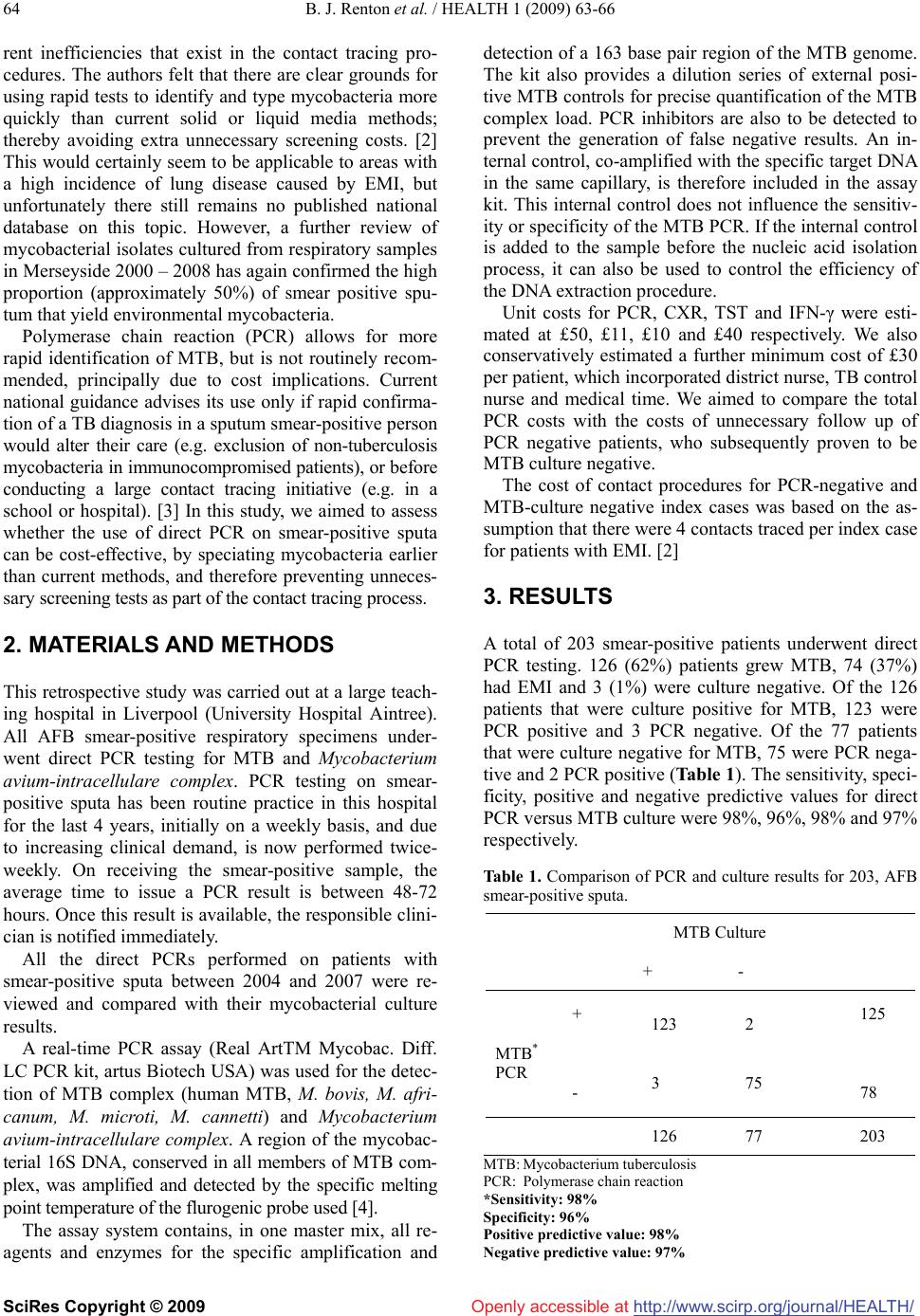 B. J. Renton et al. / HEALTH 1 (2009) 63-66 http://www.scirp.org/journal/HEALTH/ 64 Openly accessible at rent inefficiencies that exist in the contact tracing pro- cedures. The authors felt that there are clear grounds for using rapid tests to identify and type mycobacteria more quickly than current solid or liquid media methods; thereby avoiding extra unnecessary screening costs. [2] This would certainly seem to be applicable to areas with a high incidence of lung disease caused by EMI, but unfortunately there still remains no published national database on this topic. However, a further review of mycobacterial isolates cultured from respiratory samples in Merseyside 2000 – 2008 has again confirmed the high proportion (approximately 50%) of smear positive spu- tum that yield environmental mycobacteria. Polymerase chain reaction (PCR) allows for more rapid identification of MTB, but is not routinely recom- mended, principally due to cost implications. Current national guidance advises its use only if rapid confirma- tion of a TB diagnosis in a sputum smear-positive person would alter their care (e.g. exclusion of non-tuberculosis mycobacteria in immunocompromised patients), or before conducting a large contact tracing initiative (e.g. in a school or hospital). [3] In this study, we aimed to assess whether the use of direct PCR on smear-positive sputa can be cost-effective, by speciating mycobacteria earlier than current methods, and therefore preventing unneces- sary screening tests as part of the contact tracing process. 2. MATERIALS AND METHODS This retrospective study was carried out at a large teach- ing hospital in Liverpool (University Hospital Aintree). All AFB smear-positive respiratory specimens under- went direct PCR testing for MTB and Mycobacterium avium-intracellulare complex. PCR testing on smear- positive sputa has been routine practice in this hospital for the last 4 years, initially on a weekly basis, and due to increasing clinical demand, is now performed twice- weekly. On receiving the smear-positive sample, the average time to issue a PCR result is between 48-72 hours. Once this result is available, the responsible clini- cian is notified immediately. All the direct PCRs performed on patients with smear-positive sputa between 2004 and 2007 were re- viewed and compared with their mycobacterial culture results. A real-time PCR assay (Real ArtTM Mycobac. Diff. LC PCR kit, artus Biotech USA) was used for the detec- tion of MTB complex (human MTB, M. bovis, M. afri- canum, M. microti, M. cannetti) and Mycobacterium avium-intracellulare complex. A region of the mycobac- terial 16S DNA, conserved in all members of MTB com- plex, was amplified and detected by the specific melting point temperature of the flurogenic probe used [4]. The assay system contains, in one master mix, all re- agents and enzymes for the specific amplification and detection of a 163 base pair region of the MTB genome. The kit also provides a dilution series of external posi- tive MTB controls for precise quantification of the MTB complex load. PCR inhibitors are also to be detected to prevent the generation of false negative results. An in- ternal control, co-amplified with the specific target DNA in the same capillary, is therefore included in the assay kit. This internal control does not influence the sensitiv- ity or specificity of the MTB PCR. If the internal control is added to the sample before the nucleic acid isolation process, it can also be used to control the efficiency of the DNA extraction procedure. Unit costs for PCR, CXR, TST and IFN-γ were esti- mated at £50, £11, £10 and £40 respectively. We also conservatively estimated a further minimum cost of £30 per patient, which incorporated district nurse, TB control nurse and medical time. We aimed to compare the total PCR costs with the costs of unnecessary follow up of PCR negative patients, who subsequently proven to be MTB culture negative. The cost of contact procedures for PCR-negative and MTB-culture negative index cases was based on the as- sumption that there were 4 contacts traced per index case for patients with EMI. [2] 3. RESULTS A total of 203 smear-positive patients underwent direct PCR testing. 126 (62%) patients grew MTB, 74 (37%) had EMI and 3 (1%) were culture negative. Of the 126 patients that were culture positive for MTB, 123 were PCR positive and 3 PCR negative. Of the 77 patients that were culture negative for MTB, 75 were PCR nega- tive and 2 PCR positive (Table 1). The sensitivity, speci- ficity, positive and negative predictive values for direct PCR versus MTB culture were 98%, 96%, 98% and 97% respectively. Table 1. Comparison of PCR and culture results for 203, AFB smear-positive sputa. MTB Culture + - + MTB* PCR - 123 2 3 75 125 78 126 77 203 MTB: Mycobacterium tuberculosis PCR: Polymerase chain reaction *Sensitivity: 98% Specificity: 96% Positive predictive value: 98% Negative predictive value: 97% SciRes Copyright © 2009 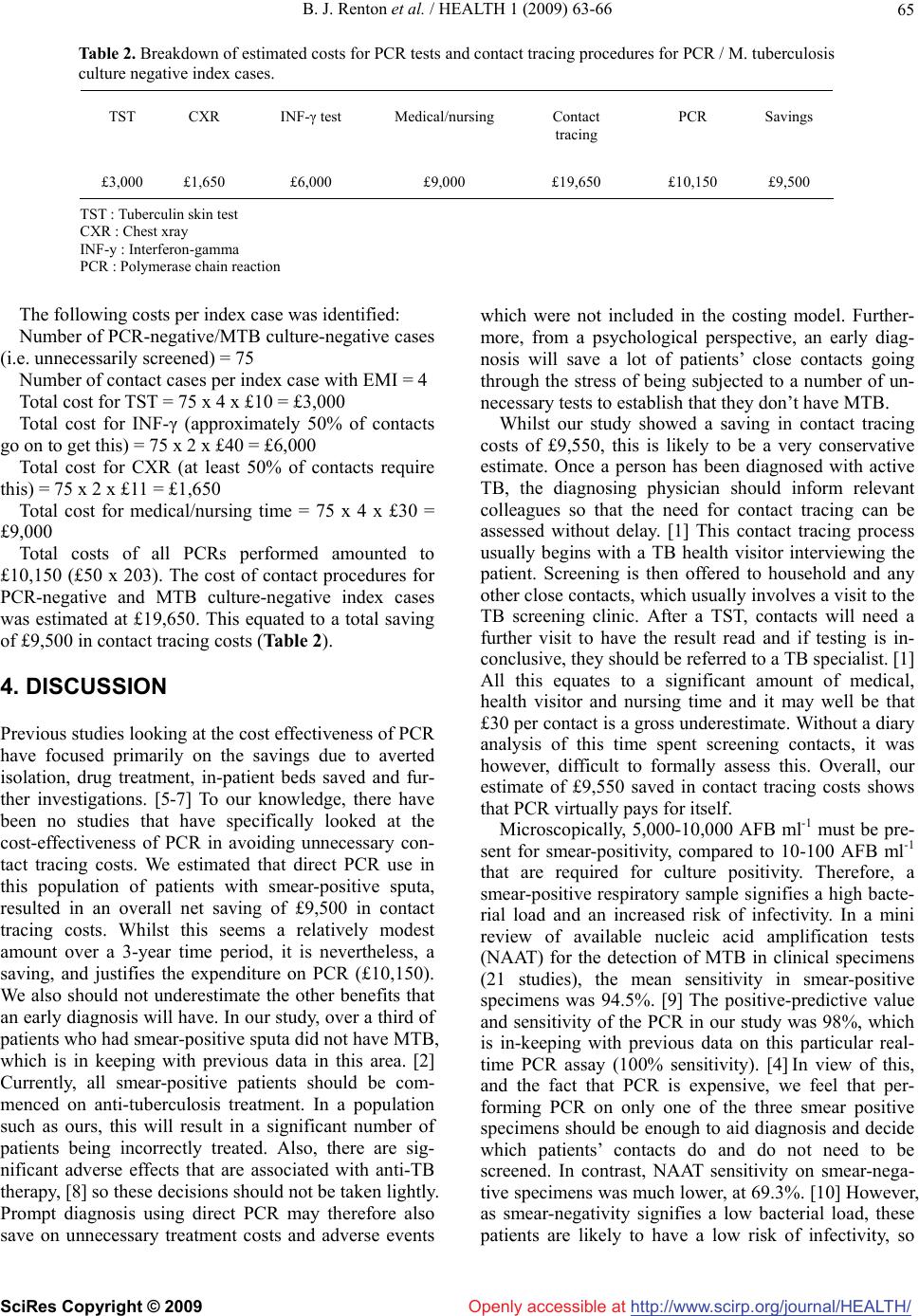 B. J. Renton et al. / HEALTH 1 (2009) 63-66 SciRes Copyright © 2009 http://www.scirp.org/journal/HEALTH/Openly accessible at 65 Table 2. Breakdown of estimated costs for PCR tests and contact tracing procedures for PCR / M. tuberculosis culture negative index cases. TST CXR INF-γ test Medical/nursing Contact tracing PCR Savings £3,000 £1,650 £6,000 £9,000 £19,650 £10,150 £9,500 TST : Tuberculin skin test CXR : Chest xray INF-y : Interferon-gamma PCR : Polymerase chain reaction The following costs per index case was identified: Number of PCR-negative/MTB culture-negative cases (i.e. unnecessarily screened) = 75 Number of contact cases per index case with EMI = 4 Total cost for TST = 75 x 4 x £10 = £3,000 Total cost for INF-γ (approximately 50% of contacts go on to get this) = 75 x 2 x £40 = £6,000 Total cost for CXR (at least 50% of contacts require this) = 75 x 2 x £11 = £1,650 Total cost for medical/nursing time = 75 x 4 x £30 = £9,000 Total costs of all PCRs performed amounted to £10,150 (£50 x 203). The cost of contact procedures for PCR-negative and MTB culture-negative index cases was estimated at £19,650. This equated to a total saving of £9,500 in contact tracing costs (Table 2). 4. DISCUSSION Previous studies looking at the cost effectiveness of PCR have focused primarily on the savings due to averted isolation, drug treatment, in-patient beds saved and fur- ther investigations. [5-7] To our knowledge, there have been no studies that have specifically looked at the cost-effectiveness of PCR in avoiding unnecessary con- tact tracing costs. We estimated that direct PCR use in this population of patients with smear-positive sputa, resulted in an overall net saving of £9,500 in contact tracing costs. Whilst this seems a relatively modest amount over a 3-year time period, it is nevertheless, a saving, and justifies the expenditure on PCR (£10,150). We also should not underestimate the other benefits that an early diagnosis will have. In our study, over a third of patients who had smear-positive sputa did not have MTB, which is in keeping with previous data in this area. [2] Currently, all smear-positive patients should be com- menced on anti-tuberculosis treatment. In a population such as ours, this will result in a significant number of patients being incorrectly treated. Also, there are sig- nificant adverse effects that are associated with anti-TB therapy, [8] so these decisions should not be taken lightly. Prompt diagnosis using direct PCR may therefore also save on unnecessary treatment costs and adverse events which were not included in the costing model. Further- more, from a psychological perspective, an early diag- nosis will save a lot of patients’ close contacts going through the stress of being subjected to a number of un- necessary tests to establish that they don’t have MTB. Whilst our study showed a saving in contact tracing costs of £9,550, this is likely to be a very conservative estimate. Once a person has been diagnosed with active TB, the diagnosing physician should inform relevant colleagues so that the need for contact tracing can be assessed without delay. [1] This contact tracing process usually begins with a TB health visitor interviewing the patient. Screening is then offered to household and any other close contacts, which usually involves a visit to the TB screening clinic. After a TST, contacts will need a further visit to have the result read and if testing is in- conclusive, they should be referred to a TB specialist. [1] All this equates to a significant amount of medical, health visitor and nursing time and it may well be that £30 per contact is a gross underestimate. Without a diary analysis of this time spent screening contacts, it was however, difficult to formally assess this. Overall, our estimate of £9,550 saved in contact tracing costs shows that PCR virtually pays for itself. Microscopically, 5,000-10,000 AFB ml-1 must be pre- sent for smear-positivity, compared to 10-100 AFB ml-1 that are required for culture positivity. Therefore, a smear-positive respiratory sample signifies a high bacte- rial load and an increased risk of infectivity. In a mini review of available nucleic acid amplification tests (NAAT) for the detection of MTB in clinical specimens (21 studies), the mean sensitivity in smear-positive specimens was 94.5%. [9] The positive-predictive value and sensitivity of the PCR in our study was 98%, which is in-keeping with previous data on this particular real- time PCR assay (100% sensitivity). [4] In view of this, and the fact that PCR is expensive, we feel that per- forming PCR on only one of the three smear positive specimens should be enough to aid diagnosis and decide which patients’ contacts do and do not need to be screened. In contrast, NAAT sensitivity on smear-nega- tive specimens was much lower, at 69.3%. [10] However, as smear-negativity signifies a low bacterial load, these patients are likely to have a low risk of infectivity, so  B. J. Renton et al. / HEALTH 1 (2009) 63-66 http://www.scirp.org/journal/HEALTH/ 66 Openly accessible at contact tracing becomes less of an urgent issue. As rapid liquid culture takes approximately 8-10 days in our hos- pital, we therefore felt that routine use of PCR in this group of patients would be unlikely to be cost-effective. In a recent article by Taegtmeyer et al., the authors found that PCR had a direct impact on clinical manage- ment in one third of smear-positive patients in whom it was used. This included patients for whom treatment was changed and situations in which contact tracing ex- ercises were either commenced or stopped. PCR signifi- cantly reduced the time to identification of the myco- bacteria and detection or exclusion of rifampicin resis- tance, which allowed prompt alterations in management when needed. They concluded that there would be addi- tional clinical benefit from PCR being applied to all smear-positive specimens in low prevalence settings. [10] We would concur with this, and believe that our study illustrates that direct PCR testing of all smear-positive patients can also be cost-effective. In conclusion, although current national guidance on direct PCR recommends its use principally to confirm true MTB before a large contact tracing exercise is un- dertaken, our results suggest that it may have a useful and cost-effective role in routine clinical practice on smear-positive respiratory samples, particularly in areas with a high incidence of EMI. Whilst there are reports suggesting that the incidence of EMI has increased over the past few decades, this observation has not been con- clusively established due to the lack of a comprehensive surveillance system. [11] This data would be particularly helpful in deciding which areas in the UK may benefit from direct PCR testing on all smear-positive respiratory specimens. Such an approach should be reflected in the National Institute of Clinical Excellence (NICE) guide- lines when they are next revised. REFERENCES [1] CG33 Tuberculosis – National Institute of Clinical Ex- cellent (NICE) guidelines. March 2006. [2] Corless, J.A., Stockton, P.A., Davies, P.D. (2000) Myco- bacterial culture results of smear-positive patients with suspected pulmonary tuberculosis in Britain. Eur Respir J, 16: 976-9. [3] National Collaborating Centre for Chronic Conditions: clinical diagnosis and management of tuberculosis and measures for its prevention and control. (2006). London, Royal College of Physicians. [4] Cramer, S.O., Matinmehr, F, Hillemann, D. (2004) Fast and sensitive detection of the Mycobacterium tuberculo- sis complex by real-time PCR, Clinical Microbiology and Infection, 10(3), 418. [5] Drobniewski, F.A., Watterson, S.A., Wilson, S.M., Harris, G.A. (2000) A clinical, microbiological and economic analysis of a national service for the rapid molecular di- agnosis of tuberculosis and rifampicin resistance in My- cobacterium tuberculosis. J Med Microbiol, 49:271-8. [6] Dowdy, D.W., Maters, A., Parrish, N., Beyrer, C., Dorman, S.E. (2003) Cost-effectiveness analysis of the Gen-Probe amplified Mycobacterium tuberculosis direct test as used routinely on smear-positive respiratory specimens. J Clin Microbiol, 41(3), 948-953. [7] van Cleeff, M., Kivihya-Ndugga, L., Githui, W., Ng’ang’a L., Kibuga, D., Odhiambo, J., et al. (2005) Cost-effectiveness of polymerase chain reaction versus Ziehl-Neelsen smear microscopy for diagnosis of tuber- culosis in Kenya. Int J Tuberc Lung Dis, 9:877-83. [8] Zalekis, R. (2005) Side-effects of Tuberculosis treatment. Breathe, 2(1), 69-73. [9] Piersimoni, C. and Scarparo, C. (2003) Minre- view–Relevance of commercial amplification methods for direct detection of Mycobacterium tuberculosis com- plex in clinical samples. J Clin Microbiol, 41(12), 5355- 5365. [10] Taegtmeyer, M., Beeching, N.J., Scott, J., Seddon, K., Jamieson, S., Squire, S.B., Mwandumba, H.C., Miller, A.R.O., Davies, P.D.O., Parry, C.M. ( 2007) The Clinical impact of nucleic acid amplification tests on the diagno- sis and management of tuberculosis in a British hospital. Thorax Online. [11] Griffith, D.E., Aksamit, T., Barbara, A., et al. (2007) American thoracic society guidelines: Diagnosis, treat- ment and prevention of nontuberculous mycobacterial diseases. Am J Resp and Crit Care Med, 175, 367-417. SciRes Copyright © 2009 |