

Paper Menu >>
Journal Menu >>
 Materials Sciences and Applicatio n, 2011, 2, 1127-1133 doi:10.4236/msa.2011.28152 Published Online August 2011 (http://www.SciRP.org/journal/msa) Copyright © 2011 SciRes. MSA 1127 Hot Forging and Hot Pressing of AlSi Powder Compared to Conventional Powder Metallurgy Route Sayed Moustafa1, Walid Daoush1*, Ahmed Ibrahim2, Erich Neubauer3 1Department of Powder Technology at Central Metallurgical. Research and Development Institute (CMRDI), Cairo, Egypt; 2Department of Mechanical Engineering, Faculty of Engineering at Helwan University, Cairo, Egypt; 3Department of Materials Re- search at ARC Seibersdorf Research Center GmbH, Seibersdorf, Austria E-mail: *[email protected] Received April 27th, 2011; revised May 21st, 2011; accepted June 12th, 2011 ABSTRACT Aluminum silicon alloy of composition (Al-25%Si-3%Ni-1%Fe-2%Cu) was atomized using water atomization. The powders were cold compacted in a die to produce green cylinder compacts. Four consolidation processes were applied, namely; conventional sintering at 500 ℃ , sintering followed by hot forging to obtain pistons, one step hot forging into pistons, and hot pressing. The microstructure of the sintered specimens showed inter-granular pores and oxide layers on particle interfaces of 84% relative density. When the sintered specimens were hot forged, both the inter-granular pores and oxide layers on particle interfaces almost disappeared and the relative densities increased up to about 95%. The same microstructure is also obtained for the one step forged specimens, but the relative densities increased to about 97%. However, the hot pressing specimens showed the presence of oxide layers on particle surfaces as well as few isolated pores. The relative density of the hot pressed specimens was about 90%. Hardness and ultimate compres- sion strength were measured. It is noted that the strongest bulk materials are those made by hot forging, followed by those made by hot pressing and the weakest bulk materials are those made by conventional sintering. Keywords: Aluminum-Silicon Alloy, Powder Metallurgy, Hot Forging, Hot Pressing, Hardness, Compression Test 1. Introduction Aluminum alloys are not only light weight materials, but also have excellent thermal conductivity, electrical con- ductivity, corro sion resistance, and work ability. For these previous reasons, aluminum is widely used in structural components, electrical conductors, and consumer prod- ucts. Among the newly developed aluminum alloys, rap- idly solidified Al–Si alloys have superior mechanical properties, such as high strength, modulus, wear resis- tance and elevated temperature strength relative to con- ventional alloys [1]. Also Al–Si alloys are well known as typical high strength and lightweight materials, which are widely used in automotive and aerospace industries due to their higher strength; good wear resistance and low thermal expansion co-efficient [2 ]. The early technological development of hypereutectic Al-Si grew out of its application for internal combustion engine blocks and pistons. This application uses all the properties for which the material is well known: high specific stiffness and strength, good hot strength, low thermal expansion and excellent wear resistance. The composition repr esen ts a co mpro mise between castab ility and properties: it is close to the maximum silicon con tent in which sound produc ts can cons istently b e obtained [3]. Al–Si alloys are manufactured by casting and powder metallurgy methods. But, the relatively slower cooling rate, associated with the conventional casting process, produces coarse and segregated primary Si and/or eutec- tic Si in the Al–Si alloys [4]. Yet, the distribution and size of the primary silicon particles is more important than the overall silicon content of the alloy. Therefore, many efforts have been made in the microstructural modification of casting Al–Si alloys in order to achieve fine Si particles with the desired shapes and distributions. For example, techniques such as modification [5], ternary alloying [6], spray-deposition [2], or rapid solidification processing [7] have been applied to refine the primary Si *Associate Professor Walid. M. Daoush, Head of Powder Technology Division at Central Metallurgical R&D Institute, Cairo, Egypt. 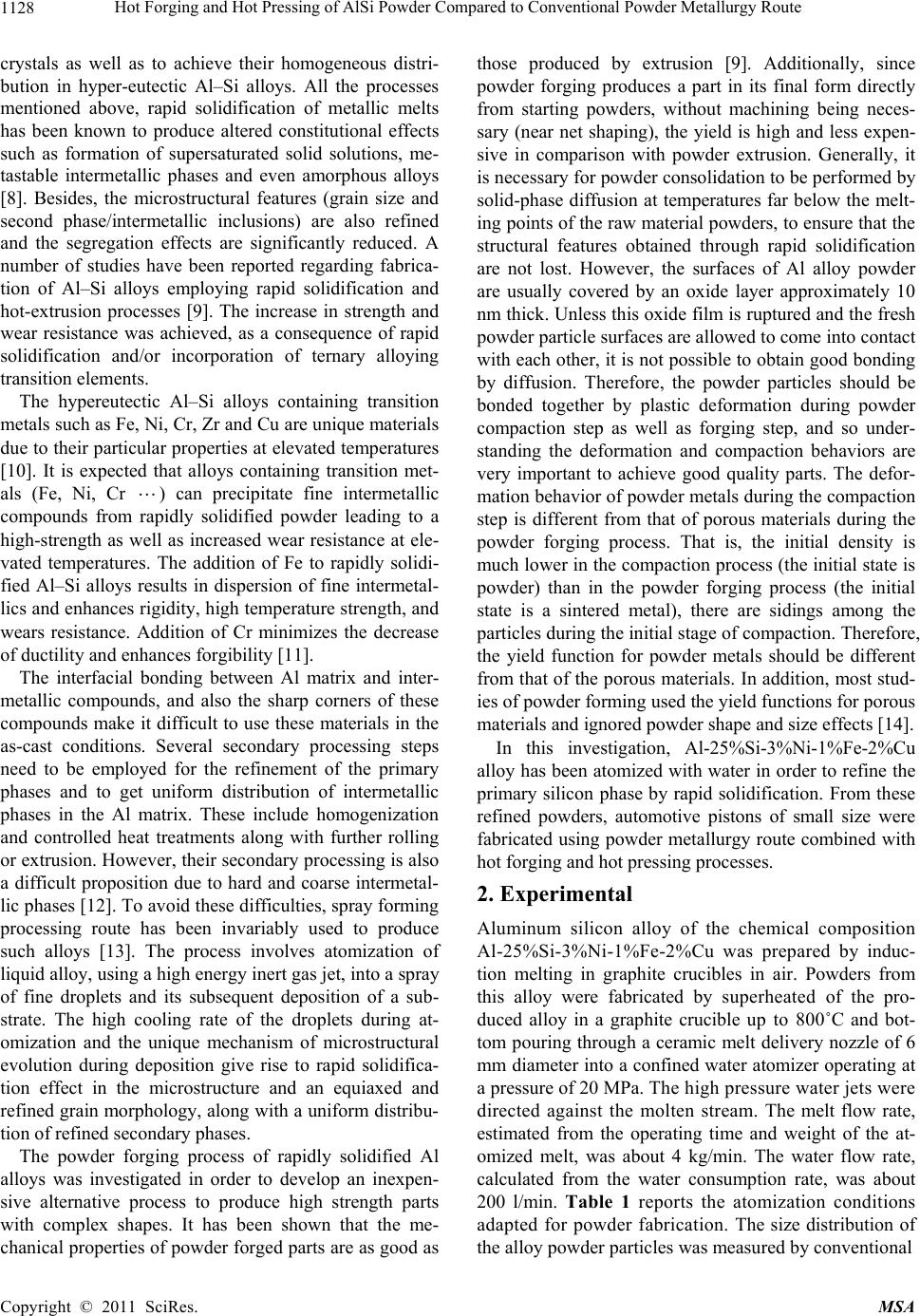 Hot Forging and Hot Pressing of AlSi Powder Compared to Conventional Powder Metallurgy Route 1128 crystals as well as to achieve their homogeneous distri- bution in hyper-eutectic Al–Si alloys. All the processes mentioned above, rapid solidification of metallic melts has been known to produce altered constitutional effects such as formation of supersaturated solid solutions, me- tastable intermetallic phases and even amorphous alloys [8]. Besides, the microstructural features (grain size and second phase/intermetallic inclusions) are also refined and the segregation effects are significantly reduced. A number of studies have been reported regarding fabrica- tion of Al–Si alloys employing rapid solidification and hot-extrusion processes [9]. The increase in strength and wear resistance was achieved, as a consequence of rapid solidification and/or incorporation of ternary alloying transition elements. The hypereutectic Al–Si alloys containing transition metals such as Fe, Ni, Cr, Zr and Cu are unique materials due to their particular properties at elevated temperatures [10]. It is expected that alloys containing transition met- als (Fe, Ni, Cr ) can precipitate fine intermetallic compounds from rapidly solidified powder leading to a high-strength as well as increased wear resistance at ele- vated temperatures. The addition of Fe to rapidly solidi- fied Al–Si alloys results in dispersion of fine intermetal- lics and enhances rigidity, high temperature strength, and wears resistance. Addition of Cr minimizes the decrease of ductility and enhances forgibility [1 1]. The interfacial bonding between Al matrix and inter- metallic compounds, and also the sharp corners of these compounds make it difficult to use these materials in the as-cast conditions. Several secondary processing steps need to be employed for the refinement of the primary phases and to get uniform distribution of intermetallic phases in the Al matrix. These include homogenization and controlled heat treatments along with further rolling or extrusion. However, their secondary processing is also a difficult proposition due to hard and coarse intermetal- lic phases [12]. To avoid th ese difficulties, spray forming processing route has been invariably used to produce such alloys [13]. The process involves atomization of liquid alloy, using a high energy inert gas jet, into a spray of fine droplets and its subsequent deposition of a sub- strate. The high cooling rate of the droplets during at- omization and the unique mechanism of microstructural evolution during deposition give rise to rapid solidifica- tion effect in the microstructure and an equiaxed and refined grain morphology, along with a uniform distribu- tion of refined secondary phases. The powder forging process of rapidly solidified Al alloys was investigated in order to develop an inexpen- sive alternative process to produce high strength parts with complex shapes. It has been shown that the me- chanical properties of powder forged parts ar e as good as those produced by extrusion [9]. Additionally, since powder forging produces a part in its final form directly from starting powders, without machining being neces- sary (near net shaping), the yield is high and less expen- sive in comparison with powder extrusion. Generally, it is necessary for powder consolidation to be performed by solid-phase diffusion at temperatures far below the melt- ing points of the raw material powders, to ensure that the structural features obtained through rapid solidification are not lost. However, the surfaces of Al alloy powder are usually covered by an oxide layer approximately 10 nm thick. Unless this oxide film is ruptured and the fresh powder particle surfaces are allowed to come into contact with each other, it is not possible to obtain good bon ding by diffusion. Therefore, the powder particles should be bonded together by plastic deformation during powder compaction step as well as forging step, and so under- standing the deformation and compaction behaviors are very important to achieve good quality parts. The defor- mation behavior of powder metals during the compaction step is different from that of porous materials during the powder forging process. That is, the initial density is much lower in the compaction process (the initial state is powder) than in the powder forging process (the initial state is a sintered metal), there are sidings among the particles during the initial stage of compactio n. Therefore, the yield function for powder metals should be different from that of the porous materials. In addition, most stud- ies of powder forming used the yield functions for porous materials and ignored powder shape and size effects [14]. In this investigation, Al-25%Si-3%Ni-1%Fe-2%Cu alloy has been atomized with water in order to refine the primary silicon phase by rapid solidification. From these refined powders, automotive pistons of small size were fabricated using powd er metallurgy route combined with hot forging and hot pressing processes. 2. Experimental Aluminum silicon alloy of the chemical composition Al-25%Si-3%Ni-1%Fe-2%Cu was prepared by induc- tion melting in graphite crucibles in air. Powders from this alloy were fabricated by superheated of the pro- duced alloy in a graphite crucible up to 800˚C and bot- tom pouring through a ceramic melt delivery nozzle of 6 mm diameter into a confined water atomizer operating at a pressure of 20 MPa. The high pressure water jets wer e directed against the molten stream. The melt flow rate, estimated from the operating time and weight of the at- omized melt, was about 4 kg/min. The water flow rate, calculated from the water consumption rate, was about 200 l/min. Table 1 reports the atomization conditions adapted for powder fabrication. The size distribution of the alloy powder particles was measured by conventio nal Copyright © 2011 SciRes. MSA 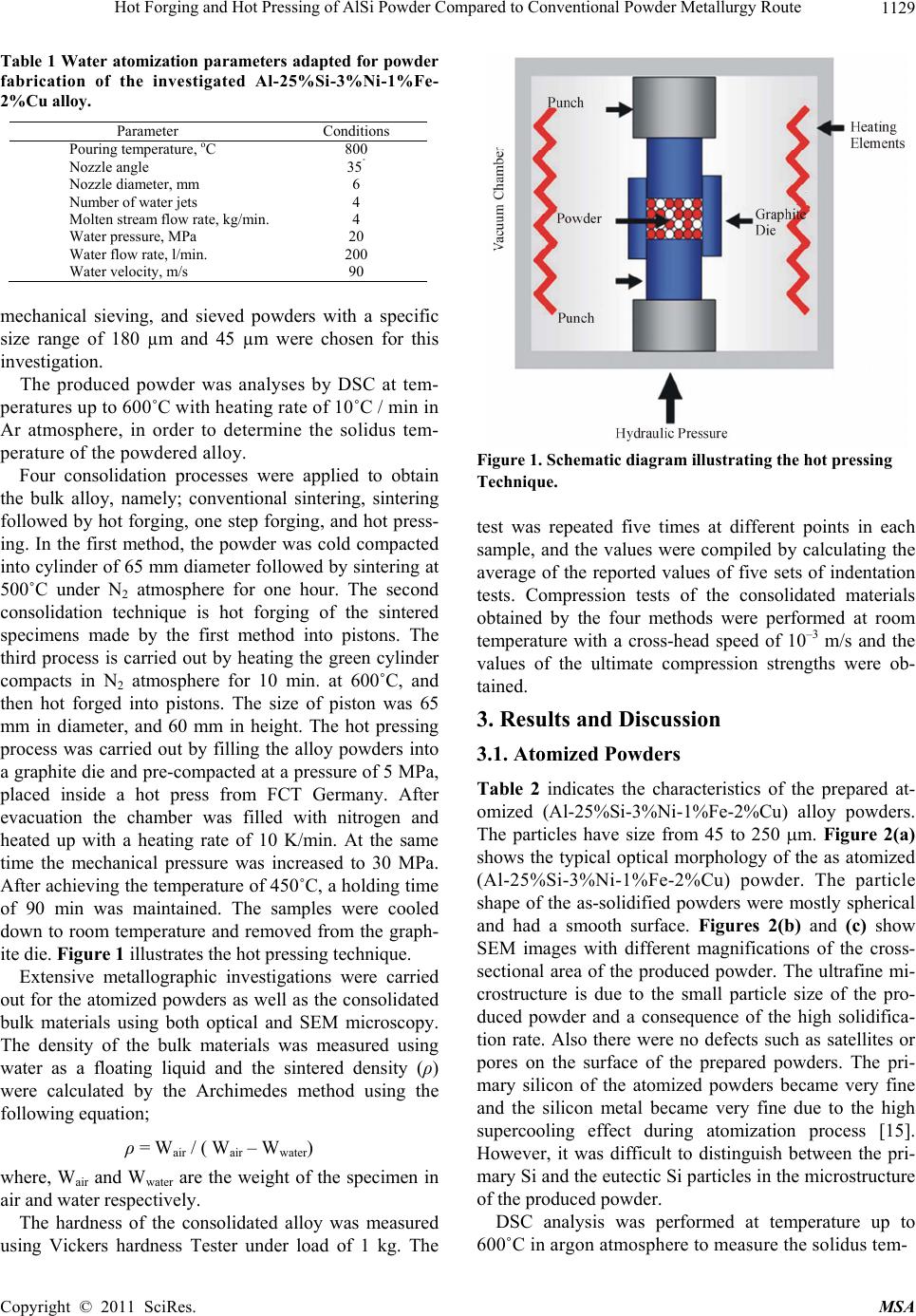 Hot Forging and Hot Pressing of AlSi Powder Compared to Conventional Powder Metallurgy Route 1129 Table 1 Water atomization parameters adapted for powder fabrication of the investigated Al-25%Si-3%Ni-1%Fe- 2%Cu alloy. Parameter Conditions Pouring temperature, oC Nozzle angle Nozzle diameter, mm Number of water jets Molten stream flow rate, kg/min. Water pressure, MPa Water flow rate, l/min. Water velocity, m/s 800 35˚ 6 4 4 20 200 90 mechanical sieving, and sieved powders with a specific size range of 180 µm and 45 µm were chosen for this investigation. The produced powder was analyses by DSC at tem- peratures up to 600˚C with he a ting rate o f 1 0˚C / m in i n Ar atmosphere, in order to determine the solidus tem- perature of the powdered alloy. Four consolidation processes were applied to obtain the bulk alloy, namely; conventional sintering, sintering followed by hot forging , one step forging, and hot press- ing. In the first method, the powder was cold compacted into cylinder of 65 mm diameter followed by sintering at 500˚C under N2 atmosphere for one hour. The second consolidation technique is hot forging of the sintered specimens made by the first method into pistons. The third process is carried out by heating the green cylinder compacts in N2 atmosphere for 10 min. at 600˚C, and then hot forged into pistons. The size of piston was 65 mm in diameter, and 60 mm in height. The hot pressing process was carried out by filling the alloy powders into a graphite die and pre-compacted at a pressure of 5 MPa, placed inside a hot press from FCT Germany. After evacuation the chamber was filled with nitrogen and heated up with a heating rate of 10 K/min. At the same time the mechanical pressure was increased to 30 MPa. After achieving the temperatur e of 450˚C, a holding time of 90 min was maintained. The samples were cooled down to room temperature and removed from the graph- ite die. Figure 1 illustrates the hot pressing technique. Extensive metallographic investigations were carried out for the atomized powders as well as the consolidated bulk materials using both optical and SEM microscopy. The density of the bulk materials was measured using water as a floating liquid and the sintered density (ρ) were calculated by the Archimedes method using the following equation; ρ = Wair / ( Wair – Wwater) where, Wair and Wwater are the weight of the specimen in air and water respectively. The hardness of the consolidated alloy was measured using Vickers hardness Tester under load of 1 kg. The Figure 1. Schematic diagram illustrating the hot pressing Technique. test was repeated five times at different points in each sample, and the values were compiled by calculating the average of the reported values of five sets of indentation tests. Compression tests of the consolidated materials obtained by the four methods were performed at room temperature with a cross-head speed of 10–3 m/s and the values of the ultimate compression strengths were ob- tained. 3. Results and Discussion 3.1. Atomized Powders Table 2 indicates the characteristics of the prepared at- omized (Al-25%Si-3%Ni-1%Fe-2%Cu) alloy powders. The particles have size from 45 to 250 m. Figure 2(a) shows the typical optical morphology of the as atomized (Al-25%Si-3%Ni-1%Fe-2%Cu) powder. The particle shape of the as-solidified powders were mostly spherical and had a smooth surface. Figures 2(b) and (c) show SEM images with different magnifications of the cross- sectional area of the produced powder. The ultrafine mi- crostructure is due to the small particle size of the pro- duced powder and a consequence of the high solidifica- tion rate. Also there were no defects such as satellites or pores on the surface of the prepared powders. The pri- mary silicon of the atomized powders became very fine and the silicon metal became very fine due to the high supercooling effect during atomization process [15]. However, it was difficult to distinguish between the pri- mary Si and the eutectic Si particles in th e microstructure of the produced pow der . DSC analysis was performed at temperature up to 600˚C in argon atmosphere to measure the solidus tem- Copyright © 2011 SciRes. MSA 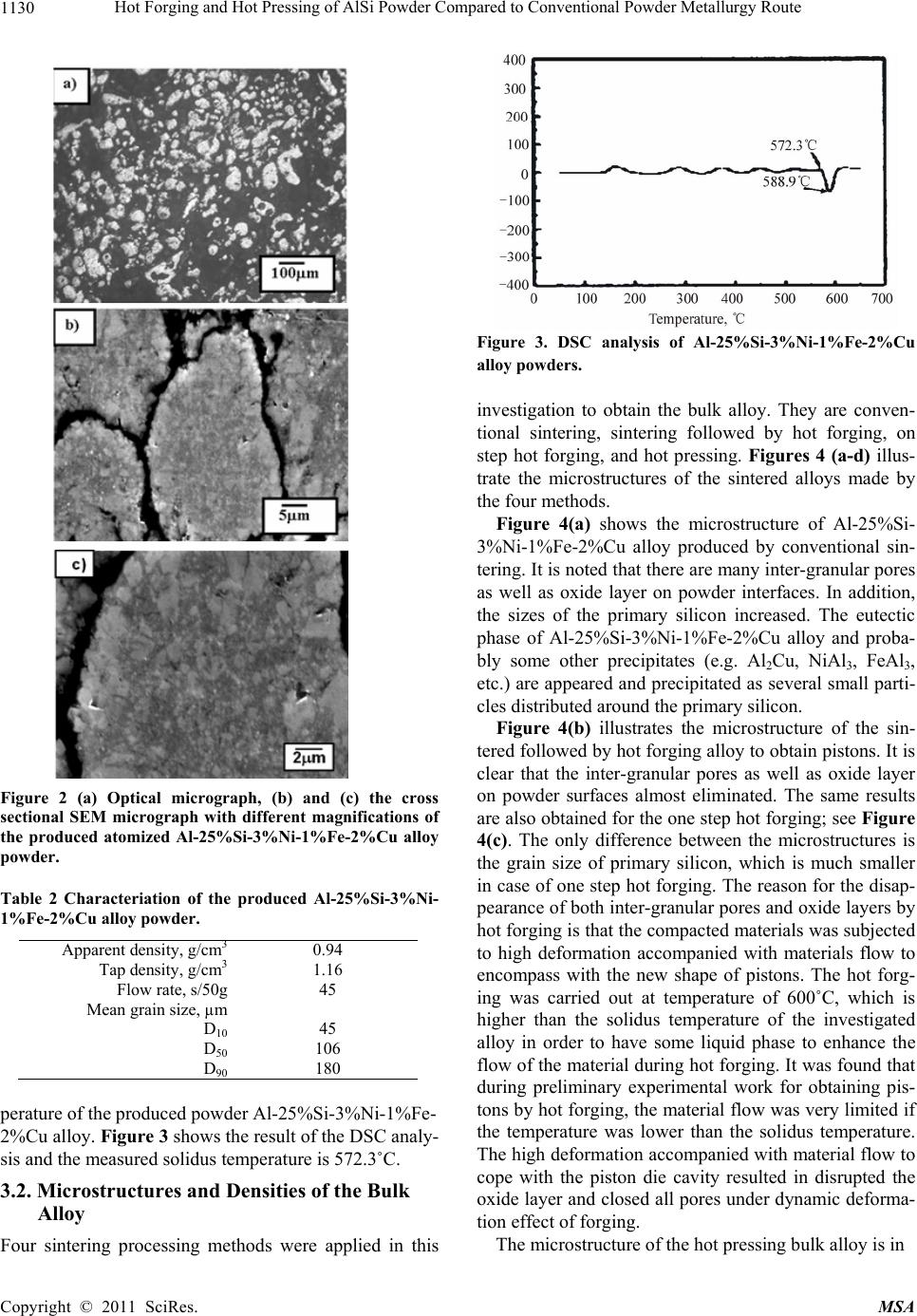 Hot Forging and Hot Pressing of AlSi Powder Compared to Conventional Powder Metallurgy Route 1130 Figure 2 (a) Optical micrograph, (b) and (c) the cross sectional SEM micrograph with different magnifications of the produced atomized Al-25%Si-3%Ni-1%Fe-2%Cu alloy powder. Table 2 Characteriation of the produced Al-25%Si-3%Ni- 1%Fe-2%Cu alloy powder. Apparent density, g/cm3 Tap density, g/cm3 Flow rate, s/50g Mean grain size, µm D10 D50 D90 0.94 1.16 45 45 106 180 perature of the produced powder Al-25%Si - 3%Ni-1%Fe- 2%Cu alloy. Figure 3 shows the result of the DSC analy- sis and the measured solidus temperature is 572.3˚C. 3.2. Microstructures and Densities of the Bulk Alloy Four sintering processing methods were applied in this Figure 3. DSC analysis of Al-25%Si-3%Ni-1%Fe-2%Cu alloy powders. investigation to obtain the bulk alloy. They are conven- tional sintering, sintering followed by hot forging, on step hot forging, and hot pressing. Figures 4 (a-d) illus- trate the microstructures of the sintered alloys made by the four methods. Figure 4(a) shows the microstructure of Al-25%Si- 3%Ni-1%Fe-2%Cu alloy produced by conventional sin- tering. It is noted that there are many inter-granular pores as well as oxide layer on powder interfaces. In addition, the sizes of the primary silicon increased. The eutectic phase of Al-25%Si-3%Ni-1%Fe-2%Cu alloy and proba- bly some other precipitates (e.g. Al2Cu, NiAl3, FeAl3, etc.) are appeared and precipitated as several small parti- cles distributed around the primary silicon. Figure 4(b) illustrates the microstructure of the sin- tered followed by hot forg ing alloy to obtain pistons. It is clear that the inter-granular pores as well as oxide layer on powder surfaces almost eliminated. The same results are also obtained for the one step hot forging; see Figure 4(c). The only difference between the microstructures is the grain size of primary silicon, which is much smaller in case of one step hot forging. Th e reason for the disap- pearance of both inter-granular pores and oxide layers by hot forging is that the compacted materials was subjected to high deformation accompanied with materials flow to encompass with the new shape of pistons. The hot forg- ing was carried out at temperature of 600˚C, which is higher than the solidus temperature of the investigated alloy in order to have some liquid phase to enhance the flow of the material dur ing hot forging. It was found that during preliminary experimental work for obtaining pis- tons by hot forging, the material flow was very limited if the temperature was lower than the solidus temperature. The high deformation accompanied with material flow to cope with the piston die cavity resulted in disrupted the oxide layer and closed all pores under dynamic deforma- tion effect of forging. The microstructure of the hot pressing bulk alloy is in Copyright © 2011 SciRes. MSA 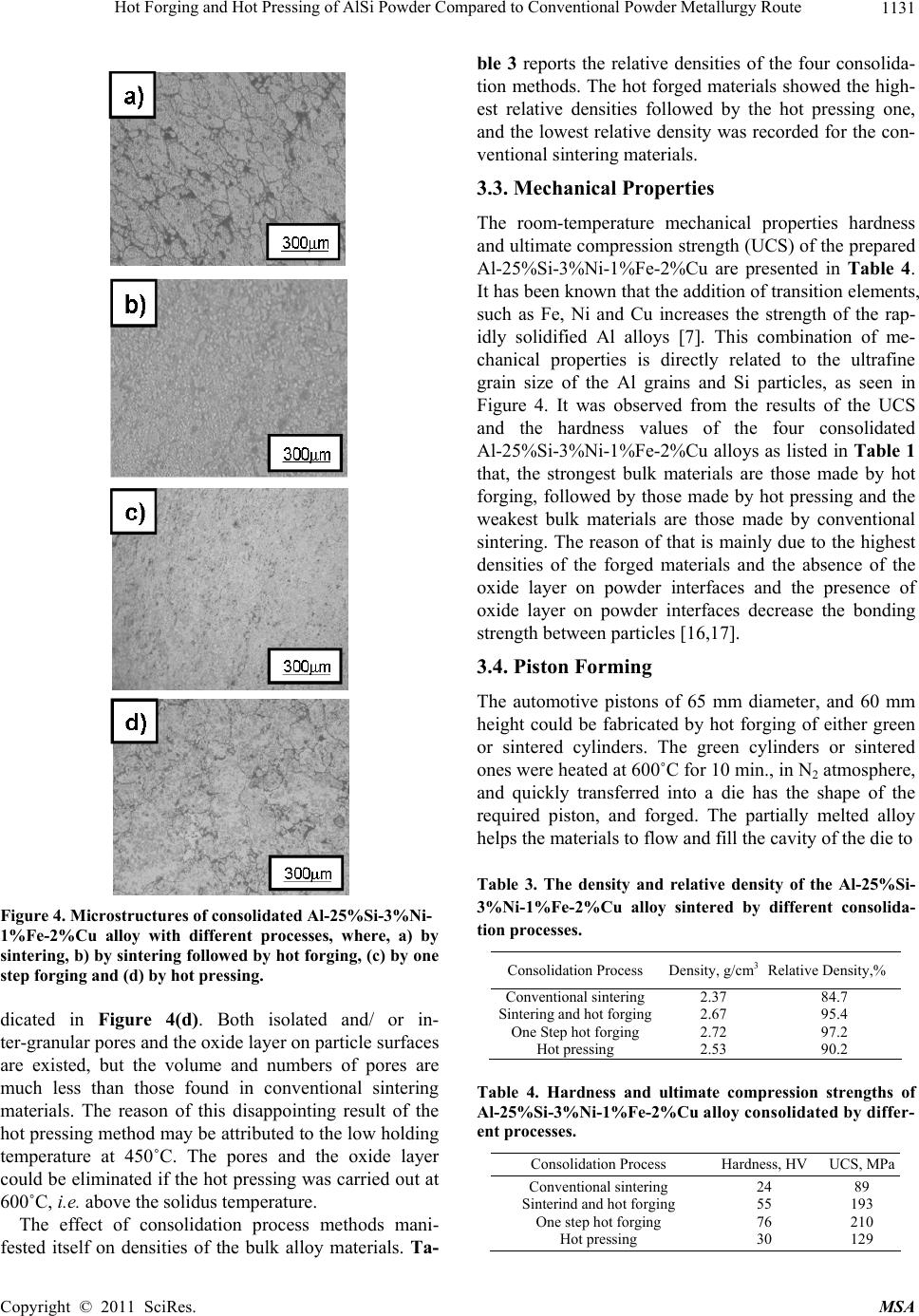 Hot Forging and Hot Pressing of AlSi Powder Compared to Conventional Powder Metallurgy Route 1131 Figure 4. Microstructures of consolidated Al-25%Si-3%Ni- 1%Fe-2%Cu alloy with different processes, where, a) by sintering, b) by sintering followed by hot forging, (c) by one step forging and (d) by hot pressing. dicated in Figure 4(d). Both isolated and/ or in- ter-granular pores and the oxide layer on particle surfaces are existed, but the volume and numbers of pores are much less than those found in conventional sintering materials. The reason of this disappointing result of the hot pressing method may be attributed to the low holding temperature at 450˚C. The pores and the oxide layer could be eliminated if the hot pressing was carried out at 600˚C, i.e. above the solidus temperature. The effect of consolidation process methods mani- fested itself on densities of the bulk alloy materials. Ta- ble 3 reports the relative densities of the four consolida- tion methods. The hot forged materials showed the high- est relative densities followed by the hot pressing one, and the lowest relative density was recorded for the con- ventional sintering materials. 3.3. Mechanical Properties The room-temperature mechanical properties hardness and ultimate compression strength (UCS) of the prepared Al-25%Si-3%Ni-1%Fe-2%Cu are presented in Table 4. It has been known that the addition of transition elements, such as Fe, Ni and Cu increases the strength of the rap- idly solidified Al alloys [7]. This combination of me- chanical properties is directly related to the ultrafine grain size of the Al grains and Si particles, as seen in Figure 4. It was observed from the results of the UCS and the hardness values of the four consolidated Al-25%Si-3%Ni-1%Fe-2%Cu alloys as listed in Table 1 that, the strongest bulk materials are those made by hot forging, followed by those made by hot pressing and the weakest bulk materials are those made by conventional sintering. The reason of that is mainly due to the highest densities of the forged materials and the absence of the oxide layer on powder interfaces and the presence of oxide layer on powder interfaces decrease the bonding strength between part i c le s [1 6, 17] . 3.4. Piston Forming The automotive pistons of 65 mm diameter, and 60 mm height could be fabricated by hot forging of either green or sintered cylinders. The green cylinders or sintered ones were heated at 600˚C for 10 min., in N2 atmosphere, and quickly transferred into a die has the shape of the required piston, and forged. The partially melted alloy helps the materials to flow and fill the cavity of th e die to Table 3. The density and relative density of the Al-25%Si- 3%Ni-1%Fe-2%Cu alloy sintered by different consolida- tion processes. Consolidation Process Density, g/cm3 Relative Density,% Conventional sintering Sintering and hot forging One Step hot forging Hot pressing 2.37 2.67 2.72 2.53 84.7 95.4 97.2 90.2 Table 4. Hardness and ultimate compression strengths of Al-25%Si-3%Ni-1%Fe-2%Cu al lo y co n so l i da te d by di f fe r - ent processes. Consolidation Process Hardness, HV UCS, MPa Conventional sintering Sinterind and hot forging One step hot forging Hot pressing 24 55 76 30 89 193 210 129 Copyright © 2011 SciRes. MSA  Hot Forging and Hot Pressing of AlSi Powder Compared to Conventional Powder Metallurgy Route 1132 Figure 5. Photo of a simple piston produced by hot forging. form the shape of the piston. Also, the presence of liquid phase disrupted the oxide film on the powders and in- creased the consolidation effect of forging to produce more sound bulk materials. Figure 5 illustrates the pro- duced piston of simple shape. Hot forging process could be used to produce automotive piston without limitation in its chemical composition. Not only that, but also it is possible to increase both the productivity and the mate- rial yield of piston fabrication. 4. Conclusions 1) The atomization technique can be used to fabricate aluminum silicon alloy powder includes small content of transition metals such as nickel, iron and copper to en- hance the mechanical properties. Very fine primary sili- con particles were formed in the powder due to the cool- ing effect of the atomization technique. 2) The microstructure and the mechanical properties of the fabricated Al-25%Si-3%Ni-1%Fe-2%Cu alloy were investigated as a function of the fabrication process. Four consolidation processes were applied on the produced powder. The hot forging processes of either sintered or green compacts exhibited the largest densities and strengths. The conventional sintering showed the small- est densities and strength. But the hot pressed samples indicated intermediate prop erties. 3) The hot forging process could be used to fabricate automotive pistons with high productivity and without limitation in the chemical compositions of the alloy. REFERENCES [1] T. Hanlon, Y. N. Kwon and S. Suresh, “Grain Size Ef- fects on the Fatigue Response of Nanocrystalline Metals,” Scripta Materialia, Vol. 49, No. 7, 2003, pp. 675-690. doi:10.1016/S1359-6462(03)00393-2 [2] J. Zhou, J. Duszczyk and B. M. Korevaar, “Microstruc- tural Features and Final Mechanical Properties of the Iron-Modified Al-20Si-3Cu-1 Mg Alloy Product Proc- essed from Atomized Powder,” Journal of Materials Sci- ence, Vol. 26, No. 11, 1991. pp. 3041-3050. doi:10.1007/BF01124840 [3] P. J. Ward, H. V. Atkinson, P. R. Anderson, L. G. Elias, B. Garcia, L. Kahlen and J. M. Rodriguez, “Semi-Solid Processing of Novel MMCs Based on Hypereutectic Aluminium-Silicon,” Acta Materialia, Vol. 44, No. 5, 1996, pp. 1717-1727. doi:10.1016/1359-6454(95)00356-8 [4] T. H. Lee and S. J. Hong, “Microstructure and Mechani- cal Properties of Al–Si–X Alloys Fabricated by Gas At- omization and Extrusion Process,” Journal of Alloys and Compounds, Vol. 487, No. 1-2, 2009, pp. 218-224. doi:10.1016/j.jallcom.2009.07.108 [5] M. D. Hanna, S. Lu and A., Hellawell, “Modification in the Aluminum Silicon System,” Metal Transaction A, Vol. 15, No. 3, 1984, pp. 459-469. doi:10.1007/BF02644969 [6] K. D. Woo and S.W. Kim, “Tensile Behavior of Al- 4%Mg-0.4%Sc-0.5% Misch Metal Alloy at Room Tem- perature,” Metals and Materials International, Vol. 11, No. 2, 2005, pp. 95-99. doi:10.1007/BF03027452 [7] S. J. Hong and C. Suryanarayana, “Mechanical Properties and Fracture Behavior of an Ultrafine-Grained Al-20 wt% Si Alloy,” Metallurgical and Materials Transactions A, Vol. 36A, 2005, pp. 1-9. [8] Z. C. Zhong, X. Y. Jiang and A. L. Greer, “Micro Struc- ture and Hardening of Al-Based Nanophase,” Materials Science and Engineering A, Vol. 226-228, No. 15, 1997, pp. 531-535. doi:10.1016/S0921-5093(97)80062-7 [9] H. S. Kim, “Yield and Compaction Behavior of Rapidly Solidified Al-Si Alloy Powders,” Materials Science and Engineering A, Vol. 251, No. 1-2, 1998, pp. 100-105. doi:10.1016/S0921-5093(98)00635-2 [10] A. K. Srivastavaa, V. C. Srivastavab, A. Gloterc and S. N. Ojhad, “Microstructural Features Induced by Spray Proc- essing and Hot Extrusion of an Al–18% Si–5% Fe–1.5% Cu Alloy,” Acta Materialia, Vol. 54, No. 7, 2006, pp. 1741-1748. [11] R. Yearim and D. Shechtman, “The Structure of Rapidly Solidified Al-Fe-Cr Alloys,” Chemistry and Materials Science, Vol. 13, No. 11, 1982, pp. 1891-1898. doi:10.1007/BF02645932 [12] V. C. Srivastavaa, R. K. Mandalb, S. N. Ojhab and K. Venkateswarlu, “Microstructural Modifications Induced During Spray Deposition of Al-Si-Fe Alloys and their Mechanical Properties,” Materials Science and Engi- neering A, Vol. 471, No. 1-2, 2007, pp. 38-49. [13] Z. Gu, Y. Han, F. Pan, X. Wang, D. Weng and S. Zhou, “Production and Properties of a 90%Si-Al Alloy for Elec- tronic Packaging Applications,” Materials Science Fo- rum, Vol. 610-613, 2009, pp. 542-545. doi:10.4028/www.scientific.net/MSF.610-613.542 [14] N. Sridhar and A. Fleck, “Yield Behavior of Cold Com- pacted Composite Powders,” Acta Materialia, Vol. 48, No. 13, 2000, pp. 3341-3352. Copyright © 2011 SciRes. MSA  Hot Forging and Hot Pressing of AlSi Powder Compared to Conventional Powder Metallurgy Route Copyright © 2011 SciRes. MSA 1133 doi:10.1016/S1359-6454(00)00151-8 [15] H. Jones, “Gas-Atomised Aluminum Alloy Powders and their Products,” Materials Science and Engineering A, Vol. 375-377, No. 15, 2004, pp. 104-111. doi:10.1016/j.msea.2003.10.077 [16] S. F. Moustafa, “Wear and Wear Mechanisms of Al-22%Si/A12O3 Composite,” Wear, Vol. 185, No. 1-2, 1995, pp. 189-195. doi:10.1016/0043-1648(95)06607-1 [17] F. Wang, Y. Maa, Z. Zhanga, X. Cuia and Y. Jina, “A Comparison of the Sliding Wear Behavior of a Hypereu- tectic Al-Si Alloy Prepared by Spray-Deposition and Conventional Casting,” Wear, Vol. 256, No. 3-4, 2004, pp. 342-345. doi:10.1016/S0043-1648(03)00412-5 |