

Paper Menu >>
Journal Menu >>
 Materials Sciences and Applicatio n, 2011, 2, 1109-1115 doi:10.4236/msa.2011.28149 Published Online August 2011 (http://www.SciRP.org/journal/msa) Copyright © 2011 SciRes. MSA 1109 Growth Kinetics of Nd2Fe14B Phase during Hydrogen-Induced Reverse Phase Transformation in Nd2Fe14B Type Nanocrystalline Magnetic Alloy Sergey Borisovich Rybalka Department of Physics, Donetsk National Technical University, Donetsk, Ukraine. Email: [email protected] Received January 13th, 2011; revised March 17th, 2011; accepted June 17th, 2011. ABSTRACT The influence of hydrogen pressure on kinetics of growth of Nd2Fe14B phase during hydrogen-induced reverse phase transformations in the industrial Nd2Fe14B hard magnetic alloy has been studied. It has been determined that, as the temperature and the initial hydrogen pressure increase, a reverse phase transformation significantly accelerates. It has been shown that the kinetics of the reverse phase transformation is controlled by the Fe atoms diffusion and that the rate growth of new Nd2Fe14B phase increase with increase of initial hydrogen pressure. On the base of the Kolmogorov kinetic theory the kinetic equation describing influence of initial hydrogen pressure on the isothermal kinetic diagram for this transformation has been obtained. Keywords: Intermetallics, Growth Kinetics, Permanent Magnets, Gas-Solid Reactions 1. Introduction As well known permanent magnet materials of a RE-TM (rare-earth–transition-metal) type are key components of numerous modern devices [1]. There are many process- ing routes for improving of their magnetic properties [2]. In particular, one from perspective technologies for im- provement of magnetic properties of RE-TM type alloys is HDDR-process (Hydrogenation–Decomposition– Desorption–Recombination) [3]. The most significant aspect of the HDDR process is that there is a dramatic change in the microstructure from an initial grain size of typically ~150 µm to a very fine, uniform grain size of about 0.1 - 0.3 µm [3-6]. On magnetisation, the HDDR nanocrystalline powder exhibits an appreciable coercivity and this means that, in its simplest net shape form, the powder can be mixed with a thermosetting resin to pro- duce an isotropic and anisotropic permanent magnet by compression moulding [3-5]. Above-mentioned HDDR-process is based on hydro- gen-induced reversible phase transformations in the RE-TM type hard magnetic alloys [6]. The transforma- tion process is based on the formation of a RE-TM (rare-earth-transition-metal) hydride which at higher tem- peratures has a tendency to disproportionate into a mix- ture of RE-hydride and iron—direct hydrogen induced phase transformation that occurs in case of NdFeB-based alloys by the following scheme [6] Nd2Fe14B NdH2+ -Fe+Fe2B (1) Further, at second stage, subsequent desorption of the hydrogen using a vacuum (~10–2 Torr) at high tempera- tures from decomposed alloy leads to recombination into initial phase of Nd2Fe14B—reverse hydrogen induced phase transformation by the following scheme in NdFeB-based alloys [6] NdH2+ -Fe+Fe2B Nd2Fe14B (2) The carrying out of these type phase transformations lead to formation of a fine-grained ferromagnetic phase Nd2Fe14B that allows to obtain permanent magnets with a high coercive [4,5]. Earlier the effect of the hydrogen pressure on the ki- netics of hydrogen-induced direct phase transformations in RE-TM type alloys has been studied systematically in [7-10] and was established that phase transformation process accelerates as hydrogen pressure increase. Thus, the main aim of this paper is to establish the in- fluence of hydrogen pressure on kinetics of subsequent hydrogen-induced reverse phase transformations proceed by Equation (2) in the Nd2Fe14B type alloys and to de- scribe kinetics features within a framework of classical  Growth Kinetics of NdFe B Phase during Hydrogen-Induced Reverse Phase Transformation in NdFe B Type 1110 2 142 14 Nanocrystalline Magnetic Alloy kinetic theory of phase transformations in condensed state. 2. Experimental Studies of the reverse phase transformations have been carried out on special hydrogen-vacuum equipment using a Sadikov’s type magnetometer [9,10]. The industrial R2Fe14B type alloy (R36.4Fe62.45B1.15, where R is mixture of rare-earth metals—33% Nd, 2% Pr, 0.9% Се and 0.5% Dy, weight %) samples in the form of powder with aver- age grain size ~100 m (~1.25 g) were placed into the reaction chamber, which was evacuated to a pressure of ~1 Pa. Then, the samples were heated under vacuum to the desired temperature. After establishing isothermal conditions, the reaction chamber was filled with hydro- gen under selected pressures ranging from 0.1 to 0.2 MPa. The direct transformation was continuously monitored under isothermal conditions by measuring the amount of newly formed ferromagnetic phases ( -Fe and Fe2B) according to scheme (1). After completion of the direct transformation, from moment of hydrogen evacuation from reaction chamber it lead to the reverse phase trans- formation evolution, i.e. recombination of decomposed phases into Nd2Fe14B phase according to scheme (2). The development of the reverse transformations was then followed by continuously monitoring the decreasing amount of the ferromagnetic phases in the sample. The resulting data were plotted as isothermal kinetic diagrams of the reverse transformations occurring in the R2Fe14B compound. 3. Results and Discussion The isothermal kinetic diagrams of the reverse phase transformation in the industrial R2Fe14B alloy at various temperatures and initial hydrogen pressures are shown in Figure 1. As follows from Figure 1 if the reverse phase transformation starts from higher initial hydrogen pres- sure it leads to increase of phase transformation evolu- tion for all transformation temperatures. In general, a (a) (b) (c) Figure 1. The isothermal kinetic diagrams for hydrogen induced reverse phase transformation in R2Fe14B alloy, where T is the isothermal exposure temperature, t is the transformation time and 10, 30, 50, 70, 90 100% is the degrees of the reverse transformation at different initial hydrogen pressure: (a) – 0.10 MPa; (b) – 0.15 MPa; (c) – 0.20 MPa. Copyright © 2011 SciRes. MSA  Growth Kinetics of NdFe B Phase during Hydrogen-Induced Reverse Phase Transformation in NdFe B Type 1111 2 142 14 Nanocrystalline Magnetic Alloy twofold increase of the initial hydrogen pressure (from 0.1 MPa up to 0.2 MPa) results in an acceleration of the reverse phase transformation evolution in the R2Fe14B alloy in ~1.52 times. As can be seen from Equation (2) for transformation of this type needs diffusion of alloy’s components and in fact earlier on a base of kinetic, TEM and X-ray diffrac- tion studies during reverse phase transformation in Nd2Fe14B type alloys has been showed that transforma- tions of this type maybe classified as diffusive phase transformation in solid state and that the reverse trans- formation process proceeds by the nucleation and growth mechanism [11,12]. Because of this, according to de- tailed TEM investigations [12] at first NdH2 phase disso- ciates into Nd due to desorption of H2 and then -Fe dif- fuses into Nd. The Fe2B grains act as boron carriers and due to their small size and random distribution there are short transfer-lengths for the boron atoms during recom- bination. Finally the disproportionated mixture recom- bines to the thermodynamically more stable Nd2Fe14B phase. Therefore, it is obviously that from viewpoint of clas- sical kinetic theory of phase transformations in con- densed state above-described hydrogen-induced reverse phase transformation in Nd2Fe14B type alloys proceeds by the nucleation and growth mechanism. Further, it is possible to find an effective activation energy of phase transformation process in accordance with Becker-Döe- ring model of nucleation kinetics [13,14] if plots de- pendence lnt on 1/T where t is the time, which is needed for reaching of some degree of transformation and T is the transformation temperature. With this goal experimental data from Figure 1 were re-plotted in co-ordinates lnt versus which are shown in Fig- ure 2. The obtained values of effective energy of phase transformation for various hydrogen pressures and de- grees of transformation are given in Tables 1. T/1 As can be seen the from Table 1 all obtained values of effective activation energy have good agreement by order of magnitude with activation energy for iron atoms diffu- sion in -phase of Fe (QFe = 259.54 284.2 kJ/mol [15,16]). Therefore, it is really possible to consider that evolution process of reverse phase transformation is con- trolled by iron atoms diffusion to new centres of Nd2Fe14B phase. On the other hand, it is obviously that the driving force of this transformation is dissociation of NdH2 phase due to desorption of H2. Thus, in accordance with above-described model transformation let’s obtain then kinetic equation for hydrogen induced reverse phase transformation in Nd2Fe14B type alloy taking into ac- count influence of hydrogen pressure at direct phase transformation stage on reverse transformation kinetics. In accordance with well known Kolmogorov kinetic theory of phase transformation in condensed state [17] the volume of transformed area during reverse phase transformation can be written as follows: 34 () π 1exp , 3 o Vt I t V (2) where V(t) is the transformed area volume at time mo- ment t, Vo is the initial untransformed volume, I is the nucleation rate of centres of new Nd2Fe14B phases, is the rate of growth of a new Nd2Fe14B phase. On the other hand, rate of nucleation I of new Nd2Fe14B phases centers in condensed systems in accor- dance with Turnbull-Fisher model [18,19] in case of dif- fusion-controlled growth is , GQ RT RT Ie h (3) where G is the energy necessary for formation of Nd2Fe14B critical nucleus, Q is the activation energy diffusion of Fe atoms to centres of new Nd2Fe14B phases, = 10–4 mol/m3 [20], R is the gas constant, h is the Planck constant, T is transformation temperature. Then, substitute equation (3) into (2) we can obtain kinetic equation for volume of the transformed area in dependence on t transformation time and transformation temperature T: 34 π ()1 exp3 GQ RT RT te h t (4) As a rule, phase transformation kinetics for practical application describes by curves showing time transfor- mation t needs for reaching some degree of transforma- tion in dependence on transformation temperature T Table 1. The effective activation energy of hydrogen induced reverse phase transformation in R2Fe14B alloy for various initial hydrogen pressur e s P and degree s of phase transformation . , degree of transformation P = 0.1 MPa, initial hydrogen pressure P = 0.15 MPa, initial hydrogen pressure P = 0.2 MPa, initial hydrogen pressure 0.5 198.31 7.51 kJ/mol 181.24 6.78 kJ/mol 214.23 8.05 kJ/mol 0.7 225.29 7.95 kJ/mol 177.83 7.96 kJ/mol 216.62 8.23 kJ/mol 0.9 224.46 8.14 kJ/mol 224.99 7.96 kJ/mol 198.96 8.21 kJ/mol Copyright © 2011 SciRes. MSA  Growth Kinetics of NdFe B Phase during Hydrogen-Induced Reverse Phase Transformation in NdFe B Type 1112 2 142 14 Nanocrystalline Magnetic Alloy (a) (b) Figure 2. The dependence of lnt versus 1/T for hydrogen induced reverse phase transformation in R2Fe14B alloy for degrees of transformation 50% (a), 70% (b) and 90% (c) and following initial hydrogen pressure: 1 - 0.20 MPa; 2 - 0.15 MPa; 3 - 0.10 MPa. (c) [22]. Thus, in this case Equation (4) has been written in following form: 1 1 4 4 4 3 4 ln 1 3 ,. π U R T h tT e RT (5) Further, in isothermal conditions the rate of nucleation I describing by Equation (3) is constant in accordance to classical theory of nucleation rate in condensed systems because and as a rule are constants for same ore, we can believe that the rate of nucleation of Nd2Fe14B phase is not depends on initial W 0,22] Q falloy [2. There Copyright © 2011 SciRes. MSA 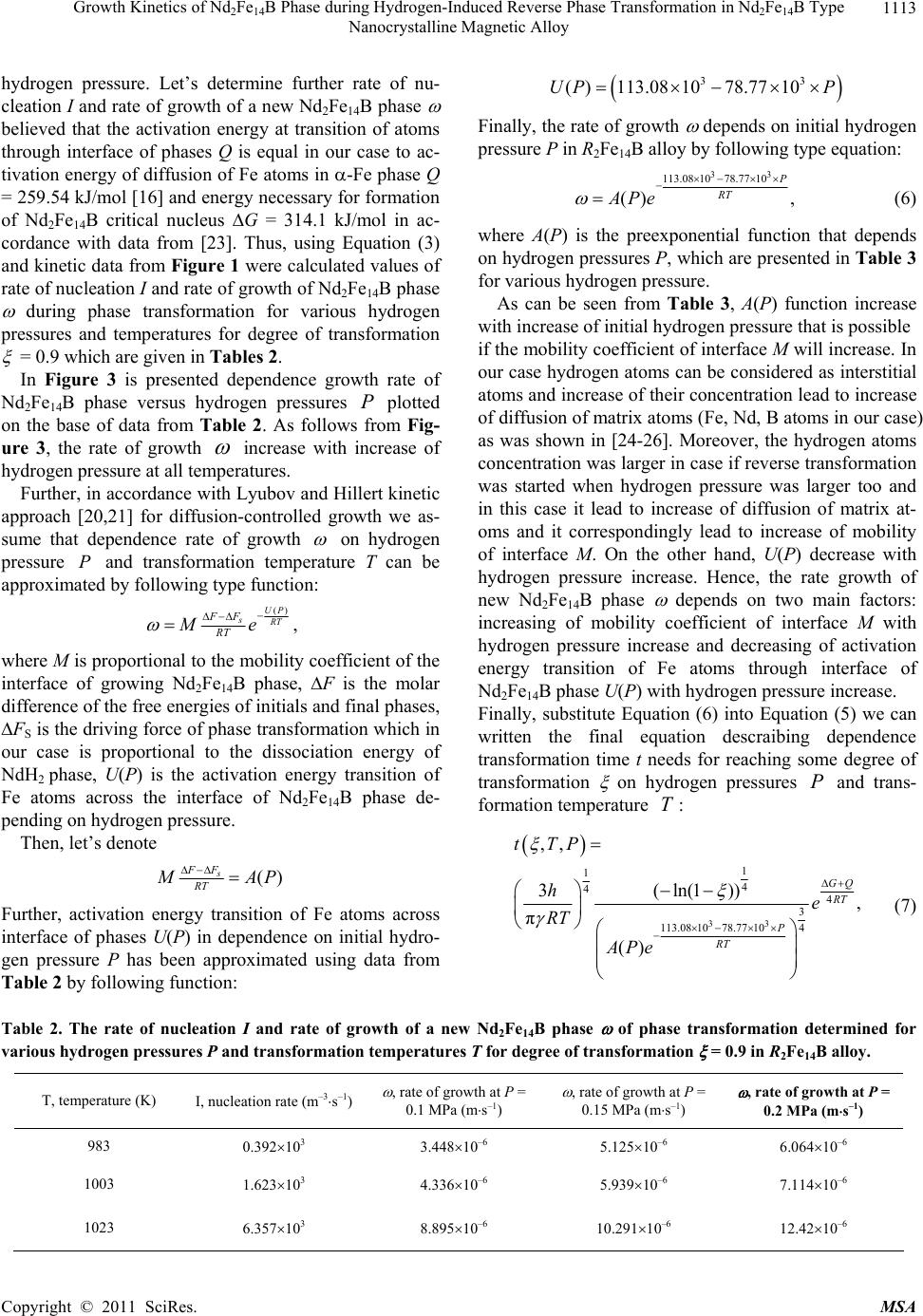 Growth Kinetics of NdFe B Phase during Hydrogen-Induced Reverse Phase Transformation in NdFe B Type 1113 2 142 14 Nanocrystalline Magnetic Alloy hydrogen pressure. Let’s determine further rate of nu- cleation I and rate of growth of a new Nd2Fe14B phase believed that the activation energy at transition of atoms through interface of phases Q is equal in our case to ac- tivation energy of diffusion of Fe atoms in -Fe phase Q = 259.54 kJ/mol [16] and energy necessary for formation of Nd2Fe14B critical nucleus G = 314.1 kJ/mol in ac- cordance with data from [23]. Thus, using Equation (3) and kinetic data from Figure 1 were calculated values of rate of nucleation I and rate of growth of Nd2Fe14B phase during phase transformation for various hydrogen pressures and temperatures for degree of transformation = 0.9 which are given in Tables 2. In Figure 3 is presented dependence growth rate of Nd2Fe14B phase versus hydrogen pressures P plotted on the base of data from Table 2. As follows from Fig- ure 3, the rate of growth increase with increase of hydrogen pressure at all temperatures. Further, in accordance with Lyubov and Hillert kinetic approach [20,21] for diffusion-controlled growth we as- sume that dependence rate of growth on hydrogen pressure and transformation temperature T can be approximated by following type function: P ()UP s R T FF RT Me , where M is proportional to the mobility coefficient of the interface of growing Nd2Fe14B phase, F is the molar difference of the free energies of initials and final phases, FS is the driving force of phase transformation which in our case is proportional to the dissociation energy of NdH2 phase, U(P) is the activation energy transition of Fe atoms across the interface of Nd2Fe14B phase de- pending on hydrogen pressure. Then, let’s denote () s FF RT M AP Further, activation energy transition of Fe atoms across interface of phases U(P) in dependence on initial hydro- gen pressure P has been approximated using data from Table 2 by following function: 33 ( )113.08 1078.77 10UP P Finally, the rate of growth depends on initial hydrogen pressure P in R2Fe14B alloy by following type equation: 33 113.08 1078.77 10 () , P RT APe (6) where A(P) is the preexponential function that depends on hydrogen pressures P, which are presented in Table 3 for various hydrogen pressure. As can be seen from Table 3, A(P) function increase with increase of initial hydrogen pressure that is possible if the mobility coefficient of interface M will increase. In our case hydrogen atoms can be considered as interstitial atoms and increase of their concentration lead to increase of diffusion of matrix atoms (Fe, Nd, B atoms in our case) as was shown in [24-26]. Moreover, the hydrogen atoms concentration was larger in case if reverse transformation was started when hydrogen pressure was larger too and in this case it lead to increase of diffusion of matrix at- oms and it correspondingly lead to increase of mobility of interface M. On the other hand, U(P) decrease with hydrogen pressure increase. Hence, the rate growth of new Nd2Fe14B phase depends on two main factors: increasing of mobility coefficient of interface M with hydrogen pressure increase and decreasing of activation energy transition of Fe atoms through interface of Nd2Fe14B phase U(P) with hydrogen pressure increase. Finally, substitute Equation (6) into Equation (5) we can written the final equation descraibing dependence transformation time t needs for reaching some degree of transformation on hydrogen pressures P and trans- formation temperature T : 33 1 1 4 4 4 3 4 113.08 1078.77 10 ,, 3(ln(1)) , π () GQ RT P RT tTP he RT APe (7) Table 2. The rate of nucleation I and rate of growth of a new Nd2Fe14B phase of phase transformation determined for various hydrogen pr e ssures P and transformation temperatures T for degree of transformation = 0.9 in R2Fe14B alloy. T, temperature (K) I, nucleation rate (m–3s–1) , rate of growth at P = 0.1 MPa (ms–1) , rate of growth at P = 0.15 MPa (ms–1) , rate of growth at P = 0.2 MPa (ms–1) 983 0.392103 3.44810–6 5.12510–6 6.06410–6 1003 1.623103 4.33610–6 5.93910–6 7.11410–6 1023 6.357103 8.89510–6 10.29110–6 12.4210–6 Copyright © 2011 SciRes. MSA 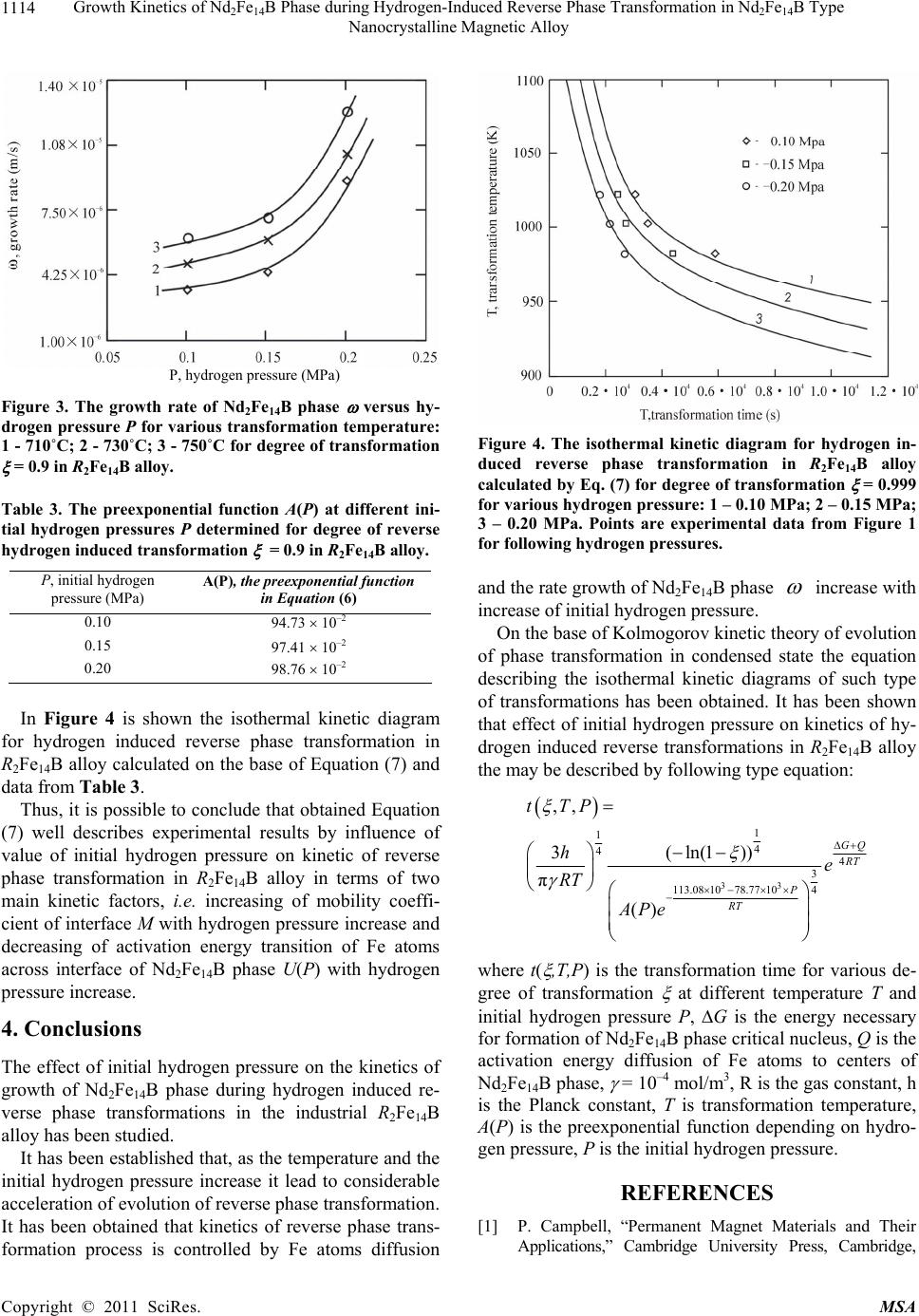 Growth Kinetics of NdFe B Phase during Hydrogen-Induced Reverse Phase Transformation in NdFe B Type 1114 214 214 Nanocrystalline Magnetic Alloy P, hydrogen pressure (MPa) Figure 3. The growth rate of Nd2Fe14B phase versus hy- drogen pressure P for various transformation temperature: 1 - 710˚C; 2 - 730˚C; 3 - 750˚C for degree of transformation = 0.9 in R2Fe14B alloy. Table 3. The preexponential function A(P) at different ini- tial hydrogen pressures P determined for degree of reverse hydrogen induced transformation = 0.9 in R2Fe14B alloy. P, initial hydrogen pressure (MPa) A(P), the preexponential function in Equation (6) 0.10 94.73 10–2 0.15 97.41 10–2 0.20 98.76 10–2 In Figure 4 is shown the isothermal kinetic diagram for hydrogen induced reverse phase transformation in R2Fe14B alloy calculated on the base of Equation (7) and data from Table 3. Thus, it is possible to conclude that obtained Equation (7) well describes experimental results by influence of value of initial hydrogen pressure on kinetic of reverse phase transformation in R2Fe14B alloy in terms of two main kinetic factors, i.e. increasing of mobility coeffi- cient of interface M with hydrogen pressure increase and decreasing of activation energy transition of Fe atoms across interface of Nd2Fe14B phase U(P) with hydrogen pressure increase. 4. Conclusions The effect of initial hydrogen pressure on the kinetics of growth of Nd2Fe14B phase during hydrogen induced re- verse phase transformations in the industrial R2Fe14B alloy has been studied. It has been established that, as the temperature and the initial hydrogen pressure increase it lead to considerable acceleration of evolution of reverse phase transformation. It has been obtained that kinetics of reverse phase trans- formation process is controlled by Fe atoms diffusion Figure 4. The isothermal kinetic diagram for hydrogen in- duced reverse phase transformation in R2Fe14B alloy calculated by Eq. (7) for degree of transformation = 0.999 for various hydrogen pressure: 1 – 0.10 MPa; 2 – 0.15 MPa; 3 – 0.20 MPa. Points are experimental data from Figure 1 for following hydrogen pressur e s. and the rate growth of Nd2Fe14B phase increase with increase of initial hydrogen pressure. On the base of Kolmogorov kinetic theory of evolution of phase transformation in condensed state the equation describing the isothermal kinetic diagrams of such type of transformations has been obtained. It has been shown that effect of initial hydrogen pressure on kinetics of hy- drogen induced reverse transformations in R2Fe14B alloy the may be described by following type equation: 33 1 1 4 4 4 3 4 113.08 1078.77 10 ,, 3(ln(1)) π () GQ R T P RT tTP he RT APe where t( ,T,P) is the transformation time for various de- gree of transformation at different temperature T and initial hydrogen pressure P, G is the energy necessary for formation of Nd2Fe14B phase critical nucleus, Q is the activation energy diffusion of Fe atoms to centers of Nd2Fe14B phase, = 10–4 mol/m3, R is the gas constant, h is the Planck constant, T is transformation temperature, A(P) is the preexponential function depending on hydro- gen pressure, P is the initial hydrogen pressure. REFERENCES [1] P. Campbell, “Permanent Magnet Materials and Their Applications,” Cambridge University Press, Cambridge, Copyright © 2011 SciRes. MSA 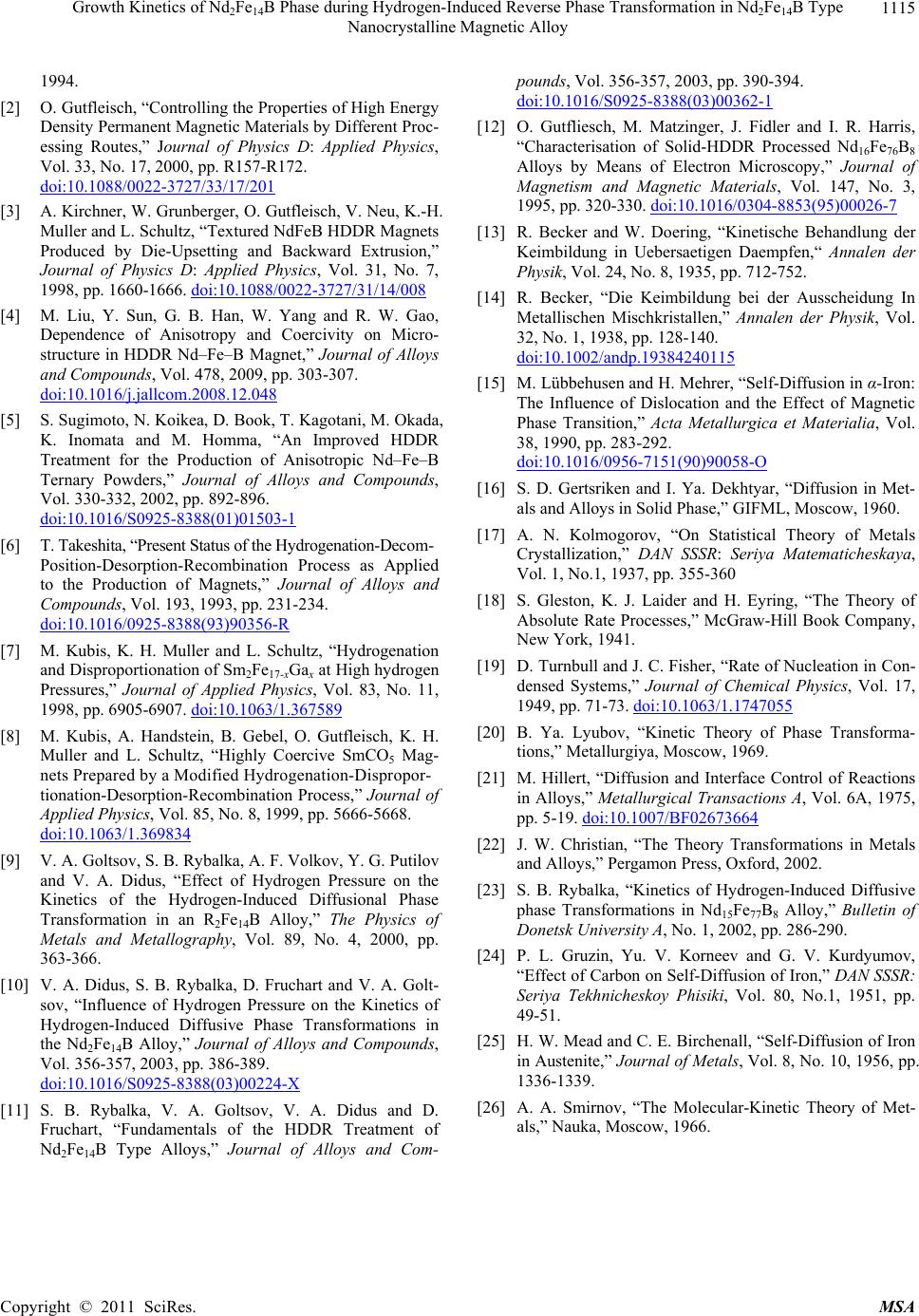 Growth Kinetics of Nd2Fe14B Phase during Hydrogen-Induced Reverse Phase Transformation in Nd2Fe14B Type Nanocrystalline Magnetic Alloy Copyright © 2011 SciRes. MSA 1115 1994. [2] O. Gutfleisch, “Controlling the Properties of High Energy Density Permanent Magnetic Materials by Different Proc- essing Routes,” Journal of Physics D: Applied Physics, Vol. 33, No. 17, 2000, pp. R157-R172. doi:10.1088/0022-3727/33/17/201 [3] A. Kirchner, W. Grunberger, O. Gutfleisch, V. Neu, K.-H. Muller and L. Schultz, “Textured NdFeB HDDR Magnets Produced by Die-Upsetting and Backward Extrusion,” Journal of Physics D: Applied Physics, Vol. 31, No. 7, 1998, pp. 1660-1666. doi:10.1088/0022-3727/31/14/008 [4] M. Liu, Y. Sun, G. B. Han, W. Yang and R. W. Gao, Dependence of Anisotropy and Coercivity on Micro- structure in HDDR Nd–Fe–B Magnet,” Journal of Alloys and Compounds, Vol. 478, 2009, pp. 303-307. doi:10.1016/j.jallcom.2008.12.048 [5] S. Sugimoto, N. Koikea, D. Book, T. Kagotani, M. Okada, K. Inomata and M. Homma, “An Improved HDDR Treatment for the Production of Anisotropic Nd–Fe–B Ternary Powders,” Journal of Alloys and Compounds, Vol. 330-332, 2002, pp. 892-896. doi:10.1016/S0925-8388(01)01503-1 [6] T. Takeshita, “Present Status of the Hydrogenation-Decom- Position-Desorption-Recombination Process as Applied to the Production of Magnets,” Journal of Alloys and Compounds, Vol. 193, 1993, pp. 231-234. doi:10.1016/0925-8388(93)90356-R [7] M. Kubis, K. H. Muller and L. Schultz, “Hydrogenation and Disproportionation of Sm2Fe17-xGax at High hydrogen Pressures,” Journal of Applied Physics, Vol. 83, No. 11, 1998, pp. 6905-6907. doi:10.1063/1.367589 [8] M. Kubis, A. Handstein, B. Gebel, O. Gutfleisch, K. H. Muller and L. Schultz, “Highly Coercive SmCO5 Mag- nets Prepared by a Modified Hydrogenation-Dispropor- tionation-Desorption-Recombination Process,” Journal of Applied Physics, Vol. 85, No. 8, 1999, pp. 5666-5668. doi:10.1063/1.369834 [9] V. A. Goltsov, S. B. Rybalka, A. F. Volkov, Y. G. Putilov and V. A. Didus, “Effect of Hydrogen Pressure on the Kinetics of the Hydrogen-Induced Diffusional Phase Transformation in an R2Fe14B Alloy,” The Physics of Metals and Metallography, Vol. 89, No. 4, 2000, pp. 363-366. [10] V. A. Didus, S. B. Rybalka, D. Fruchart and V. A. Golt- sov, “Influence of Hydrogen Pressure on the Kinetics of Hydrogen-Induced Diffusive Phase Transformations in the Nd2Fe14B Alloy,” Journal of Alloys and Compounds, Vol. 356-357, 2003, pp. 386-389. doi:10.1016/S0925-8388(03)00224-X [11] S. B. Rybalka, V. A. Goltsov, V. A. Didus and D. Fruchart, “Fundamentals of the HDDR Treatment of Nd2Fe14B Type Alloys,” Journal of Alloys and Com- pounds, Vol. 356-357, 2003, pp. 390-394. doi:10.1016/S0925-8388(03)00362-1 [12] O. Gutfliesch, M. Matzinger, J. Fidler and I. R. Harris, “Characterisation of Solid-HDDR Processed Nd16Fe76B8 Alloys by Means of Electron Microscopy,” Journal of Magnetism and Magnetic Materials, Vol. 147, No. 3, 1995, pp. 320-330. doi:10.1016/0304-8853(95)00026-7 [13] R. Becker and W. Doering, “Kinetische Behandlung der Keimbildung in Uebersaetigen Daempfen,“ Annalen der Physik, Vol. 24, No. 8, 1935, pp. 712-752. [14] R. Becker, “Die Keimbildung bei der Ausscheidung In Metallischen Mischkristallen,” Annalen der Physik, Vol. 32, No. 1, 1938, pp. 128-140. doi:10.1002/andp.19384240115 [15] M. Lübbehusen and H. Mehrer, “Self-Diffusion in α-Iron: The Influence of Dislocation and the Effect of Magnetic Phase Transition,” Acta Metallurgica et Materialia, Vol. 38, 1990, pp. 283-292. doi:10.1016/0956-7151(90)90058-O [16] S. D. Gertsriken and I. Ya. Dekhtyar, “Diffusion in Met- als and Alloys in Solid Phase,” GIFML, Moscow, 1960. [17] A. N. Kolmogorov, “On Statistical Theory of Metals Crystallization,” DAN SSSR: Seriya Matematicheskaya, Vol. 1, No.1, 1937, pp. 355-360 [18] S. Gleston, K. J. Laider and H. Eyring, “The Theory of Absolute Rate Processes,” McGraw-Hill Book Company, New York, 1941. [19] D. Turnbull and J. C. Fisher, “Rate of Nucleation in Con- densed Systems,” Journal of Chemical Physics, Vol. 17, 1949, pp. 71-73. doi:10.1063/1.1747055 [20] B. Ya. Lyubov, “Kinetic Theory of Phase Transforma- tions,” Metallurgiya, Moscow, 1969. [21] M. Hillert, “Diffusion and Interface Control of Reactions in Alloys,” Metallurgical Transactions A, Vol. 6A, 1975, pp. 5-19. doi:10.1007/BF02673664 [22] J. W. Christian, “The Theory Transformations in Metals and Alloys,” Pergamon Press, Oxford, 2002. [23] S. B. Rybalka, “Kinetics of Hydrogen-Induced Diffusive phase Transformations in Nd15Fe77B8 Alloy,” Bulletin of Donetsk University А, No. 1, 2002, pp. 286-290. [24] P. L. Gruzin, Yu. V. Korneev and G. V. Kurdyumov, “Effect of Carbon on Self-Diffusion of Iron,” DAN SSSR: Seriya Tekhnicheskoy Phisiki, Vol. 80, No.1, 1951, pp. 49-51. [25] H. W. Mead and C. E. Birchenall, “Self-Diffusion of Iron in Austenite,” Journal of Metals, Vol. 8, No. 10, 1956, pp. 1336-1339. [26] A. A. Smirnov, “The Molecular-Kinetic Theory of Met- als,” Nauka, Moscow, 1966. |