

Paper Menu >>
Journal Menu >>
 Applied Mathematics, 2011, 2, 947-952 doi:10.4236/am.2011.28130 Published Online August 2011 (http://www.SciRP.org/journal/am) Copyright © 2011 SciRes. AM The Capacitated Location-Allocation Problem in the Presence of k Connections Saber Shiripour, Mehdi Amiri-Aref, Iraj Mahdavi Department of In d ust ri al Engineering, Mazandaran University of Science & Technology, Babol, Iran E-mail: s_saber2004@yahoo.co m, m.a.aref @ u stmb.ac.ir, [email protected] Received June 13, 2011; revised July 2, 2011; accepted July 9, 2011 Abstract We consider a capacitated location-allocation problem in the presence of k connections on the horizontal line barrier. The objective is to locate a set of new facilities among a set of existing facilities and to allocate an optimal number of existing facilities to each new facility in order to satisfy their demands such that the summation of the weighted rectilinear barrier distances from new facilities to existing facilities is minimized. The proposed problem is designed as a mixed-integer nonlinear programming model. To show the efficiency of the model, a numerical example is provided. It is worth noting that the global optimal solution is obtained. Keywords: Capacitated Location-Allocation Problem, Line Barrier, Mixed Integer Nonlinear Programming 1. Introduction Facility location problems have been extensively inves- tigated in operations research (OR) and theoretical com- puter science literature (Cornu ejols et al. [1] and Shmoys [2]). For the first time, facility location problem is intro- duced by Weber [3]. He introduced a classical Weber problem in which locating a warehouse is considered so that the distance traveled between the warehouse and its customers is minimized. The American Mathematical Society (AMS) even generated specific codes for loca- tion problems (90B80 for discrete location and assign- ment, and 90B85 for continuous location). Location area can be divided into three branches: location problems, allocation problems and location-allocation problems. We used location-allocation problems in this work. Lo- cation-allocation (LA) problem is to locate a set of new facilities such that the total transportation cost from fa- cilities to customers is minimized and an op timal number of customers have to be allocated in an area of interest in order to satisfy the customer demands. Generally, there are some aspects affecting formulation this problem such as: either each customer is serviced by only one new facility or more, demand of customers are deterministic or stochastic and facilities are capacitated or uncapaci- tated. The models available for this problem are divided into two main sections: the general models (Cooper [4]) and developed models (Zhou and Liu [5]). In many of location problems, we have to consider some restrictions in finding locations of new facilities so that these restrictions refuse establishment of new facili- ties in some specified regions. In general, the restricted planar location problems are categorized in three catego- ries. The first category is called forbidden regions, namely, in these regions the locating of facility is not permitted but passing through is allowed (e.g., rods or forests). In Hamacher and Nickel [6] an extensive over- view of the location problems with forbidden regions is provided. The second category is consist of regions where placement of a facility is prohibited but travelling through is possible with a penalty cost (e.g., lakes that can be crossed only using a jolly boat). These regions are called congested regions. The third group considers bar- rier regions, for which both placement a facility and passing through are forbidden (e.g., lakes, big machines and conveyor belts in a plant). Note that, in some cases travelling on the barrier regions boundaries is allowed. The special case of almost linear barriers in the plane that have only a finite number of passages is frequently encountered in practice. Line barriers with passages may be used urban design for rivers, border lines, highways, mountain ranges, or, on a smaller scale, con- veyer belts in industrial plants. In all these examples trespassing is allowed only through a finite number of passag es . Barrier regions were first specified to location model- ing by Katz and Cooper [7], who consider Weber prob- lems with the Euclidean distance and a circular barrier.  948 S. SHIRIPOUR ET AL. Consideration of all barrier sets as polyhedral permits construction of a visibility graph that can be applied to efficiently compute barrier distances. They showed that the objective function of the problem was non-convex and suggested a heuristic algorithm for solving this pro- blem that is based on a sequential unconstrained mini- mization technique (SUMT) for nonlinear programming problems. This heuristic algorithm did not guarantee achievement of a global optimum solution. The problem was further investigated in Klamroth [8] and it was de- picted that in the case of a single circular barrier, the feasible set can be subd ivided into a polynomial nu mber, O(N2), of sub-regions, on every convex subset of which the Weber objective function is convex. N is the number of existing facilities on the plane so that, when N in- creases, construction of these convex subsets becomes cumbersome and hence is not desired. To overcome this difficulty, Bischoff and Klamroth [9] suggested a genetic algorithm (GA) and Weiszfeld technique-based solution to the problem. In the case of line barriers, Klamroth [10] considered a limited number of passages with any distance measure, separated the plane into two sub-planes and showed that an optimal solution of the non-convex barrier problem can be attained by solving a polynomial number of re- lated unconstrained sub-problems. Klamroth and Wiecek [11] generalized this result to multi-criteria problems. Huang et al. [12] find the optimal location of k connec- tions in the plane for uncapacitated and capacitated loca- tion problems. Huang et al. [13] considered the same problem and find the optimum capacity of each connec- tion. Huang et al. [14] discussed the same problem sub- ject to congestion. Recently, Canbolat and Wesolowsky [15] presented a single facility location problem in the presence of a line barrier that is distributed randomly on a given horizontal route on the plane. The goal is to locate a new facility such that the sum of the expected rectilinear distances from the facility to the demand points is minimized. They proposed a solution algorithm in which the feasible region is divided into two half-planes and to obtain a global optimum solution. For the first time, location-allocation problem is pre- sented by Cooper [4] who introduced a general model of location-allocation with two new facilities and seven demand points. He showed that the objective function is neither concave nor convex and may attain several local minima. Later on, Badri [16] provided network loca- tion-allocation problem and many models for this prob- lem. In a study Brady and Rosenthal [17] provided in- teractive graphics to solve facility location problems with a center objective function involving single as well as multiple new facilities in the presence of forbidden re- gion having any arbitrary configuration. Batta and Leifer [18] discussed multi-facility Weber problems with Man- hattan metric and give lower and upper bounds as well as the relative accuracy of solutions for problems with and without barriers. A network location problem where de- mand produced at a node is distance-dependent is ana- lyzed by Berman and Drezner [19]. The objective is to find a given number of facilities on network so that the facilities can serve no more than a given number of cus- tomers. Berman et al. [20] studied the problem of locat- ing a set of service facilities on a network while the de- mand for service is stochastic and congestion may occur at the facilities while considering two potential sources of lost demand like increasing long queues and travel distance. In this context, several integer programming formulations and heuristic approaches are investigated by them. For the same work, Berman et al. [21] proposed heuristic-based solution procedures to maximize the ex- pected number of captured demand when customer de- mands are stochastic and congestion exists at facilities. Also, Zhou and Liu [22] presented models for capaci- tated location—allocation problem with fuzzy demands. Recently, a multi-dimensional mixed-integer optimiza- tion problem for the location-allocation problem with the Euclidean distance in the presence of polyhedral barriers is presented by Bischoff et al. [23]. They introduced two different alternate location and allocation heuristics and used genetic algorithm in the location step of both algo- rithms. Iyigun and Ben-Israel [24] proposed an iterative method for the K facilities location problem. This me- thod relaxes the problem applying probabilistic assign- ments, depending on the distances to the facilities, so that the probabilities together with the facility locations are updated at each iteration. In this paper we focus on the capacitated location-al- location problem in the presence of k connections in the rectangular space (p = 1) and present an MINLP model for the problem. In this problem, it is assumed that new facilities are capacitated, there is no relationship between the new facilities, the solution space is continues and each the existing facility can be serviced by only one new facility. So, in addition to finding optimum locatio ns for the new facilities, the optimum assignments of exist- ing facilities to any new facility should be searched. The rest of this work is organized as follows. In next section, the problem structure and definitions are inves- tigated. In Section 3, we introduce a mathematical pro- gramming model for the capacitated location-allocation problem in the presence of k connection with the rectan- gular distance. Section 4 contains the computational re- sults where we evaluate the performance of the proposed model. Conclusions and scope for future studies are pro- vided in the last section. Copyright © 2011 SciRes. AM  S. SHIRIPOUR ET AL. Copyright © 2011 SciRes. AM 949 I 2. Problem Description Let be set of existing facilities in the feasible region. Suppose 1, ,i , iii X ab 1, be the ith exist- ing facility coordinates. Let be set of new facility in the feasible region. Suppose J,j , j jj X xy be the jth new facility coordinates in the plane, (see Fig- ure 1). Let wi be the demand of the ith point and Cj be the maximum capacity the jth new facility. The feasible region is defined as the union of the two closed Figure 1. Demand points wi th 2 conne ctions. X are located in the same half-plane we have , pij dXX , half-planes and on both sides. Let 1 2 , B L p ij dXX without any restrictions. Else the shortest traveled dis- tance through K connections should be considered. Al- though, distance metric lp, p=[1,) is applicable, the rectilinear distance, p = 1, is considered for this problem. be the p-norm barrier distance between Xi and Xj in the presence of a horizontal line barrier which trespassing through L 1, ,k is allowed only at the K connections (i.e., Pk, ), where K , kkk Prs , k s is the coordinates of the connections. Since the connections are located on a horizontal line, we set If Xi and 1,,.k The p-norm shortest path from each new facility to the existing facilities through the connections is as follo ws. K '' ,, ,min ,,,,, 1, ,;1, ,;1,...,2 mm Piji j Lmmm pijPikPkj ijij kmm mm dXXX X dXX dXPdPXXXXX iIjJm m (1) It means that while both i X and j X are located in the same half-plane, the p-norm distance is computed and while i X and j X are located in the opposite half- plane, the shortest path should be calculated. In this case, the shortest permitted path should be considered from the new facility to the existing facilities through all passages. So, considering p = 1 (i.e., rectilinear dis- tance), we have: '' 1 , ,min,, , 1, ,;1, ,;1, ,2 mm ji jiij Lmmm ij ikik jj ijij kmm mm xa ybXX dXX arbrxyXXXX iIjJm m (2) 3. Proposed Mathematical Model In this section, we introduce a nonlinear mathematical model for capacitated location-allocation problem in the presence of k connections on the line barrier. Generally, for the capacitated location-allocation problem with bar- rier, the problem of locating a set of J new facilities, Xj, , with respect to a finite set of I existing facili- ties, to minimize the total weighted barrier distances can be stated as follows: 1, ,jJ I 1 1,1, , J ij j zi (3) 1 ,1,, I iij j i wz CjJ 0,1,1, ,,1, , ij ziIjJ (4) , j X j where 1, Bij dXX is the rectilinear barrier distance between the i-th demand point and the j-th new facility and the binary variables stand for the allocation of if existing facility i to new facility j, i.e., ij z 1 11 min , IJ LB iiji j ij wz dXX 1,ifexisting facilityis assignedto newfacility,1, ,,1, ,. 0, otherwise, ij ij zi IjJ  S. SHIRIPOUR ET AL. Copyright © 2011 SciRes. AM 950 In this model, constraints (3) assure that each demand point can be served only by one new facility. Constraints (4) guarantee that the each new facility cannot serve more than their correspondence capacity. Here, three binary variables and a binary parameter are introduced. Let if the existing facility i and the new facility j are located in different half-planes and else , if the existing facility i be served to the new facility j through passage k else 1 ij t 0 ij t1 ijk u0 ijk u and if the y-coordinate of the j-th new facility is greater than 1 j g (j y ), otherwise . Assume if 0 j g 1 i qi b , else . 0 i q Now, with respect to the parameter and variables in- troduced, the capacitated location-allocation problem in the presence of k connections on the line barrier can be written as follows: 11 1 min 1 IJ K iiji kikj ij k jijk ijijijij wza rbrx yut axbyt (5) Subject to: 1 1,1, , J ij j zi I , J 1 ,1, I iij j i wz CjJ 1 1,1,,,1, , K ijk k uiIj (6) 2 jjj j ygg y (7) ,1,,; 1,, iji j tqgi IjJ (8) ,,,0,1,1,,;1,,,1,, j ijijijk g tzui Ij JkK (9) , jj xy0 (10) The objective function (5) consists of two parts. The first part of the objective function considers the shortest path from each existing facility to each the new facility through the passages if they are located in the different halfplanes. The second part of the objective function considers the regular rectilinear metric while the existing and new facilities are located in the one halfplane. This expression minimizes the total weighted traveled barrier distance from each new facility to the allocated existing facilities. Constraints (6) assure that the each new facility can serve every existing facility through only one con- nection. Constraints (7) determine that whether the new facility j is located in the upper-plane or not. Constraints (8) determine that whether the existing facility and the new facility, both are located in the same half-planes or not. Constraints (9) and constraints (10), respectively, show the binary and non-negative variables. Because of the complexity of the proposed mathematical program- ming model in large size problems, a numerical example in small size is presented. 4. Numerical Example In this section we assess the performance of the proposed model by providing a numerical example. In this exam- ple, we will find the optimum locations for establishment of two new facilities and the optimum assignments of existing facilities to these new facilities in the presence of a line barrier with two connections. This example consists of 8 existing facilities on the plane. The x and y coordinates of existing facilities are provided according to the sample data by Canbolat and Wesolowsky [15]. However, they considered the problem in the presence of a probabilistic line barrier. The coordinates of the exist- ing facilities and values of demands of the existing fa- cilities, ,1,,8 i wi are showed in Table 1. These values are chosen in the range [1-10]. The coordinates of the connections are provided in Table 2. The proposed model has been implemented in the LINGO 9.0 software package using global solver. To achieve a better understanding of the proposed model, the optimum locations found for two new facili- ties in two cases of without and with barrier are reported in Table 3. The capacities of new facilities 1 and 2 are considered 16 and 30 respectively. The obtained results state that the presence of line barrier with connections was effective on the optimum locations of both new fa- cilities 1 and 2. Also the value of objective function in case of with barrier is more than the case of without bar- rier, as we expected. This addition cost is due to the fact that the presence of line barrier can be effective on weighted rectilinear distances of mutual points on the Table 1. Existing facility locations and their demands. Existing facilitie Coordinates wi 1 (4,2) 10 2 (12,2) 3 3 (5,4) 7 4 (10,4.5) 2 5 (7,8) 5 6 (4,9) 2 7 (12,9.5) 8 8 (7,11) 7 Table 2. Coordinates of the connections Connections Coordinates 1 (6,6) 2 (10,6) 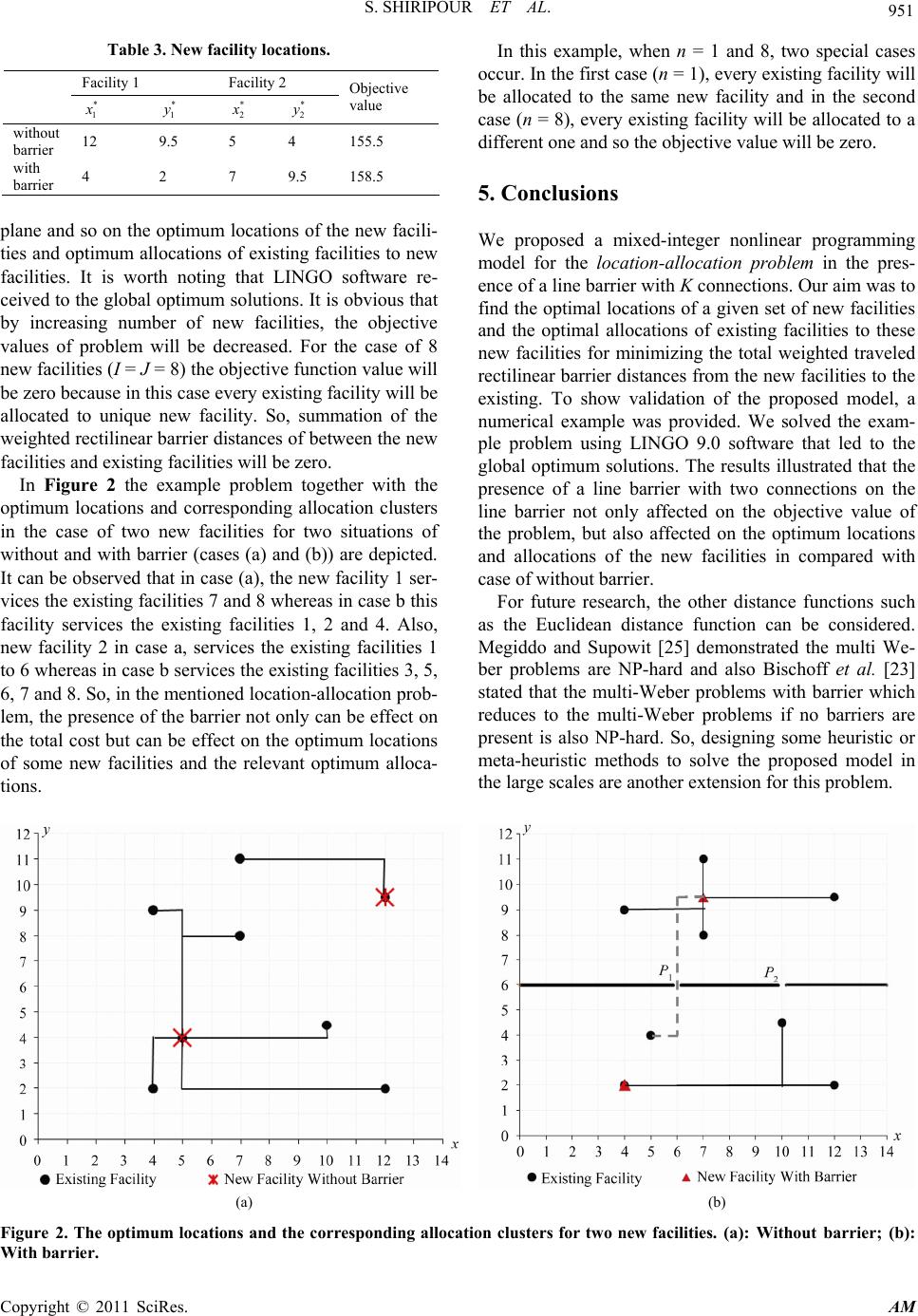 S. SHIRIPOUR ET AL. 951 Table 3. New facility locations. Facility 1 Facility 2 * 1 x * 1 y * 2 x * 2 y Objective value without barrier 12 9.5 5 4 155.5 with barrier 4 2 7 9.5 158.5 plane and so on the optimum locations of the new facili- ties and optimum allocations of existing facilities to new facilities. It is worth noting that LINGO software re- ceived to the global optimum solutions. It is obvious that by increasing number of new facilities, the objective values of problem will be decreased. For the case of 8 new facilities (I = J = 8) the objective function value will be zero because in this case every existing facility will be allocated to unique new facility. So, summation of the weighted rectilinear barrier distances of between the new facilities and existing facilities will be zero. In Figure 2 the example problem together with the optimum locations and corresponding allocation clusters in the case of two new facilities for two situations of without and with barrier (cases (a) and (b)) are depicted. It can be observed that in case (a), the new facility 1 ser- vices the existing facilities 7 and 8 whereas in case b this facility services the existing facilities 1, 2 and 4. Also, new facility 2 in case a, services the existing facilities 1 to 6 whereas in case b services the existing facilities 3, 5, 6, 7 and 8. So, in the mentioned location-allocation prob- lem, the presence of the barrier not only can be effect on the total cost but can be effect on the optimum locations of some new facilities and the relevant optimum alloca- tions. In this example, when n = 1 and 8, two special cases occur. In the first case (n = 1), every existing facility will be allocated to the same new facility and in the second case (n = 8), every existing facility will be allocated to a different one and so the objective value will be zero. 5. Conclusions We proposed a mixed-integer nonlinear programming model for the location-allocation problem in the pres- ence of a line barrier with K connections. Our aim was to find the optimal locations of a given set of new facilities and the optimal allocations of existing facilities to these new facilities for minimizing the total weighted traveled rectilinear barrier distances from the new facilities to the existing. To show validation of the proposed model, a numerical example was provided. We solved the exam- ple problem using LINGO 9.0 software that led to the global optimum solutions. The results illustrated that the presence of a line barrier with two connections on the line barrier not only affected on the objective value of the problem, but also affected on the optimum locations and allocations of the new facilities in compared with case of without barrier. For future research, the other distance functions such as the Euclidean distance function can be considered. Megiddo and Supowit [25] demonstrated the multi We- ber problems are NP-hard and also Bischoff et al. [23] stated that the multi-Weber problems with barrier which reduces to the multi-Weber problems if no barriers are present is also NP-hard. So, designing some heuristic or meta-heuristic methods to solve the proposed model in the large scales are another extension for this problem. (a) (b) Figure 2. The optimum locations and the corresponding allocation clusters for two new facilities. (a): Without barrier; (b): With barrier. Copyright © 2011 SciRes. AM 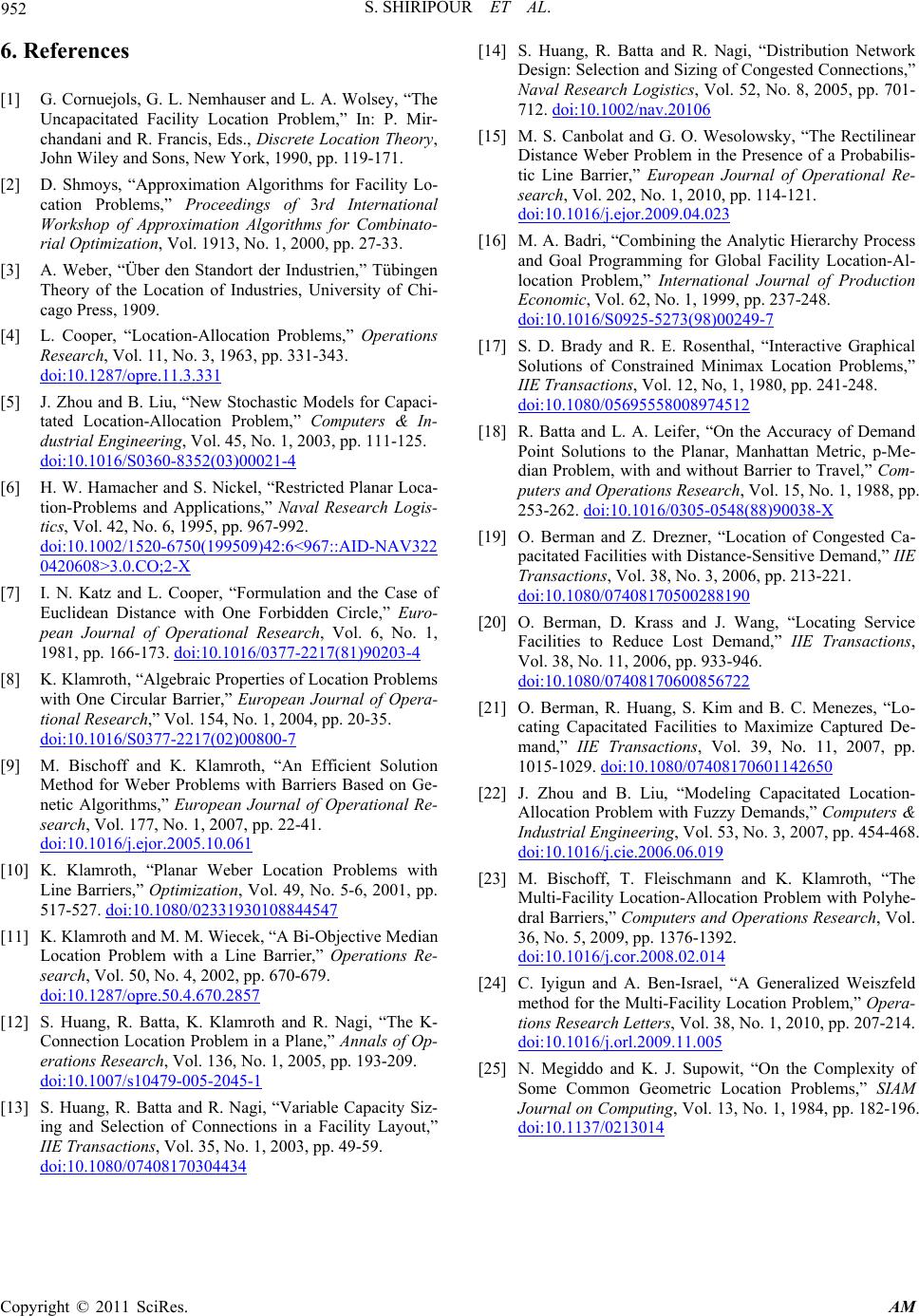 S. SHIRIPOUR ET AL. Copyright © 2011 SciRes. AM 952 6. References [1] G. Cornuejols, G. L. Nemhauser and L. A. Wolsey, “The Uncapacitated Facility Location Problem,” In: P. Mir- chandani and R. Francis, Eds., Discrete Location Theory, John Wiley and Sons, New York, 1990, pp. 119-171. [2] D. Shmoys, “Approximation Algorithms for Facility Lo- cation Problems,” Proceedings of 3rd International Workshop of Approximation Algorithms for Combinato- rial Optimization, Vol. 1913, No. 1, 2000, pp. 27-33. [3] A. Weber, “Über den Standort der Industrien,” Tübingen Theory of the Location of Industries, University of Chi- cago Press, 1909. [4] L. Cooper, “Location-Allocation Problems,” Operations Research, Vol. 11, No. 3, 1963, pp. 331-343. doi:10.1287/opre.11.3.331 [5] J. Zhou and B. Liu, “New Stochastic Models for Capaci- tated Location-Allocation Problem,” Computers & In- dustrial Engineering, Vol. 45, No. 1, 2003, pp. 111-125. doi:10.1016/S0360-8352(03)00021-4 [6] H. W. Hamacher and S. Nickel, “Restricted Planar Loca- tion-Problems and Applications,” Naval Research Logis- tics, Vol. 42, No. 6, 1995, pp. 967-992. doi:10.1002/1520-6750(199509)42:6<967::AID-NAV322 0420608>3.0.CO;2-X [7] I. N. Katz and L. Cooper, “Formulation and the Case of Euclidean Distance with One Forbidden Circle,” Euro- pean Journal of Operational Research, Vol. 6, No. 1, 1981, pp. 166-173. doi:10.1016/0377-2217(81)90203-4 [8] K. Klamroth, “Algebraic Properties of Location Problems with One Circular Barrier,” European Journal of Opera- tional Research,” Vol. 154, No. 1, 2004, pp. 20-35. doi:10.1016/S0377-2217(02)00800-7 [9] M. Bischoff and K. Klamroth, “An Efficient Solution Method for Weber Problems with Barriers Based on Ge- netic Algorithms,” European Journal of Operational Re- search, Vol. 177, No. 1, 2007, pp. 22-41. doi:10.1016/j.ejor.2005.10.061 [10] K. Klamroth, “Planar Weber Location Problems with Line Barriers,” Optimization, Vol. 49, No. 5-6, 2001, pp. 517-527. doi:10.1080/02331930108844547 [11] K. Klamroth and M. M. Wiecek, “A Bi-Objective Median Location Problem with a Line Barrier,” Operations Re- search, Vol. 50, No. 4, 2002, pp. 670-679. doi:10.1287/opre.50.4.670.2857 [12] S. Huang, R. Batta, K. Klamroth and R. Nagi, “The K- Connection Location Problem in a Plane,” Annals of Op- erations Research, Vol. 136, No. 1, 2005, pp. 193-209. doi:10.1007/s10479-005-2045-1 [13] S. Huang, R. Batta and R. Nagi, “Variable Capacity Siz- ing and Selection of Connections in a Facility Layout,” IIE Transactions, Vol. 35, No. 1, 2003, pp. 49-59. doi:10.1080/07408170304434 [14] S. Huang, R. Batta and R. Nagi, “Distribution Network Design: Selection and Sizing of Congested Connections,” Naval Research Logistics, Vol. 52, No. 8, 2005, pp. 701- 712. doi:10.1002/nav.20106 [15] M. S. Canbolat and G. O. Wesolowsky, “The Rectilinear Distance Weber Problem in the Presence of a Probabilis- tic Line Barrier,” European Journal of Operational Re- search, Vol. 202, No. 1, 2010, pp. 114-121. doi:10.1016/j.ejor.2009.04.023 [16] M. A. Badri, “Combining the Analytic Hierarchy Process and Goal Programming for Global Facility Location-Al- location Problem,” International Journal of Production Economic, Vol. 62, No. 1, 1999, pp. 237-248. doi:10.1016/S0925-5273(98)00249-7 [17] S. D. Brady and R. E. Rosenthal, “Interactive Graphical Solutions of Constrained Minimax Location Problems,” IIE Transactions, Vol. 12, No, 1, 1980, pp. 241-248. doi:10.1080/05695558008974512 [18] R. Batta and L. A. Leifer, “On the Accuracy of Demand Point Solutions to the Planar, Manhattan Metric, p-Me- dian Problem, with and without Barrier to Travel,” Com- puters and Operations Research, Vol. 15, No. 1, 1988, pp. 253-262. doi:10.1016/0305-0548(88)90038-X [19] O. Berman and Z. Drezner, “Location of Congested Ca- pacitated Facilities with Distance-Sensitive Demand,” IIE Transactions, Vol. 38, No. 3, 2006, pp. 213-221. doi:10.1080/07408170500288190 [20] O. Berman, D. Krass and J. Wang, “Locating Service Facilities to Reduce Lost Demand,” IIE Transactions, Vol. 38, No. 11, 2006, pp. 933-946. doi:10.1080/07408170600856722 [21] O. Berman, R. Huang, S. Kim and B. C. Menezes, “Lo- cating Capacitated Facilities to Maximize Captured De- mand,” IIE Transactions, Vol. 39, No. 11, 2007, pp. 1015-1029. doi:10.1080/07408170601142650 [22] J. Zhou and B. Liu, “Modeling Capacitated Location- Allocation Problem with Fuzzy Demands,” Computers & Industrial Engineering, Vol. 53, No. 3, 2007, pp. 454-468. doi:10.1016/j.cie.2006.06.019 [23] M. Bischoff, T. Fleischmann and K. Klamroth, “The Multi-Facility Location-Allocation Problem with Polyhe- dral Barriers,” Computers and Operations Research, Vol. 36, No. 5, 2009, pp. 1376-1392. doi:10.1016/j.cor.2008.02.014 [24] C. Iyigun and A. Ben-Israel, “A Generalized Weiszfeld method for the Multi-Facility Location Problem,” Opera- tions Research Letters, Vol. 38, No. 1, 2010, pp. 207-214. doi:10.1016/j.orl.2009.11.005 [25] N. Megiddo and K. J. Supowit, “On the Complexity of Some Common Geometric Location Problems,” SIAM Journal on Computing, Vol. 13, No. 1, 1984, pp. 182-196. doi:10.1137/0213014 |