

Paper Menu >>
Journal Menu >>
 Vol.1, No.2, 62- 65 (2011) doi:10.4236/ojpm.2011.12009 Copyright © 2011 SciRes. Openly accessible at http://www.scirp.org/journal/OJPM/ Open Journal of Preventive Medicine Suggested health ser vices research action to achieve reduction of neonatal mortality in India Manoj Kumar1*, Haresh M. Kirpalani2 1Neonatal Division, Department of Pediatrics, University of Alberta, Edmonton, Canada; *Corr es ponding a uthor : [email protected] 2Div ision of Neona tology, The Children’s Hospital of Philadelphia , Pennsylvania , U SA . Received 28 May 2011; revised 19 July 2011; accepted 28 July 20 11. AB S TRAC T Despite several national programs to reduce infant mortality, India had repeatedly failed to achieve its set targets for infant mortality. There are approximately one million neonatal deaths in India each year which accounts for nearly two-thirds of the infant deaths in India. India’s current trajectories of neonatal and infant mor- tality rates make it unlikely that it will achieve it s targets for infant mortality rate for 2015 set un- der the Millennium Development Goals. Since two-thirds of infant deaths in India are neonatal deaths, implementation of effective neonatal care strategies would be essential to reduce infant mortality considerably. The history of child health services in India suggests an inat- tention to qualitative parameters, hindering a reversal of its failures. We discuss a format of mixed-methods participatory research, inte- grated with routine district level household sur- veys (DLHS), as a model of health services re- search which would better delineate the prob- lems encountered in delivering effective new- born care at the primary care level. Keywords: Health Services Research; Infant Mortality; Neonatal Mortality; Mixed-Methods Research; Qualitative 1. INTRODUCTION India is signatory to the United Nations’ declaration of the Millennium Development Goals (MDGs); accord- ingly, it is expected to decrease childhood mortality by two-third by year 2015 from its level in 1990 (MDG4). For India, the target for infant mortality rate (IMR) is 27 per thousand births [1]. In past, India has repeatedly failed to achieve health targets that it had set for itself. For example, in 2002, a revised national policy set the target for reduction in IMR to less than 30 by 2010 [2], whereas the most recent estimate of India’s IMR is above 50 [3]. Approximately two-thirds of the infant deaths in India are neonatal deaths (deaths between 0 - 28 days of life), resulting in nearly one million deaths annually [4]. 70% of India’s population still resides in rural and semi-urban areas which is serviced by the primary healthcare net- work [5]. Thus large strides in reduction of IMR would be dependant upon improving neonatal survival in those areas. As 75% of the neonatal deaths occur within first week of life, a strategic focus on dealing with the factors leading to the three main causes of early neonatal deaths, i.e., prematurity, birth asphyxia and neonatal sepsis will be paramount [6]. India has a well-developed basic health infrastructure at the primary care level (Table 1). In rural and semi- urban areas, this now consists of 146,036 sub-centers, 23,458 primary health centers and 4276 first-referral units [7]. More so, in last two decades, it has launched several large public programs targeted to the reduction of neonatal and infant mortality, namely Child Survival and Safe Motherhood (CSSM) Program in 1992 [8], Reproductive and Child Health (RCH) program in 1997 [9], followed by its second phase in 2005. More recently, it has launched a program of conditional cash transfers, Janani Suraksha Yojana(JSY), to encourage in-facility deliveries [10]. However, the decline in the neonatal mortality rate (NMR) and IMR continue to be less than satisfactory. Approximately 47% of all births occur in any sort of health facilities [11]. If these trends continue, India will not able to achieve its MDG target for infant mortality [12]. 2. REASONS FOR PROGRAMMATIC FAILURES India lacks behind several other developing countries 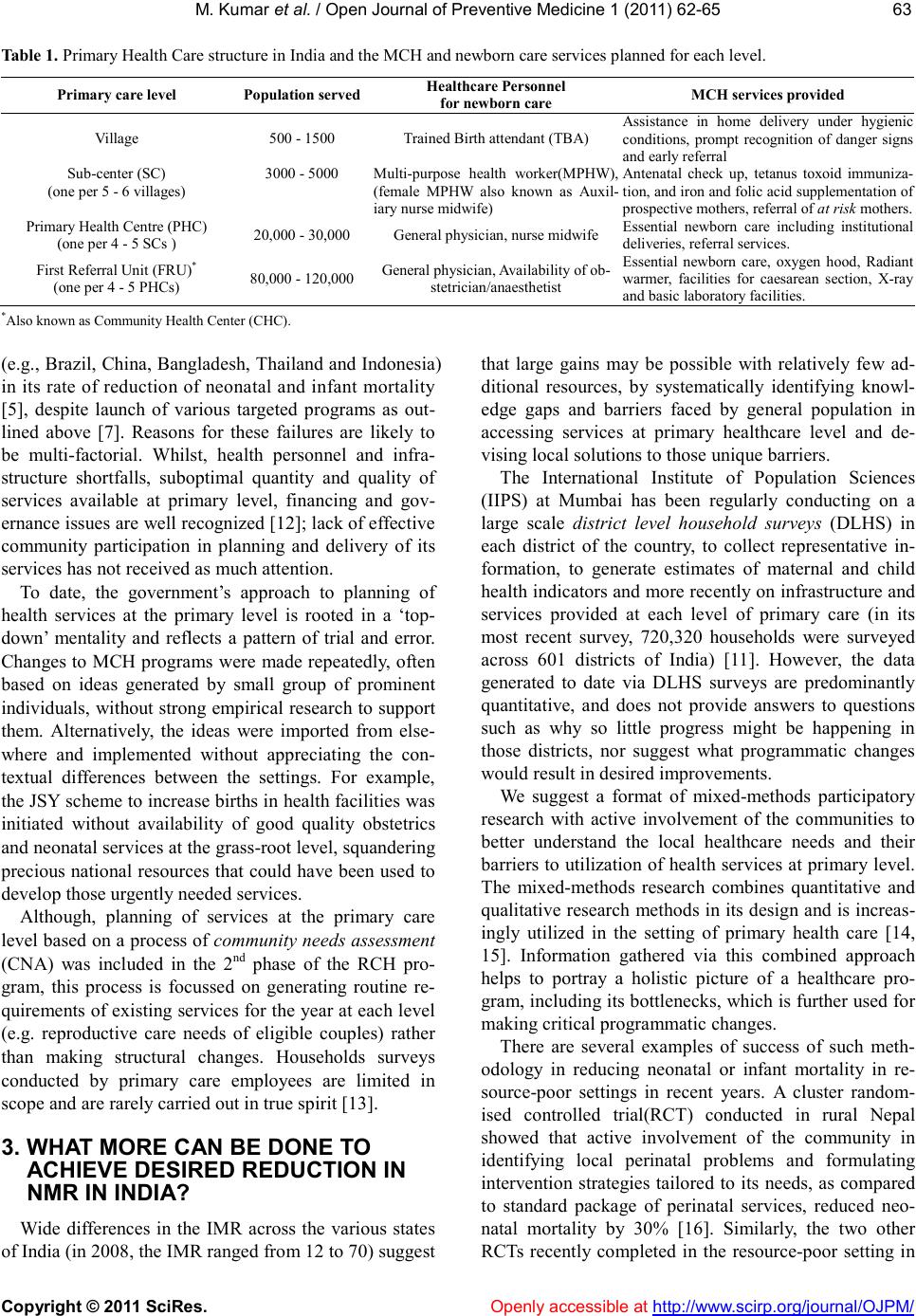 M. Ku mar et al. / Open Journal of Preventive Medicine 1 (2011) 62-65 Copyright © 2011 SciRes. Openly accessible at http://www.scirp.org/journal/OJPM/ 63 63 Table 1. Primary Health Care structure in India and the MCH and newborn care services planned for each level. Primary care level Population servedHealthcare Personnel for newborn care MCH services provided Village 500 - 1500 Trained Birth attendant (TBA) Assistance in home delivery under hygienic conditions, prompt recognition of danger signs and early refe rral Sub-center (SC) (one per 5 - 6 villages) 3000 - 5000 Multi- p urpose health worker(MPHW), (female MPHW also known as Auxil- iary nurse midwife) Antenatal check up, tetanus toxoid immuniza- tion, and iron and folic acid supplementation of prospective mothers, referral of at risk mothers. Primary Health Centre (PHC) (one per 4 - 5 SCs ) 20,000 - 30,000 General physician, nurse midwife Essential newborn care including institutional deliveries, referral services. First Referral Unit (FRU)* (one per 4 - 5 PHCs) 80,000 - 120,000 General physician, Availability of ob - stetrician/anaesthetist Essential newborn care, oxygen hood, Radiant warmer, facilities for caesarean section, X-ray and basic laboratory facilities. *Also known as Community Health Center (CHC). (e.g., Brazil, China, Bangladesh, Thailand and Indonesia) in its ra te of reductio n of neona tal and infan t mortality [5], despite launch of various targeted programs as out- lined above [7]. Reasons for these failures are likely to be multi-factorial. Whilst, health personnel and infra- structure shortfalls, suboptimal quantity and quality of services available at primary level, financing and gov- ernance issues are well recognized [12]; lack of effective community participation in planning and delivery of its services has not received as much attention. To date, the government’s approach to planning of health services at the primary level is rooted in a ‘top- down’ mentality and reflects a pattern of trial and error. Changes to MCH programs were made repeatedly, often based on ideas generated by small group of prominent individuals, without strong empirical research to support them. Alternatively, the ideas were imported from else- where and implemented without appreciating the con- textual differences between the settings. For example, the JSY scheme to increase births in health facilities was initiated without availability of good quality obstetrics and neonatal services at the grass-root level, squandering precious national resources that could have been used to develop those urgently needed services. Although, planning of services at the primary care level based on a process of community n eeds assessmen t (CNA) was included in the 2nd phase of the RCH pro- gram, this process is focussed on generating routine re- quirements of existing services for the year at each level (e.g. reproductive care needs of eligible couples) rather than making structural changes. Households surveys conducted by primary care employees are limited in scope and are rarely carried out in true spirit [13]. 3. WH AT MORE CAN BE DONE TO ACHIEVE DESIRED REDUCTION IN NMR IN INDI A? Wide differences in the IMR across the various states of India (in 2008, the IMR ranged from 12 to 70) suggest that large gains may be possible with relatively few ad- ditional resources, by systematically identifying knowl- edge gaps and barriers faced by general population in accessing services at primary healthcare level and de- vising local solutions to those unique barriers. The International Institute of Population Sciences (IIPS) at Mumbai has been regularly conducting on a large scale district level household surveys (DLHS) in each district of the country, to collect representative in- formation, to generate estimates of maternal and child health indicators and more recently on infrastructure and services provided at each level of primary care (in its most recent survey, 720,320 households were surveyed across 601 districts of India) [11]. However, the data generated to date via DLHS surveys are predominantly quantitative, and does not provide answers to questions such as why so little progress might be happening in those districts, nor suggest what programmatic changes would result in desired improvements. We suggest a format of mixed-methods participatory research with active involvement of the communities to better understand the local healthcare needs and their barriers to utilization of health services at primary level. The mixed-methods research combines quantitative and qualitative research methods in its design and is increas- ingly utilized in the setting of primary health care [14, 15]. Information gathered via this combined approach helps to portray a holistic picture of a healthcare pro- gram, including its bottle necks, which is further used for making critical programmatic changes. There are several examples of success of such meth- odology in reducing neonatal or infant mortality in re- source-poor settings in recent years. A cluster random- ised controlled trial(RCT) conducted in rural Nepal showed that active involvement of the community in identifying local perinatal problems and formulating intervention strategies tailored to its needs, as compared to standard package of perinatal services, reduced neo- natal mortality by 30% [16]. Similarly, the two other RCTs recently completed in the resource-poor setting in  M. Ku mar et al. / Open Journal of Preventive Medicine 1 (2011) 62-65 Copyright © 2011 SciRes. Openly accessible at http://www.scirp.org/journal/OJPM/ 64 rural India [17,18], with variable levels of community involvement in identification and planning of interven- tions showed 32% to 54% reduction i n NMR. Ho wever, such packages of interventions may not replicate desired benefits in other settings when scaled up to the entire country, due to contextual differences among the settings [19]. 4. HOW COULD THE PROPOS E D MIXED-METHODS PARTICIPATORY RESE ARCH BE DESIGNED AT THE NATIONAL LEVEL? The current data collection approach at the national level could itself be adapted into the methodology for the purposed mixed-method research. Alongside the quantitative data that are routinely collected through the district level surveys (DLHS), additional qualitative questions could be posed as an add-on questionnaire, seeking responses from households on their health seek- ing behaviours, barriers for using health services and their perceived solutions. Salient themes that should be explored are shown in Table 2, along with proposed collection methods. When questions would be framed as open-ended queries, an enhanced response is likely. We also suggest that an additional data set of qualita- Ta bl e 2 . Proposed themes for add-on questionnaire to current DLHS data reporting forms. Questions should explore: Care-seeking behaviours during the most recent episode of neona- tal or infant illness? (Semi-structu red questio nnaire with Open -ende d questions where applicable) How was illness id entified? Durati on between suspicion of i llness and arri val at hea lth facilit y, resons(s) for delay Satisfaction with the treatment received at the primary healthcare facility Reason(s) for not seeking care at a health facility (if, applicable) Were referral made to another health facility? If so, further explore the f ollowing: Cause(s) for referral Duration between referral advice made and arrival at suggested health facility, Cost s involved in following referral advice Satisfaction with the t r eatment received at the referral fa cili ty Reason (s) for not acting upon referral advic e (if, applicable) Barriers to utilization of health services (Semi-structured question- naire as above, and also via focus group discussions) Reason(s) if regular antenatal care was not obtained during the most recent pregnancy Reason(s) if a trained birth attendant was not used during the mos t recent birth Reason(s) if the most recent birth was not obtained in a health facility Reason(s) that would prevent you from attending the nearest SC, PHC and FRU if you baby gets sick? What are the likely solutions to the above barriers from your per- spective? tive information be obtained via holding focus group discussions in local communities at regular intervals. To enable frank discussion by those normally not vocal, we strongly suggest focus groups be both socially and gender homogenous. Information obtained through these sepa- rate sources, would better delineate the existing barriers to local populations in seeking healthcare and utilizing existing healthcare facilities. In addition, such discus- sions are likely to identify solutions that would be more acceptable among the communities, rooted in their active participation in arriving at those decisions. 5. DISCUSSION Based on the current trends of decline in the neonatal and infant mortality in India, it is unlikely to meet its MDG target for IMR set for 2015. There are known cost- effective interventions targeting acute obstetrical and neonatal care in developing countries that could reduce NMR by over 50% [20]. However, understanding of the contextual differences are important for success of those packages of interventions when applied to another re- source poor setting [19]. We have proposed a format of mixed-methods re- search, conducted concurrently with national level sur- veys, which will generate additional qualitative data on the community needs which would serve the useful function of providing clients’ perspective on bottlenecks in the delivery of health services. There are several po- tential advantages of undertaking this research action at the national level. First, the inferences drawn from the data collected would have greater validity due to appro- priate sampling techniques used in its collection, and its collection by an independent agency (DLHS staff) rather than local healthcare employees who may have vested interest in maintaining status quo. Second, quantitative data from each community (or district) could be easily collated with its qualitative data on an ongoing basis to understand its unique barriers and its felt needs. Lastly, the availability of these results would help program managers make timely and more effective programmatic changes at local level, as the changes made in the deliv- ery of health services will be based on direct inputs from those communities. In summary, the organization and delivery of MCH services at primary care level in India have been grossly inadequate in meeting its population’s needs, resulting in India’s repeated failures in achieving its set targets for infant and neonatal mortality. We have suggested a framework of mixed-methods research at the national level, strongly grounded in active participation from local communities, as a model for ongoing health ser- vices research which would better delineate the prob-  M. Ku mar et al. / Open Journal of Preventive Medicine 1 (2011) 62-65 Copyright © 2011 SciRes. http://www.scirp.org/journal/OJPM/ 65 65 [11] The International Institute for Population Sciences (IIPS), Mumbai (2010) District level household and facility sur- vey (DLHS-3), 2007-08, India. http://www.rchiips.org/pdf/INDIA_REPORT_DLHS-3.pdf lems encountered in delivering effective newborn care at the primary level and generate unique solutions tailored to the needs of the each communit y. [12] Paul, V.K., Sachdev, H.S., Mavalankar, D., Rama- chandran, P., Sankar, M.J., et al. (2011) Reproductive health, and child health and nutrition in India: Meeting the challenge. Lan cet, 377, 332-349. doi:10.1016/S0140-6736(10)61492-4 REFERENCES [1] The Official United Nations site for the MDG Indicators (2011) Millennium development goals indicators. http://mdgs.un.org/unsd/mdg/Data.aspx [13] Prinja, S., Lal, S. and Verma, R. (2007) Operationaliza- tion of the community needs assessment approach under the Reproductive and Child Health Programme at sub- centre level in north India. Regional Health Forum, 11, 39-47. [2] Ministry of Health and family Welfare, Government of India (2002) National health policy—2002. http://mohfw.nic.in/WriteReadData/l892s/2105179110Na tional%20Health%20policy-2002.pdf [3] Rajaratnam, J.K., Marcus, J.R., Flaxman, A.D., Wang, H., Levin-Rector, A., et al. (2010) Neonatal, postneonatal, childhood, and under-5 mortality for 187 countries, 1970 -2010: A systematic analysis of progress towards Millen- nium Development Goal 4. Lancet, 375, 1988- 2008. doi:10.1016/S0140-6736(10)60703-9 [14] Borkan, J.M. (2004) Mixed methods studies: A founda- tion for primary care research. Annals of Family Medi- cine, 2, 4-6. doi:10.1370/afm.111 [15] Creswell, J.W., Fetters, M.D. and Ivankova, N.V. (2004) Designing a mixed methods study in primary care. An- nals of Family Medicine, 2, 7-12. doi:10.1370/af m. 104 [4] Black, R.E., Cousens, S., Johnson, H.L., Lawn, J.E., Rudan, I., et al. (2010) Global, regional, and national causes of child mortality in 2008: A systematic analysis. Lan cet, 375, 969-987 . doi: 10.1016/S0140-6736(10)60549-1 [16] Manandhar, D.S., Osrin, D., Shrestha, B.P., Mesko, N., Morrison, J., et al. (2004) Effect of a participatory inter- vention with women's groups on birth outcomes in Nepal: Cluster-randomised controlled trial. Lancet, 364, 97 0-979. doi:10.1016/S0140-6736(04)17021-9 [5] WHO Statistical Information System (WHOSIS) (2008) Core health indicators. http://apps.who.int/whosis/database/core/core_select.cfm [17] Kumar,V., Mohanty, S., Kumar, A., Misra, R.P., Santo- sham, M., et al. (2008) Effect of community-based be- haviour change management on neonatal mortality in Shivgarh, Uttar Pradesh, India: A cluster-randomised controlled trial. Lancet, 372, 1151-1162. doi:10.1016/S0140-6736(08)61483-X [6] National Neonatology Forum of India and Save the Chil- dren (2004) State of India’s newborns. http://www.healthynewbornnetwork.org/sites/default/file s/resources/India-SOIN.pdf [18] Trip athy, P., Nair, N. , Barnet t, S., Mah apatr a, R., Bo rghi, J., et al . (2010) Effect of a participatory intervention with women’s groups on birth outcomes and maternal depres- sion in Jharkhand and Orissa, India: A cluster randomised controlled trial. Lancet, 375, 1182-1192. doi:10.1016/S0140-6736(09)62042-0 [7] Ministry of Health & Family Welfare, Government of India (2009) Annual report 2009-10. http://www.mohfw.nic.in/Health%20English%20Report. pdf [8] Ministry of Health and Family Welfare, Government of India (1994) National childhood survival and safe moth- erhood programme, New Delhi. [19] Knippenberg, R., Lawn, J.E., Darmstadt, G.L., Begkoy- ian, G., Fogstad, H., et al. (2005) Systematic scaling up of neonatal care in countries. Lancet, 365, 1087- 10 98. doi:10.1016/S0140-6736(05)71145-4 [9] Paruthi, R. and Dutta, P.K. (2002) Reproductive and child health p rogramme. Indian Journal of Public Health, 46, 72-7 7. [20] Darmstadt, G.L., Bhutta, Z.A., Cousens, S., Adam, T., Walker, N., et al. (2005) Evidence-based, cost-effective interventions: How many newborn babies can we save? Lan cet, 365, 977-988 . doi:10.1016/S0140-6736(05)71088-6 [10] Lim, S.S., Dandona, L., Hoisington, J.A., James, S.L., Hogan, M.C., et al. (2010) India’s Janani Suraksha Yo- jana, a conditional cash transfer programme to increase births in health facilities: An impact evaluation. Lancet, 375, 2009- 2023. doi:10.1016/S0140-6736(10)60744-1 Openly accessible at |