

Paper Menu >>
Journal Menu >>
 Vol.1, No.2, 20- 24 (2011) doi:10.4236/ojpm.2011.12004 Copyright © 2011 SciRes. Openly accessible at http://www.scirp.org/journal/OJPM/ Open Journal of Preventive Medicine Symptomatic changes in p ostmen opause with differen t methods of hormonal therapy Marcelino Hernández-Valencia*, Nydia Cordova, Antonio Vargas, Lourdes Basurto, Renata Saucedo, Carlos Vargas, Miriam Ruiz, Leticia Manuel-Apolinar, Arturo Zárate Endocrine Research Unit, Specialties Hospital, National Medical Center, Instituto Mexicano del Seguro Social, México City, Mexico; *Corresponding author: mhernandezval [email protected] Received 20 April 2011; revised 30 May 2011; accepted 20 July 2011. AB S TRAC T Objective: the diversity of opinions on the ad- verse effects of medications used to treat post- menopausal symptoms has prompted the use of various routes and mechanisms of action that need to be explored because bioavailability of the medications can vary. In order to select the appropriate route of administration for hormo- nal therapy (HT), it is necessary to determine baseline therapeutic efficacy. Design: we de- signed a prospective, randomized study con- sisting of four groups of postmenopausal wo- men: group 1 received oral conjugated estro- gens, group 2 received a synthethic steroid, group 3 received estradiol nasally in spray form, and group 4 used transdermal estradiol in the form of patches. Criteri a used to evaluat e effec- tiveness was the Greene scale, which evaluate six components. These criteria were applied to each patient before hormonal intervention and then each month for 6 months. Luteinizing hormone (LH), follicle stimulating horone (FSH) and estradiol concentration were determined by chemiluminescence. Student’s t-test was used for intra-group comparisons before and after treatment. Results: There was a significant de- crease in the vasomotor and sexual component (p < 0.05) with the use of four HT types. For de- pression, a difference was observed with syn- thetic steroids and oral estrogens. Upon ana- lyzing the somatic component there was a de- crease in s ymptoms w it h nasal an d transd ermal routes. Psychological changes were observed with the use of oral synthethic steroids and transdermal patches. Anxiety component dem- onstrated differences with nasal spray and oral estrogens, although all HT forms in this com- ponent showed a pattern of irregular changes. Conclusions: changes in the response could be due each route of administration and medica- tion used. Absorption variability may exist, which has repercussions in the control of symptoms and should be taken into considera- tion when selecting the appropriate route of administration for patients beginning HT. Keywords: Hormonal Therapy; Transdermal Estradiol; Tibolone; Oral Estrogen; Nasal Estradiol; Postmenopause 1. INTRODUCTION Postmenopause is the stage of life when a profound decrease occurs in the circulating concentration of es- trogens, inducing the appearance of characteristic psy- chosomatic symptoms [1,2]. Absence of this hor mone is the reason for estrogens receptors not exercising intra- cellular messages in different tissues sensitive to estro- gens, producing a functional derangement clinically translated by menopause symptoms that compromise quality of life [3,4]. Due to a variety of opinions on the adverse effects of medications used to treat menopause [5,6], diverse routes and mechanisms of action have been used, which need to be explored as to their responses. Differences in bioavai- lability of medications can vary when passing through the intestine and liver [7,8]. The actual tendency is to find the baseline therapeutic efficacy when choosing the appropriate route of hormonal therapy (HT) administra- tion to provide relief for the predominant symptoms that each patient presents at the first medical visit, since both doctors and women are seeking the optimal way to use HT [9,10]. This study was undertaken to compare the effects of different HT forms and routes of administration used to improve each of the symptomatic components in post- menopause. 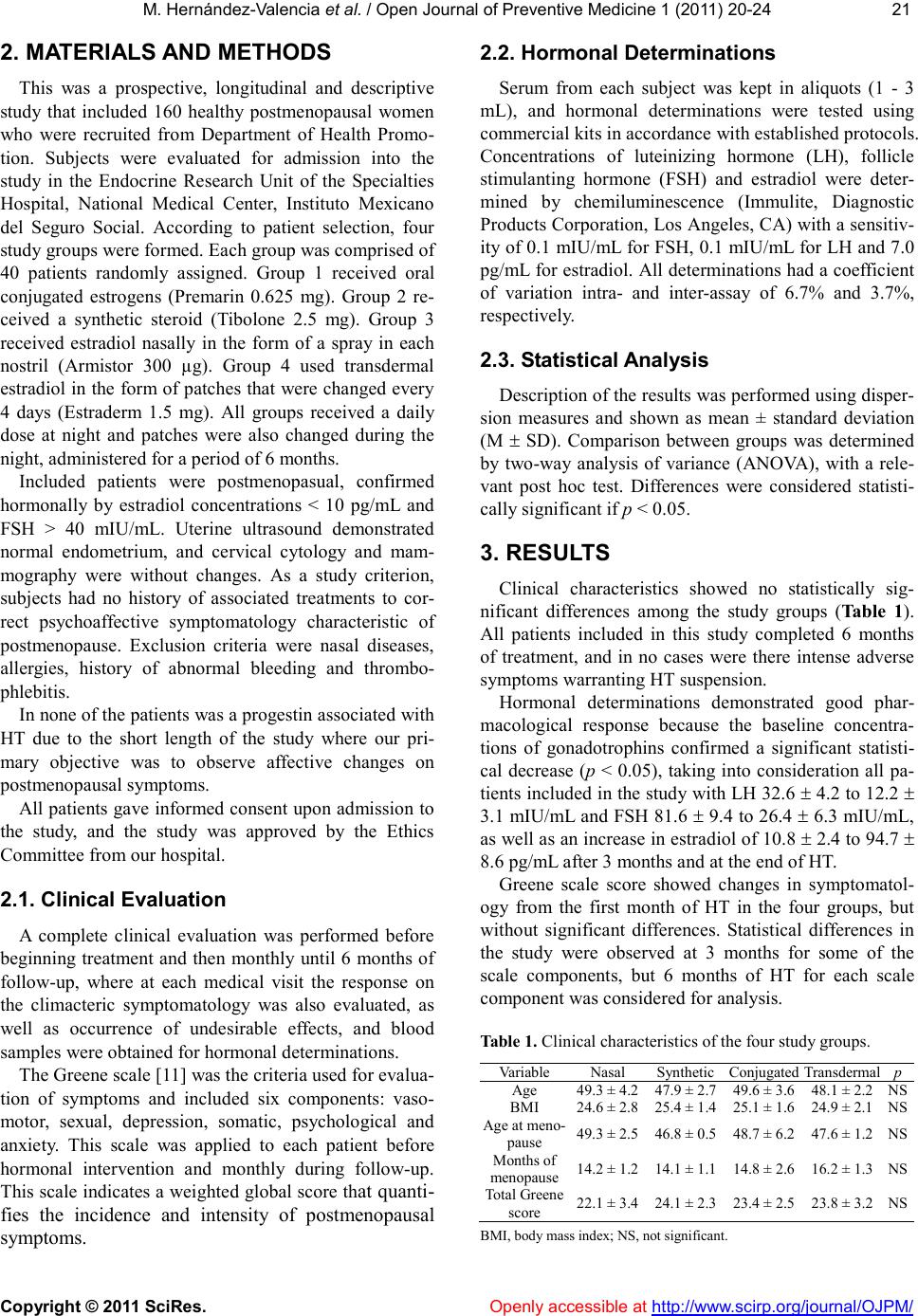 M. Hernández-Valencia et al. / Open Journal of Preventive Medicine 1 (2011) 20-24 Copyright © 2011 SciRes. Openly accessible at http://www.scirp.org/journal/OJPM/ 21 21 2. MATERIALS AND METHODS This was a prospective, longitudinal and descriptive study that included 160 healthy postmenopausal women who were recruited from Department of Health Promo- tion. Subjects were evaluated for admission into the study in the Endocrine Research Unit of the Specialties Hospital, National Medical Center, Instituto Mexicano del Seguro Social. According to patient selection, four study groups were formed. Each group was comprised of 40 patients randomly assigned. Group 1 received oral conjugated estrogens (Premarin 0.625 mg). Group 2 re- ceived a synthetic steroid (Tibolone 2.5 mg). Group 3 received estradiol nasally in the form of a spray in each nostril (Armistor 300 µg). Group 4 used transdermal estradiol in the form of patches that were changed every 4 days (Estraderm 1.5 mg). All groups received a daily dose at night and patches were also changed during the night, administered for a period of 6 months. Included patients were postmenopasual, confirmed hormonally by estradiol concentrations < 10 pg/mL and FSH > 40 mIU/mL. Uterine ultrasound demonstrated normal endometrium, and cervical cytology and mam- mography were without changes. As a study criterion, subjects had no history of associated treatments to cor- rect psychoaffective symptomatology characteristic of postmenopause. Exclusion criteria were nasal diseases, allergies, history of abnormal bleeding and thrombo- phlebitis. In none of the patients was a progestin associated with HT due to the short length of the study where our pri- mary objective was to observe affective changes on postmenopausal symptoms. All patients gave infor med consent upon ad mission to the study, and the study was approved by the Ethics Committee from our hospital. 2.1. Clinical Evaluation A complete clinical evaluation was performed before beginning treatment and then monthly until 6 months of follow-up, where at each medical visit the response on the climacteric symptomatology was also evaluated, as well as occurrence of undesirable effects, and blood samples were obtained for hormonal determinations. The Greene scale [11] was the criteria used for evalua- tion of symptoms and included six components: vaso- motor, sexual, depression, somatic, psychological and anxiety. This scale was applied to each patient before hormonal intervention and monthly during follow-up. This scale indicates a weighted global score that quanti- fies the incidence and intensity of postmenopausal symptoms. 2.2. Hormonal Determinations Serum from each subject was kept in aliquots (1 - 3 mL), and hormonal determinations were tested using commercial kits in accordance with established protocols. Concentrations of luteinizing hormone (LH), follicle stimulanting hormone (FSH) and estradiol were deter- mined by chemiluminescence (Immulite, Diagnostic Products Corpor ation, Los Angeles, CA) with a sensitiv- ity of 0.1 mIU/mL for FSH, 0.1 mIU/mL for LH and 7.0 pg/mL for estradiol. All determinations had a coefficient of variation intra- and inter-assay of 6.7% and 3.7%, respectively. 2.3. Statistical An alysis Description of the results was performed using disper- sion measures and shown as mean ± standard deviation (M SD). Comparison between groups was determined by two-way analysis of variance (ANOVA), with a rele- vant post hoc test. Differences were considered statisti- cally significant if p < 0.05. 3. RESULTS Clinical characteristics showed no statistically sig- nificant differences among the study groups (Table 1). All patients included in this study completed 6 months of treatment, and in no cases were there intense adverse symptoms war ranting HT suspensio n. Hormonal determinations demonstrated good phar- macological response because the baseline concentra- tions of gonadotrophins confirmed a significant statisti- cal decrease (p < 0.05), taking into consideration all pa- tients included in the study with LH 32.6 4.2 to 12.2 3.1 mIU/mL a nd FSH 81.6 9.4 to 26.4 6.3 mIU/mL, as well as an increase in e stradio l of 10.8 2.4 to 94.7 8.6 pg/mL after 3 months and at the end of HT. Greene scale score showed changes in symptomatol- ogy from the first month of HT in the four groups, but without significant differences. Statistical differences in the study were observed at 3 months for some of the scale components, but 6 months of HT for each scale component was considered for analysis. Table 1. Clinical characteristics of the four study groups. Variable Nasal Synthetic Conjugated Transdermalp Age 49.3 ± 4.247.9 ± 2.7 49.6 ± 3.6 48.1 ± 2.2NS BMI 24.6 ± 2.825.4 ± 1.4 25.1 ± 1.6 24.9 ± 2.1NS Age at m eno- pause 49.3 ± 2.546.8 ± 0.5 48.7 ± 6.2 47.6 ± 1.2NS Months of menopause 14.2 ± 1.214.1 ± 1.1 14.8 ± 2.6 16.2 ± 1.3NS Tot al Gr een e score 22.1 ± 3.424.1 ± 2.3 23.4 ± 2.5 23.8 ± 3.2NS BMI, body mass index; NS, not significant. 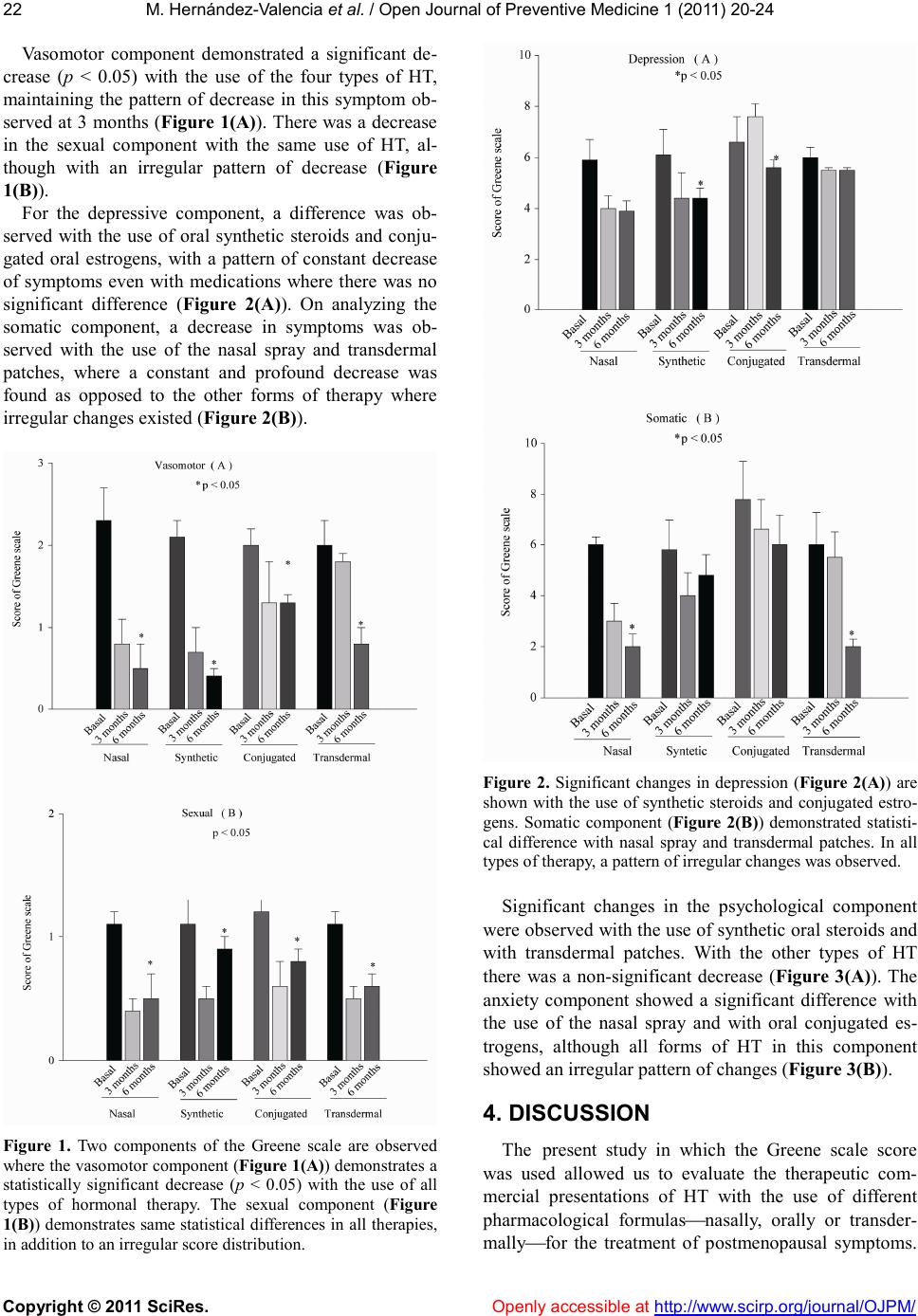 M. Hernández-Valencia et al. / Open Journal of Preventive Medicine 1 (2011) 20-24 Copyright © 2011 SciRes. Openly accessible at http://www.scirp.org/journal/OJPM/ 22 Vasomotor component demonstrated a significant de- crease (p < 0.05) with the use of the four types of HT, maintaining the pattern of decrease in this symptom ob- served at 3 months (Figure 1(A)). There was a decrease in the sexual component with the same use of HT, al- though with an irregular pattern of decrease (Figure 1(B)). For the depressive component, a difference was ob- served with the use of oral synthetic steroids and conju- gated oral estrogens, with a pattern of constant decrease of symptoms even with medications where there was no significant difference (Figure 2(A)). On analyzing the somatic component, a decrease in symptoms was ob- served with the use of the nasal spray and transdermal patches, where a constant and profound decrease was found as opposed to the other forms of therapy where irregular changes existed (Figure 2(B)). Figure 1. Two components of the Greene scale are observed where the vasomotor component (Figure 1(A)) demonstrates a statistically significant decrease (p < 0.05) with the use of all types of hormonal therapy. The sexual component (Figure 1(B)) demonstrates same statistic al differences in al l therapies, in addition to an irregular score distribution. Figure 2. Significant changes in depression (Figure 2(A)) are shown with the use of synthetic steroids and conjugated estro- gens. Somatic component (Figure 2(B)) demonstrated statisti- cal difference with nasal spray and transdermal patches. In all types of therapy, a pattern of irregular ch anges was observed. Significant changes in the psychological component were observed with the use of synthetic oral steroids and with transdermal patches. With the other types of HT there was a non-significant decrease (Figure 3(A)). The anxiety component showed a significant difference with the use of the nasal spray and with oral conjugated es- trogens, although all forms of HT in this component showed an irregular pattern of changes (Figure 3(B)). 4. DISCUSSION The present study in which the Greene scale score was used allowed us to evaluate the therapeutic com- mercial presentations of HT with the use of different pharmacological formulasnasally, orally or transder- mallyfor the treatment of postmenopausal symptoms. 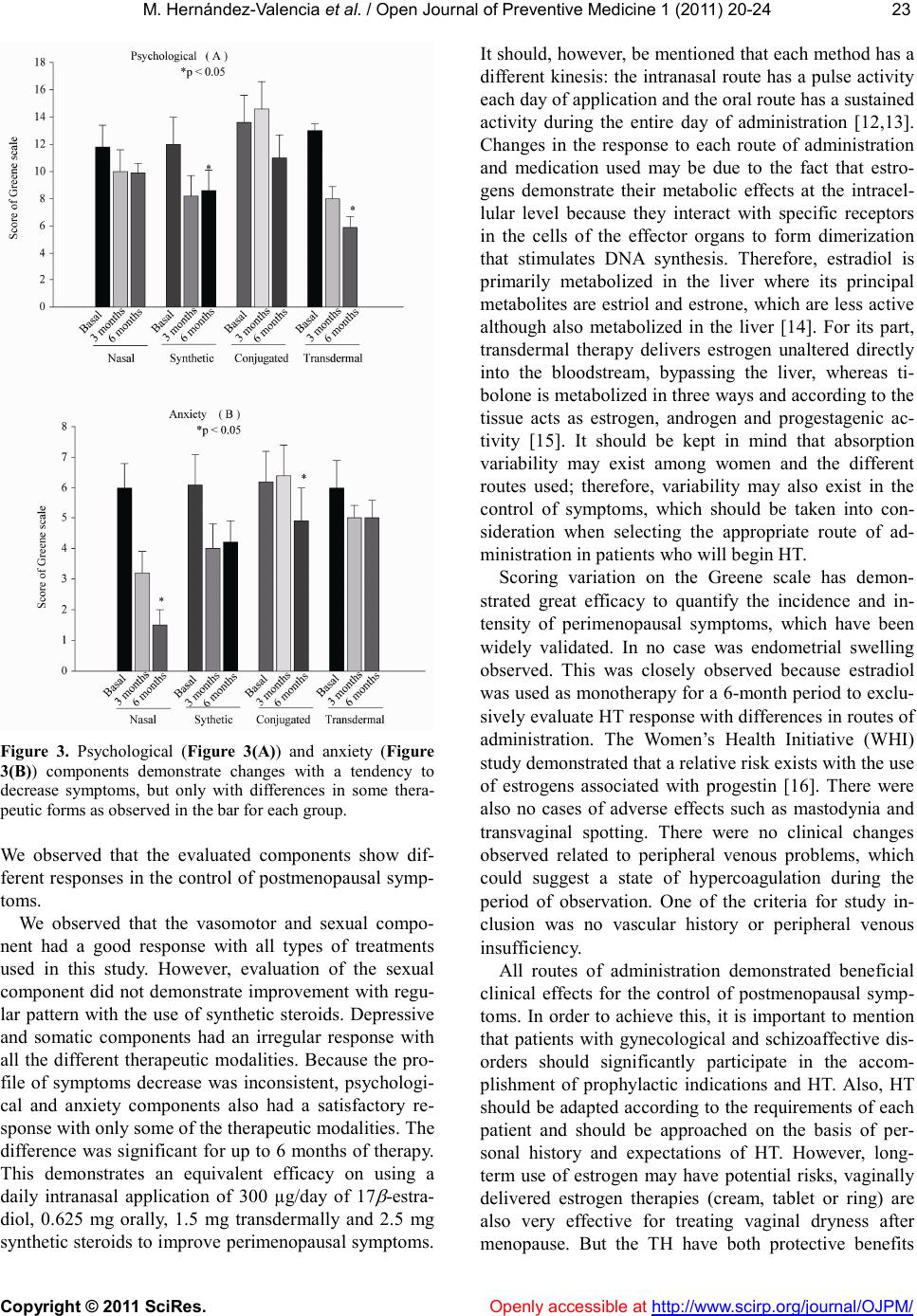 M. Hernández-Valencia et al. / Open Journal of Preventive Medicine 1 (2011) 20-24 Copyright © 2011 SciRes. Openly accessible at http://www.scirp.org/journal/OJPM/ 23 23 Figure 3. Psychological (Figure 3(A)) and anxiety (Figure 3(B)) components demonstrate changes with a tendency to decrease symptoms, but only with differences in some thera- peuti c forms as ob served in the bar for each group. We observed that the evaluated components show dif- ferent responses in the control of postmenopausal symp- toms. We observed that the vasomotor and sexual compo- nent had a good response with all types of treatments used in this study. However, evaluation of the sexual component did not demonstrate improvement with regu- lar pattern with the use of synthetic steroids. Depressive and somatic components had an irregular response with all the different therapeutic modalities. Because the pro- file of symptoms decrease was inconsistent, psychologi- cal and anxiety components also had a satisfactory re- sponse with only some of the therapeutic modalities. The difference was significant for up to 6 months of therapy. This demonstrates an equivalent efficacy on using a daily intranasal application of 300 µg/day of 17 -estra- diol, 0.625 mg orally, 1.5 mg transdermally and 2.5 mg synthetic steroids to improve perimenopausal symptoms. It should, however, be mentioned that each method has a different kinesis: the intranasal route has a pulse activity each day of application and the oral route has a sustained activity during the entire day of administration [12,13]. Changes in the response to each route of administration and medication used may be due to the fact that estro- gens demonstrate their metabolic effects at the intracel- lular level because they interact with specific receptors in the cells of the effector organs to form dimerization that stimulates DNA synthesis. Therefore, estradiol is primarily metabolized in the liver where its principal metabolites are estriol and estrone, which are less active although also metabolized in the liver [14]. For its part, transdermal therapy delivers estrogen unaltered directly into the bloodstream, bypassing the liver, whereas ti- bolone is metabolized in three ways and according to the tissue acts as estrogen, androgen and progestagenic ac- tivity [15]. It should be kept in mind that absorption variability may exist among women and the different routes used; therefore, variability may also exist in the control of symptoms, which should be taken into con- sideration when selecting the appropriate route of ad- ministration in patients who will begin HT. Scoring variation on the Greene scale has demon- strated great efficacy to quantify the incidence and in- tensity of perimenopausal symptoms, which have been widely validated. In no case was endometrial swelling observed. This was closely observed because estradiol was used as monotherapy for a 6-month period to exclu- sively evaluate HT response with differences in routes of administration. The Women’s Health Initiative (WHI) study demonstrated that a relative risk exists with the use of estrogens associated with progestin [16]. There were also no cases of adverse effects such as mastodynia and transvaginal spotting. There were no clinical changes observed related to peripheral venous problems, which could suggest a state of hypercoagulation during the period of observation. One of the criteria for study in- clusion was no vascular history or peripheral venous insufficiency. All routes of administration demonstrated beneficial clinical effects for the control of postmenopausal symp- toms. In order to achieve this, it is important to mention that patients with gynecological and schizoaffective dis- orders should significantly participate in the accom- plishment of prophylactic indications and HT. Also, HT should be adapted according to the requirements of each patient and should be approached on the basis of per- sonal history and expectations of HT. However, long- term use of estrogen may have potential risks, vaginally delivered estrogen therapies (cream, tablet or ring) are also very effective for treating vaginal dryness after menopause. But the TH have both protective benefits  M. Hernández-Valencia et al. / Open Journal of Preventive Medicine 1 (2011) 20-24 Copyright © 2011 SciRes. http://www.scirp.org/journal/OJPM/ 24 and potential risks like breast cancer, stroke or heart at- tack or heart attack and blood clot development, since older women, obese/diabetic women have much higher levels of a marker associated with inflammation, protein kinase C (PKC). Estrogen can either exacerbate or in- hibit inflammatory processes depending upon whether PKC or protein kinase A (PKA) is constitutively active within cells. This fact probably explains the seemingly conflicting results of estrogen-only therapy between younger and older women; old age is associated with higher levels of inflammation markers like PKC. Fur- thermore, since estrogen also produces a biphasic re- sponse, younger, normal-weight women are best advised to take only physiological doses of the natural hor mone. Openly accessible at We can conclude from these results that HT should be initiated for relief of symptoms through suitable selec- tion of the route of administration and drug that has the greatest effect on the predominant symptoms of each pati ent , for whic h me d ica l eva l uati o n wa s soug ht. 5. ACKNOWLEDGEMENTS The authors thank the personnel of the Endocrine Research Unit of the Specialties Hospital, National Medical Center of the Instituto Mexicano del Seguro Social for medical care and follow-up. Addition- ally, we thank Sharon Morey for editorial assistance in this manuscript. The study was financed in part by the Fondo para la Investigaciión en Salud (FIS) of the IMSS and by the National Council Investigators (SNI). REFERENCES [1] Hansen, L.B. and Portman, D. (2006) Hormone therapy update. Current recommendations for menopausal symp- toms. US Pharmacist, 31, 86-89. [2] Smith, A.L. and Wein, A.J. (2010) Estrogen replacement therapy for the treatment of postmenopausal genitouri- nary tract dysfunction. Discovery Medici ne, 10, 500-510. [3] Dennerstein, L. and Lehert, P. (2004) Women’s sexual functioning, lifestyle, mid-age, and menopause in 12 European countries. Menopause, 6, 778-785. do i:10.1097/01.GME.0000138544.50670.CC [4] Reimer, A. and Johnson, L. (2011) Atrophic vaginitis: Signs, symptoms, and better outcomes. The Nurse Prac- titioner, 36, 22- 28. [5] Kingsberg, S., Kellogg, S. and Krychman, M. (2010) Treating dyspareunia caused by vaginal atrophy: A re- view of treatment options using vaginal estrogen therapy. Internat io nal J our n al of Women’s Health, 9, 105-111. [6] Writing Group for the Women’s Health Initiative Inves- tigators (2002) Risks and benefits of estrogen plus pro- gestin in healthy postmenopausal women: Principal re- sults from the Women’s Health Initiative randomized controlled trial. The Journal of the American Medical Association, 288, 321-3 33 . [7] Bond, S. and Horton, L.S. (2010) Management of post- menopausal vaginal symptoms in women. Journal of Gerontological Nursing, 36, 3-7. do i:10.3928/00989134-20100527-96 [8] Lacroix, A.Z., Chlebowski, R.T., Manson, J.E., Aragaki, A.K., Johnson, K.C., Martin, L., Margolis, K.I., Stefan- ick, M.I., Brzyski, R., Curb, J.D., Howard, B.V., Lewis, C.E. and Wactawski-Wende, J. (2011) Health outcomes after stopping conjugated equine estrogens among post- menopausal women with prior hysterectomy. The Jour- nal of the American Medical Association, 30, 1305-1314. doi:10.1001/jama.2011.382 [9] Lowe, D.A., Baltgalvis, K.A. and Greising, S.M. (2010) Mechanisms behind estrogen’s beneficial effect on mus- cle strength in females. Exercise and Sport Sciences Re- views, 38, 61-67. doi:10.1097/JES.0b013e3181d496bc [10] Basurto, L., Saucedo, R., Zarate, A., Martinez, C., Gamino, C.E. and Reyes, E. (2006) Hernandez-Valencia M. Effect of pulsed estrogen therapy on hemostatic markers in comparison with oral estrogens regimen in postmenopausal women. Ginecologlay and Obstetricia Investigation, 61, 61-64. doi:10.1159/000088603 [11] Hernández-Valencia, M., Córdova-Pérez, N., Basu rto, L., Saucedo, R., Vargas, C., Vargas, A., Ruiz, M., Manuel, L. and Zárate, A. (2010) Frequency of symptoms of the cli- macteric synd rome. Gineco loglay Obstetri cia de Mexico, 78, 232- 237 . [12] Henderson, V.W. (2010) Action of estrogens in the aging brain: dementia and cognitive aging. Biochimica et Bio- physica Ac ta, 1800, 1077- 1083. [13] Rachon, D., Suchecka-Rachon, K., Hak, L. and Mysli- wska, J. (2006) Effects of intranasal 17- estradiol ad- ministration on serum bioactive interleukin-6 and C-re- active protein levels in healthy postmenopausal women. Menopause, 5, 840-845. [14] Gompel, A. (2006) Molecular action of estrogens and anti-estrogens. Maturitas, 54, 313-314. doi:10.1016/j.maturitas.2006.04.015 [15] Simoncini, T., Mannella, P., Fornari, L., Caruso, A., Va- rone, G., Garibal di, S. and Genazzan i , A. (2004) Tibolone activates nitric oxide synthesis in human endothelial cells. Journal of Clinical Endocrinology & Metabolism, 89, 4594-4600. doi:10.1210/jc.2003-032189 [16] The Women’s Health Initiative Steering Committee. (2004) Effects of conjugated equine estrogens in post- menopausal women with hysterectomy: The Women’s Health Initiative randomized, controlled trial. The Jour- nal of the American Medical Association, 291, 1701- 1712. doi:10.1001/jama.291.14.1701 |