

Paper Menu >>
Journal Menu >>
 Creative Education 2011. Vol.2, No.3, 276-278 Copyright © 2011 SciRes. DOI:10.4236/ce.2011.23037 The Role of Learning the Japanese Kuku Multiplication Chant in Simple Arithmetic Operations Hiroyasu Ito, Namiko Kubo-Kawai, Nobuo Masataka Primate Research Institute, Kyoto University, Inuyama, Japan. Email: [email protected] Received April 5th, 2011; revised May 7th, 2011; accepted May 16th, 2011. In Japanese primary schools, children are required to learn the kuku (“nine nines”) method of multiplication during the formal course of mathematics. When learning, they are taught to recite it as though reciting a Chinese poem or chanting. In the present study, we undertook an experiment designed to examine the role of learing the Japanese kuku multiplication chant in arithmetic operations by requiring the participants to solve the three types of simple arithmetic problems. In each problem presentation, an equation of simple addition (e.g., 3 (three) added to 4 (four) makes 7 (seven)), of simple multiplication (e.g., 3 (three) multiplied by 4 (four) is 12 (twelve)), or of kuku (e.g., 3 (three) 4 (four) 12 (twelve)) was auditorily presented with either the addend or augend in the addition, or the multiplicand or multiplier in the multiplication or kuku always being acoustically masked by peep sounds so that the participants did not hear the numbers masked. Comparison of the latency to their answer across the three types of problems revealed that as a consequence of learning kuku, a learner could produce the answers for the arithmetic multiplication problems as well as the answers for the kuku problems relatively more easily as compared to the arithmetic addition problems. Implications of the results are argued with reference to the cognitive load theory, a theory of learning and education which underwent substantial development and ex- pansion during last two decades. Keywords: Kuku, Mathematics, Arithmetic Operation, Number Sense, Cognitive Load Theory Introduction Numbers might be considered a ver y recent cultu ral invention in the evolution of the human species. Indeed, number words and digits arise from the specifically human and evolutionarily re- cent ability to cr eate and mental ly manipul ate co mp lex s ymbols. However, the sense of numbers is older. A sensitivity to nu- merical properties of the world is present even in nonhuman species (Dehaene, 1997; Dehaene, Dupoux, & Mehler, 1990; Gallsitel & Gelman, 1992). For instance, lionesses with their prides on the Serengeti Plains, Tanzania, decide to attack back only when the number of defenders is superior to the number of intruders. When deciding to drive the intruders off or not, they evaluate the number of intruders just by hearing the roars pro- duced (McComb, Packer, & Pusey, 1994). Altogether, previous evidence consistently indicates that this mental magnitude rep- resentation supports the more complex symbolic numerical capabilities developed by humans alone. Although such basic preverbal “number sense” provides a foundation for formal mathematics by performing arithmetic operations on approximate number representations, the devel- opmental process of the capability of formal mathematical per- formance would be environmentally modulated across the variations of linguistic cultures in the world. Nevertheless, ex- perimental evidence revealing such variations is still limited except for that with deaf people who acquired sign languages as their first languages (Bull, Marshark, & Baltto-Vallee, 2005; Frosted, 1996; Heiling, 1995; Nunes & Moreno, 2002). In order to pursue thi s issue , in the pr esent stu dy, we invest igated the rol e of learning the Japanese kuku multiplication chant in arithmetic operations in the formal mathematics. In Japanese primary schools, children are required to memo- rize the kuku (“nine nines”) method of multiplication during the formal course of mathematics. When learn ing, they are taught to recite it as though reciting a Chin ese poem or chanting. The digit names are often modified to maintain the rhythm, analogous to the phenomenon to recitation of a rhythmic poetry. As the learning pro ceeds, all chi ldren, unless mentally ret arded, become capable of reciting it from memor y, and the stored knowledge, as verbal quantitative information, might serve as a foundation for the formal mathematics they will learn later. Assuming such possibility would one to reason the learning of the kuku to be particularly helpful to children with dyscalculia, which may affect as much as 5% of the total population (Sousa, 2008). In fact, the history of kuku can be traced back more than 1,000 years (Lancy, 1983), during which, it might have been tradi- tionally transmitted as a powerful convention of creative educa- tion to support people ex periencing specific learni ng difficulti es. Nonetheless, such potential creativity of the kuku still remains novel in Western countries. In order to reveal that experimen- tally, the present investigation was conceived. As a first step to explore the possibility noted above, we un- dertook an experiment designed to examine the role of learning the kuku in arithmetic operations by requiring the adult partici- pants to solve simple arithmetic problems. As our intent is to investigate the role of learning the kuku in subsequent formal mathematics development, it is certainly ideal to select primary school students as the participants. It is also necessary to trace the performance of these primary school students in formal mathematics as a later stage. As a preliminary stage of such future research, the present study was conducted. The findings 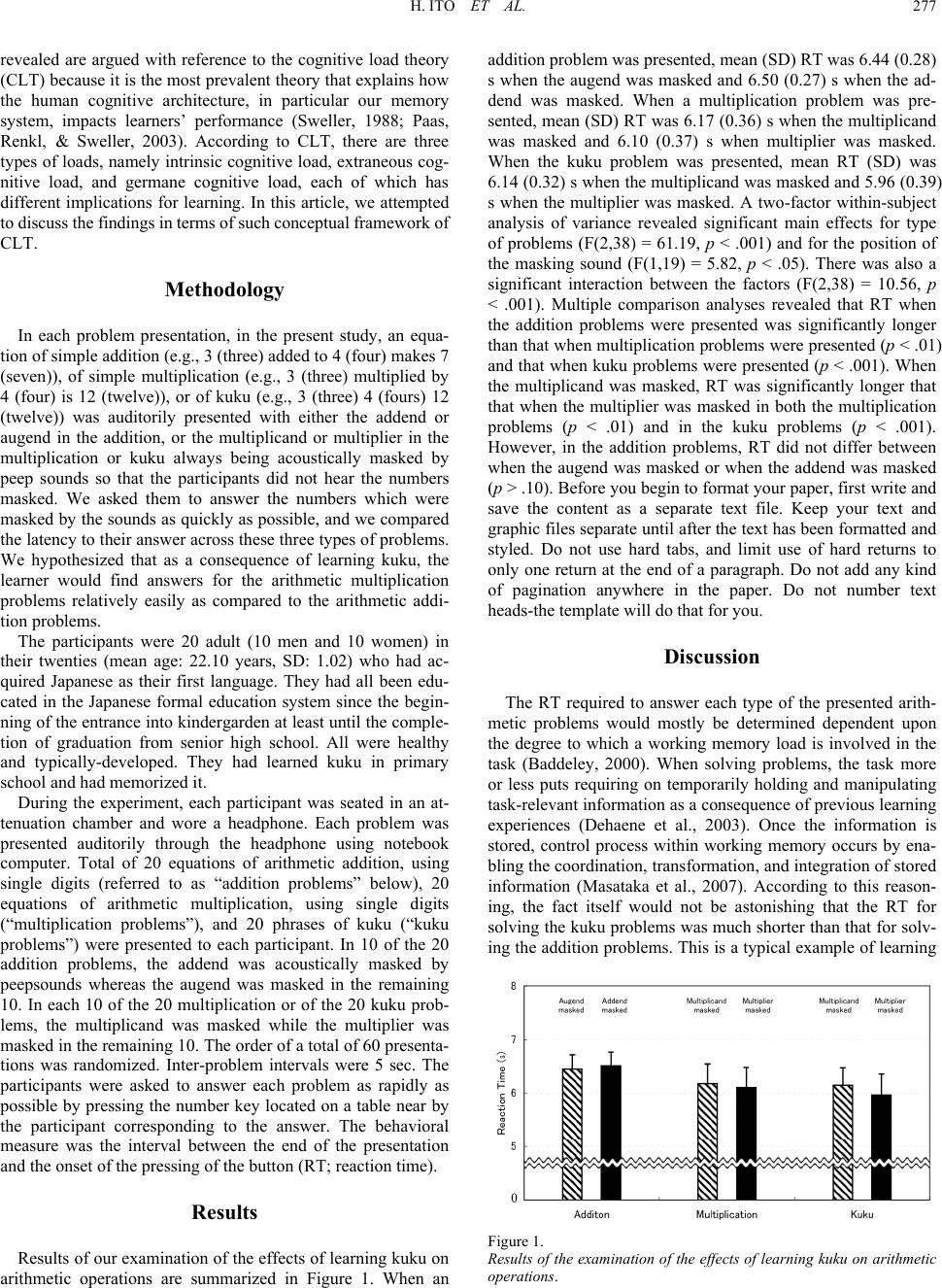 H. ITO ET AL. 277 revealed are argued with reference to the cognitive load theory (CLT) because it is the most prevalent theory that explains how the human cognitive architecture, in particular our memory system, impacts learners’ performance (Sweller, 1988; Paas, Renkl, & Sweller, 2003). According to CLT, there are three types of loads, namely intrinsic cognitive load, extraneous cog- nitive load, and germane cognitive load, each of which has different implications for learning. In this article, we attempted to discuss the findings in terms of such conceptu al framework of CLT. Methodology In each problem presentation, in the present study, an equa- tion of simple addition (e.g., 3 (three) added to 4 (four) makes 7 (seven)), of simple multiplication (e.g., 3 (three) multiplied by 4 (four) is 12 (twelve)), or of kuku (e.g., 3 (three) 4 (fours) 12 (twelve)) was auditorily presented with either the addend or augend in the addition, or the multiplicand or multiplier in the multiplication or kuku always being acoustically masked by peep sounds so that the participants did not hear the numbers masked. We asked them to answer the numbers which were masked by the sounds as quickly as possible, and we compared the latency to their answer across these three types of problems. We hypothesized that as a consequence of learning kuku, the learner would find answers for the arithmetic multiplication problems relatively easily as compared to the arithmetic addi- tion problems. The participants were 20 adult (10 men and 10 women) in their twenties (mean age: 22.10 years, SD: 1.02) who had ac- quired Japanese as their first language. They had all been edu- cated in the Japanese formal education system since the begin- ning of the entrance into kindergarden at least until the comple- tion of graduation from senior high school. All were healthy and typically-developed. They had learned kuku in primary school and had memorized it. During the experiment, each participant was seated in an at- tenuation chamber and wore a headphone. Each problem was presented auditorily through the headphone using notebook computer. Total of 20 equations of arithmetic addition, using single digits (referred to as “addition problems” below), 20 equations of arithmetic multiplication, using single digits (“multiplication problems”), and 20 phrases of kuku (“kuku problems”) were presented to each participant. In 10 of the 20 addition problems, the addend was acoustically masked by peepsounds whereas the augend was masked in the remaining 10. In each 10 of the 20 multiplication or of the 20 kuku prob- lems, the multiplicand was masked while the multiplier was masked in the remaining 10. The order of a total of 60 presenta- tions was randomized. Inter-problem intervals were 5 sec. The participants were asked to answer each problem as rapidly as possible by pressing the number key located on a table near by the participant corresponding to the answer. The behavioral measure was the interval between the end of the presentation and the onset of the pressing of the button (RT; reaction time). Results Results of our examination of the effects of learning kuku on arithmetic operations are summarized in Figure 1. When an addition problem was presented, mean (SD) RT was 6.44 (0.28) s when the augend was masked and 6.50 (0.27) s when the ad- dend was masked. When a multiplication problem was pre- sented, mean (SD) RT was 6.17 (0.36) s when the multiplicand was masked and 6.10 (0.37) s when multiplier was masked. When the kuku problem was presented, mean RT (SD) was 6.14 (0.32) s when the multiplicand was masked and 5.96 (0.39) s when the multiplier was masked. A two-factor within-subject analysis of variance revealed significant main effects for type of problems (F(2,38) = 61.19, p < .001) and for the position of the masking sound (F(1,19) = 5.82, p < .05). There was also a significant interaction between the factors (F(2,38) = 10.56, p < .001). Multiple comparison analyses revealed that RT when the addition problems were presented was significantly longer than that when multiplication problems were presented (p < .01) and that when kuku problems were presented (p < .001). When the multiplicand was masked, RT was significantly longer that that when the multiplier was masked in both the multiplication problems (p < .01) and in the kuku problems (p < .001). However, in the addition problems, RT did not differ between when the augend was masked or when the addend was masked (p > .10). Before you begin to format your paper, first write and save the content as a separate text file. Keep your text and graphic files separate until after the text has been formatted and styled. Do not use hard tabs, and limit use of hard returns to only one return at the end of a paragraph. Do not add any kind of pagination anywhere in the paper. Do not number text heads-the template will do that for you. Discussion The RT required to answer each type of the presented arith- metic problems would mostly be determined dependent upon the degree to which a working memory load is involved in the task (Baddeley, 2000). When solving problems, the task more or less puts requiring on temporarily holding and manipulating task-relevant information as a consequence of previous learning experiences (Dehaene et al., 2003). Once the information is stored, control process within working memory occurs by ena- bling the coordination, transformation, and integration of stored information (Masataka et al., 2007). According to this reason- ing, the fact itself would not be astonishing that the RT for solving the kuku problems was much shorter than that for solv- ing the addition problems. This is a typical example of learning Figure 1. Results of the examination of the effects of learning kuku on arithmetic operations.  H. ITO ET AL. 278 process outlined by CLT (Sweller, 1988; Paas, Renkl, & Sweller, 2003), in which each relevant element of high-element interactivity material that enables learning can be learned indi- vidually, but they cannot be understood until all of the elements and their interactions are processed simultaneously. Such ele- ment interactivity is the drive of the first category of cognitive load in CLT, which is referred to as intrinsic cognitive load because demands on working memory capacity imposed by element interactivity are intrinsic to the material being learned. Different materials differ in their levels of element interactivity and therefore intrinsic cognitive load, and they cannot be al- tered by instructional manipulations. In fact, working memory, in which all conscious cognitive processing occurs, is capable of handling only a very limited number of novel interacting elements. While this number is far below the number of interacting elements that occurs in most areas of human intellectual activity, long-term memory pro- vides humans with the ability to vastly expand this processing ability. This memory store can contain vast numbers of sche- mas that are cognitive constructs which incorporates multiple elements of information into a single element with a specific function. In this regard, the fact should be noticeable that the RT for solving the multiplication problems recorded in the present study was approximately equivalent to that for solving the kuku problems rather than to that for solving the addition problems. This strongly indicates that the participants utilized their knowledge of kuku to obtain the answers for the multipli- cation problems. No doubt, this knowledge is stored in long- term memory. CLT explains that schemas can be brought from long-term memory to working memory. While working memory might, for example, only deal one element that can be handled easily among a large number of interacting elements, their incorpora- tion in a schema reduces the load of working memory. It is by this process that human cognitive architecture handles complex material that appears to exceed the capacity of working mem- ory and that learning the Japanese kuku multiplication chant becomes an effective aid to performing arithmetic operations. Acknowledgements The present study was supported by a grant-in-aid from the Ministry of Education, Science, Sports and Culture, Japanese Government (#20243034) as well as by Global COE Research Program (A06 to Kyoto University). We are grateful to Eliza- beth Nakajima for her reading an earlier version of this manu- script and correcting its English. References Baddeley, A. D. (2000). The episodic buffer: A new component of wor kin g me mory . Trends in Cognitive Sciences, 4, 417-423. doi:10.1016/S1364-6613(00)01538-2 Bull, H., Marshark, M., & Baltto-Vallee, F. (2005) SNARC hunting: Examining number representation in deaf students. Learning and In- dividual Differences, 15, 223-236. doi:10.1016/j.lindif.2005.01.004 Dehaene, S. (1997). Number sense. Oxford: Oxford University Press. Deahaene, S., Dupoux, E. & Mehler, J. (1990). Is numerical compari- son digital? Analogical and symbolic effects in two-digit number comparison. Journal of Experimental Psychology, Human Percep- tion and Performance, 16, 626-641. doi:10.1037/0096-1523.16.3.626 Dehaene, S., Piazza, M., Pinel, P. & Cohen, L. (2003). Three parietal circuits for number processing. Cognit i ve Neuroscience, 20, 487-506. Frosted, P. (1996). Mathematical achievement of hearing-impaired students in Norway. European Journal of Special Needs of Educa- tion, 11, 67-81. Gallistel, C. R., & Gelman, R. (1992). Preverbal and verbal counting and computation. Cognition, 44, 43-74. doi:10.1016/0010-0277(92)90050-R Heiling, K. (1995). The development of deaf school children. Hamburg: Signum. Lancy D. F (1983). Cross-cultural studies in cognition and arithmetic. New York, NY: Academic Press. Masataka, N., Ohnishi, T., Imabayashi, E., HIrakara, M., & Matsuda, H. (2007). Neural correlates for learning to read Roman numerals. Brain and Language, 100, 276- 282. doi:10.1016/j.bandl.2006.11.011 McComb, K., Packer, C., & Pusey, A. (1994). Roaring and numerical assessment in contests between groups of female lions, Panthara leo. Animal Behaviour, 47, 379-387. doi:10.1006/anbe.1994.1052 Nunes, T. & Moreno, C. (2002). An intervention program to promote deaf pupils’ achievement in mathematics. Journal of Deaf Studies and Deaf Education, 7, 120-133. doi:10.1093/deafed/7.2.120 Paas, F., Renkl, A. & Sweller, J. (2003). Cognitive load theory and instructional design: Recent developments. Educational Psychologist, 38, 1-4. doi:10.1207/S15326985EP3801_1 Piazza, M., & Dehaene, S. (2005) From number neurons to mental arithmetic: The cognitive neuroscience of number sense. In M. S. Gazzaniga (Ed.), The Cognitive neurosciences III (pp. 865-875). Cambridge, MA: MIT press. Sousa, D. A. (2008) How the brain learns mathematics. Thousand Oaks, CA: Corwin. Sweller, J. (1988). Cognitive load during problem solving: Effects on learning. Cognitive Science, 12, 257-285. doi:10.1207/s15516709cog1202_4 |