

Paper Menu >>
Journal Menu >>
 Materials Sciences and Applicatio n, 2011, 2, 1090-1096 doi:10.4236/msa.2011.28147 Published Online August 2011 (http://www.SciRP.org/journal/msa) Copyright © 2011 SciRes. MSA Structural and Electrical Properties of Niobium Doped Y0.6Gd0.4Ba2-xNbxCu3O7-y Superconductors Mucahit Yilmaz1*, Oguz Dogan1 1A. Keleşoğlu Education Faculty Department of Physics, Selçuk University, Meram-Konya, Turkey Email: *[email protected] Received August 9th, 2010; revised January 8th, 2011; accepted May 30th, 2011 ABSTRACT Polycrystalline samples of Y0.6Gd0.4Ba2-xNbxCu3O7-y (YGBNCO) with different Nb contents (x = 0.05, 0.10, 0.15, 0.20, and 0.25) were prepared using the usual solid state reaction technique. The structure for all samples was characterized by XRD and SEM. The electrical properties were measured by the FPP method in the temperature range from 70 to 130 K. The lattice constant of b remains almost unchanged and a and c increases with the increase of Nb content with x ≤ 0.10. The zero resistance transition temperature and Jc decrease with increasing Nb content. But superconductivity did not suppress. As the Nb content in the samples increases, it gives a diffused phase indicating a niobium perovskite phase and it is a small amount of unidentified phase. Keywords: Y0.6Gd0.4Ba2Cu3O7-Y Cuprates, Gd and Nb Co-Doping, Structural and Superconducting Properties 1. Introduction YBCO is one of the most widely studied compound among the cuprate superconductors, owing to simplicity of synthesis procedure by solid-state reaction, the easy availability of the starting powders, and the non-toxity of the material compared to the other high-Tc superconduc- tors such as Tl and Hg based oxides [1-5]. One of the most fascinating challenges of the material science is to develop YBa2Cu3O7-x (YBCO) and RE- Ba2Cu3O7-x (REBCO: RE = Er, Nd, Gd, Sm) supercon- ductors for practical applications [6]. Several attempts have been made to study the effects of substituting Nb for YBCO [7-13]. In a study by Suresha et al. [14], a resistivity for YBa2Cu3-xNbxO7-y sample with x = 0.3, 0.45 and 0.6 indicated that Tc was in the range 85 - 90.3 K. They showed a possible change in crystal structure and composition with changing of x. Kuwabara and Ku- saka [13] concluded that Cu and Nb did not co-exist in the same compound containing Y and Ba. Another study by Abdullah and Tan [7] mentioned that the added Nb formed perovskite YBa2NbO6 instead of a compound containing Cu. On the other hand, in a study by Eguchi et al. [15] it was shown that Nb substitute to Cu in the sam- ple with nominal composition x = 0.01. Some researches [9,16] reported the existence of two phases in Y-Ba-Cu- Nb-O compound. One is the cubic Nb perovskite YBa2- NbO6, and the other is YBa2Cu3Oy phase. Some previous works indicated that at a small amount of Nb content of transition temperature, Tc, of the Y-Ba-Cu-Nb-O com- pound was nearly constant [9,14,17] or slowly higher [10,18]. The effect of Gd substitution in YBCO polycrystalline stabilizes an orthorhombic phase while the lattice pa- rameters are found to increase due to a larger size of the Gd atoms than Y atoms. There is no effect in the transi- tion temperature regardless of the concentration of Gd atoms introduced in YBCO [18], but Tc in Gd123 and Nd123 decreases rapidly with only little oxygen defi- ciency from fully oxygenated state, while in Y123 high- est Tc is retained even with certain oxygen deficiency (up to δ ≈ 0.2). This may be one of the reasons why the Gd123 material is not yet considered for various applica- tions as widely as Y123 [19]. The results of X-ray dis- tribution maps of x = 0.4 composite indicate that the RE123 matrix is homogeneous and Y and Gd elements in the Y1-xGdxBa2Cu3O7-δ a perfect solid solution [20]. For the Gd diffused-doped samples, magnetization and resis- tivity measurements show that the critical transition temperature, Tc, increased from 88 to 91 K and the criti- cal current density, Jc, which was calculated from M-H loops taken at 77 K, increased from 55 to 122 A·cm−2 in comparison with those of undoped Y123. Such en- hancement, which is considered to represent a character- istic strength of inter-grain coupling, is more clearly rec- 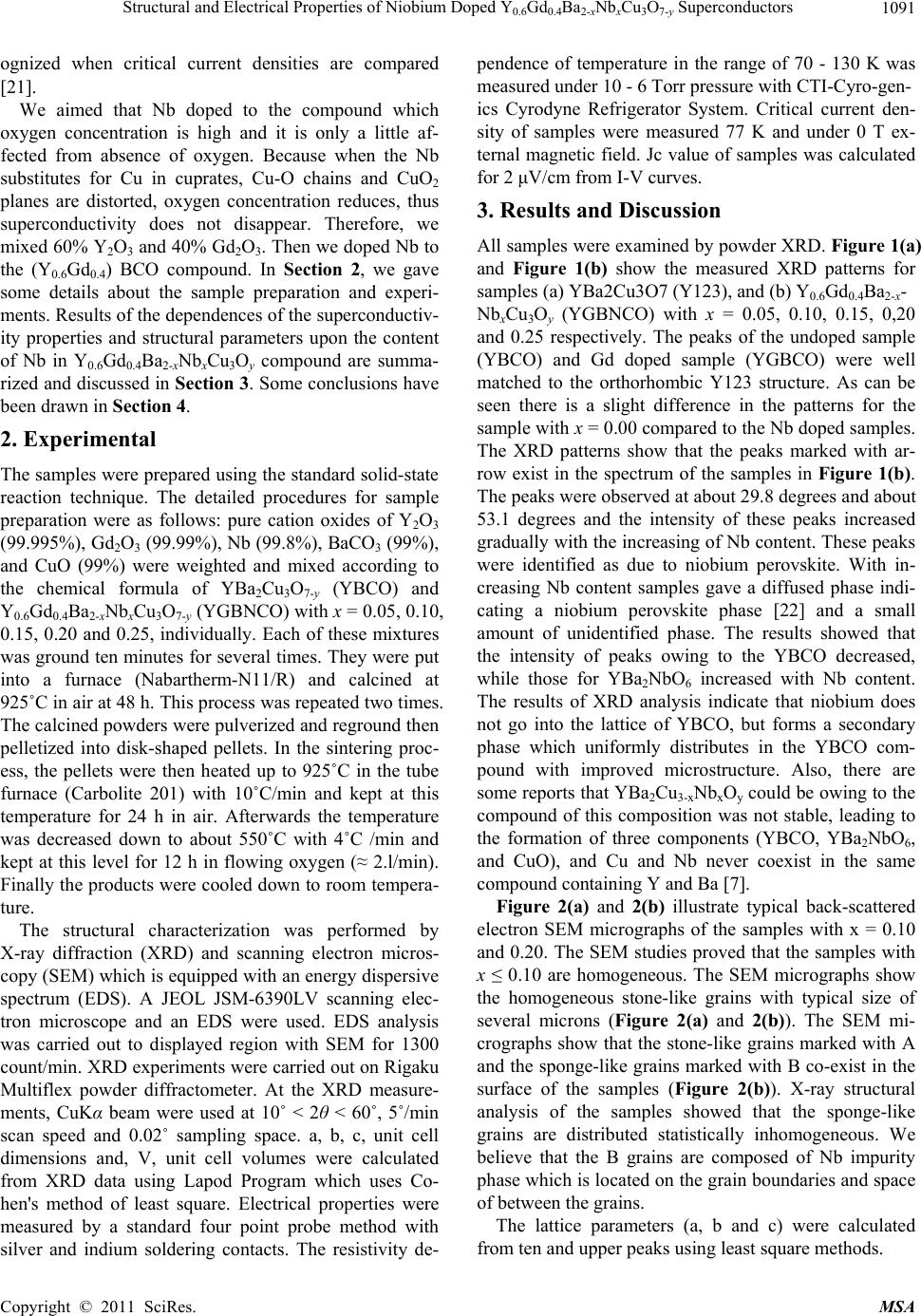 Structural and Electrical Properties of Niobium Doped YGd Ba Nb Cu O Superconductors1091 0.60.4 2-xx 37-y ognized when critical current densities are compared [21]. We aimed that Nb doped to the compound which oxygen concentration is high and it is only a little af- fected from absence of oxygen. Because when the Nb substitutes for Cu in cuprates, Cu-O chains and CuO2 planes are distorted, oxygen concentration reduces, thus superconductivity does not disappear. Therefore, we mixed 60% Y2O3 and 40% Gd2O3. Then we doped Nb to the (Y0.6Gd0.4) BCO compound. In Section 2, we gave some details about the sample preparation and experi- ments. Results of the dependences of the superconductiv- ity properties and structural parameters upon the content of Nb in Y0.6Gd0.4Ba2-xNbxCu3Oy compound are summa- rized and discussed in Section 3. Some conclusions have been drawn in Section 4. 2. Experimental The samples were prepared using the standard solid-state reaction technique. The detailed procedures for sample preparation were as follows: pure cation oxides of Y2O3 (99.995%), Gd2O3 (99.99%), Nb (99.8%), BaCO3 (99%), and CuO (99%) were weighted and mixed according to the chemical formula of YBa2Cu3O7-y (YBCO) and Y0.6Gd0.4Ba2-xNbxCu3O7-y (YGBNCO) with x = 0.05, 0.10, 0.15, 0.20 and 0.25, individually. Each of these mixtures was ground ten minutes for several times. They were put into a furnace (Nabartherm-N11/R) and calcined at 925˚C in air at 48 h. This process was repeated two times. The calcined powders were pulverized and reground then pelletized into disk-shaped pellets. In the sintering proc- ess, the pellets were then heated up to 925˚C in the tube furnace (Carbolite 201) with 10˚C/min and kept at this temperature for 24 h in air. Afterwards the temperature was decreased down to about 550˚C with 4˚C /min and kept at this level for 12 h in flowing oxygen (≈ 2.l/min). Finally the products were cooled down to room tempera- ture. The structural characterization was performed by X-ray diffraction (XRD) and scanning electron micros- copy (SEM) which is equipped with an energy dispersive spectrum (EDS). A JEOL JSM-6390LV scanning elec- tron microscope and an EDS were used. EDS analysis was carried out to displayed region with SEM for 1300 count/min. XRD experiments were carried out on Rigaku Multiflex powder diffractometer. At the XRD measure- ments, CuKα beam were used at 10˚ < 2θ < 60˚, 5˚/min scan speed and 0.02˚ sampling space. a, b, c, unit cell dimensions and, V, unit cell volumes were calculated from XRD data using Lapod Program which uses Co- hen's method of least square. Electrical properties were measured by a standard four point probe method with silver and indium soldering contacts. The resistivity de- pendence of temperature in the range of 70 - 130 K was measured under 10 - 6 Torr pressure with CTI-Cyro-gen- ics Cyrodyne Refrigerator System. Critical current den- sity of samples were measured 77 K and under 0 T ex- ternal magnetic field. Jc value of samples was calculated for 2 μV/cm from I-V curves. 3. Results and Discussion All samples were examined by powder XRD. Figure 1(a) and Figure 1(b) show the measured XRD patterns for samples (a) YBa2Cu3O7 (Y123), and (b) Y0.6Gd0.4Ba2-x- NbxCu3Oy (YGBNCO) with x = 0.05, 0.10, 0.15, 0,20 and 0.25 respectively. The peaks of the undoped sample (YBCO) and Gd doped sample (YGBCO) were well matched to the orthorhombic Y123 structure. As can be seen there is a slight difference in the patterns for the sample with x = 0.00 compared to the Nb doped samples. The XRD patterns show that the peaks marked with ar- row exist in the spectrum of the samples in Figure 1(b). The peaks were observed at about 29.8 degrees and about 53.1 degrees and the intensity of these peaks increased gradually with the increasing of Nb content. These peaks were identified as due to niobium perovskite. With in- creasing Nb content samples gave a diffused phase indi- cating a niobium perovskite phase [22] and a small amount of unidentified phase. The results showed that the intensity of peaks owing to the YBCO decreased, while those for YBa2NbO6 increased with Nb content. The results of XRD analysis indicate that niobium does not go into the lattice of YBCO, but forms a secondary phase which uniformly distributes in the YBCO com- pound with improved microstructure. Also, there are some reports that YBa2Cu3-xNbxOy could be owing to the compound of this composition was not stable, leading to the formation of three components (YBCO, YBa2NbO6, and CuO), and Cu and Nb never coexist in the same compound containing Y and Ba [7]. Figure 2(a) and 2(b) illustrate typical back-scattered electron SEM micrographs of the samples with x = 0.10 and 0.20. The SEM studies proved that the samples with x ≤ 0.10 are homogeneous. The SEM micrographs show the homogeneous stone-like grains with typical size of several microns (Figure 2(a) and 2(b)). The SEM mi- crographs show that the stone-like grains marked with A and the sponge-like grains marked with B co-exist in the surface of the samples (Figure 2(b)). X-ray structural analysis of the samples showed that the sponge-like grains are distributed statistically inhomogeneous. We believe that the B grains are composed of Nb impurity phase which is located on the grain boundaries and space of between the grains. The lattice parameters (a, b and c) were calculated from ten and upper peaks using least square methods. Copyright © 2011 SciRes. MSA 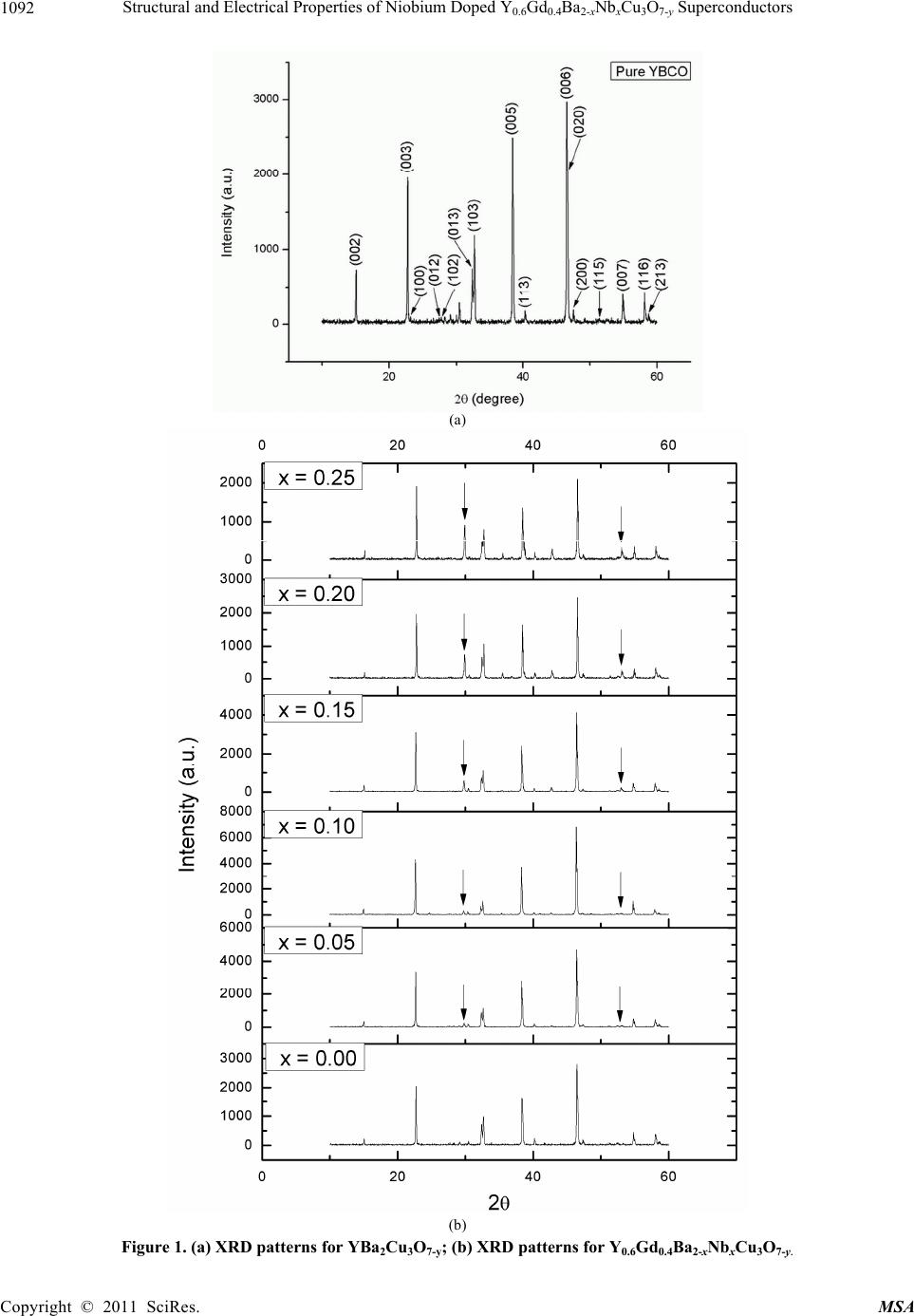 Structural and Electrical Properties of Niobium Doped YGd Ba Nb Cu O Superconductors 1092 0.60.4 2-xx 37-y (a) (b) Figure 1. (a) XRD patterns for YBa2Cu3O7-y; (b) XRD patterns for Y0.6Gd0.4Ba2-xNbxCu3O7-y. Copyright © 2011 SciRes. MSA 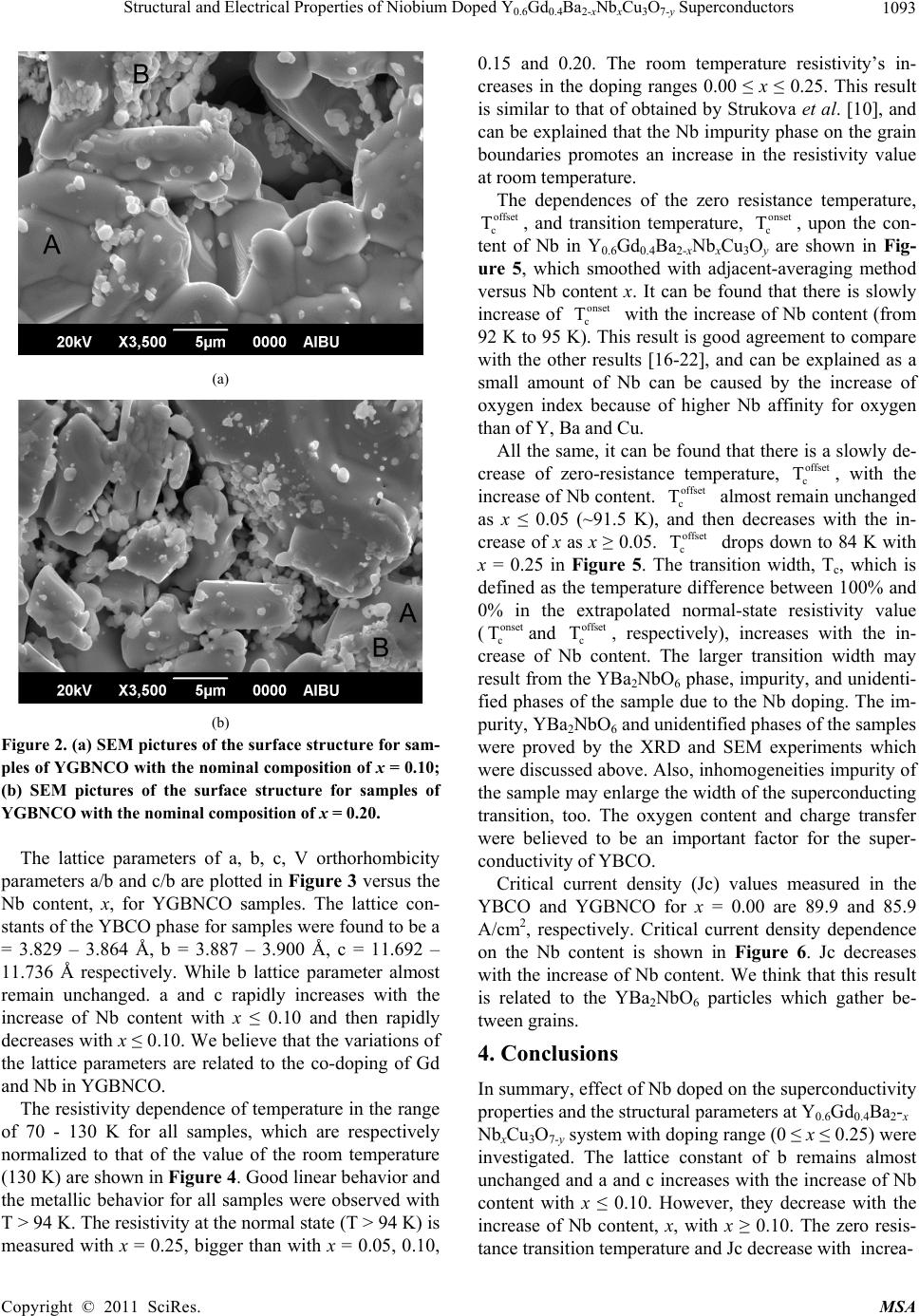 Structural and Electrical Properties of Niobium Doped YGd Ba Nb Cu O Superconductors 1093 0.60.4 2-xx 37-y (a) (b) Figure 2. (a) SEM pictures of the surface structure for sam- ples of YGBNCO with the nominal composition of x = 0.10; (b) SEM pictures of the surface structure for samples of YGBNCO with the nominal composition of x = 0.20. The lattice parameters of a, b, c, V orthorhombicity parameters a/b and c/b are plotted in Figure 3 versus the Nb content, x, for YGBNCO samples. The lattice con- stants of the YBCO phase for samples were found to be a = 3.829 – 3.864 Å, b = 3.887 – 3.900 Å, c = 11.692 – 11.736 Å respectively. While b lattice parameter almost remain unchanged. a and c rapidly increases with the increase of Nb content with x ≤ 0.10 and then rapidly decreases with x ≤ 0.10. We believe that the variations of the lattice parameters are related to the co-doping of Gd and Nb in YGBNCO. The resistivity dependence of temperature in the range of 70 - 130 K for all samples, which are respectively normalized to that of the value of the room temperature (130 K) are shown in Figure 4. Good linear behavior and the metallic behavior for all samples were observed with T > 94 K. The resistivity at the normal state (T > 94 K) is measured with x = 0.25, bigger than with x = 0.05, 0.10, 0.15 and 0.20. The room temperature resistivity’s in- creases in the doping ranges 0.00 ≤ x ≤ 0.25. This result is similar to that of obtained by Strukova et al. [10], and can be explained that the Nb impurity phase on the grain boundaries promotes an increase in the resistivity value at room temperature. The dependences of the zero resistance temperature, , and transition temperature, , upon the con- tent of Nb in Y0.6Gd0.4Ba2-xNbxCu3Oy are shown in Fig- ure 5, which smoothed with adjacent-averaging method versus Nb content x. It can be found that there is slowly increase of with the increase of Nb content (from 92 K to 95 K). This result is good agreement to compare with the other results [16-22], and can be explained as a small amount of Nb can be caused by the increase of oxygen index because of higher Nb affinity for oxygen than of Y, Ba and Cu. offset c Tonset c T onset c T All the same, it can be found that there is a slowly de- crease of zero-resistance temperature, , with the increase of Nb content. almost remain unchanged as x ≤ 0.05 (~91.5 K), and then decreases with the in- crease of x as x ≥ 0.05. drops down to 84 K with x = 0.25 in Figure 5. The transition width, Tc, which is defined as the temperature difference between 100% and 0% in the extrapolated normal-state resistivity value (and , respectively), increases with the in- crease of Nb content. The larger transition width may result from the YBa2NbO6 phase, impurity, and unidenti- fied phases of the sample due to the Nb doping. The im- purity, YBa2NbO6 and unidentified phases of the samples were proved by the XRD and SEM experiments which were discussed above. Also, inhomogeneities impurity of the sample may enlarge the width of the superconducting transition, too. The oxygen content and charge transfer were believed to be an important factor for the super- conductivity of YBCO. offset c T offset c T offset c T onset c Toffset c T Critical current density (Jc) values measured in the YBCO and YGBNCO for x = 0.00 are 89.9 and 85.9 A/cm2, respectively. Critical current density dependence on the Nb content is shown in Figure 6. Jc decreases with the increase of Nb content. We think that this result is related to the YBa2NbO6 particles which gather be- tween grains. 4. Conclusions In summary, effect of Nb doped on the superconductivity properties and the structural parameters at Y0.6Gd0.4Ba2-x NbxCu3O7-y system with doping range (0 ≤ x ≤ 0.25) were investigated. The lattice constant of b remains almost unchanged and a and c increases with the increase of Nb content with x ≤ 0.10. However, they decrease with the increase of Nb content, x, with x ≥ 0.10. The zero resis- tance transition temperature and Jc decrease with increa- Copyright © 2011 SciRes. MSA 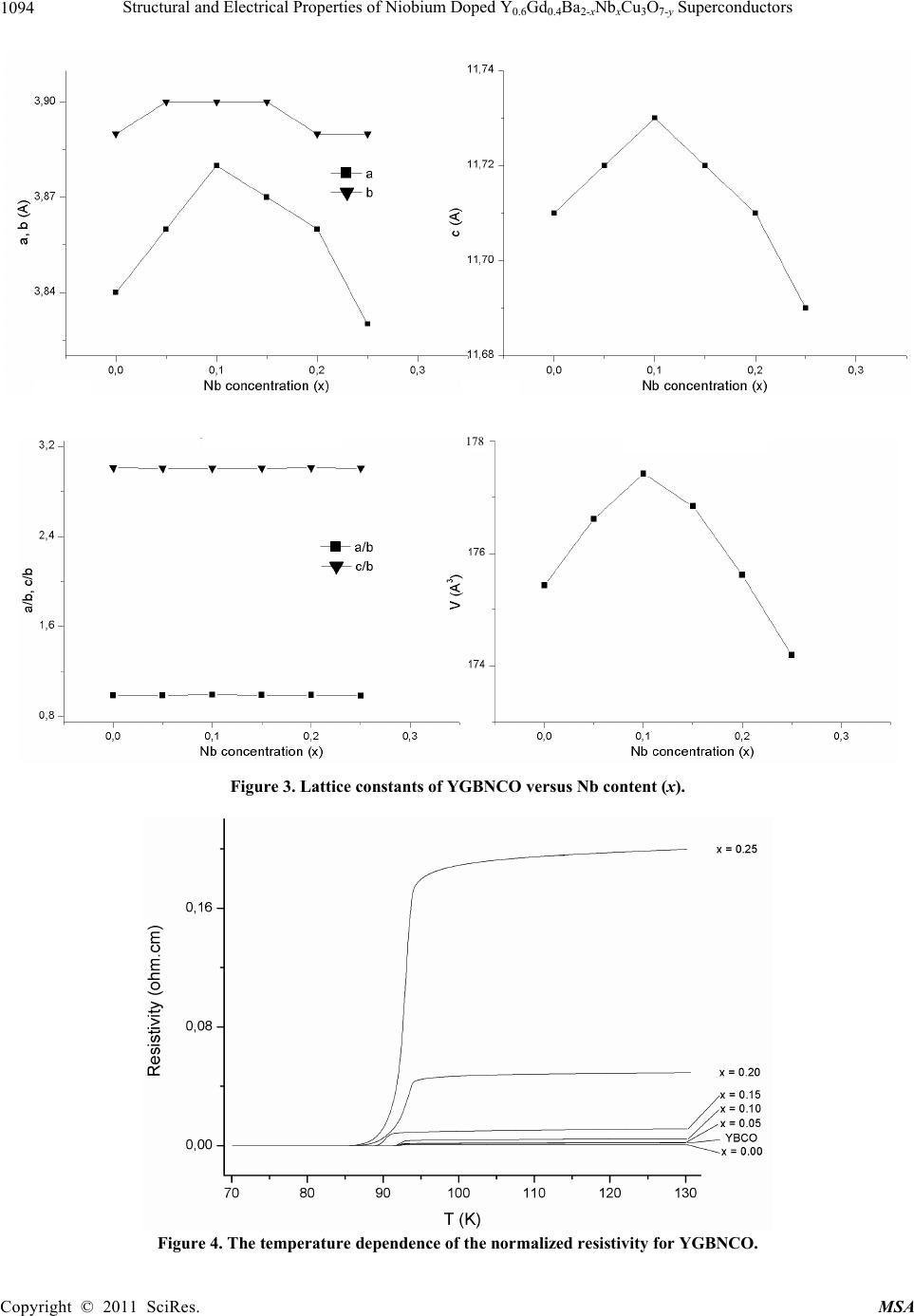 Structural and Electrical Properties of Niobium Doped YGd Ba Nb Cu O Superconductors 1094 0.60.4 2-xx 37-y Figure 3. Lattice constants of YGBNCO versus Nb content (x). Figure 4. The temperature dependence of the normalized resistivity for YGBNCO. 178 Copyright © 2011 SciRes. MSA 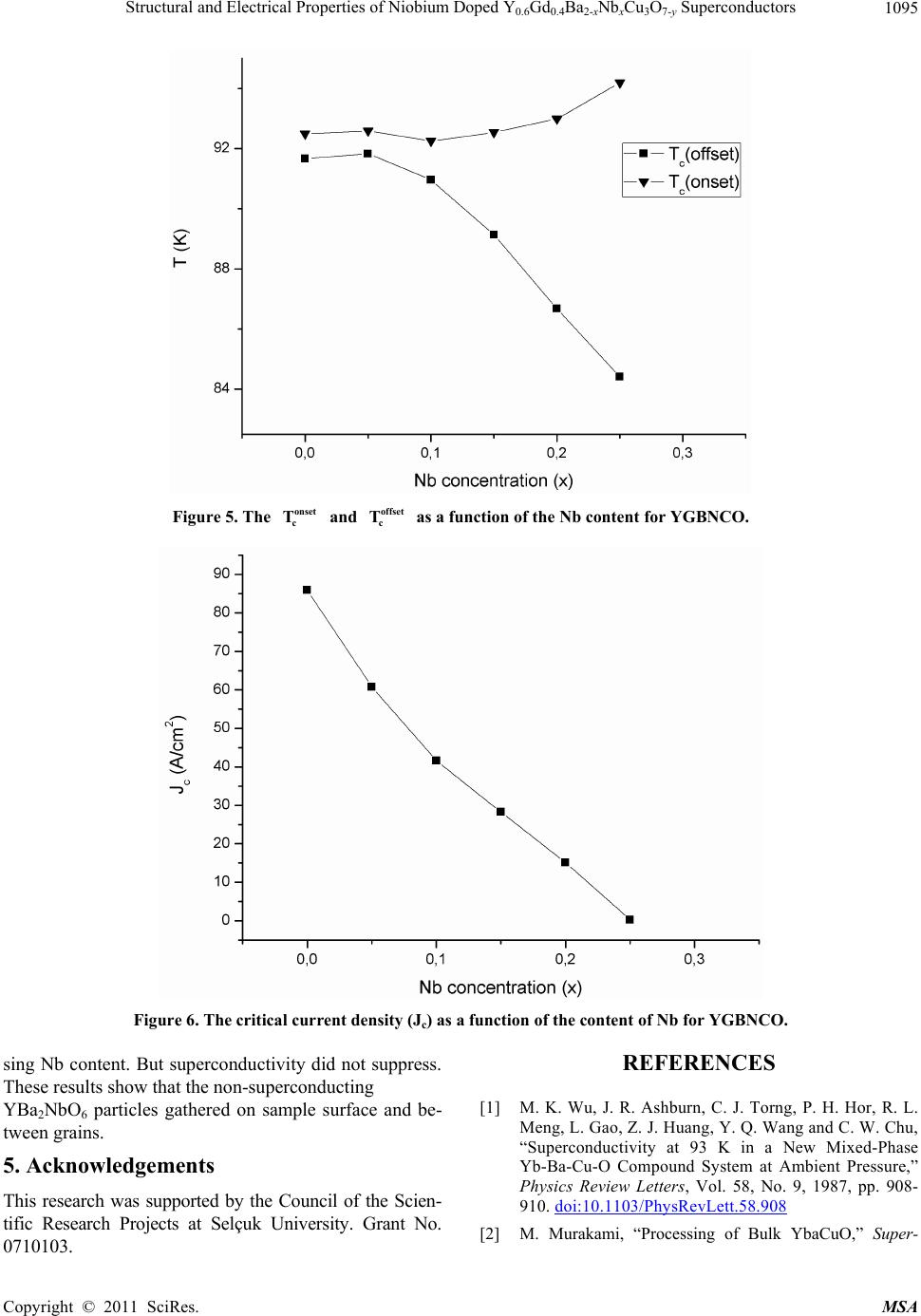 Structural and Electrical Properties of Niobium Doped Y0.6Gd0.4Ba2-xNbxCu3O7-y Superconductors Copyright © 2011 SciRes. MSA 1095 Figure 5. The and as a function of the Nb content for YGBNCO. onset c Toffset c T Figure 6. The critical current density (Jc) as a function of the content of Nb for YGBNCO. REFERENCES sing Nb content. But superconductivity did not suppress. These results show that the non-superconducting YBa2NbO6 particles gathered on sample surface and be- tween grains. [1] M. K. Wu, J. R. Ashburn, C. J. Torng, P. H. Hor, R. L. Meng, L. Gao, Z. J. Huang, Y. Q. Wang and C. W. Chu, “Superconductivity at 93 K in a New Mixed-Phase Yb-Ba-Cu-O Compound System at Ambient Pressure,” Physics Review Letters, Vol. 58, No. 9, 1987, pp. 908- 910. doi:10.1103 / Phy sRevL ett.5 8. 908 5. Acknowledgements This research was supported by the Council of the Scien- tific Research Projects at Selçuk University. Grant No. 0710103. [2] M. Murakami, “Processing of Bulk YbaCuO,” Super- 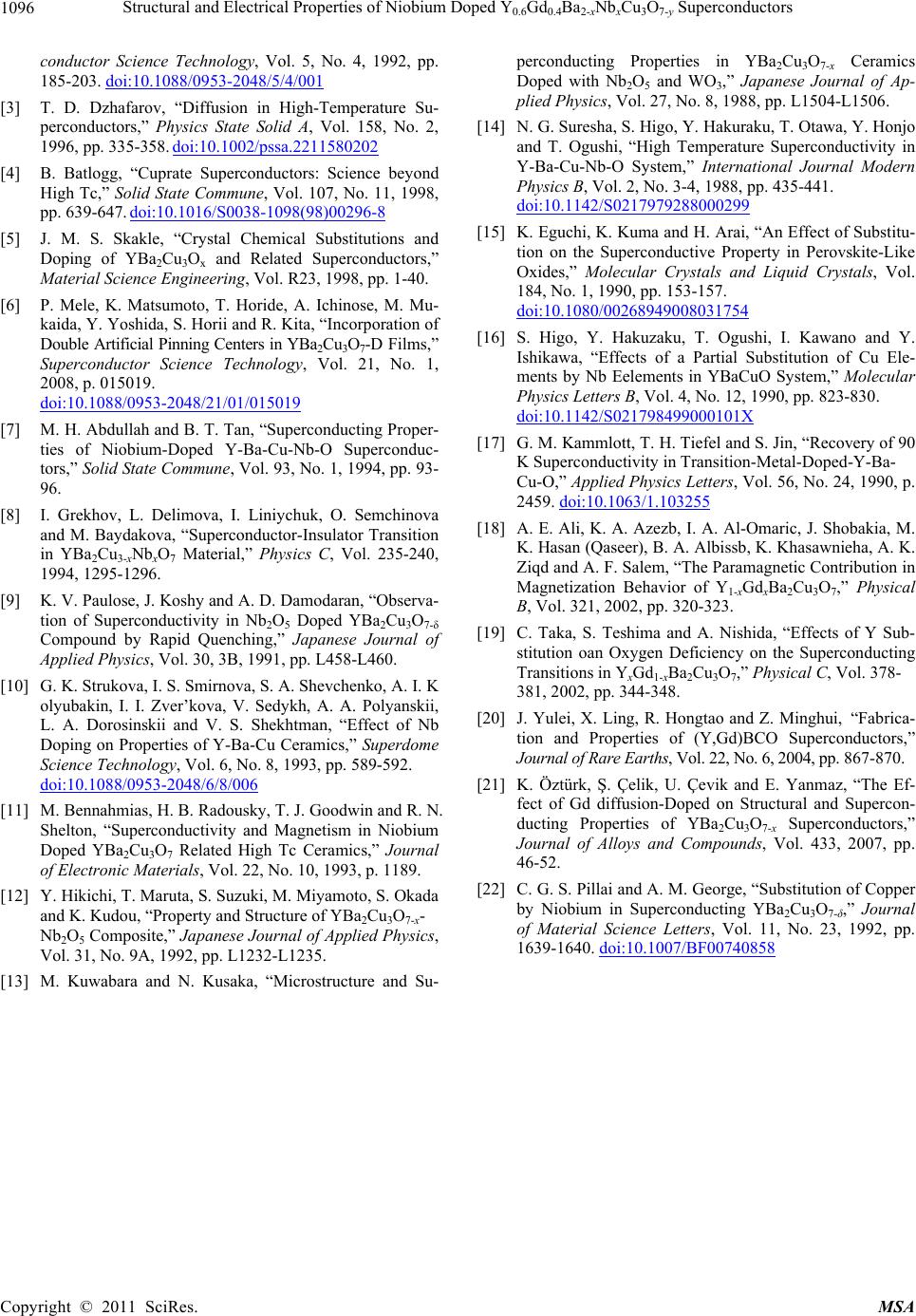 Structural and Electrical Properties of Niobium Doped YGd Ba Nb Cu O Superconductors 1096 0.60.4 2-xx 37-y conductor Science Technology, Vol. 5, No. 4, 1992, pp. 185-203. doi:10.1088/0953-2048/5/4/001 [3] T. D. Dzhafarov, “Diffusion in High-Temperature Su- perconductors,” Physics State Solid A, Vol. 158, No. 2, 1996, pp. 335-358. doi:10.1002/pssa.2211580202 [4] B. Batlogg, “Cuprate Superconductors: Science beyond High Tc,” Solid State Commune, Vol. 107, No. 11, 1998, pp. 639-647. doi:10.1016/S0038-1098(98)00296-8 [5] J. M. S. Skakle, “Crystal Chemical Substitutions and Doping of YBa2Cu3Ox and Related Superconductors,” Material Science Engineering, Vol. R23, 1998, pp. 1-40. [6] P. Mele, K. Matsumoto, T. Horide, A. Ichinose, M. Mu- kaida, Y. Yoshida, S. Horii and R. Kita, “Incorporation of Double Artificial Pinning Centers in YBa2Cu3O7-D Films,” Superconductor Science Technology, Vol. 21, No. 1, 2008, p. 015019. doi:10.1088/0953-2048/21/01/015019 [7] M. H. Abdullah and B. T. Tan, “Superconducting Proper- ties of Niobium-Doped Y-Ba-Cu-Nb-O Superconduc- tors,” Solid State Commune, Vol. 93, No. 1, 1994, pp. 93- 96. [8] I. Grekhov, L. Delimova, I. Liniychuk, O. Semchinova and M. Baydakova, “Superconductor-Insulator Transition in YBa2Cu3-xNbxO7 Material,” Physics C, Vol. 235-240, 1994, 1295-1296. [9] K. V. Paulose, J. Koshy and A. D. Damodaran, “Observa- tion of Superconductivity in Nb2O5 Doped YBa2Cu3O7-δ Compound by Rapid Quenching,” Japanese Journal of Applied Physics, Vol. 30, 3B, 1991, pp. L458-L460. [10] G. K. Strukova, I. S. Smirnova, S. A. Shevchenko, A. I. K olyubakin, I. I. Zver’kova, V. Sedykh, A. A. Polyanskii, L. A. Dorosinskii and V. S. Shekhtman, “Effect of Nb Doping on Properties of Y-Ba-Cu Ceramics,” Superdome Science Technology, Vol. 6, No. 8, 1993, pp. 589-592. doi:10.1088/0953-2048/6/8/006 [11] M. Bennahmias, H. B. Radousky, T. J. Goodwin and R. N. Shelton, “Superconductivity and Magnetism in Niobium Doped YBa2Cu3O7 Related High Tc Ceramics,” Journal of Electronic Materials, Vol. 22, No. 10, 1993, p. 1189. [12] Y. Hikichi, T. Maruta, S. Suzuki, M. Miyamoto, S. Okada and K. Kudou, “Property and Structure of YBa2Cu3O7-x- Nb2O5 Composite,” Japanese Journal of Applied Physics, Vol. 31, No. 9A, 1992, pp. L1232-L1235. [13] M. Kuwabara and N. Kusaka, “Microstructure and Su- perconducting Properties in YBa2Cu3O7-x Ceramics Doped with Nb2O5 and WO3,” Japanese Journal of Ap- plied Physics, Vol. 27, No. 8, 1988, pp. L1504-L1506. [14] N. G. Suresha, S. Higo, Y. Hakuraku, T. Otawa, Y. Honjo and T. Ogushi, “High Temperature Superconductivity in Y-Ba-Cu-Nb-O System,” International Journal Modern Physics B, Vol. 2, No. 3-4, 1988, pp. 435-441. doi:10.1142/S0217979288000299 [15] K. Eguchi, K. Kuma and H. Arai, “An Effect of Substitu- tion on the Superconductive Property in Perovskite-Like Oxides,” Molecular Crystals and Liquid Crystals, Vol. 184, No. 1, 1990, pp. 153-157. doi:10.1080/00268949008031754 [16] S. Higo, Y. Hakuzaku, T. Ogushi, I. Kawano and Y. Ishikawa, “Effects of a Partial Substitution of Cu Ele- ments by Nb Eelements in YBaCuO System,” Molecular Physics Letters B, Vol. 4, No. 12, 1990, pp. 823-830. doi:10.1142/S021798499000101X [17] G. M. Kammlott, T. H. Tiefel and S. Jin, “Recovery of 90 K Superconductivity in Transition-Metal-Doped-Y-Ba- Cu-O,” Applied Physics Letters, Vol. 56, No. 24, 1990, p. 2459. doi:10.1063/1.103255 [18] A. E. Ali, K. A. Azezb, I. A. Al-Omaric, J. Shobakia, M. K. Hasan (Qaseer), B. A. Albissb, K. Khasawnieha, A. K. Ziqd and A. F. Salem, “The Paramagnetic Contribution in Magnetization Behavior of Y1-xGdxBa2Cu3O7,” Physical B, Vol. 321, 2002, pp. 320-323. [19] C. Taka, S. Teshima and A. Nishida, “Effects of Y Sub- stitution oan Oxygen Deficiency on the Superconducting Transitions in YxGd1-xBa2Cu3O7,” Physical C, Vol. 378- 381, 2002, pp. 344-348. [20] J. Yulei, X. Ling, R. Hongtao and Z. Minghui, “Fabrica- tion and Properties of (Y,Gd)BCO Superconductors,” Journal of Rare Earths, Vol. 22, No. 6, 2004, pp. 867-870. [21] K. Öztürk, Ş. Çelik, U. Çevik and E. Yanmaz, “The Ef- fect of Gd diffusion-Doped on Structural and Supercon- ducting Properties of YBa2Cu3O7-x Superconductors,” Journal of Alloys and Compounds, Vol. 433, 2007, pp. 46-52. [22] C. G. S. Pillai and A. M. George, “Substitution of Copper by Niobium in Superconducting YBa2Cu3O7-δ,” Journal of Material Science Letters, Vol. 11, No. 23, 1992, pp. 1639-1640. doi:10.1007/BF00740858 Copyright © 2011 SciRes. MSA |