

Paper Menu >>
Journal Menu >>
 Vol.2, No.3, 198-200 (2011) Agricultural Sciences doi:10.4236/as.2011.23027 Copyright © 2011 SciRes. Openly accessible at http://www.scirp.org/journal/AS/ The effect of nitrification inhibitor 3,4-dimethylpyrazole phosphate (DMPP) on nitrifying organism populations under in vitro conditions David Beltran-Rendon1, Kenne Rico-Fragozo1, Lina Farfan-Caceres2, Hermann Restrepo-Diaz2*, Lilliana Hoyos-Carvajal2 1Faculty of Science, Pontificia Universidad Javeriana, Bogotá, Colombia; 2Faculty of Agronomy, National University of Colombia, Bogotá, Colombia; *Corresponding Autor: [email protected] Received 6 April 2011; revised 23 May 2011; accepted 1 June 2011. ABSTRACT The application of nitrification inhibitors is a technique to reduce the ni trate conc entration on leachates that delay ammonium oxidation by reducing the activity of ammonium oxidizing bacteria in soils. Two experiments were carried out in order to estimate the influence of DMPP on the population of ammonium oxidization bacteria under in vitro conditions. In both ex- periments, three treatments were established. The treatments were the following: a) ammo- nium oxidization bacteria established in a grow- ing media without fertilizers, b) ammonium oxi- dization bacteria established in a g rowing media with Urea, and c) ammonium oxidization bacte- ria established in a growing media with DMPP. Results obtained showed that the population of the ammonia oxidizing bacteria diminished in the DMPP treatment as compared with the urea and control treatments. In conclusion, DMMP influences on ammonium oxidization bacteria activity being a useful tool in fertilizers strate- gies to reduce the contamination by nitrates in groundwater. Keywords: Ammonium Oxidizing Bacteria; Fertilizers; Nitrogen; Nitrification Inhibitors; Winogradsky 1. INTRODUCTION Nitrogen (N) plays an important role on the growth and yield, since it is required in highest amounts by plants and, hence; constitutes the basis of fertilization strategies for agronomic and horticultural crops [1]. In actual agricultural practices, nitrogen is usually used in greater quantities than those needed in order to guarantee a high yield [2]. As a consequence, nitrogen over fertili- zation may cause environmental degradation due to ni- trogen losses [3]. Nitrogen losses are caused by Nitrate (3 N O ) and amonnium (4 N H) leaching, erosion, vola- tilization, denitrification and fixation in soil organic matter [4]. 3 NO leaching from agricultural soils is one of the important global environmental concerns [5]. These losses contribute to 3 N O-N contamination of groundwater [6]. A high 3 NO -N content in groundwater and drinking water does harm people and livestock [5]. A technique to– diminish NO3-N leaching into ground- water and to conserve 4 N H fertilizers applied to soils is the retardation of biological oxidation of 4 N H -N to 3 NO -N [5,6]. Actually, there are compoundseffec- inhibit nitrification when applied to soils in con- junction with NH4 + fertilizers or 4 that tively N H-producing com- pounds, such as urea or ammoniumhate [6,7]. These compounds are called nitrification inhibitors (NIs). NIS delay ammonium oxidation by reducing the activity of Nitrosomonas bacteria (ammonium oxidizing bacteria) in the soil. Ammonium oxidization bacteria transform NH4 + into 2 sulp N O , which in turn is oxidized to 3 N O by Nitrobacter teria [8]. Recently, DMPP haeen introduced in Colombia to be used in nitrogen nutrition of different crops [9]. Likewise, contamination of sur- face water and/or groundwater by nitrates leaching has obtained importance in managing of crops, mainly; in rose crops in Colombia [10]. In particular, little is known about the effect of fertilizers, especially, NIs on micro- organisms present in tropical soils. For that reason, the aim of this study was to estimate the influence of DMPP on the population of ammonium oxidization bacteria collected from tropical soil under in vitro conditions. bacve b 2. MATERIAL AND METHODS  D. Beltran-Rendon et al. / Agricultural Science 2 (2011) 198-200 Copyright © 2011 SciRes. Openly accessible at http://www.scirp.org/journal/AS/ 199199 ts were carried out in May acteria were obtained by th 2.1. Isolation Bacteria In our study, two experimen 2010. Ammonium oxidization b e preparation of Winogradsky’s columns [11]. Soil for columns was collected on 10 December 2009 from upper 10 cm of a rose crop established in Mosquera, Colombia (4˚42′28″ N and 74˚13′58″ W). For bacteria extraction, 10 ml from middle of Winogradsky’s column was di- luted in 250-ml Erlenmeyer flask containing 90 ml of a NH4 + salt solution for ammonium oxidization bacteria which had the following composition: NaHPO4 (13.5 g), KH2PO4 (0.7 g), MgSO4·7H2O (0.1 g), NaHCO3 (0.5 g), FeCl3·6H2O (0.014 g), CaCl2·H2O (0.18 g) and (NH4)2SO4 (0.5 g) per liter of water [12]. Three growing media were established in a shaker incubator (Labline 3527, Lab- Line instrument, Inc. USA) during 15 days at 28˚C and 150 rpm, to achieve fully aerobic conditions. After the period of incubation, 10 ml of solution were taken from the growth media to determine the existence of ammo- nium oxidization bacteria by the presence of 2 N O -N and 3 N O-N using the Griess’s reagent, respectively [5]. Then, NH3 oxidizers were obtained by the teue descr by Skinner and Walker [13]. Consequently, isolated colonies of ammonium oxidization bacteria from agar were taken by a handle. Next, those colonies were diluted in a salt solution of NaCl at 20% w/v. To estimate the initial concentration of inoculum, twofold dilutions series from 102 to 106 were done realized, and after that, inoculum was set in agar during 48 h. Subse- quently, inoculum concentration was calculated by counting colonies as described by Madigan et al. [14]. The initial concentrations were 6.2 × 10 5 cfu/ml and 3.7 × 10⁴ cfu/ml for each experiment, respectively. 2.2. Treatments chniq ibed f inoculum solution at 20% of NaCl ml Erlenmeyer flask containing 90 m cal Analysis arried out on the data to treatments. Both experi- m teria popu- r the begin- ni n the double interaction fertilizer tr After that, 10 ml o were diluted in 250- l of a salt solution for ammonium oxidization bacteria (concentration is mentioned above) for each experiment, respectively. In both experiments, three treatments were established. The treatments were the following: i) a 250- ml Erlenmeyer flask containing 90 ml of an ammonium salt solution and 10 ml of NaCl at 20% with Urea plus DMMP at 1%. 37 mg of fertilizer were added by grow- ing media. This amount is equivalent to 170 ppm that it is the commercial dose used at fertirrigation programs in rose crops. ii) a 250-ml Erlenmeyer flask containing 90 ml of a salt solution and 10 ml of NaCl at 20% with Urea (37 mg of fertilizer), and iii) a 250-ml Erlenmeyer flask containing 90 ml of a salt solution and 10 ml of NaCl at 20% without fertilizer (control). Each treatment was placed in a shaker incubator (Labline 3527, Lab- Line instrument, Inc, USA) during 14 days at 28˚C and 150 rpm. Additionally, fertilizer was added to treatments with urea or Urea + DMPP at a dose mentioned above every 2 days during the incubation. To determine the concentration of inoculum at each sample point, 2 ml of each Erlenmeyer were taken to perform twofold dilution series up to 107. Afterwards, inoculum was placed in plates with agar. Consequently, inoculum concentration was estimated by counting the colonies as described by Madigan et al. [14]. Samples were done every 2 days during 14 days. The same methodology was used in both experiments. 2.3. Statisti Analyses of variance were c evaluate the effect of different ents were analyzed together as a series of experiments. Values were transformed using the Log10 transformation before analysis. Data were evaluated using Statistix Ver- sion 8.0 (Analytical Software, Tallahassee, FL, USA). Four replicates for each treatment were used. 3. RESULTS AND DIS CUSSION An increasing ammonium oxidization bac lation was observed during first 4 days afte ng of treatments. Significant differences were found on ammonium oxidization bacteria population in both ex- periments at 6 days after the treatments started. Ammo- nium oxidization bacteria cultivated in a growing media with DMPP had a less population than bacteria estab- lished in urea or control treatments. After this period, ammonium oxidization bacteria population started di- minishing in all treatments. At 14 days after the begin- ning of experiments, bacteria established in a media with urea had a higher population than DMPP and control treatments in both experiment 1and experiment 2 (Fig- ures 1( a) and (b)). Differences were found on ammonium oxidization bacteria population i eatments and the different experiments (Figure 2). Treatments with DMPP showed a lower amount of am- monium oxidization bacteria population than control and urea treatments at 6 days after beginning both experi- ments. DMPP inhibited the mean ammonium oxidization bacteria population by 5% and 12% compared to urea treatments in experiments 1 and 2, respectively. A simi- lar trend was observed at 14 days after the treatments started, but the DMPP had a greater percentage of inhi- bition than at 6 days after the beginning of treatments. DMPP reduced the mean ammonium oxidization bacte- ria populations by 31% and 33% regarding urea in ex- periments 1 and 2, respectively. Also, DMPP diminished 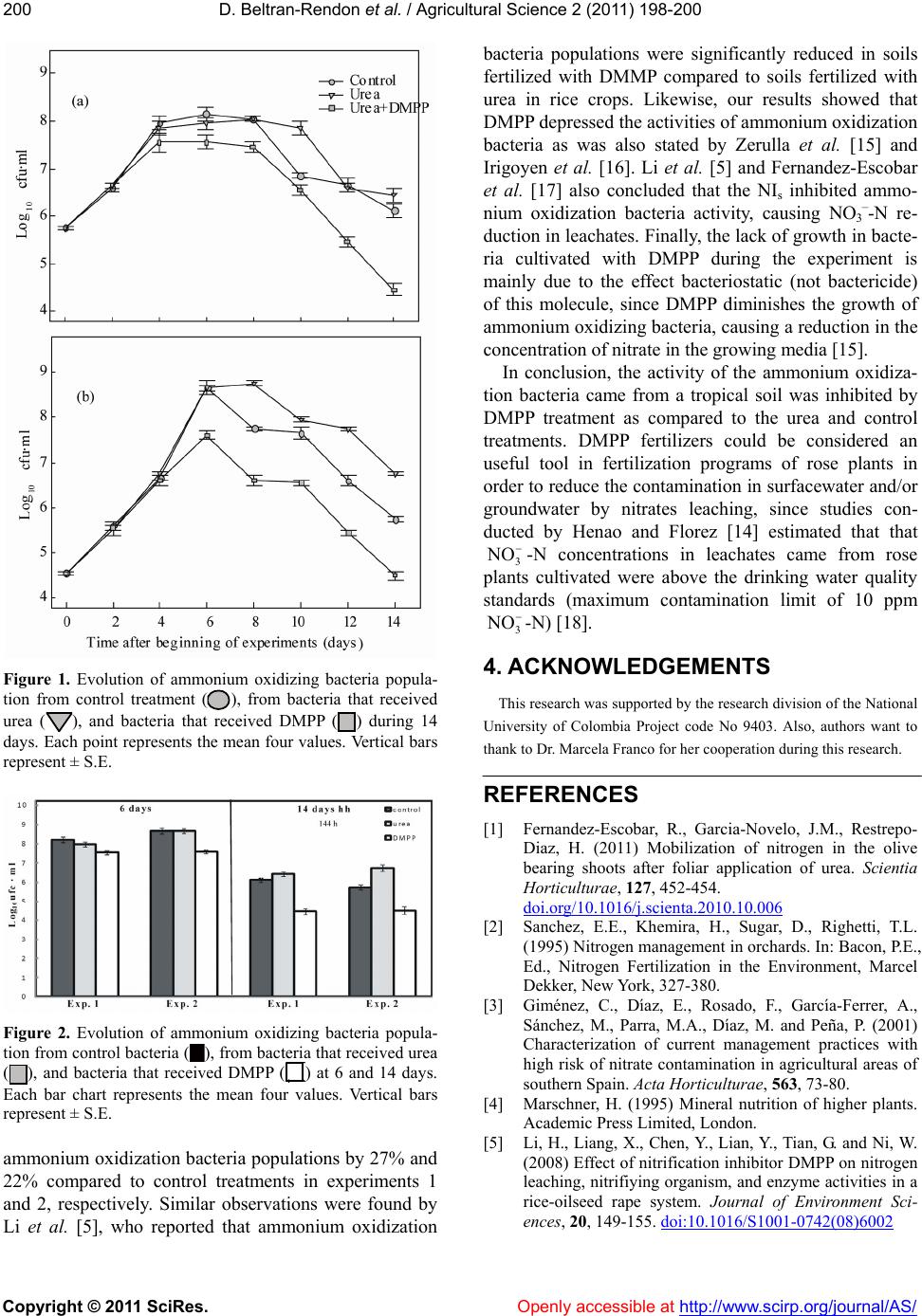 D. Beltran-Rendon et al. / Agricultural Science 2 (2011) 198-200 Copyright © 2011 SciRes. Openly accessible at http://www.scirp.org/journal/AS/ 200 Figure 1. Evolution of ammonium oxidizing bacteria popula- tion from control treatment (), from bacteria that received urea (), and bacteria that received DMPP () during 14 days. Each point represents the ean four values. Vertical bars represent ± S.E. m Figure 2. Evolution of ammonium oxidizing bacteria popula- tion from control bacteria (), from bacteria that received urea (), and bacteria that received DMPP () at 6 and 14 days. Each bar chart represents the mean four values. Vertical bars represent ± S.E. ammonium oxidization bacteria populations by 27% and 22% compared to control treatments in experiments 1 fertilized with DMMP compared to soils fertilized with urea in rice crops. Likewise, our results showed that DMPP depressed the activities of ammonium oxidization bacteria as was also stated by Zerulla et al. [15] and Irigoyen et al. [16]. Li et al. [5] and Fernandez-Escobar et al. [17] also concluded that the NIs inhibited ammo- nium oxidization bacteria activity, causing NO3 –-N re- duction in leachates. Finally, the lack of growth in bacte- ria cultivated with DMPP during the experiment is mainly due to the effect bacteriostatic (not bactericide) of this molecule, since DMPP diminishes the growth of ammonium oxidizing bacteria, causing a reduction in the concentration of nitrate in the growing media [15]. In conclusion, the activity of the ammonium oxidiza- tion bacteria came from a tropical soil was inhibited by DMPP treatment as compared to the urea and control treatments. DMPP fertilizers could be considered an useful tool in fertilization programs of rose plants in order to reduce the contamination in surfacewater and/or groundwater by nitrates leaching, since studies con- ducted by Henao and Florez [14] estimated that that and 2, respectively. Similar observations were found by Li et al. [5], who reported that ammonium oxidization bacteria populations were significantly reduced in soils 3 N O -N concentrations in leachates came from rose plants cultivated were above the drinking water quality rds (maximum contamination limit of 10 ppm standa 3 N O -N) [18]. 4. ACKNOWLEDGEMENTS This research was supported by the research division of the National University of Colombia Project code No 9403. Also, authors want to thank to Dr. Marcela Franco for her cooperation during this research. REFERENCES [1] Fernandez-Escobar, R., Garcia-Novelo, J.M., Restrepo- Diaz, H. (2011) Mobilization of nitrogen in the olive bearing shoots after foliar application of urea. Scientia Horticulturae, 127, 452-454. doi.org/10.1016/j.scienta.2010.10.006 [2] Sanchez, E.E., Khemira, H., Sugar, D., Righetti, T.L. (1995) Nitrogen management in orchards. In: Bacon, P.E., Ed., Nitrogen Fertilization in the Environment, Marcel Dekker, New York, 327-380. [3] Giménez, C., Díaz, E., Rosado, F., García-Ferrer, A., Sánchez, M., Parra, M.A., Díaz, M. and Peña, P. (2001) Characterization of current management practices with high risk of nitrate contamination in agricultural areas of southern Spain. Acta Horticulturae, 563, 73-80. [4] Marschner, H. (1995) Mineral nutrition of higher plants. Academic Press Limited, London. [5] Li, H., Liang, X., Chen, Y., Lian, Y., Tian, G. and Ni, W. (2008) Effect of nitrification inhibitor DMPP on nitrogen leaching, nitrifiying organism, and enzyme activities in a rice-oilseed rape system. Journal of Environment Sci- ences, 20, 149-155. doi:10.1016/S1001-0742(08)6002 |