

Paper Menu >>
Journal Menu >>
 Vol.2, No.3, 313-317 (2011) doi:10.4236/as.2011.23042 Copyright © 2011 SciRes. Openly accessible at http://www.scirp.org/journal/AS/ Agricultural Scienc es Influence of phosphorus on the performance of cowpea (Vigna unguiculata (L) Walp.) varieties in the Sudan savanna of Nigeria A. Singh1*, A. L. Baoule1, H. G. Ahmed1, A. U. Dikko2, U. Aliyu1, M. B. Sokoto1, J. Alhassan1, M. Musa1, B. Haliru1 1Department of Crop Science, Usmanu Danfodiyo University, Sokoto, Nigeria; *Corresponding author: [email protected], 2Department of Soil Science and Agricultural Engineering, Usmanu Danfodiyo University, Sokoto, Nigeria. Received 28 March 2011; revised 24 May 2011; accepted 21 July 2011. ABSTRACT Savanna regions of Nigeria are deficient in ni- trogen and phosphorus, which retard the growth and yield of crops. Therefore, a study was conducted in the wet season of 2006 at the Dry Land Teaching and Research Farm of Us- manu Danfodiyo University, Sokoto to evaluate the effect of phosphorus on the growth and yield of two cowpea varieties sourced from Republic of Niger. Treatment consisted of four (4) rates of phosphorus (0, 20, 40, 60 kg·ha–1) factorialy combined with (2) varieties of cowpea (KVX303096G and TN5-78) and laid out in a randomized complete block design (RCBD) rep- licated three (3) times. Results showed signifi- cant response to applied P on pods per plant, grain and stover yield and 100-seed weight with highest respon se to the application of 60 kg P ha–1. From this study it can be concluded that KVX303096G and TN5-78 could both be sown under Sokoto condition to obtain reasonable yield of about 1 t·ha–1 of grain and 1.6 t·ha–1 of stover. Irrespective of the varieties, application of 60 kg P2O5 ha–1 could be recommended for higher yi eld of co wpea (1.4 t·ha–1) rela tive to 0 kg P/ha that yielded 1.0 t·ha–1. Keywords: Cowpea [Vigna Ung uiculata (L.) Walp.]; Phosphorus; Sudan Savanna; Nigeria 1. INTRODUCTION Cowpea (Vigna unguiculata (L.) Walp.) is an important grain legume in the dry savanna of the tropics covering 12.5 million hectares with annual production of about 3.3 million tones [1]. Nigeria is the world’s largest producer with 2.1 million tones followed by Niger with 650,000 tones and Mali with 110,000 tones [2]. About 64% of the area under cowpea is grown in central and east Africa. Cowpea is mostly cultivated in mixture with others crops such as millet and sorghum mostly in Sahelian and Sudan region. Cowpea is well adapted to poor fertility and low rainfall conditions. Cowpea grows best on fertile, loam soils with rainfall of 760 - 1520 mm during the growing period, and thrives best on dry areas of Northern part of Nigeria and transported to the Southern part of Nigeria [3]. Cowpea is an important crop because of its role in human and livestock nutrition. It reduces the shortage of food by making efficient use of water and nutrient. It is a source of protein and also less expensive than meat. Cowpea is of vital importance to the livelihood of several million of people in east and central Africa [4]. Cowpea is an important legume crop in the dry savannas of Africa, especially West Africa. Out of the 12.5 million hectare cultivated to cowpea worldwide, Singh et al. [5] estimated that eight million hectare are in West and Cen- tral Africa, distributed predominantly between Nigeria and Niger. In spite of the fact that grain yields are low, cowpea has continued to be a popular crop among farmers. This is because cowpea provides high protein food for people, especially children; it improves and sustains soil fertility, and provides high quality fodder for livestock [6,7]. Cowpea contributes to the improve- ment of soil fertility by the fixation of nitrogen (N) in the soil (60 - 70 kg·N·ha–1 to the subsequent crop) [8]. The result obtained from a research work carried by IITA [9] showed that cowpea fixed 240 kg·ha–1 of N. The crop provides a high proportion of its own requirement, besides leaving a fixed N deposit in the soil of up to 60 - 70 kg·ha–1. In addition to its role-played in mixture with cereals, the crop is advantageous in terms of weed  A. Singh et al. / Agricultural Science 2 (2011) 313-317 Copyright © 2011 SciRes. Openly accessible at http://www.scirp.org/journal/AS/ 314 control, soil cover, protection from soil erosion and dispersal of insects [10]. Phosphorus (P) is among the most needed elements for crop production in many tropical soils. However, many tropical soils are P-deficient [11]. Phosphorus, although not required in large quantities, is critical to cowpea yield because of its multiple effects on nutrition [12]. All growing plants require P for growth and development in significantly large quantity. P deficiency is the most limiting soil fertility factor for cowpea production [10]. Phosphorus although not required in large quantities is critical to cowpea yield (particularly for improved photoperiod-insensitive cultivars) because of its multiples effects on nutrition. It not only increases seed yields but also nodulation. Others workers have reported that phosphorus application influences the content of others nutrients in leaves [13] and seed. The deficiency can be so acute in some soils of the savanna zone of western Africa that plant growth ceases as soon as the P stored in the seed is exhausted [14]. Because of its multiple effects on plant nutrition (not only on nodulation), a phosphorus fertilizer is recommended to increase yields (P2O5: 20 - 60 kg·ha–1) [10]. Smyth and Cravo [15] working on Xanthic Hapludox near Manaus, Brazil reported that for cowpea critical levels for soil P was 60 kg·P·ha–1. Despite the importance of cowpea in human diet and feed for animals, the yield obtained by most farmers is very low. In Nigeria the average yield per hectare in the respective years were 0.75 t·ha–1 in 1990, 0.72 t·ha–1 in 1991, 0.51 t·ha–1 in 1992, 1993 and 1994, 0.49 t·ha–1 in 1995, 0.45 t·ha–1 in 1996, 0.48 t·ha–1 in 1997, 0.41 t·ha–1 in 1998, 0.42 t·ha–1 in 1999, 2000, 2001 and 2002; 0.43 t·ha–1 2003 and 2004 [16]. Because of the rapid increase in population, there is a high demand for food and therefore, there is a need to augment the production of cowpea. N is not critical for legumes because legumes fix atmospheric N2 through symbiotic association with strains of Rhizobium sp. Phosphorus is the second most important nutrient after N and could be used to increase production of cowpea as most soils in the tropics are P deficient. Phosphorus is known to increases the yield of cowpea by increased N2 fixation through nodulation and utilization of N fertilizer [10]. Thus, this study was con- ducted to evaluate the effect of phosphorus fertilizer on yield of cowpea and select cowpea variety responsive to phosphorus application. 2. MATERIALS AND METHODS The experiment was conducted in 2006 cropping season at the dry land farm of Usmanu Danfodiyo University, Sokoto. Sokoto is located on latitude 13˚01′ N and at longitude 05˚15′ E and lies at an altitude of 350 m above the sea level. It falls in Sudan Savanna agro- ecological zone. The rainfall starts mostly in June and ends in October with a mean annual rainfall of about 350 - 700 mm. The maximum and minimum temperature of Sokoto ranges from 40 to 15˚C, respectively [17]. The treatments consisted of factorial combinations of four (4) levels of phosphorous (0, 20, 40 and 60) and twovarieties of cowpea (KVX303096G and T5-78) (8 treatment combinations) laid out in a randomized complete block design (RCBD) replicated 3 times. The seeds of cowpea varieties were obtained from the research institute of Niger Republic known as INRAN in Tahoua State and sown on the 18th of June, 2006. Two seeds were sown per hill at a depth of 3 - 4 cm and 75 cm apart at a plant-to-plant spacing of 50 cm within a row. Urea at the rate 15 kg·ha–1 was applied as a starter dose to all the plots while P2O5 was applied as per treatment (0, 20, 40, and 60 kg P2O5 ha–1). Weeding was carried out twice manually at 5 and 8 weeks after sowing. The plots were sprayed with karate (Lambda cyhorlothrim) to take care of Aphis craccivora. Harvesting was done manually at physiological maturity when the pods had turned yellowish brown. Data collected on yield parameters were subjected to analysis of variance (ANOVA) technique using Statisti- cal Analysis System (SAS) [18]. Significant different between treatments were further analyzed using least significant different test (LSD) for mean separation. 3. RESULTS AND DISCUSSION 3.1. Physico-Chemical Prope rties of the So il The general chemical and physical properties of the surface soils (0 - 15 cm) used for the field experiments are presented in Tabl e 1 . Soils at the experimental site were largely Sandy and the soil pH (H2O) was moder- ately acidic (6.5). The organic carbon (OC), total N and available P in the soil was very low while exchangeable K in the soil at the experimental site was low. The total annual rainfall at the experimental site was 604 mm with peak in August. The rain established in June and ceased in October coinciding with sowing and harvesting of cowpea, respectively (Figure 1). Ta bl e 1 . Physico-chemical characteristic of the soil at the ex- periment site. Parameters Value Remarks Texture Sandy pH in water 6.50 Mod. acidic pH in CaCl2 6.19 Total phosphorus (P) (mg·kg–1) 1.80 Very Low Organic carbon (g·kg–1) 1.58 Very Low Total nitrogen (N) (g·kg–1) 0.65 Very low Exchangeable potassium (K) (cmol·kg–-1) 0.65 Low 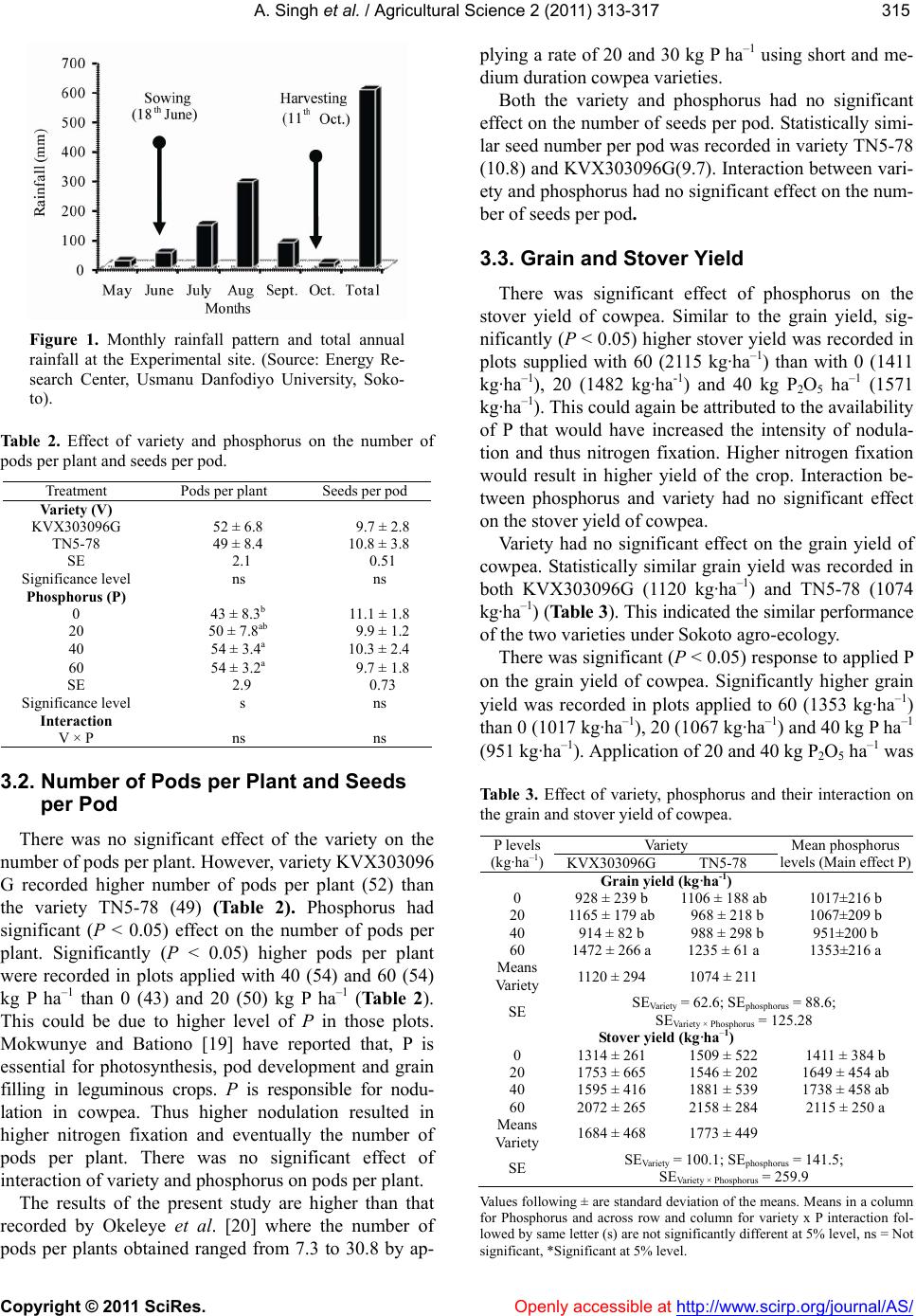 A. Singh et al. / Agricultural Science 2 (2011) 313-317 Copyright © 2011 SciRes. Openly accessible at http://www.scirp.org/journal/AS/ 315315 Figure 1. Monthly rainfall pattern and total annual rainfall at the Experimental site. (Source: Energy Re- search Center, Usmanu Danfodiyo University, Soko- to). Table 2. Effect of variety and phosphorus on the number of pods per plant and seeds per pod. Treatment Pods per plant Seeds per pod Variety (V) KVX303096G 52 ± 6.8 9.7 ± 2.8 TN5-78 49 ± 8.4 10.8 ± 3.8 SE 2.1 0.51 Significance level ns ns Phosphorus (P) 0 43 ± 8.3b 11.1 ± 1.8 20 50 ± 7.8ab 9.9 ± 1.2 40 54 ± 3.4a 10.3 ± 2.4 60 54 ± 3.2a 9.7 ± 1.8 SE 2.9 0.73 Significance level s ns Interaction V × P ns ns 3.2. Number of Pods per Plant and Seeds per Pod There was no significant effect of the variety on the number of pods per plant. However, variety KVX303096 G recorded higher number of pods per plant (52) than the variety TN5-78 (49) (Table 2). Phosphorus had significant (P < 0.05) effect on the number of pods per plant. Significantly (P < 0.05) higher pods per plant were recorded in plots applied with 40 (54) and 60 (54) kg P ha–1 than 0 (43) and 20 (50) kg P ha–1 (Tab le 2). This could be due to higher level of P in those plots. Mokwunye and Bationo [19] have reported that, P is essential for photosynthesis, pod development and grain filling in leguminous crops. P is responsible for nodu- lation in cowpea. Thus higher nodulation resulted in higher nitrogen fixation and eventually the number of pods per plant. There was no significant effect of interaction of variety and phosphorus on pods per plant. The results of the present study are higher than that recorded by Okeleye et al. [20] where the number of pods per plants obtained ranged from 7.3 to 30.8 by ap- plying a rate of 20 and 30 kg P ha–1 using short and me- dium duration cowpea varieties. Both the variety and phosphorus had no significant effect on the number of seeds per pod. Statistically simi- lar seed number per pod was recorded in variety TN5-78 (10.8) and KVX303096G(9.7). Interaction between vari- ety and phosphorus had no significant effect on the num- ber of seeds per pod. 3.3. Grain and Stover Yield There was significant effect of phosphorus on the stover yield of cowpea. Similar to the grain yield, sig- nificantly (P < 0.05) higher stover yield was recorded in plots supplied with 60 (2115 kg·ha–1) than with 0 (1411 kg·ha–1), 20 (1482 kg·ha-1) and 40 kg P2O5 ha–1 (1571 kg·ha–1). This could again be attributed to the availability of P that would have increased the intensity of nodula- tion and thus nitrogen fixation. Higher nitrogen fixation would result in higher yield of the crop. Interaction be- tween phosphorus and variety had no significant effect on the stover yield of cowpea. Variety had no significant effect on the grain yield of cowpea. Statistically similar grain yield was recorded in both KVX303096G (1120 kg·ha–1) and TN5-78 (1074 kg·ha–1) (Table 3). This indicated the similar performance of the two varieties under Sokoto agro-ecology. There was significant (P < 0.05) response to applied P on the grain yield of cowpea. Significantly higher grain yield was recorded in plots applied to 60 (1353 kg·ha–1) than 0 (1017 kg·ha–1), 20 (1067 kg·ha–1) and 40 kg P ha–1 (951 kg·ha–1). Application of 20 and 40 kg P2O5 ha–1 was Ta b le 3 . Effect of variety, phosphorus and their interaction on the grain and stover yield of cowpea. Va ri e ty P levels (kg·ha–1)KVX303096GTN5-78 Mean phosphorus levels (Main effect P) Grain yield (kg·ha-1) 0 928 ± 239 b 1106 ± 188 ab 1017±216 b 20 1165 ± 179 ab968 ± 218 b 1067±209 b 40 914 ± 82 b 988 ± 298 b 951±200 b 60 1472 ± 266 a 1235 ± 61 a 1353±216 a Means Va ri e ty 1120 ± 294 1074 ± 211 SE SEVa ri e ty = 62.6; SEphosphorus = 88.6; SEVariety × Phosphorus = 125.28 Stover yield (kg·ha–1) 0 1314 ± 261 1509 ± 522 1411 ± 384 b 20 1753 ± 665 1546 ± 202 1649 ± 454 ab 40 1595 ± 416 1881 ± 539 1738 ± 458 ab 60 2072 ± 265 2158 ± 284 2115 ± 250 a Means Va ri e ty 1684 ± 468 1773 ± 449 SE SEVa ri e ty = 100.1; SEphosphorus = 141.5; SEVariety × Phosphorus = 259.9 Values following ± are standard deviation of the means. Means in a column for Phosphorus and across row and column for variety x P interaction fol- lowed by same letter (s) are not significantly different at 5% level, ns = Not significant, *Significant at 5% level. 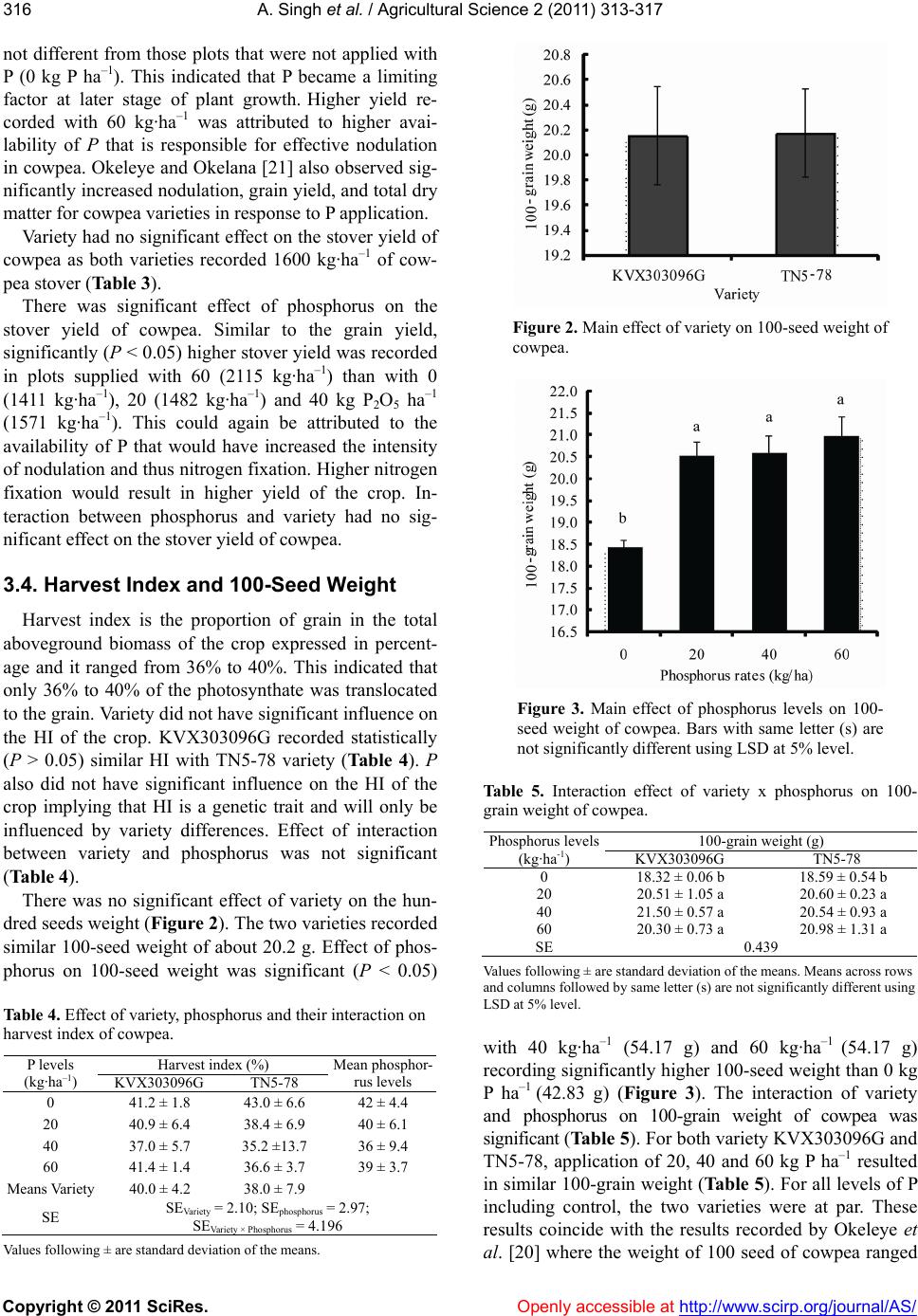 A. Singh et al. / Agricultural Science 2 (2011) 313-317 Copyright © 2011 SciRes. Openly accessible at http://www.scirp.org/journal/AS/ 316 not different from those plots that were not applied with P (0 kg P ha–1). This indicated that P became a limiting factor at later stage of plant growth. Higher yield re- corded with 60 kg·ha–1 was attributed to higher avai- lability of P that is responsible for effective nodulation in cowpea. Okeleye and Okelana [21] also observed sig- nificantly increased nodulation, grain yield, and total dry matter for cowpea varieties in response to P application. Variety had no significant effect on the stover yield of cowpea as both varieties recorded 1600 kg·ha–1 of cow- pea stover (Table 3). There was significant effect of phosphorus on the stover yield of cowpea. Similar to the grain yield, significantly (P < 0.05) higher stover yield was recorded in plots supplied with 60 (2115 kg·ha–1) than with 0 (1411 kg·ha–1), 20 (1482 kg·ha–1) and 40 kg P2O5 ha–1 (1571 kg·ha–1). This could again be attributed to the availability of P that would have increased the intensity of nodulation and thus nitrogen fixation. Higher nitrogen fixation would result in higher yield of the crop. In- teraction between phosphorus and variety had no sig- nificant effect on the stover yield of cowpea. 3.4. Harvest Index and 100-Seed Weight Harvest index is the proportion of grain in the total aboveground biomass of the crop expressed in percent- age and it ranged from 36% to 40%. This indicated that only 36% to 40% of the photosynthate was translocated to the grain. Variety did not have significant influence on the HI of the crop. KVX303096G recorded statistically (P > 0.05) similar HI with TN5-78 variety (Ta b le 4). P also did not have significant influence on the HI of the crop implying that HI is a genetic trait and will only be influenced by variety differences. Effect of interaction between variety and phosphorus was not significant (Table 4). There was no significant effect of variety on the hun- dred seeds weight (Figure 2). The two varieties recorded similar 100-seed weight of about 20.2 g. Effect of phos- phorus on 100-seed weight was significant (P < 0.05) Table 4. Effect of variety, phosphorus and their interaction on harvest index of cowpea. Harvest index (%) P levels (kg·ha–1) KVX303096G TN5-78 Mean phosphor- rus levels 0 41.2 ± 1.8 43.0 ± 6.6 42 ± 4.4 20 40.9 ± 6.4 38.4 ± 6.9 40 ± 6.1 40 37.0 ± 5.7 35.2 ±13.7 36 ± 9.4 60 41.4 ± 1.4 36.6 ± 3.7 39 ± 3.7 Means Variety 40.0 ± 4.2 38.0 ± 7.9 SE SEVa r ie t y = 2.10; SEphosphorus = 2.97; SEVariety × Phosphorus = 4.196 Values following ± are standard deviation of the means. Figure 2. Main effect of variety on 100-seed weight of cowpea. Figure 3. Main effect of phosphorus levels on 100- seed weight of cowpea. Bars with same letter (s) are not significantly different using LSD at 5% level. Table 5. Interaction effect of variety x phosphorus on 100- grain weight of cowpea. 100-grain weight (g) Phosphorus levels (kg·ha-1) KVX303096G TN5-78 0 18.32 ± 0.06 b 18.59 ± 0.54 b 20 20.51 ± 1.05 a 20.60 ± 0.23 a 40 21.50 ± 0.57 a 20.54 ± 0.93 a 60 20.30 ± 0.73 a 20.98 ± 1.31 a SE 0.439 Values following ± are standard deviation of the means. Means across rows and columns followed by same letter (s) are not significantly different using LSD at 5% level. with 40 kg·ha–1 (54.17 g) and 60 kg·ha–1 (54.17 g) recording significantly higher 100-seed weight than 0 kg P ha–1 (42.83 g) (Figure 3). The interaction of variety and phosphorus on 100-grain weight of cowpea was significant (Table 5). For both variety KVX303096G and TN5-78, application of 20, 40 and 60 kg P ha–1 resulted in similar 100-grain weight (Table 5). For all levels of P including control, the two varieties were at par. These results coincide with the results recorded by Okeleye et al. [20] where the weight of 100 seed of cowpea ranged  A. Singh et al. / Agricultural Science 2 (2011) 313-317 Copyright © 2011 SciRes. http://www.scirp.org/journal/AS/ 317317 from 13.50 to 39.7 g by the application of 20 and 30 kg P ha–1. Phosphorus intervenes in the formation of seed and improves seed quality [21]. Openly accessible at 4. CONCLUSIONS From this study it can be concluded that KVX303096G and TN5-78 could both be sown under Sokoto condition to obtain reasonable yield of about 1 t·ha–1 of grain and 1.6 t·ha–1 of stover. Irrespective of the varieties, applica- tion of 60 kg P2O5 ha–1 could be recommended for higher yield of cowpea (1.4 t·ha–1) relative to 0 kg P2O5 ha–1 that yielded 1.0 t·ha–1. However, 60 kg P2O5 ha–1 may not be the optimum as further application of P may or may not increase the yield of cowpea. Therefore it is subject to investigation. REFERENCES [1] FAO (Food and Agriculture Organisation) (2005) Cow- pea production data base for Nigeria 1990-2004. http://www.faostat.fao.org/ [2] IITA (International Institute of Tropical Agriculture) (2003) Crop and farming systems. http://www.iita.org/crop/cowpea.htm [3] Adegbola, A.M. and Akinsanmi, A.K. (1971) Agricul- tural sciences for West African schools and colleges. 3rd Edition, Oxford University, Oxford. [4] Bressani, R. (1985) Nutritive value. In: Singh, S.R. and Rachies, K.O., Eds., Cowpea Research Production and Utilization, John Wiley and Sons, New York. [5] Singh, B.B., Chambliss, O.L. and Sharma, B. (1997) Recent advances in cowpea breeding. In: Singh, B.B., Mohan-Raj, D.R., Dashiell, K.E. and Jackai, L.E.N., Eds., Advances in Cowpea Research, Copublication of Interna- tional Institute of Tropical Agriculture (IITA) and Japan International Research Center for Agricultural Sciences (JIRCAS). IITA, Ibadan, Nigeria, 30-49. [6] Tarawali, S.A., Singh, B.B., Peters, S.M. and Blade, S.F. (1997) Cowpea haulms as fodder. In: Singh, B.B., Mohan -Raj, D.R., Dashiell, K.E. and Jackai, L.E.N., Advances in Cowpea Research, Copublication of International In- stitute of Tropical Agriculture (IITA) and Japan Interna- tional Research Center for Agricultural Sciences (JIR- CAS), Ibadan, Nigeria, 313-325. [7] Singh, B.B. and Tarawali, S.A. (1997) Cowpea: An inte- gral component of sustainable mixed crop/livestock farming systems in West Africa and strategies to improve its productivity. In: Renard, C., Ed., Crop Residues in Sustainable Mixed Crop-Livestock Farming Systems, CAB International in Association with the International Crops Research Institute for the Semi-arid Tropics (IC- RISAT) and the International Livestock Research Insti- tute (ILRI), 79-100. [8] Rachies, A.K. (1985) Problems prospects of cowpea production in Nigeria Savannah. Tropical Grain Legumes Bulletin, 32, 78-87. [9] IITA (International Institute of Tropical Agriculture) (1973-1974) Annual Report. [10] Reamaekers, R.H. (2001) Crop production tropical Africa. DGIC, Belgium, 334-34. [11] Smyth, T.J. and Cravo, M.S. (1990) Critical phosphorus levels for corn and cowpea in a Brazilian Oxisol. Agro- nomy Journal, 82, 309-312. [12] Adetunji, M.T. (1995) Equilibrium phosphate concentra- tion as an estimate of phosphate needs of maize in some tropical Alfisols. Tropical Agriculture, 72, 285-289. [13] Muleba, N. and Ezumah, H.C. (1985) Optimizing cul- tural practices for cowpea in Africa. In: Singh, S.R. and Rachie, K.O., Eds., Cowpea Research, Production, and Utilization, John Wiley and Sons Ltd, Chichester, 289- 295. [14] Kang, B.T. and Naggos, M. (1983) Phosphorous re- quirement of cowpea. IITA Ibadan, Annual Report, 79- 115. [15] Mokwunye, A.U., Chien, S.H. and Rhodes, E. (1986) Phosphorus reaction with tropical African soils. In: Mokwunye, A.U. and Vlek, P.L.G., Eds., Management of Nitrogen and Phosphorus Fertilizers in Sub- Saharan Af- rica, Martinus Nijhoff, Dordrecht, 253-281. [16] FAOSTAT (2004) Cowpea production data base for Ni- geria 1990-2004. http://www.faostat.fao.org/cowpeayield/cowpeaproductio n [17] Arnborg, T. (1988) Where savannah turns into desert. International rural development center. Swedish Univer- sity of Agriculture Sciences Rural Development Studies. [18] SAS (2003) Statistical analysis system. SAS release 9.1 for Windows, SAS Institute Inc. Cary. [19] Mokwunye, A.U., Bationo A (2002) Meeting the phos- phorus needs of the soils and crops of West Africa: The role of indigenous phosphate rocks. In: Vanlauwe, B., J., Diels, Sanginga, N. and Merckx, R., Eds., Integrated Plant Nutrient Management in Sub-Saharan Africa: From Concept to Practice, CABI/IITA, Cromwell Press, Trow- bridge, 209-224. [20] Okeleye, K., Ariyo, O.J. and Olawe, V.I. (1999) Evalua- tion of early and medium duration (Vigna unguiculata L.) cultivars for organic trails and grain yield. The Nigerian Agricultural Journal, 30, 1-11 [21] Okeleye, K.A. and Okelana, M.A.O. (1997) Effect of phosphorus fertilizer on nodulation, growth and yield of cowpea (Vigna unguiculata) varieties. Indian Journal of Agricultural Science, 67, 10-12. [22] Kang, B.T. and O.C. Osiname (1979) Phosphorus re- sponse of cowpea grown on alfisols of southern Nigeria. Agronomy Journal, 71, 873-877. |