

Paper Menu >>
Journal Menu >>
 Intelligent Control and Automation, 2011, 2, 182-185 doi:10.4236/ica.2011.23022 Published Online August 2011 (http://www.SciRP.org/journal/ica) Copyright © 2011 SciRes. ICA Continuous Stabilizing of First Order Single Input Nonlinear Systems Aref Shahmansoorian Department of Electrical Engineering, Imam Khomeini International University, Qazvin, Iran E-mail: [email protected] Received October 20, 2010; revised May 14, 2011; accepted May 21, 2011 Abstract In this paper, stabilizability of first order nonlinear systems by a smooth control law is investigated. The main results are presented by the examples and finally summarized in a lemma. The proof for the lemma is according to Sontag’s formula. In addition, it is explained that using weak control Lyapunov functions in Sontag’s formula generates (possibly nonsmooth) the control law, which globally stabilizes the system- globally asymptotic stability needs more investigation. Keywords: Control Lyapunov Function, Inverse Optimality, Sontag’s Formula 1. Introduction Consider the following nonlinear system: x fx gxu (1) where n x R is state space vector, is control input vector and m uR , n f xgx R. Definition [1]: A differentiable positive definite and radially unbounded function is called a CLF for the system (1), if for each , : n Vx RR 0x 0 0 0 gf LV xLV x (2) If there exist nonzero points where 0Vx , then is sometimes referred to as Weak Control Lyapunov Function (WCLF) [2,3]. Vx Assume that is a CLF for the system (1). It is known that the existence of a CLF for the system (1) is equivalent to the existence of a globally asymptotic sta- bilizing control law which is continuous everywhere except possibly at [2]. If Vx ,ukxx0 Vx is a CLF for the system (1), then a particular stabilizing con- trol law s ux , smooth for all , is given by Son- 0x tag’s formula: Equation (3) [3,4] It is often desirable to guarantee at least Lipschitz con- tinuity of the control law at in addition to its smoothness elsewhere [1]. A further characterization of a stabilizing control law for (1) with a given 0x x s u Vx is continuous at 0x if and only if the CLF satisfies the small control property [3]. It is well known there is a class of nonlinear systems that can not be stabi- lized by a continuous time-invariant feedback. Examples of systems which do not admit continuous stabilizing feedback laws are systems which do not satisfy brokett’s necessary condition for continuous stabilizability [5,6]. Stabilizability of nonlinear systems is studied in lit- eratures [7,8]. In [3] Brockett defines a necessary condi- tion for stabilizability of nonlinear systems by a con- tinuous feedback. In this paper sufficient condition for stabilizability of single input nonlinear systems by a con- tinuous feedback is introduced. 2. Problem Formulation Consider the following nonlinear system: 2 2 (()) () 0 0 T ffgg T gg T sgg g LVxLVxLVx LVxLV xLVx ux LV xLV x LV x 0 (3) 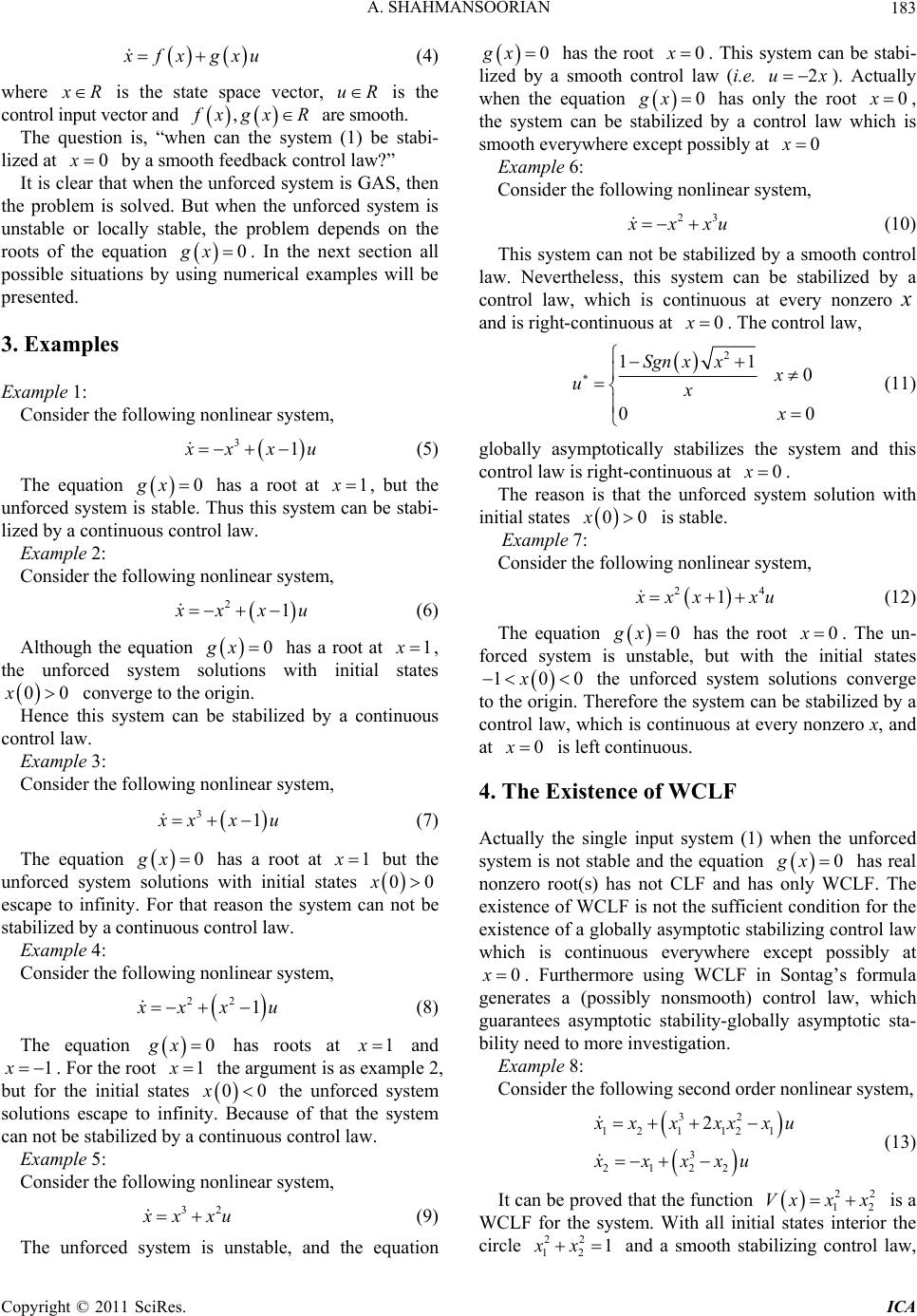 A. SHAHMANSOORIAN Copyright © 2011 SciRes. ICA 183 x fx gxu (4) where x R is the state space vector, is the control input vector and uR , f xgx R are smooth. The question is, “when can the system (1) be stabi- lized at by a smooth feedback control law?” 0x It is clear that when the unforced system is GAS, then the problem is solved. But when the unforced system is unstable or locally stable, the problem depends on the roots of the equation . In the next section all possible situations by using numerical examples will be presented. 0gx 3. Examples Example 1: Consider the following nonlinear system, 31 x xx u (5) The equation has a root at 0gx1 x , but the unforced system is stable. Thus this system can be stabi- lized by a continuous control law. Example 2: Consider the following nonlinear system, 21 x xx u (6) Although the equation has a root at 0gx1 x , the unforced system solutions with initial states converge to the origin. 00x Hence this system can be stabilized by a continuous control law. Example 3: Consider the following nonlinear system, 31 x xx u (7) The equation has a root at 0gx1 x but the unforced system solutions with initial states 00x escape to infinity. For that reason the system can not be stabilized by a continuous control law. Example 4: Consider the following nonlinear system, 22 1 x xx u (8) The equation 0gx has roots at 1 x and . For the root 1x 1 x x the argument is as example 2, but for the initial states 00 the unforced system solutions escape to infinity. Because of that the system can not be stabilized by a continuous control law. Example 5: Consider the following nonlinear system, 32 x xxu (9) The unforced system is unstable, and the equation 0gx has the root 0x . This system can be stabi- lized by a smooth control law (i.e. ). Actually when the equation 2u x 0gx has only the root 0x , the system can be stabilized by a control law which is smooth everywhere except possibly at 0x Example 6: Consider the following nonlinear system, 23 x xxu (10) This system can not be stabilized by a smooth control law. Nevertheless, this system can be stabilized by a control law, which is continuous at every nonzero x and is right-continuous at . The control law, 0x 2 11 0 0 0 Sgn xxx uxx (11) globally asymptotically stabilizes the system and this control law is right-continuous at . 0x The reason is that the unforced system solution with initial states 00x is stable. Example 7: Consider the following nonlinear system, 2 14 x xx xu (12) The equation 0gx has the root . The un- forced system is unstable, but with the initial states 0x 10x0 0x the unforced system solutions converge to the origin. Therefore the system can be stabilized by a control law, which is continuous at every nonzero x, and at is left continuous. 4. The Existence of WCLF Actually the single input system (1) when the unforced system is not stable and the equation has real nonzero root(s) has not CLF and has only WCLF. The existence of WCLF is not the sufficient condition for the existence of a globally asymptotic stabilizing control law which is continuous everywhere except possibly at 0gx 0x . Furthermore using WCLF in Sontag’s formula generates a (possibly nonsmooth) control law, which guarantees asymptotic stability-globally asymptotic sta- bility need to more investigation. Example 8: Consider the following second order nonlinear system, 32 12 1121 3 2122 2 x xxxxx xxxxu u 2 (13) It can be proved that the function 2 is a WCLF for the system. With all initial states interior the circle 2 1 Vxx x 22 12 1xx and a smooth stabilizing control law,  A. SHAHMANSOORIAN 184 the state trajectories converge to the origin. Globally asymptotic stabilizing by smooth control law is not pos- sible. Example 9: Consider the following second order nonlinear system, 12 2 1 21 12 2 1 5 πarctan543 221 25 xx x x xx x x u (14) In [2] the function: 22 12 π 2 Vxxx is used as a CLF in the Sonag’s formula. It can be veri- fied the function: 22 12 π2 2 Vxx x is a WCLF for the system. Using this WCLF in the Son- tag’s formula (Equation (3)) yields a discontinuous con- trol law which does not globally asymptotically stabilize the system. The state trajectory with this control law and the initial state converges to the point (2.946,0). In Figure 1 the state trajectory is shown. 032 T x 5. The Main Results From the above examples the following lemma can be suggested. Lemma 1: Consider the following single input first or- der system, Figure 1. State trajectory for the example 9. x fx gxu (15) where x R is state variable, is control input vector and uR f xR and g xR are smooth. As- sume the unforced system, x fx (16) is locally asymptotically stable and its domain of attrac- tion is 0, x ab and the roots of the equation 0gx belong to the interval The system can be stabilized by a continuous control law. ,.ab Proof: Using 2 1 2 Vx x as a WCLF for the system, the Sontag’s formula gives: 4 22 () ,0 0, 0 ux fxSgnxfxx gxgx gx gx (17) It can be shown that this control law globally asymp- totically stabilizes the system (15). Assume 0gx has a nonzero root x c such that . Accord- ing to the assumption of lemma acb 0,xf x ,, 0.xabx Thus we have: 3 2 24 2 3 3 24 2 lim lim lim 0 xc xc xc xgx ux fxSignxfxxgx xgx xf xxf xxgx This proves the continuity of the control law (17). When the equation g xR has root(s) at 0.x Then it is clear that: 2 0 lim x f x g x is equal to zero or infinity (when f x and g x are smooth and the system (16) is locally stable, this limit can not be equal to a nonzero finite value). Using this fact, it can be proved that: 2 2 00 2 22 lim lim 0 xx xgx ux fx fx Sign xx gx gx Remark 1: If the unforced system is unstable and the unforced system solutions with initial states 00,xb0 , 0,0xa converge to the origin, Copyright © 2011 SciRes. ICA  A. SHAHMANSOORIAN Copyright © 2011 SciRes. ICA 185 then the system can be stabilized by a control law which is continuous at every nonzero x and right/left-continuous at . 0x 0 6. Conclusions The stabilizability of affine single input first order sys- tems by a continuous control law is investigated. It is demonstrated that sometimes a stabilizing control law can be defined that is right/left-continuous at the origin. . In addition, using WCLF in Sontag’s formula generates a (possibly nonsmooth) control law, which globally stabilizes the system and globally asymptotic stability needs more investigation. x 7. References [1] R. Sepulchre, M. Jankovic and P. V. Kokotovic, “Con- structive Nonlinear Control,” Springer Verlag, London, 1997. [2] J. A. Primbs, V. Nevistic and J. C. Doyle, “A Receding Horizon Generalization of Pointwise Min Norm Control- lers,” IEEE Transactions on Automatic Control, Vol. 45, No. 5, May 2000, pp. 898-909. doi:org/10.1109/9.855550 [3] M. Krstic, I. Anellakopoulos and P. V. Kokotovic, “Nonlinear and Adaptive Control Design,” John Wiley & Sons, New York, 1995. [4] E. D. Sontag, “A ‘Universal’ Construction of Artstein’s Theorem on Nonlinear Stabilization,” System & Control letters, Vol. 13, No. 2, 1989, pp. 117-123. doi:10.1016/0167-6911(89)90028-5 [5] F. Ceragioli, “Some Remarks on Stabilization by Means of Discontinuous Feedbacks,” System & Control Letters, Vol. 45, No. 4, 2002, pp. 271-281. doi:org/10.1016/S0167-6911(01)00185-2 [6] F. A. C. C. Fontes, “Discontinuoud Feedbacks, Discon- tinuous Optimal Controls, and Continuous-Time Model Predictive Control,” International Journal of Robust Con- trol and Nonlinear Control, Vol. 13, No. 3-4, 2003, pp. 191-209. [7] R. W. Brockett, R. S. Millman and H. S. Sussmann, “Differential Geometric Control Theory,” Birkhouser, Boston, 1983. [8] A. Bacciotti and L. Rosier, “Liapunov Functions and Stability in Control Theory,” Springer-Verlag, London, 2001. |