

Paper Menu >>
Journal Menu >>
 Vol.3, No.8, 723-727 doi:10.4236/ns.2011.38095 C opyright © 2011 SciRes. Openly accessible at http://www.scirp.org/journal/NS/ (2011) Natural Science Perceived happiness level influences evocation of positive emotions Masahiro Matsunaga1*, Hiroki Murakami2, Kaori Yamakawa3, Tokiko Isowa4, Seisuke Fukuyama5, Jun Shinoda5, Jitsuhiro Yamada5, Hideki Ohira3 1Division of Cerebral Integration, Department of Cerebral Research, National Institute for Physiological Sciences, Aichi, Japan; *Corresponding Author: [email protected] 2Department of Psychology, Stony Brook University, New York, USA; 3Department of Psychology, Graduate School of Environmental Studies, Nagoya University, Aichi, Japan; 4Faculty of Nursing, Graduate School of Medicine, Mie University, Mie, Japan; 5Chubu Medical Center for Prolonged Traumatic Brain Dysfunction, Kizawa Memorial Hospital, Gifu, Japan. Received 12 April 2011; revised 30 April 2011; accepted 5 May 2011. ABSTRACT Happiness is a positive feeling characterized by satisfaction, joy, pleasure, or love. Perceived happiness level is likely associated with health and well-being. However, the neurobiological mechanisms underlying the positive effects of happiness on psychological and physiological wellness remain obscure. In this study, we found that the medial prefrontal cortex (MPFC) was strongly activated and positive emotions were strongly evoked in individuals with high perceived happiness levels compared to those with low perceived happiness lev els when either looked at a favorite person. Moreover, positive mood changes were positively correlated with MPFC activity. These results show that per- ceived happiness level is associated with posi- tive emotion evocation by means of the MPFC function, which may be involved in psycho- logical and physiological wellness. Therefore, happiness may play an important role in psy- chological and physiological wellness. Keywords: Happiness; Medial Prefrontal Cortex; Attraction; Positron Emission Tomogr aphy 1. INTRODUCTION Stress and anxiety can lead to depression [1]. Psycho- neuroimmunological studies have shown that psychoso- cial stressors can activate the sympathetic nervous sys- tem and that prolonged elevation of sympathetic nervous activity weakens immune defense mechanisms [2]. There- fore, stress and anxiety may cause or facilitate not only depression but several other diseases as well, including cancer [3]. The idea that perceived happiness level may be asso- ciated with health and well-being has recently been ex- plored. Individuals with a high level of perceived happi- ness have reduced sympathetic activation after exposure to psychological stressors compared with those having low levels of perceived happiness [4]. A recent study has also indicated that perceived happiness is negatively correlated with depression and anxiety [5]. Therefore, perceived happiness level is involved in both psycho- logical and physiological well-being. The neurobiologi- cal mechanism that explains these positive effects of happiness on psychological and physiological well-being remains obscure. The medial prefrontal cortex (MPFC) is one of the brain regions that may be involved in psy- chological and physiological wellness. It has been shown that electrical stimulation of the MPFC has an antide- pressant effect by increasing synaptic availability of se- rotonin [6], suggesting that MPFC maintains positive mood states. From this viewpoint, it is suggested that individuals with high levels of perceived happiness have stronger MPFC activity and stronger positive emotion evocation than individuals with low levels of perceived happiness upon exposure to positive emotional stimuli. To test this hypothesis, participants in this study were required to watch films featuring people that they con- sidered attractive, and we simultaneously recorded their brain activity using 15O-water positron emission tomo- graphy (PET) during various mood states. 2. METHODS 2.1. Participants We recruited 18 healthy right-handed male volunteers (age range, 20 - 29 years). None of the participants had  M. Matsunaga et al. / Natural Science 3 (2011) 723-727 Copyright © 2011 SciRes. Openly accessible at http://www.scirp.org/journal/NS/ 724 chronic illness and none were taking medications known to affect immunity. Only men were included to avoid gender-related endocrine system and immune variations caused by the female menstrual cycle. To screen indi- viduals with higher or lower levels of perceived happi- ness, we requested them to use the Japanese version of the subjective happiness scale (JSHS) [5]. The JSHS is a 4-item scale that measures relatively stable perceived happiness. Internal consistency, test-retest reliability, convergent validity, and discriminant validity of the JSHS have been confirmed [5]. Results of this screening investigation indicate that the mean JSHS score for the participants was 4.83 with a standard deviation (SD) of 0.9, similar to those reported earlier [5]. According to the mean participant JSHS score, we designated partici- pants with scores >5.0 as higher happiness respondents (n = 9) and those <4.9 as lower happiness respondents (n = 9). The participants were age-matched. All participants signed informed consent forms prior to participating in the study in accordance with university policy, and the study was approved by the Kizawa Memorial Hospital ethics committee. 2.2. Task Procedure Each participant was instructed not to eat for 2 h be- fore the scanning session but was allowed nonalcoholic and caffeine-free fluids. Either an emotionally neutral film (control film) or a film featuring people that the participant considered attractive (positive film) was viewed for 4 min on a 15-inch display positioned ap- proximately 60 cm from the participants. PET scanning (duration, 60 s) was performed during the first 2 - 3 min of the screening. To obtain reliable PET data, each par- ticipant was assigned 2 positive and 2 control films and 4 PET scans were obtained per participant. The control film was a TV news program that featured a newscaster that the participants did not consider particularly attrac- tive. The participants watched the edited control and positive films for the first time at the time of the experi- ment. The emotional valence of the films had been pre- viously evaluated [7]. The order of the 2 film types was randomized across participants. The detailed PET pro- cedure was described previously [7]. 2.3. Image Acquisition by PET, Image Processing, and Analysis During each film-watching period, the distribution of regional cerebral blood flow (rCBF) was measured using an Advance NXi PET scanner (GE Healthcare Life Sci- ences, Little Chalfont, England) operating in high-sensi- tivity 3-dimensional mode [7]. SPM99 software [8] im- plemented in Matlab (version 6.1; Mathworks, Sherborn, MA) was used for spatial preprocessing and statistical analyses as described previously [7]. To clarify signifi- cant regional changes within groups (high vs. low) dur- ing the positive condition, differences between the 2 groups were analyzed by subtracting the images of the low happiness group from the images of the high happi- ness group (each obtained by subtracting the control condition images from those obtained during the positive condition). The effects at each voxel were estimated using a general linear model. Voxel values for each con- trast yielded a statistical parametric map of the t-statistic (SPM t), which was subsequently transformed to a unit normal distribution (SPM z). The peak voxel value sig- nificance thresholds were set at p < 0.001 (uncorrected) and the cluster significance thresholds were set at 15 voxels. Further, to examine the association between brain ac- tivity reflected by the rCBF and positive mood, we cre- ated statistical parametric maps to identify the brain re- gions that were activated in synchrony with the positive mood changes using the high happiness group data. For these maps, the covariates option was selected, generat- ing regression analyses that tested the linear relationship between rCBF and positive mood, yielding a z score at each voxel. We entered the value changes obtained in the positive mood obtained by subtracting the value be- fore watching a film from the value after watching a film as covariates. For covariate analysis, the statistical threshold was set at p < 0.0001 (uncorrected) for height and clusters including >20 contiguous voxels were re- ported. For ease of discussion, we refer to our findings in terms of significant “correlations,” although the analysis formally involved linear regression rather than correla- tion assessment. After voxel-wise regression analysis, the MPFC value was extracted using SPM99, and the Pearson correlation coefficient was computed between the MPFC response and the positive mood change. Both control and positive conditions (2 × 9 data points) were used in both the voxel-wise regression analysis and the Pearson correlation coefficient computation. 2.4. Statistical Analyses The positive mood before and after film watching was compared using 3-way analysis of variance (ANOVA) (group [high vs. low] × condition [control vs. positive] × period [before vs. after]), followed by paired t-tests. This index was measured twice for each condition; thus, sta- tistical analyses were conducted among participants after each participant’s average was calculated. 3. RESULTS Subtraction of the low happiness from the high hap- 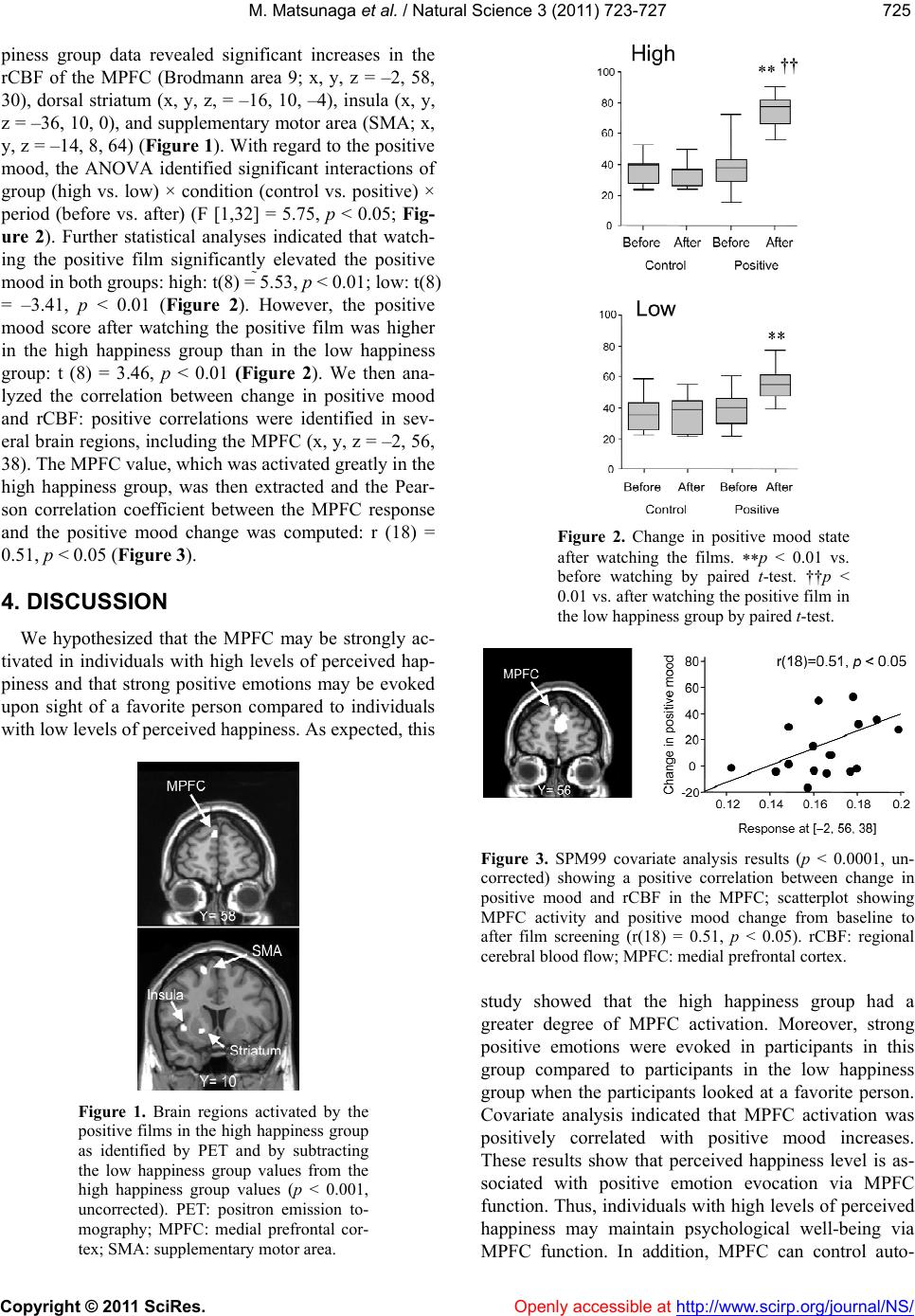 M. Matsunaga et al. / Natural Science 3 (2011) 723-727 Copyright © 2011 SciRes. Openly accessible at http://www.scirp.org/journal/NS/ 725725 piness group data revealed significant increases in the rCBF of the MPFC (Brodmann area 9; x, y, z = –2, 58, 30), dorsal striatum (x, y, z, = –16, 10, –4), insula (x, y, z = –36, 10, 0), and supplementary motor area (SMA; x, y, z = –14, 8, 64) (Figure 1). With regard to the positive mood, the ANOVA identified significant interactions of group (high vs. low) × condition (control vs. positive) × period (before vs. after) (F [1,32] = 5.75, p < 0.05; Fig- ure 2). Further statistical analyses indicated that watch- ing the positive film significantly elevated the positive mood in both groups: high: t(8) = 5.53, p < 0.01; low: t(8) = –3.41, p < 0.01 (Figure 2). However, the positive mood score after watching the positive film was higher in the high happiness group than in the low happiness group: t (8) = 3.46, p < 0.01 (Figure 2). We then ana- lyzed the correlation between change in positive mood and rCBF: positive correlations were identified in sev- eral brain regions, including the MPFC (x, y, z = –2, 56, 38). The MPFC value, which was activated greatly in the high happiness group, was then extracted and the Pear- son correlation coefficient between the MPFC response and the positive mood change was computed: r (18) = 0.51, p < 0.05 (Figure 3). 4. DISCUSSION We hypothesized that the MPFC may be strongly ac- tivated in individuals with high levels of perceived hap- piness and that strong positive emotions may be evoked upon sight of a favorite person compared to individuals with low levels of perceived happiness. As expected, this Figure 1. Brain regions activated by the positive films in the high happiness group as identified by PET and by subtracting the low happiness group values from the high happiness group values (p < 0.001, uncorrected). PET: positron emission to- mography; MPFC: medial prefrontal cor- tex; SMA: supplementary motor area. Figure 2. Change in positive mood state after watching the films. p < 0.01 vs. before watching by paired t-test. ††p < 0.01 vs. after watching the positive film in the low happiness group by paired t-test. Figure 3. SPM99 covariate analysis results (p < 0.0001, un- corrected) showing a positive correlation between change in positive mood and rCBF in the MPFC; scatterplot showing MPFC activity and positive mood change from baseline to after film screening (r(18) = 0.51, p < 0.05). rCBF: regional cerebral blood flow; MPFC: medial prefrontal cortex. study showed that the high happiness group had a greater degree of MPFC activation. Moreover, strong positive emotions were evoked in participants in this group compared to participants in the low happiness group when the participants looked at a favorite person. Covariate analysis indicated that MPFC activation was positively correlated with positive mood increases. These results show that perceived happiness level is as- sociated with positive emotion evocation via MPFC function. Thus, individuals with high levels of perceived happiness may maintain psychological well-being via MPFC function. In addition, MPFC can control auto-  M. Matsunaga et al. / Natural Science 3 (2011) 723-727 Copyright © 2011 SciRes. Openly accessible at http://www.scirp.org/journal/NS/ 726 nomic nervous system activity via brain autonomic cen- ters such as the hypothalamus and midbrain through direct neural projections [9]. Thus, it is possible that reduced sympathetic activation in individuals with high levels of perceived happiness after exposure to psycho- social stressors [4] will also be attributable to the MPFC function. A well-functioning MPFC may mediate the association between perceived happiness and health and well-being. Happiness is a positive feeling characterized by con- tentment, satisfaction, joy, pleasure, or love. Dopamine plays an important role in the expression of positive emotions [10-12]. The dopaminergic network within the brain, which projects to the prefrontal cortex and stria- tum from the midbrain region, is known as the “brain reward system” [10,11], and our results indicated that the reward-related brain regions including the dorsal striatum were strongly activated in individuals with high levels of perceived happiness. Findings have suggested that dopaminergic function deficiency may be a possible explanation for depression [13] and that antidepressant treatment facilitated dopamine release in the nucleus accumbens of a genetic animal model of depression [14]. Furthermore, activation of reward-related brain regions can improve physiological functions including immune functions [7]. Thus, brain dopaminergic function may be a key factor in the positive effects of perceived happi- ness levels. The present study also indicated that activation of the insula and SMA was higher in the high happiness group than in the low happiness group when participants looked at a favorite person. The insular cortex is in- volved in the perception of signals arising from the body and plays an important role in emotional experience [15-17]. We have recently shown that parasympathetic activity increases after an individual experiences positive emotions and that activity of the insular cortex is associ- ated with changes in peripheral autonomic activity [18]. Although the present study could not measure the pe- ripheral autonomic activity during the task because of technical limitations, it is possible that parasympathetic activity was greater in the high happiness group than in the low happiness group when positive emotions were elicited, and the greater insula activity in the high hap- piness group reflected this. Moreover, one study indi- cated a positive correlation between SMA activity and laughter/smiling; therefore, SMA activity reflects motor activity associated with these actions [19]. The individu- als with high levels of happiness probably smiled often while watching the positive film compared with those having low levels of happiness. Therefore, positive emo- tion-related brain regions may have been highly stimu- lated upon sight of a favorite person by participants of the high happiness group compared with those of the low happiness group. Certain limitations of this study must be recognized. Some reports have noted gender-related differences with regard to perceived happiness level and physiological reactivity [5,20], and we did not investigate the effect of gender. Thus, the generalizability of the present findings must be further tested using a larger sample size that includes both male and female participants. 5. CONCLUSIONS The findings of this study indicate that perceived hap- piness level is associated with evocation of positive emotions via MPFC function. High MPFC function in individuals with high perceived happiness levels may enhance psychological and physiological wellness. 6. ACKNOWLEDGEMENTS This work was supported by Grant-in-Aid for Young Scientists (B) from the Japan Society for the Promotion of Science (22700683 to MM). REFERENCES [1] Magalhaes, A.C., Holmes, K.D. and Dale, L.B., Comps- Agrar, L., Lee, D. and Yadav, P.N. et al. (2010) CRF re- ceptor 1 regulates anxiety behavior via sensitization of 5-HT2 receptor signaling. Nat Neuroscience, 13, 622-629. doi:10.1038/nn.2529 [2] Maisel, A.S., Knowlton, K.U., Fowler, P., Rearden, A., Ziegler, M.G. and Motulsky, H.J. et al. (1990) Adrenergic control of circulating lymphocyte subpopulations. Effects of congestive heart failure, dynamic exercise and terbuta- line treatment, The Journal of Clinical Investigation. 85, 462-467. doi:10.1172/JCI114460 [3] Jacobs, J.R. and Bovasso, G.B. (2000) Early and chronic stress and their relation to breast cancer. Psychological Medicine, 30, 669-678. doi:10.1017/S0033291799002020 [4] Horiuchi, S., Tsuda, A., Hashimoto, E., Kai, H. and Wen- jie, H. (2008) Effect of perceived happiness level on car- diac response to mental stress testing: a pilot study. Ja- pan Journal Biofeedb ack Research, 35, 93-98. [5] Shimai, S., Otake, K., Utsuki, N., Ikemi, A. and Lyubom- irsky, S. (2004) Development of a Japanese version of the subjective happiness scale (SHS) and examination of its validity and reliability. Japan Journal Public Health, 51, 845-853. [6] Juckel, G., Mendlin, A. and Jacobs, B.L. (1999) Electrical stimulation of rat medial prefrontal cortex enhances forebrain serotonin output: implications for electrocon- vulsive therapy and transcranial magnetic stimulation in depression. Neuropsychopharmacology, 21, 391-398. doi:10.1016/S0893-133X(98)00097-9 [7] Matsunaga, M., Isowa, T., Kimura, K., Miyakoshi, M., Kanayama, N. and Murakami, H. et al. (2008) Associa- tions among central nervous, endocrine, and immune ac- tivities when positive emotions are elicited by looking at  M. Matsunaga et al. / Natural Science 3 (2011) 723-727 Copyright © 2011 SciRes. http://www.scirp.org/journal/NS/ Openly accessible at 727727 a favorite person. Brain Behavior and Immunity, 22, 408-417. doi:10.1016/j.bbi.2007.09.008 [8] Friston, K.J., Holmes, A.P., Worsley, K.J., Poline, J.-P., Frith, C.D. and Frackowiak, R.S.J. (1995) Statistical pa- rametric maps in functional imaging: a general linear ap- proach. Human Brain Mapping, 2, 189-210. doi:10.1002/hbm.460020402 [9] Ohira, H., Isowa, T., Nomura, M., Ichikawa, N., Kimura, K. and Miyakoshi, M. et al. (2008) Imaging brain and immune association accompanying cognitive appraisal of an acute stressor. Neuroimage, 39, 500-514. doi:10.1016/j.neuroimage.2007.08.017 [10] Aron, A., Fisher, H., Mashek, D.J., Strong, G., Li, H. and Brown, L.L. (2005) Reward, motivation, and emotion systems associated with early-stage intense romantic love. Journal of Neurophysiology, 94, 327-337. doi:10.1152/jn.00838.2004 [11] Bartels, A. and Zeki, S. (2004) The neural correlates of maternal and romantic love. NeuroImage, 21, 1155-1166. doi:10.1016/j.neuroimage.2003.11.003 [12] Verhoeff, N.P., Christensen, B.K., Hussey, D., Lee, M., Papatheodorou, G. and Kopala, L. et al. (2003) Effects of catecholamine depletion on D2 receptor binding, mood, and attentiveness in humans: a replication study. Phar- macology Biochemistry Behavior, 74, 425-432. doi:10.1016/S0091-3057(02)01028-6 [13] Yadid, G. and Friedman, A. (2008) Dynamics of the dopaminergic system as a key component to the under- standing of depression. Progress in Brain Research, 172, 265-286. doi:10.1016/S0079-6123(08)00913-8 [14] Roth-Deri, I., Friedman, A., Abraham, L., Lax, E., Flau- menhaft, Y. and Dikshtein, Y. et al. (2009) Antidepressant treatment facilitates dopamine release and drug seeking behavior in a genetic animal model of depression. Europe Journal of Neuroscience, 30, 485-492. doi:10.1111/j.1460-9568.2009.06840.x [15] Critchley, H.D., Mathias, C.J., Josephs, O., O’Doherty, J., Zanini, S. and Dewar, B.K. et al. (2003) Human cingu- late cortex and autonomic control: converging neuroi- maging and clinical evidence. Brain, 126, 2139-2152. doi:10.1093/brain/awg216 [16] Critchley, H.D., Wiens, S., Rotshtein, P., Ohman, A. and Dolan, R.J. (2004) Neural systems supporting interocep- tive awareness, Nature Neuroscience, 7, 189-195. doi:10.1038/nn1176 [17] Bechara, A. and Naqvi, N. (2004) Listening to your heart: interoceptive awareness as a gateway to feeling. News and views, 7, 102-103. doi:10.1038/nn0204-102 [18] Matsunaga, M., Isowa, T., Kimura, K., Miyakoshi, M., Kanayama, N. and Murakami, H. et al. (2009) Associa- tions among positive mood, brain, and cardiovascular ac- tivities in an affectively positive situation. Brain Re- search, 1263, 93-103. doi:10.1016/j.brainres.2009.01.027 [19] Iwase, M., Ouchi, Y., Okada, H., Yokoyama, C., No- bezawa, S. and Yoshikawa, E. et al. (2002) Neural sub- strates of human facial expression of pleasant emotion induced by comic films: a PET study. Neuroimage, 17, 758-768. doi:10.1006/nimg.2002.1225 [20] Bosch, J.A., Berntson, G.G., Cacioppo, J.T. and Marucha, P.T. (2005) Differential mobilization of functionally dis- tinct natural killer subsets during acute psychological stress. Psychosomatic Medicine, 67, 366-375. doi:10.1097/01.psy.0000160469.00312.8e |