

Paper Menu >>
Journal Menu >>
 Vol.3, No.8, 683-688 (2011) Natural Science http://dx.doi.org/10.4236/ns.2011.38091 Copyright © 2011 SciRes. OPEN ACCESS Density functional theory studies on the structure, vibrational spectra of three new tetrahalogenoferrate (III) complexes Shahriare Ghammamy1,2*, Kheyrollah Mehrani1, Somayyeh Rostamzadehmansor1, Hajar Sahebalzamani1 1Departments of Chemistry, Faculty of Science, Ardabil Branch, Islamic Azad University, Ardabil, Iran; *Corresponding Author: [email protected] 2Department of Chemistry, Faculty of Science, Imam Khomeini International University,Ghazvin, Iran. Received 9 January 2011; revised 2 March 2011; accepted 12 March 2011. ABSTRACT Three new tetrahalogenoferrate (III) complexes with the general formula (R)4N[FeCl3X]– in that (X = F−, Cl−, Br−) synthesized by the reaction of FeCl3 with (C2H5)4NF, (CH3)4NCl and (C4H9)4NBr salts in anhydrous CH3CN. These were charac- terized by elemental analysis, IR, UV/Visible and 81Br-NMR spectroscopy. The optimized geome- tries and frequencies of the stationary point are calculated at the B3LYP/LANL2DZ level of theory. Harmonic vibrational frequencies and infrared intensities for FeCl3F−, FeC4 l and FeCl3Br− are studied by means of theoretical and experi- mental methods. The calculated frequencies are in reasonable agreement with the experiment values. Keywords: Tetrahalogenoferrate(III); Theoretical Study; Br-NMR; Density Functional Calculations 1. INTRODUCTION Recently, the interesting history and development of the chemistry of iron halides was reviewed [1]. A new interest steeply increasing in the last decade is caused by possibility of ferrate use as a strong oxidizing agent for environmental uses [2-5] and as a high capacity source of cathodic charge [6-8]. Furthermore it was found that some iron (III) complexes provide a useful structural and electronic model for the similarly coordinated iron (III) sites found in the heme iron enzymes [9]. The tetrahalo- genoferrates (III) have been utilized in bioinorganic chemistry as reagents for synthesizing some model compounds, such as [Fe2S2Cl4]2– [10,11]. The investiga- tion of the structures and properties of these compounds and their similarities are interested. In this work, we re- port on the synthesis and characterisation of new com- plexes of type (R)4N[FeCl3X]– (X = F–, Cl–, Br–) Ob- tained directly from FeCl3 and tetraalkylammonium salts. During this study we report the optimized geometries and infrared spectral measurements, assignments and electronic structure calculations for compounds. The str- uctures of compounds have been optimized by the den- sity functional theory (DFT) based method at B3LYP/ LANL2DZ levels of theory, using the Gaussian 03 package of programs [12-14]. The comparison between theory and experiment is made. 2. EXPERIMENTAL SECTION 2.1. General The density functional and abinitio calculation have been performed with the Gaussian program and the basis sets implemented therein [13,15-17]. Acetonitrile (Fluka, P.A.) was distilled several times from phosphorus pentaoxide before use, thereby reduc- ing its water content to < 4 ppm. FeCl3 (Merck, p.a.) were used without further purification. Anhydrous Et4N+F– and Me4N+F were obtained by a drying proce- dure of the tetrahydrate in high vacuum (d, 130˚C) [18]. Infrared spectra were recorded as KBr disks on a Shi- madzu model 420 spectrophotometer. The UV/Visible measurements were made on an Uvicon model 922 spectrometer. 81Br-NMR were recorded on a Bruker AVA NCEDRX 500 spectrometer. The percent compo- sitions of elements were obtained from the Microana- lytical Laboratories, Department of Chemistry, OIRC, Tehran. 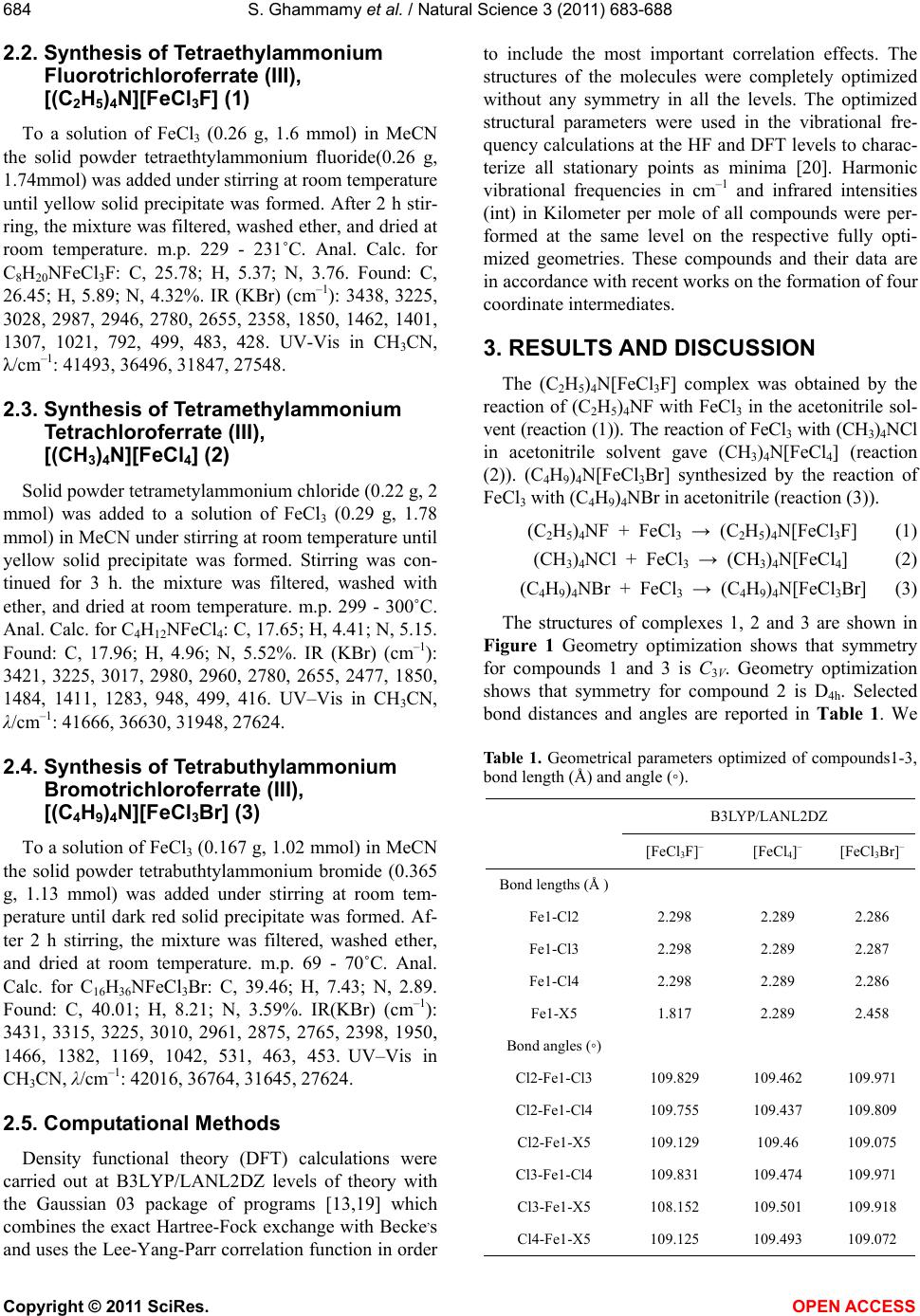 S. Ghammamy et al. / Natural Science 3 (2011) 683-688 Copyright © 2011 SciRes. OPEN ACCESS 684 2.2. Synthesis of Tetraethylammonium Fluorotrichloroferrate (III), [(C2H5)4N][FeCl3F] (1) To a solution of FeCl3 (0.26 g, 1.6 mmol) in MeCN the solid powder tetraethtylammonium fluoride(0.26 g, 1.74mmol) was added under stirring at room temperature until yellow solid precipitate was formed. After 2 h stir- ring, the mixture was filtered, washed ether, and dried at room temperature. m.p. 229 - 231˚C. Anal. Calc. for C8H20NFeCl3F: C, 25.78; H, 5.37; N, 3.76. Found: C, 26.45; H, 5.89; N, 4.32%. IR (KBr) (cm–1): 3438, 3225, 3028, 2987, 2946, 2780, 2655, 2358, 1850, 1462, 1401, 1307, 1021, 792, 499, 483, 428. UV-Vis in CH3CN, λ/cm–1: 41493, 36496, 31847, 27548. 2.3. Synthesis of Tetramethylammonium Tetrachloroferrate (III), [(CH3)4N][FeCl4] (2) Solid powder tetrametylammonium chloride (0.22 g, 2 mmol) was added to a solution of FeCl3 (0.29 g, 1.78 mmol) in MeCN under stirring at room temperature until yellow solid precipitate was formed. Stirring was con- tinued for 3 h. the mixture was filtered, washed with ether, and dried at room temperature. m.p. 299 - 300˚C. Anal. Calc. for C4H12NFeCl4: C, 17.65; H, 4.41; N, 5.15. Found: C, 17.96; H, 4.96; N, 5.52%. IR (KBr) (cm–1): 3421, 3225, 3017, 2980, 2960, 2780, 2655, 2477, 1850, 1484, 1411, 1283, 948, 499, 416. UV–Vis in CH3CN, λ/cm–1: 41666, 36630, 31948, 27624. 2.4. Synthesis of Tetrabuthylammonium Bromotrichloroferrate (III), [(C4H9)4N][FeCl3Br] (3) To a solution of FeCl3 (0.167 g, 1.02 mmol) in MeCN the solid powder tetrabuthtylammonium bromide (0.365 g, 1.13 mmol) was added under stirring at room tem- perature until dark red solid precipitate was formed. Af- ter 2 h stirring, the mixture was filtered, washed ether, and dried at room temperature. m.p. 69 - 70˚C. Anal. Calc. for C16H36NFeCl3Br: C, 39.46; H, 7.43; N, 2.89. Found: C, 40.01; H, 8.21; N, 3.59%. IR(KBr) (cm–1): 3431, 3315, 3225, 3010, 2961, 2875, 2765, 2398, 1950, 1466, 1382, 1169, 1042, 531, 463, 453. UV–Vis in CH3CN, λ/cm–1: 42016, 36764, 31645, 27624. 2.5. Computational Methods Density functional theory (DFT) calculations were carried out at B3LYP/LANL2DZ levels of theory with the Gaussian 03 package of programs [13,19] which combines the exact Hartree-Fock exchange with Becke,s and uses the Lee-Yang-Parr correlation function in order to include the most important correlation effects. The structures of the molecules were completely optimized without any symmetry in all the levels. The optimized structural parameters were used in the vibrational fre- quency calculations at the HF and DFT levels to charac- terize all stationary points as minima [20]. Harmonic vibrational frequencies in cm–1 and infrared intensities (int) in Kilometer per mole of all compounds were per- formed at the same level on the respective fully opti- mized geometries. These compounds and their data are in accordance with recent works on the formation of four coordinate intermediates. 3. RESULTS AND DISCUSSION The (C2H5)4N[FeCl3F] complex was obtained by the reaction of (C2H5)4NF with FeCl3 in the acetonitrile sol- vent (reaction (1)). The reaction of FeCl3 with (CH3)4NCl in acetonitrile solvent gave (CH3)4N[FeCl4] (reaction (2)). (C4H9)4N[FeCl3Br] synthesized by the reaction of FeCl3 with (C4H9)4NBr in acetonitrile (reaction (3)). (C2H5)4NF + FeCl3 → (C2H5)4N[FeCl3F] (1) (CH3)4NCl + FeCl3 → (CH3)4N[FeCl4] (2) (C4H9)4NBr + FeCl3 → (C4H9)4N[FeCl3Br] (3) The structures of complexes 1, 2 and 3 are shown in Figure 1 Geometry optimization shows that symmetry for compounds 1 and 3 is C3V. Geometry optimization shows that symmetry for compound 2 is D4h. Selected bond distances and angles are reported in Table 1. We Table 1. Geometrical parameters optimized of compounds1-3, bond length (Å) and angle (◦). B3LYP/LANL2DZ [FeCl3F]– [FeCl4]– [FeCl3Br]– Bond lengths (Å ) Fe1-Cl2 2.298 2.289 2.286 Fe1-Cl3 2.298 2.289 2.287 Fe1-Cl4 2.298 2.289 2.286 Fe1-X5 1.817 2.289 2.458 Bond angles (◦) Cl2-Fe1-Cl3 109.829 109.462 109.971 Cl2-Fe1-Cl4 109.755 109.437 109.809 Cl2-Fe1-X5 109.129 109.46 109.075 Cl3-Fe1-Cl4 109.831 109.474 109.971 Cl3-Fe1-X5 108.152 109.501 109.918 Cl4-Fe1-X5 109.125 109.493 109.072 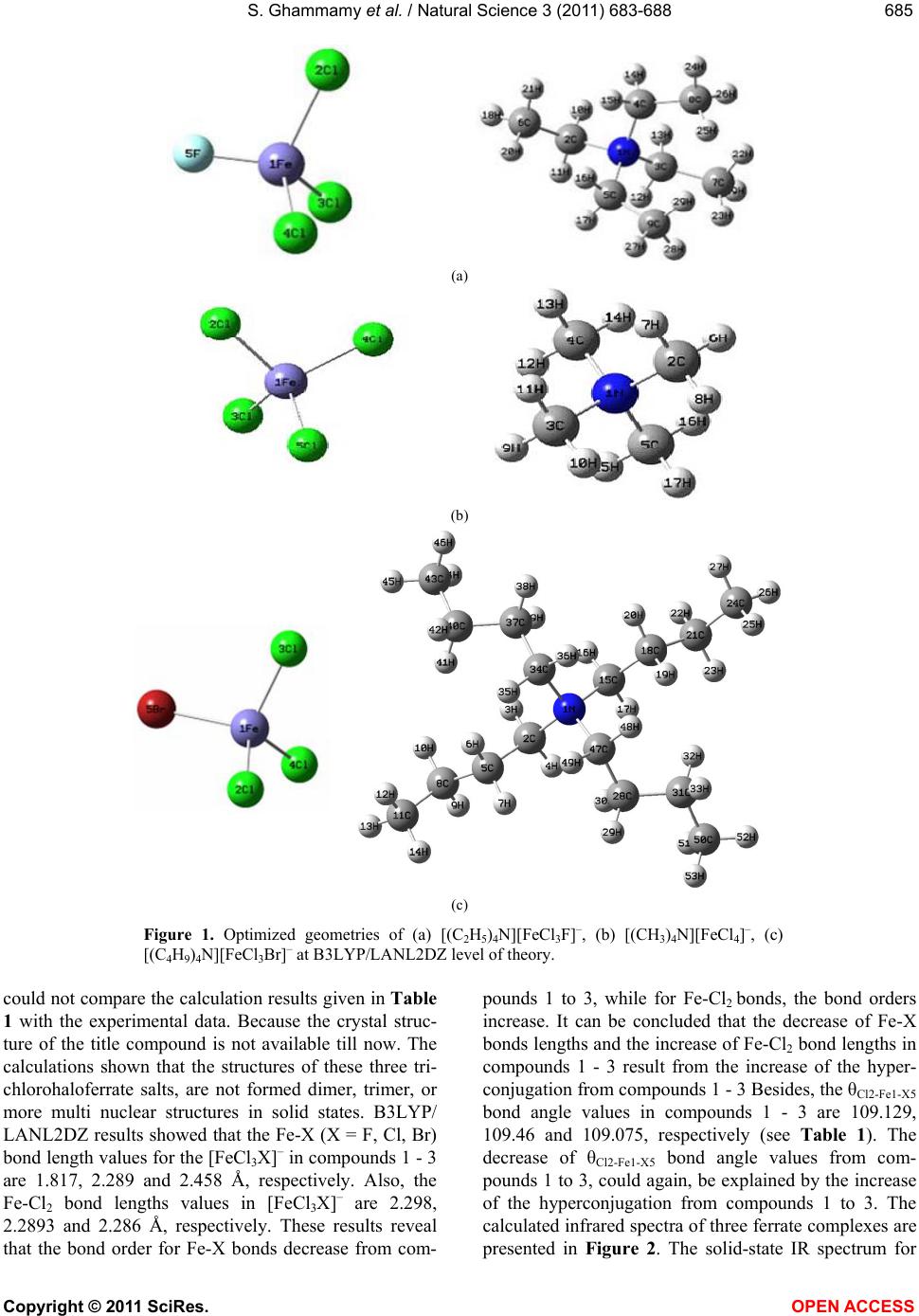 S. Ghammamy et al. / Natural Science 3 (2011) 683-688 Copyright © 2011 SciRes. OPEN ACCESS 685685 (a) (b) (c) Figure 1. Optimized geometries of (a) [(C2H5)4N][FeCl3F]–, (b) [(CH3)4N][FeCl4]–, (c) [(C4H9)4N][FeCl3Br]– at B3LYP/LANL2DZ level of theory. could not compare the calculation results given in Table 1 with the experimental data. Because the crystal struc- ture of the title compound is not available till now. The calculations shown that the structures of these three tri- chlorohaloferrate salts, are not formed dimer, trimer, or more multi nuclear structures in solid states. B3LYP/ LANL2DZ results showed that the Fe-X (X = F, Cl, Br) bond length values for the [FeCl3X]– in compounds 1 - 3 are 1.817, 2.289 and 2.458 Å, respectively. Also, the Fe-Cl2 bond lengths values in [FeCl3X]– are 2.298, 2.2893 and 2.286 Å, respectively. These results reveal that the bond order for Fe-X bonds decrease from com- pounds 1 to 3, while for Fe-Cl2 bonds, the bond orders increase. It can be concluded that the decrease of Fe-X bonds lengths and the increase of Fe-Cl2 bond lengths in compounds 1 - 3 result from the increase of the hyper- conjugation from compounds 1 - 3 Besides, the θCl2-Fe1-X5 bond angle values in compounds 1 - 3 are 109.129, 109.46 and 109.075, respectively (see Table 1). The decrease of θCl2-Fe1-X5 bond angle values from com- pounds 1 to 3, could again, be explained by the increase of the hyperconjugation from compounds 1 to 3. The calculated infrared spectra of three ferrate complexes are presented in Figure 2. The solid-state IR spectrum for 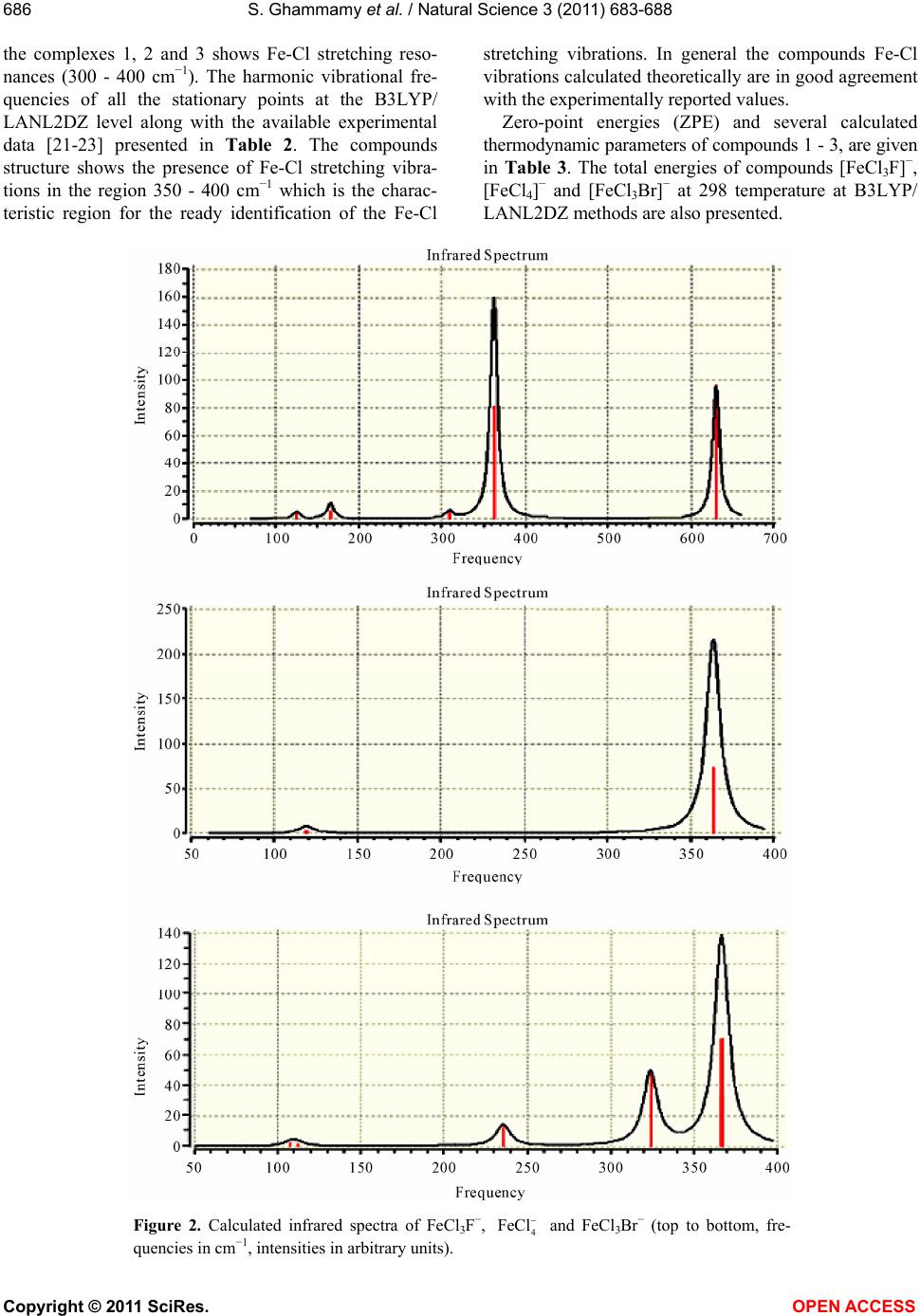 S. Ghammamy et al. / Natural Science 3 (2011) 683-688 Copyright © 2011 SciRes. OPEN ACCESS 686 the complexes 1, 2 and 3 shows Fe-Cl stretching reso- nances (300 - 400 cm−1). The harmonic vibrational fre- quencies of all the stationary points at the B3LYP/ LANL2DZ level along with the available experimental data [21-23] presented in Table 2. The compounds structure shows the presence of Fe-Cl stretching vibra- tions in the region 350 - 400 cm−1 which is the charac- teristic region for the ready identification of the Fe-Cl stretching vibrations. In general the compounds Fe-Cl vibrations calculated theoretically are in good agreement with the experimentally reported values. Zero-point energies (ZPE) and several calculated thermodynamic parameters of compounds 1 - 3, are given in Table 3. The total energies of compounds [FeCl3F]−, [FeCl4]− and [FeCl3Br]− at 298 temperature at B3LYP/ LANL2DZ methods are also presented. Figure 2. Calculated infrared spectra of FeCl3F−, 4 FeCl and FeCl3Br− (top to bottom, fre- quencies in cm−1, intensities in arbitrary units). 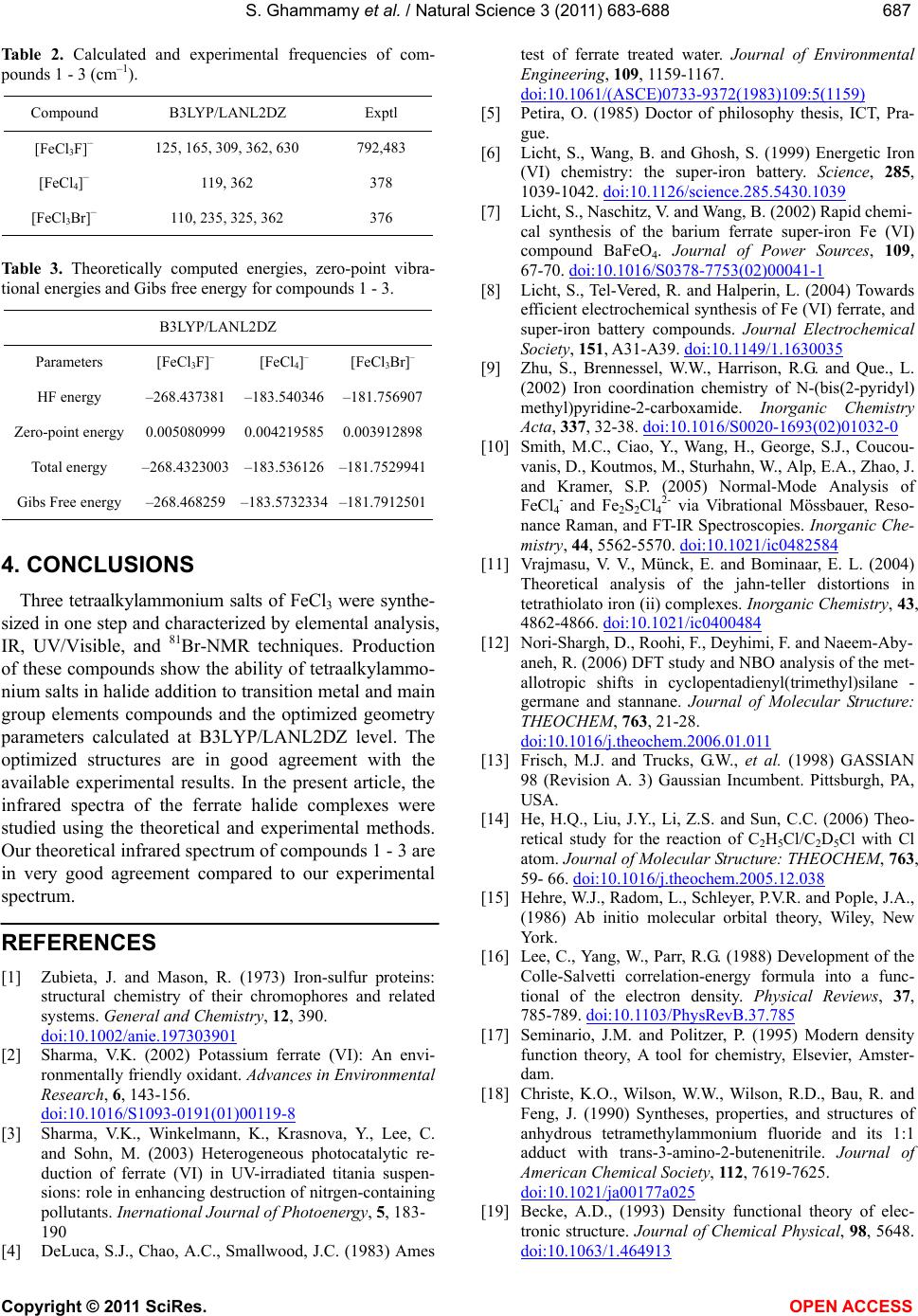 S. Ghammamy et al. / Natural Science 3 (2011) 683-688 Copyright © 2011 SciRes. OPEN ACCESS 687687 Table 2. Calculated and experimental frequencies of com- pounds 1 - 3 (cm–1). Compound B3LYP/LANL2DZ Exptl [FeCl3F]– 125, 165, 309, 362, 630 792,483 [FeCl4]– 119, 362 378 [FeCl3Br]– 110, 235, 325, 362 376 Table 3. Theoretically computed energies, zero-point vibra- tional energies and Gibs free energy for compounds 1 - 3. B3LYP/LANL2DZ Parameters [FeCl3F]– [FeCl4]– [FeCl3Br]– HF energy –268.437381–183.540346 –181.756907 Zero-point energy 0.0050809990.004219585 0.003912898 Total energy –268.4323003–183.536126 –181.7529941 Gibs Free energy –268.468259–183.5732334 –181.7912501 4. CONCLUSIONS Three tetraalkylammonium salts of FeCl3 were synthe- sized in one step and characterized by elemental analysis, IR, UV/Visible, and 81Br-NMR techniques. Production of these compounds show the ability of tetraalkylammo- nium salts in halide addition to transition metal and main group elements compounds and the optimized geometry parameters calculated at B3LYP/LANL2DZ level. The optimized structures are in good agreement with the available experimental results. In the present article, the infrared spectra of the ferrate halide complexes were studied using the theoretical and experimental methods. Our theoretical infrared spectrum of compounds 1 - 3 are in very good agreement compared to our experimental spectrum. REFERENCES [1] Zubieta, J. and Mason, R. (1973) Iron-sulfur proteins: structural chemistry of their chromophores and related systems. General and Chemistry, 12, 390. doi:10.1002/anie.197303901 [2] Sharma, V.K. (2002) Potassium ferrate (VI): An envi- ronmentally friendly oxidant. Advances in Environmental Research, 6, 143-156. doi:10.1016/S1093-0191(01)00119-8 [3] Sharma, V.K., Winkelmann, K., Krasnova, Y., Lee, C. and Sohn, M. (2003) Heterogeneous photocatalytic re- duction of ferrate (VI) in UV-irradiated titania suspen- sions: role in enhancing destruction of nitrgen-containing pollutants. Inernational Journal of Photoenergy, 5, 183- 190 [4] DeLuca, S.J., Chao, A.C., Smallwood, J.C. (1983) Ames test of ferrate treated water. Journal of Environmental Engineering, 109, 1159-1167. doi:10.1061/(ASCE)0733-9372(1983)109:5(1159) [5] Petira, O. (1985) Doctor of philosophy thesis, ICT, Pra- gue. [6] Licht, S., Wang, B. and Ghosh, S. (1999) Energetic Iron (VI) chemistry: the super-iron battery. Scie nce , 285, 1039-1042. doi:10.1126/science.285.5430.1039 [7] Licht, S., Naschitz, V. and Wang, B. (2002) Rapid chemi- cal synthesis of the barium ferrate super-iron Fe (VI) compound BaFeO4. Journal of Power Sources, 109, 67-70. doi:10.1016/S0378-7753(02)00041-1 [8] Licht, S., Tel-Vered, R. and Halperin, L. (2004) Towards efficient electrochemical synthesis of Fe (VI) ferrate, and super-iron battery compounds. Journal Electrochemical Society, 151, A31-A39. doi:10.1149/1.1630035 [9] Zhu, S., Brennessel, W.W., Harrison, R.G. and Que., L. (2002) Iron coordination chemistry of N-(bis(2-pyridyl) methyl)pyridine-2-carboxamide. Inorganic Chemistry Acta, 337, 32-38. doi:10.1016/S0020-1693(02)01032-0 [10] Smith, M.C., Ciao, Y., Wang, H., George, S.J., Coucou- vanis, D., Koutmos, M., Sturhahn, W., Alp, E.A., Zhao, J. and Kramer, S.P. (2005) Normal-Mode Analysis of FeCl4- and Fe2S2Cl42- via Vibrational Mössbauer, Reso- nance Raman, and FT-IR Spectroscopies. Inorganic Che- mistry, 44, 5562-5570. doi:10.1021/ic0482584 [11] Vrajmasu, V. V., Münck, E. and Bominaar, E. L. (2004) Theoretical analysis of the jahn-teller distortions in tetrathiolato iron (ii) complexes. Inorganic Chemistry, 43, 4862-4866. doi:10.1021/ic0400484 [12] Nori-Shargh, D., Roohi, F., Deyhimi, F. and Naeem-Aby- aneh, R. (2006) DFT study and NBO analysis of the met- allotropic shifts in cyclopentadienyl(trimethyl)silane - germane and stannane. Journal of Molecular Structure: THEOCHEM, 763, 21-28. doi:10.1016/j.theochem.2006.01.011 [13] Frisch, M.J. and Trucks, G.W., et al. (1998) GASSIAN 98 (Revision A. 3) Gaussian Incumbent. Pittsburgh, PA, USA. [14] He, H.Q., Liu, J.Y., Li, Z.S. and Sun, C.C. (2006) Theo- retical study for the reaction of C2H5Cl/C2D5Cl with Cl atom. Journal of Molecular Structure: THEOCHEM, 763, 59- 66. doi:10.1016/j.theochem.2005.12.038 [15] Hehre, W.J., Radom, L., Schleyer, P.V.R. and Pople, J.A., (1986) Ab initio molecular orbital theory, Wiley, New York. [16] Lee, C., Yang, W., Parr, R.G. (1988) Development of the Colle-Salvetti correlation-energy formula into a func- tional of the electron density. Physical Reviews, 37, 785-789. doi:10.1103/PhysRevB.37.785 [17] Seminario, J.M. and Politzer, P. (1995) Modern density function theory, A tool for chemistry, Elsevier, Amster- dam. [18] Christe, K.O., Wilson, W.W., Wilson, R.D., Bau, R. and Feng, J. (1990) Syntheses, properties, and structures of anhydrous tetramethylammonium fluoride and its 1:1 adduct with trans-3-amino-2-butenenitrile. Journal of American Chemical Society, 112, 7619-7625. doi:10.1021/ja00177a025 [19] Becke, A.D., (1993) Density functional theory of elec- tronic structure. Journal of Chemical Physical, 98, 5648. doi:10.1063/1.464913  S. Ghammamy et al. / Natural Science 3 (2011) 683-688 Copyright © 2011 SciRes. OPEN ACCESS 688 [20] Sundaraganesan, N., Ilakiamani, S. and Dominic Joshua, B. (2007) Vibrational spectroscopy investigation using ab initio and density functional theory analysis on the struc- ture of 3, 4-dimethylbenzaldehyde. Spectrochimica Acta Part A, 68, 680-687. doi:10.1016/j.saa.2006.12.046 [21] Nakamoto, K., (1978) Infrared and raman spectra of inorganic and coordiation compounds, 3rd Edition. John Wiley, New York. [22] Wyrzykowski, D., Maniecki, T., Pattek-Janczyk, A., Sta- nek, J. and Warnke, Z. (2005) Thermal analysis and spec- troscopic characteristics of tetrabutylammonium tetra- chloroferrate(III). Thermochimica Acta, 435, 92-98. doi:10.1016/j.tca.2005.05.007 [23] Wyrzykowski, D., Pattek-Janczyk, A. and Maniecki, T., et al. (2006) Thermal analysis of quinolinium tetra- chloroferrate (III). Thermochimica Acta, 443, 72-77. doi:10.1016/j.tca.2005.12.023 |