

Paper Menu >>
Journal Menu >>
 Vol.3, No.8, 689-693 (2011) Natural Science http://dx.doi.org/10.4236/ns.2011.38092 Copyright © 2011 SciRes. OPEN ACCESS Interaction of glassy fertilizers and Cd2+ ions in terms of soil pollution neutralization Irena Wacławska, Magdalena Szumera* Faculty of Materials Science and Ceramics, AGH University of Science and Technology, Cracow, Poland; *Corresponding Author: [email protected] Received 23 November 2010; revised 15 January 2011; accepted 25 January 2011. ABSTRACT Immobilization of cadmium contamination in soils by precipitation of nonassimilable for plants Cd-phosphates was considered. Glassy fertilizer of controlled release rate of the nutri- ents for plants as a source of phosphate anions was applied. The negative role of Cd complex- ing citric acid solution simulating the natural soil conditions, which inhibits the Cd-phos- phates formation, was stated. Keywords: Soil Environment Protection; Glassy Fertilizer; Cd Immobilization 1. INTRODUCTION The symptom of soils chemical degradation is, among others, the accumulation of toxic elements in its top lay- ers emitted mainly by industry, pesticides, also by min- eral fertilizers and liquid wastes used to fertilize soils. Ecological risk connected with the toxic elements con- centration in upper soils level not only results from their easy assimilation by plants; it involves also the assimila- tion of these elements by soil microorganisms and mesofauna, being important link of elements migration in feeding chain. Cadmium is element especially mobile in soil environment and activity if different biological processes inhibiting. Physiological effect of cadmium excess in plants results from the disorder of photosyn- thesis, transpiration and nitrogen compounds transfor- mation as well as with the changes of membrane cellular permeability and DNA structure. Easily accumulation of cadmium by plants makes a risk to place it in the human body, where it undergoes long time accumulation in or- gans functioning important roles (liver, kidneys, bones) [1,2]. One method of neutralizing such a type of soil envi- ronment contamination is bonding of toxic elements contained in it into compounds difficult to dissolve, which makes them nonassimilable for plants. Phospho- rus reacts with many heavy metals to form secondary phosphate precipitates that are stable over a wide range of environmental conditions. While it is true that toxic elements content in the soil does not undergo any change in this way, their mobility and toxic influence on living organisms are reduced. Experimental studies, in which well soluble phos- phates and phosphate fertilizers were used for cadmium removal were conducted on contaminated soils [3,4]. Synthetic fertilizers used as a source of phosphorus are an additional source of toxic elements (Cd, Cu, Ni, Pb, Zn), located in the soil [5]. They come from the raw materials used to production this type of fertilizers, their source is also the process of their production. This study refers to the possibilities of using chemi- cally active silicate-phosphate glasses acting as vitreous fertilizers of controlled release rate of the nutrients (P, Ca, Mg, K, microelements) for plants [6,7] for simulta- neous bonding of cadmium, constituting particularly harmful soils contamination, into the form of insoluble compounds. Glassy fertilizers because of the production does not constitute an additional source of toxic ele- ments. Characterization of processes and products of reaction between glassy fertilizer VitroFosMaK of 42 SiO2·12 P2O5·10 K2O·22 MgO·14 CaO [wt%] composition and cadmium chloride solutions (“ex situ” reactions) under soil environment simulating conditions, is the subject of the present study. 2. EXPERIMENTAL 2 wt% citric acid solution was used as an extractor re- leasing 3 4 PO ions from the glassy fertilizer structure. The glass to solution weight ratio was 1:100. Such con- ditions simulate physico-chemical state similar to the natural environment of plant roots and the surrounding soil [8]. Additionally, the inorganic acid (HCl) was used an 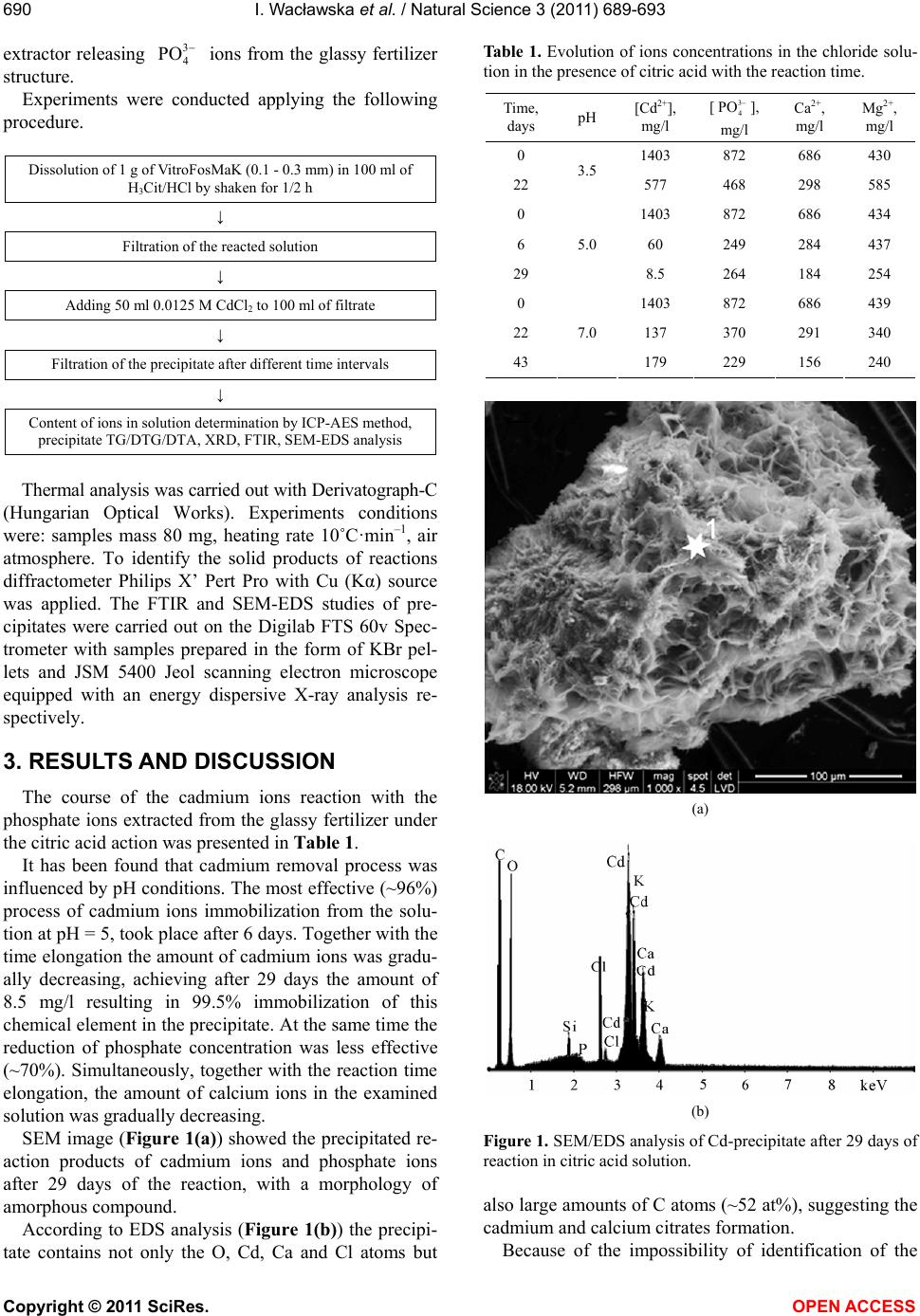 I. Wacławska et al. / Natural Science 3 (2011) 689-693 Copyright © 2011 SciRes. OPEN ACCESS 690 extractor releasing 3 4 PO ions from the glassy fertilizer structure. Experiments were conducted applying the following procedure. Dissolution of 1 g of VitroFosMaK (0.1 - 0.3 mm) in 100 ml of H3Cit/HCl by shaken for 1/2 h ↓ Filtration of the reacted solution ↓ Adding 50 ml 0.0125 M CdCl2 to 100 ml of filtrate ↓ Filtration of the precipitate after different time intervals ↓ Content of ions in solution determination by ICP-AES method, precipitate TG/DTG/DTA, XRD, FTIR, SEM-EDS analysis Thermal analysis was carried out with Derivatograph-C (Hungarian Optical Works). Experiments conditions were: samples mass 80 mg, heating rate 10˚C·min–1, air atmosphere. To identify the solid products of reactions diffractometer Philips X’ Pert Pro with Cu (Kα) source was applied. The FTIR and SEM-EDS studies of pre- cipitates were carried out on the Digilab FTS 60v Spec- trometer with samples prepared in the form of KBr pel- lets and JSM 5400 Jeol scanning electron microscope equipped with an energy dispersive X-ray analysis re- spectively. 3. RESULTS AND DISCUSSION The course of the cadmium ions reaction with the phosphate ions extracted from the glassy fertilizer under the citric acid action was presented in Table 1. It has been found that cadmium removal process was influenced by pH conditions. The most effective (~96%) process of cadmium ions immobilization from the solu- tion at pH = 5, took place after 6 days. Together with the time elongation the amount of cadmium ions was gradu- ally decreasing, achieving after 29 days the amount of 8.5 mg/l resulting in 99.5% immobilization of this chemical element in the precipitate. At the same time the reduction of phosphate concentration was less effective (~70%). Simultaneously, together with the reaction time elongation, the amount of calcium ions in the examined solution was gradually decreasing. SEM image (Figure 1(a)) showed the precipitated re- action products of cadmium ions and phosphate ions after 29 days of the reaction, with a morphology of amorphous compound. According to EDS analysis (Figure 1(b)) the precipi- tate contains not only the O, Cd, Ca and Cl atoms but Table 1. Evolution of ions concentrations in the chloride solu- tion in the presence of citric acid with the reaction time. Time, days pH [Cd2+], mg/l [3 4 PO ], mg/l Ca2+, mg/l Mg2+, mg/l 0 1403 872 686 430 22 3.5 577 468 298 585 0 1403 872 686 434 6 60 249 284 437 29 5.0 8.5 264 184 254 0 1403 872 686 439 22 137 370 291 340 43 7.0 179 229 156 240 (a) (b) Figure 1. SEM/EDS analysis of Cd-precipitate after 29 days of reaction in citric acid solution. also large amounts of C atoms (~52 at%), suggesting the cadmium and calcium citrates formation. Because of the impossibility of identification of the 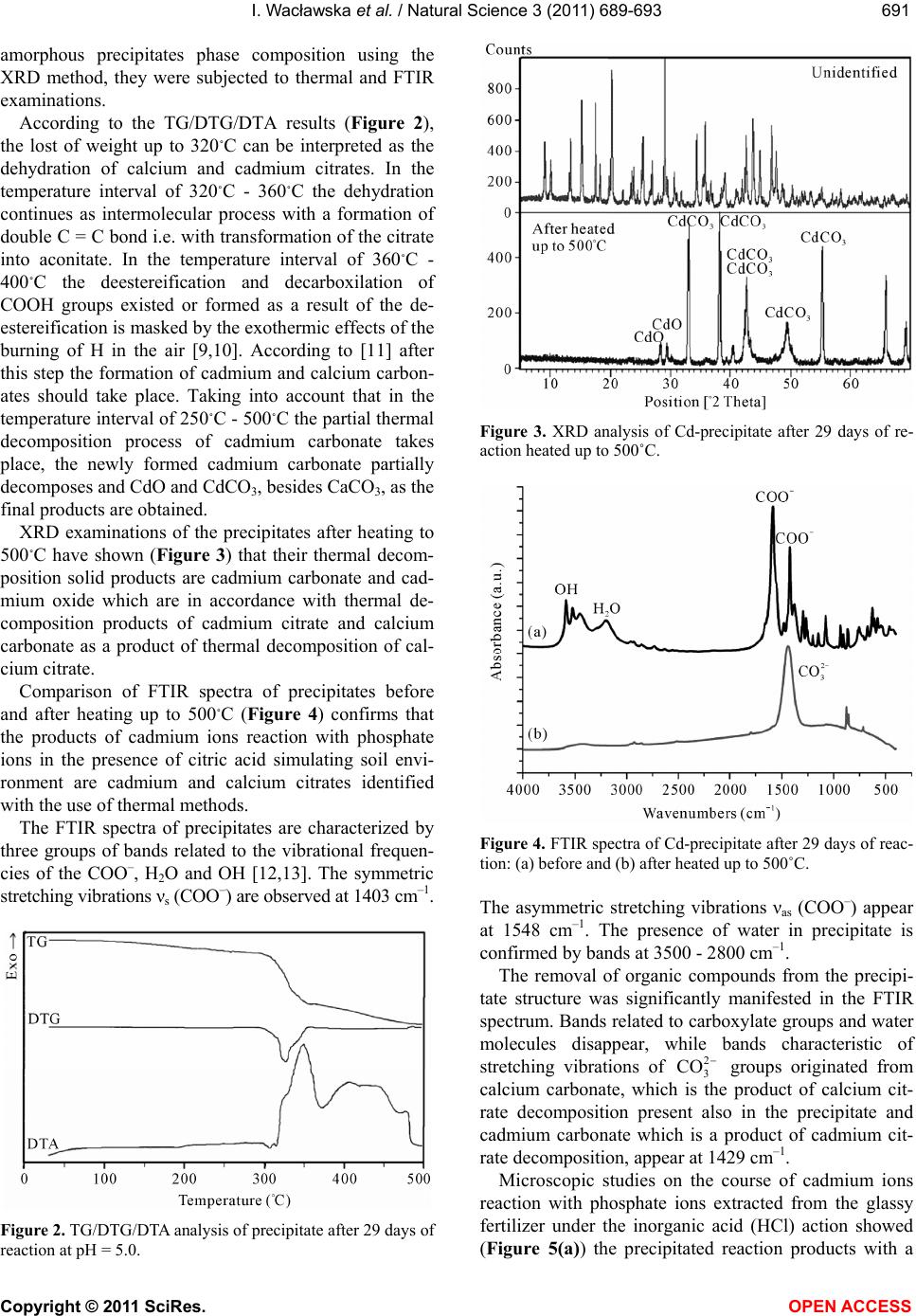 I. Wacławska et al. / Natural Science 3 (2011) 689-693 Copyright © 2011 SciRes. OPEN ACCESS 691691 amorphous precipitates phase composition using the XRD method, they were subjected to thermal and FTIR examinations. According to the TG/DTG/DTA results (Figure 2), the lost of weight up to 320˚C can be interpreted as the dehydration of calcium and cadmium citrates. In the temperature interval of 320˚C - 360˚C the dehydration continues as intermolecular process with a formation of double C = C bond i.e. with transformation of the citrate into aconitate. In the temperature interval of 360˚C - 400˚C the deestereification and decarboxilation of COOH groups existed or formed as a result of the de- estereification is masked by the exothermic effects of the burning of H in the air [9,10]. According to [11] after this step the formation of cadmium and calcium carbon- ates should take place. Taking into account that in the temperature interval of 250˚C - 500˚C the partial thermal decomposition process of cadmium carbonate takes place, the newly formed cadmium carbonate partially decomposes and CdO and CdCO3, besides CaCO3, as the final products are obtained. XRD examinations of the precipitates after heating to 500˚C have shown (Figure 3) that their thermal decom- position solid products are cadmium carbonate and cad- mium oxide which are in accordance with thermal de- composition products of cadmium citrate and calcium carbonate as a product of thermal decomposition of cal- cium citrate. Comparison of FTIR spectra of precipitates before and after heating up to 500˚C (Figure 4) confirms that the products of cadmium ions reaction with phosphate ions in the presence of citric acid simulating soil envi- ronment are cadmium and calcium citrates identified with the use of thermal methods. The FTIR spectra of precipitates are characterized by three groups of bands related to the vibrational frequen- cies of the COO–, H2O and OH [12,13]. The symmetric stretching vibrations νs (COO–) are observed at 1403 cm–1. Figure 2. TG/DTG/DTA analysis of precipitate after 29 days of reaction at pH = 5.0. Figure 3. XRD analysis of Cd-precipitate after 29 days of re- action heated up to 500˚C. Figure 4. FTIR spectra of Cd-precipitate after 29 days of reac- tion: (a) before and (b) after heated up to 500˚C. The asymmetric stretching vibrations νas (COO–) appear at 1548 cm–1. The presence of water in precipitate is confirmed by bands at 3500 - 2800 cm–1. The removal of organic compounds from the precipi- tate structure was significantly manifested in the FTIR spectrum. Bands related to carboxylate groups and water molecules disappear, while bands characteristic of stretching vibrations of 2 3 CO groups originated from calcium carbonate, which is the product of calcium cit- rate decomposition present also in the precipitate and cadmium carbonate which is a product of cadmium cit- rate decomposition, appear at 1429 cm–1. Microscopic studies on the course of cadmium ions reaction with phosphate ions extracted from the glassy fertilizer under the inorganic acid (HCl) action showed (Figure 5(a)) the precipitated reaction products with a 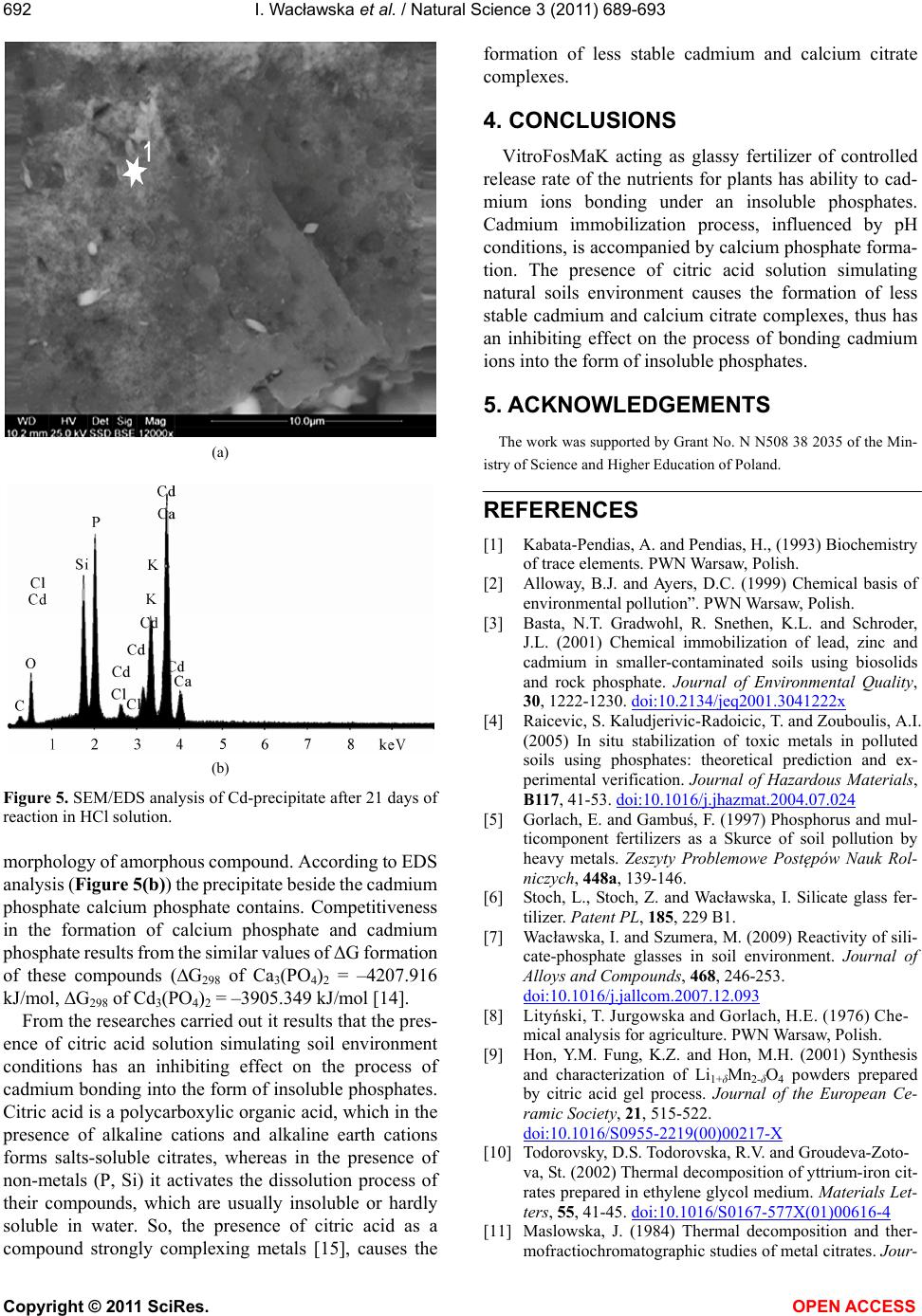 I. Wacławska et al. / Natural Science 3 (2011) 689-693 Copyright © 2011 SciRes. OPEN ACCESS 692 (a) (b) Figure 5. SEM/EDS analysis of Cd-precipitate after 21 days of reaction in HCl solution. morphology of amorphous compound. According to EDS analysis (Figure 5(b)) the precipitate beside the cadmium phosphate calcium phosphate contains. Competitiveness in the formation of calcium phosphate and cadmium phosphate results from the similar values of ΔG formation of these compounds (∆G298 of Ca3(PO4)2 = –4207.916 kJ/mol, ∆G298 of Cd3(PO4)2 = –3905.349 kJ/mol [14]. From the researches carried out it results that the pres- ence of citric acid solution simulating soil environment conditions has an inhibiting effect on the process of cadmium bonding into the form of insoluble phosphates. Citric acid is a polycarboxylic organic acid, which in the presence of alkaline cations and alkaline earth cations forms salts-soluble citrates, whereas in the presence of non-metals (P, Si) it activates the dissolution process of their compounds, which are usually insoluble or hardly soluble in water. So, the presence of citric acid as a compound strongly complexing metals [15], causes the formation of less stable cadmium and calcium citrate complexes. 4. CONCLUSIONS VitroFosMaK acting as glassy fertilizer of controlled release rate of the nutrients for plants has ability to cad- mium ions bonding under an insoluble phosphates. Cadmium immobilization process, influenced by pH conditions, is accompanied by calcium phosphate forma- tion. The presence of citric acid solution simulating natural soils environment causes the formation of less stable cadmium and calcium citrate complexes, thus has an inhibiting effect on the process of bonding cadmium ions into the form of insoluble phosphates. 5. ACKNOWLEDGEMENTS The work was supported by Grant No. N N508 38 2035 of the Min- istry of Science and Higher Education of Poland. REFERENCES [1] Kabata-Pendias, A. and Pendias, H., (1993) Biochemistry of trace elements. PWN Warsaw, Polish. [2] Alloway, B.J. and Ayers, D.C. (1999) Chemical basis of environmental pollution”. PWN Warsaw, Polish. [3] Basta, N.T. Gradwohl, R. Snethen, K.L. and Schroder, J.L. (2001) Chemical immobilization of lead, zinc and cadmium in smaller-contaminated soils using biosolids and rock phosphate. Journal of Environmental Quality, 30, 1222-1230. doi:10.2134/jeq2001.3041222x [4] Raicevic, S. Kaludjerivic-Radoicic, T. and Zouboulis, A.I. (2005) In situ stabilization of toxic metals in polluted soils using phosphates: theoretical prediction and ex- perimental verification. Journal of Hazardous Materials, B117, 41-53. doi:10.1016/j.jhazmat.2004.07.024 [5] Gorlach, E. and Gambuś, F. (1997) Phosphorus and mul- ticomponent fertilizers as a Skurce of soil pollution by heavy metals. Zeszyty Problemowe Postępów Nauk Rol- niczych, 448a, 139-146. [6] Stoch, L., Stoch, Z. and Wacławska, I. Silicate glass fer- tilizer. Patent PL, 185, 229 B1. [7] Wacławska, I. and Szumera, M. (2009) Reactivity of sili- cate-phosphate glasses in soil environment. Journal of Alloys and Compounds, 468, 246-253. doi:10.1016/j.jallcom.2007.12.093 [8] Lityński, T. Jurgowska and Gorlach, H.E. (1976) Che- mical analysis for agriculture. PWN Warsaw, Polish. [9] Hon, Y.M. Fung, K.Z. and Hon, M.H. (2001) Synthesis and characterization of Li1+δMn2-δO4 powders prepared by citric acid gel process. Journal of the European Ce- ramic Society, 21, 515-522. doi:10.1016/S0955-2219(00)00217-X [10] Todorovsky, D.S. Todorovska, R.V. and Groudeva-Zoto- va, St. (2002) Thermal decomposition of yttrium-iron cit- rates prepared in ethylene glycol medium. Materials Let- ters, 55, 41-45. doi:10.1016/S0167-577X(01)00616-4 [11] Maslowska, J. (1984) Thermal decomposition and ther- mofractiochromatographic studies of metal citrates. Jour-  I. Wacławska et al. / Natural Science 3 (2011) 689-693 Copyright © 2011 SciRes. OPEN ACCESS 693693 nal of Thermal Analysis and Calorimetry, 29, 895-904. doi:10.1007/BF02188835 [12] Todorovsky, D.S. Getsova, M.M. and Vasileva, M.A. (2002) Thermal decomposition of lanthanum-titanium citric complexes prepared from ethylene glycol medium. Journal of Materials Science, 37, 4029-4039. doi:10.1023/A:1019600815906 [13] Silva, M.F.M. Matos, J.R. and Isolani, P.C. (2008) Syn- thesis, characterization and thermal analysis of 1:1 and 2:3 lanthanide(III) citrates. Journal of Thermal Analysis and Calorimetry, 94, 305-311. doi:10.1007/s10973-007-8906-x [14] Knacke, O. Kubaschewski, K. and Hesselman, I. (1973) Thermochemical properties of inorganic substances. Spr- inger Verlag, Berlin. [15] Wyrzykowski, D. Czupryniak, J. and Ossowski, T. (2010) Thermodynamic interactions of the alkaline earth metal ions with citric acid. Journal of Thermal Analysis and Calorimetry, 102, 149-154. doi:10.1007/s10973-010-0970-y |