

Paper Menu >>
Journal Menu >>
 Materials Sciences and Applicatio n, 2011, 2, 946-949 doi:10.4236/msa.2011.27126 Published Online July 2011 (http://www.SciRP.org/journal/msa) Copyright © 2011 SciRes. MSA Studying of Diffusion of the Titan in Corundum Ceramics Vladimir Gurin1, Lev Derkachenko1, Marcus Schmidt2, Ulrich Burkhardt2, Juri Grin2 1Ioffe Physical-Technical Institute of Russian Academy of Sciences, St Petersburg, Russian Federation; 2Max Planck Institute for Chemical Physics of Solids, Dresden, Germany. Email: [email protected] Received December 30th, 2010; revised March 28th, 2011; accepted May 10th, 2011. ABSTRACT For increase in hardness (durability) and fire resistance (stability to melts metals) corundum ceramics on the basis of Al2O3 authors of the present work have suggested to protect for the first time its surface stronger and fire-resistant cov- erings, for example, from TiB2. In work results of high-temperature diffu sion TiB2 in a surface of plates from Al2O3 are shown. For the first time the cathodoluminescen ce (CL) method for identification and a conditio n of atom Ti after diffu- sion is used, in for an establishment of its quan tity electron probe microa nalysis (EPMA). Durability increa se defin ed a method microindentification b y means of a pyra mid of Knoop and strength at a bend . Researches have shown perspec- tivity of ha rdening of a surface corun dum ceramics and use of the above-stated method s for studying of results of diffu- sion. Keywords: Corundum Ceramics, Covering from Titanium Diboride, Catodolumin e scence 1. Introduction Modern the materials technology is characterized by search new and optimization of known ceramic composi- tions (in a general sense–compounds of metals with nonmetals). The basic share thus make oxides materials, though the quantity oxygen-free (on the basis of oxy- gen-free refractory compounds-borides, carbides, nitrides and silicides of metals and nonmetals) ceramics recently increases. Are used thus and various protective a cover- ing for ceramics [1-4], including oxides. So, in work [4], for example, for increase stable properties of a composite on the basis of corundum coverings from TiB2, ZrС, B4C, and WC have been used. As it is known, one of the strongest and cheap ceramic is the ceramics on the basis of sapphire. One of ways of its further increase durability and fire-resistant properties is introduction in its surface of strengthening impurity a method of high-temperature diffusion. Thus, as have shown researches, such coverings co-operate at a heat with a surface of such composite, partially or completely turning to difficult compounds and solid solutions—depending on a thickness of a cov- ering, a way of its drawing and the subsequent thermal processing. There is a formation of various zones on depth, in which diffusion covering elements, as a rule, their components-metals. 2. Materials and Methods 2.1. Materials In the present work diffusion Ti in ceramics on the basis of pure sapphire has been investigated. Layer TiB2 has been put on a surface of ceramic plates (5 × 5 × 1 cm), and then they have been subjected thermal processing in argon atmosphere at 1500˚C - 1700˚C during ~ 27 - 48 hours. As a result in sofis a layer some zones on depth to 500 micron and more, containing various quantities Ti (Figure 1) were formed. Zones consist of sapphire grains the part from which is covered by a layer containing Ti. Thus in such layer probably formation of various com- pounds and the solid solutions [4], which identification presents considerable difficulties. 2.2. Research Diffusion a Layer in Ceramics Samples of such ceramics after high-temperature diffu- sion have been investigated by electron probe micro- analysis (EPMA), local visible cathodoluminescence (CL) and microindenting by means of a pyramid of Knoop and strength at a bend. 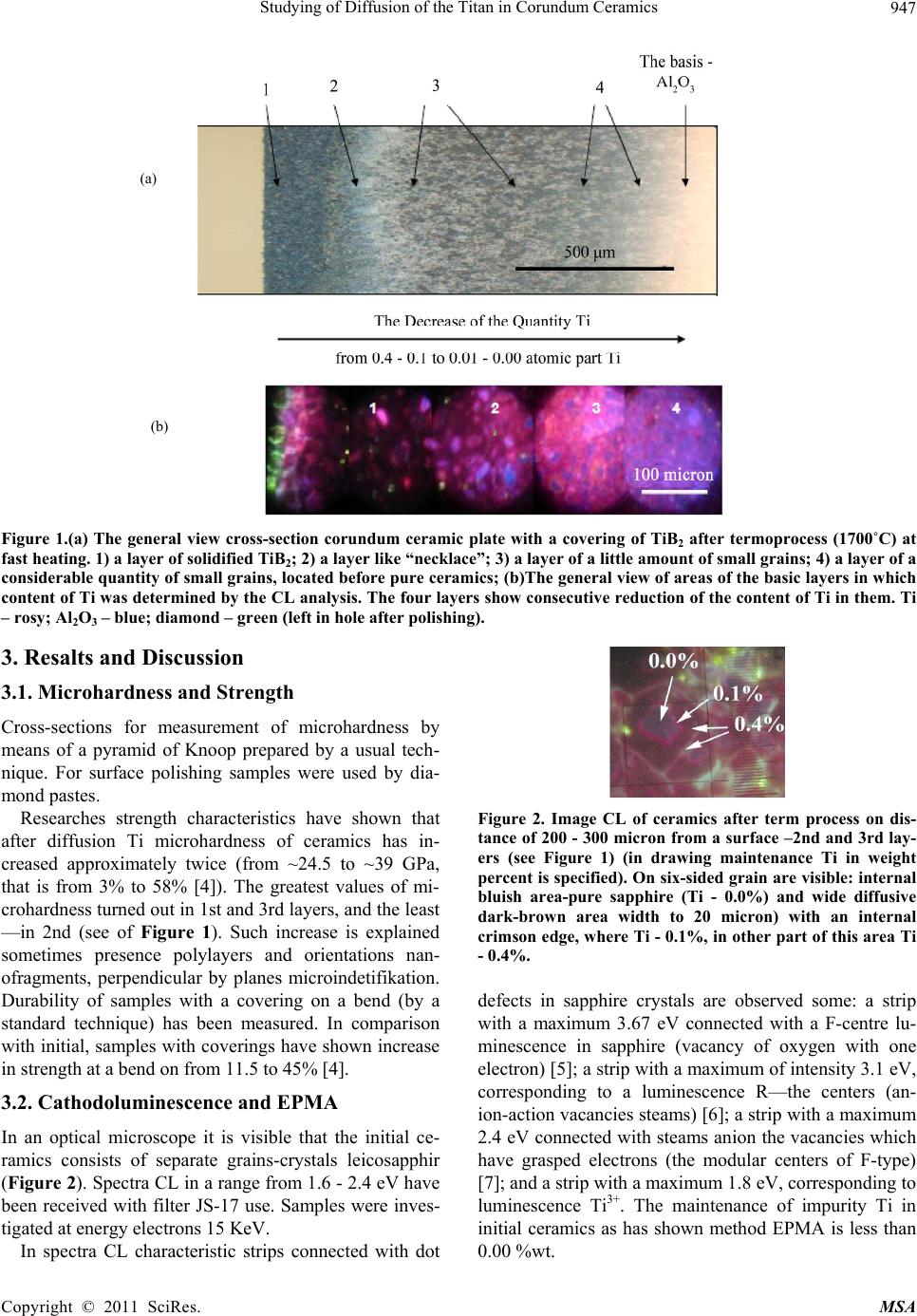 Studying of Diffusion of the Titan in Corundum Ceramics 947 (a) (b) Figure 1.(a) The general view cross-section corundum ceramic plate with a covering of TiB2 after termoprocess (1700˚C) at fast heating. 1) a layer of solidified TiB2; 2) a layer like “necklace”; 3) a layer of a little amount of small grains; 4) a layer of a considerable quantity of small grains, located before pure ceramics; (b)The general view of areas of the basic layers in which content of Ti was determined by the CL analysis. The four layers show consecutive reduction of the content of Ti in them. Ti – rosy; Al2O3 – blue; diamond – green (left in hole after polishing). 3. Resalts and Discussion 3.1. Microhardness and Strength Cross-sections for measurement of microhardness by means of a pyramid of Knoop prepared by a usual tech- nique. For surface polishing samples were used by dia- mond pastes. Researches strength characteristics have shown that after diffusion Ti microhardness of ceramics has in- creased approximately twice (from ~24.5 to ~39 GPa, that is from 3% to 58% [4]). The greatest values of mi- crohardness turned out in 1st and 3rd layers, and the least —in 2nd (see of Figure 1). Such increase is explained sometimes presence polylayers and orientations nan- ofragments, perpendicular by planes microindetifikation. Durability of samples with a covering on a bend (by a standard technique) has been measured. In comparison with initial, samples with coverings have shown increase in strength at a bend on from 11.5 to 45% [4]. 3.2. Cathodoluminescence and EPMA In an optical microscope it is visible that the initial ce- ramics consists of separate grains-crystals leicosapphir (Figure 2). Spectra CL in a range from 1.6 - 2.4 eV have been received with filter JS-17 use. Samples were inves- tigated at energy electrons 15 KeV. In spectra CL characteristic strips connected with dot Figure 2. Image CL of ceramics after term process on dis- tance of 200 - 300 micron from a surface –2nd and 3rd lay- ers (see Figure 1) (in drawing maintenance Ti in weight percent is specified). On six-sided grain are visible: internal bluish area-pure sapphire (Ti - 0.0%) and wide diffusive dark-brown area width to 20 micron) with an internal crimson edge, where Ti - 0.1%, in other part of this area Ti - 0.4%. defects in sapphire crystals are observed some: a strip with a maximum 3.67 eV connected with a F-centre lu- minescence in sapphire (vacancy of oxygen with one electron) [5]; a strip with a maximum of intensity 3.1 eV, corresponding to a luminescence R—the centers (an- ion-action vacancies steams) [6]; a strip with a maximum 2.4 eV connected with steams anion the vacancies which have grasped electrons (the modular centers of F-type) [7]; and a strip with a maximum 1.8 eV, corresponding to luminescence Ti3+. The maintenance of impurity Ti in initial ceramics as has shown method EPМА is less than 0.00 %wt. Copyright © 2011 SciRes. MSA  Studying of Diffusion of the Titan in Corundum Ceramics 948 After carrying out of high-temperature diffusion in CL the image it is possible to allocate some the characteristic areas located on various depths from a surface. In the area located deep into on 500 micron large grains with the expressed gradient of maintenance Ti (Figure 2) were observed. Apparently, in this area Ti got into grains on depth to 20 micron. In the centre of the majority of grains there were “single crystal” part of pure sapphire with zero maintenance Ti. Luminescent properties of the allocated areas in grains (Figure 3) have been investigated. In spectra of sapphire ceramics are allocated a strip with a maximum 3.65 eV and a strip with a maximum 1.8 eV. For a strip with a maximum 1.8 eV concentration dependence (Figure 4) has been constructed. On depth more than 500 micron from a surface the in- 1,6 1,82,0 2,2 0 1000 2000 0.4%wt. energy, eV 0 1000 2000 0.0%wt 0.1%wt 0 1000 2000 CL intensity , a . u . Figure 3. Spectra CL of areas in ceramics with various maintenance Ti. 0,0 0,2 0,4 0,6 0,8 1,0 1,2 0 200 400 % wt. CL intensity, a.u. Figure 4. Dependence of intensity CL of a strip with a maximum 1.8 eV from maintenance Ti in the investigated micro volume. tegrated grains of ceramics also are observed. In this case Ti diffusion in grains on depth no more than 5 microns (Figure 5). On depth more than 3 mm from a surface maintenance Ti corresponded to initial ceramics, i.e., 0.00% wt. Comparison (on the area of crimson coloring) CL pic- tures of the crystal sapphire initially alloyed Ti (with the maintenance nearby 1% wt., the Figure 6) with the above-stated pictures of distribution Ti in crystal grains (Figure 2 see and Figure 5) shows volume alloying Ti the grains in the crystal sample and superficial alloying on some depth of grains of ceramics from a covering. Depth of diffusion Ti in ceramics volume (to 1 - 3 mm depending on time of heat treatment and a thickness of a covering from TiB2) on usages exceeds depth of diffu- sion Ti in single crystal grain of sapphire under the same conditions. This anomaly is caused by that diffusion Ti passes in ceramics on intersize to borders. Then from borders of grains there is diffusion Ti to their centre on internal dispositions and cracks (area to maintenance Ti of 0.4% wt.). Ti reachesborder of single crystal grain of sapphire with the low maintenance of dispositions and- diffusion on depth of an order of 1 micron (maintenance Ti in this area of 0.1% wt.). In the grain centre zero- maintenance Ti remains. 0.0% wt. 0.1% wt. CL intensity, a.u. 0.4% wt. Figure 5. Image CL of ceramics after term process on dis- tance more than 500 microns from a surface (in the end of 3rd layer—see Figure 1). Grains with dark-blue the mid- dle (Ti - 0.0%) and sites with diffuse Ti - from 0.2 to 0.4% and no more than 5 micron are visible width. Energy, eV Figure 6. General view CL of a picture of single crystal grains of the sapphire alloyed Ti (~1% wt.). Uniform dis- tribution Ti is characterized by uniform coloring of grains. Copyright © 2011 SciRes. MSA  Studying of Diffusion of the Titan in Corundum Ceramics Copyright © 2011 SciRes. MSA 949 4. Summary Thus, in the present work results of high-temperature diffusion Ti from TiB2 in a surface pure corundum ce- ramics for the first time are shown: 1) depending on a temperature mode it is formed dif- fusions a layer with various depth (to 500 µm - 3 mm) in which some zones differ; 2) at transition from a surface deep into the sample, maintenance Ti in zones decreases with ~0.4 to 0.00% wt. (It is established with the help visible cathodelumines- cence); 3) also can be defined and depth of penetration Ti in a surface of grains of sapphire in the form of ion Ti+3 (it is maximum to 20 µm, CL); 4) Knoop microhardness after thermodiffusion in- creases more, than in 1.5 times. Samples with coverings have shown increase in strength at a bend on from 11.5% to 45% [4] in compari- son with initial samples. In summary it is possible to notice that there are real prospects of improvement of physicomechanical proper- ties of a surface of ceramics for the account of ceramic coverings with the improved properties. 5. Acknowledgements Authors consider as the pleasant debt to express gratitude to doctors M. V. Zamoryanskaya, E. V. Ivanova, and V. M. Krymov for the help in work. REFERENCES [1] “Materials Technology of Refractory Compounds: Achie- vements and Problems,” Proceedings of Grigorij V. Sam- sonov Member, Internal Conferences, Frantsevich Insti- tute for Problems of Materials Science of National Academy of Sciences of Ukraine, Kiev, Ukraine, 27-29 May 2008, 224 Pages (in Russian). [2] G. V. Kalinnikov, R. A. Andrievsky, V. N. Kopylov and D. Louzguine, “Properties Nanostructural and Amor- phous Films of System TiB2-B4C,” Physics of the Solid State, Vol. 50, No. 2, 2008, pp. 360-363 (in Russian). [3] I. A. Podchernjaeva, “Structure and Properties of Com- posite Electrospark, Laser and Magnetron Deposited AlN –TiB2 Coatings,” Powder Metallurgy and Metal Ceram- ics, Vol. 40, No. 9-10, 2001, pp. 501-508. (in Russian). [4] V. N. Gurin, A. B. Sinani, L. I. Derkachenko, V. A. Trunov, G. P. Zajtsev and V. M. Krymov, “Some Ways of Hardening of a Surface Corundum Ceramics,” Refrac- tories and Industrial Ceramics, No. 8, 2008, pp. 47-53. (in Russian). [5] V. S. Kortov, I. I. Milman, S. V. Nikiforov and V. E. Pelenev, “The Mechanism of a Luminescence of the F-Centers in Anion-Defective Single Crystals Aluminum Ocsid,” Physics of the Solid State, Vol. 45, No. 7, 2003, pp. 1202-1208. (in Russian). [6] A. V. Puyats, M. J. Springis and J. A. Valbis, “On the Nature of the Violet Luminescence in Quenche α-Al2O3 Single Crystals,” Physica Status Solidi (A), Vol. 62, 1980, pp. 85-87. doi:10.1002/pssa.2210620162 [7] M. J. Springis and J. A. Valbis, “Visible Luminescence of Colour Centres in Sapphire,” Physica Status Solidi (B), Vol. 123, 1984, pp. 335-343. doi:10.1002/pssb.2221230136 |