

Paper Menu >>
Journal Menu >>
 Materials Sciences and Applicatio n, 2011, 2, 771-776 doi:10.4236/msa.2011.27106 Published Online July 2011 (http://www.SciRP.org/journal/msa) Copyright © 2011 SciRes. MSA Studies on Interacting Blends of Acrylated Epoxy Resin Based Poly(Ester-Amide)s and Vinyl Ester Resin Pragnesh N. Dave1*, Nikul N. Patel2 1Department of Chemistry, KSKV Kachchha University, Gujarat, India; 2Institute of Technology, Nirma University, Ahmedabad, India. E-mail: [email protected] Received January 24th, 2011; revised March 23rd, accepted May 27th, 2011. ABSTRACT Epoxy resin based Unsaturated poly(ester-amide) resins (UPEAs) can be prepared by many methods but here these were prepared by reported method [1]. These UPEAs were then treated with acrylotl chloride to afford acrylated UPEAs resin (i.e. AUPEAs). Interacting blends of equal proportional AUPEAs and vinyl ester epoxy (VE) resin were prepared. APEAs and AUPEAs were characterized by elemental analysis, molecular weight determined by vapour pressure osmometer and by IR spectral study and by thermogravimetry. The curing of interacting blends was monitored on differential scanning calorimeter (DSC). Based on DSC data in situ glass reinforced composites of the resultant blends have been prepared and characterized for mechanical, electrical and chemical properties. Unreinforced blends were characterized by thermogravimetry (TGA). Keywords: Unsaturated Bisamic Acid, Epoxy Resin, Unsaturated Poly(Ester-Amide) Resin (Upeas), Acrylation, Vinyl Ester (VE) Resin, Differential Scanning Calorimetry, Thermogarvimetry, Glass Reinforced Compos ites 1. Introduction Both the polyesters and polyamides discussed have par- ticular individual properties and applications. Hence many researchers have synthesized co-poly (ester-am- ide)s from different raw materials in order to obtain the properties and applications of the individual ones into one segment. Some of the poly (ester-amide)s synthe- sized by different researchers. The three polymer candi- dates namely epoxy resin, unsaturated poly ester and polyamides are most widely versatile industrial materials and have broad spectrum of characteristics for wide ap- plications ranging from aerospace to micro electronics. They are also important as laminating resins, moulding composites, fibers, films, surface coating resins, fiber cushion [3,4]. Particularly Polyamides material used in the form of fibers as especially thermoplastics of par- ticular used in engineering applications. The glass fiber reinforced nylon plastics are now of substantial impor- tance due to rigidity and creep resistance. Polyamides are also used in fiber application, automotive industries, valve covers, coatings [5,6]. Merging of all three segments (i.e. epoxy, ester and amide) into saturated and unsaturated polymer chain has been recently reported from our Indian scientists [7-10]. Certain properties of resins may also be improved via interact of with the other unsaturated resin is another possibility. In order to improve certain properties of such reported USPEAs their blending with commercial vinyl ester epoxy resin is possible. While vinyl ester resin is versatile industrial resin today [11,12] Hence the present paper comprises studies of interacting blending of re- ported unsaturated poly(ester-amide) resin with vinyl ester (VE) resin. The glass fiber reinforced composites of these blends have been fabricated and characterized by chemical, mechanical and electrical properties. The whole work is scanned in Scheme 1. 2. Materials and Methods 2.1. Materials Commercially available epoxy resin, diglycidyl ether of bisphenol-A and vinyl ester epoxy resin was obtained from local market. The specification of diglycidyl ether of bisphenol-A (DGEBA) are as follows: 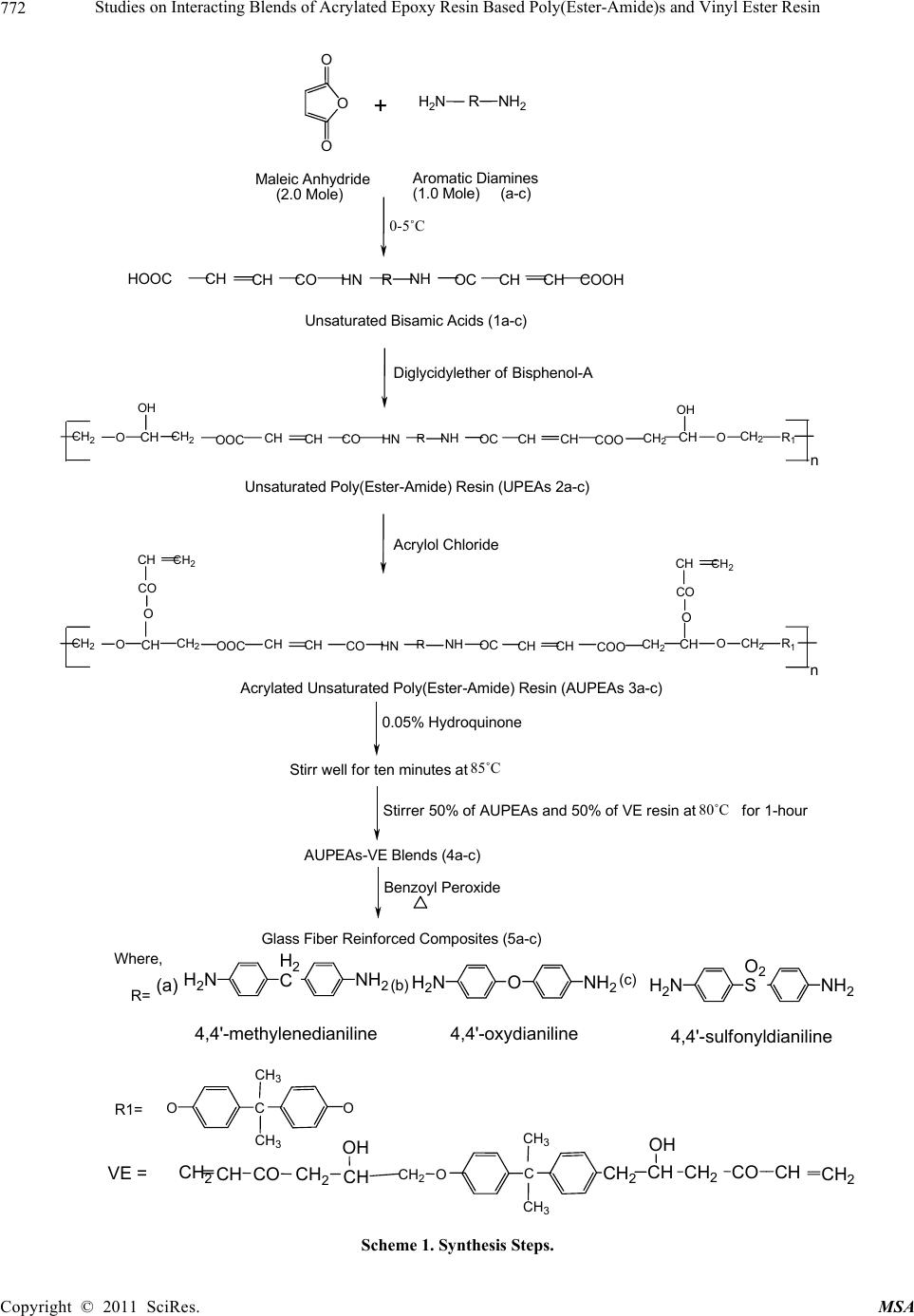 Studies on Interacting Blends of Acrylated Epoxy Resin Based Poly(Ester-Amide)s and Vinyl Ester Resin Copyright © 2011 SciRes. MSA 772 O O O +H2NNH2 Maleic Anhydride (2.0 Mole) 0-5 0C HOOC CH CH OC CO HNNH CH CH COOH Unsaturated Bisamic Acids(1a-c) Diglycidylether of Bisphenol-A CH CH OC CO HNNH CH CH OOC COO CH2CH2 CH OH OR1 n Unsaturated Poly(Ester-Amide) Resin (UPEAs 2a-c) R Aromatic Diamines (1.0 Mole)(a-c) Acrylol Chloride O CO CH CH2 Acrylated Unsaturated Poly(Ester-Amide) Resin (AUPEAs 3a-c) Benzoyl Peroxide 0.05% Hydroquinone Stirr well forten minutes at 850C AUPEAs-VE Blends (4a-c) Glass Fiber Reinforced Composites (5a-c) Stirrer 50% of AUPEAs and 50% of VE resin atfor 1-hour Where, (b) (c) R= R1= C CH3 CH3 O O CH2 CH OH O CH2 CH CH OC CO HNNHCH CH OOC COO CH2CH2 CH OR1 80 0C CH2 CH O CH2 O CO CH CH2 n VE =C CH3 CH3 O CH2CH2CH CH2CO CHCH2 OH CH CH2 CO CH CH2 OH 0-5˚C R R R 85˚C 80˚C H2 CO2 S NH2 H2N 4,4'-methylenedianiline O H2NNH2H2NNH2 4,4'-oxydianiline 4,4'-sulfonyldianiline (a) Scheme 1. Synthesis Steps.  Studies on Interacting Blends of Acrylated Epoxy Resin Based Poly(Ester-Amide)s and Vinyl Ester Resin 773 1) Epoxy equivalent weight, 190. 2) Viscosity 40 - 100 poise at 25˚C. 3)Density at 25˚C, 1.16 - 1.17 g/cm. Vinyl ester epoxy. The aromatic diamines used for the preparation of un- saturated poly(ester-amide) resin are, 1) 4,4’-methylenedianiline 2) 4,4’-oxydianiline 3) 4,4’-sulfonyldianiline Plain weave fibers, in the form of E-glass woven fab- ric (poly (ester-amide) compatible) 0.25 mm thick (Un- nati Chemicals, India) of a real weight 270 g·m–2 were used for composite fabrication. All other chemicals used were of pure grade. 2.2. Synthesis of Unsaturated Bisamic Acids The unsaturated bisamic acid was prepared by a simple addition reaction of maleic anhydride and diamines. These were prepared by using method reported in the literature [7,8]. The general procedure for the synthesis of unsaturated bisamic acid is as follows. To a well-stirred solution of maleic anhydride (2.0 mole) in dry acetone, the solution of diamine (1.0 mole) in dry acetone was gradually added at 0˚C -5˚C within 30 minutes. After complete addition of the diamine, the re- action mixture was further stirred for half an hour at room temperature. The resulting unsaturated bisamic acid was then filtered, washed with dry acetone and air-dried. Unsaturated bisamic acid was obtained in the form of free flowing powder. The reaction scheme for the syn- thesis of unsaturated bisamic acid is shown in Scheme 1. 2.3. Synthesis of Unsaturated Poly(Ester-Amide) Resin and Acrylated Poly(Ester-Amide) Resin The unsaturated poly(ester-amide) resin (UPEAs) was prepared by following the same method reported in [7,8] The general procedure is as follows: Diglycidylether of Bisphenol-A (DGEBA) (1.0 mole) and unsaturated bisamic acid (1.0 mole) were charged in three necked flask equipped with a mechanical stirrer. The unsaturated bisamic acid was then treated with di- glycidylether of Bisphenol-A according to method re- ported for reaction of epoxy resin and carboxylic group [13]. To this 8.0% of the total weight of above, triethyl- amine (TEA) was added as a base catalyst. The reaction mixture was slowly heated up to 85˚C with continuous stirring till the acid value fell below 60 mg KOH/gm. The resultant resin was then discharged and called un- saturated poly(ester-amide) resin (UPEAs) and their de- tails are furnished in Table 1. Further reaction of all these unsaturated poly(ester-amide) resin (UPEAs) was carried out with acryloyl chloride (i.e. acrylation) and the resultant products called acrylated poly(ester-amide)s (APEAs) and their details are furnished in Table 2. 2.4. Synthesis of Acrylated Poly(Ester-Amide) Resin and Vinyl Ester Resin Blend When the acid value of acrylated poly(ester-amide)s fell below 55 mg KOH/gm, 0.05% of hydroquinone was added as an inhibitor. The whole reaction stirred well for ten minutes maintaining the temperature at 85˚C. Then add 50% of APEAs and 50% of vinyl ester (VE) resin was added and stirred well at 80˚C for one hour. The resultant APEAs-VE blends were obtained in the form of viscous syrup. 3. Analysis and Thermal Study 3.1. Elemental Analysis The C, H, N content of unsaturated poly(ester-amide)s (UPEAs) and acrylated poly(ester-amide)s (APEAs) was estimated by means of Thermofinagan 1101 flash ele- Table 1. Characterization of UPEAs (2a-c). Elemental analysis (Wt%) Calc. / (Found) UPEAs %C %H %N No. of –OH group per repeating unit Number average molecular weight (Mn ) ± 60 2a 65.62/64.23 5.72/5.50 6.43/5.83 1.96 3902 2b 64.06/63.83 5.20/4.86 3.64/3.15 1.82 3828 2c 60.29/60.12 4.90/4.63 3.43/3.05 1.81 4206 Table 2. Characterization of AUPEAs (3a-c). Elemental analysis (Wt%) Calc. / (Found) AUPEAs %C %H %N No. of double bonds per repeating unit Number average mo- lecular weight (Mn) ± 60 3a 65.75/65.37 5.74/5.48 3.19/2.63 3.91 4133 3b 64.38/63.87 5.02/4.70 3.19/2.91 3.76 4135 3c 63.22/62.88 4.93/4.62 3.13/2.61 3.81 4428 Copyright © 2011 SciRes. MSA  Studies on Interacting Blends of Acrylated Epoxy Resin Based Poly(Ester-Amide)s and Vinyl Ester Resin 774 mental analyzer (Italy). The IR spectra were recorded in Kerr pellets on a Nicollet 760 D spectrometer. The num- ber average weight of unsaturated poly(ester-amide)s (UPEAs) and acrylated poly(ester-amide)s (APEAs) was estimated by non-aqueous conductometric titration fol- lowing by method reported in the literature [14]. Pyridine was used as a solvent and tetra-n-butyl ammonium hy- droxide was used as a titrant. 3.2. Thermal Study Curing of all APEAs-VE blends were carried out on a differential scanning calorimeter (DSC) by using benzoyl peroxide as a catalyst. A Du Pont 900 DSC was used for this study. The instrument was calibrated using standard indium metal with known heat of fusion (ΔH = 28.45 J/g). Curing was carried out from 30˚C - 300˚C at 10˚C min–1 heating rate. The sample weight used for this investiga- tion was in the range of 4 - 5 mg along with an empty reference cell. The results are furnished in Table 3. Unreinforced cured samples of APEAs-VE blends were subjected to thermogravimetric analysis (TGA) on Du Pont 950 thermo gravimetric analyzer in air at a heating rate of 10˚C min–1. The sample weight used for this investigation was in the range of 4 - 5 mg. The re- sults are furnished in Table 4. 4. Composite Fabrication The composites were prepared by using E-type of glass fiber. The glass fiber: APEAs-VE blend ratio is 60:40 (40% APEAs-VE blends). Suspensions of APEAs-VE blends were prepared in tetrahydrofuran (THF). In the above polymer suspension, 1% of ethylene dimethy- lacrylate (as a cross linking agent) with 0.05% benzoyl peroxide (as an initiator) were added and mixed well. The mixture was applied with a brush to a 200 mm × 200 mm glass cloth and the solvent was allowed to evaporate. The ten dried prepregs prepared in this way were then stacked one on top of another and pressed between steel plates coated with a “Teflon” film release sheet and compressed under 70 psi pressure. The prepregs stacks were cured by heating it in an autoclave oven at around 140˚C for about 6 hour. The composites so obtained were cooled to 45˚C - 50˚C before the pressure was released. 4.5. Composite Characterizations 4.5.1. Chemical Resistance Test The resistances against Chemicals of the composites were measured according to ASTM D 543. The results are furnished in Table 5. 4.5.2. Mechanical and Electrical Testing 1) The Flexural strength was measured according to ASTM D 790. 2) The Compressive strength was measured according to ASTM D 695. 3) The Impact strength was measured according to ASTM D 256. 4) The Rockwell hardness was measured according to ASTM D 785. 5) The Electrical strength was measured according to ASTM D 149. 6) The Tensile elongation was tested according to Table 3. DSC Curing of UAPEAs-Vinyl ester epoxy resin Blends (4a-c). Curing Temperature (˚C) UAPEAs-VE resin Blends Ti Tp Tf 4a 130 151 172 4b 116 147 174 4c 126 138 186 Table 4. TGA of Unreinforced Cured Samples of UAPEAs-Vinyl ester epoxy resin Blends (5a-c)-BPO system. % Weight loss at various temps. (˚C) from TGA UAPEAs-VE resin Blends 150˚C 300˚C 450˚C 600˚C 750˚C 5a 2.01 9.34 64.23 77.32 81.34 5b 1.87 9.21 68.56 76.63 79.34 5c 1.71 8.03 65.25 75.87 80.06 Table 5. Chemical, Mechanical and Electrical Properties of Composites Based on APEAs-MMA Blends. % Change on exposure to 25% (W/V) NaOH Composites Thickness Weight Compressive strength (MPa)Impact Strength (MPa)Rockwell hardness (R) Electrical strength (in air) (kV/mm) 5a 0.78 1.07 460 424 111 22.65 5b 0.81 1.10 467 456 104 19.45 5c 0.79 1.02 478 447 106 23.35 Copyright © 2011 SciRes. MSA 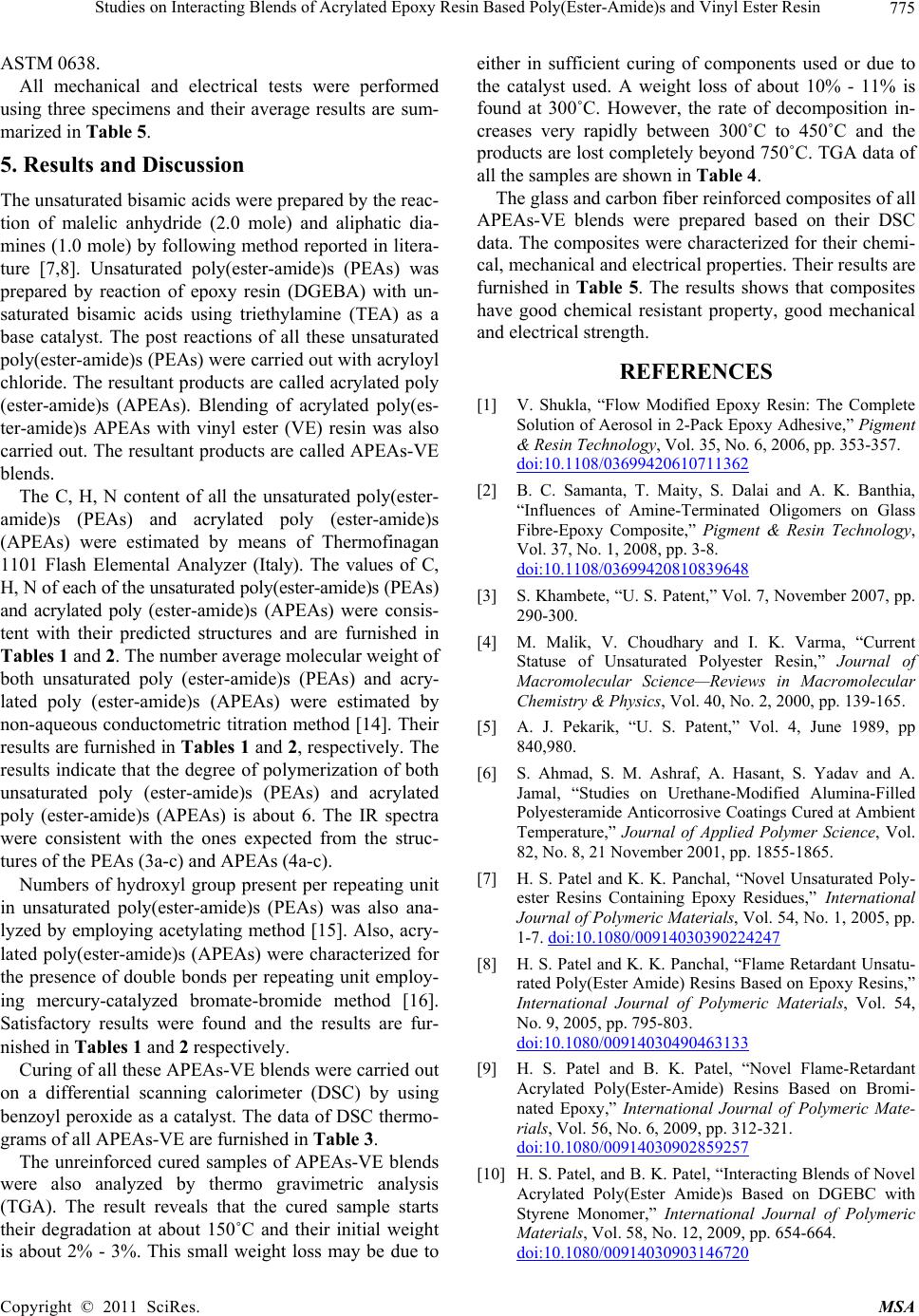 Studies on Interacting Blends of Acrylated Epoxy Resin Based Poly(Ester-Amide)s and Vinyl Ester Resin 775 ASTM 0638. All mechanical and electrical tests were performed using three specimens and their average results are sum- marized in Table 5. 5. Results and Discussion The unsaturated bisamic acids were prepared by the reac- tion of malelic anhydride (2.0 mole) and aliphatic dia- mines (1.0 mole) by following method reported in litera- ture [7,8]. Unsaturated poly(ester-amide)s (PEAs) was prepared by reaction of epoxy resin (DGEBA) with un- saturated bisamic acids using triethylamine (TEA) as a base catalyst. The post reactions of all these unsaturated poly(ester-amide)s (PEAs) were carried out with acryloyl chloride. The resultant products are called acrylated poly (ester-amide)s (APEAs). Blending of acrylated poly(es- ter-amide)s APEAs with vinyl ester (VE) resin was also carried out. The resultant products are called APEAs-VE blends. The C, H, N content of all the unsaturated poly(ester- amide)s (PEAs) and acrylated poly (ester-amide)s (APEAs) were estimated by means of Thermofinagan 1101 Flash Elemental Analyzer (Italy). The values of C, H, N of each of the unsaturated poly(ester-amide)s (PEAs) and acrylated poly (ester-amide)s (APEAs) were consis- tent with their predicted structures and are furnished in Tables 1 and 2. The number average molecular weight of both unsaturated poly (ester-amide)s (PEAs) and acry- lated poly (ester-amide)s (APEAs) were estimated by non-aqueous conductometric titration method [14]. Their results are furnished in Tables 1 and 2, respectively. The results indicate that the degree of polymerization of both unsaturated poly (ester-amide)s (PEAs) and acrylated poly (ester-amide)s (APEAs) is about 6. The IR spectra were consistent with the ones expected from the struc- tures of the PEAs (3a-c) and APEAs (4a-c). Numbers of hydroxyl group present per repeating unit in unsaturated poly(ester-amide)s (PEAs) was also ana- lyzed by employing acetylating method [15]. Also, acry- lated poly(ester-amide)s (APEAs) were characterized for the presence of double bonds per repeating unit employ- ing mercury-catalyzed bromate-bromide method [16]. Satisfactory results were found and the results are fur- nished in Tables 1 and 2 respectively. Curing of all these APEAs-VE blends were carried out on a differential scanning calorimeter (DSC) by using benzoyl peroxide as a catalyst. The data of DSC thermo- grams of all APEAs-VE are furnished in Table 3. The unreinforced cured samples of APEAs-VE blends were also analyzed by thermo gravimetric analysis (TGA). The result reveals that the cured sample starts their degradation at about 150˚C and their initial weight is about 2% - 3%. This small weight loss may be due to either in sufficient curing of components used or due to the catalyst used. A weight loss of about 10% - 11% is found at 300˚C. However, the rate of decomposition in- creases very rapidly between 300˚C to 450˚C and the products are lost completely beyond 750˚C. TGA data of all the samples are shown in Table 4. The glass and carbon fiber reinforced composites of all APEAs-VE blends were prepared based on their DSC data. The composites were characterized for their chemi- cal, mechanical and electrical properties. Their results are furnished in Table 5. The results shows that composites have good chemical resistant property, good mechanical and electrical strength. REFERENCES [1] V. Shukla, “Flow Modified Epoxy Resin: The Complete Solution of Aerosol in 2-Pack Epoxy Adhesive,” Pigment & Resin Technology, Vol. 35, No. 6, 2006, pp. 353-357. doi:10.1108/03699420610711362 [2] B. C. Samanta, T. Maity, S. Dalai and A. K. Banthia, “Influences of Amine-Terminated Oligomers on Glass Fibre-Epoxy Composite,” Pigment & Resin Technology, Vol. 37, No. 1, 2008, pp. 3-8. doi:10.1108/03699420810839648 [3] S. Khambete, “U. S. Patent,” Vol. 7, November 2007, pp. 290-300. [4] M. Malik, V. Choudhary and I. K. Varma, “Current Statuse of Unsaturated Polyester Resin,” Journal of Macromolecular Science—Reviews in Macromolecular Chemistry & Physics, Vol. 40, No. 2, 2000, pp. 139-165. [5] A. J. Pekarik, “U. S. Patent,” Vol. 4, June 1989, pp 840,980. [6] S. Ahmad, S. M. Ashraf, A. Hasant, S. Yadav and A. Jamal, “Studies on Urethane-Modified Alumina-Filled Polyesteramide Anticorrosive Coatings Cured at Ambient Temperature,” Journal of Applied Polymer Science, Vol. 82, No. 8, 21 November 2001, pp. 1855-1865. [7] H. S. Patel and K. K. Panchal, “Novel Unsaturated Poly- ester Resins Containing Epoxy Residues,”International Journal of Polymeric Materials, Vol. 54, No. 1, 2005, pp. 1-7. doi:10.1080/00914030390224247 [8] H. S. Patel and K. K. Panchal, “Flame Retardant Unsatu- rated Poly(Ester Amide) Resins Based on Epoxy Resins,” International Journal of Polymeric Materials, Vol. 54, No. 9, 2005, pp. 795-803. doi:10.1080/00914030490463133 [9] H. S. Patel and B. K. Patel, “Novel Flame-Retardant Acrylated Poly(Ester-Amide) Resins Based on Bromi- nated Epoxy,” International Journal of Polymeric Mate- rials, Vol. 56, No. 6, 2009, pp. 312-321. doi:10.1080/00914030902859257 [10] H. S. Patel, and B. K. Patel, “Interacting Blends of Novel Acrylated Poly(Ester Amide)s Based on DGEBC with Styrene Monomer,” International Journal of Polymeric Materials, Vol. 58, No. 12, 2009, pp. 654-664. doi:10.1080/00914030903146720 Copyright © 2011 SciRes. MSA  Studies on interacting Blends of Acrylated Epoxy Resin Based Poly(Ester-Amide)s and Vinyl Ester Resin Copyright © 2011 SciRes. MSA 776 [11] A. M. Atta, S. M. ElSaeed and R. M. Farag, “New Vinyl Ester Resins Based on Rosin for Coating Applications,” Reactive and Functional Polymer, Vol. 66 No. 12, De- cember 2006, pp. 1596-1608. [12] I. K. Varma, “Matrix Resin for Composite,” Department of Science and Technology Government of India, 1986, p. 148. [13] R. S. Darke, D. R. Egan and W. T. Murphy, “Elas- tomer-Modified Epoxy Resins in Coatings Applications,” ACS Symposium Series, Vol. 221, 1982, pp. 1-20. doi:10.1021/bk-1983-0221.ch001 [14] R. N. Patel and S. R. Patel, “Synthesis and Characteriza- tion of Poly(Keto-Amines). 1. Self Polycondensation of 4-Aminophenacyl Chloride,” Die Angewandte Makro- molekulare Chemie, Vol. 96 No. 1, May 1981, pp. 85-92. doi:10.1002/apmc.1981.050960107 [15] A. I. Vogel, “Quantitative Organic Analysis,” CBS Pub- lishers, New Delhi, Vol. 3, No. 2, 1998, pp. 677-679. [16] A. I. Vogel, “Quantitative Organic Analysis,” CBS Pub- lishers, New Delhi, Vol. 3 No. 2, 1998, pp. 765-766. |