

Paper Menu >>
Journal Menu >>
 Materials Sciences and Applicatio n, 2011, 2, 758-764 doi:10.4236/msa.2011.27104 Published Online July 2011 (http://www.SciRP.org/journal/msa) Copyright © 2011 SciRes. MSA Particle Size Control, Sinterability and Piezoelectric Properties of BaTiO3 Prepared by a Novel Composite-Hydroxide-Mediated Approach Yahong Xie1,3, Takesi Kimura1, Shu Yin1, Takatoshi Hashimoto2, Yuichi Tokano2, Atsushi Sasaki2, Tsugio Sato2 1Institute of Multidisciplinary Research for Advanced Materials, Tohoku University, Japan; 2NEC Tokin Corporation, Koriyama, Taihaku-ku, Japan; 3Xin Jiang University, Urumqi, China. Email: [email protected] Received Feburary 18th, 2011; revised March 9th, 2011; accepted March 21th, 2011. ABSTRACT The size of BaTiO3 particles was controlled by adjusting the molar ratio of the starting materials (BaCl2 + TiO2) to mineralizer (NaOH + KOH) during a composite-hydroxide-mediated approach using a novel hydrothermal reaction apparatus with a rolling system. The mean particle diameter decreased from 500 to 50 nm with a decrease in the (BaCl2 + TiO2)/(NaOH + KOH) molar ratio from 0.44 to 0.04. The powders were sintered by normal one-step sintering at 1200˚C for 5 h and two-step sintering in which temperature was raised to 1200˚C at first and then decreased to 1100˚C and kept at 1100˚C for 5 h. The BaTiO3 particles prepared with the (BaCl2 + TiO2)/(NaOH + KOH) molar ratio of 0.32 and 0.22 showed excellent sinterability and could be sintered to almost full theoretical density by both method. The sin- tered bodies obtained by both methods showed similarly excellent dielectric and piezoelectric properties. Keywords: BaTiO3, Synthesis, Low Temperature Sintering, Piezoelectric Properties 1. Introduction The excellent dielectric and ferroelectric properties of barium titanate make it attractive material in the field of electrceramic and microelectronics. However, the con- ventional synthetic methods for BaTiO3 involves calcina- tion of a BaCO3 and TiO2 powder mixture above 1200˚C, and thus often results in polydispersity and the introduc- tion of impurities and the powders prepared by this method consist of non-uniform and coarse particles [1-3]. To overcome these deficiencies, a number of innovative synthesis methods and chemical prcedures have been developed [4-7]. Among them, the composite-hydroxide- mediated (CHM) approach has been considered as an effective method to synthesize high purity BaTiO3 [8-10]. In the present research a novel ball-milling assisted hydrothermal reaction was used to promote the diffusion of chemical species for a higher reaction rate as well as the uniformity of the product [11-12]. By combining with the addition of a Li2CO3 and V2O5 mixed sintering addi- tive [13-16], BaTiO3 could be sintered to almost full theoretical density at a low sintering temperature of 1200˚C for 5 h. The tendency of the electronic industry towards mini- aturization leads to high interest in fabricating some ma- terials with nanometer-scale structure. The conventional sintering prcesses are generally accompanied by rapid grain growth, which has greatly hampered efforts to produce dense materials with nanometer-scale structure. Two-step sintering is a promising approach to obtain dense nanograin ceramics because it suppresses grain growth in the final stage of sintering. The two-step sin- tering prcedure consists of the following two steps: (1) at first step, sintering at a constant rapid heating rate until a normal sintering temperature; (2) lowering the tempera- ture by ca.100˚C afterwards followed by sintering at a lowered temperature until it is fully dense. In this paper, two-step sintering approach is used to densify the pre- pared BaTiO3 ceramics at low temperature [17-19]. 2. Experimental 2.1. Synthesis Techniques A mixture of 460 mmol of anhydrous hydroxides (NaOH/ KOH molar ratio = 51.5:48.5) was put into a Teflon®- 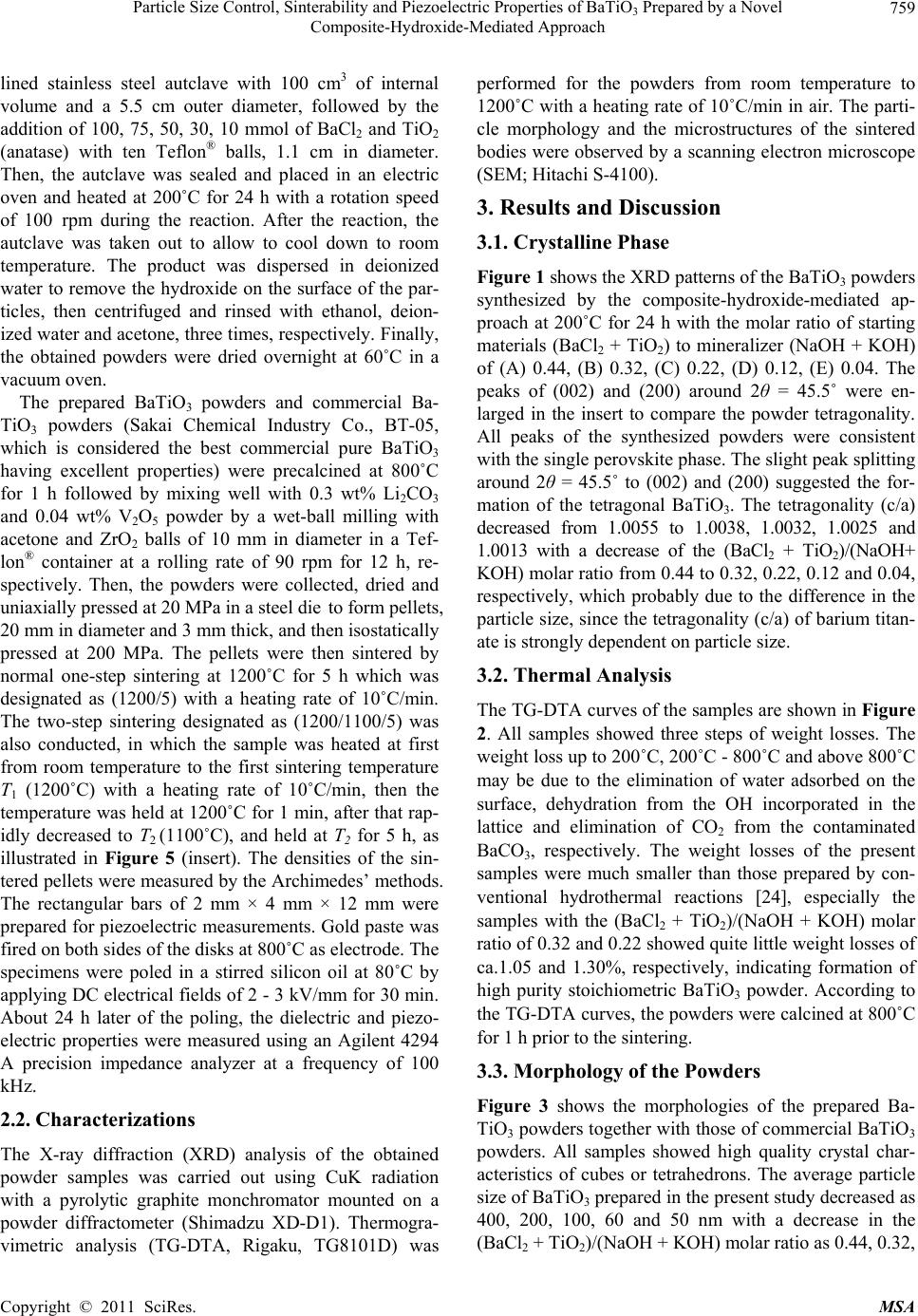 Particle Size Control, Sinterability and Piezoelectric Properties of BaTiO Prepared by a Novel 759 3 Composite-Hydroxide-Mediated Approach lined stainless steel autclave with 100 cm3 of internal volume and a 5.5 cm outer diameter, followed by the addition of 100, 75, 50, 30, 10 mmol of BaCl2 and TiO2 (anatase) with ten Teflon® balls, 1.1 cm in diameter. Then, the autclave was sealed and placed in an electric oven and heated at 200˚C for 24 h with a rotation speed of 100 rpm during the reaction. After the reaction, the autclave was taken out to allow to cool down to room temperature. The product was dispersed in deionized water to remove the hydroxide on the surface of the par- ticles, then centrifuged and rinsed with ethanol, deion- ized water and acetone, three times, respectively. Finally, the obtained powders were dried overnight at 60˚C in a vacuum oven. The prepared BaTiO3 powders and commercial Ba- TiO3 powders (Sakai Chemical Industry Co., BT-05, which is considered the best commercial pure BaTiO3 having excellent properties) were precalcined at 800˚C for 1 h followed by mixing well with 0.3 wt% Li2CO 3 and 0.04 wt% V2O5 powder by a wet-ball milling with acetone and ZrO2 balls of 10 mm in diameter in a Tef- lon® container at a rolling rate of 90 rpm for 12 h, re- spectively. Then, the powders were collected, dried and uniaxially pressed at 20 MPa in a steel die to form pellets, 20 mm in diameter and 3 mm thick, and then isostatically pressed at 200 MPa. The pellets were then sintered by normal one-step sintering at 1200˚C for 5 h which was designated as (1200/5) with a heating rate of 10˚C/min. The two-step sintering designated as (1200/1100/5) was also conducted, in which the sample was heated at first from room temperature to the first sintering temperature T1 (1200˚C) with a heating rate of 10˚C/min, then the temperature was held at 1200˚C for 1 min, after that rap- idly decreased to T2 (1100˚C), and held at T2 for 5 h, as illustrated in Figure 5 (insert). The densities of the sin- tered pellets were measured by the Archimedes’ methods. The rectangular bars of 2 mm × 4 mm × 12 mm were prepared for piezoelectric measurements. Gold paste was fired on both sides of the disks at 800˚C as electrode. The specimens were poled in a stirred silicon oil at 80˚C by applying DC electrical fields of 2 - 3 kV/mm for 30 min. About 24 h later of the poling, the dielectric and piezo- electric properties were measured using an Agilent 4294 A precision impedance analyzer at a frequency of 100 kHz. 2.2. Characterizations The X-ray diffraction (XRD) analysis of the obtained powder samples was carried out using CuK radiation with a pyrolytic graphite monchromator mounted on a powder diffractometer (Shimadzu XD-D1). Thermogra- vimetric analysis (TG-DTA, Rigaku, TG8101D) was performed for the powders from room temperature to 1200˚C with a heating rate of 10˚C/min in air. The parti- cle morphology and the microstructures of the sintered bodies were observed by a scanning electron microscope (SEM; Hitachi S-4100). 3. Results and Discussion 3.1. Crystalline Phase Figure 1 shows the XRD patterns of the BaTiO3 powders synthesized by the composite-hydroxide-mediated ap- proach at 200˚C for 24 h with the molar ratio of starting materials (BaCl2 + TiO2) to mineralizer (NaOH + KOH) of (A) 0.44, (B) 0.32, (C) 0.22, (D) 0.12, (E) 0.04. The peaks of (002) and (200) around 2θ = 45.5˚ were en- larged in the insert to compare the powder tetragonality. All peaks of the synthesized powders were consistent with the single perovskite phase. The slight peak splitting around 2θ = 45.5˚ to (002) and (200) suggested the for- mation of the tetragonal BaTiO3. The tetragonality (c/a) decreased from 1.0055 to 1.0038, 1.0032, 1.0025 and 1.0013 with a decrease of the (BaCl2 + TiO2)/(NaOH+ KOH) molar ratio from 0.44 to 0.32, 0.22, 0.12 and 0.04, respectively, which probably due to the difference in the particle size, since the tetragonality (c/a) of barium titan- ate is strongly dependent on particle size. 3.2. Thermal Analysis The TG-DTA curves of the samples are shown in Figure 2. All samples showed three steps of weight losses. The weight loss up to 200˚C, 200˚C - 800˚C and above 800˚C may be due to the elimination of water adsorbed on the surface, dehydration from the OH incorporated in the lattice and elimination of CO2 from the contaminated BaCO3, respectively. The weight losses of the present samples were much smaller than those prepared by con- ventional hydrothermal reactions [24], especially the samples with the (BaCl2 + TiO2)/(NaOH + KOH) molar ratio of 0.32 and 0.22 showed quite little weight losses of ca.1.05 and 1.30%, respectively, indicating formation of high purity stoichiometric BaTiO3 powder. According to the TG-DTA curves, the powders were calcined at 800˚C for 1 h prior to the sintering. 3.3. Morphology of the Powders Figure 3 shows the morphologies of the prepared Ba- TiO3 powders together with those of commercial BaTiO3 powders. All samples showed high quality crystal char- acteristics of cubes or tetrahedrons. The average particle size of BaTiO3 prepared in the present study decreased as 400, 200, 100, 60 and 50 nm with a decrease in the (BaCl2 + TiO2)/(NaOH + KOH) molar ratio as 0.44, 0.32, Copyright © 2011 SciRes. MSA 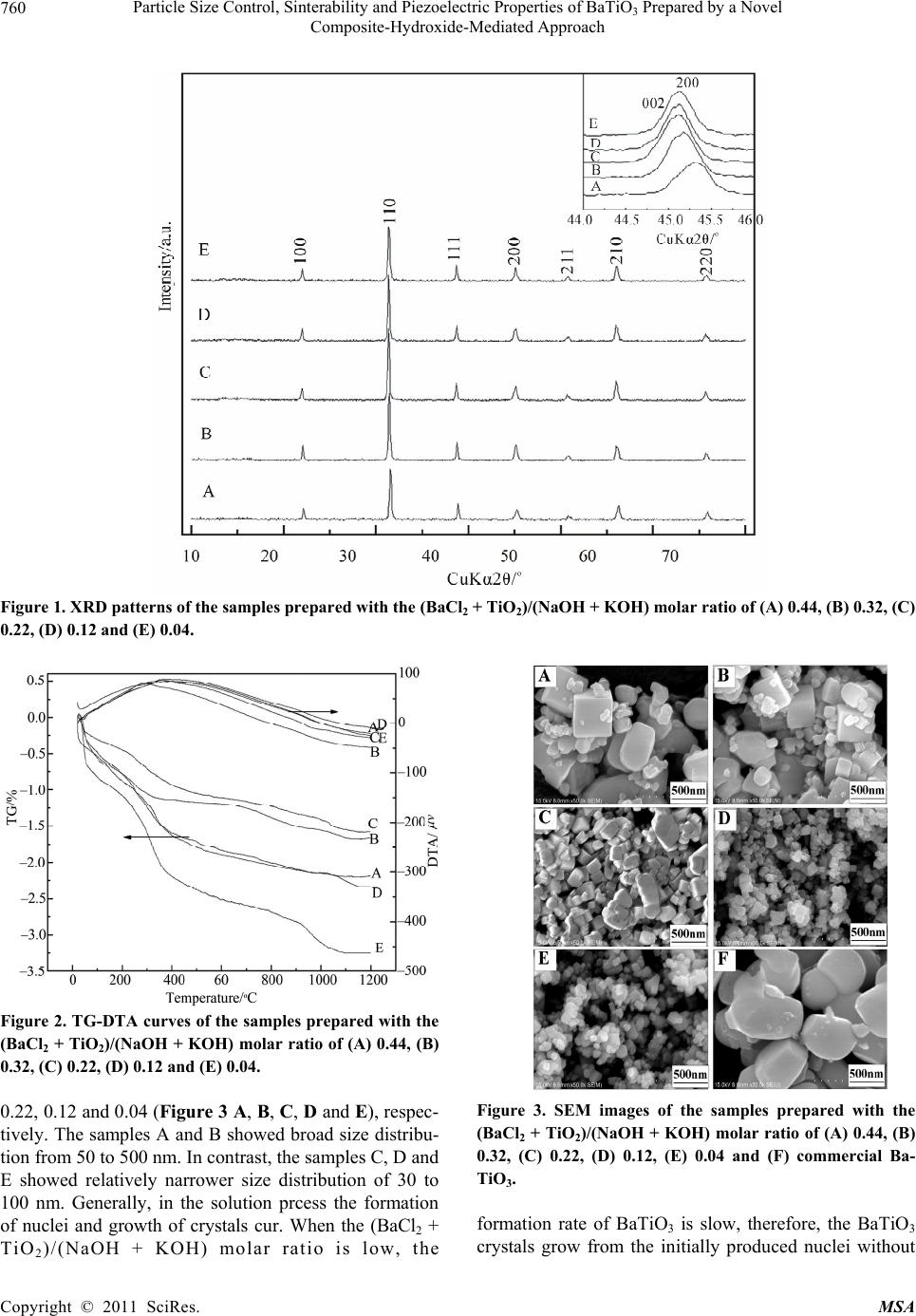 Particle Size Control, Sinterability and Piezoelectric Properties of BaTiO Prepared by a Novel 760 3 Composite-Hydroxide-Mediated Approach Figure 1. XRD patterns of the samples prepared with the (BaCl2 + TiO2)/(NaOH + KOH) molar ratio of (A) 0.44, (B) 0.32, (C) 0.22, (D) 0.12 and (E) 0.04. Figure 2. TG-DTA curves of the samples prepared with the (BaCl2 + TiO2)/(NaOH + KOH) molar ratio of (A) 0.44, (B) 0.32, (C) 0.22, (D) 0.12 and (E) 0.04. 0.22, 0.12 and 0.04 (Figure 3 A, B, C, D and E), respec- tively. The samples A and B showed broad size distribu- tion from 50 to 500 nm. In contrast, the samples C, D and E showed relatively narrower size distribution of 30 to 100 nm. Generally, in the solution prcess the formation of nuclei and growth of crystals cur. When the (BaCl2 + TiO2)/(NaOH + KOH) molar ratio is low, the Figure 3. SEM images of the samples prepared with the (BaCl2 + TiO2)/(NaOH + KOH) molar ratio of (A) 0.44, (B) 0.32, (C) 0.22, (D) 0.12, (E) 0.04 and (F) commercial Ba- TiO3. formation rate of BaTiO3 is slow, therefore, the BaTiO3 crystals grow from the initially produced nuclei without Copyright © 2011 SciRes. MSA 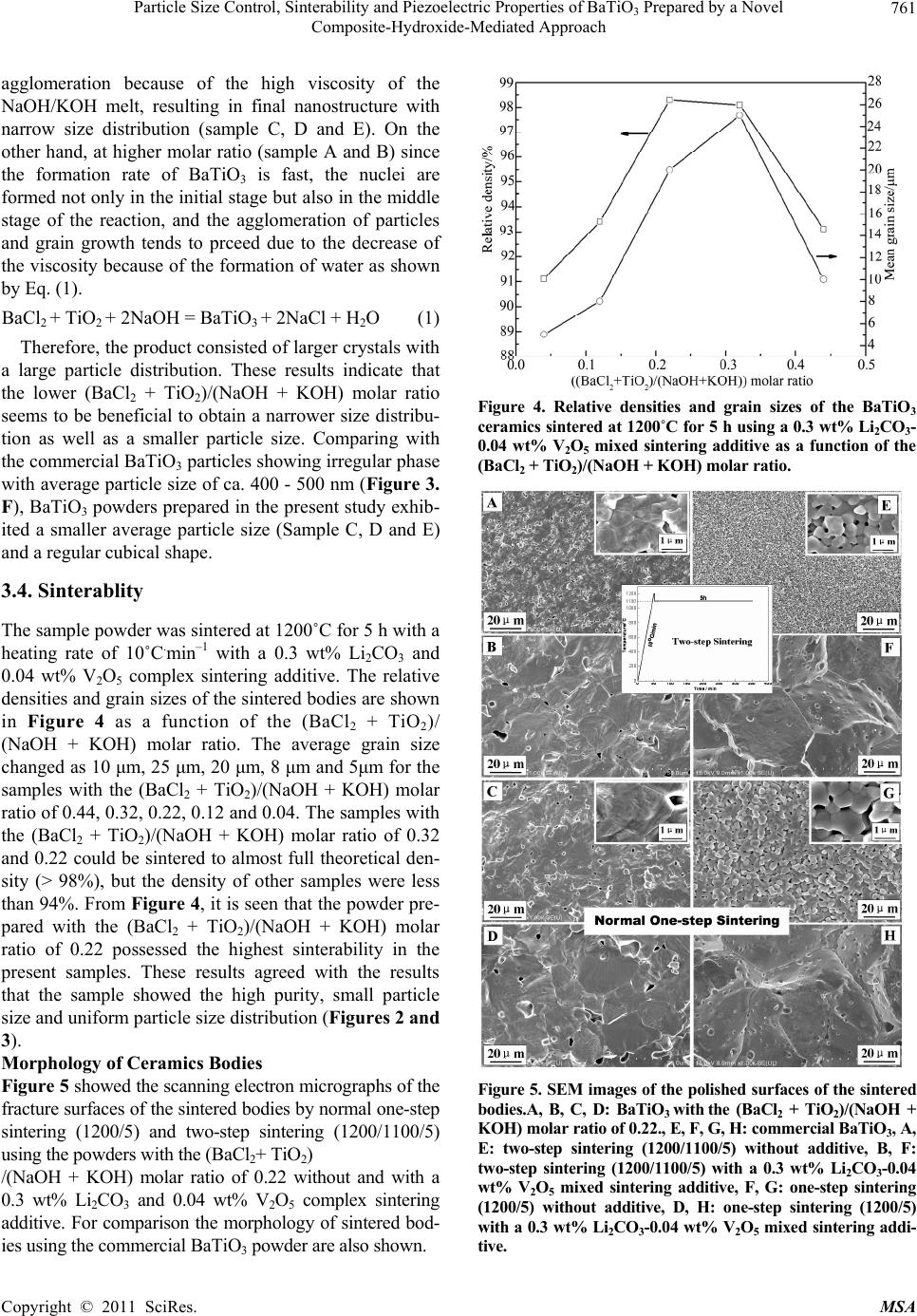 Particle Size Control, Sinterability and Piezoelectric Properties of BaTiO Prepared by a Novel 761 3 Composite-Hydroxide-Mediated Approach agglomeration because of the high viscosity of the NaOH/KOH melt, resulting in final nanostructure with narrow size distribution (sample C, D and E). On the other hand, at higher molar ratio (sample A and B) since the formation rate of BaTiO3 is fast, the nuclei are formed not only in the initial stage but also in the middle stage of the reaction, and the agglomeration of particles and grain growth tends to prceed due to the decrease of the viscosity because of the formation of water as shown by Eq. (1). BaCl2 + TiO2 + 2NaOH = BaTiO3 + 2NaCl + H2O (1) Therefore, the product consisted of larger crystals with a large particle distribution. These results indicate that the lower (BaCl2 + TiO2)/(NaOH + KOH) molar ratio seems to be beneficial to obtain a narrower size distribu- tion as well as a smaller particle size. Comparing with the commercial BaTiO3 particles showing irregular phase with average particle size of ca. 400 - 500 nm (Figure 3. F), BaTiO3 powders prepared in the present study exhib- ited a smaller average particle size (Sample C, D and E) and a regular cubical shape. 3.4. Sinterablity The sample powder was sintered at 1200˚C for 5 h with a heating rate of 10˚C.min–1 with a 0.3 wt% Li2CO3 and 0.04 wt% V2O5 complex sintering additive. The relative densities and grain sizes of the sintered bodies are shown in Figure 4 as a function of the (BaCl2 + TiO2)/ (NaOH + KOH) molar ratio. The average grain size changed as 10 μm, 25 μm, 20 μm, 8 μm and 5μm for the samples with the (BaCl2 + TiO2)/(NaOH + KOH) molar ratio of 0.44, 0.32, 0.22, 0.12 and 0.04. The samples with the (BaCl2 + TiO2)/(NaOH + KOH) molar ratio of 0.32 and 0.22 could be sintered to almost full theoretical den- sity (> 98%), but the density of other samples were less than 94%. From Figure 4, it is seen that the powder pre- pared with the (BaCl2 + TiO2)/(NaOH + KOH) molar ratio of 0.22 possessed the highest sinterability in the present samples. These results agreed with the results that the sample showed the high purity, small particle size and uniform particle size distribution (Figures 2 and 3). Morphology of Ceramics Bodies Figure 5 showed the scanning electron micrographs of the fracture surfaces of the sintered bodies by normal one-step sintering (1200/5) and two-step sintering (1200/1100/5) using the powders with the (BaCl2+ TiO2) /(NaOH + KOH) molar ratio of 0.22 without and with a 0.3 wt% Li2CO3 and 0.04 wt% V2O5 complex sintering additive. For comparison the morphology of sintered bod- ies using the commercial BaTiO3 powder are also shown. Figure 4. Relative densities and grain sizes of the BaTiO3 ceramics sintered at 1200˚C for 5 h using a 0.3 w t% Li2CO3- 0.04 wt% V2O5 mixed sintering additive as a function of the (BaCl2 + TiO2)/(NaOH + KOH) molar ratio. Figure 5. SEM images of the polished surfaces of the sintered bodies.A, B, C, D: BaTiO3 with the (BaCl2 + TiO2)/(NaOH + KOH) molar ratio of 0.22., E, F, G, H: commercial BaTiO 3, A, E: two-step sintering (1200/1100/5) without additive, B, F: two-step sintering (1200/1100/5) with a 0.3 wt% Li2CO3-0.04 wt% V2O5 mixed sintering additive, F, G: one-step sintering (1200/5) without additive, D, H: one-step sintering (1200/5) with a 0.3 wt % Li2CO3-0.04 wt% V2O5 mixed sintering addi - tive. Copyright © 2011 SciRes. MSA 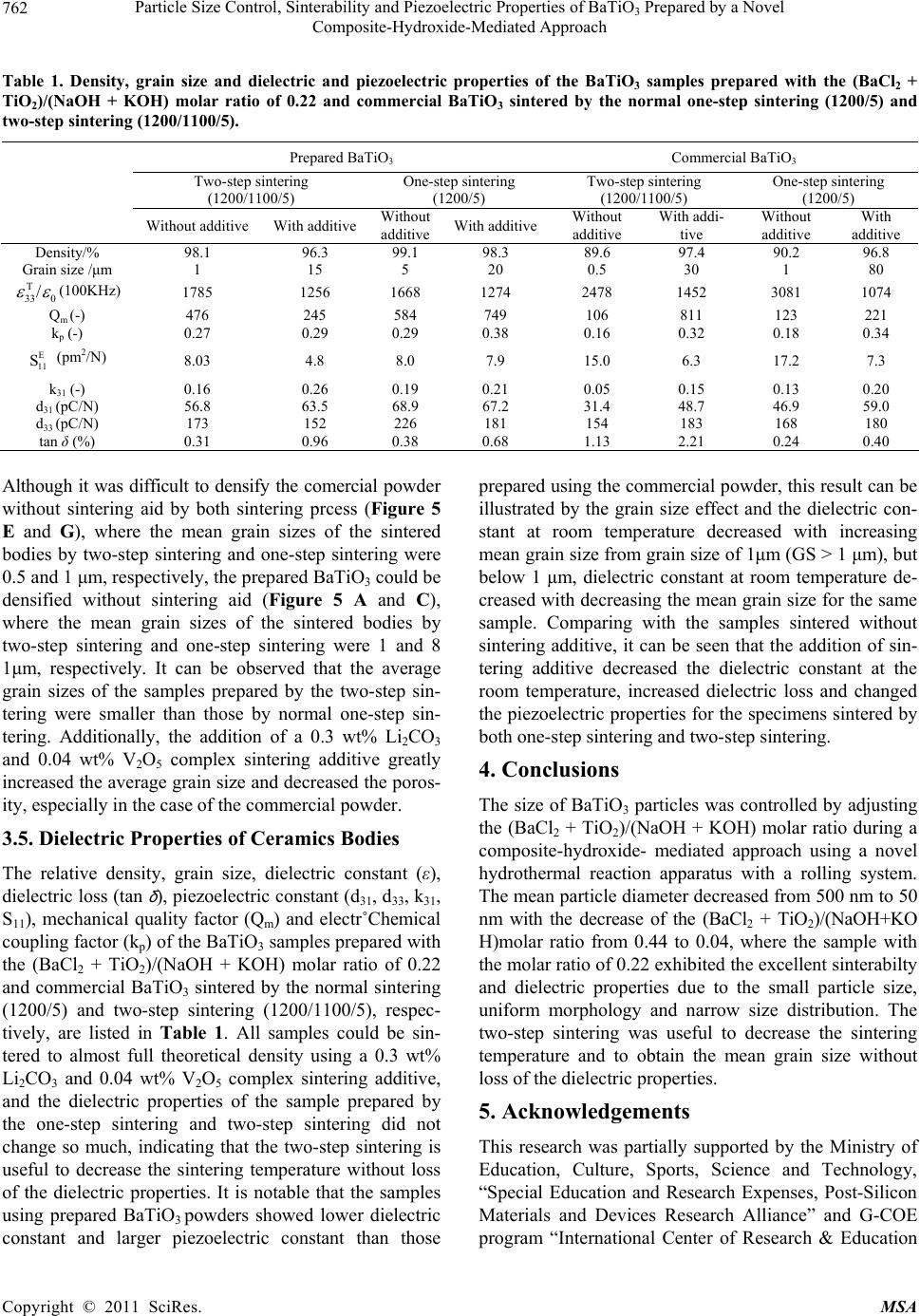 Particle Size Control, Sinterability and Piezoelectric Properties of BaTiO Prepared by a Novel 762 3 Composite-Hydroxide-Mediated Approach Table 1. Density, grain size and dielectric and piezoelectric properties of the BaTiO3 samples prepared with the (BaCl2 + TiO2)/(NaOH + KOH) molar ratio of 0.22 and commercial BaTiO3 sintered by the normal one-step sintering (1200/5) and two-step sintering (1200/1100/5). Prepared BaTiO3 Commercial BaTiO3 Two-step sintering (1200/1100/5) One-step sintering (1200/5) Two-step sintering (1200/1100/5) One-step sintering (1200/5) Without additive With additive Without additive With additiveWithout additive With addi- tive Without additive With additive Density/% 98.1 96.3 99.1 98.3 89.6 97.4 90.2 96.8 Grain size /μm 1 15 5 20 0.5 30 1 80 T 33 0 / (100KHz) 1785 1256 1668 1274 2478 1452 3081 1074 Qm (-) 476 245 584 749 106 811 123 221 kp (-) 0.27 0.29 0.29 0.38 0.16 0.32 0.18 0.34 E 11 S (pm2/N) 8.03 4.8 8.0 7.9 15.0 6.3 17.2 7.3 k31 (-) 0.16 0.26 0.19 0.21 0.05 0.15 0.13 0.20 d31 (pC/N) 56.8 63.5 68.9 67.2 31.4 48.7 46.9 59.0 d33 (pC/N) 173 152 226 181 154 183 168 180 tan δ (%) 0.31 0.96 0.38 0.68 1.13 2.21 0.24 0.40 Although it was difficult to densify the comercial powder without sintering aid by both sintering prcess (Figure 5 E and G), where the mean grain sizes of the sintered bodies by two-step sintering and one-step sintering were 0.5 and 1 μm, respectively, the prepared BaTiO3 could be densified without sintering aid (Figure 5 A and C), where the mean grain sizes of the sintered bodies by two-step sintering and one-step sintering were 1 and 8 1μm, respectively. It can be observed that the average grain sizes of the samples prepared by the two-step sin- tering were smaller than those by normal one-step sin- tering. Additionally, the addition of a 0.3 wt% Li2CO3 and 0.04 wt% V2O5 complex sintering additive greatly increased the average grain size and decreased the poros- ity, especially in the case of the commercial powder. 3.5. Dielectric Properties of Ceramics Bodies The relative density, grain size, dielectric constant (ε), dielectric loss (tan δ ), piezoelectric constant (d31, d33, k31, S11), mechanical quality factor (Qm) and electr˚Chemical coupling factor (kp) of the BaTiO3 samples prepared with the (BaCl2 + TiO2)/(NaOH + KOH) molar ratio of 0.22 and commercial BaTiO3 sintered by the normal sintering (1200/5) and two-step sintering (1200/1100/5), respec- tively, are listed in Table 1. All samples could be sin- tered to almost full theoretical density using a 0.3 wt% Li2CO3 and 0.04 wt% V2O5 complex sintering additive, and the dielectric properties of the sample prepared by the one-step sintering and two-step sintering did not change so much, indicating that the two-step sintering is useful to decrease the sintering temperature without loss of the dielectric properties. It is notable that the samples using prepared BaTiO3 powders showed lower dielectric constant and larger piezoelectric constant than those prepared using the commercial powder, this result can be illustrated by the grain size effect and the dielectric con- stant at room temperature decreased with increasing mean grain size from grain size of 1μm (GS > 1 μm), but below 1 μm, dielectric constant at room temperature de- creased with decreasing the mean grain size for the same sample. Comparing with the samples sintered without sintering additive, it can be seen that the addition of sin- tering additive decreased the dielectric constant at the room temperature, increased dielectric loss and changed the piezoelectric properties for the specimens sintered by both one-step sintering and two-step sintering. 4. Conclusions The size of BaTiO3 particles was controlled by adjusting the (BaCl2 + TiO2)/(NaOH + KOH) molar ratio during a composite-hydroxide- mediated approach using a novel hydrothermal reaction apparatus with a rolling system. The mean particle diameter decreased from 500 nm to 50 nm with the decrease of the (BaCl2 + TiO2)/(NaOH+KO H)molar ratio from 0.44 to 0.04, where the sample with the molar ratio of 0.22 exhibited the excellent sinterabilty and dielectric properties due to the small particle size, uniform morphology and narrow size distribution. The two-step sintering was useful to decrease the sintering temperature and to obtain the mean grain size without loss of the dielectric properties. 5. Acknowledgements This research was partially supported by the Ministry of Education, Culture, Sports, Science and Technology, “Special Education and Research Expenses, Post-Silicon Materials and Devices Research Alliance” and G-COE program “International Center of Research & Education Copyright © 2011 SciRes. MSA  Particle Size Control, Sinterability and Piezoelectric Properties of BaTiO Prepared by a Novel 763 3 Composite-Hydroxide-Mediated Approach for Molecular Complex Chemistry (IREMC)”. REFERENCES [1] D. L. Polla and F. F. Lorraine, “Prcessing and Charac- terization of Piezoelectric Materials and Intergation into Microelectromechanical Systems,” Annual Review Mater Sciense, Vol. 28, 1998, pp. 563-597. doi:10.1146/annurev.matsci.28.1.563 [2] T. Takenaka and H. Nagata, “Current Status and Pros- pects of Lead-Free Piezoelectric Ceramics,” Journal Europe Ceram Science, Vol. 25, No.12, 2005, pp. 2693- 2700. doi:10.1016/j.jeurceramsc.2005.03.125 [3] H. I. Won, H. H. Nersisyan and C. W. Won, “Low Tem- Perature Solid-Phase Synthesis of Tetragonal BaTiO3 Powders and Its Characterization,” Materials Letters, Vol. 61, No.7, 2007, pp. 1492-1496. doi:10.1016/j.matlet.2006.07.059 [4] Z. X. Hua, Z. J. Min, Z. S. Hua, L. Z. Guo, M. N. Ben and H. Dietrich, “BaTiO3 Nancrystals: Hydrothermal Synthesis and Structural Characterization,” Journal of Crystal Growth, Vol. 283, No. 3-4, 2005, pp. 553-562. doi:10.1016/j.jcrysgro.2005.05.080 [5] K. Matsui, T. Noguchi, N. M. Islam and Y. Hakuta, “Ha- yashi, Rapid Synthesis of BaTiO3 Nanoparticles in Su- percritical Water by Continuous Hydrothermal FLow Reaction System,” Journal of Crystal Growth, Vol. 310, No. 3, 2008, pp. 2584-2589. doi:10.1016/j.matlet.2006.06.006 [6] T. K. Mandal, “Characterization of Tetragonal BaTiO3 Nanopowders Prepared with a New Soft Chemistry Route,” Material Leters, Vol. 61, No. 3, 2007, pp. 850- 854. doi:10.1016/j.matlet.2006.06.006 [7] Y. Ma, E. Vileno, S. L. Suib and P. K. Dutta, “Synthesis of Tetragonal BaTiO3 by Microwave Heating and Con- ventional Heating,” Chemical Material, Vol. 9, No. 12, 1997, pp. 23-31. doi:10.1021/cm970371n [8] H. Liu, C. Hu and Z. L. Wang, “Compoite-Hydroxide-M- ediated Approach for the Synthesis of Nanostructures of Complex Functional-Oxides,” Nano Letters, Vol. 6, No. 7, 2006, pp. 1535-1540. doi:10.1021/nl061253e [9] M. Jing, H. C. Guo, L. Hong and X. Y. Feng, “BaTiO3 Nancubes: Size-Selective Formation and Structure Analy- sis,” Material Letters, Vol. 62, No. 2, 2008, pp. 235-238. doi:10.1016/j.matlet.2007.05.009 [10] S. Qin, D. Liu, H. Liu and Z. Zuo, “Size-Dependent Se- lective Etching Mechanism: Cavity Formation on Barium Titanate Nancubes,” Journal Physical Chemical C, Vol. 112, No. 44, 2008, pp. 17171-17174. doi:10.1021/jp8057993 [11] Y. Hotta, K. Tsunekawa, C. Duran, K. Sato, T. Nagaoka and K. Watari, “Low-Temperature Sintering of BaTiO3 Powders Prepared by a Hydrothermal Prcess with Ball Milling System,” Materials Science Engineering A, Vol. 475, No. 1-2, 2008, pp. 57-61. doi:10.1016/j.msea.2006.12.138 [12] Y. Hotta, C. Duran, K. Sato, T. Nagaoka and K. Watari, “Densification and Grain Growth in BaTiO3 Ceramics Fabricated from Nanopowders Synthesized by Ball-Mill- ing Assisted Hydrothermal Reaction,” Journal Europe Ceram Science, Vol. 28, No. 3, 2008, pp. 599-604. doi:10.1016/j.jeurceramsc.2007.07.007 [13] H. Takatoshi, S. Toru, S. Tsugio, Y. Shu and X. Yahong, “Dielectric Ceramic and Its Synthesis Method,” Japan Patent, Tokugan, 2009, pp. 2010-215435A. [14] Y. Zhang, J. Han and L. Hu, “The Effect of Sintering Additive on Fracture Behavior of Carbon-Whisker-Rein- forced Silicon Carbide Composites,” Maerial Science Engineering A, Vol. 480, No. 1-2, 2008, pp. 62-67. doi:10.1016/j.msea.2007.08.034 [15] K. Chunga, J. Yoo, C. Lee, D. Lee, Y. Jeong and H. Lee, “Microstructural Dielectric and Piezoelectric Properties of Low-Temperature Sintering Pb(Co1/2W1/2)O3-Pb(Mn1/2- Nb2/3)O3-Pb(Zr,Ti)O3 Ceramics with the Addition of Li2CO3 and Bi2O3,” Sensor Actuat A, Vol. 125, No. 2, 2006, pp. 340-345. doi:10.1016/j.sna.2005.06.018 [16] H. You, S. Koo, J. Ha, J. Koh and J. Park, “Microstruc- ture and Dielectric Properties of Li2CO3 Doped 0.7 (Ba,Sr)TiO3-0.3MgO Ceramics,” Current Applied Phys- ics, Vol. 9, No. 5, 2009, pp. 875-879. doi:10.1016/j.cap.2008.08.008 [17] T. Karaki, K. Yan and M. Adachi, “Barium Titanate Pie- zoelectric Ceramics Manufactured by Two-Step Sinter- ing,” Japenese Journal Applied Phyical, Vol. 46, 2007, pp. 7035-7038. doi:10.1143/JJAP.46.7035 [18] I. Wei Chen and X. H. Wang, “Sintering Dense Nancry- stalline Ceramics Without Final-Stage Grain Growth,” Nature, Vol. 404, 2000, pp. 168-171. doi:10.1038/35004548 [19] A. Polotai, K. Breece, E. Dickey and C. Randallw, “A Novel Approach to Sintering Nan˚Crystalline Barium Ti- tanate Ceramics,” Journal of the American Ceramic Sci- ety, Vol. 88, No. 11, 2005, pp. 3008-3012. doi:10.1111/j.1551-2916.2005.00552.x [20] G. Arit, D. hennings and G. de With, “Dielectric Proper- ties of Fine-Grained Barium Titanate Ceramics,” Applied Physical, Vol. 58, 1985, pp. 1619-1625. [21] V. Buscaglia, M. T. Buscaglia, M. Viviani, L. Mitoseriu, P. Nanni, V. Trefiletti, P. Piaggio, I. Gregora, T. Ostap- chuk, J. Pokorny and J. Petzelt, “Grain Size And Grain Boundary-Related Effects on the Properties of Nancrys- talline Barium Titanate Ceramics,” Journal Europe Ce- ram Sciense, Vol. 26, No. 14, 2006, pp. 2889-2898. doi:10.1016/j.jeurcerams˚C.2006.02.005 [22] S. Zhao, H. Wu and Q. Sun, “Study on PSN-PZN-PZT Quaternary Piezoelectric Ceramics near the Morphotrop- ic Phase Boundary,”Material Science Engineering B, Vol. 123, No. 11, 2005, pp. 203-210. doi:10.1016/j.matlet.2004.12.041 [23] Y. Li, W. Chen, Q. Xu, J. Zhou and X. Gu, “Piezoelectric and Ferroelectric Properties of Na0.5Bi0.5TiO3-K0.5Bi0.5Ti- O3-BaTiO3 Piezoelectric Ceramics,” Material Letters, Copyright © 2011 SciRes. MSA  Particle Size Control, Sinterability and Piezoelectric Properties of BaTiO3 Prepared by a Novel Composite-Hydroxide-Mediated Approach Copyright © 2011 SciRes. MSA 764 Vol. 59, No. 11, 2005, pp. 1361-1364. doi:10.1016/j.matlet.2004.12.041 [24] Y. H. Xie, S. Yin, T. Hashimoto, H. Kimura and T. Sato, “Microwave-Hydrothermal Synthesis of Nano-Sized Sn2+- Doped Batio3 Powders and Dielectric Properties of Cor responding Ceramics Obtained by Spark Plasma Sintering Method,” Journal Material Science, Vol. 44, No. 18, 2009, pp. 4834-4839. doi:10.1007/s10853-009-3737-8 |